
Professional Potting Soil Market Size and Share
Market Overview
| Study Period | 2022 - 2032 |
|---|---|
| Market Size (2027) | USD 1.9 Billion |
| Market Size (2032) | USD 2.52 Billion |
| Growth Rate (2027 - 2032) | 5.81 % |
| Fastest Growing Market | Asia-Pacific |
| Largest Market | North America |
| Market Concentration | Medium |
Major Players *Disclaimer: Major Players sorted in no particular order Image © Mordor Intelligence. Reuse requires attribution under CC BY 4.0. | |
Professional Potting Soil Market Analysis by Mordor Intelligence
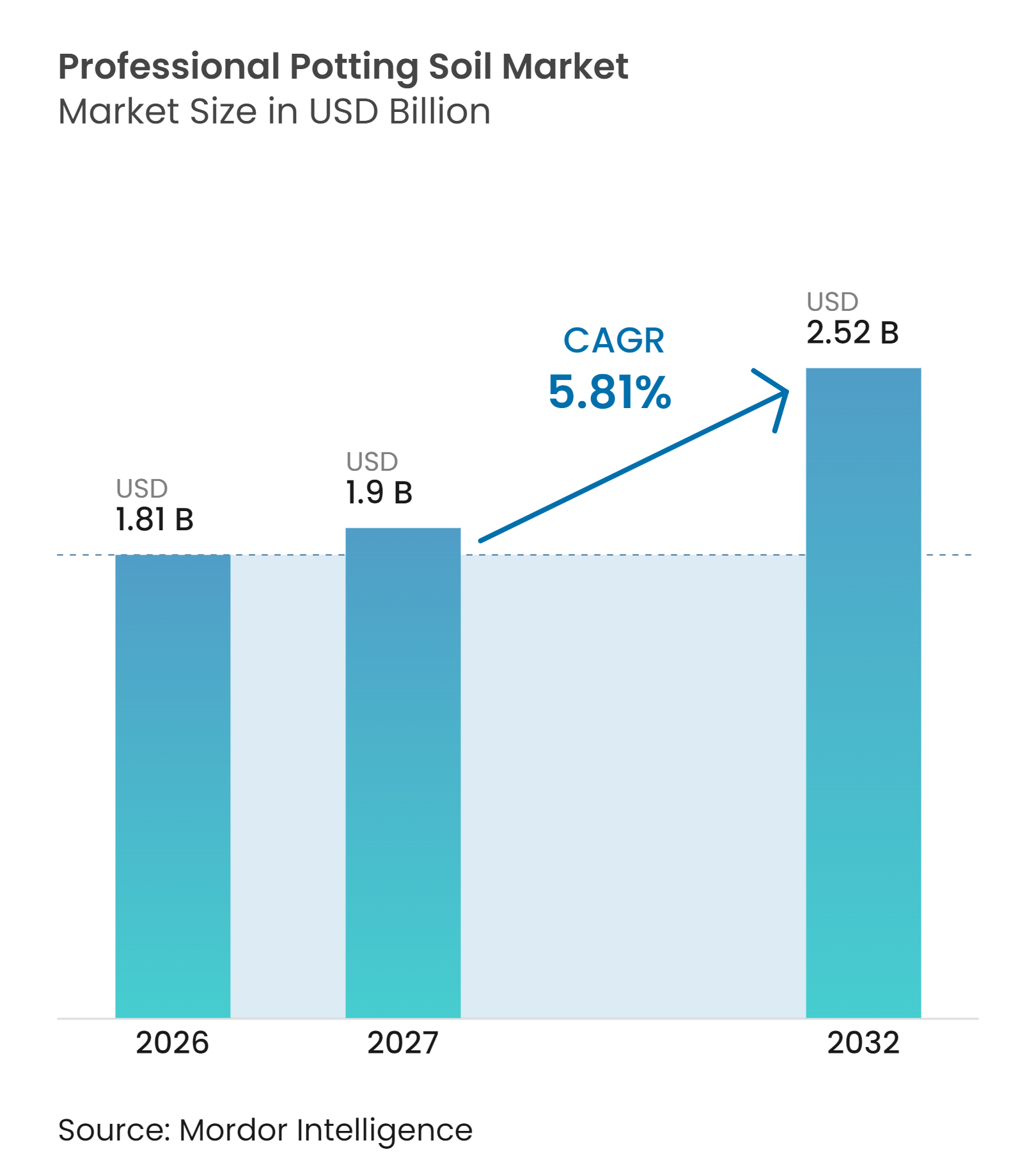
The professional potting soil market size was valued at USD 1.81 billion in 2026 and is projected to grow from USD 1.90 billion in 2027 to USD 2.52 billion by 2032, at a CAGR of 5.81% during the forecast period. The market is shifting toward defined growing media that commercial buyers select based on nutrient content, pathogen control, water movement, and compatibility with their irrigation systems. Controlled-environment agriculture, commercial greenhouse capacity, and urban indoor cultivation are driving demand for products that deliver repeatable crop performance. This shift makes formulation capability more important than bulk blending capacity, particularly for suppliers able to tailor products by crop and production method. Raw material shortages are also influencing purchasing decisions, as growers must balance cost, supply assurance, and the performance of newer alternatives. The market is therefore favoring producers that can secure inputs, document product performance, and offer practical peat-reduction pathways.
Key Report Takeaways
-
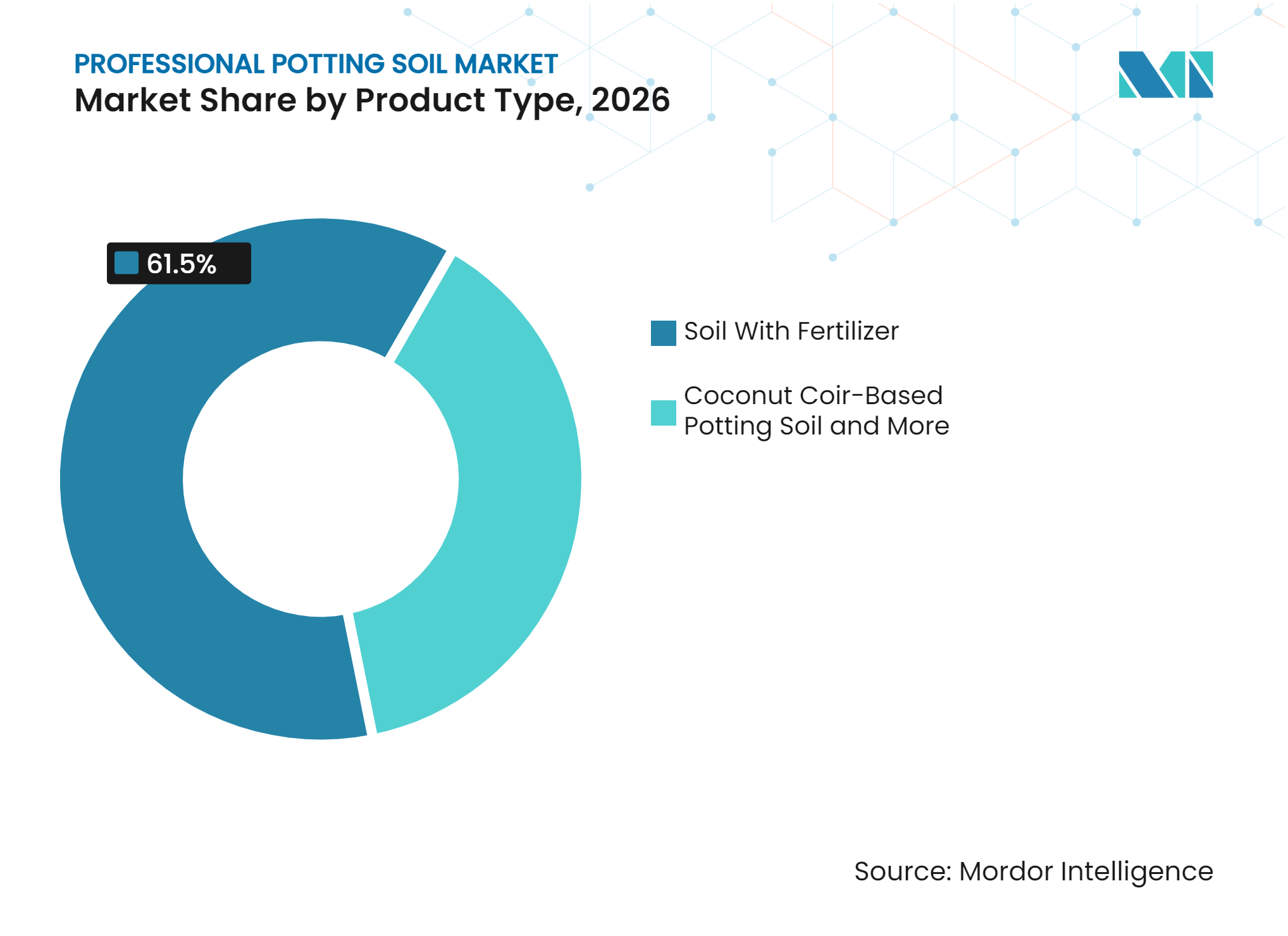
By product type, soil with fertilizer accounted for the largest 61.5% of the professional potting soil market share in 2026, while coconut coir-based potting soil is projected to grow at the fastest CAGR of 8.0% from 2027 to 2032.
-
By formulation and growing-media composition, peat-dominant blends accounted for the largest share at 54.0% in 2026, while the professional potting soil market size for peat-reduced blends is projected to grow at the fastest CAGR of 6.5% from 2027 to 2032.
-
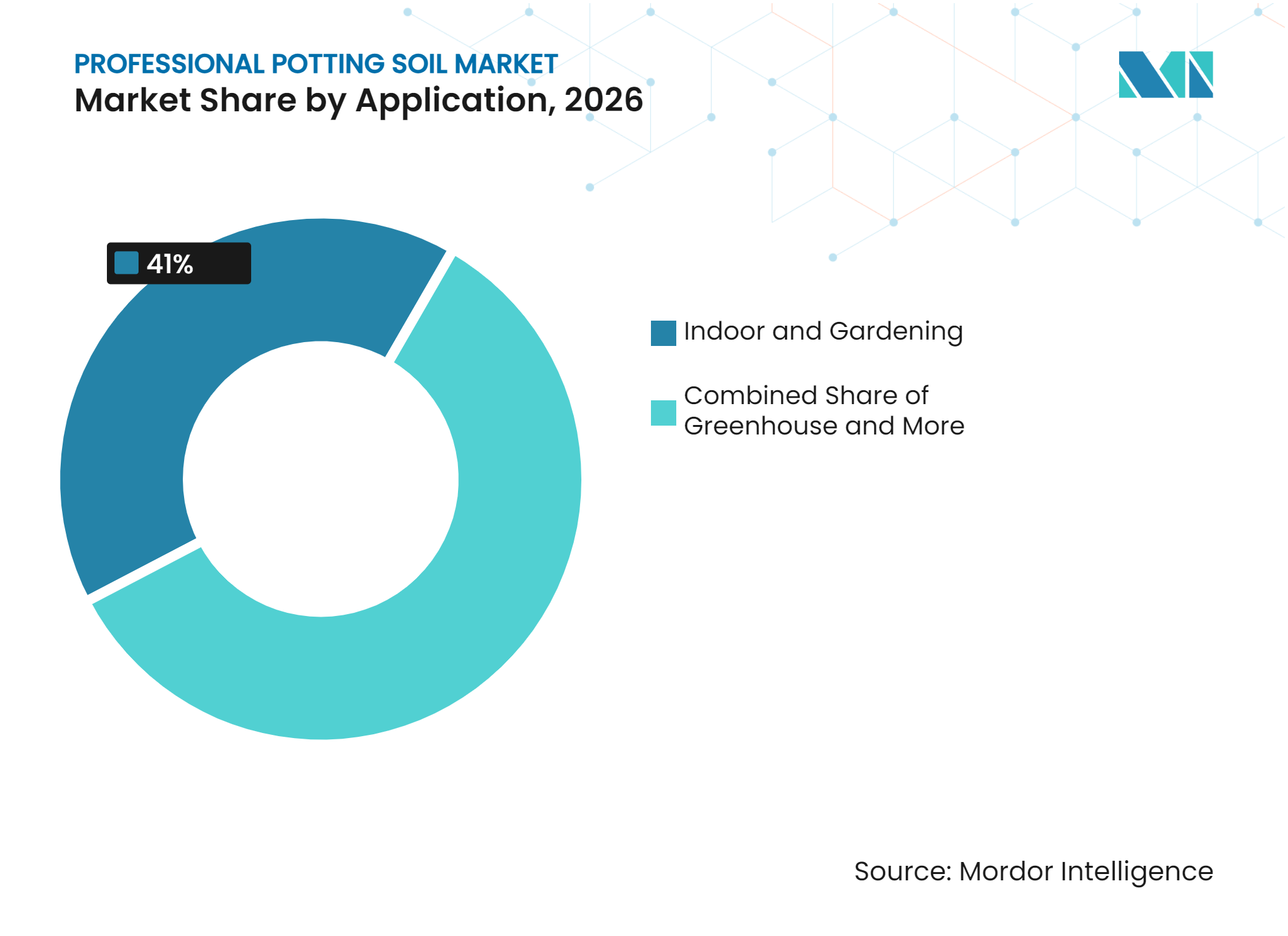
By application, indoor and gardening accounted for the largest share at 41.0% in 2026, while greenhouse is projected to grow at the fastest CAGR of 6.0% from 2027 to 2032.
-
By crop type, fruits and berries accounted for the largest share at 44.7% in 2026, while vegetables and herbs are projected to grow at the fastest CAGR of 7.0% from 2027 to 2032.
-
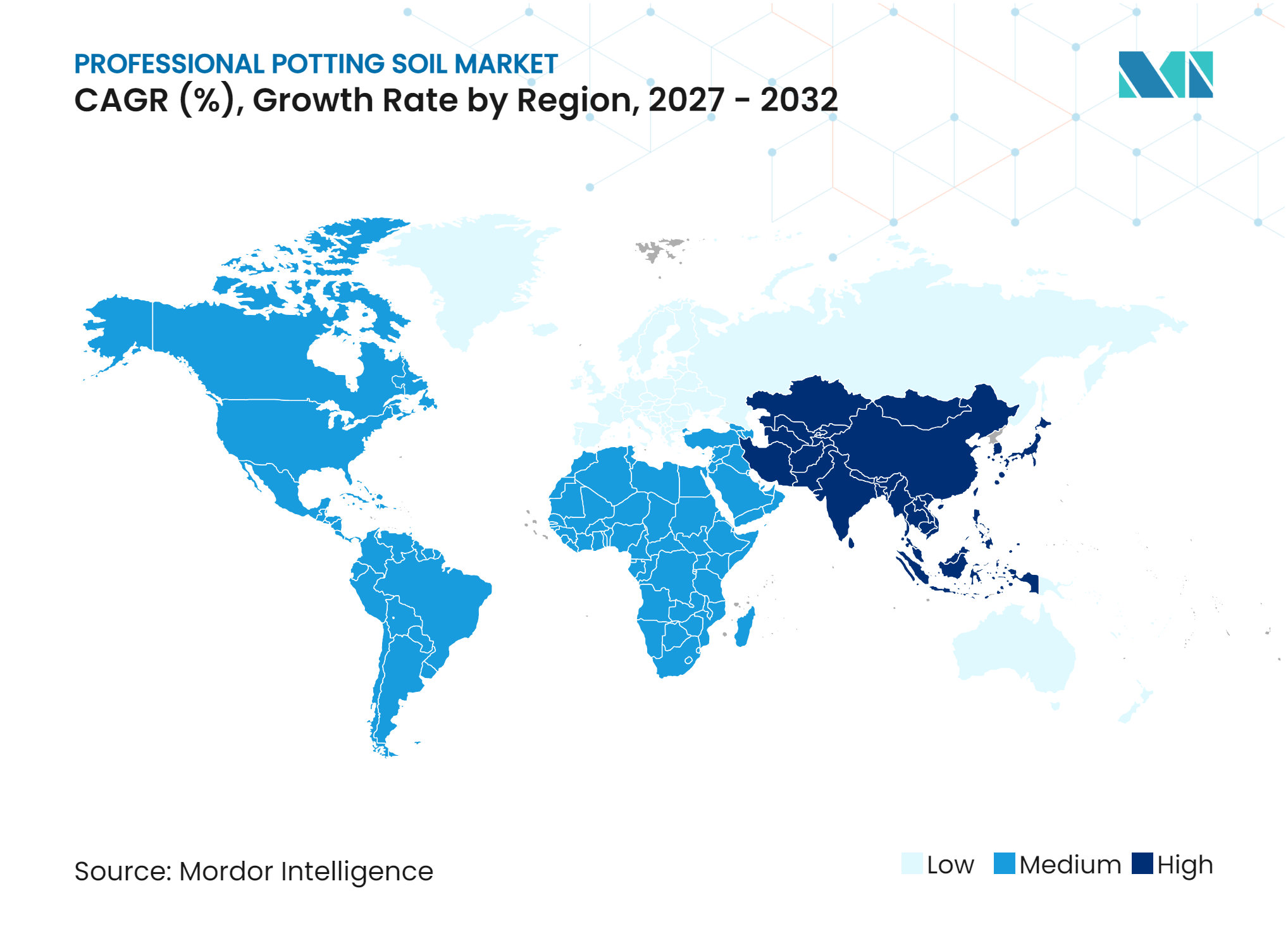
By geography, North America accounted for the largest share at 47.6% in 2026, while Asia-Pacific is projected to grow at the fastest CAGR of 8.1% from 2027 to 2032.
Note: Market numbers in this report are based on Mordor Intelligence's proprietary estimation framework, which combines nine months of actuals with Q4 projections for base year 2026.
Market Trends and Insights
Drivers Impact Analysis of Professional Potting Soil Market*
| Driver | (~) % Impact on CAGR Forecast | Geographic Relevance | Impact Timeline |
|---|---|---|---|
| Expansion of Controlled-Environment Horticulture | +1.3% | Global, concentrated in North America, Europe, and East Asia | Medium term (2-4 years) |
| Growth of Urban and Indoor Gardening | +1.0% | Global, with growth in the Asia-Pacific and Middle East and Africa urban centers | Short term (≤ 2 years) |
| Demand for Nutrient-Enriched Ready-to-Use Media | +0.9% | North America and Europe | Short term (≤ 2 years) |
| Peat Reduction and Sustainable Substrate Innovation | +0.8% | Europe, with effects in North America and Asia-Pacific | Long term (≥ 4 years) |
| Commercial Nursery and Floriculture Expansion | +0.7% | Global, notably the Netherlands, Kenya, Colombia, and the United States | Medium term (2-4 years) |
| Precision Irrigation and Crop-Consistency Requirements | +0.6% | North America, Europe, and Australia | Medium term (2-4 years) |
| Source: Mordor Intelligence | |||
Expansion of Controlled-Environment Horticulture
Controlled-environment horticulture supports the professional potting soil market, as greenhouse flower and plant producers require prepared growing media for propagation, container production, and crop maintenance. Statistics Canada reported that greenhouse flower and plant sales and resales increased 7.0% to CAD 2.4 billion (USD 1.75 billion) in 2025[1]. Growing greenhouse plant sales indicate increased commercial production activity, supporting recurring demand for crop-specific potting substrates and professionally formulated growing media across greenhouse operations and ornamental horticultural facilities.
Demand for Nutrient-Enriched Ready-to-Use Media
Ready-to-use growing media support convenient cultivation by combining suitable ingredients and nutrients into prepared formulations, reducing the need for separate substrate blending. Buyer preferences reinforce this demand, with research published in the Journal of Agricultural and Applied Economics in 2025 finding that plant- or garden-specific formulations ranked first among potting mix characteristics, followed by pre-mixed ingredients. These preferences encourage manufacturers to develop tailored, nutrient-enriched products that meet specific cultivation requirements, supporting demand for professionally blended potting soil across gardening, nursery, and greenhouse applications.
Peat Reduction and Sustainable Substrate Innovation
Growing media manufacturers are developing peat-reduced formulations to meet horticultural demand for substrates with lower peat content while maintaining crop suitability. The European Commission (EC) records that the PEATLESS project brings together 12 partners from 4 countries to develop and demonstrate alternative blends for mushroom, seedling, and ornamental production[2]. This coordinated research and commercial testing can help address performance and adoption barriers, giving suppliers evidence to refine formulations and expand the range of sustainable growing media. These innovation efforts support product development and demand across professional potting soil applications.
Precision Irrigation and Crop-Consistency Requirements
Commercial greenhouse and nursery growers require potting soil with consistent water retention, drainage, and aeration to maintain root-zone moisture and align irrigation with crop requirements. The importance of substrate selection is evident from research published in Frontiers in Plant Science in 2025, which reported 135% higher water-use efficiency for 'Florida Brilliance' strawberries grown in a substrate system compared to a nutrient film technique system. This finding highlights the role of growing media in water-use performance, supporting demand in the professional potting soil market for crop-specific substrates with measurable physical properties.
Restraints Impact Analysis of Professional Potting Soil Market*
| Restraint | (~) % Impact on CAGR Forecast | Geographic Relevance | Impact Timeline |
|---|---|---|---|
| Volatility in Peat, Coir and Biomass Availability | -0.9% | Global, especially Europe for Baltic peat and Asia-Pacific for coir | Short term (≤ 2 years) |
| Higher Cost and Variable Performance of Peat-Free Blends | -0.7% | Europe and North America | Medium term (2-4 years) |
| Contamination and Pathogen-Control Requirements for Renewable Inputs | -0.6% | Global, especially regulated commercial horticulture markets | Long term (≥ 4 years) |
| Freight Intensity and Bulk-Product Logistics Constraints | -0.4% | Global, especially island and interior markets in the Asia-Pacific and Middle East and Africa | Short term (≤ 2 years) |
| Source: Mordor Intelligence | |||
Volatility in Peat, Coir and Biomass Availability
Rising coir procurement costs represent a restraint for the market, as they increase input costs for professional potting soil manufacturers, particularly those developing peat-reduced formulations. The International Coconut Community (ICC), in its 2025 market review, reported that Sri Lankan coir fiber prices increased from USD 73 per metric ton in October 2024 to USD 124 per metric ton in October 2025[3]. This year-over-year increase raises the cost of coir-based substrates, potentially compressing manufacturers' margins and increasing product prices, thereby limiting the affordability and growth of the professional potting soil market.
Higher Cost and Variable Performance of Peat-Free Blends
Higher production costs can limit the adoption of peat-free formulations among commercial growers and other potting soil buyers. Research published in Resources, Conservation and Recycling in 2025 found that peat-free potting soils in Germany carried an average price premium of 21% over peat-containing alternatives. This price difference increases growers' purchasing costs and can make peat-free products less affordable for large-scale cultivation and routine growing media needs. Consequently, manufacturers may face greater challenges in expanding the commercial uptake of these formulations, restraining growth in the professional potting soil market.
*Our forecasts treat driver/restraint impacts as directional, not additive. The impact forecasts reflect baseline growth, mix effects, and variable interactions.
Professional Potting Soil Market Segment Analysis
By Product Type:
Soil With Fertilizer Lead Value and Coconut Coir-Based Potting Soil Lead GrowthSoil with fertilizer accounted for the largest 61.5% of the professional potting soil market share in 2026. These formulations combine growing media with nutrients, supporting growers who prefer prepared substrates for transplanting, container cultivation, and routine crop production. Their use simplifies input handling and provides a standardized starting medium across greenhouse, nursery, and gardening operations. Demand is supported by the convenience of purchasing substrate and fertilizer in a single formulation, while nutrient requirements vary by crop, production stage, and irrigation practices. Manufacturers therefore offer differentiated nutrient-enriched mixes for professional and consumer applications.
Coconut coir-based potting soil is projected to grow at the fastest CAGR of 8.0% from 2027 to 2032. Coir-based media are used in container production and protected cultivation because their physical properties can be adapted through particle size, washing, buffering, and blending. Their use also gives manufacturers another formulation option for growers evaluating peat-reduced substrates. Product suitability depends on crop requirements, irrigation frequency, and the consistency of processed coir quality. Suppliers compete through substrate specifications, processing controls, and technical guidance that help growers manage water and nutrient delivery across different crop cycles.



By Formulation and Growing-Media Composition:
Peat-Dominant Blends Retain a Large Base While Peat-Reduced Blends Gain GroundPeat-dominant blends accounted for the largest share at 54.0% in 2026. Their established use reflects familiar handling characteristics and the ability to formulate substrates with predictable water retention, aeration, and acidity. Professional growers value consistency across propagation, container production, and greenhouse operations, making peat-based formulations relevant to a range of crops. Manufacturers combine peat with other components to adjust structure and performance for specific growing systems. Demand is supported by the availability of proven formulations and established production practices across professional horticulture and commercial growing operations.
Peat-reduced blends are projected to grow at the fastest CAGR of 6.5% from 2027 to 2032. These formulations allow growers to reduce peat content while retaining familiar substrate characteristics through combinations of coir, wood fiber, bark, compost, and other components. Their suitability depends on crop type, irrigation management, nutrient requirements, and local input availability. Manufacturers are developing blends and conducting trials to assess performance under different production conditions. This creates opportunities to supply growers seeking practical formulation options while managing operational changes associated with alternative growing media ingredients, sourcing, and production costs.
By Application:
Indoor and Gardening Leads Value While Greenhouses Expand FasterIndoor and gardening accounted for the largest share at 41.0% in 2026. This application includes growing media used for indoor plants, household gardening, container cultivation, and urban food production. Buyers select products based on plant type, container size, moisture needs, and ease of handling. Ready-to-use formulations support consumers and professional operators who require consistent substrates for routine planting and repotting. Product requirements vary across foliage plants, herbs, vegetables, and ornamental species, prompting manufacturers to offer different textures and nutrient profiles. This broad range supports demand across retail and professional distribution channels.
The greenhouse segment is projected to grow at the fastest CAGR of 6.0% from 2027 to 2032. Greenhouse growers use potting soil and soilless substrates for propagation, transplant production, and container-grown vegetables, fruits, and ornamental crops. Controlled irrigation and fertigation systems require media with suitable water retention, drainage, aeration, and nutrient behavior. These requirements lead growers to select products based on crop and production-system specifications rather than relying on a single general-purpose formulation. Suppliers support greenhouse operations through consistent batches, crop-specific blends, and technical guidance on substrate handling and irrigation management across commercial growing environments.

By Crop Type:
Fruits and Berries Lead Value While Vegetables and Herbs Grow FasterFruits and berries accounted for the largest share at 44.7% in 2026. Container-grown strawberries, blueberries, raspberries, and other fruit crops require growing media that support root development, moisture management, aeration, and crop-specific acidity. Substrate selection influences irrigation frequency and nutrient availability throughout the production cycle. Commercial growers evaluate media based on crop requirements, container systems, and local water conditions. Manufacturers serve this application through tailored blends and technical specifications designed for different fruit varieties and production practices, sustaining demand for professionally formulated substrates in commercial fruit cultivation.
Vegetables and herbs are projected to grow at the fastest CAGR of 7.0% from 2027 to 2032. Greenhouse vegetables, culinary herbs, and container-grown food crops require growing media that support uniform establishment, root-zone aeration, and reliable moisture management. Crop-specific substrates can be adapted to different irrigation systems and production cycles, including propagation and finished-crop cultivation. Growers assess media based on physical structure, nutrient management, and compatibility with fertigation practices. This creates opportunities for manufacturers to develop tailored products for protected cultivation that meet the operating requirements of commercial vegetable and herb growers.
Geography Analysis
North America
North America accounted for the largest share at 47.6% in 2026. Regional demand is supported by established greenhouse, nursery, landscaping, and home-gardening industries across the United States and Canada. Suppliers serve both professional growers and retail customers through peat-based, coir-based, organic, and nutrient-enriched formulations. Product selection reflects crop mix, climate, distribution networks, and grower preferences. Established substrate manufacturers and broad retail channels support product availability, while technical requirements in greenhouse and nursery production sustain demand for consistent growing media across commercial and consumer applications.
Asia-Pacific
Asia-Pacific is projected to grow at the fastest CAGR of 8.1% from 2027 to 2032. Growth is associated with the expansion of protected cultivation, commercial floriculture, nursery production, and urban gardening in markets such as China, India, Japan, and South Korea. Growers increasingly require substrates suited to greenhouse vegetables, ornamental plants, propagation, and container production. Local manufacturers and importers supply peat, coir, bark, and other growing-media components, with formulation choices shaped by crop requirements and input availability. Investment in controlled-environment production creates opportunities for specialized potting soil products and technical substrate services.
Europe, South America, Middle East, and Africa
Europe, South America, the Middle East, and Africa have diverse professional horticulture markets shaped by climate conditions, crop specialization, and growing-media availability. European suppliers are actively developing peat-reduced and alternative substrate formulations to address sustainability requirements and changing grower preferences. South American demand is supported by established floriculture industries, berry cultivation, and protected vegetable production. Across the Middle East and Africa, greenhouse cultivation, commercial nurseries, and ornamental horticulture create demand for specialized growing media. Regional differences in raw material availability, import dependence, distribution networks, and cultivation practices influence product selection and supplier strategies.
Competitive Landscape
Market Concentration
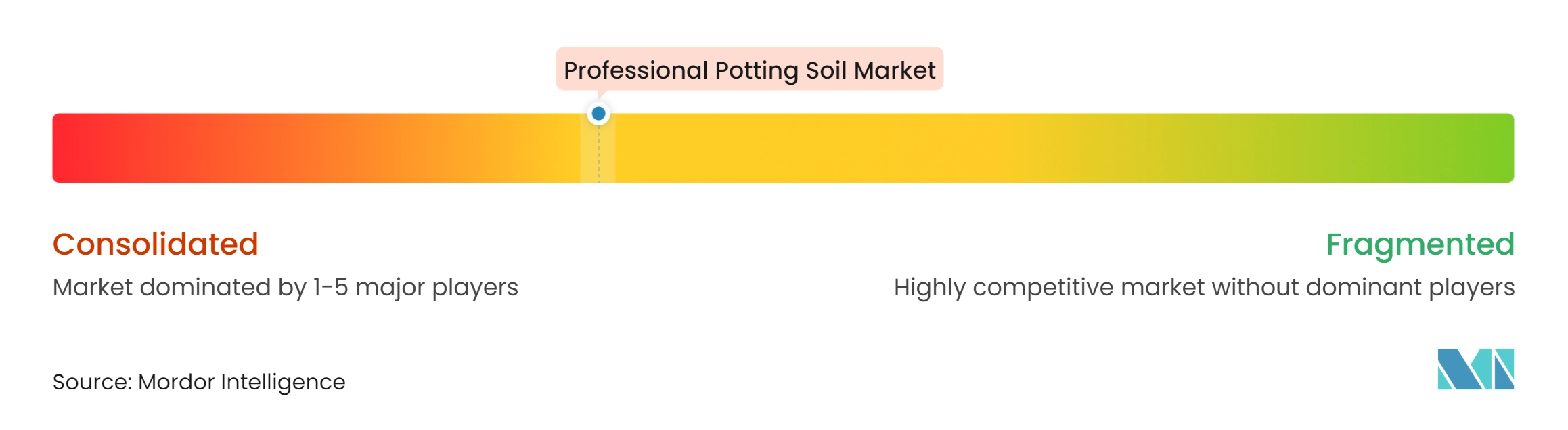
The professional potting soil market is moderately consolidated, with The Scotts Miracle-Gro Company, Sun Gro Horticulture, Inc., Klasmann-Deilmann GmbH, Premier Horticulture Ltd. (Premier Tech), and Pindstrup Mosebrug A/S as the key players. These companies compete through established growing-media portfolios, raw material sourcing networks, manufacturing capabilities, and regional distribution channels. Their product offerings serve professional nurseries, greenhouse operators, commercial floriculture, and gardening applications. Competitive positioning is influenced by substrate quality, crop-specific formulations, product consistency, sustainability initiatives, technical support, and the ability to maintain reliable supplies of growing-media inputs across regional markets.
Competitive positioning depends on the ability to secure peat, coir, wood fiber, bark, and other substrate components while maintaining reliable product specifications. Manufacturers are developing peat-reduced and peat-free formulations, expanding processing capabilities, and working with growers to validate performance under commercial conditions. Product portfolios span professional greenhouse substrates, nursery media, propagation products, and consumer potting mixes. Regional specialists can compete through local sourcing and customer relationships, while larger suppliers benefit from broader manufacturing and distribution networks. Technical service, supply resilience, and formulation flexibility remain important differentiators across the competitive landscape.
The professional potting soil market is seeing greater emphasis on sustainable sourcing and responsible raw material management. The Scotts Miracle-Gro Company reported in its 2025 Corporate Responsibility Report that it diverted 1.76 million pounds of coir waste from landfills for agricultural, municipal, and industrial applications. This initiative demonstrates how established manufacturers can incorporate resource recovery into their growing-media supply chains. Suppliers can strengthen their competitive positioning through responsible material sourcing, waste reduction, sustainable substrate development, and consistent product performance, supporting customer confidence and differentiation across professional horticultural applications.
Professional Potting Soil Industry Leaders
-
The Scotts Miracle-Gro Company
-
Sun Gro Horticulture, Inc.
-
Klasmann-Deilmann GmbH
-
Premier Horticulture Ltd. (Premier Tech)
-
Pindstrup Mosebrug A/S
- *Disclaimer: Major Players sorted in no particular order
Professional Potting Soil Market Companies Covered in this Report
- The Scotts Miracle-Gro Company
- Sun Gro Horticulture, Inc.
- Klasmann-Deilmann GmbH
- Lambert Peat Moss, Inc.
- FoxFarm Soil & Fertilizer Co
- Premier Horticulture Ltd. (Premier Tech)
- Pindstrup Mosebrug A/S
- Michigan Peat LLC
- The Espoma Company
- COMPO GmbH
- Gramoflor GmbH and Co. KG
- HAWITA Gruppe GmbH (Group De Ceuster)
- Floragard Vertriebs-GmbH
- Erdenwerk Gregor Ziegler GmbH
- Good Earth Horticulture, Inc.
Recent Industry Developments in Professional Potting Soil Market
- July 2026: Klasmann-Deilmann GmbH opened a new growing-media facility in Papenburg, Germany. The facility expands loose-substrate manufacturing capacity, supporting the supply of professional potting soils and growing media to horticultural customers across Germany, Austria, and Switzerland.
- July 2026: The Espoma Company introduced its organic Houseplant Mix, a potting soil formulated with earthworm castings and mycorrhizae. The product supports indoor plant cultivation, including tropical, foliage, and flowering plants, expanding its specialized potting soil portfolio.
- February 2026: Pindstrup Mosebrug A/S acquired La Mundial de Coco, a Dominican Republic-based supplier of coconut fiber and pith. The acquisition expands its access to coir raw materials used in peat-reduced potting soils and professional growing-media formulations.
Global Professional Potting Soil Market Report Scope
Professional potting soil is a specially formulated growing medium used for cultivating plants in pots, containers, nurseries, and greenhouses. It provides adequate root support, moisture retention, drainage, aeration, and nutrient availability for healthy plant growth. The professional potting soil market report is segmented by product type (soil with fertilizer, soil without fertilizer, organic potting soil, peat-based potting soil, coconut coir-based potting soil, soil-less mixes, and custom and nutrient-enriched soils), by formulation and growing-media composition (peat-dominant blends, peat-reduced blends, peat-free blends, organic-matter blends, inorganic and mineral blends, and mixed substrates), by application (greenhouse, indoor and gardening, lawn and landscaping, professional nurseries, commercial floriculture, container gardening, and controlled-environment agriculture), by crop type (ornamental plants, vegetables and herbs, fruits and berries, nursery and bedding plants, turf and landscape plants, and medicinal and specialty crops), and by geography (North America, South America, Europe, Asia-Pacific, Middle East, and Africa). The market forecasts are provided in terms of value (USD).
Segmentation Overview
| Soil With Fertilizer |
| Soil Without Fertilizer |
| Organic Potting Soil |
| Peat-Based Potting Soil |
| Coconut Coir-Based Potting Soil |
| Soil-Less Mixes |
| Custom and Nutrient-Enriched Soils |
| Peat-Dominant Blends |
| Peat-Reduced Blends |
| Peat-Free Blends |
| Organic-Matter Blends |
| Inorganic and Mineral Blends |
| Mixed Substrates |
| Greenhouse |
| Indoor and Gardening |
| Lawn and Landscaping |
| Professional Nurseries |
| Commercial Floriculture |
| Container Gardening |
| Controlled-Environment Agriculture |
| Ornamental Plants |
| Vegetables and Herbs |
| Fruits and Berries |
| Nursery and Bedding Plants |
| Turf and Landscape Plants |
| Medicinal and Specialty Crops |
| North America | United States |
| Canada | |
| Mexico | |
| Rest of North America | |
| South America | Brazil |
| Argentina | |
| Chile | |
| Rest of South America | |
| Europe | Germany |
| United Kingdom | |
| France | |
| Italy | |
| Spain | |
| Russia | |
| Rest of Europe | |
| Asia-Pacific | China |
| India | |
| Japan | |
| South Korea | |
| Australia | |
| Rest of Asia-Pacific | |
| Middle East | Saudi Arabia |
| United Arab Emirates | |
| Turkey | |
| Rest of Middle East | |
| Africa | South Africa |
| Egypt | |
| Kenya | |
| Rest of Africa |
| By Product Type | Soil With Fertilizer | |
| Soil Without Fertilizer | ||
| Organic Potting Soil | ||
| Peat-Based Potting Soil | ||
| Coconut Coir-Based Potting Soil | ||
| Soil-Less Mixes | ||
| Custom and Nutrient-Enriched Soils | ||
| By Formulation and Growing-Media Composition | Peat-Dominant Blends | |
| Peat-Reduced Blends | ||
| Peat-Free Blends | ||
| Organic-Matter Blends | ||
| Inorganic and Mineral Blends | ||
| Mixed Substrates | ||
| By Application | Greenhouse | |
| Indoor and Gardening | ||
| Lawn and Landscaping | ||
| Professional Nurseries | ||
| Commercial Floriculture | ||
| Container Gardening | ||
| Controlled-Environment Agriculture | ||
| By Crop Type | Ornamental Plants | |
| Vegetables and Herbs | ||
| Fruits and Berries | ||
| Nursery and Bedding Plants | ||
| Turf and Landscape Plants | ||
| Medicinal and Specialty Crops | ||
| By Geography | North America | United States |
| Canada | ||
| Mexico | ||
| Rest of North America | ||
| South America | Brazil | |
| Argentina | ||
| Chile | ||
| Rest of South America | ||
| Europe | Germany | |
| United Kingdom | ||
| France | ||
| Italy | ||
| Spain | ||
| Russia | ||
| Rest of Europe | ||
| Asia-Pacific | China | |
| India | ||
| Japan | ||
| South Korea | ||
| Australia | ||
| Rest of Asia-Pacific | ||
| Middle East | Saudi Arabia | |
| United Arab Emirates | ||
| Turkey | ||
| Rest of Middle East | ||
| Africa | South Africa | |
| Egypt | ||
| Kenya | ||
| Rest of Africa | ||
Key Questions Answered in the Report
What is the current and forecast market size for the professional potting soil market?
The professional potting soil market is forecast to grow from USD 1.90 billion in 2027 to USD 2.52 billion by 2032, at a 5.81% CAGR from 2027 to 2032.
Which product type leads the professional potting soil market?
Soil with fertilizer accounted for the largest share at 61.5% in 2026.
Which growing media type is projected to grow fastest in the professional potting soil market?
Coconut coir-based potting soil is forecast to grow at the fastest CAGR of 8.0% from 2027 to 2032.
Which application is growing fastest?
Greenhouse applications are forecast to grow at the fastest CAGR of 6.0% from 2027 to 2032.