
Private Networks For Smart Manufacturing Market Size and Share
Market Overview
| Study Period | 2020 - 2031 |
|---|---|
| Market Size (2026) | USD 1.36 Billion |
| Market Size (2031) | USD 8.52 Billion |
| Growth Rate (2026 - 2031) | 44.34 % |
| Fastest Growing Market | Asia-Pacific |
| Largest Market | Asia-Pacific |
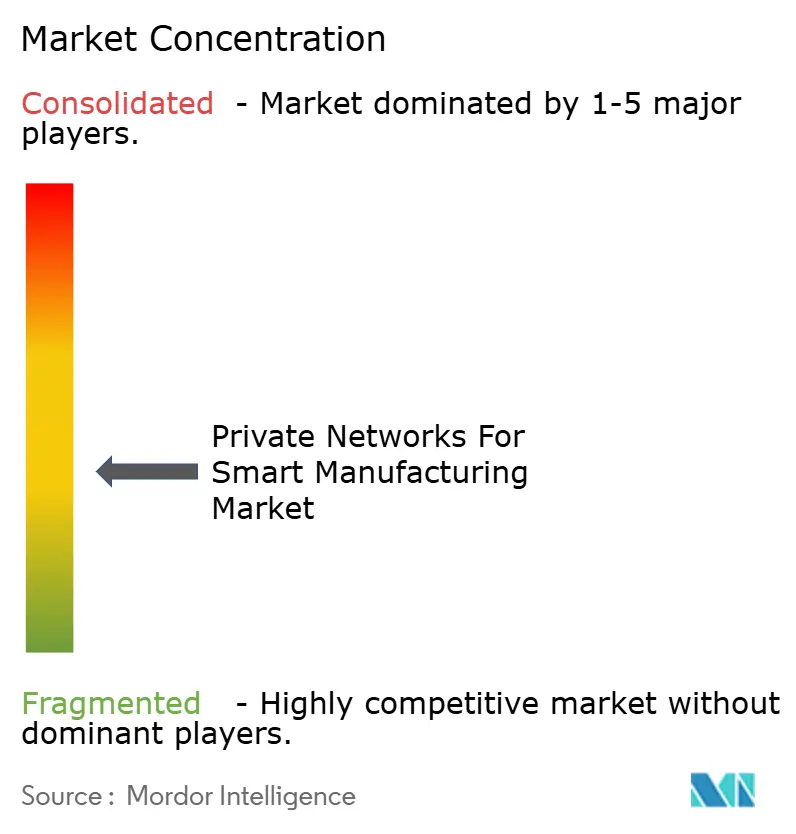
| Market Concentration | Medium |
Major Players *Disclaimer: Major Players sorted in no particular order Image © Mordor Intelligence. Reuse requires attribution under CC BY 4.0. | |
Private Networks For Smart Manufacturing Market Analysis by Mordor Intelligence
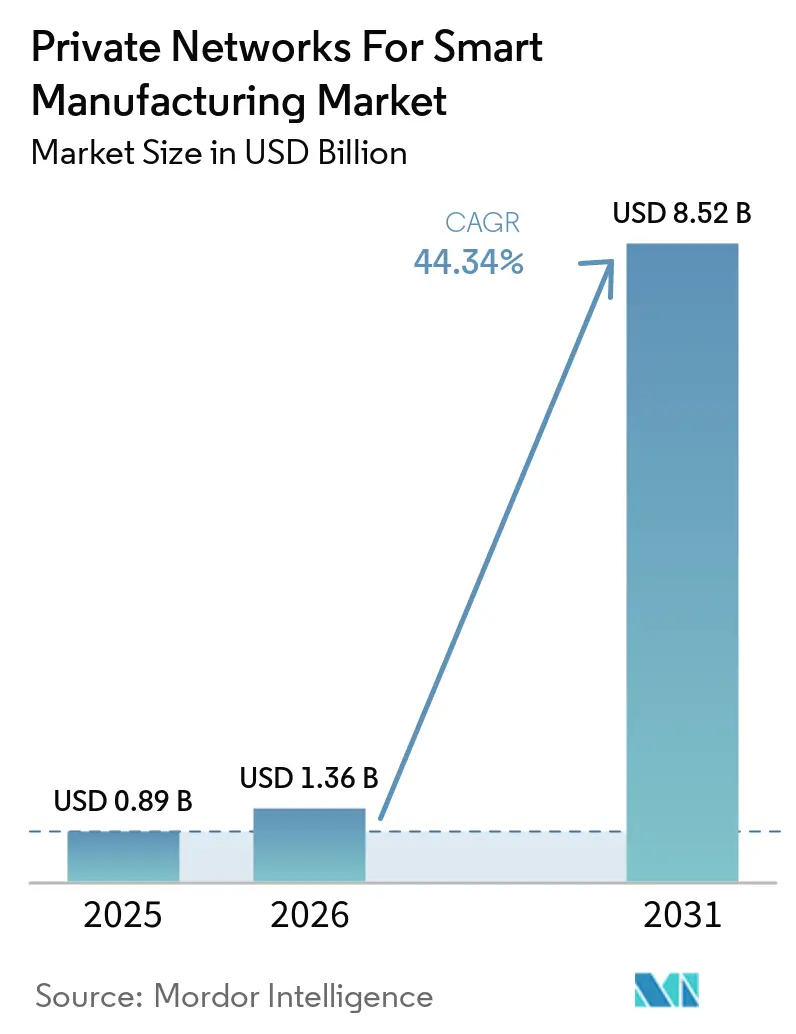
The Private Networks for Smart Manufacturing Market size is projected to expand from USD 0.89 billion in 2025 to USD 1.36 billion in 2026, and to USD 8.52 billion by 2031, registering a CAGR of 44.34% between 2026 and 2031. The Private Networks for Smart Manufacturing Market is growing as factories connect automation systems, inspection equipment, mobile robots, and workers through dedicated wireless infrastructure. Private 5G supports reliable, low-latency communication where shared Wi-Fi and fixed cabling can limit production flexibility. Manufacturers are also placing more computing capacity on site, which lets them process quality and process data closer to machines. This approach supports tighter control of sensitive operational data and faster responses on the factory floor. Network vendors, operators, and industrial automation providers are responding with packaged hardware, software, managed services, and integration offerings.
Key Report Takeaways
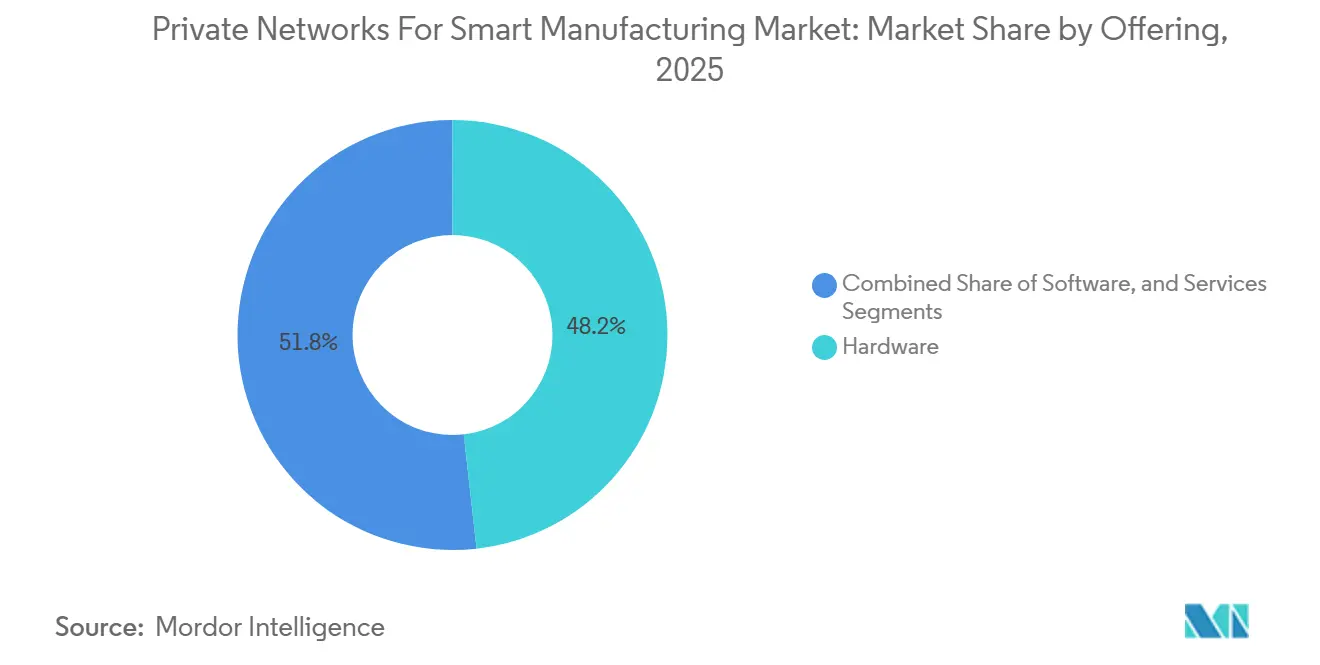
- By offering, hardware held 48.21% of the Private Networks for Smart Manufacturing Market share in 2025, while software is forecast to grow at a 44.61% CAGR through 2031.
- By frequency band, mid-band accounted for 54.12% of the Private Networks for Smart Manufacturing Market share in 2025, while millimeter wave is forecast to grow at a 44.83% CAGR through 2031.
- By deployment architecture, cloud-based systems held 61.34% of the 2025 market, while hybrid architecture is forecast to grow at a 44.41% CAGR through 2031.
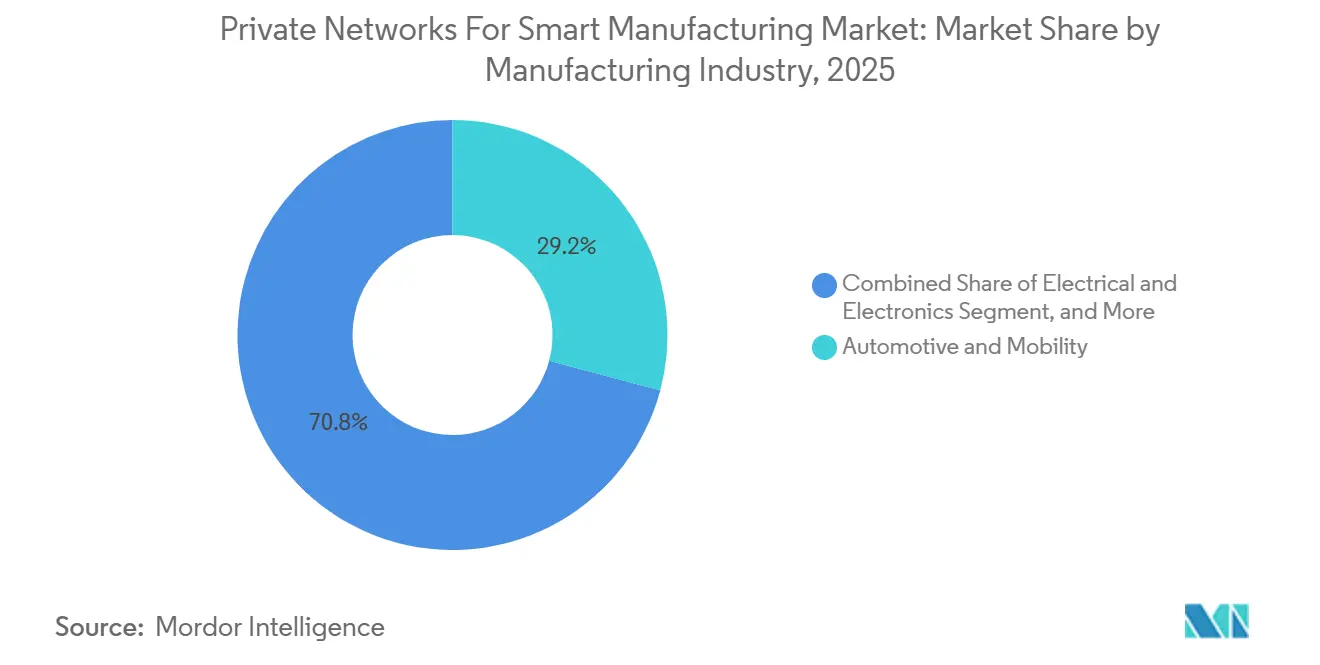
- Within the manufacturing industry, automotive and mobility accounted for 29.16% of the 2025 Private Networks for Smart Manufacturing Market, while electrical and electronics are forecast to grow at a 45.12% CAGR through 2031.
- By enterprise size, large enterprises held 72.34% of the 2025 Private Networks for Smart Manufacturing Market, while small and medium enterprises are forecast to grow at a 45.63% CAGR through 2031.
Note: Market size and forecast figures in this report are generated using Mordor Intelligence’s proprietary estimation framework, updated with the latest available data and insights as of January 2026.
Global Private Networks For Smart Manufacturing Market Trends and Insights
Drivers Impact Analysis*
| Driver | (~) % Impact on CAGR Forecast | Geographic Relevance | Impact Timeline |
|---|---|---|---|
| Industrial Automation and Smart Factory Investment | +12.8% | Global | Medium term (2-4 years) |
| Deterministic Connectivity for Mobile Robotics and Machine Vision | +9.6% | Global, concentrated in Asia-Pacific and Europe | Short term (≤ 2 years) |
| Private Edge Intelligence for Real-Time Quality and Process Decisions | +8.2% | Global, strongest in North America and Asia-Pacific | Medium term (2-4 years) |
| Localized Spectrum Access and Industrial 5G Policy Support | +6.4% | North America, Europe, Asia-Pacific | Medium term (2-4 years) |
| Wireless Reconfiguration of Production Lines and Digital Twins | +5.0% | Europe, Asia-Pacific core, spillover to North America | Long term (≥ 4 years) |
| Physical AI Fleet Expansion Across Factories | +4.2% | Asia-Pacific core, spillover to North America and Europe | Long term (≥ 4 years) |
| Source: Mordor Intelligence | |||
Industrial Automation and Smart Factory Investment
Factory automation investment is expanding the set of applications requiring dedicated wireless connectivity. Automated guided vehicles, real-time supervisory control and data acquisition systems, AI inspection, and connected-worker tools need dependable communications across production areas. The Private Networks for Smart Manufacturing Market benefits when these systems move from isolated deployments to linked operating environments. Dedicated networks help factories avoid the limitations of general-purpose enterprise networks when production processes become more automated. They provide a common communications base for applications that would otherwise require separate connectivity arrangements. Manufacturers are also seeking infrastructure that can support automation, analytics, and operational technology together.
Deterministic Connectivity for Mobile Robotics and Machine Vision
Mobile robotics and machine vision require stable service levels that shared wireless networks can struggle to provide. Industrial guidance targets availability above 99.9999% and latency of 1 to 2.5 milliseconds for cooperative carrying applications.[1] Samsung and Hyundai Motor completed an end-to-end private 5G RedCap trial at Hyundai Motor’s Ulsan plant in February 2025, transmitting vehicle inspection data at a facility producing 6,000 vehicles per day. RedCap devices can reduce device size and power requirements while retaining key 5G capabilities. This can make dense arrays of sensors, cameras, and inspection terminals more practical. The Private Networks for Smart Manufacturing Market benefits where production applications require predictable connectivity and fast data transmission.
Private Edge Intelligence for Real-Time Quality and Process Decisions
Edge computing with private 5G can support continuous inspection and faster process decisions. Ericsson reported that on-premise private 5G and edge computing can support inspection loops below 10 milliseconds, compared with 200 milliseconds or more for cloud processing.[2] Siemens uses Arm-based edge AI platforms at manufacturing sites, and Arm reported defect-detection response times below 50 milliseconds. Local processing can help factories act before defective products move through later stations. It can also help keep sensitive production data within the facility. The Private Networks for Smart Manufacturing Market benefits when low-latency performance and local data control are both required.
Localized Spectrum Access and Industrial 5G Policy Support
Local spectrum access allows industrial sites to control private 5G performance and coverage. The 3.55-3.7 GHz CBRS band is a key U.S. option, and 75% of U.S. private 5G networks deployed in 2025 used CBRS spectrum. Germany had granted 465 frequency allocations for private campus networks by April 2025.[3] The European Commission’s 2025 decision required member states to make the 3.8-4.2 GHz band available for local industrial use by 2026. These frameworks can simplify industrial deployment planning, although changing spectrum policy can still affect long-term investment decisions. The Private Networks for Smart Manufacturing Market remains sensitive to reliable access to local spectrum.
Restraints Impact Analysis*
| Restraint | (~) % Impact on CAGR Forecast | Geographic Relevance | Impact Timeline |
|---|---|---|---|
| High Initial Deployment and Endpoint Costs | -4.8% | Global, strongest impact in South America and Africa | Medium term (2-4 years) |
| OT-IT Integration and Multi-Vendor Skills Gaps | -3.6% | Global | Short term (≤ 2 years) |
| Limited Industrial 5G Endpoint Variety and Lifecycle Risk | -2.6% | Global, strongest in small and medium enterprise segments | Medium term (2-4 years) |
| Fragmented Spectrum Rules and Cross-Border Rollout Friction | -2.0% | Europe, Middle East and Africa, South America | Long term (≥ 4 years) |
| Source: Mordor Intelligence | |||
High Initial Deployment and Endpoint Costs
A private 5G deployment may require investment in radio access hardware, a dedicated core, edge servers, system integration, and spectrum access where needed. This initial requirement can be difficult for small and medium manufacturers that must compare it with process projects that offer faster returns. Industrial endpoint selection is also more limited than the broader 5G device ecosystem. The Global Mobile Suppliers Association listed 326 5G modules and 330 industrial routers and modems within a catalog of 3,378 5G devices as of April 2025.[4] The limited range can keep endpoint prices high and reduce procurement flexibility. The Private Networks for Smart Manufacturing Market may develop more slowly in regions where manufacturers cannot spread costs across multiple high-value applications.
OT-IT Integration and Multi-Vendor Skills Gaps
Private 5G programs bring together operational technology, information technology, and cellular networking expertise. These functions often have different safety requirements, budget owners, and approaches to change management. The Private Networks for Smart Manufacturing Market faces a practical limitation when plant teams lack sufficient personnel with expertise across all 3 domains. Cybersecurity, data separation, and operational continuity must be addressed before teams approve changes near production systems. This can extend deployment schedules even when the network design is technically ready. Manufacturers are increasingly using managed service providers to bridge these skills gaps, though they still need clear roles to define the relationship between plant operations and network teams.
*Our forecasts treat driver/restraint impacts as directional, not additive. The impact forecasts reflect baseline growth, mix effects, and variable interactions.
Segment Analysis
By Offering: Hardware Anchors Revenue as Software Closes the Gap
Hardware represented 48.21% of the Private Networks for Smart Manufacturing Market in 2025. This reflects the initial cost of radio access network equipment, private 5G core hardware, edge servers, and gateways. Hardware remains necessary when a manufacturer first builds local coverage across a factory. Radio equipment is becoming more differentiated as open radio access network designs allow manufacturers to consider multi-vendor configurations. Services remain important because many manufacturers lack in-house expertise in cellular networks.
Software is forecast to grow at a 44.61% CAGR through 2031. Network management, orchestration, security, and analytics software become more important as the installed base of hardware expands. NTT Docomo launched 5G slicing services for enterprise customers in March 2026. Private networks in the smart manufacturing industry are shifting toward recurring software and service revenue as factories use network functions beyond the initial equipment purchase. This transition makes ongoing platform support more relevant to the supplier relationship.

By Frequency Band: Mid Band Leads as Millimeter Wave Gains Industrial Traction
Mid band held 54.12% of the Private Networks for Smart Manufacturing Market in 2025. It provides a balance between coverage, capacity, and deployment density for large factory floors. Mid-band networks can support automated guided vehicles, machine vision, and sensor systems without the dense access-point layout often required by higher frequencies. CBRS has reinforced this position in the United States. The 2025 American Made 5G study reported that 75% of U.S. private 5G networks deployed that year used CBRS spectrum.
Millimeter wave is forecast to grow at a 44.83% CAGR through 2031. An industrial evaluation published in MDPI Electronics found reliable high-throughput performance for additive manufacturing and precision robotics in line-of-sight environments. Low band remains relevant for outdoor industrial campuses where signal propagation around obstructions matters more than high data rates. Dense small-cell designs and configurable multi-band radios can help address millimeter-wave constraints in metal-heavy facilities. The private networks for the smart manufacturing industry will use several bands because factory layouts and application needs vary widely.
By Deployment Architecture: Cloud-Based Frameworks Dominate While Hybrid Scales Production Operations
Cloud-based architecture held 61.34% of the Private Networks for Smart Manufacturing Market in 2025. Manufacturers often use managed cloud infrastructure for initial deployments because it reduces local integration work and capital requirements. This model is useful for innovation centers, secondary sites, and early deployments outside core production processes. Cloud-based management can support centralized monitoring across multiple locations. The approach is a practical entry point before extending a private network across the factory portfolio.
Hybrid architecture is forecast to grow at a 44.41% CAGR through 2031. It combines local operational control and edge processing with cloud-based orchestration, analytics, and AI model training. On-premises deployment remains important in regulated environments and facilities with strict data location requirements. GlobalLogic and Ericsson deployed private 5G at Hitachi Rail’s 307,000-square-foot Hagerstown facility in September 2025. The Private Networks for Smart Manufacturing Market is likely to favor hybrid designs when factories scale latency-sensitive applications into core production operations.
By Manufacturing Industry: Automotive Leads as Electronics Manufacturing Accelerates
Automotive and mobility accounted for 29.16% of the Private Networks for Smart Manufacturing Market in 2025. Assembly lines use connected vehicles, inspection systems, mobile robots, and machine vision at a scale that supports dedicated wireless investment. Hyundai Motor and Samsung completed their private 5G RedCap trial at the Ulsan plant in February 2025. The project used wireless transmission of vehicle inspection data at a facility producing 6,000 vehicles per day. Machinery producers are also using private networks to make line changes without rerouting physical cabling.
The electrical and electronics sector is forecast to grow at a 45.12% CAGR through 2031. Semiconductor and consumer electronics plants use dense camera systems, robotic arms, and AI inspection tools that create heavy data traffic. Aerospace, defense, pharmaceutical, medical-device, chemical, metals, and materials facilities have different traceability and security needs. These differences encourage suppliers to tailor applications and integration services to plant conditions. The Private Networks for Smart Manufacturing Market has opportunities across these sectors because each has a different mix of automation, data, and compliance needs.
By Enterprise Size: Large Enterprises Drive Volume While SMEs Reshape Market Composition
Large enterprises held 72.34% of the Private Networks for Smart Manufacturing Market in 2025. They have the capital, internal resources, and multi-site footprints needed to standardize private network programs. Automotive manufacturers, aerospace companies, and chemicals producers can use a reference design at a flagship site before applying it to other facilities. A shared architecture can reduce the effort required to introduce new applications at later sites. Large organizations can spread network design, integration, and lifecycle costs across a wider asset base.
Small and medium enterprises are forecast to grow at a 45.63% CAGR through 2031. Managed private 5G services can turn network complexity into a recurring service rather than a major internal engineering project. CBRS-based solutions can reduce the burden of obtaining licensed spectrum in the United States. Smaller suppliers may face increasing pressure from larger customers to meet digital traceability and quality data requirements. The Private Networks for Smart Manufacturing Market can expand among these firms when providers offer simple deployment models and applications with clear operational value.
Geography Analysis
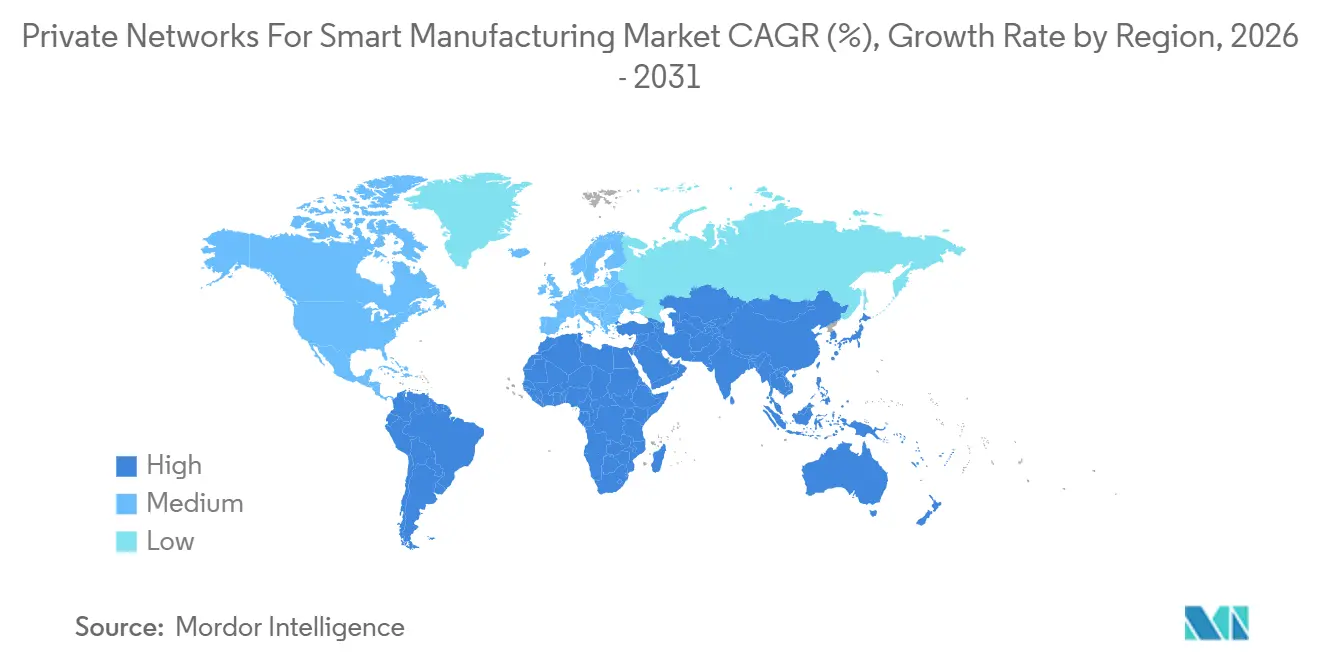
Asia-Pacific led the Private Networks for Smart Manufacturing Market with a 41.21% share in 2025 and is forecast to grow at a 46.14% CAGR through 2031. The region combines manufacturing density, local spectrum policy, and rising adoption of robotics. SoftBank and Murata Manufacturing demonstrated time-sensitive networking over a private 5G standalone network in February 2026, achieving a time synchronization accuracy of 122 nanoseconds. This work shows a shift toward 5G-native production control rather than using private wireless only as an add-on to wired systems. Japan, South Korea, China, India, Southeast Asia, and Oceania contribute different demand drivers across automotive, electronics, and export-oriented manufacturing.
North America held the second-largest regional position, supported by CBRS access and manufacturing investment in the automotive, aerospace, and food and beverage sectors. Celanese deployed NTT DATA’s managed private 5G at 2 Texas manufacturing facilities in September 2025. TERAGO and Ericsson launched a private 5G network at the McMaster Manufacturing Research Institute in May 2026 for sensor, robotics, and AI validation. Europe is advancing through Germany’s campus-network framework and production-grade deployment activity. The Middle East, Africa, and South America remain earlier-stage regions where spectrum rules and available manufacturing capital will shape rollout speed.
The Private Networks for Smart Manufacturing Market has a broad regional base because new facilities can incorporate dedicated wireless systems in their initial designs. Mature industrial regions are using private networks to update complex existing plants. Emerging regions can use industrial parks and greenfield projects to introduce dedicated wireless systems from the start. Local spectrum availability influences whether manufacturers can deploy quickly or must rely on operator partnerships. Cross-border manufacturers also benefit when regional rules and equipment options are easier to align. These conditions make geography an important factor in the timing and design of private-network projects.
Competitive Landscape
The Private Networks for Smart Manufacturing Market is moderately fragmented in radio access infrastructure but more fragmented in managed services, software, and system integration. Nokia, Ericsson, Huawei, Samsung, and ZTE are important infrastructure vendors. Operators, including Deutsche Telekom, Verizon, Vodafone, and Telefónica, compete by providing managed private network services. Industrial automation providers and information technology integrators add the applications and operational capabilities needed in factories. This structure means that large contracts often combine several suppliers rather than relying on a single vendor.
Verizon selected Nokia as the hardware and software provider for Thames Freeport’s multi-site private 5G deployment in the United Kingdom. The contract uses the Nokia Digital Automation Cloud and MX Industrial Edge platforms as part of a long-term operational transformation program. NTT DATA and Ericsson announced a multi-year partnership in February 2026 to scale private 5G and physical AI deployments. The partnership combines Ericsson’s private 5G and edge platforms with NTT DATA’s managed services, IT and OT security, and edge AI tools. These examples show how network suppliers are pairing their infrastructure with integration and lifecycle services.
Specialist software companies such as Celona, Cumucore, and Druid Software are competing with established equipment providers through lighter cloud-native core systems and enterprise-focused management tools. The main opening for new providers is the integration layer between the 5G network and industrial protocols such as PROFINET, OPC UA, and Modbus. Siemens has developed industrial 5G capabilities that connect core, radio, and industrial networking functions, including PROFINET support. Open RAN approaches can give manufacturers more flexibility in sourcing network components. However, factories still need a clear party to manage performance, security, and accountability across the full system.
Private Networks For Smart Manufacturing Industry Leaders
-
Huawei Technologies Co., Ltd.
-
Nokia Corporation
-
Telefonaktiebolaget LM Ericsson
-
Samsung Electronics Co., Ltd.
-
ZTE Corporation
- *Disclaimer: Major Players sorted in no particular order
Recent Industry Developments
- May 2026: TERAGO and Ericsson commissioned an enterprise private 5G network at the McMaster Manufacturing Research Institute in Drummondville, Canada, creating a live environment for Canadian startups to validate sensor, robotics, and applied AI solutions for industrial use.
- April 2026: Siemens and Humanoid completed testing of the HMND 01 wheeled humanoid robot, built on the NVIDIA physical AI stack, at Siemens' electronics factory in Erlangen, Germany, performing autonomous logistics tasks, as part of a broader Siemens-NVIDIA partnership to build AI-driven adaptive manufacturing sites
- April 2026: CENGN, CNIMI, and Ericsson opened an Advanced Manufacturing Living Lab powered by Ericsson Private 5G at CNIMI's Drummondville, Quebec facility, offering co-funded access to private 5G validation infrastructure including 5G indoor advanced positioning for Canadian startups targeting robotics and sensor use cases
- February 2026: NTT DATA and Ericsson announced a multi-year strategic partnership to scale private 5G and physical AI globally, combining Ericsson's private 5G and edge platforms with NTT DATA's managed services, IT-OT security, and edge AI agents to deliver outcome-based manufacturing transformation at production scale
Global Private Networks For Smart Manufacturing Market Report Scope
The private networks for smart manufacturing market refers to the ecosystem of dedicated, localized cellular network solutions, primarily private LTE and 5G, designed to meet the ultra-reliable, low-latency, and high-bandwidth connectivity requirements of industrial environments. This market includes the deployment of specialized hardware (such as RAN and private core network equipment), network orchestration and industrial security software, and associated professional and managed services. Utilizing licensed spectrum bands (low, mid, and millimeter wave) and deployed via cloud, on-premise, or hybrid architectures, these networks operate independently from public telecom infrastructure. They empower manufacturing enterprises across sectors such as automotive, electronics, and pharmaceuticals to securely support critical Industry 4.0 use cases, including industrial IoT, automated guided vehicles (AGVs), robotic automation, and real-time predictive maintenance, without the interference or security vulnerabilities associated with public networks.
The Private Networks for Smart Manufacturing Market Report is Segmented by Offering ((Hardware (Radio Access Network Hardware, Private 5G Core Network Hardware, and Edge Servers and Gateways), Software (Network Management and Orchestration, and Industrial Security and Analytics Software), and Services (Professional Services, and Managed Services)), Frequency Band (Low Band, Mid Band, and Millimeter Wave), Deployment Architecture (Cloud-Based, On-Premise, and Hybrid), Manufacturing Industry (Automotive and Mobility, Electrical and Electronics, Machinery and Industrial Equipment, Food and Beverage, Pharmaceuticals and Medical Devices, Aerospace and Defense Manufacturing, and Chemicals, Metals, and Materials), Enterprise Size (Large Enterprises, and Small and Medium Enterprises), and Geography (North America, South America, Europe, Asia-Pacific, Middle East, and Africa). The Market Forecasts are Provided in Terms of Value (USD).
| Hardware | Radio Access Network Hardware |
| Private 5G Core Network Hardware | |
| Edge Servers and Gateways | |
| Software | Network Management and Orchestration |
| Industrial Security and Analytics Software | |
| Services | Professional Services |
| Managed Services |
| Low Band |
| Mid Band |
| Millimeter Wave |
| Cloud-Based |
| ON Premise |
| Hybrid |
| Automotive and Mobility |
| Electrical and Electronics |
| Machinery and Industrial Equipment |
| Food and Beverage |
| Pharmaceuticals and Medical Devices |
| Aerospace and Defense Manufacturing |
| Chemicals, Metals, and Materials |
| Large Enterprises |
| Small and Medium Enterprises |
| North America | United States |
| Canada | |
| Mexico | |
| South America | Brazil |
| Rest of South America | |
| Europe | Germany |
| United Kingdom | |
| France | |
| Italy | |
| Russia | |
| Rest of Europe | |
| Asia-Pacific | China |
| Japan | |
| South Korea | |
| India | |
| Southeast Asia | |
| Rest of Asia-Pacific | |
| Middle East | Turkey |
| Saudi Arabia | |
| United Arab Emirates | |
| Rest of Middle East | |
| Africa | South Africa |
| Kenya | |
| Rest of Africa |
| By Offering | Hardware | Radio Access Network Hardware |
| Private 5G Core Network Hardware | ||
| Edge Servers and Gateways | ||
| Software | Network Management and Orchestration | |
| Industrial Security and Analytics Software | ||
| Services | Professional Services | |
| Managed Services | ||
| By Frequency Band | Low Band | |
| Mid Band | ||
| Millimeter Wave | ||
| By Deployment Architecture | Cloud-Based | |
| ON Premise | ||
| Hybrid | ||
| By Manufacturing Industry | Automotive and Mobility | |
| Electrical and Electronics | ||
| Machinery and Industrial Equipment | ||
| Food and Beverage | ||
| Pharmaceuticals and Medical Devices | ||
| Aerospace and Defense Manufacturing | ||
| Chemicals, Metals, and Materials | ||
| By Enterprise Size | Large Enterprises | |
| Small and Medium Enterprises | ||
| By Geography | North America | United States |
| Canada | ||
| Mexico | ||
| South America | Brazil | |
| Rest of South America | ||
| Europe | Germany | |
| United Kingdom | ||
| France | ||
| Italy | ||
| Russia | ||
| Rest of Europe | ||
| Asia-Pacific | China | |
| Japan | ||
| South Korea | ||
| India | ||
| Southeast Asia | ||
| Rest of Asia-Pacific | ||
| Middle East | Turkey | |
| Saudi Arabia | ||
| United Arab Emirates | ||
| Rest of Middle East | ||
| Africa | South Africa | |
| Kenya | ||
| Rest of Africa | ||
Key Questions Answered in the Report
How large is the private networks for smart manufacturing market?
The market is projected to grow from USD 1.36 billion in 2026 to USD 8.52 billion by 2031 at a 44.34% CAGR.
What is driving adoption of private networks in smart manufacturing?
Manufacturers are using dedicated networks to connect robots, machine vision, sensors, and workers with reliable, low-latency communications.
Which offering is growing fastest in private networks for smart manufacturing?
Software is forecast to expand at a 44.61% CAGR through 2031 as factories add management, security, orchestration, and analytics functions.
Which frequency band leads factory private 5G deployments?
Mid band held 54.12% of the 2025 market because it balances coverage and capacity for many factory settings.
Which manufacturing sector has the largest share of private network demand?
Automotive and mobility held 29.16% of the 2025 market, supported by connected assembly, inspection, and mobile-robot applications.
Which region is growing fastest for smart manufacturing private networks?
Asia-Pacific is forecast to grow at a 46.14% CAGR through 2031, supported by manufacturing density, spectrum programs, and robotics investment.