
Private Networks For Ports Market Size and Share
Market Overview
| Study Period | 2020 - 2031 |
|---|---|
| Market Size (2026) | USD 0.42 Billion |
| Market Size (2031) | USD 1.43 Billion |
| Growth Rate (2026 - 2031) | 27.77 % |
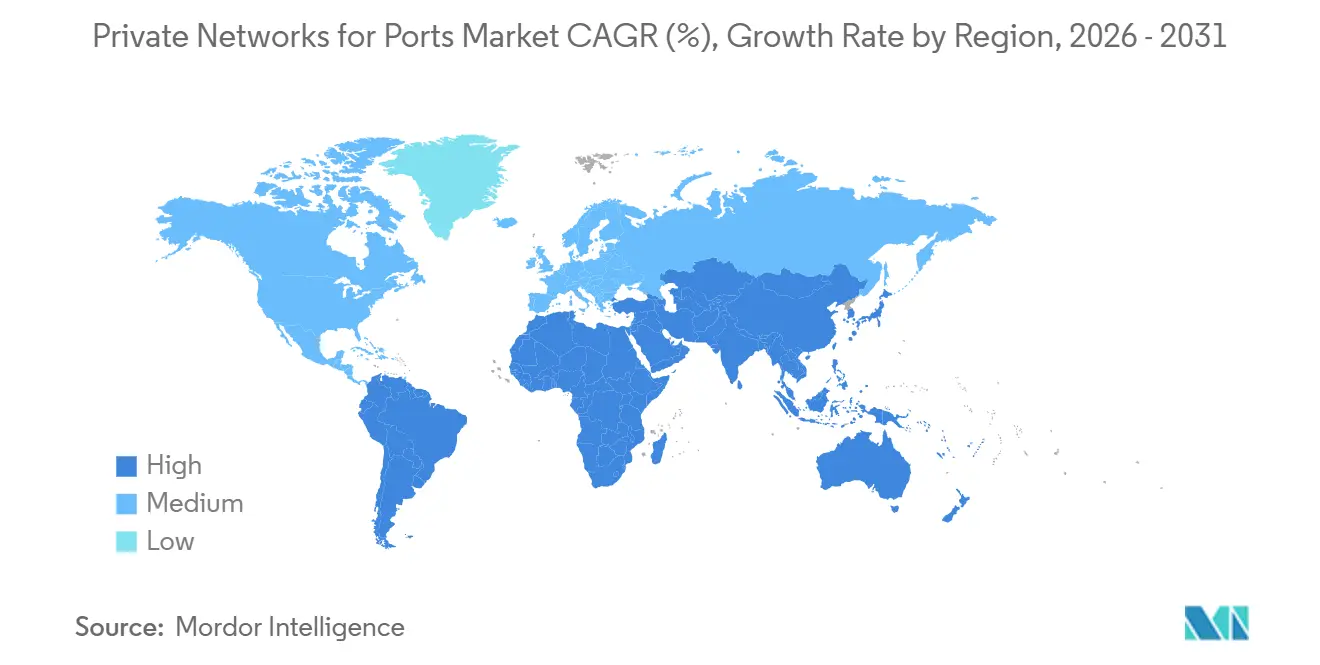
| Fastest Growing Market | Asia-Pacific |
| Largest Market | North America |
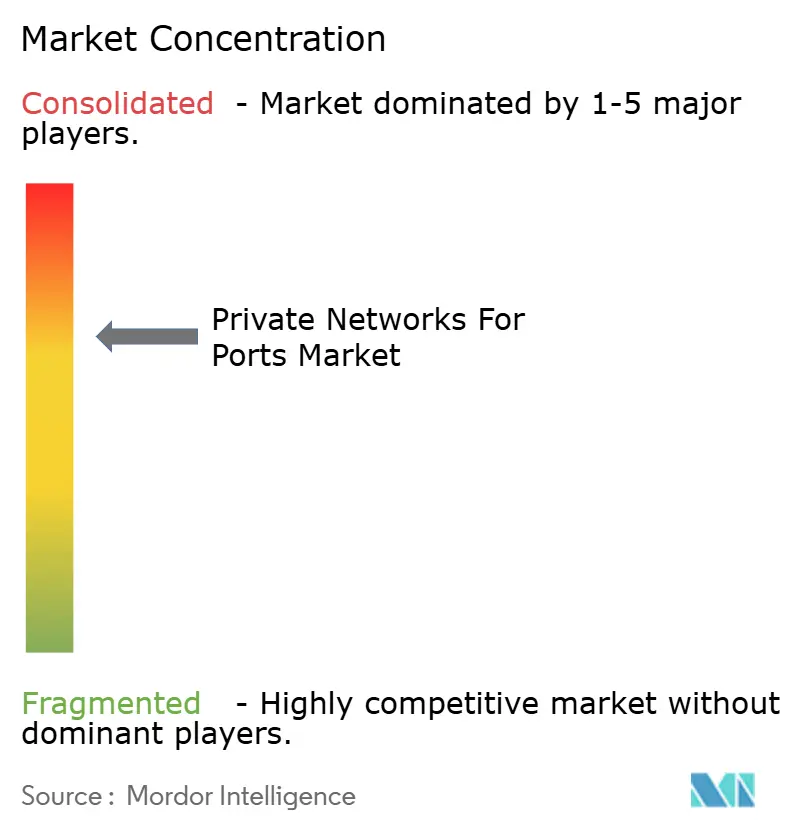
| Market Concentration | Medium |
Major Players *Disclaimer: Major Players sorted in no particular order Image © Mordor Intelligence. Reuse requires attribution under CC BY 4.0. | |
Private Networks For Ports Market Analysis by Mordor Intelligence
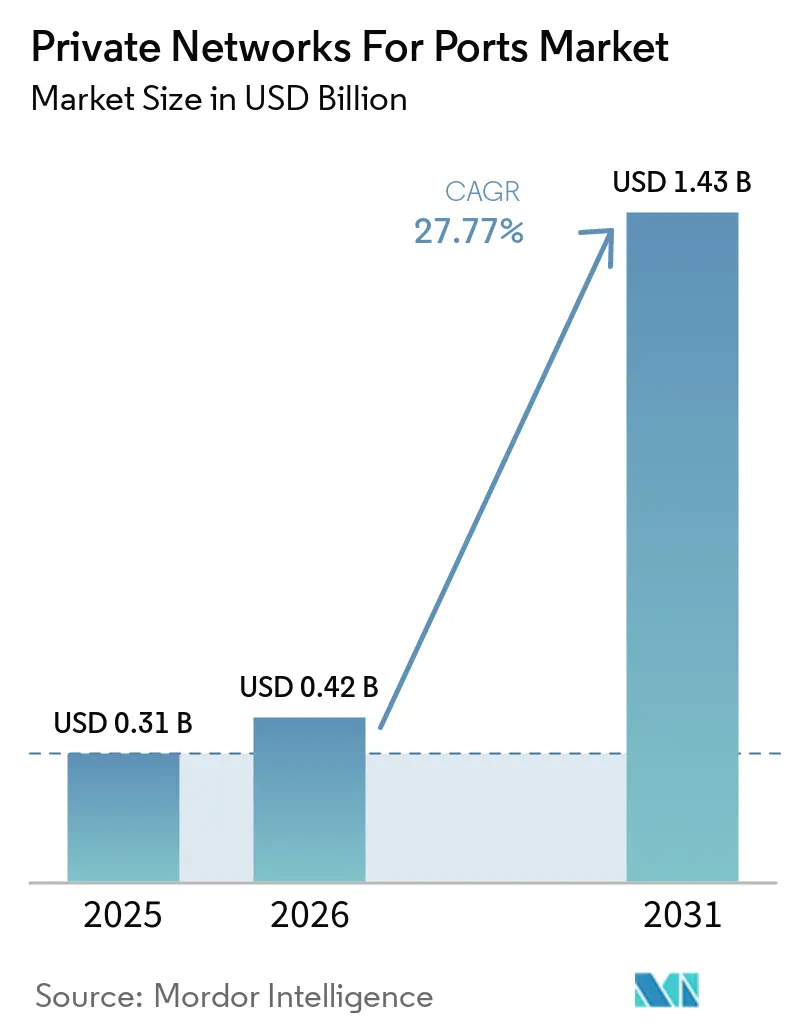
The Private Networks for Ports Market size was valued at USD 0.31 billion in 2025 and estimated to grow from USD 0.42 billion in 2026 to reach USD 1.43 billion by 2031, at a CAGR of 27.77% during the forecast period (2026-2031). Dedicated LTE and 5G systems support automated guided vehicles, remote crane control, digital twins, and video systems in locations where public networks and legacy Wi-Fi can be unreliable. Container stacks, cranes, and other steel structures can weaken wireless coverage, so ports are treating dedicated connectivity as part of automation infrastructure rather than a separate technology purchase. The addressable opportunity is widening as operators add environmental sensors, drone inspection, worker safety systems, and asset tracking to the same network. Suppliers are responding with managed network offerings, edge computing, and operational technology integration services that reduce the burden on ports without internal radio engineering teams. The private networks for the ports market, therefore, depend on automation plans, spectrum access, cyber safeguards, and the ability to link new wireless systems to established terminal operations.
Key Report Takeaways
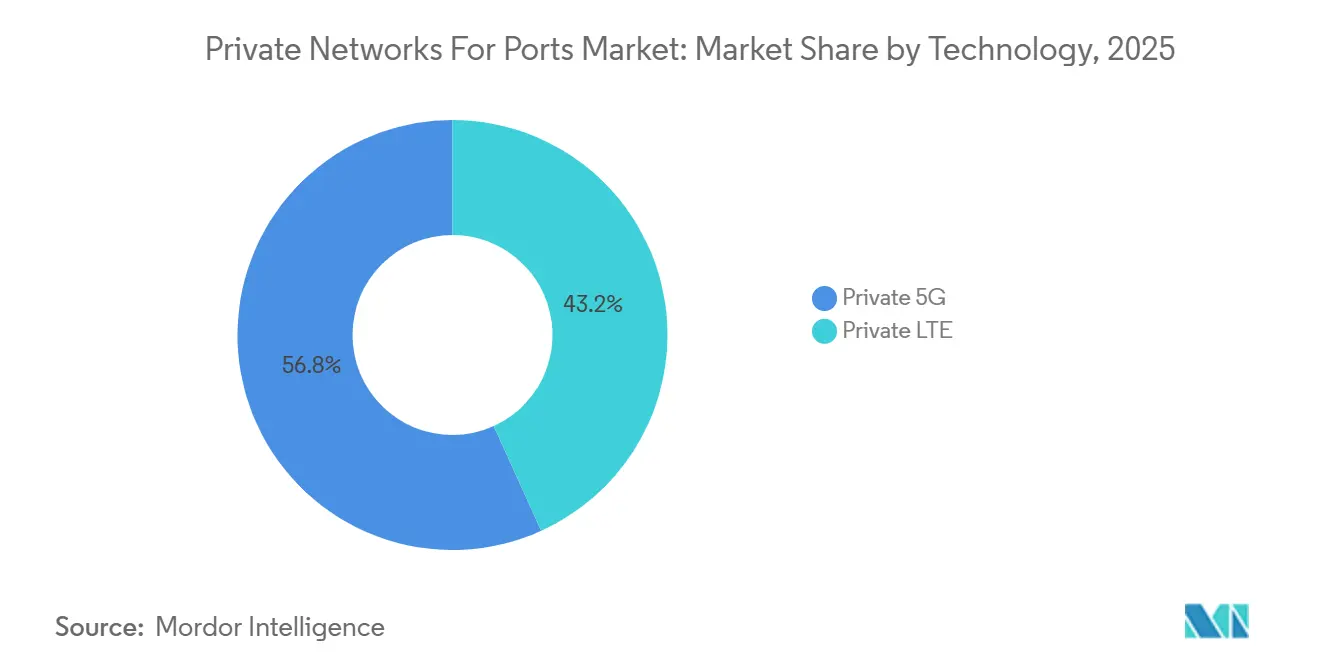
- By technology, private 5G held 56.78% of the Private Networks for Ports Market share in 2025 and is forecast to grow at a 28.04% CAGR through 2031.
- By component, hardware held 66.59% of the Private Networks for Ports Market share in 2025, while services are forecast to grow at a 29.57% CAGR through 2031.
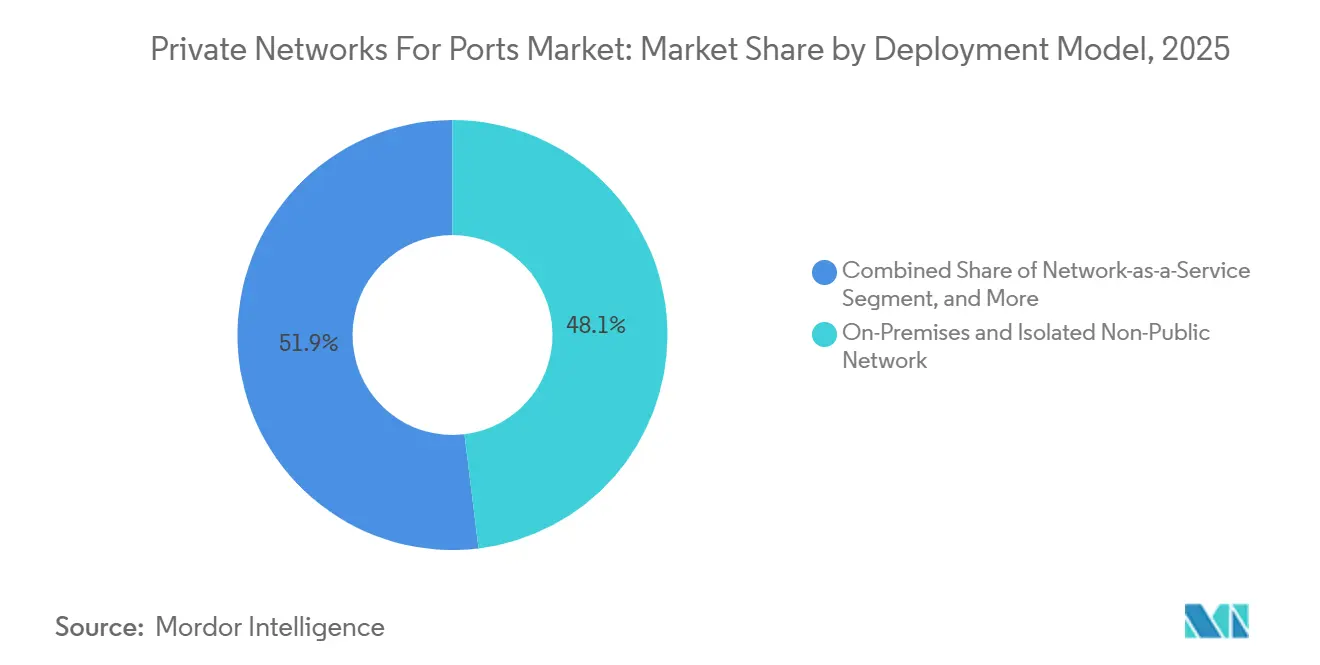
- By deployment model, on-premises and isolated deployments held 48.07% in Private Networks for Ports Market 2025, while network as a service is forecast to grow at a 28.12% CAGR through 2031.
- By spectrum, shared and unlicensed spectrum held 62.21% in 2025, while shared spectrum is forecast to grow at a 28.78% CAGR through 2031.
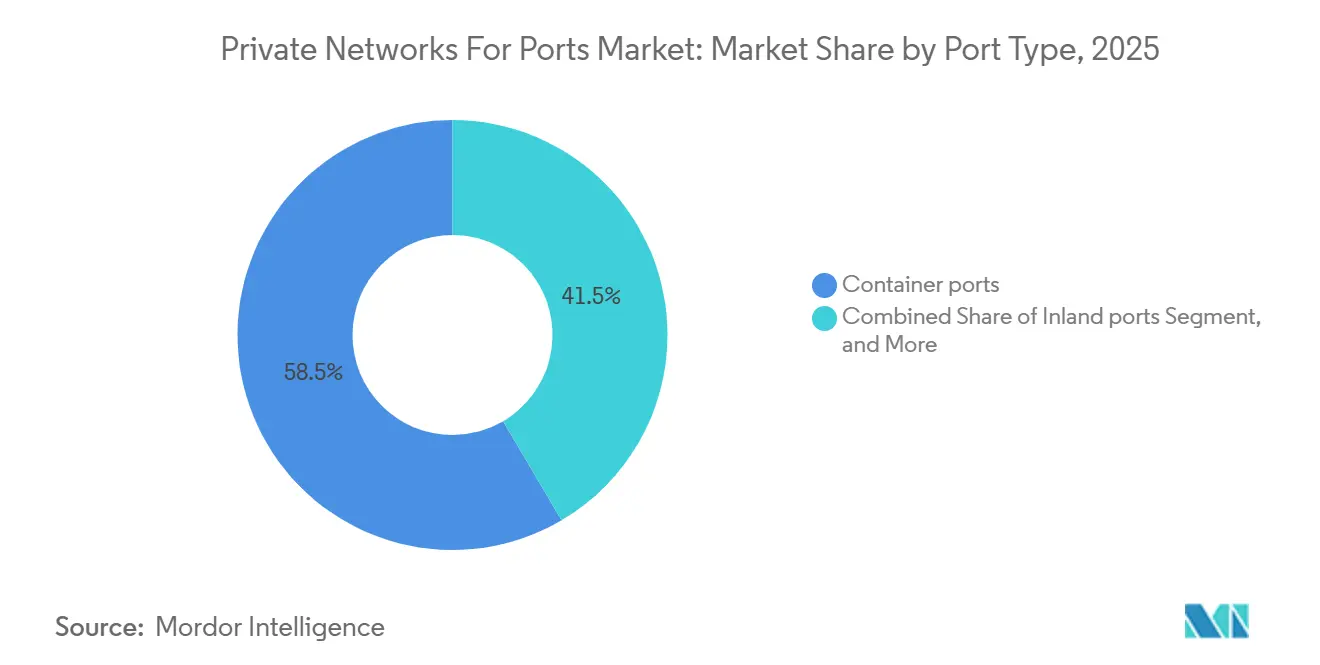
- By port type, container ports held 58.47% in 2025, while inland ports are forecast to grow at a 29.12% CAGR through 2031.
- By application, cargo handling and yard automation held 84.12% in Private Networks for Ports Market 2025, while environmental monitoring and drone inspection are forecast to grow at a 28.89% CAGR through 2031.
- By region, North America held 84.12% of the Private Networks for Ports Market in 2025, while Asia-Pacific is forecast to grow at a 29.69% CAGR through 2031.
Note: Market size and forecast figures in this report are generated using Mordor Intelligence’s proprietary estimation framework, updated with the latest available data and insights as of January 2026.
Market Trends and Insights
Drivers Impact Analysis of Private Networks For Ports Market*
| Driver | (~) % Impact on CAGR Forecast | Geographic Relevance | Impact Timeline |
|---|---|---|---|
| Port Automation and Autonomous Equipment Adoption | +7.5% | Global, with greater intensity in Asia-Pacific and North America | Medium term (2-4 years) |
| Secure Low-Latency Connectivity for Mission-Critical Operations | +6.2% | Global | Short term (≤ 2 years) |
| Industrial IoT and Real-Time Video Analytics Expansion | +5.1% | Global, with early gains in North America and Europe | Medium term (2-4 years) |
| Local Spectrum Liberalization and Shared-Spectrum Availability | +4.0% | North America and Europe, with spillover to Asia-Pacific | Short term (≤ 2 years) |
| Port-Wide Digital Twin and Environmental Monitoring Programs | +3.2% | Europe and Asia-Pacific | Long term (≥ 4 years) |
| Seasonal Bandwidth Scaling Through Network-as-a-Service | +2.5% | Global | Medium term (2-4 years) |
| Source: Mordor Intelligence | |||
Port Automation and Autonomous Equipment Adoption
The private networks for the ports market are advancing as terminal automation moves from isolated equipment projects to coordinated operating systems. Automated guided vehicles, rail-mounted gantry cranes, and yard optimization tools need dependable, low-latency communication to exchange positions, commands, and safety data. Konecranes completed live private 5G trials for automated rail-mounted gantry cranes in the third quarter of 2025, supporting the use of 5 G for remote and automated crane operations.[1] The trials also provided terminal operators with a reference for assessing radio coverage, equipment response, and operational safety before replacing established control links. This relationship raises the cost of delaying network deployment because equipment investments cannot deliver their intended operating gains without a stable data layer. It also favors suppliers that understand crane controls, vehicle systems, terminal operating software, and radio networks.
Secure Low-Latency Connectivity for Mission-Critical Operations
The private networks for ports market benefits from demand for connectivity that stays available during safety-sensitive operations. The U.S. Department of Homeland Security reported in 2024 that surveyed ports did not regularly exercise transitions from digital to manual cargo processing, which makes resilient communications an important operational consideration.[2] At the Port of Virginia, Verizon used licensed spectrum rather than General Authorized Access spectrum because nearby Navy and Coast Guard facilities could create channel competition. This decision shows that spectrum protection can matter as much as network speed when a site operates near critical public infrastructure. Dedicated networks also give port operators more control over traffic priorities and access policies than public wireless services. These benefits are most relevant when crane movements, vehicle routing, video feeds, and security systems must operate simultaneously.
Industrial IoT and Real-Time Video Analytics Expansion
The Private Networks for Ports Market expands when a single deployment supports several operational applications. At the Freeport of Riga, LMT demonstrated crane inspection, water-quality monitoring, oil-spill response, and autonomous surface operations over a private 5G network. Video feeds, restricted-area alerts, personal protective equipment monitoring, and road-condition analysis can use the same core infrastructure as cargo systems. Each additional application can improve the economics of the original investment by reusing coverage, edge resources, and management tools. Lyttelton Port’s private 5G deployment was designed to support asset tracking and remote machinery operations while laying the groundwork for additional uses.[3] Environmental monitoring and drone inspection are forecast to grow at a 28.89% CAGR through 2031, which broadens demand beyond terminals that have already installed advanced automation.
Local Spectrum Liberalization and Shared-Spectrum Availability
The private networks for ports market gains access to more port operators when spectrum rules offer a clear path to deployment. Shared access can lower the cost of entry for operators that cannot justify acquiring fully exclusive spectrum. The OnGo Alliance reported more than 420,000 active CBRS base-station radios in the United States by mid-2025 and more than USD 14 billion in accumulated private investment since 2020. Germany’s campus licensing approach and the United Kingdom’s shared-access framework have also created options for industrial private networks. A 2025 academic analysis compared private wireless spectrum rules across several countries and found that regulatory design materially affects the density of industrial adoption. Clear local rules allow terminal groups to plan equipment, coverage, and integration work with less uncertainty, while differing band allocations can force multinational operators to maintain separate designs by site.
Restraints Impact Analysis of Private Networks For Ports Market*
| Restraint | (~) % Impact on CAGR Forecast | Geographic Relevance | Impact Timeline |
|---|---|---|---|
| High Upfront Deployment and Integration Costs | -5.2% | Global, with the greatest effect in Africa and South America | Short term (≤ 2 years) |
| Limited Harmonization of Local Spectrum Rules | -3.8% | Asia-Pacific and South America | Medium term (2-4 years) |
| Port-Specific Cybersecurity and Operational Technology Skills Gap | -2.4% | Global, with the greatest effect in emerging markets | Long term (≥ 4 years) |
| RF Complexity From Container Stacks, Cranes, and Metal Structures | -1.8% | Global | Short term (≤ 2 years) |
| Source: Mordor Intelligence | |||
High Upfront Deployment and Integration Costs
Private network projects require outdoor radios, a core network, edge computing, rugged devices, and integration with operational technology. These requirements can be difficult to fund when a port has not yet committed to automation programs that can produce measurable throughput or labor gains. At the Baltic Container Terminal in Riga, a private 5G installation replaced 22 legacy Wi-Fi towers with 2 antennas across a 50-hectare site after 12 months of radio planning. The case illustrates potential infrastructure savings, but it also shows the engineering effort required before implementation. Boldyn Networks and Nokia were selected in October 2025 to deploy and operate private 5G at OPCSA’s Canary Islands terminal under a managed service structure. Such models can shift spending from a large initial investment toward recurring operating costs, although integration and cybersecurity validation still require time and specialist skills.
Limited Harmonization of Local Spectrum Rules
The private networks for the ports market face different spectrum rules across national jurisdictions. The United States, Germany, and the United Kingdom have established routes for industrial private-network access, while many markets in the Asia-Pacific, South America, and Africa still have less predictable processes. Differences among n48, n77, n78, and n79 bands can require different radio configurations at each location. This limits the procurement scale for terminal groups operating in several countries. Japan’s Local 5G program and South Korea’s e-Um 5G program show progress, but licensing requirements can remain difficult for smaller port authorities. Operators must therefore account for regulatory timing, permitted frequencies, and coordination requirements before network commissioning begins.
*Our forecasts treat driver/restraint impacts as directional, not additive. The impact forecasts reflect baseline growth, mix effects, and variable interactions.
Private Networks For Ports Market Segment Analysis
By Technology:
Private 5G Leads New Port Network PlansPrivate 5G held 56.78% of the technology segment in 2025 and is forecast to grow at a 28.04% CAGR through 2031. The technology supports high-capacity video, connected equipment, and multiple traffic classes across a single physical network. Standalone 5G cores can separate crane control, sensors, and video via logical network partitions, each with different quality requirements. The Private Networks for Ports Market size tied to private 5G is supported by ports that are planning full automation rather than isolated trials. Konecranes’ 2025 trials for automated gantry cranes provided a practical reference point for terminals considering a move from LTE to 5G. The technology is especially relevant when traffic needs to remain predictable around moving equipment and large cargo stacks.
Private LTE remains useful where existing devices depend on LTE or where a staged migration can reduce transition risk. The Port of Virginia combined 5G Ultra Wideband small cells with an LTE packet core, preserving compatibility with existing LTE equipment while expanding its private network capabilities.[4] This hybrid design reflects the varied device base across a terminal, including sensors, handhelds, vehicles, cameras, and control equipment. LTE can also be a practical option for ports with defined use cases that do not require the full capabilities of 5G. Over time, the balance will depend on device availability, safety requirements, and the pace of automation investment. The private networks for ports industry is therefore likely to retain LTE as an operational bridge even as 5G becomes the preferred basis for new large-site deployments.
By Component:
Hardware Leads Spending While Services Gain MomentumHardware accounted for 66.59% of the component segment in 2025. Radios, industrial devices, edge platforms, and core infrastructure form the physical foundation of a port-wide deployment. Nokia’s installation at Maher Terminals combined its Digital Automation Cloud, MX Industrial Edge platform, rugged devices, device management software, and a Network Digital Twin. This bundled approach demonstrates that hardware contracts increasingly include software and data-management capabilities. Port conditions require equipment that can tolerate weather, vibration, dust, and large outdoor coverage areas. These requirements keep hardware spending significant even when the operator uses a managed commercial model.
Services are forecast to be the fastest-growing component at a 29.57% CAGR through 2031. Service providers can plan radio coverage, provision SIMs, optimize performance, monitor security, and coordinate incident response. Hughes and Celona announced a managed private wireless partnership in October 2025 that included SIM provisioning, performance optimization, and 24/7 threat detection. The model provides ports with access to private cellular capabilities when they lack internal network operations resources. Software remains the layer that links hardware data to automation systems, digital twins, and analytical tools. As a result, the Private Networks for Ports Market is shifting from equipment procurement toward long-term operating relationships, while hardware remains essential to site coverage.
By Deployment Model:
On-Premises Control and Managed Services Serve Different NeedsOn-premises and isolated non-public networks accounted for 48.07% of the deployment model segment in 2025. Large terminals often prefer locally managed cores, dedicated radio access, and direct control of data flows. In the Private Networks for Ports Market, this model is suited to sites that handle sensitive cargo or work near defense facilities. The Port of Virginia selected licensed spectrum to avoid competition with nearby federal facilities, underscoring the importance of interference isolation in some deployments. On-premises systems can also support site-specific security policies and operational priorities. Their main limitation is the larger responsibility for design, maintenance, and specialist staffing.
Network as a service is forecast to grow at a 28.12% CAGR through 2031. The model allows a provider to handle deployment, spectrum coordination, monitoring, and routine network operations for a recurring fee. Boldyn’s deployment at OPCSA used Nokia Digital Automation Cloud under a service-based arrangement, reducing the terminal’s infrastructure management burden. This approach can be relevant to smaller terminals or first-time adopters that have a clear use case but limited specialist capacity. It does not remove the need for careful integration with cranes, vehicles, and terminal software. The private networks for the ports market can therefore grow through both ownership models, with the choice shaped by data-control needs, capital availability, and operational capability.

By Spectrum:
Shared Access Broadens the Buyer BaseShared and unlicensed spectrum together accounted for 62.21% of the spectrum segment in 2025. The position reflects CBRS's role in the United States and comparable access models in parts of Europe. Shared spectrum is forecast to grow at a 28.78% CAGR through 2031. These models can reduce the barrier to entry by avoiding the cost and delay associated with exclusive spectrum acquisition. The OnGo Alliance’s reported base-station growth indicates that the U.S. ecosystem has established a broad supply base for private wireless deployment. The private networks for the ports market benefit when operators can select among interoperable suppliers while retaining suitable control of local coverage.
Licensed spectrum remains important where remote crane control, collision avoidance, or security systems cannot accept the risk of interference. Verizon chose licensed spectrum at the Port of Virginia to prevent channel competition in an area with Navy and Coast Guard operations. In the Private Networks for Ports Market, this choice demonstrates that spectrum selection follows the operational risk of each use case rather than a single technology preference. Unlicensed Wi-Fi 6 and Wi-Fi 6E can still extend indoor or noncritical coverage at a lower cost. They commonly complement private cellular rather than replace it across a large outdoor site. The eventual mix of licensed, shared, and unlicensed access will remain sensitive to local policy, traffic criticality, and the physical layout of each port.
By Port Type:
Container Ports Lead While Inland Sites Grow FasterContainer ports accounted for 58.47% of the port-type segment in 2025. Deep-sea terminals can spread network costs across high container volumes and extensive fleets of automated equipment. Their operating model produces sustained demand for vehicle coordination, crane control, video, and yard management. Hutchison Ports deployed private 5G infrastructure across Felixstowe, Harwich International Port, and London Thamesport to support autonomous transport and later applications, including remote crane control and digital twin applications. Bulk, multipurpose, and energy ports use different device mixes and safety requirements. Energy and liquid-bulk facilities can use dedicated connectivity for environmental sensing and communications in hazardous areas.
Inland ports are forecast to grow at a 29.12% CAGR through 2031. Intermodal hubs are adopting drones, automated weighing, asset management, and environmental monitoring even where their traffic volume is lower than that of a major container terminal. HavelPort Berlin deployed a private 5G network using COCUS and Airspan technology to support autonomous drone-based inventory control, automated weighing, and real-time monitoring. The project reported that automated weighing could increase capacity by up to 60% annually. For the Private Networks for Ports Market, this example shows that a port does not need the scale of a leading container gateway to establish a focused business case. The Private Networks for Ports Market can expand as inland sites select practical applications that improve capacity, safety, or cost control.
By Application:
Yard Automation Dominates as Monitoring Use Cases ExpandCargo handling and yard automation accounted for 84.12% of the application segment in 2025. Automated guided vehicles, remote cranes, and terminal operating systems create the most demanding need for reliable real-time coverage. The largest application position reflects direct links between connectivity, crane cycles, truck turnaround, and container throughput. This type of deployment positions wireless connectivity as a prerequisite for automation rather than a separate digital service. It also makes network resilience central to daily terminal performance.
Environmental monitoring and drone inspection are forecast to grow at a 28.89% CAGR through 2031. The applications can support crane inspection, air and water quality monitoring, oil spill response, and infrastructure assessment. LMT’s Riga demonstration combined aerial and underwater drones with autonomous surface vessels via a single private 5G network. Within the Private Networks for Ports Market, these applications can create a starting point for ports that have not yet adopted extensive yard automation. Worker communication, safety systems, video analytics, asset tracking, and rail and vessel management add further demand. The Private Networks for Ports Market is strengthened when these users share the same network as cargo operations, since this can improve the value of site coverage and edge resources.
Geography Analysis
North America Private Networks for Ports Market
North America held 84.12% of the Private Networks for Ports Market in 2025. The Port of Virginia deployed a dedicated Verizon private 5G network in 2024 as part of a USD 1.4 billion capital program covering its 6 terminals. The port processed 3.4 million TEUs in fiscal year 2025, indicating that the network operated at high throughput. The regional ecosystem gives operators access to vendors, shared-spectrum options, and integration capabilities that are still developing in many other locations. Canadian and Mexican adoption has remained focused on major gateways and cross-border logistics corridors.
APAC Private Networks for Ports Market
Asia-Pacific is forecast to grow at a 29.69% CAGR through 2031. Automated-terminal programs in South Korea, Japan, India, and Singapore increase the need for reliable private wireless systems. The breadth of these programs gives the region a strong growth base, although national spectrum rules remain varied. Local requirements can increase the design work for operators with terminals in more than 1 country.
Europe, South America and Africa Private Networks for Ports Market
Europe holds a meaningful position in the Private Networks for Ports Market, with activity in Germany, the United Kingdom, Italy, and the Netherlands. Riga’s 2025 private 5G deployment showed how a managed network can replace legacy wireless infrastructure at an active container terminal. The region’s local licensing models can provide defined deployment routes, although rules vary across countries. South America and Africa remain early-stage adopters because uncertain spectrum access and high initial costs are difficult to absorb at lower-throughput sites.
Competitive Landscape
Nokia and Ericsson have prominent positions in the private networks for ports market through large private 5G installations, while managed service providers compete for long-term operational contracts. Nokia’s work at Maher Terminals combined private wireless, edge computing, device management, and a Network Digital Twin for real-time asset tracking and cargo handling. This approach indicates that supplier differentiation increasingly includes data, edge computing, and operational integration rather than radio equipment alone. Verizon has positioned licensed-spectrum private 5G as part of a broader terminal modernization program at the Port of Virginia. Competition is centered on the ability to deliver reliable coverage and support real terminal workloads over time.
Managed service providers are important because many port authorities do not operate their own cellular network teams. In October 2025, Boldyn Networks and Nokia agreed to design, deploy, and operate private 5G for OPCSA’s terminal under a subscription model. Hughes and Celona similarly described a service offering that combines SIM management, optimization, and continuous security monitoring. These offerings can reduce operational barriers for smaller ports and first-time users. They also make service quality, integration support, and cybersecurity response material selection factors.
Specialist providers retain roles in private-network cores, Open RAN, edge applications, and port-specific integration. Druid Software supported the Baltic private 5G deployment with LMT, while Airspan technology was used in the HavelPort Berlin project. These deployments show that regional partnerships can address distinct port requirements without a single supplier providing every layer. The competitive field remains diverse because ports differ in cargo mix, existing systems, spectrum access, and automation maturity.
Private Networks For Ports Industry Leaders
-
Nokia Corporation
-
Huawei Technologies Co., Ltd.
-
Telefonaktiebolaget LM Ericsson
-
ZTE Corporation
-
Samsung Electronics Co., Ltd.
- *Disclaimer: Major Players sorted in no particular order
Private Networks For Ports Market Companies Covered in this Report
- Telefonaktiebolaget LM Ericsson
- Nokia Corporation
- Verizon Communications Inc.
- Huawei Technologies Co., Ltd.
- Samsung Electronics Co., Ltd.
- Cisco Systems, Inc.
- ZTE Corporation
- NEC Corporation
- Siemens AG
- Hewlett Packard Enterprise Company
- Juniper Networks, Inc.
- Mavenir Systems, Inc.
- Airspan Networks Inc.
- Celona, Inc.
- Druid Software Limited
- Future Technologies Venture, LLC
- COCUS AG
- 2degrees Group Limited
- AT&T Inc.
- Deutsche Telekom AG
- Orange S.A.
- Vodafone Group Plc
- Tech Mahindra Limited
- Inseego Corp.
- Khasm Labs
Recent Industry Developments in Private Networks For Ports Market
- October 2025: Boldyn Networks and Nokia were engaged by OPCSA to design, deploy, and operate a private 5G network using Nokia DAC at the Canary Islands’ largest container terminal, leveraging Boldyn’s private 5G as a service model to provide secure, scalable connectivity under a subscription structure without OPCSA assuming infrastructure management responsibilities.
- September 2025: Nokia and Future Technologies Venture deployed the Nokia Edge platform at Maher Terminals, Port Elizabeth, New Jersey, incorporating Nokia DAC, Nokia MX Industrial Edge compute, a Network Digital Twin, and ruggedized industrial devices to support real-time asset tracking and cargo handling at one of the largest container terminals serving the New York metropolitan area
- April 2025: LMT and Druid Software launched the first private 5G Standalone network in the Baltic region at the Baltic Container Terminal in the Freeport of Riga, replacing 22 legacy Wi-Fi towers with 2 antennas across a 50-hectare site following 12 months of radio planning, operated as a 24/7 managed service from LMT’s Network Operations Centre
- July 2025: Verizon Business secured a multi-site private 5G contract at Thames Freeport, with Nokia as the sole hardware and software provider, covering DP World London Gateway, DP World Logistics Park, and the Port of Tilbury to support AI-driven analytics, predictive maintenance, autonomous vehicle control, and real-time logistics orchestration.
Global Private Networks For Ports Market Report Scope
The private networks for ports market refers to the ecosystem of dedicated, localized cellular networks, primarily private LTE and 5G, designed specifically to meet the stringent connectivity, security, and reliability requirements of modern port environments. This market includes the necessary hardware, software, and professional and managed services, utilizing licensed, shared, or unlicensed spectrum to provide seamless, high-bandwidth, and ultra-low-latency coverage across various port types, including container, bulk, and inland ports. Deployed through on-premises isolated networks, operator-integrated models, or network-as-a-service (NaaS), these private networks power critical operational applications such as cargo handling and yard automation, remote control of cranes and terminal tractors, autonomous guided vehicle (AGV) navigation, real-time asset tracking, worker safety communications, and advanced video analytics. By providing a secure and independent communication infrastructure, private networks enable port authorities and operators to eliminate public network congestion, enhance operational efficiency, improve safety, and successfully execute smart port and maritime digital transformation initiatives.
The Private Networks for Ports Market Report is Segmented by Technology (Private LTE, and Private 5G), Component (Hardware, Software, and Services), Deployment Model (On-Premises and Isolated Non-Public Network, Operator-Integrated Non-Public Network, Hybrid Public-Private Network, and Network-as-a-Service), Spectrum (Licensed Spectrum, Shared Spectrum, and Unlicensed Spectrum), Port Type (Container Ports, Bulk Ports, Multipurpose Ports, Energy and Liquid Bulk Ports, and Inland Ports), Application (Cargo Handling and Yard Automation, Crane and Terminal Tractor Remote Control, Autonomous Guided Vehicles and Truck Operations, Asset Tracking and Positioning, Worker Communications and Safety, Video Analytics and Security, Environmental Monitoring and Drone Inspection, and Port Traffic, Rail, and Vessel Management), and Geography (North America, South America, Europe, Asia-Pacific, Middle East, and Africa). The Market Forecasts are Provided in Terms of Value (USD).
| Private LTE |
| Private 5G |
| Hardware |
| Software |
| Services |
| On-Premises and Isolated Non-Public Network |
| Operator-Integrated Non-Public Network |
| Hybrid Public-Private Network |
| Network-as-a-Service |
| Licensed Spectrum |
| Shared Spectrum |
| Unlicensed Spectrum |
| Container Ports |
| Bulk Ports |
| Multipurpose Ports |
| Energy and Liquid Bulk Ports |
| Inland Ports |
| Cargo Handling and Yard Automation |
| Crane and Terminal Tractor Remote Control |
| Autonomous Guided Vehicles and Truck Operations |
| Asset Tracking and Positioning |
| Worker Communications and Safety |
| Video Analytics and Security |
| Environmental Monitoring and Drone Inspection |
| Port Traffic, Rail, and Vessel Management |
| North America | United States |
| Canada | |
| Mexico | |
| South America | Brazil |
| Argentina | |
| Chile | |
| Rest of South America | |
| Europe | Germany |
| United Kingdom | |
| France | |
| Italy | |
| Spain | |
| Rest of Europe | |
| Asia-Pacific | China |
| Japan | |
| India | |
| South Korea | |
| Australia | |
| Rest of Asia-Pacific | |
| Middle East | United Arab Emirates |
| Saudi Arabia | |
| Qatar | |
| Rest of Middle East | |
| Africa | South Africa |
| Egypt | |
| Nigeria | |
| Rest of Africa |
| By Technology | Private LTE | |
| Private 5G | ||
| By Component | Hardware | |
| Software | ||
| Services | ||
| By Deployment Model | On-Premises and Isolated Non-Public Network | |
| Operator-Integrated Non-Public Network | ||
| Hybrid Public-Private Network | ||
| Network-as-a-Service | ||
| By Spectrum | Licensed Spectrum | |
| Shared Spectrum | ||
| Unlicensed Spectrum | ||
| By Port Type | Container Ports | |
| Bulk Ports | ||
| Multipurpose Ports | ||
| Energy and Liquid Bulk Ports | ||
| Inland Ports | ||
| By Application | Cargo Handling and Yard Automation | |
| Crane and Terminal Tractor Remote Control | ||
| Autonomous Guided Vehicles and Truck Operations | ||
| Asset Tracking and Positioning | ||
| Worker Communications and Safety | ||
| Video Analytics and Security | ||
| Environmental Monitoring and Drone Inspection | ||
| Port Traffic, Rail, and Vessel Management | ||
| By Geography | North America | United States |
| Canada | ||
| Mexico | ||
| South America | Brazil | |
| Argentina | ||
| Chile | ||
| Rest of South America | ||
| Europe | Germany | |
| United Kingdom | ||
| France | ||
| Italy | ||
| Spain | ||
| Rest of Europe | ||
| Asia-Pacific | China | |
| Japan | ||
| India | ||
| South Korea | ||
| Australia | ||
| Rest of Asia-Pacific | ||
| Middle East | United Arab Emirates | |
| Saudi Arabia | ||
| Qatar | ||
| Rest of Middle East | ||
| Africa | South Africa | |
| Egypt | ||
| Nigeria | ||
| Rest of Africa | ||
Key Questions Answered in the Report
How large is the Private Networks for Ports Market?
The sector was valued at USD 0.31 billion in 2025 and is estimated at USD 0.42 billion in 2026, with a forecast value of USD 1.43 billion by 2031. The forecast reflects deployment needs created by port automation, private 5G, connected equipment, and managed service models across global port operations.
What is driving demand for private networks at ports?
Automation, remote crane control, connected vehicles, real-time video, and environmental monitoring are increasing demand for reliable dedicated coverage.
Why do ports choose private 5G instead of public wireless?
Private 5G can provide dedicated coverage, traffic controls, and lower-latency communications for safety-sensitive equipment and operational systems.
Which port application has the largest role in private-network spending?
Cargo handling and yard automation held 84.12% of the application segment in 2025 because these systems require dependable real-time connectivity.
Which deployment model is growing fastest for port connectivity?
Network as a service is forecast to grow at a 28.12% CAGR through 2031 as providers take responsibility for planning and ongoing operations.
Which region is forecast to grow fastest through 2031?
Asia-Pacific is forecast to grow at a 29.69% CAGR, supported by automated-terminal programs across major port economies.