
Private Networks For Oil and Gas Market Size and Share
Market Overview
| Study Period | 2020 - 2031 |
|---|---|
| Market Size (2026) | USD 0.76 Billion |
| Market Size (2031) | USD 1.76 Billion |
| Growth Rate (2026 - 2031) | 18.29 % |
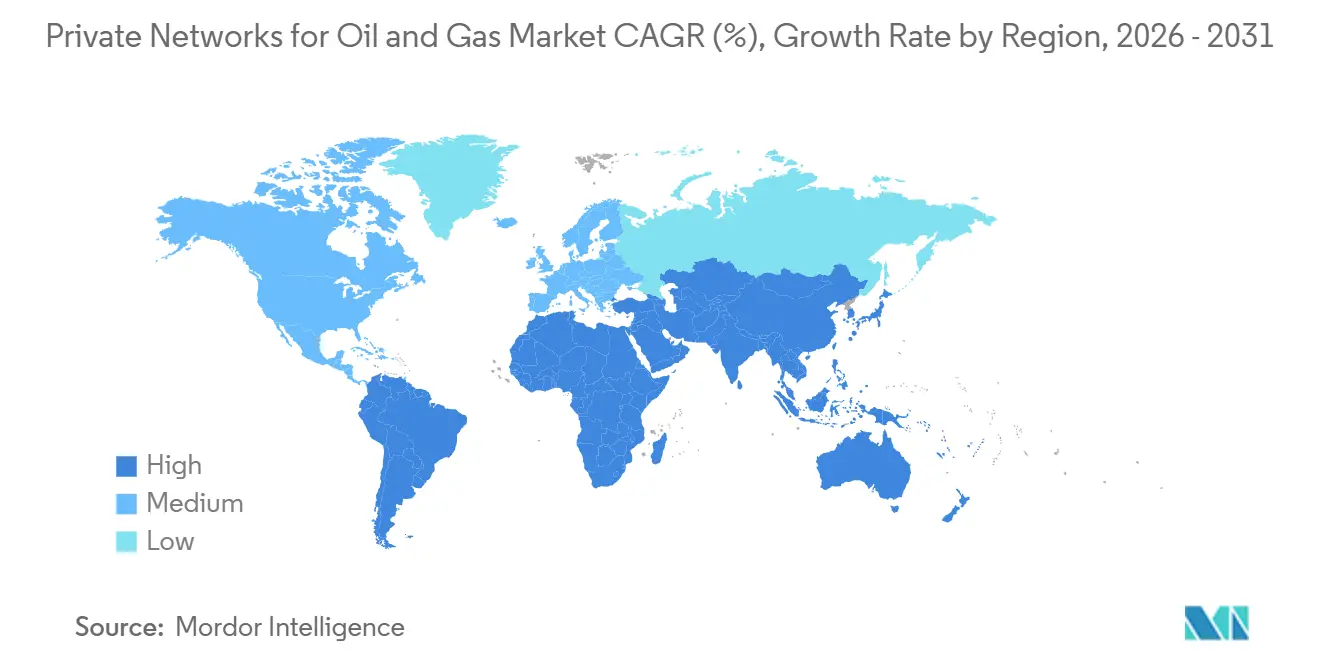
| Fastest Growing Market | Middle East |
| Largest Market | North America |
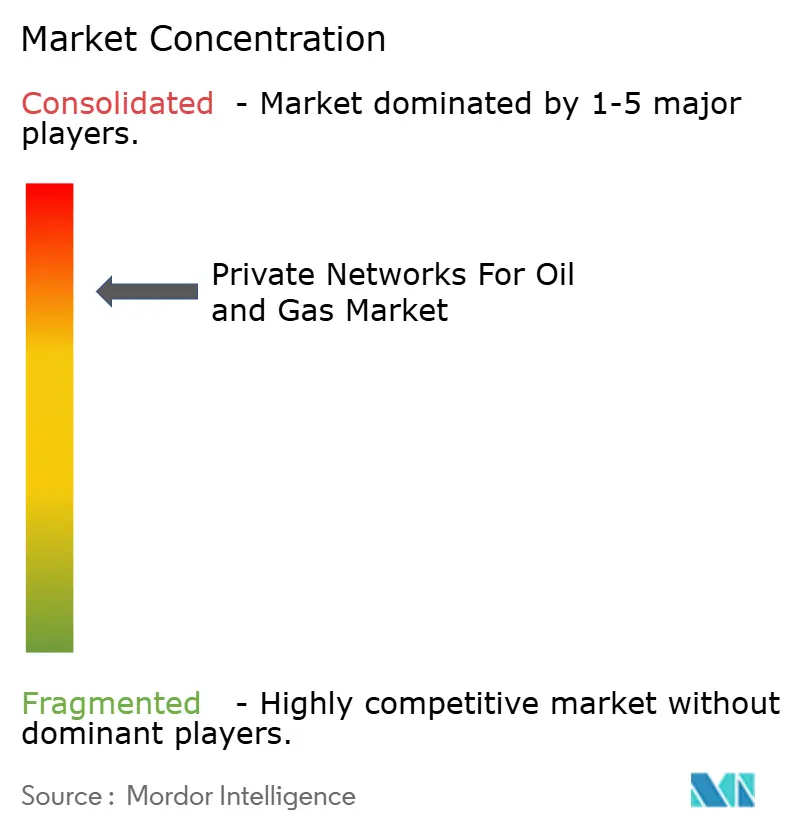
| Market Concentration | High |
Major Players *Disclaimer: Major Players sorted in no particular order Image © Mordor Intelligence. Reuse requires attribution under CC BY 4.0. | |
Private Networks For Oil and Gas Market Analysis by Mordor Intelligence
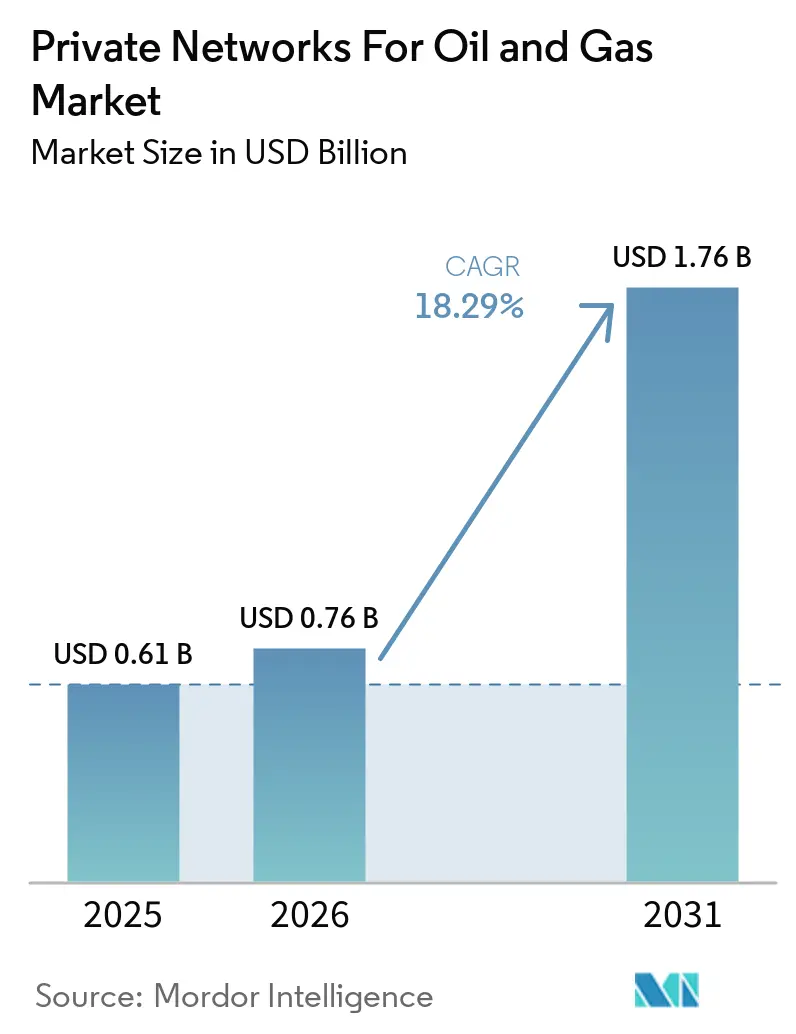
The Private Networks for Oil and Gas Market size is projected to expand from USD 0.61 billion in 2025 to USD 0.76 billion in 2026, and to USD 1.76 billion by 2031, registering a CAGR of 18.29% between 2026 and 2031. The Private Networks for Oil and Gas Market is moving from isolated trials to broader operational programs across remote fields, offshore platforms, and refinery sites. Operators are treating dedicated cellular coverage as operating infrastructure because it supports safety systems, remote monitoring, and automated workflows on the same network. The need for dependable data transfer is strongest where public coverage is unavailable, inconsistent, or unsuitable for production assets. Hardware spending remains important during initial deployments, while software, integration, and managed services become more relevant after networks enter service. Large national and offshore operators can spread costs across multiple assets, giving them a practical advantage in the Private Networks for Oil and Gas Market.
Key Report Takeaways
- By component, hardware accounted for 48.71% of revenue in 2025, while software and platform recorded the highest projected CAGR at 19.26% through 2031.
- By network type, private 5G held 42.72% of the Private Networks for Oil and Gas Market share in 2025 and recorded the highest projected CAGR at 20.27% through 2031.
- By deployment mode, on-premises deployment accounted for 67.37% of revenue in 2025, while cloud-managed deployment recorded the highest projected CAGR at 20.08% through 2031.
- By application, remote monitoring and control accounted for 25.89% of the Private Networks for Oil and Gas Market revenue in 2025, while worker safety and connected worker recorded the highest projected CAGR at 18.33% through 2031.
- By end user, upstream held 39.21% revenue share in 2025 and recorded the highest projected CAGR at 19.76% through 2031.
- By geography, North America accounted for 38.43% of the Private Networks for Oil and Gas Market revenue share in 2025, while the Middle East recorded the highest projected CAGR at 20.19% through 2031.
Note: Market size and forecast figures in this report are generated using Mordor Intelligence’s proprietary estimation framework, updated with the latest available data and insights as of January 2026.
Market Trends and Insights
Drivers Impact Analysis of Private Networks For Oil and Gas Market*
| Driver | (~) % Impact on CAGR Forecast | Geographic Relevance | Impact Timeline |
|---|---|---|---|
| Digital Oilfield and Industrial Automation Investment | +4.2% | Global, concentrated in North America, the Middle East, and Asia-Pacific | Medium term (2-4 years) |
| Mission-Critical Worker Safety and Emergency Response | +3.5% | Global, with early acceleration in North America and Europe | Short term (≤ 2 years) |
| Low-Latency Connectivity for Autonomous and Remote Operations | +2.8% | North America, the Middle East, and the North Sea | Medium term (2-4 years) |
| Methane, Emissions, and Process Safety Monitoring Requirements | +2.4% | North America and the European Union, with expansion into the Middle East | Medium term (2-4 years) |
| Private Edge Computing for Real-Time AI and Digital Twins | +1.8% | North America, the Middle East, and Asia-Pacific | Long term (≥ 4 years) |
| Brownfield Wireless Replacement and Connected-Worker Programs | +1.5% | Global, concentrated in mature North Sea and Gulf of Mexico assets | Medium term (2-4 years) |
| Source: Mordor Intelligence | |||
Digital Oilfield and Industrial Automation Investment
Digital oilfield programs are increasing the need for dedicated networks at production sites. Autonomous inspection, digital twins, and reservoir workflows need dependable capacity and low delay. Legacy Wi-Fi and public cellular services often cannot provide consistent coverage across large or remote assets. Subsea fiber and onshore control links can support wider platform connectivity. The Private Networks for Oil and Gas Market benefits when operators use one network to support equipment data, visual inspection, and operational control. Operators can then extend the same platform to related digital operating systems.
Mission-Critical Worker Safety and Emergency Response
Safety applications provide a direct reason to deploy private cellular coverage. Push-to-talk services, personnel tracking, wearables, and man-down alerts require reliable service in hazardous locations. Public networks may not provide the necessary coverage or service control at offshore sites and remote fields. Video-enabled communications can also help teams coordinate during an emergency. This demand broadens the Private Networks for Oil and Gas Market beyond equipment monitoring and routine data collection. It also makes a clear operational case for coverage across active work areas.
Low-Latency Connectivity for Autonomous and Remote Operations
Remote operations are becoming increasingly important in situations where offshore staffing is difficult or costly. Private 5G can support drones, remote assistance, and local data processing without relying fully on shore connections. Local processing can support inspection and operating workflows near the asset. Networks built for current remote work can also support later automation projects. This makes early deployment decisions important for the Private Networks for Oil and Gas Market. The resulting network can serve several operating functions at the same site.
Methane, Emissions, and Process Safety Monitoring Requirements
Continuous monitoring requires stable connections between field sensors and operating systems. Methane and process safety programs increase the amount of data collected across wells, pipelines, and plant equipment. SLB’s Methane LiDAR Camera received U.S. Environmental Protection Agency approval as an alternative test method in September 2025.[1] Private networks can provide a controlled route for those sensor data streams in areas with weak public service. They also support quicker alarm handling when data is processed near the asset. These requirements add a compliance-related source of demand to the Private Networks for Oil and Gas Market.
Restraints Impact Analysis of Private Networks For Oil and Gas Market*
| Restraint | (~) % Impact on CAGR Forecast | Geographic Relevance | Impact Timeline |
|---|---|---|---|
| High Capital Cost and Long Payback for Remote Sites | -2.8% | Global, most severe in Africa and remote South America | Medium term (2-4 years) |
| Limited Spectrum Availability Across Offshore and Cross-Border Assets | -1.9% | North Sea, Gulf of Mexico, and Asia-Pacific | Medium term (2-4 years) |
| Cybersecurity Exposure Across IT, OT, and Edge Domains | -1.4% | Global, most acute in North America and Europe | Medium term (2-4 years) |
| Shortage of Radio-Frequency and Industrial-Networking Specialists | -1.0% | Global, concentrated in emerging geographies | Long term (≥ 4 years) |
| Source: Mordor Intelligence | |||
High Capital Cost and Long Payback for Remote Sites
Remote deployments require more than radios and field devices. They can require new power systems, backhaul links, hazardous-area equipment, and specialist installation teams. These requirements raise the cost of each remote well pad, deepwater platform, or Arctic site. Long mobilization cycles can further delay the point at which a project begins to generate savings. Large operators can spread these costs across several platforms or field assets. Smaller operators may instead prefer managed services or shared infrastructure, which can delay their commitment to Private Networks for the Oil and Gas Market at low-use sites.
Limited Spectrum Availability Across Offshore and Cross-Border Assets
Spectrum availability varies between countries and offshore jurisdictions. A mobile asset can cross several licensing areas during normal operations. Each area may have separate rules for private spectrum and network operation. Established providers can gain an advantage by holding licenses in multiple jurisdictions. Fragmented licensing can lengthen project planning and slow expansion in the Private Networks for Oil and Gas Market. It can also increase the amount of work required before an offshore network becomes operational.
*Our forecasts treat driver/restraint impacts as directional, not additive. The impact forecasts reflect baseline growth, mix effects, and variable interactions.
Private Networks For Oil and Gas Market Segment Analysis
By Component:
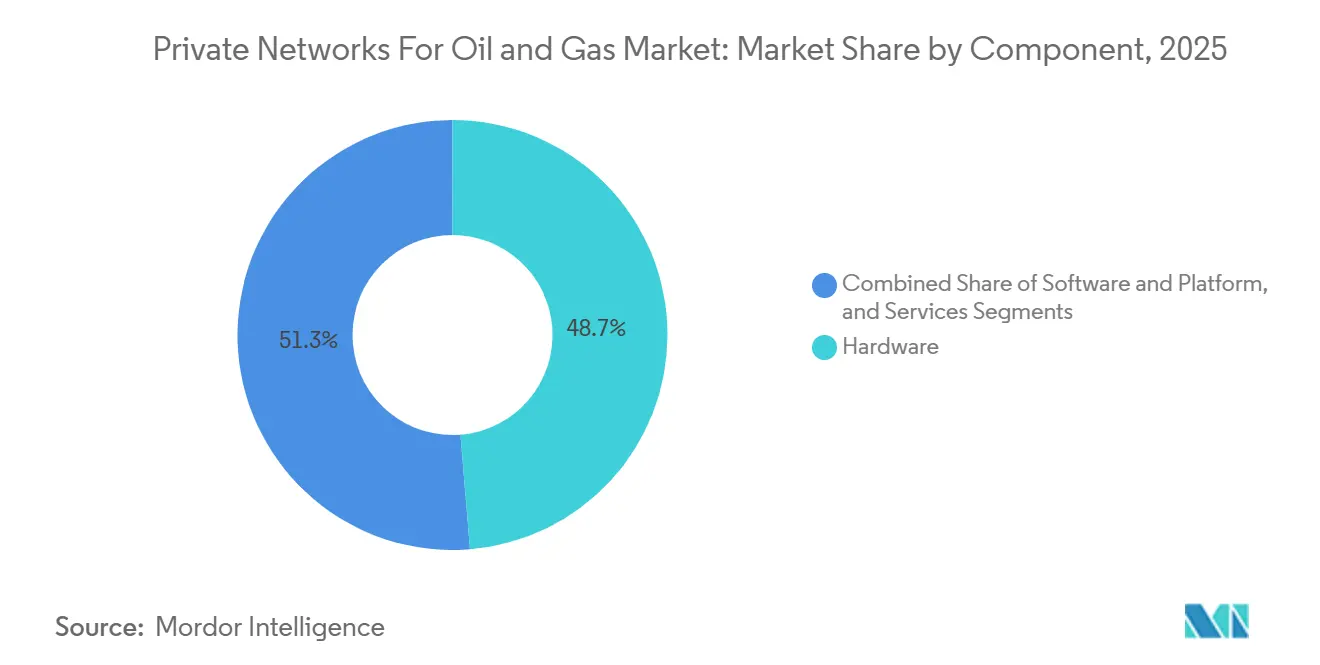
Hardware Leads Initial Spending While Software ExpandsHardware held 48.71% of the Private Networks for Oil and Gas Market in 2025. Base stations, radio units, rugged devices, and hazardous-area equipment account for much of the initial investment. Offshore and remote sites often require specialized equipment capable of operating in harsh conditions. These requirements keep hardware spending high at the start of a project. Initial coverage design and field installation remain central to the buying decision.
Software and platform are forecast to grow at a CAGR of 19.26% through 2031. Operators use these tools for network control, security, spectrum management, and data processing. The Private Networks for Oil and Gas industry is creating demand for managed services where operators lack radio-frequency skills. Integration partners can combine network services with asset monitoring and workforce applications. Software and services can become more important after initial network construction.

By Network Type:
Private 5G Gains Scale While LTE Remains RelevantPrivate 5G held 42.72% of the Private Networks for Oil and Gas Market share in 2025. It supports faster data transfer and more consistent performance for demanding applications. These capabilities suit remote inspection, connected cameras, drones, and control functions. Private 5G also offers a clear upgrade path for operators with existing private LTE sites. The leading share shows that private 5G has moved beyond limited proof-of-concept projects.
Private 5G is forecast to grow at a CAGR of 20.27% through 2031. Private LTE remains useful where reliable coverage matters more than very low delay. A phased migration can help operators retain useful LTE assets while adding 5G where operating needs justify it. Hybrid networks can support legacy dispatch and supervisory control needs during this transition. This approach recognizes that not every site requires the same performance level.
By Deployment Mode:
On-Premises Control Remains the Preferred ModelOn-premises deployment held 67.37% of the Private Networks for Oil and Gas Market in 2025. Oil and gas operators often keep critical network functions close to production assets. This approach supports local control when connectivity to remote cloud systems is limited. It also aligns with security and data residency requirements at national oil companies. These factors keep on-premises architecture important across offshore and remote field sites.
Cloud-managed deployment is forecast to grow at a CAGR of 20.08% through 2031. Operators can use cloud tools for configuration, security updates, capacity planning, and performance analytics. They can retain production-critical functions locally while moving less critical management tasks to cloud platforms. This hybrid approach reduces the choice between fully local and fully remote systems. The model provides a practical route to wider use of cloud management.
By Application:
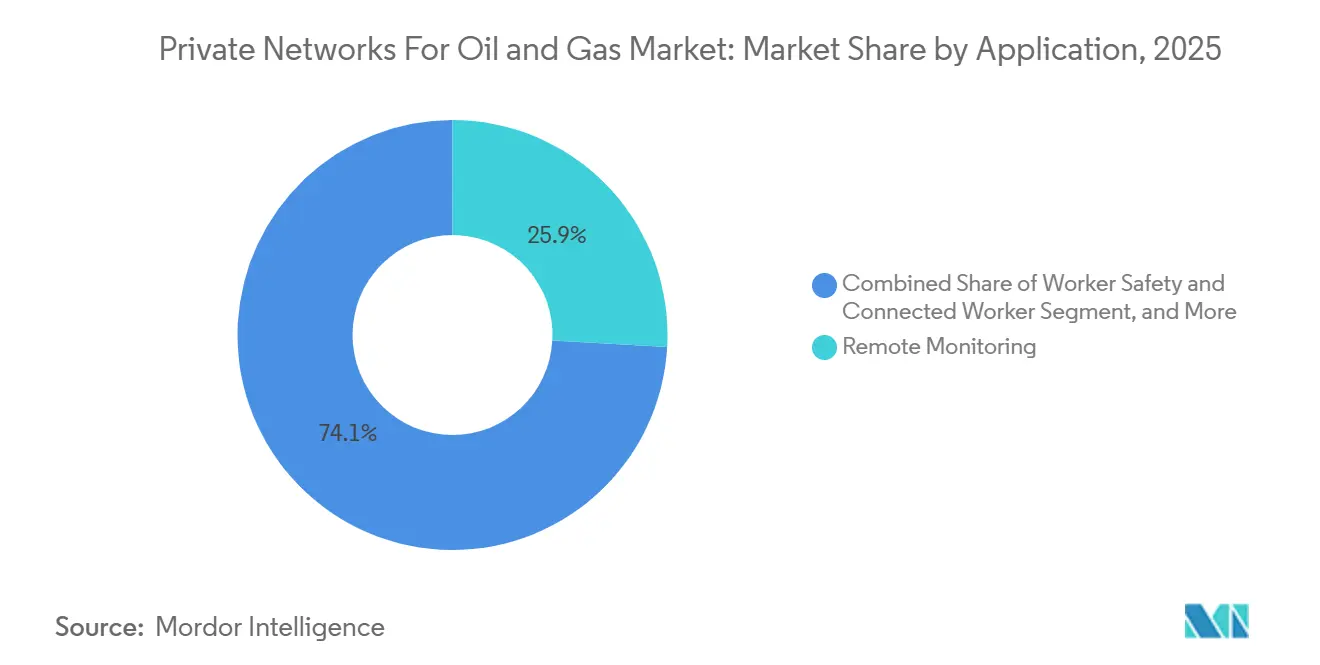
Monitoring Leads While Worker Safety Grows FasterRemote monitoring and control held 25.89% of the Private Networks for Oil and Gas Market in 2025. It provides the initial use case for connecting wellheads, pumps, equipment, and process data. Operators can observe field conditions without sending additional workers to every location. This is especially valuable for assets spread across large production areas. Their established role explains the segment’s leading position.
Worker safety and connected worker applications are forecast to grow at a 18.33% CAGR through 2031. Wearables, body cameras, augmented reality tools, and location systems all need dependable mobile service. Asset management and predictive maintenance also use private networks to transmit vibration, acoustic, and thermal data. Pipeline integrity and supervisory control applications remain important for midstream operators. The Private Networks for Oil and Gas Market, therefore, has several application paths beyond basic remote monitoring.
By End User:
Upstream Combines the Largest Base With the Fastest GrowthUpstream held 39.21% of the Private Networks for Oil and Gas Market in 2025. Exploration, drilling, and production sites have many automation and safety requirements. Offshore platforms, FPSOs, and remote well pads often lack dependable public cellular coverage. These conditions make dedicated connectivity more valuable for upstream operations. New offshore developments can include network design during initial project planning.
Upstream is forecast to grow at a CAGR of 19.76% through 2031. National oil company investments in the Middle East and Asia-Pacific are supporting new private network programs. Midstream operators use private networks for pipeline monitoring and compressor station automation. Downstream sites use them during turnarounds, contractor coordination, and digital permit-to-work processes. Upstream remains the main source of large, complex network requirements.
Geography Analysis
The Americas Private Networks for Oil and Gas Market
North America held 38.43% of the Private Networks for Oil and Gas Market share in 2025. The Gulf of Mexico, the Permian Basin, and Canadian offshore assets support demand. Existing private LTE sites are laying the groundwork for 5G upgrades. Tampnet and Nokia are extending offshore coverage in the Gulf of Mexico across 120 active base stations.[2] South America is also expanding through offshore fiber and private connectivity projects in Brazil and Mexico.
Middle East Private Networks for Oil and Gas Market
The Middle East is forecast to grow at a CAGR of 20.19% through 2031. National oil companies are building networks as part of wider automation programs. ADNOC and e& announced a private 5G network spanning 11,000 square kilometers and connecting more than 12,000 wells and pipelines.[3] The scale of these deployments supports dedicated connectivity as a core operating platform. It also creates a large base for safety, automation, and data applications in the Private Networks for Oil and Gas Market.
Europe, APAC and Africa Private Networks for Oil and Gas Market
Europe remains important because of the mature North Sea offshore infrastructure. Asia-Pacific has separate growth paths in China, India, and Malaysia. Africa remains a smaller opportunity where remote-site economics and specialist availability constrain expansion. The Private Networks for Oil and Gas Market has different regional paths because spectrum access, field conditions, and operator investment models vary widely.
Competitive Landscape
The Private Networks for Oil and Gas Market is consolidated among large radio vendors and specialized offshore providers. Nokia and Ericsson compete for radio access and enterprise connectivity programs. Tampnet has a strong position in offshore markets because it combines spectrum rights, subsea fiber, and managed services. Its position is especially relevant in the North Sea and the Gulf of Mexico. Smaller integrators continue to serve local deployments and targeted industrial projects.
Nokia focuses on combining private wireless with edge computing, safety tools, and industrial applications. Its 2025 annual report identified enterprise campus and industrial private networks as a priority growth area.[4] Kongsberg Digital signed a multi-year agreement with Vår Energi in June 2026 to deploy its Kognitwin digital twin across 4 assets on the Norwegian Continental Shelf. These actions show that network providers and software specialists increasingly work within the same operating environment. They also show a wider focus on operational data and predictive maintenance in the Private Networks for Oil and Gas Market.
Managed-service offerings are widening access for operators that do not want to own every network element. Brownfield compressor stations and pump facilities remain areas where legacy radio replacement can create opportunities. Emerging-market refineries also offer potential as digital programs broaden. The Private Networks for Oil and Gas Market remains open to specialists, but established offshore infrastructure providers retain a clear advantage.
Private Networks For Oil and Gas Industry Leaders
-
Huawei Investment and Holding Co., Ltd.
-
Nokia Corporation
-
Telefonaktiebolaget LM Ericsson
-
Samsung Electronics Co., Ltd.
-
ZTE Corporation
- *Disclaimer: Major Players sorted in no particular order
Private Networks For Oil and Gas Market Companies Covered in this Report
- Nokia Corporation
- Telefonaktiebolaget LM Ericsson
- Huawei Investment and Holding Co., Ltd.
- Cisco Systems, Inc.
- Motorola Solutions, Inc.
- Samsung Electronics Co., Ltd.
- ZTE Corporation
- Hewlett Packard Enterprise Company
- Siemens Aktiengesellschaft
- Schneider Electric SE
- ABB Ltd
- Hitachi Energy Ltd.
- General Electric Company
- Honeywell International Inc.
- Rockwell Automation, Inc.
- Baker Hughes Company
- Tampnet AS
- Speedcast International Limited
- Redline Communications Inc.
- Rajant Corporation
- Moxa Inc.
Recent Industry Developments in Private Networks For Oil and Gas Market
- August 2026: Nokia and Tampnet extended their 5G private wireless partnership beyond the Gulf of Mexico, with Nokia confirming deployment of 5G AirScale radios across Tampnet's entire offshore footprint of 120 active base stations and coverage extension to 350-400 platforms, rigs, FPSOs, wind farms, and vessels the largest contiguous private 5G maritime network globally.
- June 2026: Kongsberg Digital signed a multi-year enterprise agreement with Vår Energi to deploy the Kognitwin AI-powered digital twin across all four NCS assets in 2026, integrating agentic AI and copilot capabilities for predictive maintenance workflows on private-network-connected infrastructure.
- January 2026: Aramco Digital announced the launch of Saudi Arabia's national industrial communications network in the 450 MHz band, targeting over 50 industrial zones with AI-enabled smart radios under a Specialised Radio Network Licence from Saudi Arabia's Communications, Space and Technology Commission, marking a significant step in sovereign industrial connectivity for the Kingdom's oil, gas, and petrochemical sectors.
- August 2025: Tampnet completed the world's first private 5G FPSO deployment for Vår Energi's Jotun FPSO at the Balder Field on the Norwegian Continental Shelf, equipping the platform with full PMEC-enabled private network coverage for real-time communication, edge AI, predictive maintenance, and remote assistance the first installation of its kind on a floating production storage and offloading unit globally.
Global Private Networks For Oil and Gas Market Report Scope
The term "private networks for the oil and gas market" refers to dedicated, secure, low-latency wireless networks (such as private LTE and 5G) designed specifically for oil and gas operations. This includes hardware, software platforms, and managed services deployed on-premises or via cloud-managed models. These networks support critical applications like remote monitoring, SCADA connectivity, predictive maintenance, and connected worker safety across upstream, midstream, and downstream operations, enabling energy companies to enhance operational efficiency and ensure reliable connectivity in remote and hazardous environments.
The Private Networks for Oil and Gas Market Report is Segmented by Component (Hardware, Software and Network Platforms, and Services), Network Type (Private LTE, Private 5G, and Hybrid and Other Private Wireless Networks), Deployment Mode (On-Premises, and Cloud-Managed), Application (Remote Monitoring and Control, Asset Management and Predictive Maintenance, Pipeline Integrity and SCADA Connectivity, Worker Safety and Connected Worker, and Other Application), End User (Upstream, Midstream, and Downstream), and Geography (North America, South America, Europe, Asia-Pacific, Middle East, and Africa). The Market Forecasts are Provided in Terms of Value (USD).
Segmentation Overview
| Hardware |
| Software and Platforms |
| Services |
| Private LTE |
| Private 5G |
| Hybrid and Other Private Wireless Networks |
| On-Premises |
| Cloud-Managed |
| Remote Monitoring and Control |
| Asset Management and Predictive Maintenance |
| Pipeline Integrity and SCADA Connectivity |
| Worker Safety and Connected Worker |
| Other Applications |
| Upstream |
| Midstream |
| Downstream |
| North America | United States |
| Canada | |
| Mexico | |
| South America | Brazil |
| Argentina | |
| Chile | |
| Rest of South America | |
| Europe | Germany |
| United Kingdom | |
| France | |
| Italy | |
| Spain | |
| Rest of Europe | |
| Asia-Pacific | China |
| Japan | |
| India | |
| South Korea | |
| Australia | |
| Rest of Asia-Pacific | |
| Middle East | United Arab Emirates |
| Saudi Arabia | |
| Qatar | |
| Rest of Middle East | |
| Africa | South Africa |
| Egypt | |
| Nigeria | |
| Rest of Africa |
| By Component | Hardware | |
| Software and Platforms | ||
| Services | ||
| By Network Type | Private LTE | |
| Private 5G | ||
| Hybrid and Other Private Wireless Networks | ||
| By Deployment Mode | On-Premises | |
| Cloud-Managed | ||
| By Application | Remote Monitoring and Control | |
| Asset Management and Predictive Maintenance | ||
| Pipeline Integrity and SCADA Connectivity | ||
| Worker Safety and Connected Worker | ||
| Other Applications | ||
| By End User | Upstream | |
| Midstream | ||
| Downstream | ||
| By Geography | North America | United States |
| Canada | ||
| Mexico | ||
| South America | Brazil | |
| Argentina | ||
| Chile | ||
| Rest of South America | ||
| Europe | Germany | |
| United Kingdom | ||
| France | ||
| Italy | ||
| Spain | ||
| Rest of Europe | ||
| Asia-Pacific | China | |
| Japan | ||
| India | ||
| South Korea | ||
| Australia | ||
| Rest of Asia-Pacific | ||
| Middle East | United Arab Emirates | |
| Saudi Arabia | ||
| Qatar | ||
| Rest of Middle East | ||
| Africa | South Africa | |
| Egypt | ||
| Nigeria | ||
| Rest of Africa | ||
Key Questions Answered in the Report
How large is the Private Networks for Oil and Gas Market?
The sector is estimated at USD 0.76 billion in 2026 and is forecast to reach USD 1.76 billion by 2031, expanding at a CAGR of 18.29%.
What is driving adoption of private networks for oil and gas operations?
Safety applications, remote monitoring, automation, emissions monitoring, and unreliable public coverage are supporting adoption across remote and offshore assets.
Which network technology leads oil and gas private connectivity?
Private 5G held 42.72% share in 2025 and is forecast to grow at a CAGR of 20.27% through 2031.
Why do oil and gas companies prefer on-premises networks?
On-premises deployment held 67.37% share in 2025 because it supports local control, security, and data residency needs near critical assets.
Which end user is expanding fastest?
Upstream is forecast to grow at a CAGR of 19.76% through 2031 because offshore platforms and remote well pads have dense automation and safety needs.
Which region is growing fastest for private oil and gas networks?
The Middle East is forecast to grow at a CAGR of 20.19% through 2031, supported by large national oil company automation programs.