
Pregnancy Tracking And Postpartum Care Apps Market Size and Share
Market Overview
| Study Period | 2020 - 2031 |
|---|---|
| Market Size (2026) | USD 0.71 Billion |
| Market Size (2031) | USD 1.27 Billion |
| Growth Rate (2026 - 2031) | 12.52 % |
| Fastest Growing Market | Asia Pacific |
| Largest Market | North America |
| Market Concentration | Medium |
Major Players *Disclaimer: Major Players sorted in no particular order Image © Mordor Intelligence. Reuse requires attribution under CC BY 4.0. | |
Pregnancy Tracking And Postpartum Care Apps Market Analysis by Mordor Intelligence
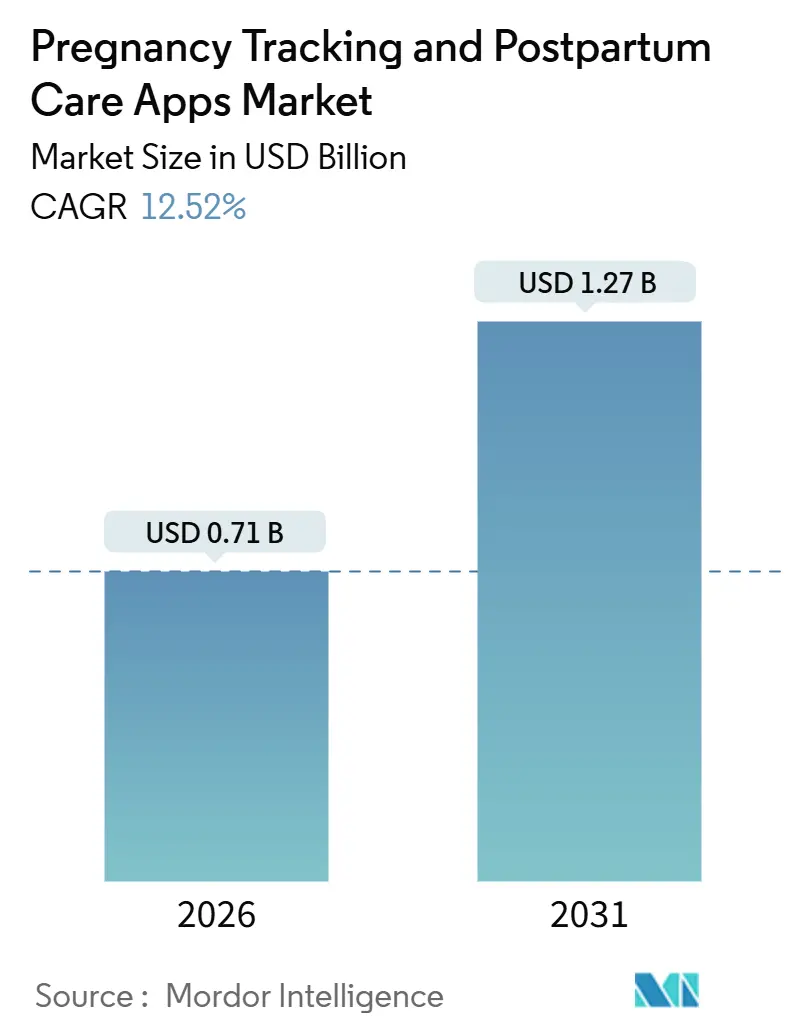
The Pregnancy Tracking And Postpartum Care Apps Market size is estimated at USD 0.71 billion in 2026, and is expected to reach USD 1.27 billion by 2031, at a CAGR of 12.52% during the forecast period (2026-2031).
Growing employer budgets for digital maternity benefits and payer interest in avoiding costly emergency-department visits are the chief catalysts behind this acceleration. Venture funding into femtech, maturing reimbursement codes for remote-monitoring data, and the rapid diffusion of smartphones among women of child-bearing age in emerging economies further expand the addressable base. Competitive momentum favors platforms that bundle medical-grade wearables with on-demand virtual specialists, as demonstrated by Owlet’s FDA-cleared Dream Sock and Maven Clinic’s nurse-led escalation paths, which together trim NICU admissions and readmission costs. Meanwhile, privacy regulations in North America and Europe raise compliance hurdles, pushing smaller developers toward enterprise partnerships or niche community models.
Key Report Takeaways
- By platform, Android led with 61.55% of pregnancy tracking and postpartum care apps market share in 2025; iOS is forecast to expand at a 13.25% CAGR through 2031.
- By functionality, pregnancy tracking held 55.23% revenue share in 2025, while post-partum care and recovery is advancing at an 18.15% CAGR through 2031.
- By revenue model, freemium captured 48.15% of the pregnancy tracking and postpartum care apps market size in 2025 and subscription models are projected to grow at a 17.51% CAGR through 2031.
- By end user, expectant mothers commanded 69.25% share of the pregnancy tracking and postpartum care apps market size in 2025; healthcare providers record the highest projected CAGR at 15.02% through 2031.
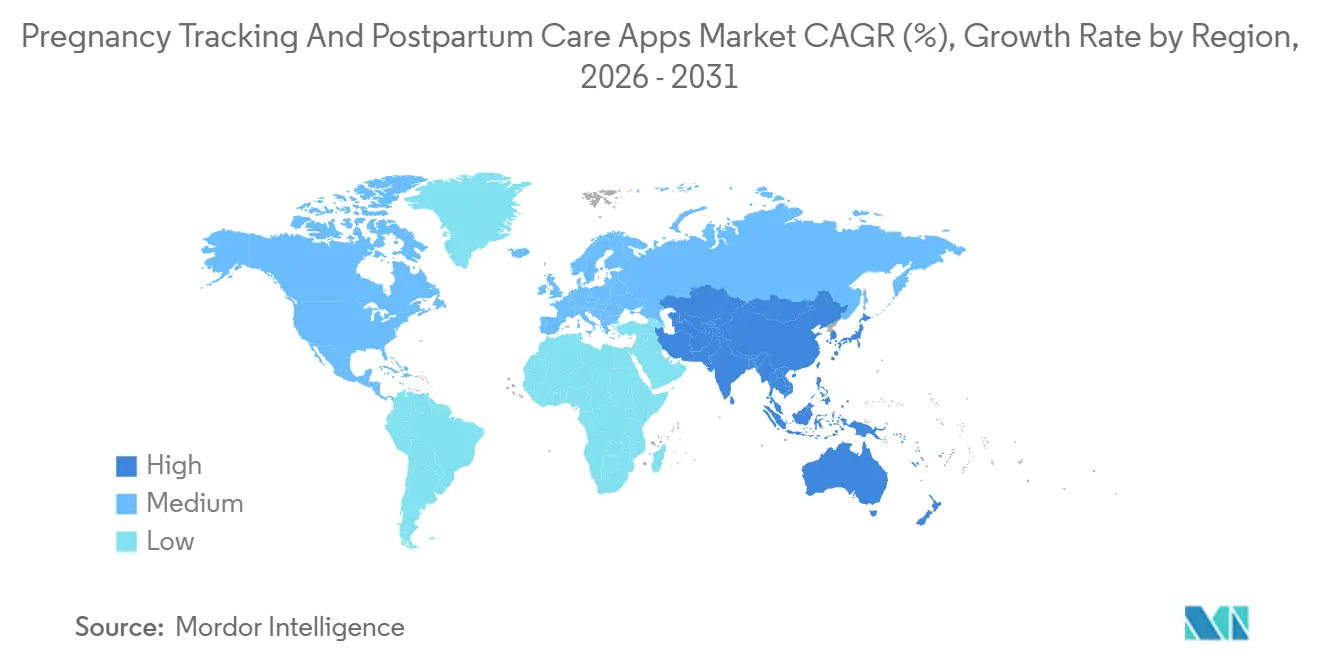
- By geography, North America accounted for 38.45% of pregnancy tracking and postpartum care apps market share in 2025, whereas Asia-Pacific is on track for a 14.22% CAGR through 2031.
Note: Market size and forecast figures in this report are generated using Mordor Intelligence’s proprietary estimation framework, updated with the latest available data and insights as of January 2026.
Market Trends and Insights
Drivers Impact Analysis of Pregnancy Tracking And Postpartum Care Apps Market*
| Driver | (~) % Impact on CAGR Forecast | Geographic Relevance | Impact Timeline |
|---|---|---|---|
| Rising smartphone & internet penetration among expectant mothers | +2.1% | Asia-Pacific core, spill-over to MEA and South America | Medium term (2-4 years) |
| Increasing clinician-endorsed use of digital health tools | +1.8% | Global, early adoption in North America & EU | Short term (≤ 2 years) |
| Growing VC funding in femtech and digital maternal health | +2.3% | North America & EU, expanding to Asia-Pacific | Medium term (2-4 years) |
| Integration with remote-patient-monitoring devices | +1.9% | North America, Western Europe, urban Asia-Pacific | Long term (≥ 4 years) |
| Demand for longitudinal data for population-health analytics | +1.6% | North America, select EU markets with value-based care | Long term (≥ 4 years) |
| Employer-sponsored maternity-wellness benefits | +1.5% | North America, pilot programs in EU and Australia | Medium term (2-4 years) |
| Source: Mordor Intelligence | |||
Rising Smartphone & Internet Penetration Among Expectant Mothers
Smartphone ownership among women aged 18–44 in urban India topped 82% in late 2025, translating into about 120 million digitally literate expectant or new mothers who now rely on mobile apps for perinatal information. India’s Ayushman Bharat Digital Mission assigns unified health identifiers, allowing pregnancy apps to link antenatal records to consumer devices and close data gaps within public programs. In China, Guangdong and Zhejiang provinces require maternity hospitals to interface with approved tracking platforms, turning optional downloads into routine touchpoints for prenatal monitoring. South Africa’s MomConnect exemplifies scale in resource-constrained contexts after registering 5.2 million users by December 2025 through SMS and lightweight apps. These trends emphasize the need for vernacular-language content and 3G-optimized code that can reach first-time smartphone owners across bandwidth-limited markets.
Increasing Clinician-Endorsed Use of Digital Health Tools
The American College of Obstetricians and Gynecologists endorsed app-based blood-pressure logging in April 2024, opening reimbursement channels that 14 state Medicaid programs adopted by early 2025[1]. Maven Clinic leveraged this policy turn by embedding its remote-monitoring kit in employer benefits, reporting a 32% drop in preterm births among high-risk members. The United Kingdom’s Royal College of Obstetricians and Gynaecologists issued parallel guidelines, prompting NHS trusts to ingest app data into electronic records, thus institutionalizing consumer apps as legitimate clinical instruments. A Journal of Medical Internet Research survey from February 2025 found that 68% of pregnant users would switch apps on clinician recommendation, confirming medical authority as the decisive adoption trigger.
Growing VC Funding in Femtech and Digital Maternal Health
Investors poured USD 3.8 billion into femtech during 2024, with maternal-health platforms absorbing 41% of the total. Flo Health’s USD 200 million Series C financed expansion into 15 new countries where app localization cut customer-acquisition costs to under USD 8 per user. Delfina’s USD 17 million Series A funded algorithms that fuse wearables and claims data to pre-empt gestational complications. Lōvu Health raised USD 8 million in September 2025 to build NLP-based postpartum-depression screening that unobtrusively flags risk during journaling sessions. Capital now gravitates toward business models showing payback inside 18 months, favoring enterprise licenses over pure consumer subscriptions.
Integration with Remote-Patient-Monitoring Devices
Owlet’s Dream Sock obtained Class II clearance in January 2024, turning a consumer gadget into a billable monitoring tool for at-risk infants. Nanit’s Pro Camera pipes breathing-motion data directly into Maven Clinic’s postpartum dashboard, giving lactation consultants objective sleep and feeding metrics. Hatch Baby’s smart changing pad logs weight and feeding data to flag growth deviations early. Oura Ring’s 2024 integration with Clue, Flo, and Natural Cycles shows that continuous temperature and heart-rate streams improve ovulation and early-pregnancy detection compared with calendar methods. Closed-loop escalation pathways—wearable alert, nurse triage, same-day televisit—redirect potential emergencies away from emergency departments.
Restraints Impact Analysis of Pregnancy Tracking And Postpartum Care Apps Market*
| Restraint | (~) % Impact on CAGR Forecast | Geographic Relevance | Impact Timeline |
|---|---|---|---|
| Data-privacy concerns & tightening digital-health regulations | -1.4% | Global, acute in EU & North America | Short term (≤ 2 years) |
| Low clinical validation of most apps’ medical claims | -0.9% | Global, affecting consumer freemium models | Medium term (2-4 years) |
| App fatigue leading to high uninstall rates | -0.7% | Global, higher churn in ad-supported apps | Short term (≤ 2 years) |
| Limited inclusivity for underserved language & cultural groups | -0.6% | Emerging Asia-Pacific, MEA, South America | Long term (≥ 4 years) |
| Source: Mordor Intelligence | |||
Data-Privacy Concerns & Tightening Digital-Health Regulations
The FTC expanded the Health Breach Notification Rule in May 2024, compelling non-HIPAA apps to report breaches within 60 days, a burden that led several small developers to shut down analytics integrations[2]. HHS added protections for reproductive-health data, complicating cross-state data-sharing in the U.S. Europe increased enforcement under GDPR; Ireland fined a menstrual-tracking app EUR 5.5 million for data transfers to U.S. servers without safeguards, forcing many platforms to migrate to EU-based clouds. User trust deteriorated, with 54% of U.S. women expressing subpoena concerns over app data by January 2025. Clue responded by moving sensitive data to on-device storage, trading analytical depth for privacy reassurance.
Low Clinical Validation of Most Apps’ Medical Claims
A March 2024 JAMA review found that only 11% of 73 apps cited peer-reviewed evidence, while 64% made unsupported claims on fetal development or nutrition. Consequently, 72% of obstetricians surveyed in June 2024 refused to recommend an app lacking clinical trials or FDA clearance. The FDA clarified that disease-specific claims trigger premarket review, creating a gray zone that many freemium apps exploit by labeling medical advice as “educational”. Payers now demand real-world evidence; Maven Clinic and Ovia Health have published cohort studies to satisfy contracting criteria. Smaller international developers often lack the capital for rigorous trials, restricting their expansion into evidence-centric markets.
*Our forecasts treat driver/restraint impacts as directional, not additive. The impact forecasts reflect baseline growth, mix effects, and variable interactions.
Pregnancy Tracking And Postpartum Care Apps Market Segment Analysis
By Platform:
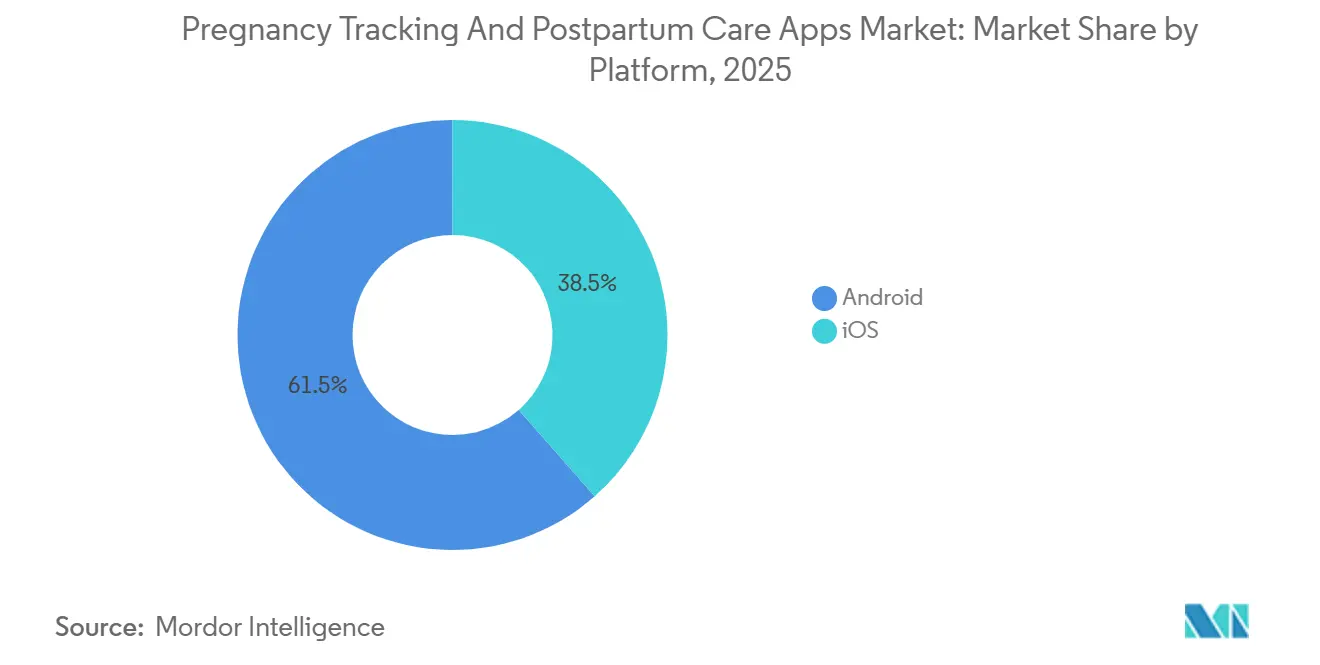
iOS Gains Ground in Premium TiersAndroid controlled 61.55% of pregnancy tracking and postpartum care apps market share in 2025, benefiting from sub-USD 200 handsets that dominate India, Southeast Asia, and Latin America. However, iOS will grow at 13.25% CAGR, fueled by higher average revenue per user and HealthKit’s pregnancy-specific data types that streamline interoperability with clinician dashboards. Flo Health reported a 34% better conversion rate to paid plans among iOS users than Android users in 2024, confirming monetization advantages on Apple devices. Android remains indispensable in emerging markets through carrier billing that bypasses credit cards, and cross-platform frameworks now mitigate dual-codebase costs. Feature divergence is widening: iOS apps leverage ARKit for 3D fetal visualizations, whereas Android services tap Google Assistant for voice-activated contraction timers. Data-localization policies in Europe and India may further steer clinically oriented vendors toward iOS, whose on-device processing eases compliance.
Second-order effects appear in monetization. Premium subscription tiers cluster on iOS where users accept USD 5–15 monthly pricing, while Android ecosystems sustain freemium adoption via low-price microtransactions. Enterprise vendors often build first on iOS to secure provider trust, then retrofit Android modules for mass deployment. The platform split therefore reflects a dual market: a premium clinical segment and a mass-market educational segment, each pursuing distinct revenue physics yet coexisting under one pregnancy tracking and postpartum care apps market.
By Functionality:
Postpartum Care Closes the GapPregnancy tracking generated 55.23% of 2025 revenue, but the postpartum care and recovery segment will climb at 18.15% CAGR through 2031 as payers recognize the financial burden of complications in the first 12 weeks after birth. ACOG’s redefinition of postpartum care as a longitudinal continuum legitimized digital programs delivering daily check-ins and mental-health screenings. Mahmee’s virtual doula model cut readmissions by 28% in its Cedars-Sinai pilot, providing financial proof for deeper payer engagement. Mental-health and community-support modules are also ascending, with Peanut crossing 4.5 million monthly users on the back of peer chat rooms moderated by AI.
Hardware integrations add clinical heft. Hatch Baby’s feeding tracker logged 2.3 million sessions in its first year, generating longitudinal data that pediatricians now use for early tongue-tie detection. Regional preferences shape feature mixes: Asia-Pacific users value fetal development and nutritional guidance rooted in traditional medicine, while North American users demand return-to-work planning and postpartum mood tracking. Predictive analytics are set to personalize content further, as Maven Clinic algorithms flag depression risk based on chat sentiment before crisis onset.
By Revenue Model:
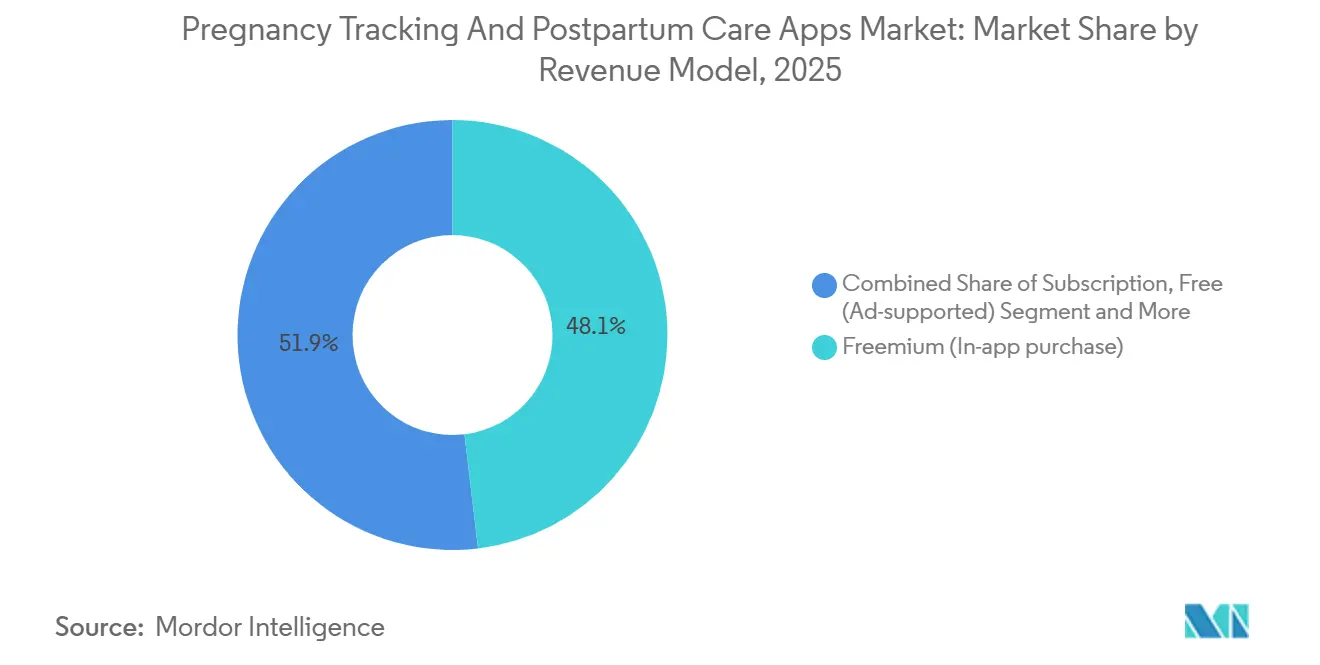
Subscription Momentum AcceleratesFreemium strategies delivered 48.15% of 2025 revenue, a legacy of ad-supported mobile ecosystems. Yet subscriptions will post a 17.51% CAGR through 2031 as privacy rules erode targeted-ad economics. Flo Health’s pivot to subscription-first lifted its paid base to 5 million by mid-2025 at USD 49.99 per year, driving a higher pregnancy tracking and postpartum care apps market size contribution than ads ever achieved. Habit-based usage, spanning the 40-week pregnancy arc and transitional postpartum months, underpins willingness to pay. What To Expect converted 18% of free users within 90 days after bundling dietitian and sleep-consult services into a USD 9.99 plan.
Enterprise licenses sold to payers and employers are growing 16.2% annually. Per-member-per-month fees shift cost from consumers to institutions and support clinical QA. Ad-supported models face platform headwinds: Apple’s App Tracking Transparency reduced ad targeting efficacy up to 60%, while Google’s Privacy Sandbox curbs cross-app IDs. Hybrid strategies—ad-supported freemium tiers, premium subscriptions, and enterprise bundles—now hedge revenue volatility.

By End User:
Providers Enter the EcosystemExpectant mothers still account for 69.25% of 2025 demand, but healthcare providers show the fastest trajectory at 15.02% CAGR as dashboards integrate patient-generated data. Maven Clinic’s portal trims visit time by 8 minutes, letting clinicians pre-review symptom logs and blood-pressure readings. Ovia Health’s Epic and Cerner plug-ins enable bidirectional data flow so lab results surface in apps while survey answers feed EHR flowsheets. New mothers pose an engagement challenge, with churn near 70% by week 4 postpartum; platforms counter by extending content to infant care and maternal fitness.
Payers and employers monetize rapidly despite smaller user counts; one Fortune 500 contract can add USD 500,000–2 million in annual revenue. Anthem, UnitedHealthcare, and Aetna embedded digital maternity benefits into commercial plans during 2024 to cut preterm-birth costs that can exceed USD 150,000 per NICU stay. Employer contracts now span mid-market firms as well, driven by LinkedIn survey data showing maternity support ranks among top three job-selection criteria for women aged 25–40. The pregnancy tracking and postpartum care apps market therefore operates as a three-sided marketplace connecting consumers, clinicians, and payers along mutually reinforcing value flows.
Geography Analysis
North America Pregnancy Tracking and Postpartum Care Apps Market
North America commanded 38.45% of 2025 revenue, reflecting robust employer benefits and Medicaid mandates. Maven Clinic counts more than 2,000 employer clients while Ovia Health is live in over 400 health-plan networks. Canada’s Ontario and British Columbia pilot programs grant free app subscriptions to rural populations to offset clinician shortages. Mexico’s urban smartphone penetration above 75% lifts Spanish-language downloads; BabyCenter holds 3.2 million monthly users through partnerships with private hospitals. Regional policy levers include CMS models reimbursing digital opioid misuse screening and FCC broadband subsidies that now cover pregnancy-monitoring apps.
APAC Pregnancy Tracking and Postpartum Care Apps Market
Asia-Pacific is on pace for a 14.22% CAGR, the fastest regional growth. India’s ABDM supplies unique health IDs, making pregnancy apps interoperability-ready for public records, while smartphone penetration among urban women has reached 82%[3]. China’s three-child incentives prompted provincial subsidies for approved platforms, turning apps into semi-mandatory prenatal tools. Japan’s subsidy reimburses up to JPY 50,000 per employee for digital maternity services, offsetting its low fertility rate with employer-funded engagement. Australia’s permanent telehealth framework enabled a 30% cut in in-person visits across rural Queensland via app-integrated GP consultations. South Korea offers tax credits, yet cultural stigma around postpartum mental health limits uptake, illustrating the influence of socio-cultural norms on the pregnancy tracking and postpartum care apps market trajectory.
EMEA and South America Pregnancy Tracking and Postpartum Care Apps Market
Europe benefits from Germany’s DiGA pathway. Keleya secured certification in March 2024, enrolling 120,000 users within nine months. France’s Mon Suivi Grossesse became a free, nationally backed app in January 2025, integrating with France’s health-insurance system for lab results and scheduling. The U.K. NHS absorbs app data into EHRs following RCOG guidance, streamlining clinician workflows. The Middle East and Africa show promise through the UAE and Saudi digital-health initiatives alongside South Africa’s SMS-based MomConnect. South America grows on the back of Brazil’s expanding middle class, although rural bandwidth gaps constrain broader adoption.
Competitive Landscape
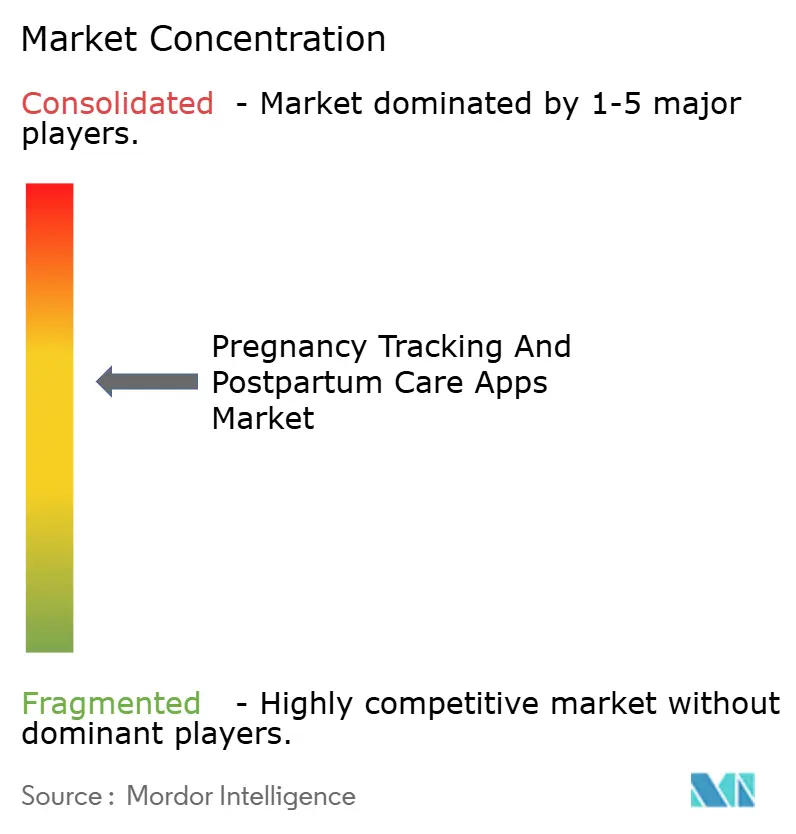
The pregnancy tracking and postpartum care apps market features moderate concentration. The top five vendors—Maven Clinic, Flo Health, Ovia Health, BabyCenter, and What To Expect—collectively hold a notable but not dominant share, leaving room for specialized challengers. Maven Clinic’s USD 125 million Series F at a USD 1.7 billion valuation underscored investor faith in enterprise-licensed virtual-care bundles. Flo Health’s cycle-to-menopause adjacency illustrates a lifecycle expansion strategy that inspires rivals like Clue to pursue similar longitudinal engagement. Mahmee and Keleya differentiate via hospital partnerships and midwife networks, transforming into care-coordination layers rather than stand-alone content apps.
Technology integration now dictates defensibility. Owlet’s FDA clearance for Dream Sock demonstrates how hardware plus software supports reimbursement, creates higher lifetime value, and raises switching costs. Nanit’s computer-vision metrics enrich Maven Clinic’s postpartum module with objective sleep data. Delfina’s risk-scoring analytics show the pull of payer contracts for platforms that deliver quantifiable risk-reduction models. Regulatory compliance—FDA 510(k) clearance or Germany’s DiGA badge—offers clinical legitimacy and fast-tracks payer reimbursement, favoring well-funded incumbents over cash-constrained newcomers.
Barriers to entry continue to rise as privacy lawyering, evidence generation, and device-integration partnerships escalate fixed costs. This fosters gradual consolidation via M&A or strategic alliances. Yet white-space opportunities remain in culturally specific content, low-bandwidth product design, and social-community niches that large incumbents have yet to master.
Pregnancy Tracking And Postpartum Care Apps Industry Leaders
-
Maven Clinic
-
Flo Health
-
BabyCenter
-
What To Expect
-
Ovia Health (Labcorp)
- *Disclaimer: Major Players sorted in no particular order
Pregnancy Tracking And Postpartum Care Apps Market Companies Covered in this Report
- Amma Pregnancy Tracker
- Baby Tracker (Amila Mendis)
- BabyCenter
- Clue (BioWink)
- Flo Health
- Glow Inc.
- Hatch Baby
- Keleya Digital-Health
- Mahmee
- Maven Clinic
- Nanit
- Ovia Health (Labcorp)
- Owlet Baby Care
- ParentLove
- Peanut App Ltd
- Philips (Pregnancy+)
- Sprout (Med ART Studios)
- The Bump (XO Group)
- What To Expect
Recent Industry Developments in Pregnancy Tracking And Postpartum Care Apps Market
- October 2025: Emagine Solutions Technology enhanced The Journey Pregnancy app with AI tools to gauge preeclampsia risk and nudge timely clinician check-ins.
- May 2025: Royal Philips and March of Dimes partnered to add evidence-based maternal education to the Philips Avent Pregnancy+ platform.
Global Pregnancy Tracking And Postpartum Care Apps Market Report Scope
As per the scope of the report, pregnancy tracking and postpartum care apps are digital applications designed to support women throughout their pregnancy journey and postpartum period. They provide features such as monitoring fetal development, tracking symptoms, managing appointments, offering health and nutrition advice, and providing educational resources to promote maternal and infant health during pregnancy and after childbirth.
The segmentation for the pregnancy tracking and postpartum care apps market is categorized by platform (operating system), functionality, revenue model, end user, and geography. By platform, the market is divided into iOS and Android. By functionality, it includes pregnancy tracking, post-partum care and recovery, breast-feeding and lactation support, and mental-health and community support. By revenue model, the segmentation covers free (ad-supported), freemium (in-app purchase), subscription, and enterprise-license (payer/employer). By end user, the market targets expectant mothers, new mothers, healthcare providers, and payers and employers. By geography, the market is segmented into North America, Europe, Asia-Pacific, Middle East and Africa, and South America. The Market Forecasts are Provided in Terms of Value (USD).
Segmentation Overview
| iOS |
| Android |
| Pregnancy Tracking |
| Post-partum Care & Recovery |
| Breast-feeding & Lactation Support |
| Mental-health & Community Support |
| Free (Ad-supported) |
| Freemium (In-app purchase) |
| Subscription |
| Enterprise-licence (Payer / Employer) |
| Expectant Mothers |
| New Mothers |
| Healthcare Providers |
| Payers & Employers |
| North America | United States |
| Canada | |
| Mexico | |
| Europe | Germany |
| United Kingdom | |
| France | |
| Italy | |
| Spain | |
| Rest of Europe | |
| Asia-Pacific | China |
| India | |
| Japan | |
| Australia | |
| South Korea | |
| Rest of Asia-Pacific | |
| Middle East and Africa | GCC |
| South Africa | |
| Rest of Middle East and Africa | |
| South America | Brazil |
| Argentina | |
| Rest of South America |
| By Platform (Operating System) | iOS | |
| Android | ||
| By Functionality | Pregnancy Tracking | |
| Post-partum Care & Recovery | ||
| Breast-feeding & Lactation Support | ||
| Mental-health & Community Support | ||
| By Revenue Model | Free (Ad-supported) | |
| Freemium (In-app purchase) | ||
| Subscription | ||
| Enterprise-licence (Payer / Employer) | ||
| By End User | Expectant Mothers | |
| New Mothers | ||
| Healthcare Providers | ||
| Payers & Employers | ||
| By Geography | North America | United States |
| Canada | ||
| Mexico | ||
| Europe | Germany | |
| United Kingdom | ||
| France | ||
| Italy | ||
| Spain | ||
| Rest of Europe | ||
| Asia-Pacific | China | |
| India | ||
| Japan | ||
| Australia | ||
| South Korea | ||
| Rest of Asia-Pacific | ||
| Middle East and Africa | GCC | |
| South Africa | ||
| Rest of Middle East and Africa | ||
| South America | Brazil | |
| Argentina | ||
| Rest of South America | ||
Key Questions Answered in the Report
What is the current value of the pregnancy tracking and postpartum care apps market?
The pregnancy tracking and postpartum care apps market size reached USD 0.71 billion in 2026 and is projected to grow to USD 1.27 billion by 2031.
Which platform shows faster revenue growth?
IOS revenues are forecast to rise at a 13.25% CAGR, outpacing Android thanks to higher conversion to paid subscriptions and streamlined HealthKit integrations.
Why are employers funding digital maternity programs?
Employer-sponsored apps lower NICU admissions and shorten parental leave, yielding net savings of around USD 4,200 per birth, alongside talent-retention benefits.
What segment is expanding quickest by function?
Postpartum care and recovery applications are projected to grow at an 18.15% CAGR as payers target complications emerging in the first 12 weeks after birth.
Which geographic region is expected to lead growth?
Asia-Pacific is set to post the highest regional CAGR at 14.22%, driven by widespread smartphone adoption and government subsidies in China, India, and Japan.
How do privacy regulations affect app developers?
Stricter rules such as the FTC's Health Breach Notification expansion and GDPR fines raise compliance costs, prompting many small developers to adopt on-device data storage or exit ad-tracking revenue models.