
Prefabricated Bathroom Modules Market Size and Share
Market Overview
| Study Period | 2020 - 2031 |
|---|---|
| Market Size (2026) | USD 2.32 Billion |
| Market Size (2031) | USD 3.35 Billion |
| Growth Rate (2026 - 2031) | 7.62 % |
| Fastest Growing Market | Asia-Pacific |
| Largest Market | Europe |
| Market Concentration | Low |
Major Players *Disclaimer: Major Players sorted in no particular order Image © Mordor Intelligence. Reuse requires attribution under CC BY 4.0. | |
Prefabricated Bathroom Modules Market Analysis by Mordor Intelligence
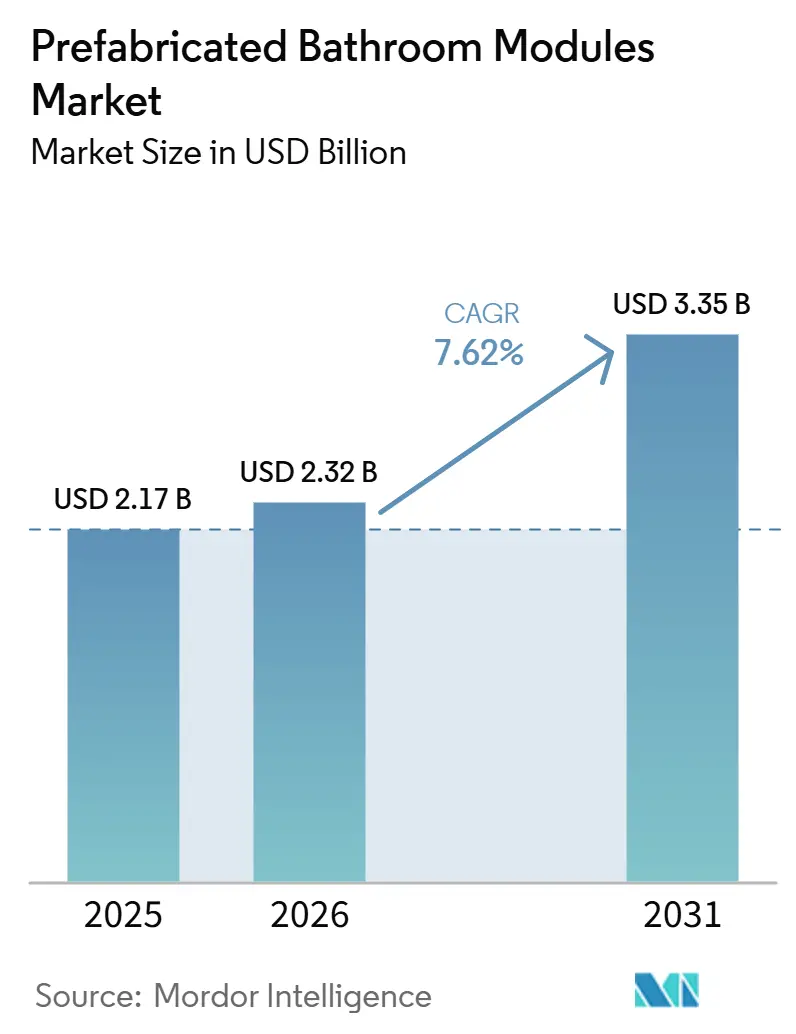
The Prefabricated Bathroom Modules Market size is expected to grow from USD 2.17 billion in 2025 to USD 2.32 billion in 2026 and is forecast to reach USD 3.35 billion by 2031 at 7.62% CAGR over 2026-2031.
The prefabricated bathroom modules market has moved beyond a niche offsite option, as factory-finished wet room units now address schedule pressure and labor shortages within the same delivery model. Contractors and developers increasingly value pod-based delivery because plumbing, tiling, waterproofing, and finishing can be shifted into controlled production settings where quality checks are easier to standardize, and rework is easier to contain before site installation. Environmental, Social, and Governance (ESG) requirements also support demand because prefabrication reduces site waste and can lower embodied carbon when design discipline, material selection, and process controls are well managed[1]Mihaela Bejinariu et al., “Systematic Review of Sustainability Outcomes in Prefabricated Construction,” Discover Civil Engineering, link.springer.com. Competitive positioning in the prefabricated bathroom modules market still depends more on delivery record, regional logistics capability, specification certification, and digital manufacturing maturity than on global scale alone. The prefabricated bathroom modules market still faces friction from project-specific customization requirements and from lifting and site access limitations. Still, those limits have not displaced its role in high-volume hotel, healthcare, student housing, and residential construction programs.
Key Report Takeaways
- By product type, steel-framed modules held 37.80% share of the prefabricated bathroom modules market size in 2025, while hybrid modules are forecast to expand at a 9.10% CAGR through 2031.
- By installation type, new build accounted for 69.40% of the prefabricated bathroom modules market share in 2025, while retrofit and renovation recorded the highest projected CAGR of 8.60% through 2031.
- By end user, hospitality accounted for 30.80% share in 2025, while healthcare is advancing at a 9.30% CAGR through 2031.
- By geography, Europe held 31.75% of the prefabricated bathroom modules market share in 2025, while Asia-Pacific is forecast to grow at a 9.80% CAGR through 2031.
Note: Market size and forecast figures in this report are generated using Mordor Intelligence’s proprietary estimation framework, updated with the latest available data and insights as of January 2026.
Global Prefabricated Bathroom Modules Market Trends and Insights
Drivers Impact Analysis*
| Drivers | (~) % Impact on CAGR Forecast | Geographic Relevance | Impact Timeline |
|---|---|---|---|
| Rising Modular Construction Adoption in Time-Sensitive Projects | +2.0% | Global, concentrated in United Kingdom, Australia, United States, India | Short term (≤ 2 years) |
| Labor Shortage and On-Site Productivity Constraints | +1.8% | Global, acute in United Kingdom, United States, Canada, Germany, Australia | Medium term (2-4 years) |
| Healthcare and Hospitality Demand for Hygienic, Standardized Wet Rooms | +1.2% | Asia-Pacific core, spill-over to Middle East Africa and European Union | Medium term (2-4 years) |
| Faster Factory QA and Lower Rework Rates Versus Site-Built Bathrooms | +0.7% | Global | Short term (≤ 2 years) |
| ESG Pressure to Cut Construction Waste and Water On-Site | +0.5% | European Union primary, Asia-Pacific and North America emerging | Medium term (2-4 years) |
| Rising Need for Repeatable Retrofit Solutions in Aging Building Stock | +0.3% | European Union dominant, United Kingdom, Germany, France, Netherlands | Long term (≥ 4 years) |
| Source: Mordor Intelligence | |||
Rising Modular Construction Adoption in Time-Sensitive Projects
The prefabricated bathroom modules market is benefiting from tighter project schedules in hospitality, student accommodation, and healthcare, where earlier building handover has become directly linked to revenue timing and occupancy targets. Laing O'Rourke's operating model requires at least 70% of each project's scope to be delivered offsite, and its design-partner framework with AECOM, BDP, and WSP has been presented as a fixed delivery discipline rather than a discretionary construction preference. The same model has been associated with more than 60% lower onsite workforce needs and 30% faster delivery, which gives general contractors a concrete schedule when they present pod-based construction to clients. For a 200-room hotel project, installing bathroom pods across all floors can be completed in under 8 weeks, whereas conventional wet-trade sequencing would require 18 to 24 months and keep bathrooms on the critical path for much longer. Once developers embed off-site bathroom specifications into procurement frameworks, pod manufacturers shift from optional suppliers to program-critical vendors with stronger pricing discipline and greater visibility into future orders. This matters because schedule assurance now carries as much weight as direct cost savings in many multi-unit projects, especially where missed completion dates affect hotel openings, student intakes, or hospital commissioning.
Labor Shortage and On-Site Productivity Constraints
The prefabricated bathroom modules market is also being pushed forward by persistent labor shortages that wage inflation alone has not resolved in major construction economies. Skills England's first Annual Skills Report in 2026 projected that the United Kingdom construction sector will need 758,000 additional workers by 2035, including 493,000 in priority occupations, which is a 26.2% increase from 2025 headcount. The Construction Industry Training Board also forecast a shortfall of 206,000 workers across the United Kingdom from 2026 to 2030, requiring 41,200 new entrants each year to preserve current delivery capacity. In the United States, 439,000 construction worker vacancies were reported in 2025, and SurePods states that conventional bathroom installation can require 35 crew members on-site compared with 7 for pod delivery and installation. A single module removes much of the sequencing burden between plumbers, tilers, electricians, and finish trades, which is valuable because coordination failures remain a major cause of delays in traditional construction. That makes the pod proposition attractive not only for labor cost reasons, but also for reducing the project-management friction that comes from relying on multiple scarce trades to finish a wet room in the correct order.
Healthcare and Hospitality Demand for Hygienic, Standardized Wet Rooms
The prefabricated bathroom modules market is seeing stronger demand from hotel and healthcare projects, as both segments favor consistent wet-room quality and faster delivery across repeated unit layouts. In hospitality, that demand is tied to international brand standards, compressed opening schedules, and the need to reproduce the same finish quality across large room counts in several buildings or locations. In healthcare, the demand profile is more technical because infection-control specifications favor seamless surfaces, integrated ventilation, and layouts that can be certified before units leave the factory. Panasonic Housing Solutions began taking orders in April 2026 for the Aquaheart F-eX W unit bath for Japanese elderly-care facilities, demonstrating how bathroom module design is diverging toward assisted bathing and care-specific layouts rather than remaining limited to standard commercial pods. That shift widens the addressable base for manufacturers that can support medical-grade design requirements, accessible layouts, and more demanding product validation before installation. It also shows that the strongest growth is not coming from one uniform use case, but from repeated wet-room demand across hotels, hospitals, care facilities, and other projects where hygiene and installation speed both matter.
Faster Factory QA and Lower Rework Rates Versus Site-Built Bathrooms
Factory-based quality assurance (QA) supports the prefabricated bathroom modules market because key wet-room activities are completed in a controlled production setting rather than spread across multiple onsite trades. This setup improves consistency in plumbing, waterproofing, tiling, and finishing, while making defects easier to identify before the unit reaches the project site. Lower rework rates matter because bathroom construction often involves tight sequencing among plumbers, electricians, tilers, and finishing teams, and any error at one step can delay the next stage in a site-built process. Prefabricated delivery reduces coordination risk by completing most of the work before installation, helping contractors avoid leak-related corrections, dimensional mismatches, and late-stage finish repairs. Manufacturers are also reinforcing this advantage through CNC-accurate production methods and factory inspection checkpoints, strengthening quality and reliability while reducing the need for manual onsite adjustments. Because these benefits are visible immediately during installation and handover, faster factory QA and lower rework rates remain a short-term global growth driver for the prefabricated bathroom modules market.
Restraints Impact Analysis*
| Restraints | (~) % Impact on CAGR Forecast | Geographic Relevance | Impact Timeline |
|---|---|---|---|
| High Upfront Design Coordination and Engineering Costs | -0.7% | Global, most pronounced in North America and Northern Europe | Medium term (2-4 years) |
| Transportation, Lifting, and Site Access Constraints | -0.6% | Dense urban markets, UK, Japan, Singapore, UAE | Medium term (2-4 years) |
| Project-Specific Customization Slows Standardization Benefits | -0.4% | Global | Long term (≥ 4 years) |
| Limited Contractor Familiarity and Fragmented Installation Capability | -0.3% | Emerging markets, South America, SEA, MEA | Long term (≥ 4 years) |
| Source: Mordor Intelligence | |||
High Upfront Design Coordination and Engineering Costs
The prefabricated bathroom modules market still faces a significant adoption barrier because architectural, structural, and mechanical, electrical, and plumbing (MEP) decisions must be fixed much earlier than in conventional bathroom delivery. Developers often need to finalize this level of design resolution 6 to 12 months earlier than under conventional contract packages, resulting in a more front-loaded planning and decision-making process. When project scope changes after fabrication planning has advanced, late revisions to pod dimensions or service layouts can trigger tooling changes and costly production disruption at the factory. The exposure increases when contractors are less familiar with Building Information Modeling (BIM) coordination and tolerance management, because interface errors may only surface at factory sign-off, when remediation is most expensive. DEBA, which can produce up to 2,600 factory bathroom units each year in a 20,000 m² facility, addresses this discipline with mandatory waterproofing checks in the factory and again on-site. However, that system still depends on design completeness before production begins. As a result, pod adoption is most reliable in project types with repeated layouts and stable specifications. In contrast, bespoke residential schemes and highly customized healthcare layouts remain harder to justify on pure factory economics.
Transportation, Lifting, and Site Access Constraints
The prefabricated bathroom modules market also faces a physical logistics barrier because finished volumetric units are sensitive to damage and require coordinated transport, lifting, and placement. A completed steel-frame module typically weighs between 1.5 and 3 tonnes, meaning crane scheduling and loading access can offset part of the labor savings that initially justified pod adoption. This is particularly important in Japan, Singapore, and central London, where demand can be strong, but wide-load transport windows and dense site conditions limit installation flexibility. LF3H Objektbau states that its room-in-room prefabricated bathroom modules can reduce onsite construction time by up to 30%. Still, this claim depends on unobstructed crane access and dedicated loading zones, which many dense urban sites lack. Lightweight hybrid formats with GRP shells and demountable steel chassis are helping by improving transport flexibility and making some constrained projects easier to service. Even so, partial disassembly and reassembly reintroduce site labor and coordination work, which narrows the productivity gap between factory-built pods and conventional bathroom construction when access is poor.
*Our forecasts treat driver/restraint impacts as directional, not additive. The impact forecasts reflect baseline growth, mix effects, and variable interactions.
Segment Analysis
By Product Type: Steel Framing Anchors Volume While Hybrid Modules Gain Specification Ground
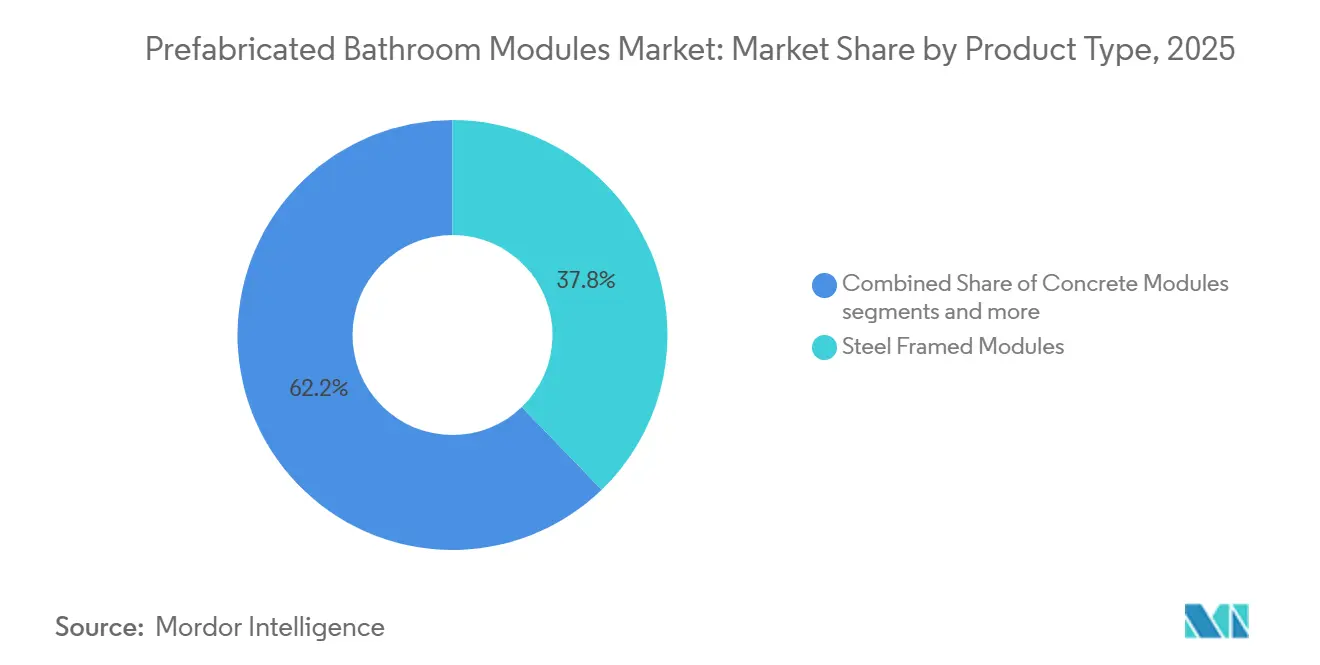
Steel-framed modules accounted for 37.80% of product-type demand in 2025, keeping them at the center of the prefabricated bathroom modules market, as galvanized cold-formed steel offers dimensional precision, non-combustibility, and load-bearing capacity for wall-mounted sanitary fixtures. That structural strength matters in healthcare and assisted-living projects where grab bars, rails, and supporting equipment place direct loads on bathroom walls and require dependable fixing performance. Steel remains attractive because CNC-based roll-forming systems enable factory-accurate production, including pre-punched MEP openings that minimize manual modifications during onsite installation. This improves quality repeatability and supports better interface control, which is one reason steel remains the reference format in many large pod programs[2]FRAMECAD, “Cold-Formed Steel Roll-Forming for Modular Construction,” FRAMECAD, framecad.com. Hybrid modules are projected to grow at a 9.10% CAGR through 2031, as developers increasingly seek steel's rigidity alongside the waterproofing, acoustic, and finish benefits of molded GRP or composite surfaces.
The prefabricated bathroom modules market does not point to one material replacing all others, because use cases still vary sharply by building type and installation conditions. Concrete modules retain a distinct role in high-rise residential towers, prisons, and mixed-use podium schemes, where acoustic isolation and fire compartmentation outweigh the penalties of greater unit weight and higher crane costs. GRP modules continue to perform well in budget hospitality and student housing because throughput is high, curing conditions are controlled, and dedicated producers can manufacture 15 to 20 units per week. Timber-based modules remain an emerging category tied to the mass-timber construction wave, where a bio-based bathroom module fits more naturally with host structures that already prioritize embodied-carbon reduction and material alignment. The result is a material mix that stratifies by end use rather than converging on a single format, leaving room for specialist producers with focused manufacturing capabilities in steel, concrete, GRP, hybrid, and timber-based designs.


By Installation Type: New Build Scale Coexists With a Fast-Accelerating Retrofit and Renovation Opportunity
New build accounted for 69.40% of installation-type volume in 2025, maintaining its dominance in the prefabricated bathroom modules market, as structural openings, riser positions, and service routes can be designed from the start to accommodate factory-sized units. This alignment lowers interface risk, improves lift planning, and makes repeated unit layouts easier to standardize across towers, hotels, student accommodation, and large residential schemes. New-build pod adoption is a natural fit for high-repetition projects, where bathroom procurement shifts from a late-stage onsite trade package to an earlier manufacturing decision, providing clearer sequencing benefits. Temporary and relocatable units are also represented as a separate cluster used in disaster-relief housing, military accommodation, and event infrastructure, where transportability and repeat installation matter more than permanent integration into the host structure. In practical terms, new build remains the easiest route to scale because dimensional consistency and early design control allow manufacturers to protect productivity while contractors preserve site schedules.
Retrofit and renovation are projected to grow at a 8.60% CAGR through 2031, making this the fastest-growing installation category in the prefabricated bathroom modules market as older building stock faces stronger renovation pressure. This acceleration is supported by the 2024 recast of the European Union (EU) Energy Performance of Buildings Directive and the fact that 85% of Europe's building stock was constructed before 2000, while national renovation rates average just 1% annually. That mismatch between the required renovation task and the limited wet-trade capacity available creates a clear opening for modular retrofit solutions that reduce time inside occupied or aging properties. German manufacturers such as KERAPID and Dennert provide precast bathroom modules in S, M, and L formats, including accessible and wheelchair-configurable options from 4.9 m² onward, highlighting the adaptation of standardized products for retrofit applications. Even with that momentum, the retrofit segment still lacks a fully established product category equal to standard new-build pods, which leaves differentiation potential for manufacturers willing to engineer around irregular existing envelopes.
By End User: Hospitality Leads by Share, Healthcare Leads by Pace
Healthcare is forecast to expand at a 9.30% CAGR through 2031, making it the fastest-rising end-use segment in the prefabricated bathroom modules market, as infection control and construction continuity are both critical in medical settings. Factory-built wet rooms support this need by enabling earlier validation of waterproofing, integrated ventilation, and sanitary layouts before installation near sensitive clinical spaces begins. The BJC Phase III hospital expansion in the United States diverted 45,000 labor hours from the construction site by using prefabricated MEP and wet-room solutions, highlighting the growing importance of minimizing disruption during hospital project approvals. Residential demand remains a volume anchor in markets where housing targets provide program visibility, supported by the United Kingdom government's GBP 625 million (USD 823.5 million) construction skills investment, which reflects the labor constraints that pod manufacturers are designed to address. Commercial offices and the broader others category, including education, prisons, and defense accommodation, still hold smaller shares but continue to widen the demand base as DfMA principles move into public procurement and more standardized room types.
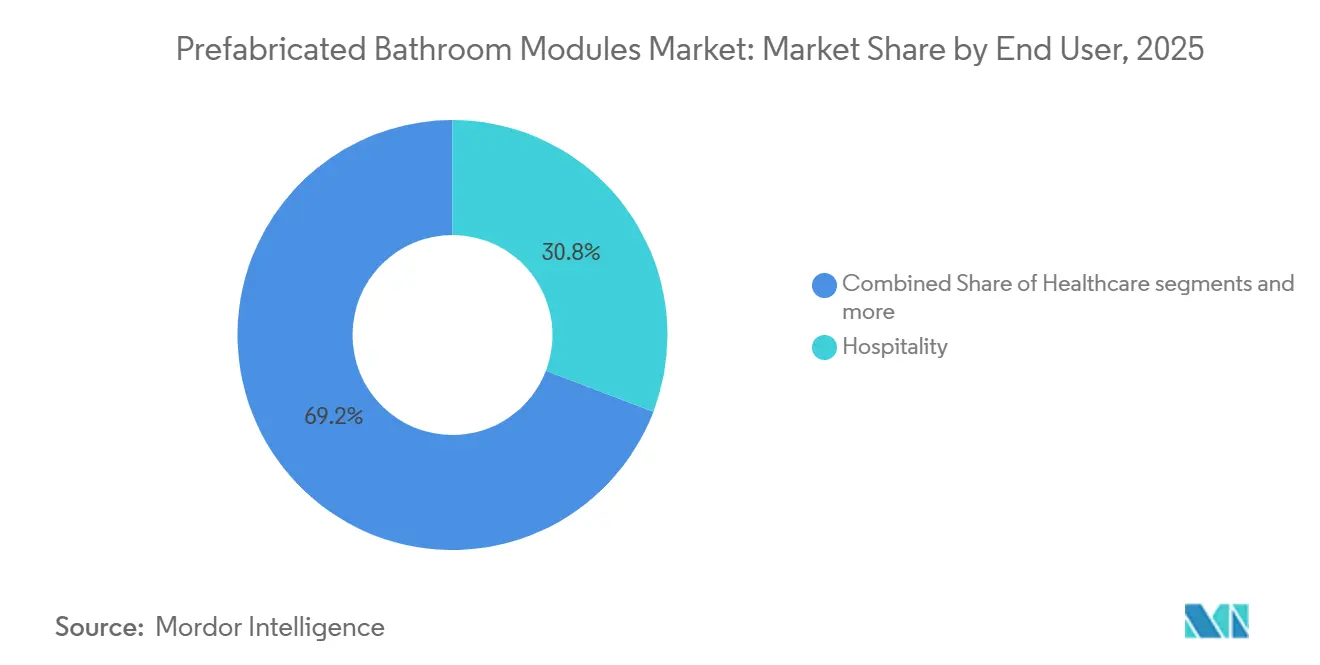
Hospitality held a 30.80% share in 2025, making it the volume leader in the prefabricated bathroom modules market, as hotel developers were among the first to normalize pod procurement across large room counts. That early adoption matters because it has created greater developer comfort with repeated wet-room delivery, brand-standard finishes, and factory-led quality assurance across multi-property pipelines. Hospitality procurement is increasingly shifting toward framework agreements with two or three pod suppliers, supporting specification consistency across property portfolios instead of re-tendering each project individually. This concentrates volume with fewer approved manufacturers and raises the access barrier for smaller entrants without reference projects, deep logistics, or the capacity to support multiple hotel openings in parallel. Healthcare may be growing faster, but hospitality still sets the commercial template for how large, repeat buyers of bathroom pods assess quality risk and define acceptable supplier capability in the global market.

Geography Analysis
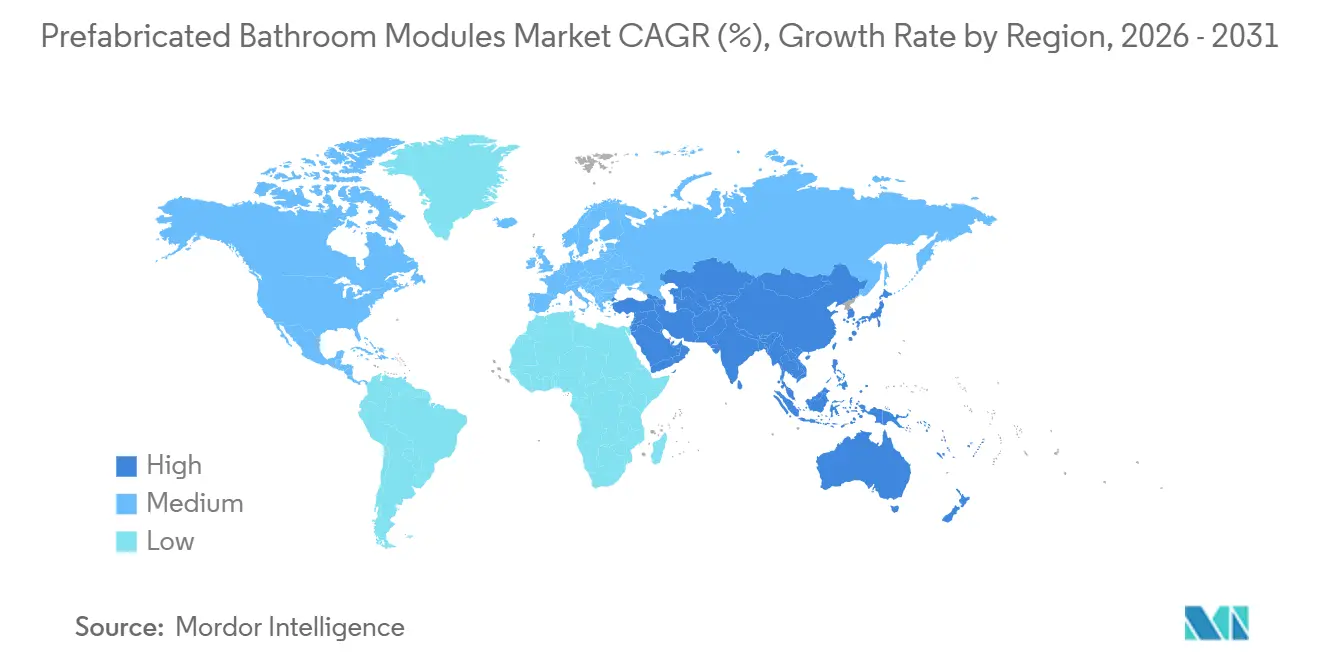
Europe accounted for 31.75% of global demand in 2025, keeping the region at the forefront of the prefabricated bathroom modules market, as industrialized construction methods have been established there longer than in most other regions. The United Kingdom remains the most developed national market, with Walker Modular, Offsite Solutions, and Elements Europe Ltd. serving student accommodation and social housing projects where pod adoption has moved from early adoption to baseline specification. Germany supports a dense manufacturing base that includes DEBA, KERAPID, Tjiko, and Dennert, reflecting the country's deep industrial culture and a large residential and commercial construction pipeline. Italy's bathroom manufacturing sector reported EUR 4.3 billion (USD 4.7 billion) in 2025 production value, while exports exceeded EUR 1.7 billion (USD 1.9 billion), and Germany remained the largest foreign market at EUR 306 million (USD 334 million) [3]FederlegnoArredo, “Assobagno Centro Studi 2025 Bathroom Sector Data,” FederlegnoArredo, federlegnoarredo.it.
Asia-Pacific is projected to grow at a 9.80% CAGR through 2031, making it the fastest-expanding regional segment of the prefabricated bathroom modules market as hospitality, healthcare, and student accommodation construction scale up. Growth is being driven by three key demand segments: expanding hotel construction, increasing hospital and university development in India, and bathroom upgrades across Japan's aging residential and care facilities. The region is important because it combines large future room counts with markets where delivery timelines are tight and wet-trade execution quality is uneven across locations, which favors more standardized factory output. Panasonic Housing Solutions began order intake in April 2026 for the Aquaheart F-eX W unit bath for elderly-care facilities, indicating that regional demand is already extending into assisted-bathing layouts and space-efficient care infrastructure rather than remaining focused solely on conventional hospitality formats. Southeast Asia, particularly Vietnam, Thailand, and Indonesia, is also becoming more relevant as international hotel chains seek repeatable wet-room quality in markets where consistent site execution at scale has historically been harder to secure.
North America has a significant base, and the prefabricated bathroom modules market there is supported by labor shortages in the United States and by digitally enabled modular investment in Canada. United States producers such as SurePods and Oldcastle Infrastructure are focused on hospitality and multi-family applications, supported by 439,000 construction vacancies in 2025 and the significantly lower onsite labor requirements associated with pod installation. Canada is also moving forward through MODS Inc.'s March 2026 commitment to USD 500 million in virtual-twin-enabled modular construction projects, which links offsite production with a more integrated design and assembly model. South America, the Middle East, and Africa remain smaller in terms of current volume. Still, Gulf Cooperation Council (GCC) hospitality programs and early social housing evaluation in Brazil are widening the future addressable base for suppliers that can localize logistics, approvals, and installation capability.

Competitive Landscape
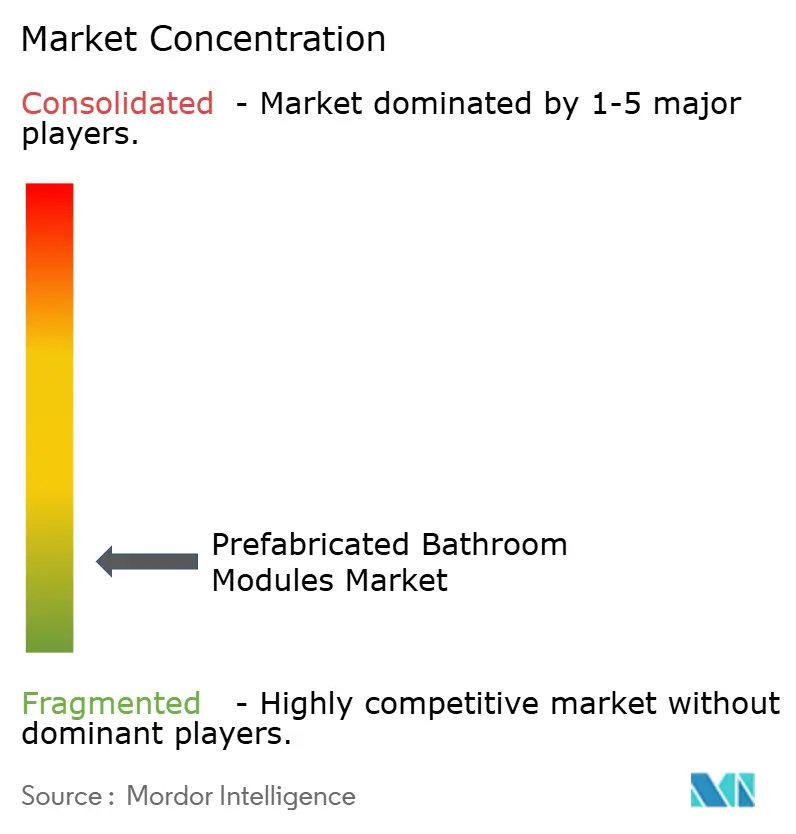
The prefabricated bathroom modules market is fragmented, with competition distributed across numerous regional manufacturers, specialist pod fabricators, and integrated modular construction companies rather than being dominated by a small group of global suppliers. Companies primarily compete through regional manufacturing footprints, project execution capabilities, material expertise, and compliance with local building regulations. United Kingdom manufacturers such as Walker Modular and Offsite Solutions have established expertise in fire-rated bathroom pods aligned with post-Grenfell safety requirements, while European companies including Bathsystem, StercheleGroup, and Elements Europe differentiate themselves through capabilities in GRP molding, concrete bathroom modules, and BIM-integrated manufacturing workflows. As procurement decisions remain highly project-specific, proven delivery performance, customization capability, and compliance with regional certification standards often outweigh production scale.
Competitive differentiation is increasingly driven by product innovation and digital manufacturing rather than market consolidation. Retrofit applications represent one of the largest untapped opportunities because existing buildings require adaptable pod solutions that can accommodate irregular layouts while preserving factory efficiency. Manufacturers are also expanding their offerings through smart bathroom technologies, including leak detection, occupancy-responsive ventilation, and predictive maintenance systems. Walker Modular's March 2026 launch of smart bathroom pods reflects this transition toward value-added, lifecycle-oriented solutions that extend beyond modular construction into facility management.
Another defining characteristic of the fragmented competitive landscape is the growing role of technology-enabled regional manufacturers that combine Design for Manufacturing and Assembly (DfMA), local production, and digital engineering capabilities. MODS Inc.'s March 2026 adoption of Dassault Systèmes' 3DEXPERIENCE virtual twin platform highlights how digital collaboration is becoming an important competitive differentiator throughout project delivery. Similarly, Panasonic's April 2026 expansion of care-focused unit bath solutions demonstrates increasing specialization by end-use application, particularly in healthcare and senior living facilities. With no single company holding a dominant global market position, competition continues to be driven by regional presence, execution quality, product specialization, certification expertise, and long-term customer relationships rather than market concentration.
Prefabricated Bathroom Modules Industry Leaders
Walker Modular
Offsite Solutions
Elematic Oyj
Laing O'Rourke
Balfour Beatty plc
- *Disclaimer: Major Players sorted in no particular order

Recent Industry Developments
- March 2026: Walker Modular announced a new smart bathroom pod collection designed to integrate building automation systems and water-monitoring capabilities, extending its proposition from structural delivery into operational asset management for building owners and facilities teams.
- April 2026: Panasonic Housing Solutions commenced order intake for the Aquaheart F-eX W, a unit bath engineered for Japanese elderly-care facilities to accommodate variable levels of assisted bathing across space-constrained environments, reflecting the growing intersection of modular bathroom manufacturing and demographic-driven demand for care infrastructure.
- September 2025: Hausutech launched a high-insulation bathtub option for its NWB/NJB rental-housing unit bath series in Japan, aligning product development with national government and Tokyo Metropolitan Government policies promoting energy efficiency in the residential rental sector.


Global Prefabricated Bathroom Modules Market Report Scope
The Prefabricated Bathroom Modules Market Report is Segmented by Product Type (Steel Framed Modules, Concrete Modules, Hybrid Modules, and More), Installation Type (New Build, and More), End User (Hospitality, Healthcare, Residential, Commercial Offices, and Others), and Geography (North America, Europe, Asia-Pacific, South America, and Middle East and Africa). The Market Forecasts are Provided in Terms of Value (USD).
| Steel Framed Modules |
| Concrete Modules |
| Hybrid Modules |
| Glass Reinforced Plastic Modules |
| Timber-Based Modules |
| New Build |
| Retrofit and Renovation |
| Temporary and Relocatable Units |
| Hospitality |
| Healthcare |
| Residential |
| Commercial Offices |
| Others |
| North America | United States |
| Canada | |
| Mexico | |
| Europe | United Kingdom |
| Germany | |
| France | |
| Italy | |
| Spain | |
| Russia | |
| Rest of Europe | |
| Asia-Pacific | China |
| India | |
| Japan | |
| Australia | |
| South Korea | |
| SouthEast Asia (Singapore, Malaysia, Thailand, Indonesia, Vietnam, and Philippines) | |
| Rest of Asia-Pacific | |
| South America | Brazil |
| Argentina | |
| Rest of South America | |
| Middle East and Africa | Saudi Arabia |
| United Arab Emirates | |
| Turkey | |
| South Africa | |
| Nigeria | |
| Rest of Middle East and Africa |
| By Product Type | Steel Framed Modules | |
| Concrete Modules | ||
| Hybrid Modules | ||
| Glass Reinforced Plastic Modules | ||
| Timber-Based Modules | ||
| By Installation Type | New Build | |
| Retrofit and Renovation | ||
| Temporary and Relocatable Units | ||
| By End User | Hospitality | |
| Healthcare | ||
| Residential | ||
| Commercial Offices | ||
| Others | ||
| By Geography | North America | United States |
| Canada | ||
| Mexico | ||
| Europe | United Kingdom | |
| Germany | ||
| France | ||
| Italy | ||
| Spain | ||
| Russia | ||
| Rest of Europe | ||
| Asia-Pacific | China | |
| India | ||
| Japan | ||
| Australia | ||
| South Korea | ||
| SouthEast Asia (Singapore, Malaysia, Thailand, Indonesia, Vietnam, and Philippines) | ||
| Rest of Asia-Pacific | ||
| South America | Brazil | |
| Argentina | ||
| Rest of South America | ||
| Middle East and Africa | Saudi Arabia | |
| United Arab Emirates | ||
| Turkey | ||
| South Africa | ||
| Nigeria | ||
| Rest of Middle East and Africa | ||


Key Questions Answered in the Report
What is the current outlook for prefabricated bathroom modules?
The segment is projected to rise from USD 2.32 billion in 2026 to USD 3.35 billion by 2031 at a 7.62% CAGR, showing that offsite wet-room delivery is moving further into mainstream construction planning.
Which product format leads today, and which one is growing fastest?
Steel framed modules led with 37.80% share in 2025, while hybrid modules are set to grow fastest at a 9.10% CAGR through 2031 as buyers balance structural rigidity with finish and waterproofing advantages.
Why are developers choosing factory-built bathrooms more often?
The strongest reasons are tighter project schedules, labor shortages, lower rework risk, and easier quality control when plumbing, tiling, and waterproofing shift into a controlled factory setting.
Which installation route offers the biggest near-term opportunity?
New build still dominates with 69.40% of volume in 2025, but retrofit and renovation are growing faster at an 8.60% CAGR because aging building stock needs faster and less disruptive bathroom replacement solutions.
Page last updated on:





