
Predictive Sales Intelligence Software Market Size and Share
Market Overview
| Study Period | 2020 - 2031 |
|---|---|
| Market Size (2026) | USD 3.36 Billion |
| Market Size (2031) | USD 6.63 Billion |
| Growth Rate (2026 - 2031) | 14.56 % |
| Fastest Growing Market | Asia-Pacific |
| Largest Market | North America |
| Market Concentration | Medium |
Major Players *Disclaimer: Major Players sorted in no particular order Image © Mordor Intelligence. Reuse requires attribution under CC BY 4.0. | |
Predictive Sales Intelligence Software Market Analysis by Mordor Intelligence
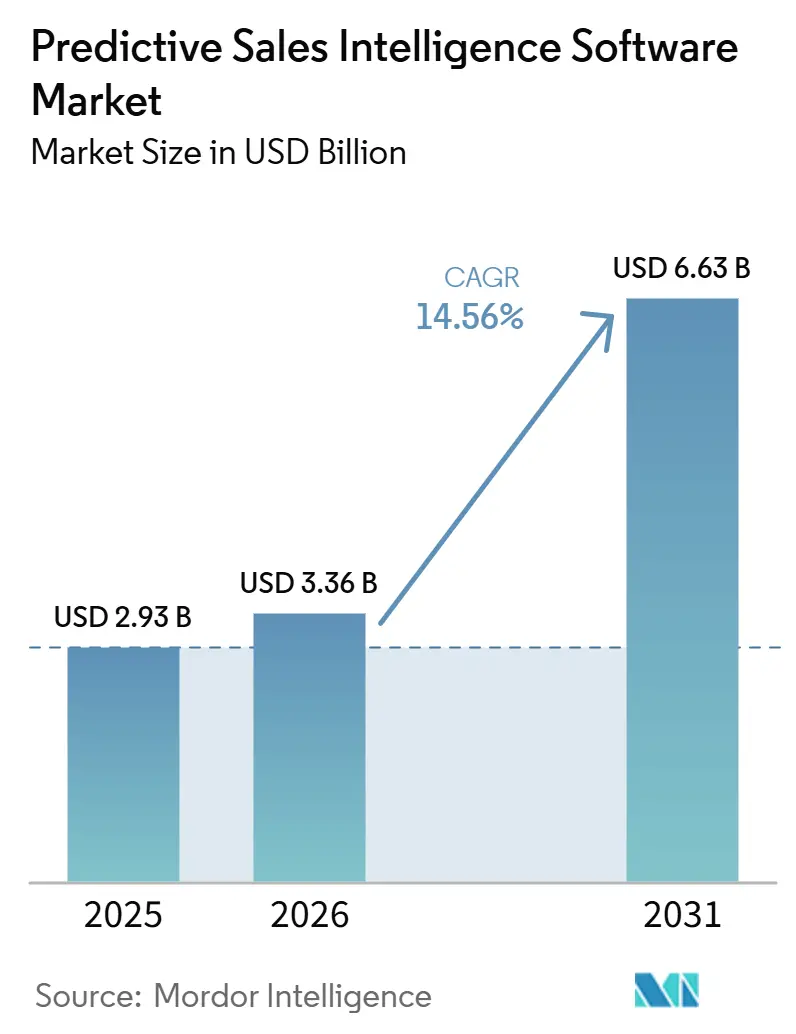
The predictive sales intelligence software market size is projected to expand from USD 2.93 billion in 2025 and USD 3.36 billion in 2026 to USD 6.63 billion by 2031, registering a CAGR of 14.56% between 2026 to 2031. The category is now moving past its early differentiation phase because AI-led signal processing has become a practical operating layer for revenue teams rather than a niche add-on. Demand is being supported by more complex go-to-market workflows, where static contact lists and manual qualification no longer support timely account targeting. The predictive sales intelligence software market is also benefiting from stronger cloud activation models, broader workflow automation, and tighter links with CRM and marketing systems. At the same time, the predictive sales intelligence software market still faces pressure from privacy regulation, stale contact data, and integration friction across fragmented enterprise stacks. Vendors that combine strong model quality with easier ecosystem interoperability are, therefore, better placed to capture the next wave of adoption.
Key Report Takeaways
- By component, software held 62.43% share in 2025, while services are projected to expand at a 16.82% CAGR through 2031.
- By deployment mode, cloud held 63.81% share of the predictive sales intelligence software market in 2025 and is also projected to record the fastest growth at a 15.39% CAGR through 2031.
- By organization size, large enterprises held 26.54% share in 2025, while small and medium enterprises are projected to expand at a 16.44% CAGR through 2031.
- By application, lead generation and prospecting accounted for 26.47% share in 2025, while predictive lead scoring is projected to grow at an 18.23% CAGR through 2031.
- By end-user industry, IT and telecommunication held 37.26% share in 2025, while healthcare and life sciences is projected to advance at a 17.39% CAGR through 2031.
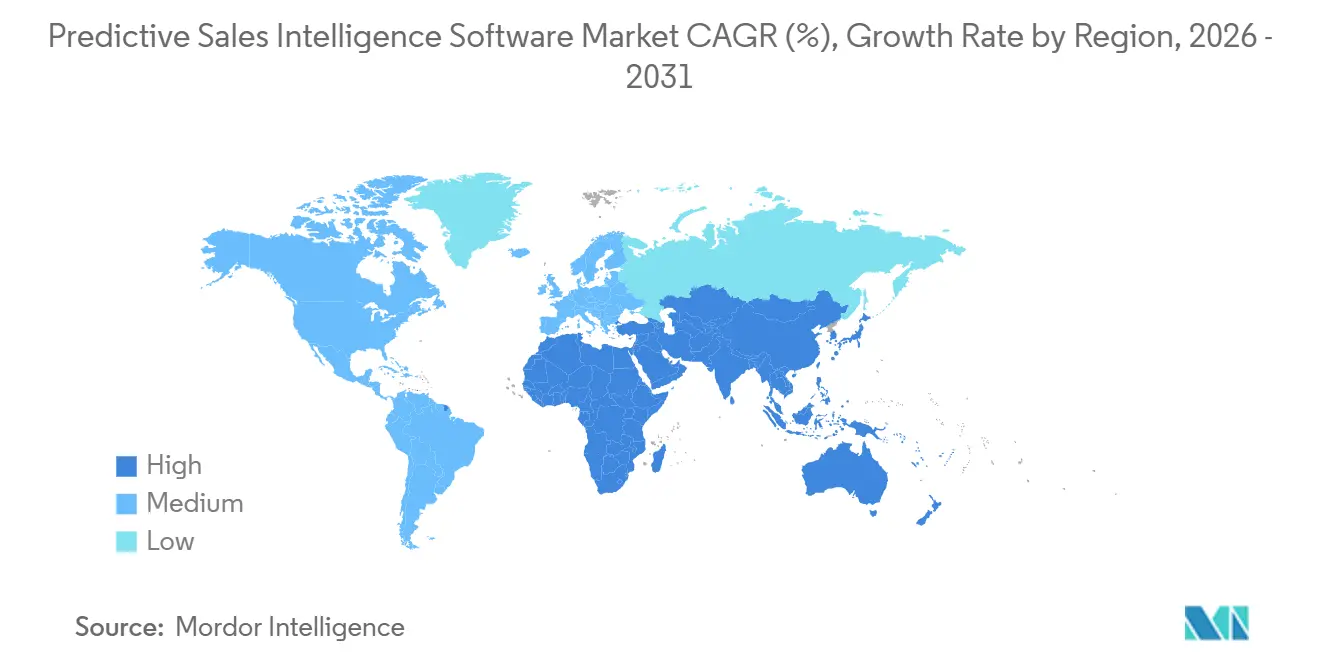
- By geography, North America held 34.56% share in 2025, while Asia-Pacific is projected to expand at a 19.42% CAGR through 2031.
Note: Market size and forecast figures in this report are generated using Mordor Intelligence’s proprietary estimation framework, updated with the latest available data and insights as of January 2026.
Market Trends and Insights
Drivers Impact Analysis of Predictive Sales Intelligence Software Market*
| DRIVER | (~) % IMPACT ON CAGR FORECAST | GEOGRAPHIC RELEVANCE | IMPACT TIMELINE |
|---|---|---|---|
| AI-Native Buyer Signal Scoring Improves Conversion Prioritization | +5.2% | Global, with highest density in North America and Western Europe | Short term (≤ 2 years) |
| RevOps Standardization Drives Cross-Functional Forecast Visibility | +3.1% | North America and EU, early gains in Australia and South Korea | Medium term (2-4 years) |
| Cloud-Based Self-Serve Adoption Expands Mid-Market Penetration | +2.8% | Global, APAC core, spill-over to South America and Middle East and Africa | Short term (≤ 2 years) |
| Intent Data Fusion With CRM and Marketing Automation Improves Signal Quality | +2.4% | North America and EU, growing relevance in APAC enterprise segment | Medium term (2-4 years) |
| Workflow Automation Reduces SDR and AE Research Time | +1.8% | Global | Short term (≤ 2 years) |
| Account-Based Selling Expansion Raises Demand for Predictive Targeting | +1.6% | North America, United Kingdom, Germany | Medium term (2-4 years) |
| Source: Mordor Intelligence | |||
AI-Native Buyer Signal Scoring Reshapes Conversion Economics
In 2026, 77% of B2B sales professionals said they would rely on AI if it could predict a prospect’s likelihood to buy with 90% accuracy, up from 37% in 2025. That shift shows how quickly buying teams are moving from curiosity to practical dependence on model-led prioritization.[1]Seamless.ai, “2026 State of AI in Sales Report,” Seamless.ai, seamless.ai 6sense reported that opportunities on prioritized 6QA accounts posted 29% higher opportunity values and 33% larger deal sizes than non-prioritized accounts between Q2 2025 and Q1 2026. The strongest results are appearing where models are trained on closed-won and closed-lost outcomes instead of simple activity signals. Buyers with sparse or biased CRM histories still face weaker scoring because the system reflects old win patterns more than present demand conditions. Vendors are responding by moving toward faster learning cycles so the predictive sales intelligence software market can shorten the gap between fresh buying signals and sales action.
RevOps Standardization Creates a New Data Governance Imperative
Revenue operations consolidation is broadening the role of predictive sales intelligence software from lead qualification into forecasting, territory planning, and renewal monitoring. Salesforce’s 2026 study of 4,050 sales professionals across 22 countries found that 44% of German sales leaders said siloed systems hinder AI initiatives.[2]Salesforce, “Studie: Vertriebsteams setzen auf KI-Agenten für mehr Effizienz,” Salesforce Deutschland, salesforce.com The same study found that 72% prioritize data cleansing and standardization before wider AI use. That pattern means the return from the predictive sales intelligence software market rises when firms already manage customer data under a unified operating model. Markets with stronger RevOps discipline, therefore, give vendors a wider opening for full platform adoption instead of limited prospecting use.
Cloud Self-Serve Models Unlock the Mid-Market Growth Layer
Self-serve cloud delivery is removing the procurement and integration barriers that once kept the predictive sales intelligence software market centered on large enterprises. In 2026, 80% of surveyed users said AI was already part of their sales workflow, while excitement around workflow automation rose to 46% from 10% in 2025. Apollo.io expanded that access layer in 2026 by bringing outbound execution workflows directly into Claude and ChatGPT through MCP-based deployment. This model helps leaner teams activate intelligence inside existing systems instead of rebuilding the full revenue stack. The tradeoff is that fast self-serve rollouts can bypass data review and consent controls, especially in stricter privacy environments. That tension explains why cloud adoption in the predictive sales intelligence software market is rising at the same time that governance requirements are becoming more demanding.
Intent Data Fusion Widens the Signal Quality Gap Between Vendors
The predictive sales intelligence software market is placing more value on platforms that combine CRM activity, web engagement, product usage, and external intent signals within one scoring layer. Clari expanded its Revenue Context layer in July 2025 through new integrations with data, intelligence, and engagement companies. That move showed that leading vendors are improving model depth through multi-source data fusion rather than depending on a single isolated feed. In the predictive sales intelligence software market, this favors platforms that can refresh and verify signals across several systems before scoring reaches frontline teams. It also supports stronger governance because firms can apply clearer processing controls across multiple data streams as privacy expectations rise. Vendors that depend mainly on purchased lists are therefore losing ground as buyers ask for richer and more defensible signal quality.
Restraints Impact Analysis of Predictive Sales Intelligence Software Market*
| RESTRAINT | (~) % IMPACT ON CAGR FORECAST | GEOGRAPHIC RELEVANCE | IMPACT TIMELINE |
|---|---|---|---|
| Data Privacy Constraints Limit Contact and Intent Data Collection | -1.8% | EU, United Kingdom, growing enforcement in Canada and Australia | Short term (≤ 2 years) |
| Signal Decay and Data Staleness Reduce Model Accuracy | -1.2% | Global | Medium term (2-4 years) |
| Integration Complexity Across CRM, MAP, and CDP Stacks Delays Deployment | -0.8% | Global, most acute in enterprise and mid-market APAC | Medium term (2-4 years) |
| Budget Scrutiny Slows Enterprise-Wide Rollouts Outside Core Revenue Teams | -0.5% | North America and EU enterprise | Medium term (2-4 years) |
| Source: Mordor Intelligence | |||
Data Privacy Regulation Compresses the Contact Data Supply Chain
The EDPB published guidance in July 2026 that tightened expectations around lawful grounds for large-scale web scraping of personal data in generative AI contexts. Those rules affect the predictive sales intelligence software market directly because professional contact details and profiling signals are core inputs for enrichment and scoring. The compliance burden is not staying inside Europe because multinational buyers are applying similar controls across broader operating footprints. Smaller vendors face higher legal engineering and workflow redesign costs when they cannot spread compliance investment across a large customer base. This slows product roadmaps and raises the likelihood that scaled incumbents gain further ground in the predictive sales intelligence software market. The pressure is most visible where outreach transparency, consent handling, and audit readiness are becoming purchase requirements rather than optional features.[3]European Data Protection Board, “EDPB Sheds Light on Anonymisation and Web Scraping for Generative AI,” EDPB, edpb.europa.eu
Signal Decay Erodes Predictive Model Accuracy Over Time
Signal decay remains a structural problem because contact records, job roles, and account priorities change faster than many systems refresh them. When stale records continue feeding scoring engines, the predictive sales intelligence software market faces an accuracy gap that buyers often notice only after opportunity outcomes start diverging from model expectations. This makes data freshness a deeper performance issue than simple database size because old information can distort both enrichment layers and model retraining loops. Vendors that refresh records through contributory networks and source-level verification hold a more durable operating advantage than those that depend on periodic bulk updates. For buyers, the hidden cost is that platform performance can weaken materially between contract signing and renewal, even when coverage dashboards still look strong.
*Our forecasts treat driver/restraint impacts as directional, not additive. The impact forecasts reflect baseline growth, mix effects, and variable interactions.
Predictive Sales Intelligence Software Market Segment Analysis
By Component:
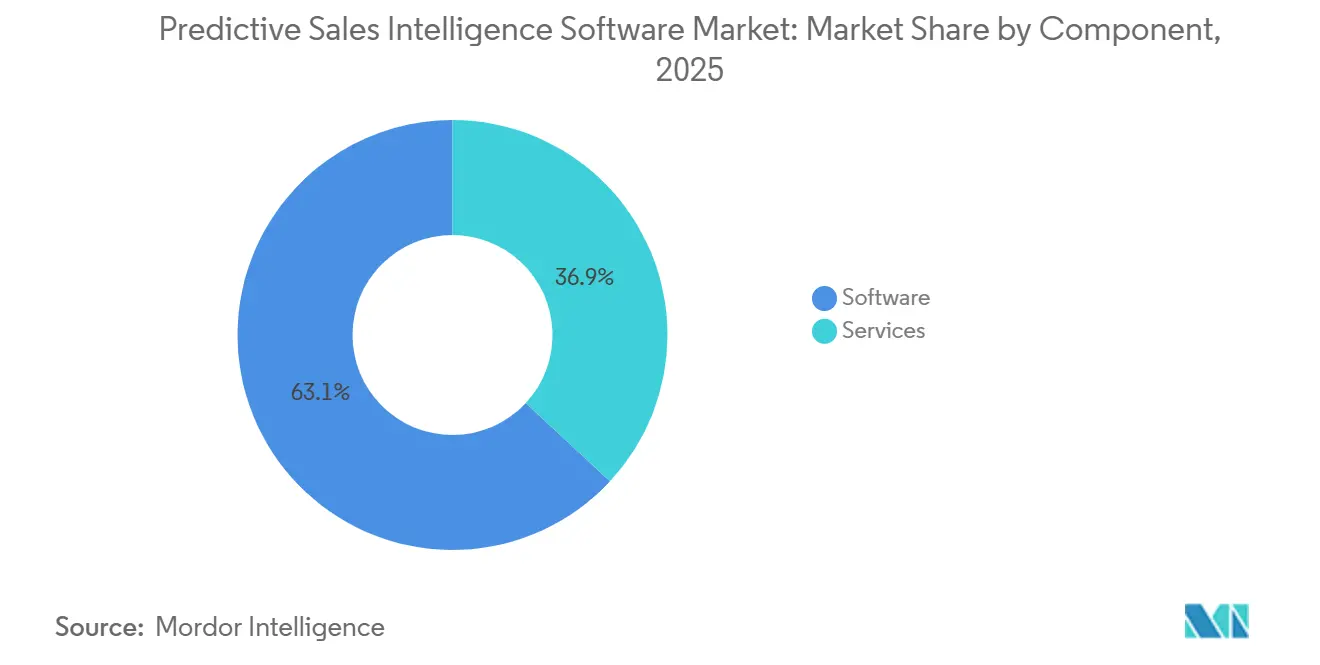
Software Leads the Core Stack While Services Deepen Deployment ValueSoftware held 62.43% share in 2025, which kept the predictive sales intelligence software market anchored in platform-led delivery rather than service-led execution. That lead reflects how buyers are prioritizing intent dashboards, predictive scoring engines, workflow automation, and CRM-embedded alerting within one operating layer. The software side also benefits from SaaS economics, where additional users carry lower incremental delivery costs and feature updates move faster than traditional enterprise release cycles. At the same time, the predictive sales intelligence software industry is not reducing the role of human support because model calibration and data governance still require specialist input during complex rollouts.
Services are projected to advance at a 16.82% CAGR through 2031, which makes them the fastest-growing component even though software remains larger. This reflects a growing need for workflow design, CRM cleanup, model tuning, and deployment oversight in enterprise environments. The service requirement tends to be strongest where organizations want to embed intelligence across forecasting, territory planning, and account prioritization at the same time. Apollo.io’s acquisition of Pocus in March 2026 also pointed to a market direction where enterprise signal intelligence is being folded more tightly into a unified platform experience. As that shift continues, the predictive sales intelligence software market is likely to see a blur between packaged software capability and what once sat inside separate professional services projects.



By Deployment Mode:
Cloud Extends Its Structural Lead Across Revenue SystemsCloud held 63.81% predictive sales intelligence software market share in 2025 and is also projected to record the fastest growth at a 15.39% CAGR through 2031. That position continues to strengthen as API-led integrations reduce the need for custom deployment work. The model aligns with how revenue teams now buy software, as activation speed matters more than infrastructure ownership in most commercial settings. On-premises remains relevant in regulated environments such as financial services, defense-linked accounts, and contractor ecosystems where residency or internal security rules remain strict. Even so, the predictive sales intelligence software market is increasingly shaped by environments where shared signal layers and linked data flows work better in cloud settings than in isolated installations.
The deeper divide now sits between cloud-native platforms and older systems that were merely moved into the cloud. Cloud-native vendors can ingest more signal types, retrain models faster, and scale compute for live scoring with less operational friction. Apollo.io’s 2026 rollout of MCP-based access through Claude and ChatGPT showed how a cloud-first design makes direct workflow activation easier for end users. Compliance requirements are also making on-premises deployments harder to defend because documentation, logging, and audit controls are easier to maintain in governed cloud environments. For that reason, cloud remains both the largest and the fastest-moving delivery layer in the predictive sales intelligence software market.
By Organization Size:
Large Enterprises Lead Spending While SMEs Expand FasterLarge enterprises held 26.54% share in 2025, reflecting earlier adoption, larger seat counts, and stronger budgets for full-featured intelligence platforms. Their advantage came from having deeper CRM histories, more structured RevOps teams, and greater capacity to connect data from sales, marketing, and customer success. That operating base made enterprise accounts the first natural buyers in the predictive sales intelligence software market. It also meant large organizations were better positioned to test forecasting, territory, and renewal use cases beyond basic prospecting.
Small and medium enterprises are projected to expand at a 16.44% CAGR through 2031 as self-serve AI tools and lower minimum spend thresholds widen access. This growth is important because it shows the predictive sales intelligence software industry is moving beyond a category defined only by the Fortune 500. Salesforce found that top performers are 1.7 times more likely to use AI agents for customer acquisition than peers with flat or declining revenue, which indicates that performance benefits are not limited to the largest companies. Pre-trained scoring models are also lowering the amount of historical data needed before a smaller team can get useful output. As a result, the predictive sales intelligence software market is widening through accessibility gains as much as through enterprise upsell.
By Application:
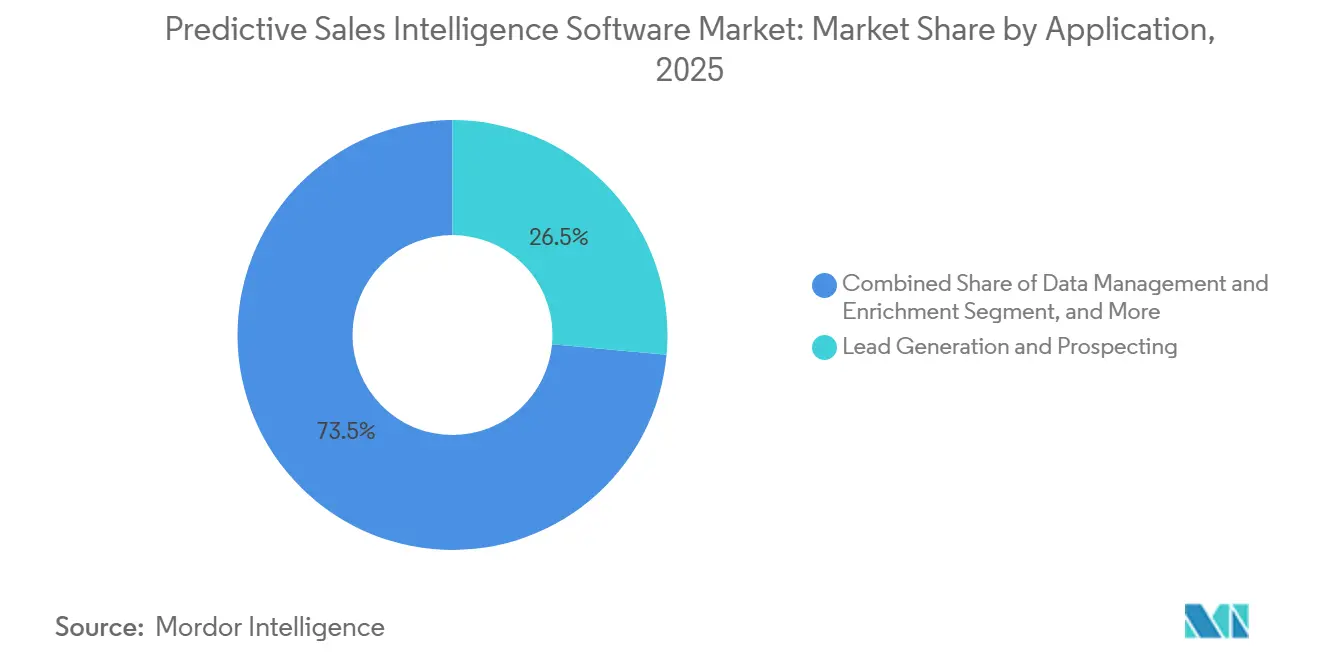
Lead Generation Stays Largest While Predictive Scoring Gains PaceLead generation and prospecting accounted for 26.47% share in 2025 because the use case fits established sales behavior and requires less internal change than broader revenue intelligence functions. Teams already understand contact sourcing, list building, and early-stage targeting, so AI layers can plug into existing workflow patterns with less disruption. That is why the predictive sales intelligence software market still sees top-of-funnel activity as the main commercial entry point. Sales forecasting, data management and enrichment, and sales performance analytics and reporting also remain important, but they usually demand wider operational alignment before value becomes visible.
Predictive lead scoring is projected to grow at an 18.23% CAGR through 2031, reflecting a shift in buyer expectations toward real-time decision support. The change is not only about more automation, it is also about better timing when accounts move into active evaluation windows. 6sense’s account prioritization results underscore why more buyers are moving toward scoring-led workflow design rather than static prospect ranking.[4]6sense Insights, “6sense Launches MCP Server, Bringing Proprietary GTM Intelligence Into Any AI Agent,” 6sense Newsroom, 6sense.com The broader predictive sales intelligence software market is therefore rewarding applications that help teams act on fresh buying-stage movement rather than only record past interactions. Other applications continue to grow as organizations move from initial adoption into fuller revenue workflow instrumentation.
By End-User Industry:
IT and Telecom Remain Core Buyers While Healthcare Gains SpeedIT and telecommunications held 37.26% share in 2025, which made it the largest end-user segment in the predictive sales intelligence software market. The sector’s position reflects long buying cycles, multi-stakeholder purchase decisions, and high contract values that make better account prioritization especially valuable. It also reflects the fact that many technology sellers are already comfortable with digital workflows, CRM discipline, and SaaS-based operating models. BFSI followed as another important vertical because regulated selling environments place a premium on efficiency and better-qualified outreach.
Healthcare and life sciences is projected to grow at a 17.39% CAGR through 2031 as commercial access becomes harder and targeting precision becomes more important. Veeva’s field trends reporting showed that healthcare professional touchpoints declined materially over the prior 18 months, which raised the value of selecting the right accounts at the right time. That shift supports the predictive sales intelligence software market because commercial teams in this sector are under pressure to do more with narrower engagement windows.[5]Veeva Systems, “Veeva Pulse Field Trends Report,” Veeva, veeva.com The healthcare segment also raises the compliance threshold, which favors vendors with audit-ready data practices and slows switching even when alternative tools offer stronger features. This is one reason the predictive sales intelligence software market is seeing healthcare emerge as a high-growth but carefully gated adoption lane.
Geography Analysis
North America Predictive Sales Intelligence Software Market
North America held 34.56% of the predictive sales intelligence software market share in 2025, which kept it as the largest regional contributor. The United States remains the center of demand because it combines dense enterprise software spending with mature CRM adoption and high GTM tool usage. The U.S. Census Bureau reported that business AI use reached 19.8% in May 2026, which provided a broad baseline for the wider digital adoption environment.[6]U.S. Census Bureau, “Business Trends and Outlook Survey, AI Use,” U.S. Census Bureau, census.gov Canada is adding demand from SaaS and financial services buyers, while Mexico is advancing as multinational firms extend standardized revenue stacks into local operations. Across the predictive sales intelligence software market, this regional lead still rests on infrastructure maturity more than on price competition.
Europe Predictive Sales Intelligence Software Market
Europe remains an important demand center because buying sophistication is high even as compliance burdens rise. Germany and the United Kingdom continue to anchor commercial demand, particularly where enterprise teams want stronger forecasting discipline and better data governance. EDPB guidance on web scraping and related privacy obligations is reshaping product architecture choices for vendors serving the region. That means the predictive sales intelligence software market in Europe rewards platforms that can support auditability, consent discipline, and transparent AI-enabled outreach.
APAC, MEA and South America Predictive Sales Intelligence Software Market
Asia-Pacific is projected to expand at a 19.42% CAGR through 2031, which makes it the fastest-growing region in the predictive sales intelligence software market. China is benefiting from fast enterprise digitalization, while India is supported by stronger SaaS adoption and a large outsourcing base that naturally values lead management efficiency. Japan and South Korea add growth through advanced enterprise IT environments and formal AI adoption efforts inside larger corporations. South America, the Middle East, and Africa still account for smaller shares, but adoption is building in Brazil, Argentina, Saudi Arabia, the United Arab Emirates, Israel, and South Africa as cloud-based entry tiers reduce commitment thresholds.

Competitive Landscape
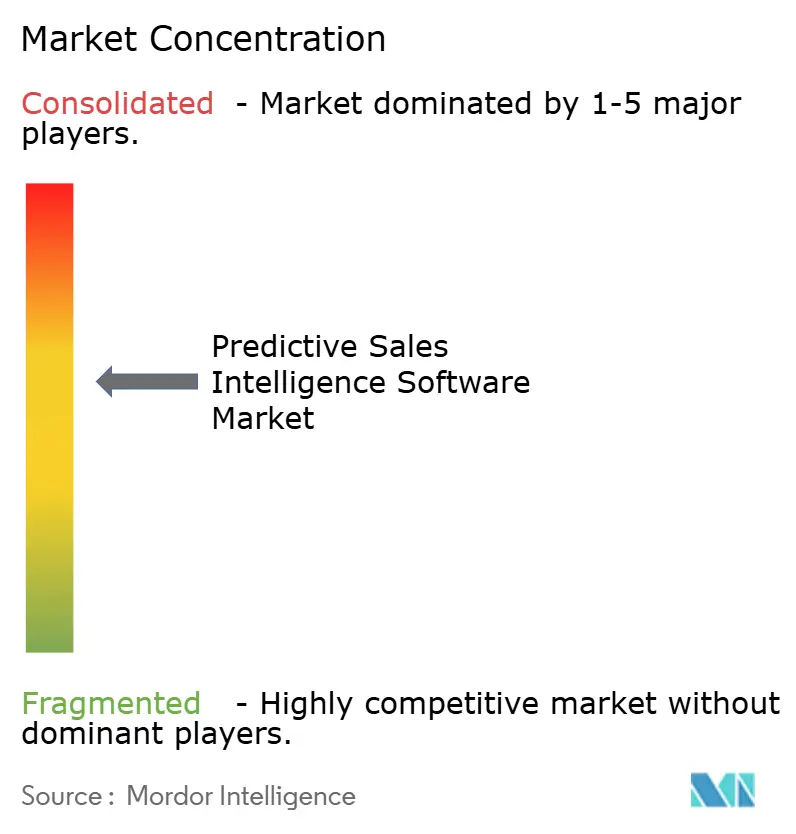
The predictive sales intelligence software market shows a moderately concentrated upper tier, while a fragmented mid-tier still competes on signal type, vertical focus, and pricing model. ZoomInfo, Salesforce, and LinkedIn benefit from large installed bases, strong data reach, and entrenched workflow positions across commercial software buyers. That structure means scale still matters, but it no longer guarantees that every leading platform will dominate every use case. In the predictive sales intelligence software market, the advantage is shifting toward vendors that can make their data, models, and activation tools work across several external environments.
A clear strategic pattern in 2026 has been the move toward ecosystem distribution rather than isolated product delivery. ZoomInfo rebuilt its Chrome Extension in July 2026 to improve speed and contact matching, which reinforced its focus on rep productivity inside daily workflow touchpoints. 6sense launched an MCP Server in open beta in July 2026 so its account insights and predictive buying stages could be called from MCP-compatible AI agents. Apollo.io also deepened its platform position through the Pocus acquisition and its 2026 rollout of workflow access through Claude and ChatGPT. These moves show that the predictive sales intelligence software market is rewarding vendors that treat intelligence as an operating layer across other applications rather than a closed destination tool.
Mid-tier players are responding by building more specialized value propositions where larger incumbents may be less precise. Clari’s open ecosystem expansion in July 2025 showed how signal depth can be improved through external partnerships instead of one-source lock-in. HG Insights used its August 2025 launch of a Revenue Growth Agentic Ecosystem and the acquisition of MadKudu to strengthen its position around agentic GTM execution. That leaves room for continued competition in healthcare, financial services, manufacturing, and governance-sensitive European accounts where workflow nuance matters. The predictive sales intelligence software market therefore remains open to focused challengers even though scale leaders still set the tone at the top.
Predictive Sales Intelligence Software Industry Leaders
ZoomInfo Technologies Inc.
Salesforce, Inc.
Apollo.io, Inc.
6sense Insights, Inc.
Predictive Sales Intelligence Software
- *Disclaimer: Major Players sorted in no particular order
Predictive Sales Intelligence Software Market Companies Covered in this Report
- ZoomInfo Technologies Inc.
- Salesforce, Inc.
- Apollo.io, Inc.
- 6sense Insights, Inc.
- Demandbase, Inc.
- LinkedIn Corporation
- Dun and Bradstreet Holdings, Inc.
- HubSpot, Inc.
- Oracle Corporation
- Cognism Ltd.
- Lusha Systems Ltd.
- SalesIntel LLC
- HG Insights LLC
- LeadGenius Inc.
- Outreach, Inc.
- SalesLoft, Inc.
- Clearbit, Inc.
- UpLead LLC
- Zoho Corporation Pvt. Ltd.
- Clari Inc.

Recent Industry Developments in Predictive Sales Intelligence Software Market
- July 2026: ZoomInfo released a fully rebuilt native version of its Chrome Extension, delivering 2-3x faster page loads and significantly higher contact-match rates. The rebuild improves rep prospecting throughput by surfacing verified phone numbers, emails, firmographics, and buying signals directly on whichever page a seller is viewing, eliminating tool-switching overhead.
- July 2026: 6sense launched the 6sense MCP Server in open beta, making its proprietary GTM intelligence, including account insights, predictive buying stages, 6QA status, keyword intent, and ad campaign performance, callable from any MCP-compatible AI agent including Claude, ChatGPT, Writer, and Salesforce Agentforce, with no custom integration required. General availability is planned for August 2026.
- July 2026: ZoomInfo released a Data Cube update adding 2.5 million new company locations, native integration with DataGroomr for automated CRM enrichment and validation, and a GTM Studio export feature allowing audiences to be added to Salesforce Campaigns as Campaign Members, improving data hygiene within existing CRM workflows.
- June 2026: Apollo.io launched its connector for Perplexity Computer, bringing sales intelligence and workflow capabilities into Perplexity's Workflows for Growing Businesses offering. The integration targets founders and lean revenue teams seeking GTM workflow automation without dedicated RevOps staffing.


Global Predictive Sales Intelligence Software Market Report Scope
The Predictive Sales Intelligence Software market comprises platforms that use data analytics, AI, and machine learning to help sales teams identify high-potential prospects, anticipate customer needs, and improve deal closures. These solutions analyze data from CRM systems, social media, websites, market databases, and competitive intelligence sources to predict which leads are most likely to convert, which products customers may purchase next, and when they are ready to buy.
The Predictive Sales Intelligence Software Market Report is Segmented by Component (Software, and Services), Deployment Mode (Cloud, and On-Premises), Organization Size (Small and Medium Enterprises, and Large Enterprises), Application (Lead Generation and Prospecting, Predictive Lead Scoring, Sales Forecasting, Data Management and Enrichment, Sales Performance Analytics and Reporting, and Other Applications), End-User Industry (Banking, Financial Services, and Insurance (BFSI), IT and Telecommunication, Healthcare and Life Sciences, Retail and E-commerce, Manufacturing, Media and Entertainment, Government and Public Sector, and Other End-User Industries), and Geography (North America, South America, Europe, Asia-Pacific, and Middle East and Africa). The Market Forecasts are Provided in Terms of Value (USD).
| Software |
| Services |
| Cloud |
| On-Premises |
| Small and Medium Enterprises |
| Large Enterprises |
| Lead Generation and Prospecting |
| Predictive Lead Scoring |
| Sales Forecasting |
| Data Management and Enrichment |
| Sales Performance Analytics and Reporting |
| Other Applications |
| Banking, Financial Services, and Insurance (BFSI) |
| IT and Telecommunication |
| Healthcare and Life Sciences |
| Retail and E-commerce |
| Manufacturing |
| Media and Entertainment |
| Government and Public Sector |
| Other End-User Industries |
| North America | United States | |
| Canada | ||
| Mexico | ||
| South America | Brazil | |
| Argentina | ||
| Rest of South America | ||
| Europe | Germany | |
| United Kingdom | ||
| France | ||
| Russia | ||
| Rest of Europe | ||
| Asia-Pacific | China | |
| Japan | ||
| India | ||
| South Korea | ||
| Australia | ||
| Rest of Asia-Pacific | ||
| Middle East and Africa | Middle East | Turkey |
| Israel | ||
| Saudi Arabia | ||
| United Arab Emirates | ||
| Rest of Middle East | ||
| Africa | South Africa | |
| Rest of Africa | ||
| By Component | Software | ||
| Services | |||
| By Deployment Mode | Cloud | ||
| On-Premises | |||
| By Organization Size | Small and Medium Enterprises | ||
| Large Enterprises | |||
| By Application | Lead Generation and Prospecting | ||
| Predictive Lead Scoring | |||
| Sales Forecasting | |||
| Data Management and Enrichment | |||
| Sales Performance Analytics and Reporting | |||
| Other Applications | |||
| By End-User Industry | Banking, Financial Services, and Insurance (BFSI) | ||
| IT and Telecommunication | |||
| Healthcare and Life Sciences | |||
| Retail and E-commerce | |||
| Manufacturing | |||
| Media and Entertainment | |||
| Government and Public Sector | |||
| Other End-User Industries | |||
| By Geography | North America | United States | |
| Canada | |||
| Mexico | |||
| South America | Brazil | ||
| Argentina | |||
| Rest of South America | |||
| Europe | Germany | ||
| United Kingdom | |||
| France | |||
| Russia | |||
| Rest of Europe | |||
| Asia-Pacific | China | ||
| Japan | |||
| India | |||
| South Korea | |||
| Australia | |||
| Rest of Asia-Pacific | |||
| Middle East and Africa | Middle East | Turkey | |
| Israel | |||
| Saudi Arabia | |||
| United Arab Emirates | |||
| Rest of Middle East | |||
| Africa | South Africa | ||
| Rest of Africa | |||


Key Questions Answered in the Report
What is the current and forecast size of the predictive sales intelligence software market?
The predictive sales intelligence software market was valued at USD 2.93 billion in 2025, stands at USD 3.36 billion in 2026, and is projected to reach USD 6.63 billion by 2031 at a 14.56% CAGR.
Which deployment model leads adoption in predictive sales intelligence software?
Cloud leads adoption with 63.81% share in 2025 and is also the fastest-growing deployment mode with a 15.39% CAGR through 2031.
Which application is growing fastest in predictive sales intelligence software?
Predictive lead scoring is the fastest-growing application, with an 18.23% CAGR through 2031, while lead generation and prospecting remained the largest application in 2025 with 26.47% share.
Which end-user sector shows the strongest growth potential?
Healthcare and life sciences is projected to grow fastest at a 17.39% CAGR through 2031, supported by tighter engagement windows and rising demand for precision targeting.
Which region leads global demand and which one is expanding fastest?
North America led with 34.56% share in 2025, while Asia-Pacific is expected to post the fastest growth at a 19.42% CAGR through 2031.
What is driving adoption among smaller companies?
SMEs are expanding at a 16.44% CAGR because self-serve cloud models, easier workflow activation, and lower spend thresholds are making advanced sales intelligence tools more accessible.
Page last updated on:





