
Predictive Lead Scoring Software Market Size and Share
Market Overview
| Study Period | 2020 - 2031 |
|---|---|
| Market Size (2026) | USD 2.46 Billion |
| Market Size (2031) | USD 6.28 Billion |
| Growth Rate (2026 - 2031) | 20.62 % |
| Fastest Growing Market | Asia-Pacific |
| Largest Market | North America |
| Market Concentration | Medium |
Major Players *Disclaimer: Major Players sorted in no particular order Image © Mordor Intelligence. Reuse requires attribution under CC BY 4.0. | |
Predictive Lead Scoring Software Market Analysis by Mordor Intelligence
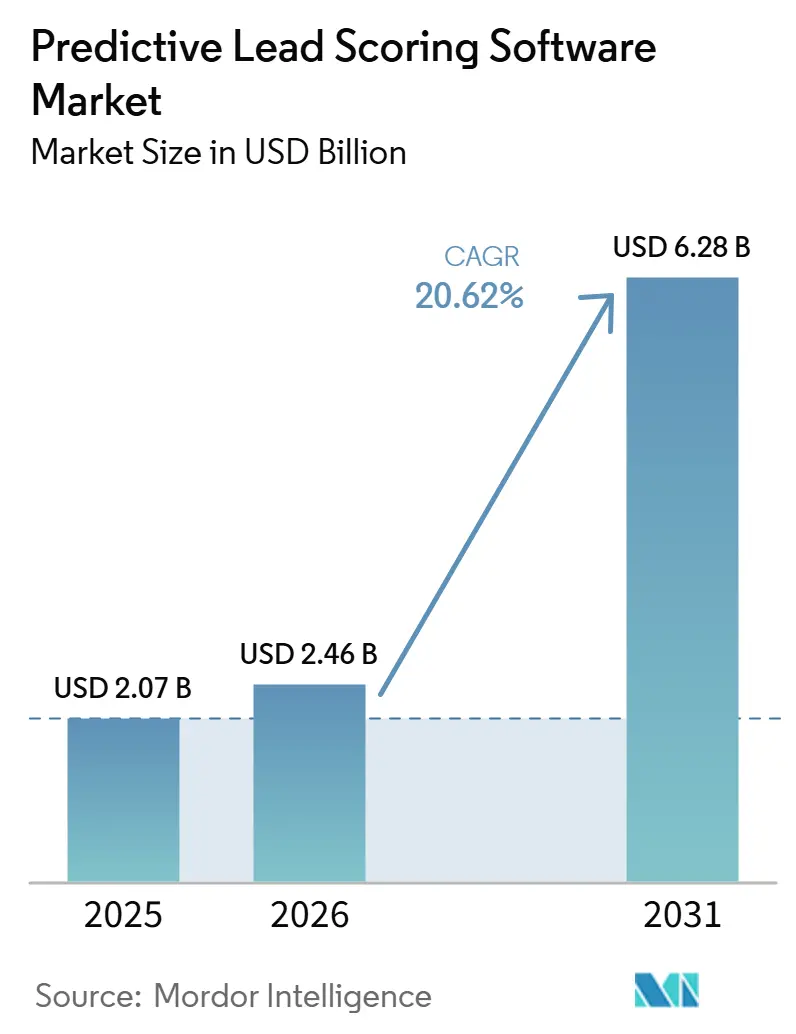
The predictive lead scoring software market size is projected to expand from USD 2.07 billion in 2025 and USD 2.46 billion in 2026 to USD 6.28 billion by 2031, registering a CAGR of 20.62% between 2026 and 2031. Growth is supported by the steady shift from manual lead review to model-based prioritization across core sales and marketing workflows. The predictive lead scoring software market is also benefiting from wider use of CRM platforms, richer intent data, and stronger demand for tools that help teams focus on the accounts most likely to convert. Buyer hesitation is no longer the main issue, as adoption has already advanced across many organizations, but many users still need better onboarding, cleaner data, and stronger model tuning to get full value from deployment. Competition is tightening as large platform vendors embed scoring into broader revenue systems, while specialist providers compete through explainability, custom signal ingestion, and workflow depth. The predictive lead scoring software market also has room to expand through regulated industries, mid-sized organizations, and account-based use cases where off-the-shelf rules often fail to capture actual buying behavior.
Key Report Takeaways
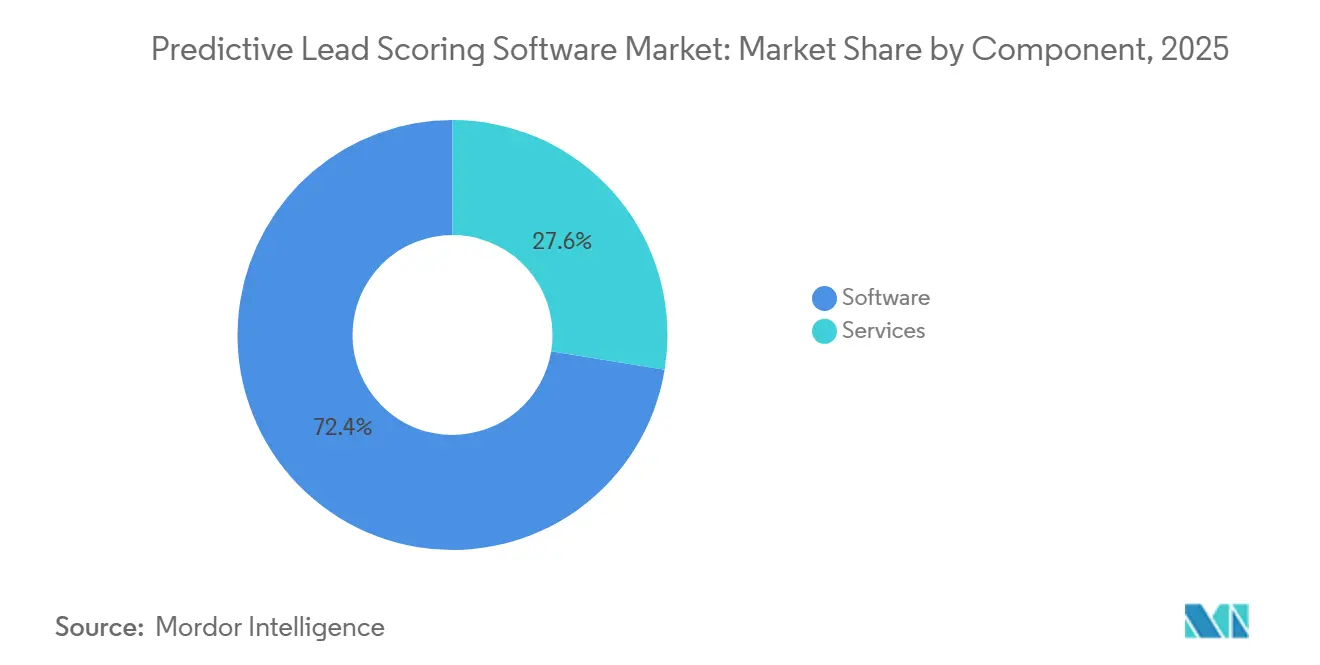
- By component, software held 72.41% of revenue in the predictive lead scoring software market in 2025, while services are projected to expand at a 23.84% CAGR through 2031.
- By deployment, cloud-based models accounted for 68.19% of revenue in 2025, while hybrid deployment is projected to grow at a 22.63% CAGR through 2031.
- By enterprise size, large enterprises accounted for 61.34% of revenue in the predictive lead scoring software market in 2025, while SMEs are projected to expand at a 24.17% CAGR through 2031.
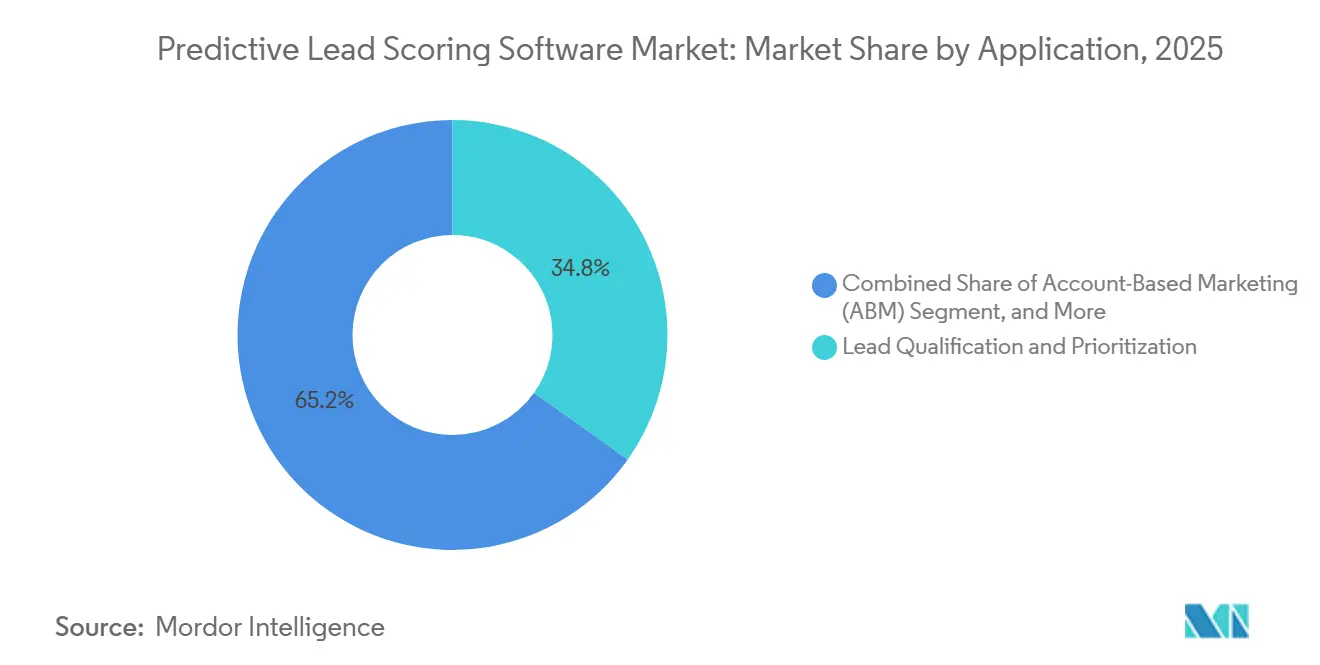
- By application, lead qualification and prioritization accounted for 34.82% of revenue in 2025, while account-based marketing is projected to advance at a 26.43% CAGR through 2031.
- By end user, BFSI accounted for 22.41% of revenue in the predictive lead scoring software market in 2025, while healthcare and life sciences are projected to grow at a 23.76% CAGR through 2031.
- By geography, North America held 36.71% of the predictive lead scoring software market share in 2025, while Asia-Pacific is projected to expand at a 25.92% CAGR through 2031.
Note: Market size and forecast figures in this report are generated using Mordor Intelligence’s proprietary estimation framework, updated with the latest available data and insights as of January 2026.
Market Trends and Insights
Drivers Impact Analysis of Predictive Lead Scoring Software Market*
| Driver | (~) % Impact on CAGR Forecast | Geographic Relevance | Impact Timeline |
|---|---|---|---|
| Rising Need for Sales Pipeline Prioritization | +5.8% | Global, with highest intensity in North America and Western Europe | Short term (≤ 2 years) |
| Expansion of AI-Based Revenue Operations Workflows | +4.7% | Global, with early gains in North America and Asia-Pacific | Medium term (2-4 years) |
| Growing Demand for Real-Time Intent And Behavior Signals | +3.6% | North America and Europe, spill-over to Asia-Pacific core | Medium term (2-4 years) |
| Wider Adoption of Cloud CRM and Marketing Automation Suites | +2.9% | Global, with accelerating gains in Southeast Asia, India, and South America | Short term (≤ 2 years) |
| Higher Conversion Pressure in High-CAC Digital Acquisition Channels | +2.1% | North America and Europe, with early signals in Asia-Pacific | Medium term (2-4 years) |
| Regulatory Preference for Auditability in Model-Based Sales Decisions | +1.2% | Europe core, spill-over to global multinationals with Europe operations | Long term (≥ 4 years) |
| Source: Mordor Intelligence | |||
Rising Need for Sales Pipeline Prioritization
The predictive lead-scoring software market is benefiting from a clear shift in how B2B sales teams manage pipeline volume. Sales teams now handle more leads, more account signals, and more channel activity than individual reps can review effectively. Salesforce reported that its own use of Agentforce for Revenue reduced quoting time by 75% and cut clicks per transaction by 87%, which shows how automation can return selling time to revenue teams.[1] This makes prioritization less of a workflow preference and more of an operating requirement inside the predictive lead scoring software market. Once teams begin relying on model-guided ranking, it becomes harder to return to manual lead triage because that process is slower, less consistent, and more exposed to missed opportunities.
Expansion of AI-Based Revenue Operations Workflows
The predictive lead scoring software market is also being lifted by the spread of AI across broader revenue operations workflows. HG Insights strengthened this direction when it acquired MadKudu and launched a revenue growth agentic ecosystem that connected predictive lead and account scoring with data from Salesforce, Gong, Marketo, Salesloft, Outreach, and Snowflake.[2] In this setting, scoring is no longer a stand-alone tool used only by SDR teams, because it becomes part of routing, sequencing, account review, and pipeline management. Salesforce also reported that Agentforce ARR reached USD 800 million in fiscal year 2026, with 29,000 deals closed, which shows the commercial scale of this shift toward agent-based execution. As more revenue teams adopt connected AI workflows, the predictive lead scoring software market is likely to see larger deal sizes and higher switching costs.[3]
Growing Demand for Real-Time Intent and Behavior Signals
The predictive lead-scoring software market is moving away from static demographic scoring toward real-time behavioral models. 6sense launched RevvyAI with customizable, transparent scoring in November 2025, and the company stated that opportunities on accounts prioritized through its AI qualification system generated 29% higher opportunity values and 33% larger deal sizes than those on non-prioritized accounts. That shift matters because buyers now leave signals across website visits, buying-stage activity, conversation data, and account-level engagement that change faster than traditional scoring models can capture. 6sense also said in July 2026 that its Signalverse covered more than 200,000 B2B properties built over 13 years, indicating the depth of data now shaping competition in the predictive lead-scoring software market. Real-time signal access is becoming a durable advantage because later entrants can build models but cannot quickly recreate large, proprietary intent networks.[4]
Wider Adoption of Cloud CRM and Marketing Automation Suites
The predictive lead scoring software market is expanding faster as cloud CRM adoption lowers the practical barriers to model deployment. HubSpot introduced its revamped Prospecting Agent in Spring 2026, and early users reported outreach response rates that were 2x the industry benchmark, with pricing set at USD 1 per recommended lead. That matters because smaller and mid-sized teams can now access scoring tools through platforms they already use rather than through separate data science projects. Salesforce reported in July 2026 that 81% of marketers in India had adopted AI in their workflows, and that teams with fully unified customer data were more likely to successfully scale AI use. The predictive lead scoring software market benefits directly from this pattern because unified cloud data makes training, retraining, and operational use much easier. As CRM and marketing automation suites continue to embed AI features, adoption should broaden beyond early enterprise buyers.
Restraints Impact Analysis of Predictive Lead Scoring Software Market*
| Restraint | (~) % Impact on CAGR Forecast | Geographic Relevance | Impact Timeline |
|---|---|---|---|
| Data Quality Gaps Across Fragmented B2B Tech Stacks | -3.4% | Global, with highest exposure in Asia-Pacific and South America where CRM hygiene norms are developing | Short term (≤ 2 years) |
| Model Drift from Rapidly Changing Buyer Journeys | -2.6% | North America and Europe, where AI-influenced buyer discovery is most advanced | Medium term (2-4 years) |
| Limited Internal Maturity in Sales and Marketing Process Design | -1.8% | Global, with acute impact in SME segments across Asia-Pacific, South America, and Middle East and Africa | Long term (≥ 4 years) |
| Integration Complexity With Legacy CRM and ERP Environments | -2.3% | North America, Europe, and industrial end-user segments globally | Medium term (2-4 years) |
| Source: Mordor Intelligence | |||
Data Quality Gaps Across Fragmented B2B Tech Stack
Data quality remains the clearest operational limitation in the predictive lead-scoring software market. Validity stated in its 2025 CRM data management report that organizations widely recognize accuracy problems, but only 32% said they actively struggle with them, which suggests many firms are still underestimating how weak data affects model output. When contact records, account identifiers, and activity fields move across many connected systems, errors can compound before data reaches the scoring engine. That creates unstable rankings, weak rep confidence, and lower returns from implementation inside the predictive lead scoring software market. The issue is especially serious for organizations trying to combine CRM, marketing automation, customer success, and third-party intent data into one model without consistent field governance.
Model Drift from Rapidly Changing Buyer Journeys
The predictive lead-scoring software market also faces a real challenge from the rapid pace of buyer behavior change. HubSpot reported in April 2026 that organic traffic for its customers was down 27% year over year while AI referral traffic tripled, showing that old channel patterns are becoming less reliable as training signals. Clari and Salesloft also cited mistrust in AI-generated data as part of the reasoning behind their merger and their plan to build a real-time, predictive revenue system. This means models trained on older discovery and engagement paths can lose accuracy even if the math still looks sound. In the predictive lead scoring software market, vendors with continuous retraining and real-time evaluation are better placed to manage this pressure than those still relying on slower update cycles.
*Our forecasts treat driver/restraint impacts as directional, not additive. The impact forecasts reflect baseline growth, mix effects, and variable interactions.
Predictive Lead Scoring Software Market Segment Analysis
By Component:
Software Leads While Services Gain SpeedSoftware accounted for 72.41% of revenue in 2025, underscoring buyers' strong preference for embedded scoring tools within CRM and marketing automation environments. This part of the predictive lead scoring software market has been shaped by vendors that embed scoring within larger platforms, reducing procurement friction and lowering the cost of first adoption. Salesforce, HubSpot, and Microsoft Dynamics 365 all helped normalize this pattern by making predictive functions available within broader workflow systems rather than selling scoring as a stand-alone purchase. As a result, basic scoring has become harder to defend as a premium feature in the predictive lead scoring software market.
Services are projected to grow at a 23.84% CAGR through 2031, making it the faster-growing component, even though software remains larger today. Buyers increasingly need help with model setup, governance, data mapping, retraining, and change management, and that need continues after initial deployment. Clari and Salesloft said after their December 2025 merger that they doubled R&D investment and committed to new AI workflow automation services, which supports the view that service depth is becoming more important in customer retention. The predictive lead scoring software market is therefore splitting between widely available embedded software and higher-value service work tied to calibration and operational improvement.
By Deployment:
Cloud Remains Core While Hybrid ExpandsCloud-based deployment accounted for 68.19% of revenue in 2025, reflecting the technical needs of modern scoring systems. Real-time model performance depends on live CRM synchronization, behavioral event feeds, and enrichment APIs, and these are much easier to support in cloud environments than in isolated local systems. This is one reason the predictive lead scoring software market has remained closely linked to the broader adoption of cloud CRM platforms. The cloud model also suits buyers who want faster updates, easier scaling, and lower internal IT burden.
Hybrid deployment is projected to grow at a 22.63% CAGR through 2031, driven by enterprises that need both flexibility and tighter control over sensitive data. Regulated sectors and multinational firms often need private infrastructure for parts of the workflow, while still relying on cloud services for signal ingestion and model serving. That combination is becoming more common in the predictive lead scoring software market as privacy, residency, and governance concerns move closer to daily operations. On-premises deployment still matters in government, defense, and some industrial settings, but it is increasingly used for selected scoring functions rather than as a full independent architecture.
By Enterprise Size:
Large Enterprises Lead While SMEs AccelerateLarge enterprises accounted for 61.34% of revenue in 2025, reflecting their earlier adoption cycles, larger data volumes, and stronger implementation budgets. Many of these organizations already had sufficient pipeline history and CRM depth to support more reliable model training, giving them an early advantage in the predictive lead-scoring software market. They also tend to manage complex account-based motions where even modest gains in prioritization can support larger revenue outcomes. That helped large buyers drive the first wave of demand in the predictive lead-scoring software market.
SMEs are projected to expand at a 24.17% CAGR through 2031, making them the fastest-growing segment by enterprise size. The change is being driven less by custom data science and more by easier access to embedded AI inside standard CRM platforms. The OECD noted in December 2025 that connectivity, skills, and data infrastructure were the main enablers of AI adoption by small and medium-sized enterprises, a direction now evident in commercial scoring tools. As these barriers come down, the predictive lead-scoring software market is reaching companies that previously relied solely on manual scoring rules or sales intuition.
By Application:
Lead Qualification Holds Scale While ABM Drives GrowthLead qualification and prioritization accounted for 34.82% of revenue in 2025, making it the largest application area. This is the most established workflow in the predictive lead scoring software market because it directly affects rep focus, conversion quality, and lead handling efficiency. For many organizations, scoring first proved its value through this use case before expanding into account planning, campaign optimization, or opportunity review. That foundation still matters because most buyers enter the predictive lead scoring software market through qualification needs rather than through fully advanced orchestration.
Account-based marketing is projected to grow at a 26.43% CAGR through 2031, making it the fastest-growing application. Demandbase strengthened its position in this area through Agentbase and a strategic intent data partnership with Informa TechTarget, reflecting the need for account-level signals and workflow execution rather than isolated contact ranking. The predictive lead scoring software market is moving toward account-aware models because contact-level scores often miss committee behavior, buying-stage context, and timing signals. This is why ABM is becoming one of the highest-value expansion paths inside the predictive lead scoring software market.

By End User:
BFSI Leads While Healthcare Builds MomentumBFSI accounted for 22.41% of revenue in 2025, making it the largest end user in the predictive lead scoring software market. Financial institutions have strong historical data, multi-product selling motions, and clear reasons to document sales decisions, all of which support the use of predictive models. This segment also tends to justify higher spending because acquisition costs are meaningful and conversion gains can carry strong financial value. These conditions have helped BFSI remain at the center of demand in the predictive lead-scoring software market.
Healthcare and life sciences are projected to grow at a 23.76% CAGR through 2031, underscoring a significant unmet need. Procurement in this sector depends on signals such as group purchasing organization status, system affiliation, capital timing, and platform adoption, and generic SaaS-trained models often do not capture those patterns well. That gives specialist vendors and verticalized offerings more room to compete in the predictive lead scoring software market. IT and telecom remain an important installed base, while retail, industrial manufacturing, education, government, media, and utilities continue to represent expansion opportunities as digital sales maturity improves.
Geography Analysis
North America and Europe Predictive Lead Scoring Software Market
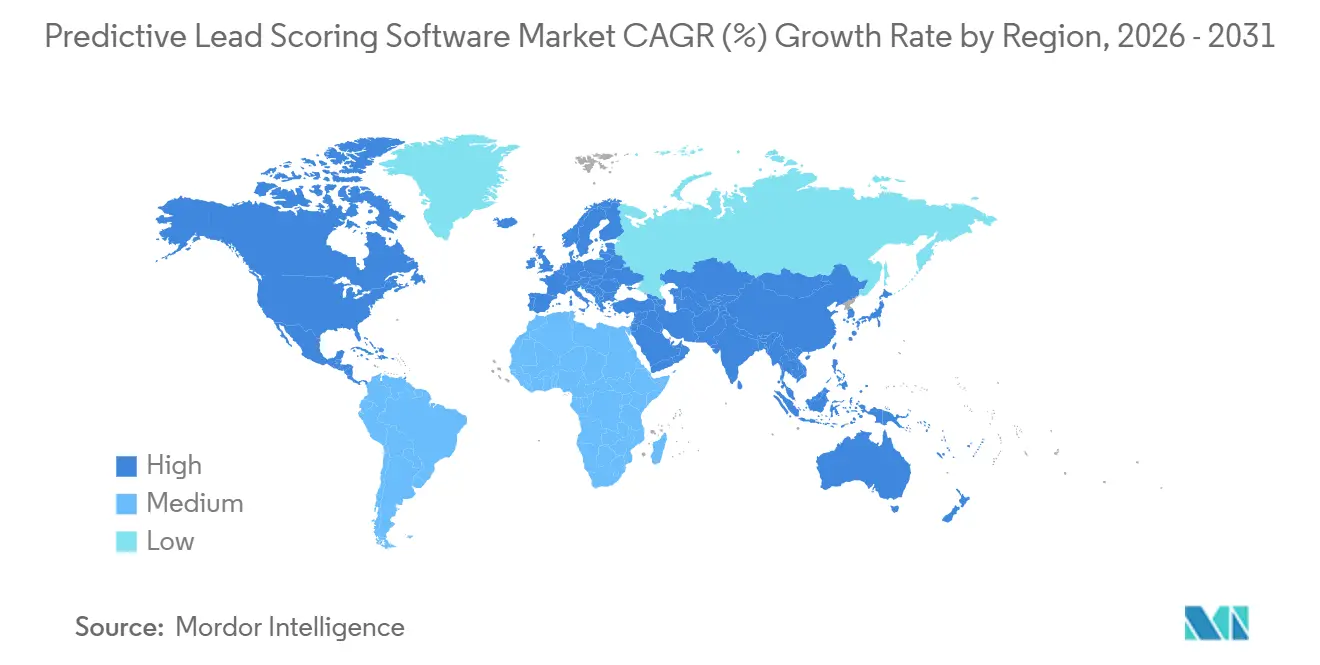
North America accounted for 36.71% of global revenue in 2025, making it the largest market share holder in the predictive lead scoring software market. The region benefits from deep CRM penetration, a high concentration of B2B software companies, and selling environments where customer acquisition costs are already under pressure. Those conditions make lead prioritization easier to justify and faster to operationalize than in less mature software markets. Europe remained the second-largest region, supported by enterprise demand in Germany, the United Kingdom, and France. The predictive lead scoring software market in Europe also reflects a stronger focus on explainability, audit trails, and data-handling controls, as buyers often treat these features as procurement requirements rather than optional upgrades.
Europe and APAC Predictive Lead Scoring Software Market
The EU AI Act added another layer to that regional pattern as its general-purpose AI obligations became applicable in August 2025 and broader high-risk system provisions rolled into 2026 enforcement. This is pushing vendors in the predictive lead-scoring software market to place greater emphasis on transparency, documentation, and model governance when serving European customers. Asia-Pacific is projected to grow at a 25.92% CAGR through 2031, making it the fastest-growing regional segment in the predictive lead scoring software market. India and Southeast Asia are emerging as the main growth engines, while Japan and South Korea continue to build on established enterprise bases.
APAC, South America and MEA Predictive Lead Scoring Software Market
Salesforce reported in July 2026 that 81% of marketers in India had adopted AI in their workflows, which shows that the region is already moving beyond early experimentation. Japan is also progressing as localization improves and local enterprises become more comfortable using AI within customer-facing workflows. South America is still in earlier stages of development, but Brazil and Argentina are seeing demand as financial services and digital commerce firms update their sales systems. The Middle East and Africa remain a smaller opportunity set, with the strongest activity concentrated in the UAE and Saudi Arabia, where national digitalization programs are supporting wider AI software adoption.
Competitive Landscape
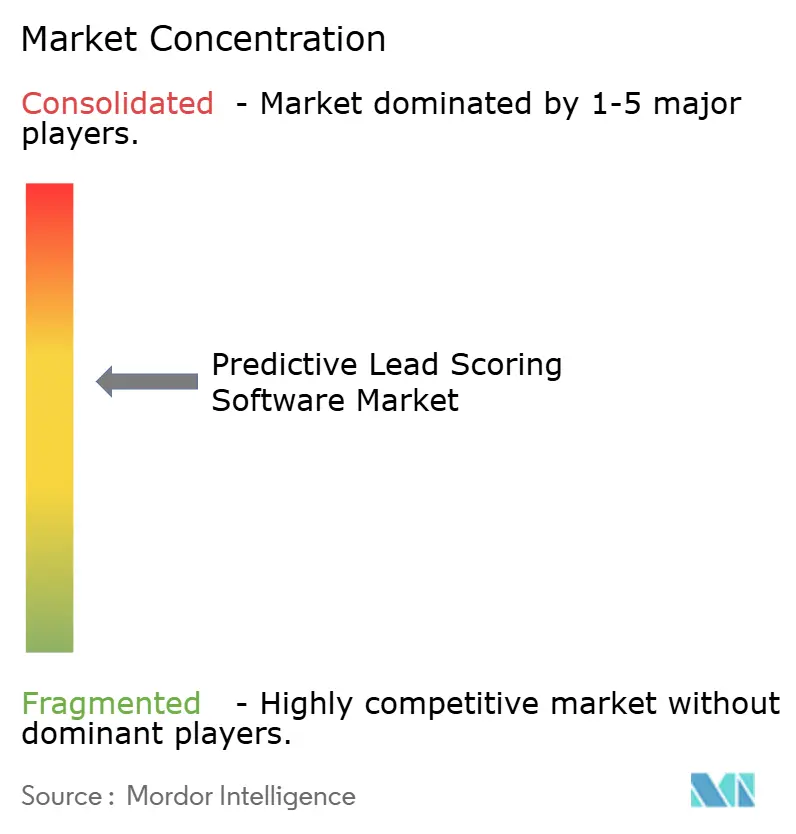
The predictive lead scoring software market remains moderately concentrated at the top, with large CRM and marketing platform vendors holding an advantage through installed customer bases and native feature embedding. Salesforce, Microsoft, HubSpot, and Adobe benefit from existing workflow ownership, which gives them direct access to the data layers where scoring models perform best. In the predictive lead-scoring software market, this reduces the need for separate buying decisions and makes entry more difficult for stand-alone vendors offering only basic scoring features. Specialists still compete effectively when they offer better intent data, stronger explainability, or deeper support for account-level orchestration. That is why the predictive lead scoring software market shows both platform concentration and active specialist competition simultaneously.
Strategic moves since 2025 show how fast the category is converging with broader revenue systems. Clari and Salesloft completed their merger in December 2025 and said the combined platform would manage USD 10 trillion in annual revenue across more than 5,000 organizations, with a roadmap focused on a predictive revenue system. Apollo.io also acquired Pocus in March 2026 to deepen its signal intelligence and account-prioritization capabilities, thereby strengthening its move upmarket. These moves show that the predictive lead scoring software market is no longer centered on isolated ranking tools, because vendors are building larger operating systems around scoring outputs.
Interoperability is becoming another major battleground in the predictive lead scoring software market. 6sense launched its MCP Server in open beta in July 2026, enabling external AI agents to use its buying-stage and account qualification signals without custom integration. Outreach reached general availability for its own MCP Server in February 2026, which showed that workflow context and model output are being designed for cross-platform use. The predictive lead scoring software market also has room for vertical models, managed offerings for SMEs, and governance layers that support explainable, auditable deployment. Research in the Journal of Cybersecurity and Privacy in 2026 reinforced that demand by outlining a modular framework for GDPR-aligned decision transparency in AI systems.
Predictive Lead Scoring Software Industry Leaders
-
Salesforce, Inc.
-
HubSpot, Inc.
-
6sense, Inc.
-
Adobe Inc.
-
Microsoft Corporation
- *Disclaimer: Major Players sorted in no particular order
Predictive Lead Scoring Software Market Companies Covered in this Report
- 6sense, Inc.
- HubSpot, Inc.
- Salesforce, Inc.
- Adobe Inc.
- Zoho Corporation Pvt. Ltd.
- Microsoft Corporation
- Oracle Corporation
- Freshworks Inc.
- Pipedrive, Inc.
- LeadSquared Inc.
- Demandbase, Inc.
- Clari Inc.
- Apollo.io, Inc.
- ActiveCampaign, LLC
- SugarCRM Inc.
- Qualified.com
- MadKudu, Inc.
- Outreach Corporation
- ZoomInfo, Inc
Recent Industry Developments in Predictive Lead Scoring Software Market
- July 2026: 6sense launched the 6sense MCP (model context protocol) Server in open beta, making its predictive buying stage data, keyword intent, 6sense Qualified Account status, and account insights callable from any MCP-compatible AI agent, including Claude, ChatGPT, Writer, and Salesforce Agentforce, without custom integration; this repositions 6sense's proprietary Signalverse intent network (spanning over 200,000 B2B properties built over 13 years) as an open composable intelligence layer for the agentic era, with general availability planned for August 2026.
- May 2026: Outreach announced a native bidirectional integration with ServiceNow Sales CRM at Knowledge 2026, enabling revenue teams to execute lead scoring-informed sales workflows directly inside ServiceNow while maintaining automatic data alignment between Outreach and CRM, expanding the platform's footprint beyond Salesforce-centric deployments.
- April 2026: Outreach launched Outreach Omni and Agent Studio at its Spring 2026 product release, allowing revenue teams to build custom AI agents that act on scored leads, execute outreach sequences, and escalate decisions to humans within a governed multi-agent framework, extending predictive scoring outputs into autonomous execution workflows.
- April 2026: HubSpot's Spring 2026 Spotlight introduced the Prospecting Agent (handling full prospecting lifecycle from buying signal identification to personalized outreach drafting) and Smart Deal Progression (AI-powered CRM update suggestions based on call transcripts and deal history), with early users reporting 2x industry benchmark outreach response rates; priced at USD 1 per recommended lead for accessibility at mid-market scale.
Global Predictive Lead Scoring Software Market Report Scope
The predictive lead scoring software market refers to the ecosystem of software solutions and associated services that leverage machine learning, artificial intelligence, and statistical algorithms to evaluate and rank prospective customers based on their likelihood of converting into paying customers. Unlike traditional rule-based scoring methods that rely on manual criteria, predictive models automatically analyze vast amounts of historical and real-time behavioral data, including demographic information, website engagement, email interactions, and CRM history, to generate dynamic, accurate lead scores. Deployed across cloud-based, hybrid, and on-premises environments, these solutions cater to organizations of all sizes across diverse industries such as BFSI, IT, retail, and healthcare. The primary applications include lead qualification and prioritization, sales opportunity management, marketing campaign optimization, and account-based marketing (ABM). By enabling sales and marketing teams to align their efforts and focus exclusively on high-intent, high-value prospects, predictive lead scoring software helps businesses increase conversion rates, reduce customer acquisition costs, shorten sales cycles, and maximize overall revenue.
The Predictive Lead Scoring Software Market Report is Segmented by Component (Software and Services), Deployment (Cloud-Based, Hybrid, and On-Premises), Enterprise Size (Large Enterprises and Small and Medium Enterprises), Application (Lead Qualification and Prioritization, Sales Opportunity Management, Marketing Campaign Optimization, Customer Acquisition and Conversion Optimization, and Account-Based Marketing (ABM)), End User (IT and Telecommunication, BFSI, Healthcare and Life Sciences, Retail and E-Commerce, Industrial Manufacturing, Education and Research Institutions, Media and Entertainment, Government and Administration, Energy and Utilities, and Other End-User Industries), and Geography (North America, South America, Europe, Asia-Pacific, and Middle East and Africa). The Market Forecasts are Provided in Terms of Value (USD).
Segmentation Overview
| Software |
| Services |
| Cloud-Based |
| Hybrid |
| On-Premises |
| Large Enterprises |
| Small and Medium Enterprises |
| Lead Qualification and Prioritization |
| Sales Opportunity Management |
| Marketing Campaign Optimization |
| Customer Acquisition and Conversion Optimization |
| Account-Based Marketing (ABM) |
| IT and Telecommunication |
| BFSI |
| Healthcare and Life Sciences |
| Retail and E-Commerce |
| Industrial Manufacturing |
| Education and Research Institutions |
| Media and Entertainment |
| Government and Administration |
| Energy and Utilities |
| Other End User Industries |
| North America | United States | |
| Canada | ||
| Mexico | ||
| South America | Brazil | |
| Argentina | ||
| Rest of South America | ||
| Europe | Germany | |
| United Kingdom | ||
| France | ||
| Russia | ||
| Spain | ||
| Rest of Europe | ||
| Asia-Pacific | China | |
| Japan | ||
| India | ||
| South Korea | ||
| Southeast Asia | ||
| Rest of Asia-Pacific | ||
| Middle East and Africa | Middle East | Saudi Arabia |
| United Arab Emirates | ||
| Rest of Middle East | ||
| Africa | South Africa | |
| Nigeria | ||
| Rest of Africa | ||
| By Component | Software | ||
| Services | |||
| By Deployment | Cloud-Based | ||
| Hybrid | |||
| On-Premises | |||
| By Enterprise Size | Large Enterprises | ||
| Small and Medium Enterprises | |||
| By Application | Lead Qualification and Prioritization | ||
| Sales Opportunity Management | |||
| Marketing Campaign Optimization | |||
| Customer Acquisition and Conversion Optimization | |||
| Account-Based Marketing (ABM) | |||
| By End User Industry | IT and Telecommunication | ||
| BFSI | |||
| Healthcare and Life Sciences | |||
| Retail and E-Commerce | |||
| Industrial Manufacturing | |||
| Education and Research Institutions | |||
| Media and Entertainment | |||
| Government and Administration | |||
| Energy and Utilities | |||
| Other End User Industries | |||
| By Geography | North America | United States | |
| Canada | |||
| Mexico | |||
| South America | Brazil | ||
| Argentina | |||
| Rest of South America | |||
| Europe | Germany | ||
| United Kingdom | |||
| France | |||
| Russia | |||
| Spain | |||
| Rest of Europe | |||
| Asia-Pacific | China | ||
| Japan | |||
| India | |||
| South Korea | |||
| Southeast Asia | |||
| Rest of Asia-Pacific | |||
| Middle East and Africa | Middle East | Saudi Arabia | |
| United Arab Emirates | |||
| Rest of Middle East | |||
| Africa | South Africa | ||
| Nigeria | |||
| Rest of Africa | |||
Key Questions Answered in the Report
What is the current and forecast value of predictive lead scoring software?
The predictive lead scoring software market size stood at USD 2.07 billion in 2025, reaches USD 2.46 billion in 2026, and is forecast to reach USD 6.28 billion by 2031 at a 20.62% CAGR.
Why are companies investing more in predictive lead scoring software?
Organizations are using these tools to prioritize sales effort, reduce manual review, and improve conversion quality as lead volumes and account signals become harder to manage manually.
Which deployment model leads adoption today?
Cloud-based deployment led with 68.19% revenue share in 2025 because real-time syncing, live signal ingestion, and easier scaling fit current sales and marketing systems.
Which application is growing the fastest in this space?
Account-based marketing is the fastest-growing application, projected to expand at a 26.43% CAGR through 2031 as buyers move toward account-level intelligence and buying-stage analysis.
Which customer segment is expanding the fastest?
SMEs are projected to grow at a 24.17% CAGR through 2031 as embedded AI in cloud CRM tools lowers the cost and complexity of adoption.
Which region offers the strongest growth outlook?
Asia-Pacific is projected to record the fastest regional growth at a 25.92% CAGR through 2031, supported by rising AI adoption and expanding cloud software use across major economies.