
Precision Weeding Market Size and Share
Market Overview
| Study Period | 2021 - 2031 |
|---|---|
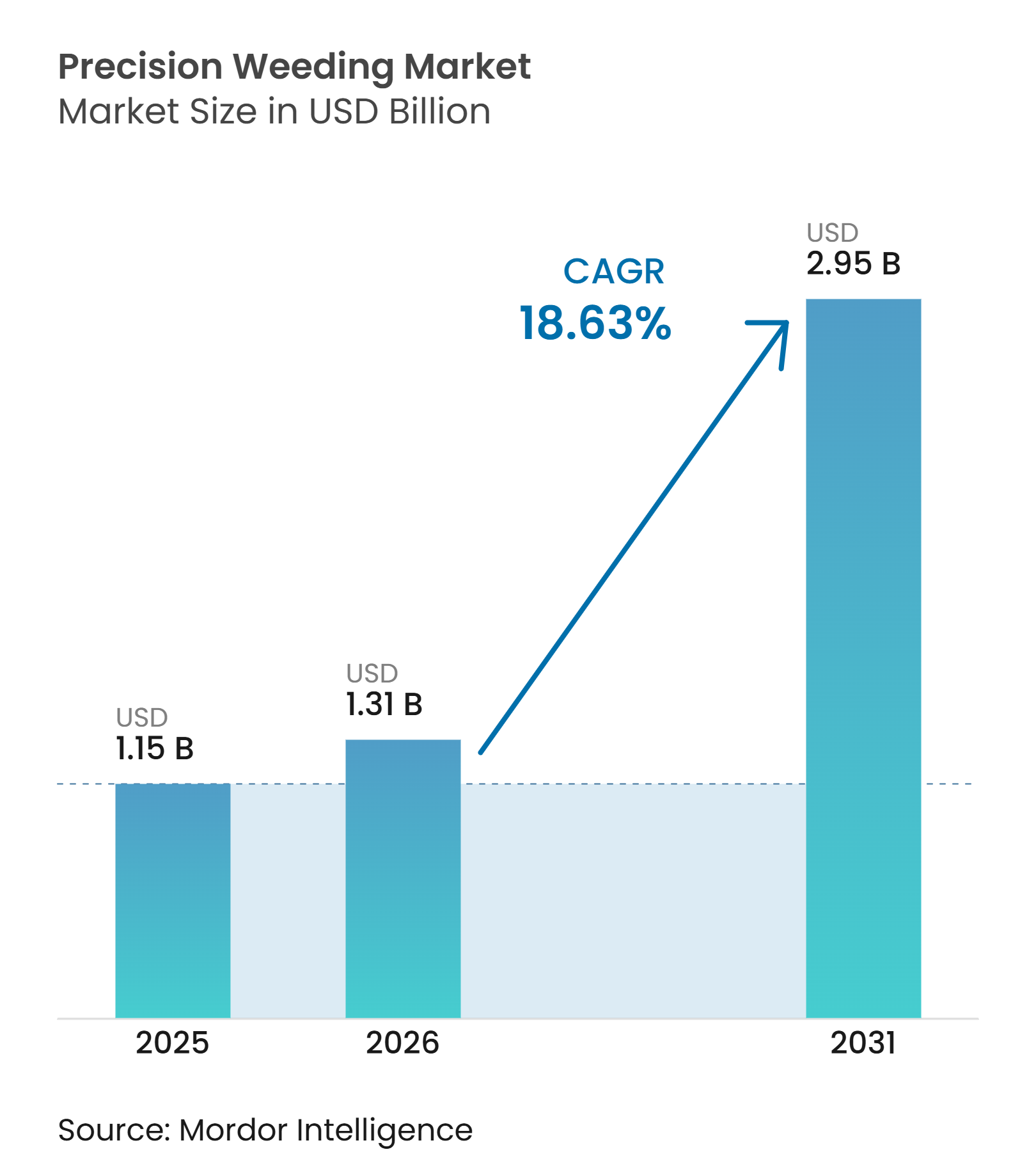
| Market Size (2026) | USD 1.31 Billion |
| Market Size (2031) | USD 2.95 Billion |
| Growth Rate (2026 - 2031) | 18.63 % |
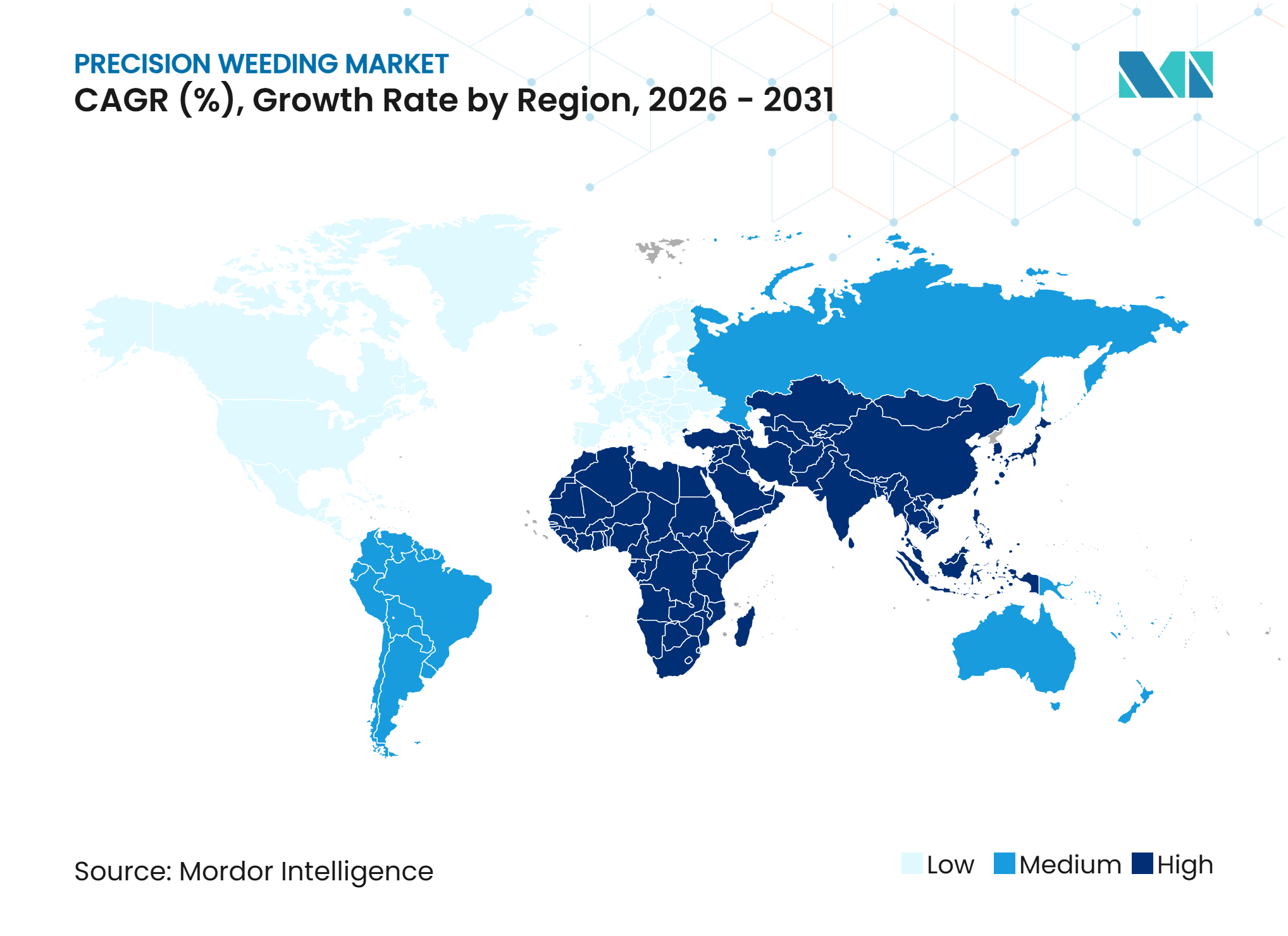
| Fastest Growing Market | Asia-Pacific |
| Largest Market | Europe |
| Market Concentration | Medium |
Major Players *Disclaimer: Major Players sorted in no particular order Image © Mordor Intelligence. Reuse requires attribution under CC BY 4.0. | |
Precision Weeding Market Analysis by Mordor Intelligence
The precision weeding market size is projected to expand from USD 1.15 billion in 2025 to USD 2.95 billion by 2031, registering a CAGR of 17.6% between 2026 and 2031. The market is moving away from blanket herbicide use and manual weeding toward systems that identify and treat individual plants. Herbicide resistance, tighter availability of farm labor, and lower costs of vision and robotics hardware are supporting this change. Data collected from commercial fleets can improve weed-recognition models as more systems operate in different crops and field conditions. This favors early deployers who can build operational datasets, while high equipment costs and field performance limits continue to narrow the pool of viable adopters.
Key Report Takeaways
- By type, weed management was the largest segment, holding 68% of the precision weeding Market share in 2025, while weed detection platforms are the fastest-growing segment, with a projected 21.7% CAGR during 2026–2031.
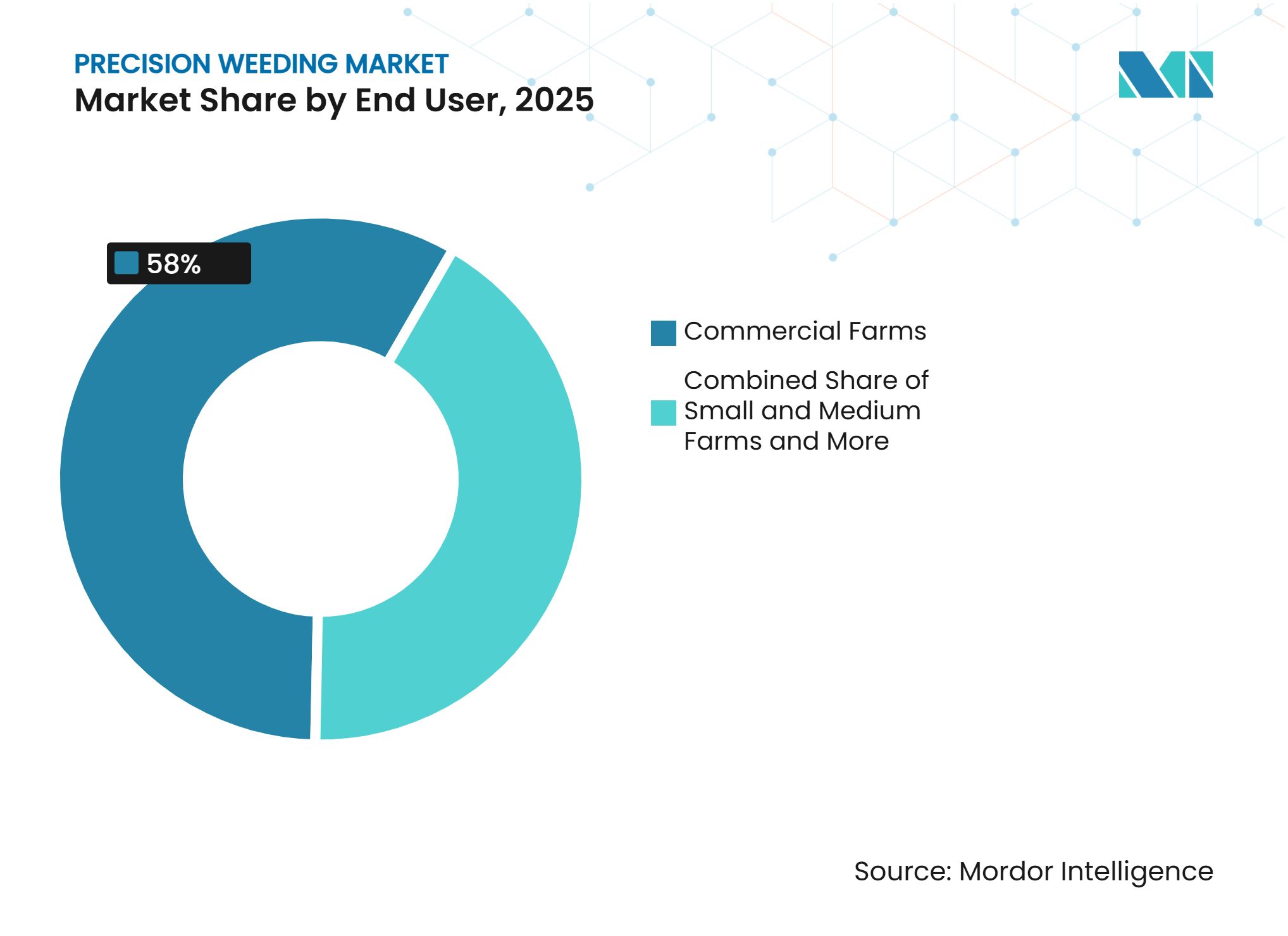
- By end user, commercial farms were the largest segment, accounting for 58% of the precision weeding market size in 2025, while small and medium farms are the fastest-growing segment, with a projected 19.8% CAGR during 2026–2031.
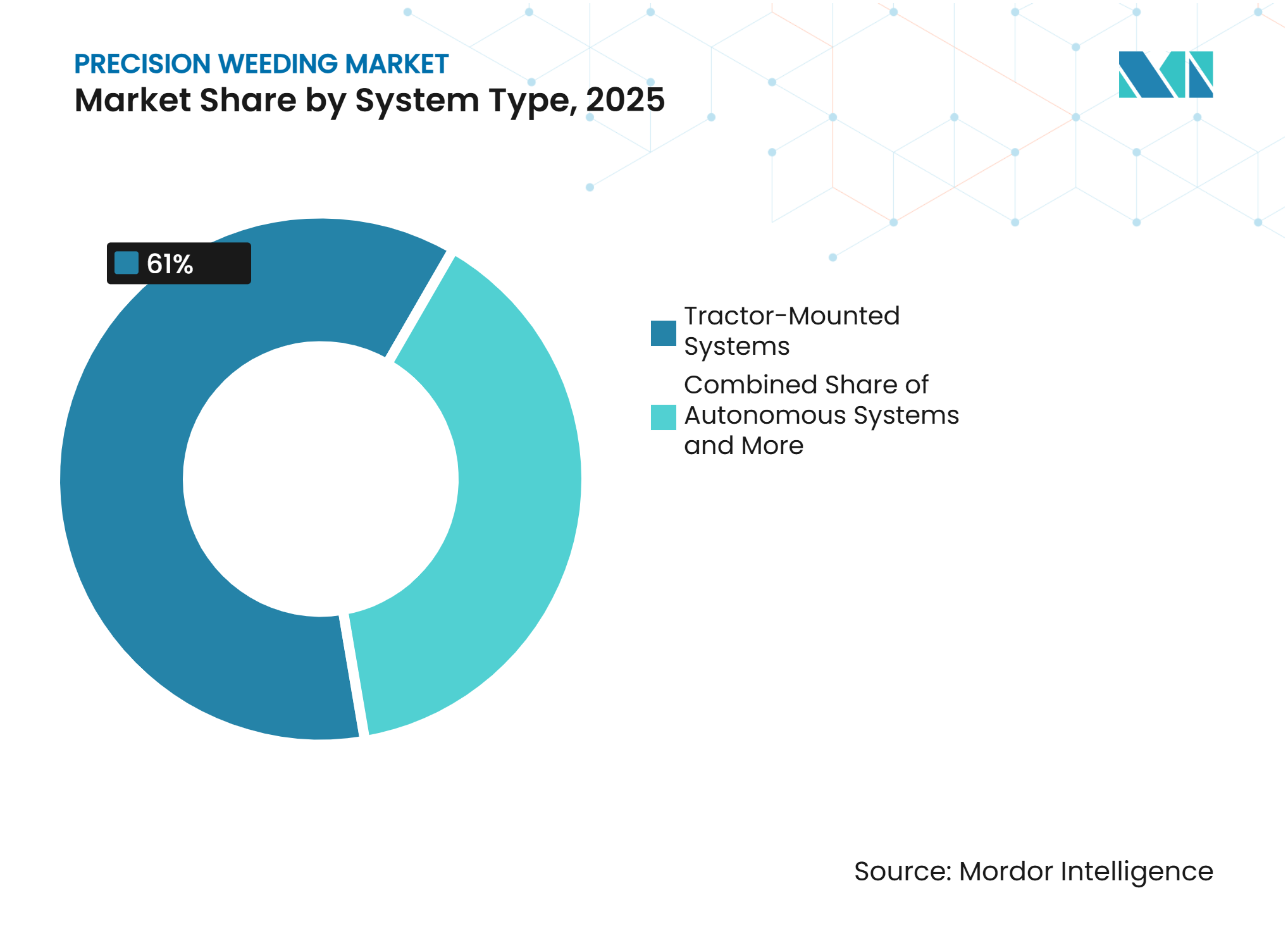
- By system type, tractor-mounted systems were the largest segment with 61% share in 2025. While autonomous systems are the fastest-growing segment, with a projected 25.1% CAGR during 2026–2031.
- By geography, Europe was the largest region with 34% share in 2025, while Asia-Pacific is the fastest-growing region, with a projected 24.5% CAGR during 2026–2031.
Note: Market size and forecast figures in this report are generated using Mordor Intelligence’s proprietary estimation framework, updated with the latest available data and insights as of January 2026.
Market Trends and Insights
Drivers Impact Analysis of Precision Weeding Market*
| Driver | (~) % Impact on CAGR Forecast | Geographic Relevance | Impact Timeline |
|---|---|---|---|
| Rising cost and scarcity of manual weed-control labor | +3.5% | Global, most acute in North America and Europe | Short term (≤ 2 years) |
| Increasing herbicide resistance and reduced effectiveness of blanket spraying | +3.2% | Global, acute in North America and South America | Medium term (2-4 years) |
| Demand for lower chemical use and residue-controlled production | +2.8% | Europe and North America core, growing in Asia-Pacific | Medium term (2-4 years) |
| Improving artificial intelligence and machine-vision performance | +2.5% | Global, early gains concentrated in North America and Europe | Long term (≥ 4 years) |
| Fleet-based weed-recognition learning effects | +1.8% | North America and Europe primarily, spreading to Asia-Pacific | Long term (≥ 4 years) |
| Retrofit compatibility reduces adoption friction | +1.5% | Global, highest impact in North America and South America | Short term (≤ 2 years) |
| Source: Mordor Intelligence | |||
Rising Cost and Scarcity of Manual Weed-Control Labor
Labor availability is a direct reason for growers to evaluate automated weed-control systems. The United States Congressional Research Service reported in 2025 that agricultural labor costs exceed one-third of specialty-crop production expenses[1]. Weeding requires repeated field work and can be difficult to schedule when seasonal labor is scarce. Precision systems reduce dependence on manual crews where acreage and crop value can support the investment. Rural-to-urban migration in China and India also reduces the seasonal labor pool used for in-row weed management, supporting demand for automation in the Asia-Pacific.
Increasing Herbicide Resistance and Reduced Effectiveness of Blanket Spraying
Herbicide resistance is making conventional weed control less reliable in many crop systems. The Weed Science Society of America reported in November 2025 that practitioners saw limited herbicide-control options for troublesome weed species. Blanket spraying can continue selection pressure within fields where resistant populations are already established. Targeted spraying, mechanical removal, and laser treatment give growers alternative intervention methods. The Precision Weeding Market is therefore supported by the need to manage weeds without relying on a single herbicide approach.
Improving Artificial Intelligence and Machine-Vision Performance
Better image processing is addressing the challenge of identifying weeds across changing field conditions. A 2025 Agronomy study reported 90% mAP@0.5 weed-detection accuracy for the GTDR-YOLOv12 model, together with a 17% reduction in computational complexity. The WeedSwin architecture achieved 0.993 mAP in a 2025 Scientific Reports assessment covering 16 weed species and 11 growth stages. These results indicate that real-time detection can be used on compact edge hardware. Better detection improves the value of mechanical, laser, and targeted-spray systems because treatment depends on accurate plant classification. It also gives vendors a stronger basis for offering performance commitments to cautious growers.
Retrofit Compatibility Reduces Adoption Friction
Many growers prefer systems that build on equipment and service relationships already in place. Tractor-mounted implementations reduce the need to purchase a separate field vehicle and can use established operator routines. Rometron B.V.'s WEED-IT and Ecorobotix SA's ARA Ultra-High Precision Sprayer are ISOBUS-compatible tractor-mounted implements. Compatibility can reduce training, maintenance, and integration requirements for a farm. Deere and Company reported that See and Spray operated across more than 5 million acres in 2025, showing the reach available through established equipment channels. This route is particularly relevant in regions with a large installed tractor base.
Restraints Impact Analysis of Precision Weeding Market*
| Restraint | (~) % Impact on CAGR Forecast | Geographic Relevance | Impact Timeline |
|---|---|---|---|
| High upfront cost and uncertain return on investment | -2.80% | Global, most acute in Africa, the Middle East, and South America | Short term (≤ 2 years) |
| Variable detection accuracy in complex field conditions | -1.50% | Global, most pronounced in Asia-Pacific and South America | Medium term (2-4 years) |
| Integration, calibration, and data-interoperability burden | -1.20% | Global, highest impact in Asia-Pacific and the Middle East and Africa | Medium term (2-4 years) |
| Throughput, reliability, and maintenance constraints in intensive operations | -1.00% | Global, most acute in Africa and the Middle East | Long term (≥ 4 years) |
| Source: Mordor Intelligence | |||
High Upfront Cost and Uncertain Return on Investment
Capital cost remains the principal barrier for smaller farms. An economic analysis published in Precision Agriculture in 2026 found that real-time spot spraying was economically justified for sugar beet farms larger than 60-172 hectares and cereal farms larger than 300-400 hectares in Northwest Germany. Seasonal variation in weed pressure further complicates investment decisions because returns can vary from year to year. Deere and Company introduced its Application Savings Guarantee in 2025, charging per acre only when measurable herbicide savings were achieved. This type of model shifts part of the financial risk to the provider. Smaller operations can still remain below the scale needed to cover connectivity and maintenance costs.
Integration, Calibration, and Data-Interoperability Burden
Precision equipment must operate reliably with the farm's tractors, implements, software, and field practices. Calibration is important because small errors in sensing or nozzle timing can compromise targeted treatment. Farms may also need training and technical support to use image, location, and application data effectively. These requirements can be harder to address where local dealer and service networks are limited. The burden is most acute when equipment from different suppliers must work together. It can delay purchases even where labor and herbicide savings appear attractive.
*Our forecasts treat driver/restraint impacts as directional, not additive. The impact forecasts reflect baseline growth, mix effects, and variable interactions.
Precision Weeding Market Segment Analysis
By End User:
Commercial Farms Lead Demand While Smaller Farms Grow FasterCommercial farms held 58% of the precision weeding market share in 2025. Large operators can spread the cost of a precision implement across more hectares and assess savings from labor and herbicide use over repeated seasons. Their field scale also supports the use of systems that require trained operators, connected equipment, and regular maintenance. Commercial vegetable and specialty-crop operations can face particularly high hand-weeding requirements. Verdant Robotics and Carbon Robotics have reported typical payback periods of 6-18 months for commercial customers, including 7 months for some high-labor-cost users, although these are company disclosures.
Small and medium farms are the fastest end-user segment, with a 19.8% CAGR during 2026–2031. Modular systems and equipment-as-a-service models lower the barrier created by a full equipment purchase. The U.S. Department of Agriculture's National Institute of Food and Agriculture reported in 2025 that technologies adopted following automated-weeding workshops saved an estimated 114,000 labor hours and USD 1.4 million annually [2]. Demonstration-based adoption is important because growers need evidence that a system works under local field conditions. Research stations, contractors, and public demonstration programs can extend access by sharing equipment among farms.



By Type:
Weed Management Holds the Largest Position While Detection Platforms ExpandWeed management accounted for 68% of the precision weeding market in 2025. Chemical application platforms, mechanical weeders, and robotic actuators have a higher per-unit value than standalone detection hardware. Robotic weeders that combine detection and intervention are relevant in specialty vegetables and organic row crops with fewer chemical options. Chemical application systems continue to serve conventional broadacre crops. Targeted chemical application remains important in broadacre cropping because it directly links plant recognition to treatment decisions.
Weed detection platforms are the fastest-growing segment, at a 21.7% CAGR during 2026–2031. Cameras and LiDAR are being used to map weed populations, guide actuation, and collect images for model improvement. Connected detection platforms can improve as field images are incorporated into weed-recognition workflows. LiDAR, sensor networks, and multispectral systems remain at an earlier revenue stage. Their role is most relevant where camera-only systems struggle with crop cover, early emergence, or variable lighting.
By System Type:
Tractor-Mounted Systems Lead While Autonomous Systems ScaleTractor-mounted systems held 61% of the precision weeding market share in 2025. The segment benefits from the global installed base of agricultural tractors and lower incremental investment than a dedicated autonomous platform. Farmers can add precision capability while retaining existing operator practices and service channels. Rometron B.V.'s WEED-IT and Ecorobotix SA's ARA systems show how tractor-mounted architectures can deliver selective application. This structure supports demand where farms need broad coverage and conventional equipment remains central to field operations, while preserving familiar repair arrangements and operator responsibilities.
Autonomous systems are the fastest system type, recording a 25.1% CAGR during 2026–2031. Their value proposition centers on continuous field operation and lower dependence on manual labor. Ecorobotix reported in March 2026 that 1,000 ARA ultra-high precision sprayers had been deployed in more than 30 countries. Self-propelled, semi-autonomous, and vehicle-mounted systems address different crop and field layouts. Their growth is constrained by throughput, maintenance, and per-hectare economics in broadacre applications.

Geography Analysis
Europe held 34% of the precision weeding market share in 2025. The region combines regulatory pressure, established precision-farming suppliers, and high agricultural labor costs. The Farm to Fork Strategy set a 50% pesticide-reduction target for 2030, supporting interest in targeted application. European manufacturers, including HORSCH Maschinen GmbH, LEMKEN GmbH and Co. KG, Garford Farm Machinery Ltd, and Einböck GmbH and Co. KG, have experience with camera-guided hoeing. The AGROSUS project reported in 2025 that it had validated alternative weed-management approaches across more than 70 experimental units in 11 countries [3].
Asia-Pacific is the fastest regional segment, with a 24.5% CAGR during 2026–2031. China faces a shrinking rural labor pool while public programs promote agricultural mechanization and robotics. Japan's aging farming population supports demand for labor-saving systems in paddy and vegetable farming. Australian broadacre farms provide a relevant setting for high-throughput detection and targeted spraying. The region’s large fields make it a relevant test case for systems that must sustain detection quality and workable coverage at scale.
North America remains a major contributor because large row-crop farms and specialty vegetable operations can absorb capital-intensive equipment. Demand also benefits from the commercial expansion of targeted-spraying systems in major row-crop applications. South America faces herbicide resistance in soybean and maize systems, although financing and variable field conditions limit adoption. The Middle East and Africa face similar barriers in dealer coverage and agricultural finance. Food-security priorities and higher labor costs may support investment later in the forecast period. The precision weeding market will depend on whether suppliers can adapt systems and commercial models to these operating conditions.
Competitive Landscape
Market Concentration
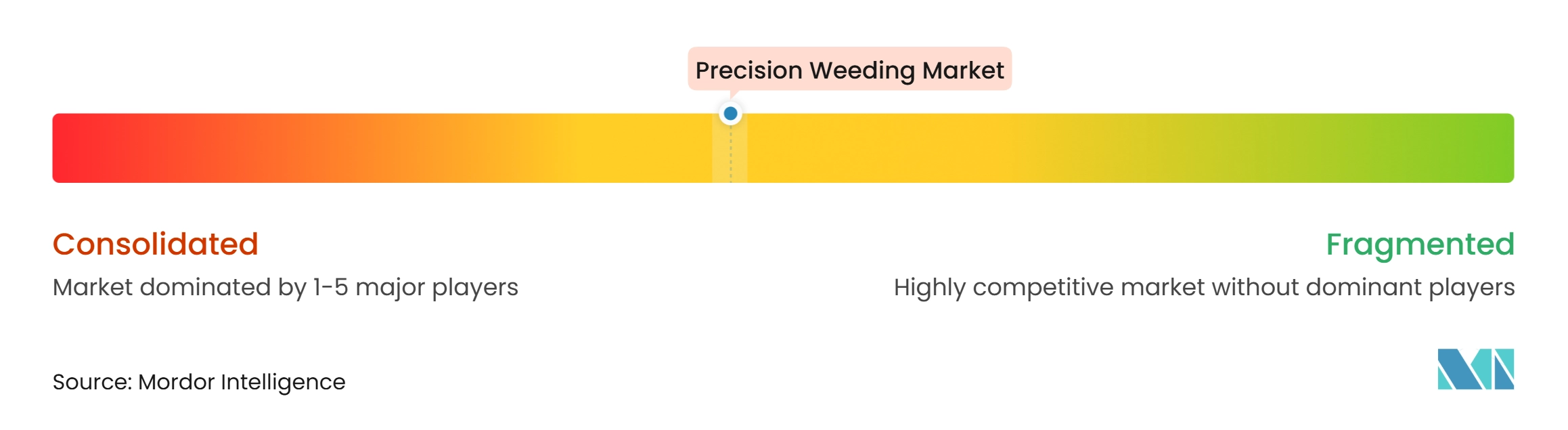
The precision weeding market has moderate concentration. Deere and Company, CNH Industrial N.V., AGCO Corporation and PTx Trimble LLC, and Bosch BASF Smart Farming GmbH have broad distribution reach in tractor-mounted targeted-spraying applications. Their factory integration, dealer coverage, and service networks can reduce friction in adoption for farm customers. Specialist providers such as Ecorobotix SA, Carbon Robotics, FarmWise Labs, Inc., and Verdant Robotics, Inc. compete in laser, robotic, and autonomous applications. No supplier has eliminated competition across all crop types, system architectures, and regional markets.
Data scale is becoming an important competitive factor. Carbon Robotics stated that its Large Plant Model draws on data from 150 million labeled plant images, which can improve recognition coverage across different environments. Deere and Company's connected equipment platform can similarly support data collection across a large installed base. These networks can raise switching costs when users benefit from improving detection models and integrated equipment workflows. Hardware suppliers without comparable field data must compete through equipment performance, price, service, or focused crop coverage. The market therefore combines scale advantages for incumbents with opportunities for focused specialists.
Companies are using product development and commercial models to broaden access. Deere and Company announced See and Spray Gen 2 in January 2026, adding targeted weed detection and application for wheat, barley, and canola. Ecorobotix SA announced in March 2026 a USD 50 million investment over 3 years to expand United States operations and assemble ARA sprayers in Lyons, Kansas. Verdant Robotics expanded SharpShooter into grass seed and sod production in April 2026. These moves address crop coverage, local delivery capacity, and application-specific performance, rather than relying on a single system configuration for every farm.
Precision Weeding Industry Leaders
-
Deere & Company
-
CNH Industrial N.V.
-
AGCO Corporation
-
Bosch BASF Smart Farming (BBSF) GmbH
-
Rometron B.V. (WEED-IT)
- *Disclaimer: Major Players sorted in no particular order
Precision Weeding Market Companies Covered in this Report
- Deere & Company
- CNH Industrial N.V.
- AGCO Corporation and Trimble Inc. (PTx Trimble LLC)
- Bosch BASF Smart Farming (BBSF) GmbH
- XAG Co., Ltd.
- Rometron B.V. (WEED-IT)
- Ecorobotix SA
- Carbon Robotics
- LEMKEN GmbH & Co. KG
- HORSCH Maschinen GmbH
- Einböck GmbH
- Garford Farm Machinery Ltd
- FarmWise Labs, Inc.
- Verdant Robotics, Inc.
Recent Industry Developments in Precision Weeding Market
- April 2026: Verdant Robotics, Inc. expanded its SharpShooter precision application system into grass seed and sod production. The company reported up to 99% herbicide savings, up to 85% labor-cost reductions, and a typical return on investment within 6-18 months
- March 2026: Ecorobotix SA announced a USD 50 million investment over 3 years to expand United States operations and establish ARA Ultra-High Precision Sprayer assembly in Lyons, Kansas. The company stated that the expansion would create more than 80 jobs.
- January 2026: Deere and Company announced See and Spray Gen 2 for its Model Year 2027 sprayer range. The update extended targeted weed detection and precision application to wheat, barley, and canola and enabled in-crop operation at any time of day
Global Precision Weeding Market Report Scope
The scope covers precision weeding technologies, systems, and solutions enabling targeted weed detection, identification, and management across agricultural operations.
The Precision Weeding Market Report is Segmented by End User (Commercial Farms, Small and Medium Farms, and Others), Type (Weed Detection Platform, including Camera-Based Systems, LiDAR-Based Systems, Sensor Networks, and Other Platforms, and Weed Management, including Mechanical Weeding, Chemical Application Systems, Robotic Weeders, and Others), System Type (Autonomous Systems, Tractor-Mounted Systems, and Other System Type), and Geography (North America, Europe, Asia-Pacific, South America, Middle East, and Africa). The Market Forecasts are Provided in Terms of Value (USD).
Segmentation Overview
| Commercial Farms |
| Small and Medium Farms |
| Others |
| Weed Detection Platform | Camera-Based Systems |
| LiDAR-Based Systems | |
| Sensor Networks | |
| Other Platforms | |
| Weed Management | Mechanical Weeding |
| Chemical Application Systems | |
| Robotic Weeders | |
| Others |
| Autonomous Systems |
| Tractor-Mounted Systems |
| Other System Type |
| North America | United States |
| Canada | |
| Mexico | |
| Rest of North America | |
| Europe | Germany |
| France | |
| Spain | |
| Italy | |
| Russia | |
| Rest of Europe | |
| Asia-Pacific | China |
| India | |
| Japan | |
| Australia | |
| Rest of Asia-Pacific | |
| South America | Brazil |
| Argentina | |
| Rest of South America | |
| Middle East | United Arab Emirates |
| Saudi Arabia | |
| Turkey | |
| Rest of Middle East | |
| Africa | South Africa |
| Rest of Africa |
| By End User | Commercial Farms | |
| Small and Medium Farms | ||
| Others | ||
| By Type | Weed Detection Platform | Camera-Based Systems |
| LiDAR-Based Systems | ||
| Sensor Networks | ||
| Other Platforms | ||
| Weed Management | Mechanical Weeding | |
| Chemical Application Systems | ||
| Robotic Weeders | ||
| Others | ||
| By System Type | Autonomous Systems | |
| Tractor-Mounted Systems | ||
| Other System Type | ||
| By Geography | North America | United States |
| Canada | ||
| Mexico | ||
| Rest of North America | ||
| Europe | Germany | |
| France | ||
| Spain | ||
| Italy | ||
| Russia | ||
| Rest of Europe | ||
| Asia-Pacific | China | |
| India | ||
| Japan | ||
| Australia | ||
| Rest of Asia-Pacific | ||
| South America | Brazil | |
| Argentina | ||
| Rest of South America | ||
| Middle East | United Arab Emirates | |
| Saudi Arabia | ||
| Turkey | ||
| Rest of Middle East | ||
| Africa | South Africa | |
| Rest of Africa | ||
Key Questions Answered in the Report
What is driving adoption of precision weeding systems?
Labor scarcity, herbicide resistance, and pressure to reduce chemical use are driving adoption.
Which precision weeding system type is growing fastest?
Autonomous systems are the fastest system type, with a projected CAGR of 25.1% during 2026–2031.
How does precision weeding reduce herbicide use?
Detection systems identify weeds before a targeted sprayer, mechanical tool, or laser applies treatment.
Which region has the fastest growth for precision weeding?
Asia-Pacific is the fastest-growing region, with a projected 24.5% CAGR during 2026–2031.