
Power Generation Water Treatment Systems and Equipment Market Size and Share
Market Overview
| Study Period | 2021 - 2031 |
|---|---|
| Market Size (2026) | USD 8.54 Billion |
| Market Size (2031) | USD 11.39 Billion |
| Growth Rate (2026 - 2031) | 5.92 % |
| Fastest Growing Market | Asia-Pacific |
| Largest Market | Asia-Pacific |
| Market Concentration | Low |
Major Players *Disclaimer: Major Players sorted in no particular order Image © Mordor Intelligence. Reuse requires attribution under CC BY 4.0. | |
Power Generation Water Treatment Systems and Equipment Market Analysis by Mordor Intelligence
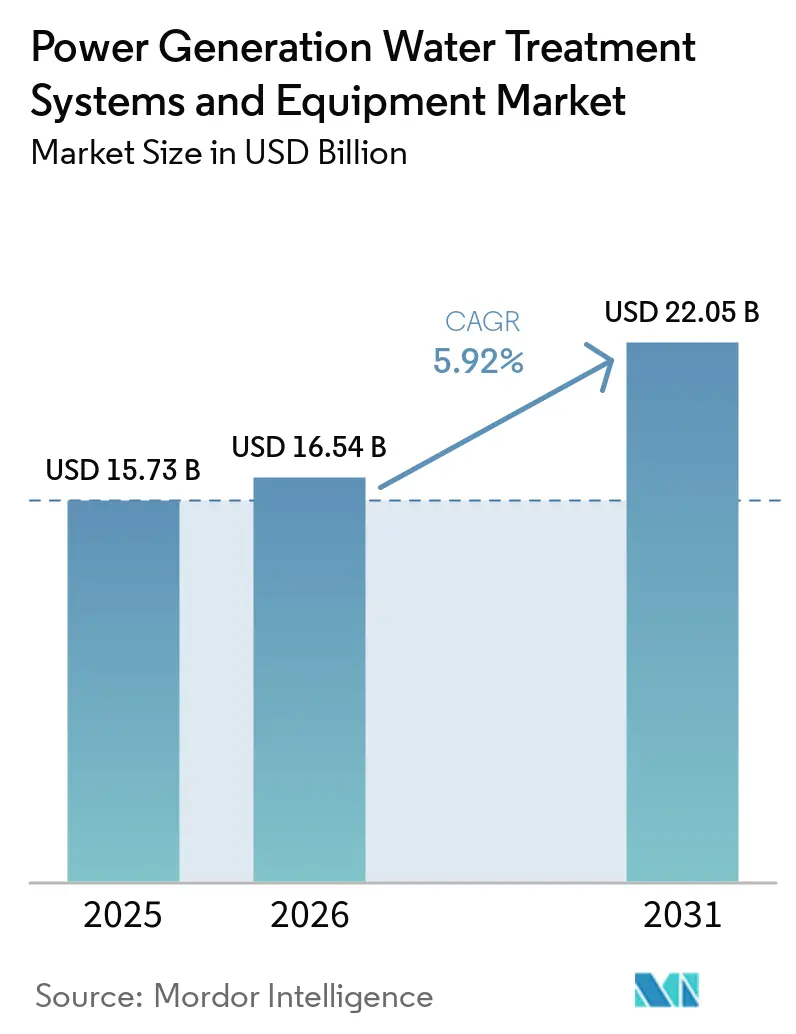
The Power Generation Water Treatment Systems And Equipment Market size is expected to increase from USD 8.13 billion in 2025 to USD 8.54 billion in 2026 and reach USD 11.39 billion by 2031, at a CAGR of 5.92% over 2026-2031. The power generation water treatment systems and equipment market is shaped by discharge regulations, water availability, and the higher-purity requirements of advanced steam cycles. Utilities are directing capital toward treatment upgrades where compliance deadlines, water shortages, and aging assets converge. This favors suppliers that can combine equipment, process design, and long-term operating support. Brownfield work is significant, as many operators require improved water recovery without prolonged outages, making retrofit solutions a key area of focus. The market also benefits from the growth of flexible generation, which increases the need for tighter chemical control and real-time monitoring to maintain system efficiency and meet regulatory standards.
Key Report Takeaways
- By treatment stage, Boiler Feedwater Treatment held 35.56% of the power generation water treatment systems and equipment market share in 2025, while Wastewater Treatment is forecast to grow at a 7.13% CAGR through 2031.
- By equipment type, Filtration Systems accounted for 32.67% of the power generation water treatment systems and equipment market share in 2025, while Membrane Systems are projected to grow at a 7.34% CAGR through 2031.
- By plant type, Coal-Fired Power Plants accounted for 34.81% in 2025, while Renewable Power Plants are projected to grow at a 7.48% CAGR through 2031.
- By project type, Brownfield Retrofit Projects held 44.78% in 2025 and are projected to grow at a 6.45% CAGR through 2031.
- By water source, Freshwater accounted for 60.43% in 2025, while Seawater is projected to grow at a 6.79% CAGR through 2031.
- By geography, Asia-Pacific held 40.57% in 2025 and is projected to grow at a 6.95% CAGR through 2031.
Note: Market size and forecast figures in this report are generated using Mordor Intelligence’s proprietary estimation framework, updated with the latest available data and insights as of January 2026.
Market Trends and Insights
Drivers Impact Analysis of Power Generation Water Treatment Systems and Equipment Market*
| Drivers | (~) % Impact on CAGR Forecast | Geographic Relevance | Impact Timeline |
|---|---|---|---|
| Stricter Power-Plant Effluent and Water-Intake Regulation | +1.4% | North America, Europe, and the Asia-Pacific | Medium term (2-4 years) |
| Expansion of High-Pressure, High-Efficiency Steam Cycles | +0.9% | Asia-Pacific and global new capacity | Long term (≥ 4 years) |
| Water Reuse and Zero Liquid Discharge Adoption in Water-Stressed Regions | +1.2% | Asia-Pacific, the Middle-East and Africa, and North America | Medium term (2-4 years) |
| Aging Treatment Assets and Brownfield Retrofit Demand | +0.8% | North America, Europe, China, and India | Short term (≤ 2 years) |
| Digital Water Balancing for Flexible and Hybrid Generation Fleets | +0.5% | Global, with early activity in the United Arab Emirates, India, the United States, and the Nordics | Medium term (2-4 years) |
| Source: Mordor Intelligence | |||
Stricter Power-Plant Effluent and Water-Intake Regulation
Regulatory compliance is a central reason utilities are investing in power plant water treatment. The US Environmental Protection Agency issued its Deadline Extensions Rule on December 23, 2025, covering flue gas desulfurization wastewater, bottom ash transport water, and combustion residual leachate. The rule extended certain zero-discharge compliance deadlines from December 2029 to December 2034, while keeping the underlying technology requirements in place[1]U.S. Environmental Protection Agency, “Steam Electric Power Generating Effluent Guidelines Deadline Extensions Rule,” U.S. Environmental Protection Agency, epa.gov. This defined timetable supports staged procurement rather than rushed end-of-cycle installations. As a result, the power generation water treatment systems and equipment market offers a longer window for utilities to plan treatment upgrades, evaluate technology options, and allocate capital across budget cycles. Operators still need to assess discharge streams, select suitable treatment trains, and demonstrate compliance under the applicable standards.
Water Reuse and Zero Liquid Discharge Adoption in Water-Stressed Regions
Water reuse is becoming a practical operating requirement where dependable freshwater supply is limited. Thermal generators are assessing wastewater as a recoverable input rather than solely a disposal stream. This shift is increasing interest in reuse systems, membrane treatment, evaporation, and crystallization steps within the power generation water treatment systems and equipment market. The need is greatest where plant water demand and local resource pressure occur simultaneously. Reclaimed water often requires extensive pretreatment, as it can carry higher dissolved solids, microbiological loads, and organic matter than conventional make-up water. Suppliers that can manage these feedwater conditions and integrate reuse equipment with plant operations are better positioned for long-term service work.
Expansion of High-Pressure, High-Efficiency Steam Cycles
Higher-pressure steam cycles require water quality that conventional filtration alone cannot consistently achieve. Ultra-supercritical and ultra-ultra-supercritical boilers require feedwater conductivity below 0.055 µS/cm and silica below 10 ppb under the applicable technical requirements. These specifications require integrated treatment trains that may combine two-pass reverse osmosis, electrodeionization, and final polishing. The resulting demand supports membrane and high-purity treatment applications within the power generation water treatment systems and equipment market. New thermal capacity additions in Asia-Pacific are particularly relevant, as advanced steam-cycle projects require treatment systems to be specified and procured during the design and commissioning phases. The same water quality requirements also create retrofit opportunities where older systems cannot reliably meet current operating specifications.
Aging Treatment Assets and Brownfield Retrofit Demand
Aging treatment assets are creating a substantial retrofit pipeline across established power fleets. Many older plants use ion exchange systems commissioned decades ago that now face tighter discharge and recovery expectations. Modern membrane-based systems can reduce chemical use, improve recovery rates, and integrate more readily with downstream zero liquid discharge processes. The power generation water treatment systems and equipment market is therefore supported by projects that improve asset performance rather than add generation capacity. Retrofit decisions also reflect broader asset management considerations, including groundwater risk around legacy ash ponds, regulatory scrutiny of aging infrastructure, and the cost of extended plant outages. Suppliers that can install modular systems and provide ongoing operations support are well positioned where utilities prefer phased replacements over full-scale overhauls.
Restraints Impact Analysis of Power Generation Water Treatment Systems and Equipment Market*
| Restraints | (~) % Impact on CAGR Forecast | Geographic Relevance | Impact Timeline |
|---|---|---|---|
| High Capital and Energy Cost of Advanced Treatment and Zero Liquid Discharge | -1.0% | Global, particularly the developing Asia-Pacific and South America | Long term (≥ 4 years) |
| Skilled-Operator and Process-Integration Shortage | -0.7% | Asia-Pacific, the Middle-East, Africa, and other markets | Medium term (2-4 years) |
| Longer Asset Lives and Declining Coal-Fleet Replacement Demand | -0.8% | Europe and North America | Long term (≥ 4 years) |
| Source: Mordor Intelligence | |||
High Capital and Energy Cost of Advanced Treatment and Zero Liquid Discharge
Zero liquid discharge systems present a significant financial constraint for plant operators. Their capital cost can be two to five times that of conventional end-of-pipe treatment, depending on feedwater salinity and throughput. Thermal brine concentration can require 20 to 60 kWh per cubic meter of water processed, adding to operating costs. These costs slow purchasing decisions in the power generation, water treatment systems, and equipment market, particularly where electricity prices or financing conditions are unfavorable. Waste-heat integration can reduce energy use, but it requires water and power systems to be designed together from the outset. Many operators respond with phased investments that address specific discharge streams first and defer a full zero-liquid-discharge configuration until capital conditions improve.
Skilled-Operator and Process-Integration Shortage
Modern treatment systems require expertise in membrane chemistry, electrochemistry, digital process control, and steam-cycle water chemistry. This combination of skills is limited in many markets where thermal capacity is expanding. Plants without specialized staff tend to use conservative dosing programs or lower recovery targets to avoid process problems, thereby increasing costs and weakening the financial case for equipment upgrades. Kurita promotes its Cetamine film-forming amine technology as a treatment approach for power plants, including cycling units[2]Kurita Europe, “Kurita Cetamine Technology Power Plants,” Kurita Europe, kurita.eu. Digital dosing platforms and remote monitoring services help suppliers transfer process knowledge to operators and support day-to-day decision-making, although they cannot fully eliminate the skills gap during the forecast period.
*Our forecasts treat driver/restraint impacts as directional, not additive. The impact forecasts reflect baseline growth, mix effects, and variable interactions.
Power Generation Water Treatment Systems and Equipment Market Segment Analysis
By Treatment Stage:
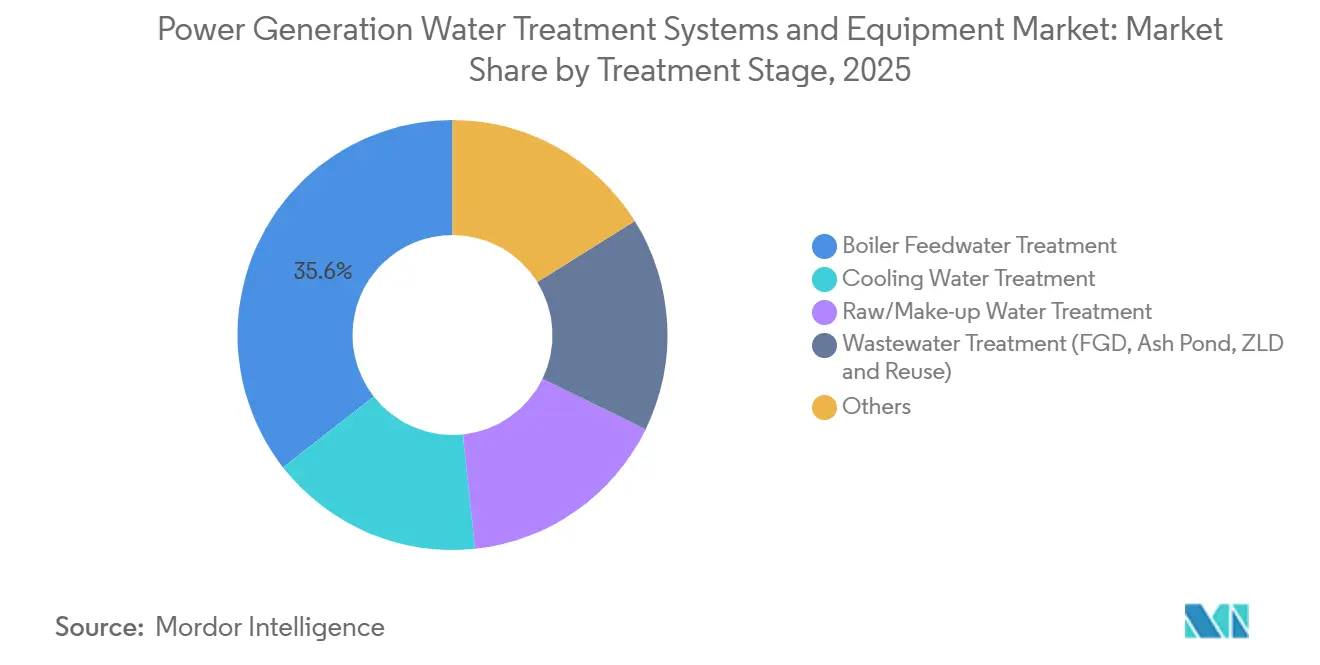
Feedwater Chemistry Anchors RevenueBoiler Feedwater Treatment accounted for 35.56% of the power generation water treatment systems and equipment market in 2025, reflecting the need for ultra-pure water in steam cycles. High-pressure boilers require close control of silica, conductivity, dissolved oxygen, and corrosion-related contaminants. Treatment trains commonly include clarification, filtration, reverse osmosis, ion exchange, or electrodeionization, depending on source-water quality. These requirements make feedwater treatment a core capital and operating priority for thermal assets. Higher-pressure plants have narrower water-quality limits, which increases the value of reliable final polishing. Feedwater systems also require continuous monitoring because deviations can damage turbines, boilers, and heat-recovery equipment. In October 2025, Toshiba announced that its EtaPRO monitoring system would be deployed across 165 power plants in India. This deployment illustrates how plant owners are linking water-quality monitoring with predictive maintenance and operational control. Cooling Water Treatment and Raw or Make-up Water Treatment remain significant adjacent stages, as cooling circuits have substantial chemical-demand and microbiological-control needs. Reclaimed surface-water supplies can make those requirements more demanding.
Wastewater Treatment, including flue gas desulfurization, ash-pond treatment, zero liquid discharge, and reuse, is projected to expand at a 7.13% CAGR through 2031. This stage is supported by discharge requirements and the commercial value of recovering water for reuse. Systems can include equalization, chemical precipitation, biological treatment, membrane concentration, evaporation, and crystallization. Each stage is selected based on the contaminants in the specific waste stream and the discharge target. Wastewater treatment is increasingly factored into plant planning at an early stage rather than addressed only after a compliance issue emerges. It also creates service opportunities because operating performance depends on chemistry, membrane condition, solids handling, and waste management. Condensate polishing and chemical make-up systems remain specialized parts of the treatment-stage landscape, and their role is important in facilities where condensate return quality directly affects steam-cycle reliability. The power generation water treatment systems and equipment market benefits from this broad treatment-stage mix, as operators must maintain water quality from intake through discharge.



By Equipment Type:
Membranes Challenge Conventional FiltrationFiltration Systems accounted for 32.67% of the 2025 market, reflecting their role as the first treatment step for nearly every water source. Media filters, pressure sand filters, and disk filters continue to remove suspended solids before downstream treatment. Their installed base in older coal plants creates replacement opportunities when sites reassess their full treatment trains. Filtration also remains relevant for seawater intake, reclaimed-water preparation, and cooling-water circuits, providing a cost-effective barrier against fouling and protecting more sensitive membrane or ion-exchange equipment. Equipment selection depends on the solids profile, flow variability, footprint, and required treatment reliability. In many applications, filtration is not replaced by membranes but combined with them, making the category essential even as more advanced technologies gain use. Suppliers can differentiate through automation, lower backwash demand, and designs suited to constrained retrofit spaces. The category remains an entry point to broader treatment-system sales.
Membrane Systems, including ultrafiltration, microfiltration, reverse osmosis, and nanofiltration, are forecast to grow at a 7.34% CAGR through 2031. Membranes can combine pretreatment, polishing, and demineralization functions in an integrated process and are increasingly used where operators need higher recovery, lower chemical regeneration, or tighter dissolved-solids control. All-membrane designs can use ultrafiltration followed by two-pass reverse osmosis and electrodeionization (EDI) for boiler make-up water, delivering high-purity output suitable for demanding steam-cycle applications. Ion Exchange and EDI Systems remain important final-polishing technologies, particularly for high-pressure boilers. Biological and Thermal Treatment Systems serve specialized wastewater roles where dissolved contaminants or concentrated brine cannot be handled efficiently by membranes alone. Compliance requirements and environmental-management practices are also supporting biological treatment for selenium and nitrogen removal. The equipment mix therefore varies by plant age, water source, discharge limits, and operating profile.
By Plant Type:
Coal Fleet Remains the Demand AnchorCoal-Fired Power Plants accounted for 34.81% of the 2025 market, supported by their large installed base and complex water-treatment needs. These plants require separate treatment approaches for cooling water, boiler feedwater, flue gas desulfurization wastewater, ash ponds, and potential reuse systems. Their water intensity and multiple waste streams create a larger treatment scope than many other plant types. Coal capacity is declining in parts of Europe and North America, but existing assets still require compliance upgrades and operating support. India and selected Southeast Asian markets continue to commission coal capacity, supporting greenfield procurement during the forecast period. Advanced steam-cycle plants increase demand for high-purity feedwater and reliable final polishing. Gas and combined heat and power plants form another important application, as heat-recovery steam generators have distinct water-chemistry requirements. Cycling operation can increase the need for corrosion management and responsive chemical treatment. The mix of installed capacity and regulation shapes regional demand more than any single fuel trend.
Renewable Power Plants, including biomass, waste-to-energy, and geothermal facilities, are projected to grow at a 7.48% CAGR through 2031. These facilities have water-treatment requirements that are often underestimated when their generation profile is compared with large thermal stations. Geothermal production fluids can contain high levels of dissolved silica and sulfides, requiring specialized scale-control and corrosion-management programs. Biomass and waste-to-energy facilities use boilers that need feedwater treatment comparable to conventional thermal plants. Their smaller operating teams and project budgets increase demand for packaged, pre-engineered treatment units, which can reduce installation time and simplify daily operation. Nuclear power plants remain a smaller but highly specified application where water chemistry must meet strict operating standards. Plant type therefore affects treatment complexity, system size, and the balance between equipment sales and service. The power generation water treatment systems and equipment market serves renewable applications through customized systems rather than a uniform technology package, which is relevant as new non-fossil generation expands alongside conventional capacity.
By Project Type:
Brownfield Retrofits Drive the BacklogBrownfield Retrofit Projects accounted for 44.78% of the 2025 market and are forecast to grow at a 6.45% CAGR through 2031. This pattern indicates that near-term spending is focused on improving existing treatment trains rather than constructing new facilities. Existing plants often cannot accommodate long outages for complete system replacement and therefore favor modular equipment, staged construction, and solutions that integrate with legacy infrastructure. Regulatory compliance, water reuse, and aging equipment can all trigger retrofit decisions. Operators also need to manage groundwater and ash-pond risks while preserving plant reliability. These conditions create a larger role for process engineering and long-term operations support. The power generation water treatment systems and equipment market benefits when a provider can assume technical responsibility across design, installation, and performance. Long-term operating and maintenance contracts can reduce the capital burden on utilities and spread payments over the life of the asset, while placing more execution and asset-performance risk on the supplier.
Operations and Maintenance Replacement Projects create recurring demand for filter media, membranes, resin, chemicals, and field service. Their annual spending profile is steadier than that of major retrofit or greenfield projects. Greenfield projects represent a smaller share of total value but can carry a higher value per installation. They are concentrated in Asia-Pacific, the Middle-East and Africa, and South America, where new energy infrastructure is being developed. New facilities allow treatment systems to be designed around expected feedwater quality and discharge requirements from the outset, supporting more efficient layouts and better integration with heat recovery or reuse systems. In 2025, Fluence Corporation announced a contract worth more than USD 12 million for an ultra-pure water treatment system at a new combined-cycle power plant in Saudi Arabia, illustrating continued competition for high-purity water systems in new power facilities. Project-type demand is therefore divided among recurring replacement needs, compliance-driven retrofits, and higher-value greenfield contracts, each requiring different supplier capabilities and commercial models.
By Water Source:
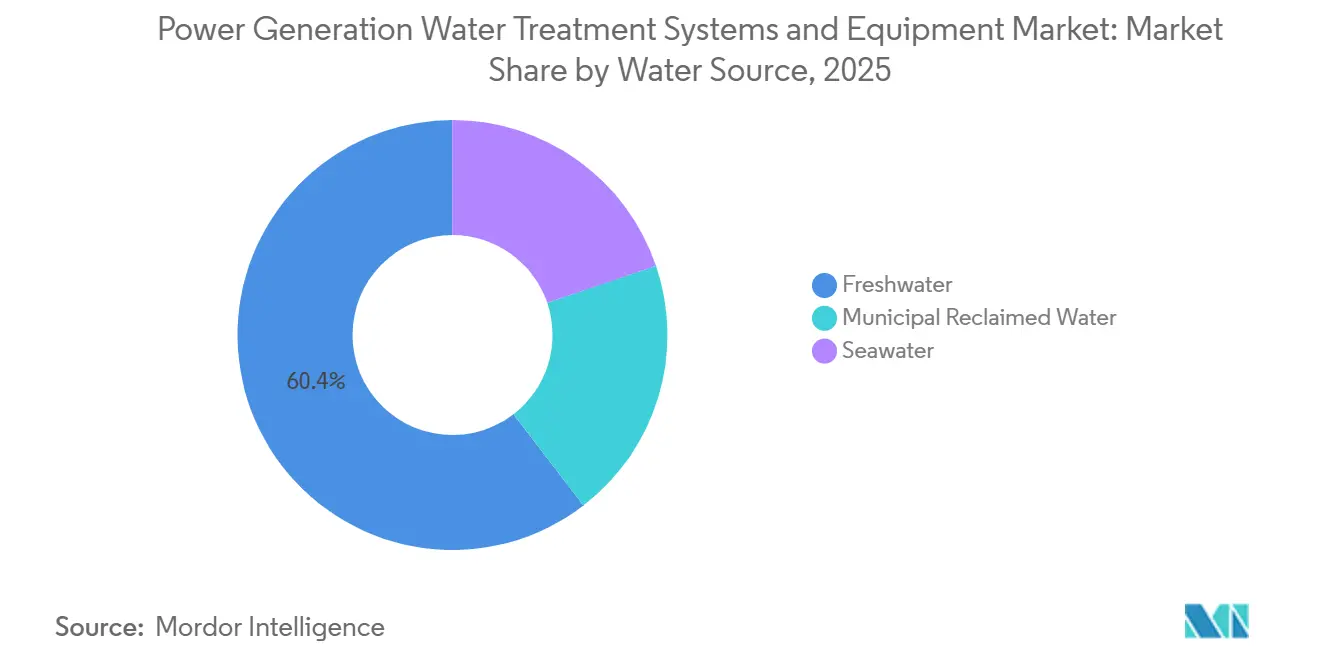
Coastal Intake Pushes Seawater Treatment UpFreshwater accounted for 60.43% of the 2025 market, reflecting the historical location of thermal plants near rivers, lakes, and reservoirs. Many existing power stations were designed around reliable freshwater withdrawals for cooling and make-up water. This source reduces pretreatment complexity when local water quality is stable, though it still requires treatment to manage suspended solids, hardness, and organics, as well as seasonal variability. Freshwater availability has been declining in water-stressed regions, particularly where power demand competes with agricultural, municipal, and industrial uses. Some inland plants have responded by treating municipal reclaimed water or industrial effluent for make-up supply, a practice that requires more extensive pretreatment to handle higher total dissolved solids, microbiological loads, and chemical oxygen demand. These water-source changes increase the scope and complexity of equipment needed at existing plants, as operators must evaluate new intake configurations, additional treatment stages, and compatibility with existing infrastructure. Water-source changes can therefore increase the scope of equipment needed at existing plants. The power generation water treatment systems and equipment market has been supported as operators redesign intake and make-up systems for more variable supplies. Source water quality is often the starting point for selecting the entire treatment train.
Seawater is projected to grow at a 6.79% CAGR through 2031 as coastal power projects seek alternatives to limited freshwater supplies. Seawater systems require filtration and desalination pretreatment capable of managing biofouling, shells, jellyfish, and high dissolved solids concentrations. Tropical marine conditions make intake protection and membrane performance especially important, as biological activity and temperature fluctuations can affect system efficiency and maintenance cycles. Coastal plants in the Philippines, India, Saudi Arabia, and China illustrate the geographic relevance of these challenges. Waste-heat integration can improve the energy performance of desalination systems where plant design allows. Japan has reported advanced water-treatment technologies that include membrane desalination capabilities. While seawater treatment can provide a more reliable supply, it increases process complexity and energy demand. Reclaimed water has also emerged as an important source category where municipal and power infrastructure can be linked, offering an additional option for plants operating in water-constrained environments. Each source has a distinct contaminant profile, operating risk, and treatment cost, requiring suppliers to tailor treatment systems to specific conditions rather than apply a single design.
Geography Analysis
APAC Power Generation Water Treatment Systems and Equipment Market
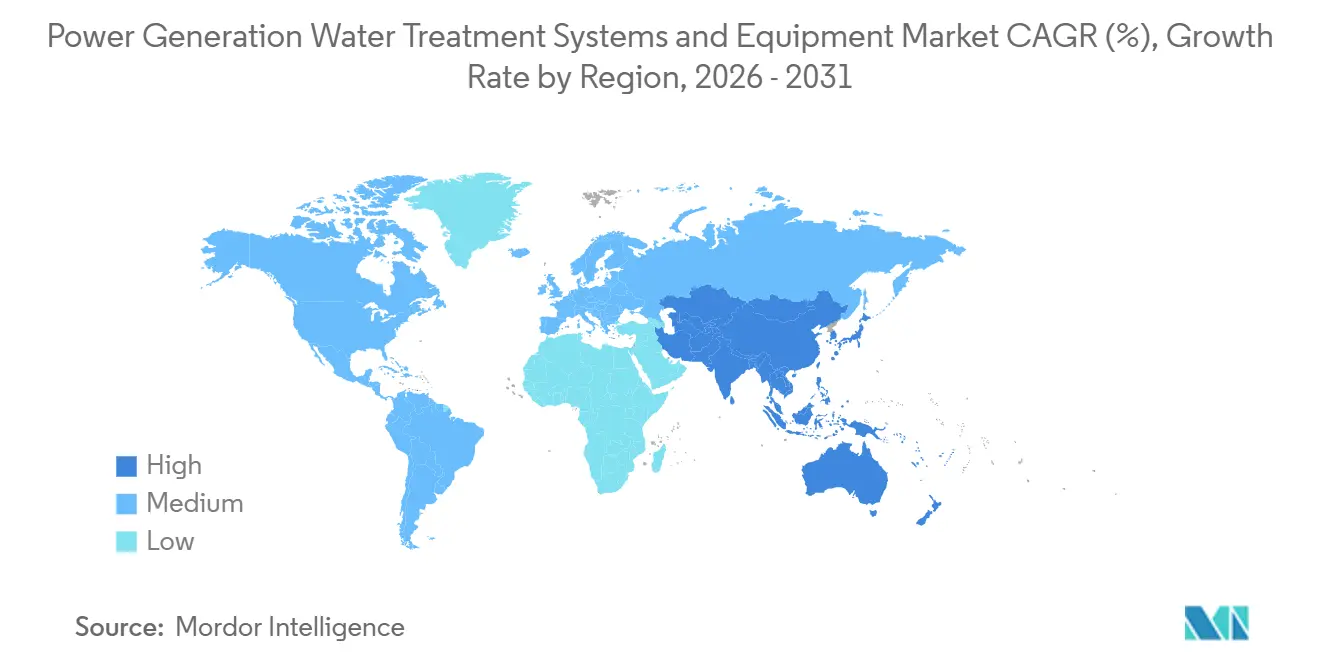
Asia-Pacific accounted for 40.57% of the power generation water treatment systems and equipment market share in 2025 and is forecast to grow at a 6.95% CAGR through 2031. The region combines new thermal capacity, large existing coal fleets, and freshwater constraints. India and China require both greenfield treatment systems and upgrades for established stations. Advanced steam-cycle projects support demand for high-purity feedwater equipment. Water reuse and zero liquid discharge are increasingly relevant in regions with limited freshwater access.
Europe, North America and APAC Power Generation Water Treatment Systems and Equipment Market
Toshiba's planned deployment of monitoring systems across Indian plants reflects demand for data-driven plant water management. Japan and South Korea contribute to the demand for high-specification water chemistry and membrane technologies. North America presents high regulatory complexity, as aging coal plants face effluent management requirements. The US Environmental Protection Agency (EPA)'s 2025 rule provides a longer timetable for qualifying steam-electric wastewater compliance activities, giving operators additional time to meet discharge standards. Europe presents a different profile, as coal retirements reduce the need for new fossil-fuel capacity, while compliance upgrades and ongoing operations continue to drive equipment demand.
MEA and South America Power Generation Water Treatment Systems and Equipment Market
South America, the Middle-East, and Africa are emerging demand areas where new energy investment and water scarcity occur together. Fluence's Saudi Arabian contract reflects the need for ultra-pure water at combined-cycle projects. In 2025, Veolia announced a SATORP industrial water contract in Saudi Arabia that included treatment technologies and a 30-year operations commitment. These regions offer greenfield opportunities, but face constraints related to financing, project execution, and availability of technical staff.

Competitive Landscape
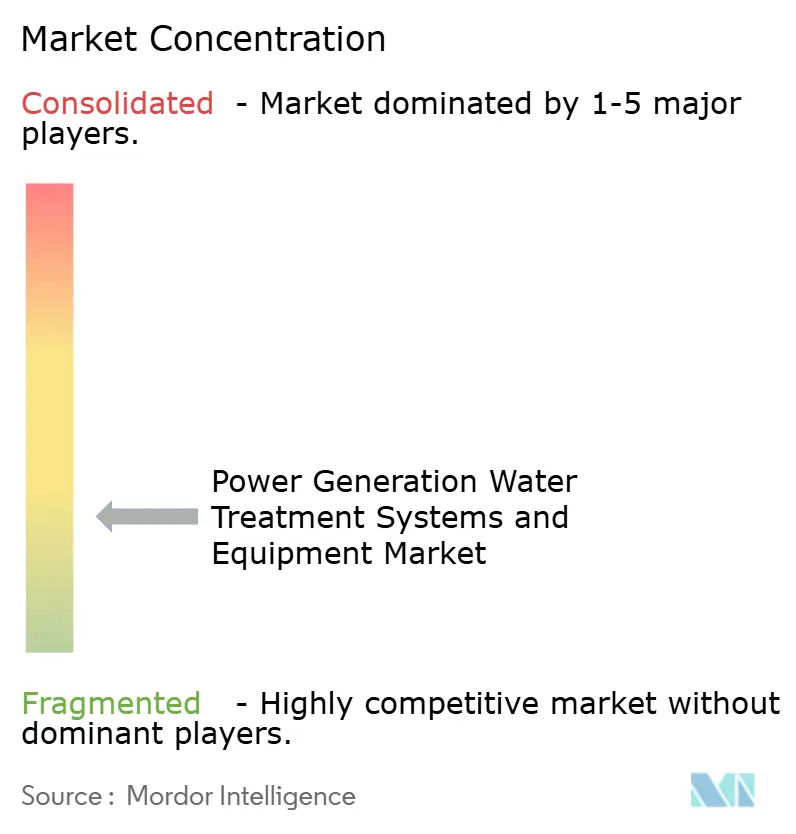
The power generation water treatment systems and equipment market is fragmented, with large water-technology integrators, specialist equipment providers, and chemical-treatment suppliers serving different parts of the value chain. Veolia, Xylem, and Ecolab's Nalco Water business compete through integrated equipment, treatment expertise, and operating services. Aquatech, Ovivo, WesTech, and Kurita Water Industries compete through equipment capability or application expertise. Plant owners procure treatment trains, chemicals, monitoring, and services through different channels. Veolia reported winning more than USD 750 million in water-technology contracts during the first quarter of 2025, including contracts for energy-related applications.
Xylem announced in June 2026 that it would design, build, and operate advanced water systems for Dow's Path2Zero project in Alberta, with operations expected by August 2028. The agreement reflects a strategy of combining technology delivery with long-term operating responsibility. In July 2026, Aquatech acquired FTS H2O, a company focused on osmotically assisted reverse osmosis, forward osmosis, and membrane brine crystallization. The acquisition broadens Aquatech's capability in energy-efficient brine concentration and resource recovery, strengthening its position in high-salinity and zero-liquid-discharge applications. Kurita Europe continues to position its power plant treatment technologies around corrosion control and simplified treatment programs for cycling units.
Competitive opportunities are concentrated in remote monitoring, energy-efficient zero-liquid discharge, and modular treatment systems for smaller plants. Remote platforms connect sensor data with chemical dosing and operational decisions, enabling more responsive and efficient plant management. Ecolab announced plans to acquire Ovivo's electronics ultra-pure water business for USD 1.8 billion in 2025, subject to stated closing conditions. Technology differentiation depends on managing difficult feedwater quality, reducing chemical and energy consumption, and integrating equipment into existing operating sites.
Power Generation Water Treatment Systems and Equipment Industry Leaders
Veolia
SUEZ
Xylem
Ecolab Inc.
Kurita Water Industries Ltd.
- *Disclaimer: Major Players sorted in no particular order
Power Generation Water Treatment Systems and Equipment Market Companies Covered in this Report
- ALFA LAVAL
- Aquatech
- Doosan Enerbility
- DuPont
- Ecolab Inc.
- GEA Group Aktiengesellschaft
- IDE
- IEI
- Kurita Water Industries Ltd.
- Ovivo Water Inc.
- Pall Corporation
- SUEZ
- Thermax Limited
- Veolia
- WesTech Engineering, LLC
- Xylem

Recent Industry Developments in Power Generation Water Treatment Systems and Equipment Market
- July 2026: Aquatech acquired FTS H2O, a company specializing in osmotically assisted reverse osmosis (RO), forward osmosis, and membrane brine crystallization technologies. The acquisition positions FTS H2O's Oregon facility as Aquatech's global Center of Excellence for membrane-driven brine concentration and resource recovery, directly expanding zero liquid discharge (ZLD) capabilities for power plant and industrial customers.
- July 2026: Kurita Water Industries and Membrane Group India established Kurita Membrane India Pvt. Ltd., a joint venture to provide advanced water treatment, wastewater recycling, and resource recovery to India's electronics and semiconductor market, combining Kurita's ultrapure water expertise with localized pricing capabilities.


Global Power Generation Water Treatment Systems and Equipment Market Report Scope
Power generation water treatment systems and equipment refer to specialized systems and devices used to clean, purify, and manage water in power plants. These systems prevent damage caused by mineral buildup, corrosion, and contaminants, protecting plant machinery and ensuring efficient operation.
The power generation water treatment systems and equipment market is segmented by treatment stage, equipment type, plant type, project type, water source, and geography. By treatment stage, the market is segmented into cooling water treatment, boiler feedwater treatment, raw/make-up water treatment, wastewater treatment (FGD, ash pond, ZLD and reuse), and others. By equipment type, the market is segmented into filtration systems, membrane systems (UF/MF/RO/NF), ion exchange and EDI systems, biological and thermal treatment systems, and others. By plant type, the market is segmented into coal-fired power plants, gas and combined heat and power plants, nuclear power plants, renewable power plants (biomass, waste-to-energy, geothermal), and others. By project type, the market is segmented into greenfield projects, brownfield retrofit projects, and operations and maintenance replacement projects. By water source, the market is segmented into freshwater, seawater, and municipal reclaimed water. The report also covers market size and forecasts for power generation water treatment systems and equipment across 16 countries in major regions. The market sizes and forecasts are provided in terms of value (USD).
| Cooling Water Treatment |
| Boiler Feedwater Treatment |
| Raw/Make-up Water Treatment |
| Wastewater Treatment (FGD, Ash Pond, ZLD and Reuse) |
| Others |
| Filtration Systems |
| Membrane Systems (UF/MF/RO/NF) |
| Ion Exchange and EDI Systems |
| Biological and Thermal Treatment Systems |
| Others |
| Coal-Fired Power Plants |
| Gas and Combined Heat and Power Plants |
| Nuclear Power Plants |
| Renewable Power Plants (Biomass, Waste-to-Energy, Geothermal) |
| Others |
| Greenfield Projects |
| Brownfield Retrofit Projects |
| Operations and Maintenance Replacement Projects |
| Freshwater |
| Seawater |
| Municipal Reclaimed Water |
| Asia-Pacific | China |
| India | |
| Japan | |
| South Korea | |
| ASEAN Countries | |
| Rest of Asia-Pacific | |
| North America | United States |
| Canada | |
| Mexico | |
| Europe | Germany |
| United Kingdom | |
| France | |
| Italy | |
| NORDIC Countries | |
| Russia | |
| Rest of Europe | |
| South America | Brazil |
| Argentina | |
| Rest of South America | |
| Middle-East and Africa | Saudi Arabia |
| South Africa | |
| Rest of Middle-East and Africa |
| By Treatment Stage | Cooling Water Treatment | |
| Boiler Feedwater Treatment | ||
| Raw/Make-up Water Treatment | ||
| Wastewater Treatment (FGD, Ash Pond, ZLD and Reuse) | ||
| Others | ||
| By Equipment Type | Filtration Systems | |
| Membrane Systems (UF/MF/RO/NF) | ||
| Ion Exchange and EDI Systems | ||
| Biological and Thermal Treatment Systems | ||
| Others | ||
| By Plant Type | Coal-Fired Power Plants | |
| Gas and Combined Heat and Power Plants | ||
| Nuclear Power Plants | ||
| Renewable Power Plants (Biomass, Waste-to-Energy, Geothermal) | ||
| Others | ||
| By Project Type | Greenfield Projects | |
| Brownfield Retrofit Projects | ||
| Operations and Maintenance Replacement Projects | ||
| By Water Source | Freshwater | |
| Seawater | ||
| Municipal Reclaimed Water | ||
| By Geography | Asia-Pacific | China |
| India | ||
| Japan | ||
| South Korea | ||
| ASEAN Countries | ||
| Rest of Asia-Pacific | ||
| North America | United States | |
| Canada | ||
| Mexico | ||
| Europe | Germany | |
| United Kingdom | ||
| France | ||
| Italy | ||
| NORDIC Countries | ||
| Russia | ||
| Rest of Europe | ||
| South America | Brazil | |
| Argentina | ||
| Rest of South America | ||
| Middle-East and Africa | Saudi Arabia | |
| South Africa | ||
| Rest of Middle-East and Africa | ||


Key Questions Answered in the Report
What is current market size of power generation water treatment systems and equipment market?
The Power Generation Water Treatment Systems And Equipment Market size is expected to increase from USD 8.13 billion in 2025 to USD 8.54 billion in 2026 and reach USD 11.39 billion by 2031, at a CAGR of 5.92% over 2026-2031.
Which treatment stage has the largest share in power generation water treatment?
Boiler Feedwater Treatment held 35.56% in 2025 because steam-cycle reliability depends on consistent ultra-pure water quality.
Which equipment category is growing the fastest?
Membrane Systems are forecast to grow at a 7.34% CAGR through 2031 as plants need improved recovery and higher-purity water.
Which region leads to the demand for power plant water treatment equipment?
Asia-Pacific held 40.57% in 2025 and is forecast to grow at a 6.95% CAGR through 2031.
Page last updated on:


 Your data is secure and never sold or shared.


