
Potato Fibre Market Size and Share
Market Overview
| Study Period | 2021 - 2031 |
|---|---|
| Market Size (2026) | USD 539.10 Million |
| Market Size (2031) | USD 725.20 Million |
| Growth Rate (2026 - 2031) | 6.11 % |
| Fastest Growing Market | Asia-Pacific |
| Largest Market | Europe |
| Market Concentration | Low |
Major Players *Disclaimer: Major Players sorted in no particular order Image © Mordor Intelligence. Reuse requires attribution under CC BY 4.0. | |
Potato Fibre Market Analysis by Mordor Intelligence
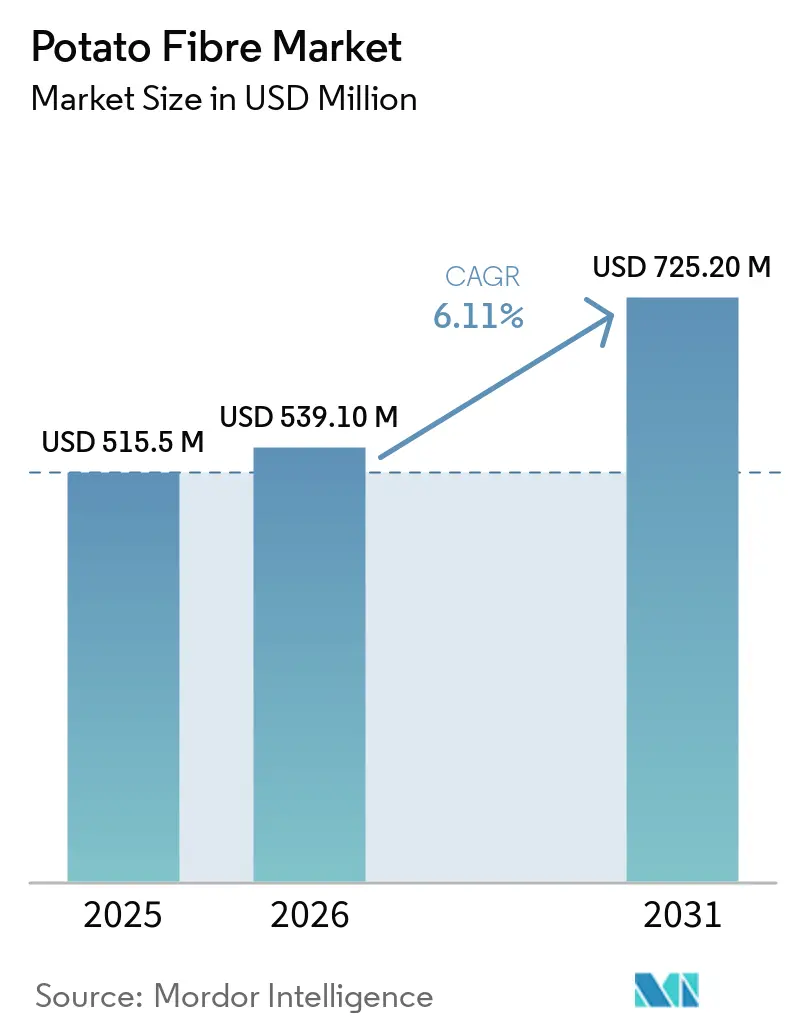
The potato fiber market size is expected to increase from USD 515.51 million in 2025 to USD 539.10 million in 2026 and reach USD 725.20 million by 2031, growing at a CAGR of 6.11% over 2026-2031. The potato fiber market is moving beyond its earlier role as a starch-processing co-product because food formulators need ingredients that manage moisture, fat, texture, and fiber content in one step. Clean-label formulation requirements, plant-based product development, and demand for greater value from potato processing streams support this shift. Suppliers are responding through broader application support, geographic distribution, certified supply programs, and portfolios that combine fiber with starch and protein ingredients. Europe remains the central production base, while Asia-Pacific offers the clearest route for demand expansion as food manufacturers add functional ingredients to processed foods. Competition is shaped by established potato processors, diversified ingredient companies, and alternative fiber suppliers that compete most directly in standardized applications.
Key Report Takeaways
- By category, conventional held 88.12% of the potato fiber market share in 2025, while organic is forecast to expand at a 6.21% CAGR through 2031.
- By application, food and beverages accounted for 42.34% of the potato fiber market size in 2025, while animal feed and pet food is projected to grow at a 6.32% CAGR through 2031.
- By geography, Europe accounted for 38.31% of the potato fiber market in 2025, while Asia-Pacific is forecast to grow at a 6.82% CAGR through 2031.
Note: Market size and forecast figures in this report are generated using Mordor Intelligence’s proprietary estimation framework, updated with the latest available data and insights as of January 2026.
Market Trends and Insights
Drivers Impact Analysis of Potato Fibre Market*
| Driver | (~) % Impact on CAGR Forecast | Geographic Relevance | Impact Timeline |
|---|---|---|---|
| Rising demand for clean-label and plant-based functional ingredients | +2.0% | Global, strongest in Europe and North America | Short term (≤ 2 years) |
| Growing fiber-enrichment demand in bakeries, meat and health foods | +1.5% | Global, core in Europe and North America, expanding in Asia-Pacific | Medium term (2-4 years) |
| Expansion of plant-based meat and dairy alternatives | +1.2% | North America, Europe, and Asia-Pacific | Medium term (2-4 years) |
| Increasing valorization of potato processing byproducts | +0.8% | Europe, with spillover to Asia-Pacific | Long term (≥ 4 years) |
| Fiber functionality in fat reduction and process yield improvement | +0.6% | Europe and North America, expanding in South America | Medium term (2-4 years) |
| Digital formulation platforms accelerating potato fibre qualification | +0.4% | North America and Europe, with early adoption in Asia-Pacific | Long term (≥ 4 years) |
| Source: Mordor Intelligence | |||
Rising Demand for Clean-Label and Plant-based Functional Ingredients
Food manufacturers are simplifying ingredient lists as consumers look for products with familiar declarations. Potato fiber can often be declared simply as potato fiber, which helps formulators avoid the labeling concerns associated with chemically modified alternatives. European rules allow a source-of-fiber claim when a food contains at least 3 g of fiber per 100 g under Regulation 1924/2006[1]. Potato fiber gives manufacturers a route to support that claim while also contributing to moisture retention and texture. This combination matters in product categories where an ingredient added only for nutrition could otherwise complicate processing. Roquette reported significant margin improvement in its Nutrition and Bioindustry business in 2025, supported by higher demand for fiber and protein products. The potato fiber market benefits when clean-label and functional requirements are addressed with the same ingredient.
Growing Fiber-enrichment Demand in Bakeries, Meat and Health foods
Potato fiber helps bakery products retain moisture during and after baking, which can slow crumb hardening and support shelf-life management. This property is relevant for retailers and manufacturers seeking to limit food waste without relying on artificial preservatives. In processed meat, the ingredient can bind water and fat in the same formulation, helping processors manage yield and texture. A 2026 review in Foods found that dietary fibers can replace phosphates in emulsion-type sausages while supporting nutritional quality and emulsion stability[2]. Potato fiber is therefore useful where processors need lower-fat recipes, phosphate replacement, and a familiar ingredient declaration. The potato fiber market is gaining relevance in formulations where these requirements occur together.
Expansion of Plant-based Meat and Dairy Alternatives
Plant-based meat and fish products need ingredients that control water and fat because plant proteins alone do not provide the same behavior as animal proteins. Lyckeby positions potato fiber for meat and plant-based applications where it supports moisture management, structure, and product yield. Roquette lists its Potato Fiber 55% XF for plant-based meat and fish products and specifies a minimum 55% fiber content with high water-holding capacity and a neutral taste[3]. These characteristics support use in burger patties, sausages, and seafood analogues. The ingredient can help reduce cook loss and improve eating quality in minced or formed products. This makes the potato fiber market relevant to developers who need a stable texture system instead of a nutrition-only addition.
Increasing Valorization of Potato Processing Byproducts
Potato starch processing produces fiber-rich pulp that was historically directed to lower-value feed uses. Food ingredient manufacturers are seeking better returns from each potato processing stream, which raises the value of functional fiber recovery. A 2025 Scientific Reports study showed that cellulose nanofibers from potato peel byproducts can reinforce starch-based biocomposites. A review in the International Journal of Food Science and Technology identified fiber, starch, protein, and bioactive compounds as recoverable fractions from potato waste streams. These findings support a circular processing model that uses more of the same raw material. The potato fiber market gains when processors can turn an existing co-product into a food ingredient with defined functional value.
Restraints Impact Analysis of Potato Fibre Market*
| Restraint | (~) % Impact on CAGR Forecast | Geographic Relevance | Impact Timeline |
|---|---|---|---|
| Weather and disease volatility in potato supply | -1.0% | Europe, North America, and spillover to South America | Short term (≤ 2 years) |
| Competition from wheat, oat, pea and citrus fibres | -0.8% | Global | Medium term (2-4 years) |
| Variable functional performance across potato varieties and processing routes | -0.5% | Global, particularly emerging procurement markets | Long term (≥ 4 years) |
| Fragmented regulatory treatment of fiber claims and novel applications | -0.4% | European Union, North America, and Asia-Pacific | Medium term (2-4 years) |
| Source: Mordor Intelligence | |||
Weather and Disease Volatility in Potato Supply
Potato fiber depends on a raw material base concentrated in specific agricultural regions. A strong harvest can improve the availability of starch potatoes and support fiber output, but adverse weather or disease can have the opposite effect. Producers also face changes in energy, fertilizer, and farming costs that can affect planting decisions and processing economics. Food manufacturers often operate with tightly managed inventories, so a disruption in fiber supply can affect formulation plans and delivery schedules. Geographic diversification of raw material sourcing can reduce this exposure, although integrated starch-processing assets remain concentrated. The potato fiber market therefore remains sensitive to agricultural conditions even when demand from food applications is stable.
Competition from Wheat, Oat, Pea and Citrus Fibres
Potato fiber competes against established dietary fiber ingredients for formulation budgets. Wheat bran and oat fiber have long-standing positions in bakery products, supported by familiar consumer associations and broad use in fiber fortification. Pea fiber benefits from growth in pea protein processing because it is available as a co-product from the same facilities. Citrus fiber offers hydration and gelling properties that can appeal to beverage and dairy applications. Competition is strongest in standard bakery recipes, where procurement decisions often focus on cost at the required inclusion level. The potato fiber market has a clearer advantage in meat and meat alternatives, where combined water and fat management can be difficult for other fibers to match.
*Our forecasts treat driver/restraint impacts as directional, not additive. The impact forecasts reflect baseline growth, mix effects, and variable interactions.
Potato Fibre Market Segment Analysis
By Category:
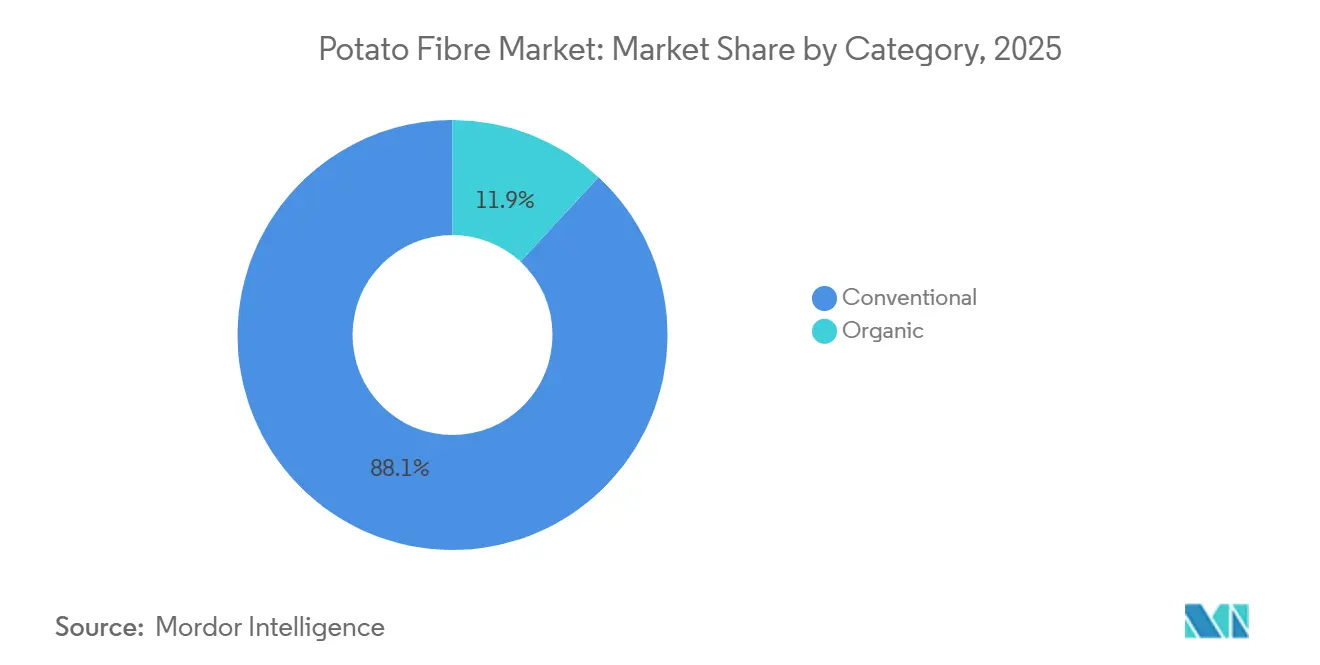
Conventional Supply Supports Scale While Organic Supports Premium DemandConventional products held 88.12% of the potato fiber market share in 2025. Their position reflects the scale of established potato starch processing across the Netherlands, Germany, France, and Denmark. Fiber is recovered alongside starch, which allows large processors to supply commercial volumes through existing facilities. Avebe, Emsland Group, KMC, and Süd-Stärke have established supply relationships with food manufacturers that prioritize consistent specifications and reliable volumes. Conventional material also avoids the additional cultivation and certification requirements associated with organic inputs. Its neutral flavor and controlled moisture-handling characteristics support broad use in bakery and processed meat applications.
Organic potato fiber is projected to grow at a 6.21% CAGR between 2026 and 2031. Its growth is linked to food brands that pair organic certification with clean-label positioning. European Union Organic Regulation 2018/848 establishes common requirements for organic production and labeling in the bloc. The United States Department of Agriculture recognizes an organic equivalence arrangement with the European Union that supports trade in certified products. This framework enables European suppliers to serve North American buyers without operating entirely separate certification systems. Producers such as Bioservice offer organic potato fiber for food applications.
By Application:
Food and Beverages Lead Demand While Animal Feed and Pet Food Grow FasterFood and beverages accounted for 42.34% of the potato fiber market size in 2025. The segment includes processed meat, meat alternatives, bakery products, savory snacks, soups, sauces, and beverages. In processed meat, potato fiber can replace part of the fat or phosphate system while helping retain water and manage texture. This provides a route to improve process yield without sacrificing eating quality. In bakery, its moisture-retention role can support softer crumb texture and longer freshness. In snacks, soups, and sauces, the ingredient can add fiber and texture while retaining a simple label declaration.
Animal feed and pet food is forecast to grow at a 6.32% CAGR from 2026 to 2031. The segment is supported by premium pet food development and the use of potato-derived ingredients in companion animal and livestock diets. Roquette markets "Tubercell" dried potato pulp for animal nutrition applications. The product supports pelleting in ruminant feed and provides soluble and insoluble fiber for pet food formulas. Roquette states that Tubercell can be used in dog food at inclusion rates of 5% to 15%. This shows that potato fiber can be marketed as a defined nutrition input rather than a residual processing material.
Geography Analysis
Europe Potato Fibre Market
Europe held 38% of the potato fiber market in 2025. The region has a concentrated base of potato starch processors in Germany, the Netherlands, Denmark, and France. This infrastructure makes fiber an integrated output of starch extraction rather than a separately cultivated crop. European suppliers including Avebe, Emsland Group, KMC, JRS, CFF, Lyckeby, and AGRANA influence technical specifications and application development. The regional supply base supports customers that need consistent commercial volumes for food processing. European food rules also provide a defined setting for fiber-related nutrition claims under Regulation 1924/2006. Europe also has established customers in processed meat, bakery, snacks, and nutrition-focused foods. These categories support the use of potato fiber for moisture retention, texture management, and fiber enrichment.
APAC Potato Fibre Market
Asia-Pacific is forecast to expand at a 5.7% CAGR through 2031. China and India offer growth potential as processed food categories expand and manufacturers seek ingredients for nutritional positioning. Japan and South Korea are high-value markets because they have developed functional food systems and health-conscious consumers. Potato fiber can appeal to regional food producers seeking gluten-free, fiber-enriched, or clean-label formulations. Local supply remains less established than in Europe, which gives international suppliers an opening but can increase logistics dependence. The potato fiber market can expand in Asia-Pacific through distribution partnerships, technical application support, and supply arrangements that meet local food requirements. Suppliers will need to explain practical benefits such as moisture control, texture, and fiber content in terms that fit regional product development priorities. They will also need to demonstrate consistent performance in local recipes, rather than assume that a formulation developed for Europe will transfer without adjustment.
The Americas and MEA Potato Fibre Market
North America held a meaningful share in 2025, supported by demand for fiber-enriched bakery products, processed meat reformulation, and plant-based foods. Consumer interest in digestive health, weight management, and glycemic control supports the use of dietary fiber in food products. Brenntag Specialties and Royal Avebe expanded their food and nutrition distribution agreement to the United States in 2025. The agreement covers specialty starches, proteins, and fibers for North American customers. South America remains at an earlier stage, with Brazil showing demand potential from its processed food base. The Middle East and Africa are developing markets where price sensitivity and limited awareness can constrain adoption, although health-focused retail growth can support future demand.
Competitive Landscape
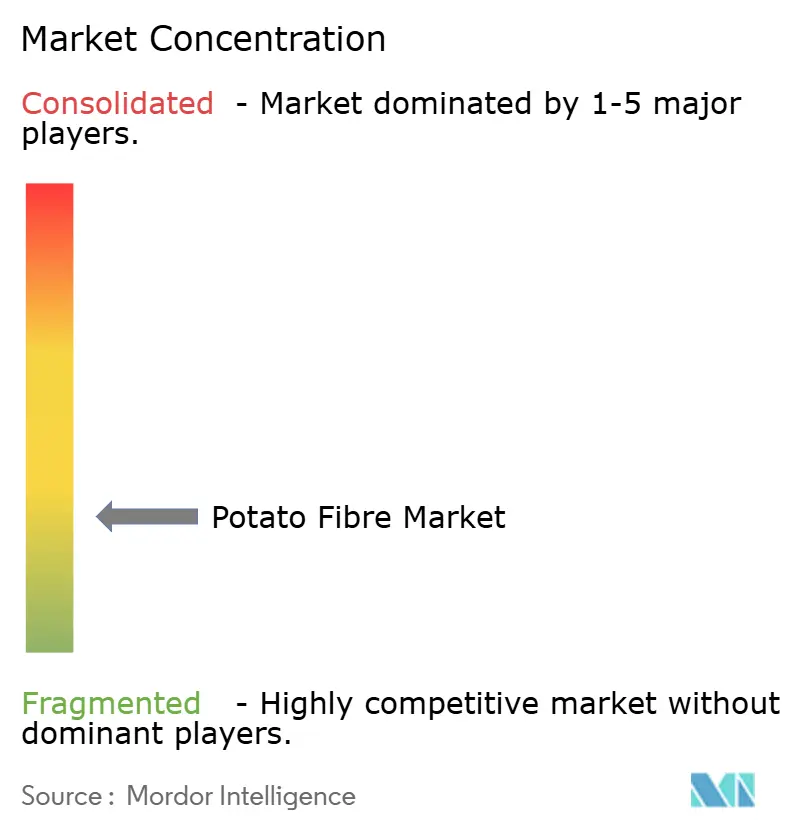
The potato fiber market is highly fragmented across regional potato cooperatives, ingredient specialists, and larger diversified suppliers. No single company was identified as having commanding power over global supply. Avebe, Emsland Group, KMC, Lyckeby, JRS, CFF, Roquette, and Ingredion are among the notable companies active in the competitive environment. European starch processors benefit from integrated processing models where fiber is recovered alongside starch. This gives them supply security and a cost structure that independent fiber producers may not replicate. Their customer relationships also provide a base for application development in food and animal nutrition.
Companies are strengthening their positions through portfolio expansion and wider distribution. Royal Avebe acquired Solan, a Polish producer of potato flakes and granules, in August 2025. The acquisition broadened Avebe’s product offer and increased its processing footprint in Poland. Brenntag and Avebe expanded their distribution agreement for food and nutrition customers in the United States during 2025. Roquette introduced its Shift and Lead plan in January 2026, emphasizing operational excellence, innovation, financial discipline, and cash generation. These actions show that market participants are competing through customer reach, broader ingredient systems, and operational capability.
Avebe identifies digitalization and automation as priorities under its Accelerate and Strengthen strategy. Faster customer qualification through formulation data, technical service, and application support can make suppliers more difficult to replace. Alternative fiber producers in oat, pea, wheat, and citrus remain the principal competitive challenge in bakery and other standardized applications. That value proposition is particularly important when customers are balancing clean-label goals with production efficiency.
Potato Fibre Industry Leaders
-
AGRANA Beteiligungs-AG
-
J. RETTENMAIER and SÖHNE GmbH + Co KG
-
Roquette Frères SA
-
Emsland Group
-
Royal Avebe
- *Disclaimer: Major Players sorted in no particular order
Potato Fibre Market Companies Covered in this Report
- AGRANA Beteiligungs-AG
- A&B Ingredients
- Royal Avebe U.A.
- Basic American Foods
- CFF GmbH and Co. KG
- Duynie Group
- Emsland Group
- Finnamyl Oy
- Goodrich Cereals Ltd.
- Ingredion Incorporated
- J. RETTENMAIER and SÖHNE GmbH + Co KG
- Keystone Potato Products LLC
- KMC Kartoffelmelcentralen a.m.b.a.
- Lyckeby Starch AB
- Novidon B.V.
- PEPEES S.A.
- Roquette Frères SA
- Royal Ingredients Group B.V.
- Südstärke GmbH
- The Wright Group
Recent Industry Developments in Potato Fibre Market
- June 2026: Ingredion Incorporated's acquired Tate & Lyle PLC for approximately GBP 3.7 billion (USD 5.0 billion). The transaction combines Ingredion’s texture and sugar-reduction capabilities with Tate & Lyle’s mouthfeel, sweetening, fortification, and fiber portfolio, expected to create a scaled global specialty ingredient platform serving customers in more than 120 countries.
- August 2025: Royal Avebe acquired Solan, a Polish producer of potato flakes and granules, as part of its “Accelerate and Strengthen” strategy. The acquisition extends Avebe’s product portfolio into flakes and granules under the SOLAN brand, broadens its geographic processing footprint into Poland.
- July 2025: Brenntag Specialties and Royal Avebe expanded their strategic distribution agreement to cover the United States, enabling Brenntag to supply North American food and nutrition customers with specialty starches, proteins, and fibers from Avebe. This expansion followed prior distribution agreements covering Turkey, Benelux, Nordics, Baltics, Poland, the United Kingdom, and Ireland.
Global Potato Fibre Market Report Scope
Potato fiber is a functional dietary fiber ingredient, primarily derived from potato cell walls during the production and processing of potato starch. It contains both insoluble and soluble fiber components and offers water-binding, bulking, texturizing, and moisture-retention properties. Manufacturers use potato fiber in food and beverage formulations, animal feed and pet food, and other applications to improve texture, fiber content, stability, and overall product functionality. The potato fiber market is segmented by category, application, and geography. By category, the market is divided into conventional and organic segments. By application, it is segmented into food and beverages, animal feed and pet food, and other applications. By geography, the market is segmented into North America, Europe, Asia-Pacific, South America, and the Middle East and Africa. Market size estimates are provided in value terms (USD) for all the aforementioned segments.
Segmentation Overview
| Conventional |
| Organic |
| Food and Beverages | Meat and Meat Alternatives |
| Savory Snacks | |
| Soups, Sauces and Dressings | |
| Bakery | |
| Beverages | |
| Other Food and Beverage Applications | |
| Animal Feed and Pet Food | |
| Other Applications |
| North America | United States |
| Canada | |
| Rest of North America | |
| Europe | Germany |
| United Kingdom | |
| France | |
| Italy | |
| Spain | |
| Rest of Europe | |
| Asia-Pacific | China |
| Japan | |
| India | |
| South Korea | |
| Rest of Asia-Pacific | |
| South America | Brazil |
| Argentina | |
| Rest of South America | |
| Middle East and Africa | Saudi Arabia |
| South Africa | |
| Rest of Middle East and Africa |
| By Category | Conventional | |
| Organic | ||
| By Application | Food and Beverages | Meat and Meat Alternatives |
| Savory Snacks | ||
| Soups, Sauces and Dressings | ||
| Bakery | ||
| Beverages | ||
| Other Food and Beverage Applications | ||
| Animal Feed and Pet Food | ||
| Other Applications | ||
| By Geography | North America | United States |
| Canada | ||
| Rest of North America | ||
| Europe | Germany | |
| United Kingdom | ||
| France | ||
| Italy | ||
| Spain | ||
| Rest of Europe | ||
| Asia-Pacific | China | |
| Japan | ||
| India | ||
| South Korea | ||
| Rest of Asia-Pacific | ||
| South America | Brazil | |
| Argentina | ||
| Rest of South America | ||
| Middle East and Africa | Saudi Arabia | |
| South Africa | ||
| Rest of Middle East and Africa | ||
Key Questions Answered in the Report
What is driving demand for potato fiber?
Clean-label formulation, fiber enrichment, plant-based products, and greater use of potato processing co-products are supporting demand.
How large is the potato fiber market in 2026?
The potato fiber market is estimated at USD 539.11 million in 2026 and is forecast to reach USD 725.20 million by 2031.
Which potato fiber category has the largest share?
Conventional products led with 88.12% in 2025 because integrated starch-processing facilities support large and consistent supply.
Which application is growing fastest for potato fiber?
Animal feed and pet food is projected to grow at a 6.32% CAGR through 2031, supported by premium pet nutrition and defined fiber uses.