
Polymers Market Size and Share
Market Overview
| Study Period | 2021 - 2031 |
|---|---|
| Market Size (2026) | USD 0.82 Trillion |
| Market Size (2031) | USD 1.04 Trillion |
| Growth Rate (2026 - 2031) | 4.87 % |
| Fastest Growing Market | Asia-Pacific |
| Largest Market | Asia-Pacific |
| Market Concentration | Low |
Major Players *Disclaimer: Major Players sorted in no particular order Image © Mordor Intelligence. Reuse requires attribution under CC BY 4.0. | |
Polymers Market Analysis by Mordor Intelligence
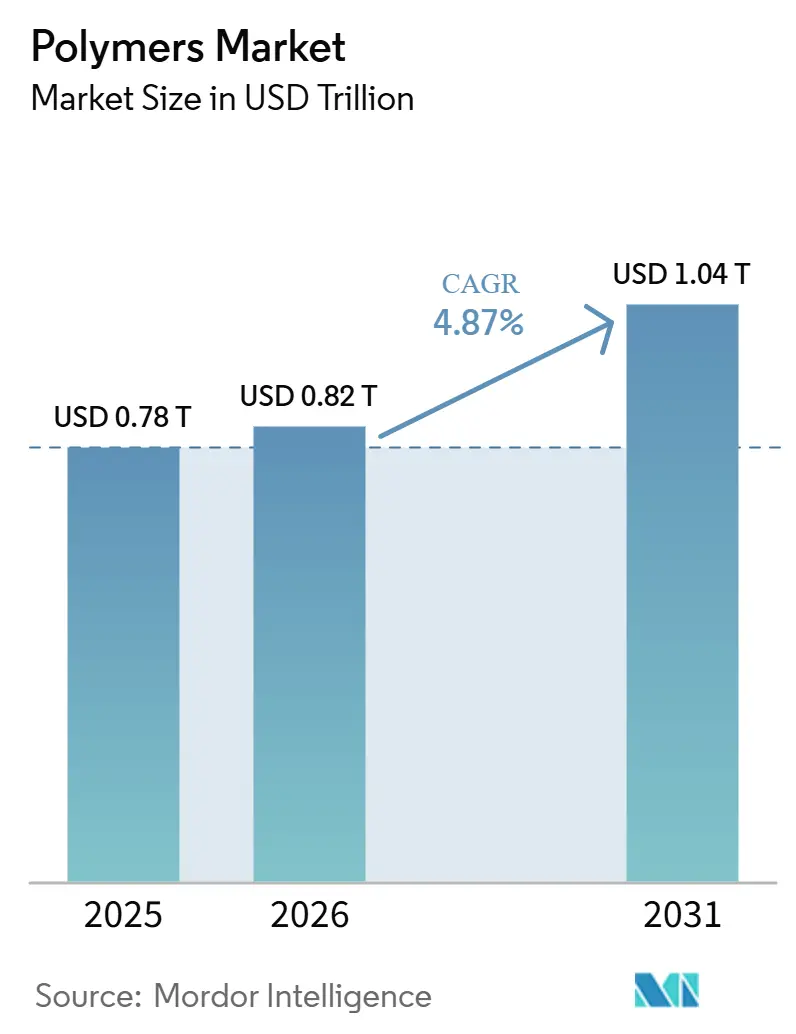
The Polymers Market size was estimated at USD 0.78 trillion in 2025 and is estimated to grow from USD 0.82 trillion in 2026 to USD 1.04 trillion by 2031, at a CAGR of 4.87% during the forecast period (2026-2031). The polymers market serves packaging, automotive, construction, healthcare, and electronics end-use industries, where material performance and cost remain key purchasing factors. E-commerce, food delivery, and healthcare supply chains continue to support demand for lightweight packaging materials. Vehicle electrification is increasing the need for polymers that can manage heat, resist flames, and replace heavier materials in selected components. Recycled and bio-based grades are gaining importance as customers seek to meet material and packaging requirements. Producers that can supply certified grades and collaborate with customers on formulations hold a stronger position in the polymers market.
Key Report Takeaways
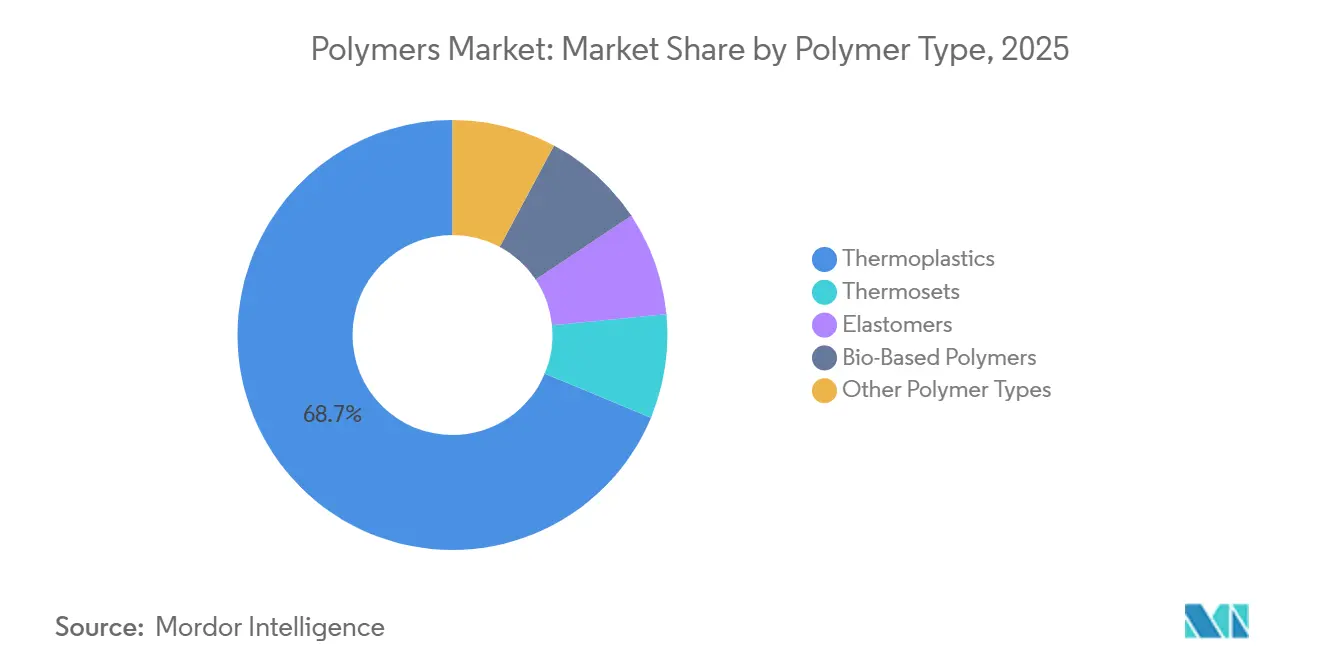
- By polymer type, thermoplastics held 68.72% of the polymers market share in 2025, while bio-based polymers are forecast to grow at a 9.42% CAGR through 2031.
- By resin type, polyethylene accounted for 28.16% of the polymers market in 2025, while engineering plastics are projected to expand at a 5.74% CAGR through 2031.
- By processing technology, injection molding accounted for 31.55% of revenue in 2025, while additive manufacturing is forecast to grow at a 7.94% CAGR through 2031.
- By application, packaging accounted for 38.95% revenue share in 2025, while healthcare and medical are projected to grow at a 5.97% CAGR through 2031.
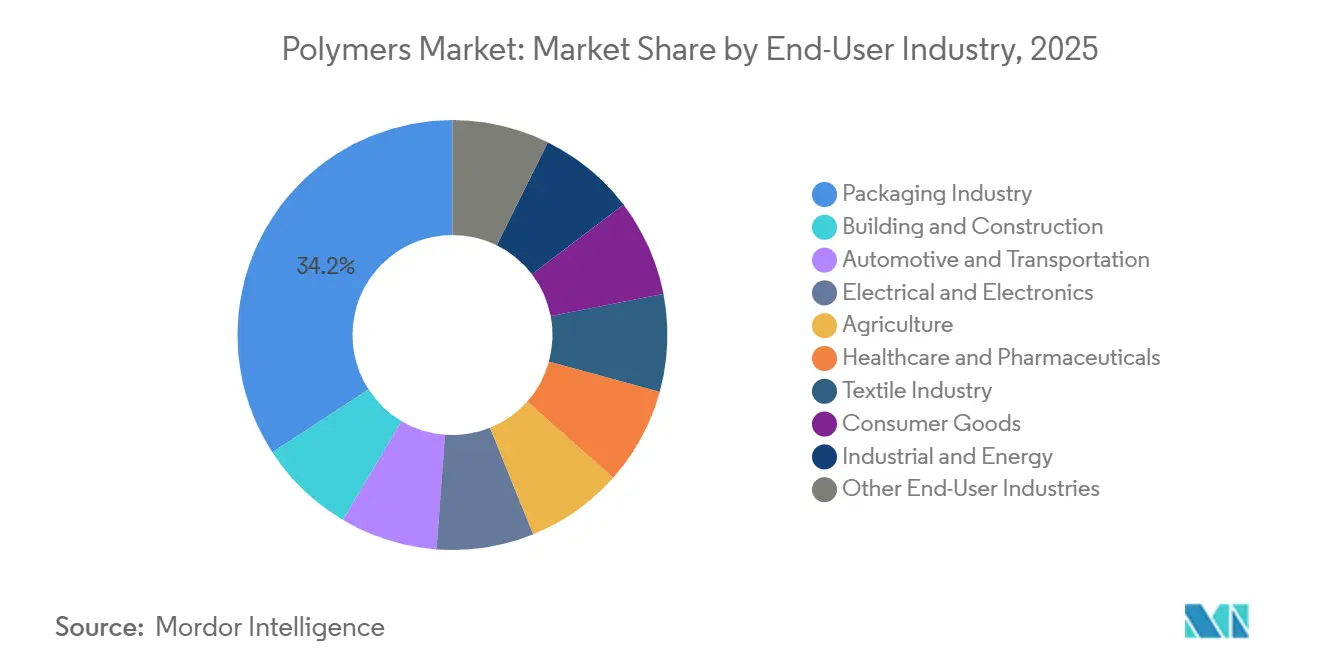
- By end-user industry, the packaging industry accounted for 34.17% of revenue in 2025, while healthcare and pharmaceuticals are forecast to expand at a 5.88% CAGR through 2031.
- By geography, Asia-Pacific held 50.76% of global output in 2025 and is projected to grow at a 6.35% CAGR through 2031.
Note: Market size and forecast figures in this report are generated using Mordor Intelligence’s proprietary estimation framework, updated with the latest available data and insights as of January 2026.
Market Trends and Insights
Drivers Impact Analysis of Polymers Market*
| Drivers | (~) % Impact on CAGR Forecast | Geographic Relevance | Impact Timeline |
|---|---|---|---|
| Packaging Demand from E-Commerce, Food Delivery, and Healthcare Supply Chains | +1.2% | Global, led by Asia-Pacific and North America | Short term (≤ 2 years) |
| Lightweight Polymer Use in Automotive and Electric Vehicle Manufacturing | +0.8% | Global, primary gains in China, Germany, and South Korea | Medium term (2-4 years) |
| Polymer Use in Infrastructure, Housing, and Utility Pipes | +0.9% | Asia-Pacific, Middle-East, South America | Medium term (2-4 years) |
| Recycled Content Mandates for Certified Recycled Resins | +0.6% | EU core, North America, spillover to APAC and MEA | Medium term (2-4 years) |
| Production Capacity Expansion and Localized Downstream Processing | +0.7% | Global, concentrated in China, India, and the Middle-East | Long term (≥ 4 years) |
| Source: Mordor Intelligence | |||
Growing Demand for Polymers in Packaging Driven by E-Commerce, Food Delivery, and Healthcare Supply Chains
E-commerce packaging remains a major source of polymer demand across global shipping networks. Polyethylene film mailers, polypropylene strapping, and polyethylene terephthalate (PET) trays support last-mile delivery formats at commercial scale. Healthcare supply chains also require single-use packaging that uses higher-specification polyethylene (PE) and polypropylene (PP) grades. Growth in food delivery in China, India, and Southeast Asia is driving demand for polypropylene containers and insulated packaging. Reliance Industries reported healthy domestic packaging demand even when Middle-East supply disruptions affected broader petrochemical offtake in 2026. This combination makes packaging demand more resilient for the polymers market than demand tied to a single end use.
Rising Adoption of Lightweight Polymers in Automotive and Electric Vehicle Manufacturing
Electric vehicle production is shifting polymer use toward engineering grades for battery housing, thermal systems, and structural parts. Replacing selected metal components with polymers can lower vehicle weight and support driving range. Automotive manufacturers are working with specialty polymer suppliers to develop materials that meet both performance and recycled-content requirements. Autoneum introduced a polyester-based front trunk solution in February 2026 with up to 70% recycled content for battery electric vehicles. The product was already selected by three major manufacturers in Asia and Europe for serial production[1]Autoneum, “Sustainable, Lightweight, and Sound Absorbing: Polyester-Based Front Trunk Solution for BEVs,” Autoneum, autoneum.com. A thermoplastic battery housing recognized by Composites United reduced weight by 15% against an aluminum reference design and passed Euro NCAP impact tests. These applications serve a higher-value segment of the polymers market.
Increasing Polymer Consumption in Infrastructure, Residential Construction, and Utility Pipe Applications
Polyvinyl chloride (PVC) pipes, polyethylene conduit, and polyurethane insulation are benefiting from infrastructure and housing projects. South Asia, the Gulf, and sub-Saharan Africa are investing in water distribution, power networks, and urban housing. This demand is largely quantity-based and can remain stable because public infrastructure programs often run for multiple years. Energy-efficient building regulations are also increasing the importance of polyurethane and extruded polystyrene insulation in commercial construction. BASF, Covestro, and other suppliers are developing products for applications where durability and energy performance affect material selection. These conditions provide a geographically diverse demand base for the polymers market through 2031.
Expanding Recycled Content Mandates Driving Demand for Certified Recycled Polymer Resins
The EU Packaging and Packaging Waste Regulation (Regulation 2025/40) entered into force in February 2025 and took full effect from August 2026. The regulation requires a minimum recycled content in plastic packaging from 2030. This requirement increases the need for certified recycled resins across packaging supply chains. Packaging converters and brand owners must revise material specifications and secure reliable sources of recycled content. Demand is strongest for grades that can meet food-contact and other regulated requirements. The regulation also gives suppliers of traceable recycled material a clearer role in the polymers market.
Restraints Impact Analysis of Polymers Market*
| Restraints | (~) % Impact on CAGR Forecast | Geographic Relevance | Impact Timeline |
|---|---|---|---|
| Plastic Waste Regulations and Environmental Compliance Costs | -0.5% | EU core, North America, with expanding compliance spillover into APAC and MEA | Medium term (2-4 years) |
| Petrochemical Feedstock and Energy Price Volatility | -0.8% | Global, most acute for naphtha-based producers in Europe and Northeast Asia | Short term (≤ 2 years) |
| Limited Supply of High-Quality Recycled Resins for Food-Contact and Automotive Uses | -0.4% | EU, North America, with emerging requirements in Japan and South Korea | Medium term (2-4 years) |
| Source: Mordor Intelligence | |||
Stringent Plastic Waste Regulations and Rising Environmental Compliance Costs
The Packaging and Packaging Waste Regulation (PPWR) requires that plastic packaging placed on the EU market be recyclable and contain a minimum post-consumer recycled content by 2030. Required recycled content ranges from 10% for contact-sensitive non-PET packaging to 35% for general plastic packaging, with higher thresholds planned for 2040. Packaging converters and brand owners must invest in redesign, material qualification, and certified recycled feedstock. These costs can be high when food-contact or performance requirements limit available material choices. Extended producer responsibility schemes in France, Germany, and the Netherlands also add annual fees for packaging placed on those markets. The polymers market, therefore, faces a more demanding compliance environment, particularly in Europe.
Volatility in Petrochemical Feedstock and Energy Prices
Middle-East tensions disrupted shipping routes through the Strait of Hormuz during the first two quarters of 2026. Naphtha and LPG costs increased by as much as 37% at the peak for Asian and European producers, while naphtha-dependent cash costs rose by up to USD 400 per ton above ethane-based alternatives[2]Gulf Petrochemicals and Chemicals Association, “Petrochemical Industry: Adapting to a New Evolving Reality,” Gulf Petrochemicals and Chemicals Association, gpcachem.org. South Korean, Japanese, and European crackers reduced operating rates, and some facilities declared force majeure. Producers without access to gas feedstock or integrated refinery-cracker operations remain more exposed to such price cycles. Downstream converters tend to purchase only immediate requirements, which can limit consumption even when selling prices rise. This cost uncertainty remains a restraint for the polymers market.
*Our forecasts treat driver/restraint impacts as directional, not additive. The impact forecasts reflect baseline growth, mix effects, and variable interactions.
Polymers Market Segment Analysis
By Polymer Type:
Thermoplastics Account for the Largest Share While Bio-Based Grades Record the Fastest GrowthThermoplastics accounted for 68.72% of revenue in 2025, making them the largest segment of the polymers market. Their recyclability and compatibility with injection molding and extrusion support wide use. PE, PP, and PVC make up a large share of the thermoplastic market. Engineering thermoplastics such as polyamide, polycarbonate, and PEEK serve higher-value automotive and electronics applications. Thermosets remain important in wind turbine blades, aerospace composites, and electrical laminates, though their limited recyclability creates pressure in regions with stricter sustainability requirements.
Bio-based polymers are forecast to grow at a 9.42% CAGR from 2026 to 2031. Brand commitments and purchasing requirements are moving these materials beyond a voluntary niche. NatureWorks added 75,000 metric tons of PLA capacity at its Thailand facility, helping reduce the cost barrier for high-capacity packaging converters. Second-generation lignocellulosic feedstock facilities in Brazil and Finland have broadened raw material options, reducing reliance on food-competitive crops and supporting the development of lower-carbon material choices across the polymers industry.



By Resin:
Polyethylene Holds the Largest Position, and Engineering Plastics Grow FastestPolyethylene accounted for 28.16% of revenue in 2025, making it the largest resin segment in the polymers market. HDPE, LDPE, and LLDPE offer food-contact suitability, flexible processing, and competitive costs, and are used in rigid packaging, flexible films, pipes, and consumer products. Polypropylene remains a major resin for construction, automotive, and healthcare applications. PET supports beverage packaging and textile fiber, while PVC remains essential in construction products and medical tubing.
Engineering plastics are projected to grow at a 5.74% CAGR through 2031. Automotive electrification requires polycarbonate and polyamide grades capable of managing heat and electrical demands. Semiconductor and 5G applications also require stable, high-purity polymer materials. Recycled-content polycarbonate copolymers can support automotive trim applications and recycled-content requirements. Specialty grades allow producers to focus on performance rather than commodity output, giving the polymers market a path toward higher-value resin demand.
By Processing Technology:
Injection Molding Retains Scale, and Additive Manufacturing Expands Use CasesInjection molding accounted for 31.55% of the polymers market in 2025 and remains cost-effective for high-quantity commodity components, with standard injection-molded parts costing less than USD 0.10 per unit. Extrusion is widely used for pipes and films, while blow molding, thermoforming, and calendering are used for bottles, trays, flooring, and other specialized products. Demand for these processes is tied to packaging and construction output.
Additive manufacturing is forecast to grow at a 7.94% CAGR from 2026 to 2031, with aerospace, orthopedic implants, and industrial tooling moving from prototyping toward serial part production. Polymer printing is also gaining use in healthcare and consumer electronics applications. However, fewer than 10% of commercial polymer grades are certified for end-use production printing. Specialty resin suppliers can address this gap through printable formulations with repeatable mechanical performance, which also explains why additive manufacturing still consumes far less polymer than injection molding.
By Application:
Packaging Leads Revenue, and Healthcare and Medical Grow FastestPackaging accounted for 38.95% of revenue in 2025, maintaining its leading position. E-commerce, healthcare packaging, and food and beverage formats support this demand, and barrier-coated polymers continue to replace glass and aluminum in selected applications. Construction is the second-largest application, driven by polyvinyl chloride (PVC) pipes, polyurethane insulation, and polyethylene conduit. Automotive and transportation require increasing polymer content as electric vehicle production expands, while electrical and electronics demand is linked to device production and material performance requirements.
Healthcare and medical applications are projected to grow at a 5.97% CAGR through 2031. Aging populations and hospital investment support demand for medical devices and packaging. Medical-grade polypropylene and polycarbonate must be biocompatible, traceable, and resistant to sterilization, creating a higher-value use case than standard industrial applications. Polyether ether ketone (PEEK), polycarbonate, and thermoplastic elastomers are used in orthopedic, cardiovascular, and drug-delivery devices. Single-use medical formats, supported by infection control requirements, further benefit the polymers market.
By End-User Industry:
Packaging Holds the Revenue Base and Healthcare and Pharmaceuticals Lead GrowthThe packaging industry held 34.17% of end-user revenue in 2025, making it the largest polymer-consuming end-user vertical worldwide. Packaging requirements are becoming more complex as mono-material and recyclable formats replace multi-material laminates. In European food packaging, flexible packaging is shifting toward linear low-density polyethylene (LLDPE)-based mono-material structures, requiring closer collaboration between resin suppliers and converters. This creates demand for both output and formulation changes across the polymers industry.
Healthcare and pharmaceuticals are forecast to expand at a 5.88% CAGR through 2031. Hospital capacity investment in Asia, including India and Vietnam, supports the use of medical polymers, with demand concentrating in medical polypropylene, polycarbonate, thermoplastic elastomers, and polyether ether ketone (PEEK). Electrical and electronics represent the next-fastest-growing end-user segment, requiring semiconductor packaging films, battery separator membranes, and high-frequency circuit substrates, thereby strengthening demand for specialized materials within the polymers market.
Geography Analysis
APAC Polymers Market
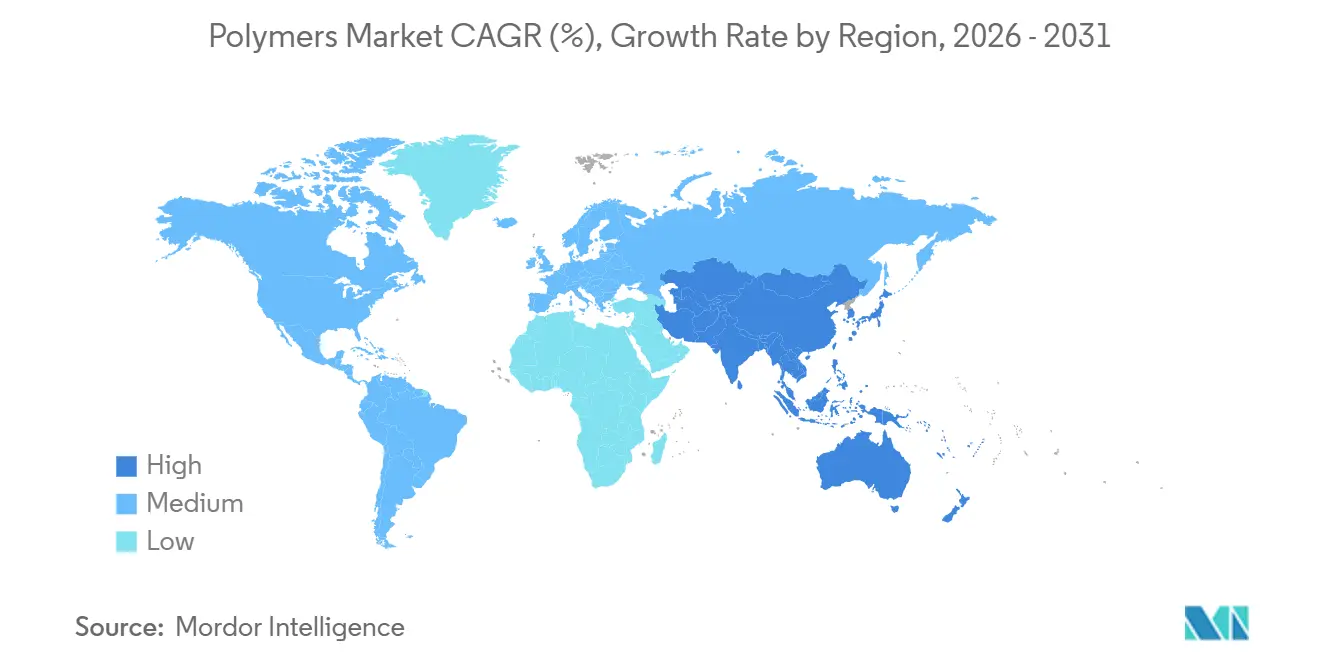
Asia-Pacific accounted for 50.76% of global revenue in 2025 and is expected to grow at a 6.35% CAGR through 2031, giving the region the largest share of the polymers market. China combines large-scale production capacity with significant domestic consumption. BASF inaugurated its world-scale Verbund site in Zhanjiang in March 2026, which includes a 1-million-ton ethylene steam cracker powered by renewable electricity. India is expanding polyvinyl chloride (PVC) and chlorinated polyvinyl chloride (CPVC) capacity through Reliance Industries projects at Dahej and Nagothane.
APAC, North America and Europe Polymers Market
Southeast Asia supports demand through packaging and consumer goods. Japan and South Korea are important markets for engineering polymers used in electronics and automotive applications. North America retains a feedstock cost advantage, as ethane-based crackers operate at lower costs than naphtha-based systems. LyondellBasell approved a 400,000-ton expansion of propylene capacity at Channelview in March 2025, with startup targeted for late 2028. Europe is adjusting to its naphtha cost disadvantage through closures, capacity reductions, and investment in recyclable and recycled-content grades. These conditions are reshaping regional trade and investment patterns in the polymers market.
MEA and South America Polymers Market
South America, the Middle-East, and Africa contribute demand through construction, packaging, and industrial development. Brazil supports regional consumption through infrastructure projects and processed food production. The Middle-East remains a major production center and a growing demand area for construction and healthcare materials. Gulf construction programs are supporting consumption in Saudi Arabia, the UAE, and Egypt. Africa is growing from a lower base in packaging, irrigation, and construction. These markets expand the geographic reach of the polymers market while differing in material needs and local production capacity.

Competitive Landscape
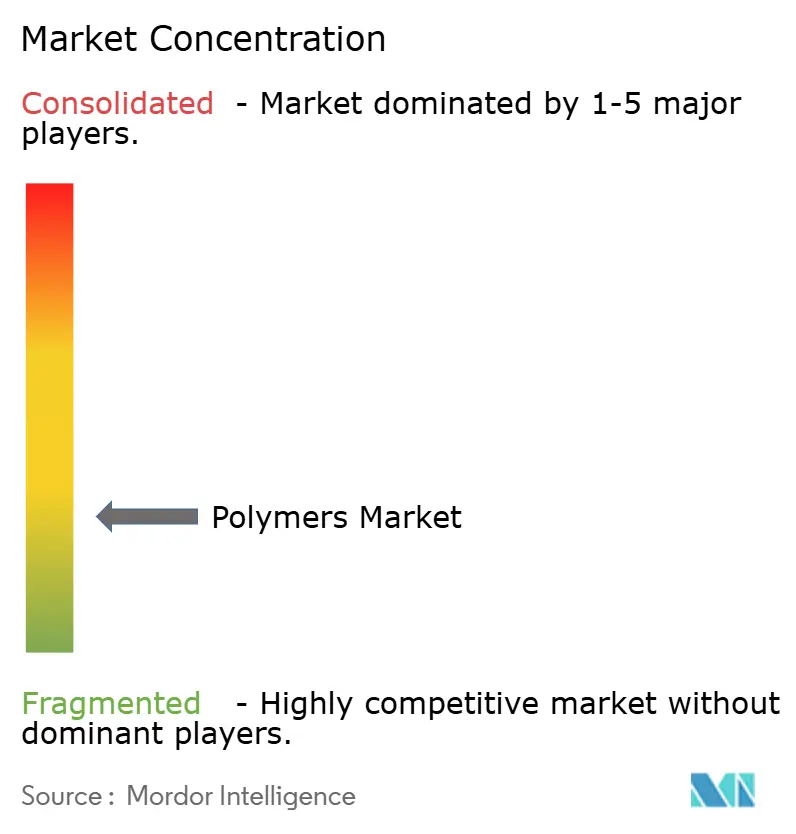
The polymers market is fragmented, with large producers including BASF, Dow, SABIC, LyondellBasell, and Covestro. Arkema, Evonik, Eastman, and Celanese compete in more focused specialty applications. Commodity producers compete primarily on feedstock costs and production scale, while specialty suppliers compete through grade performance, compliance capability, and product development. This distinction is becoming more pronounced as recycled, bio-based, and high-performance applications grow in importance. Overall, the competitive structure remains moderately concentrated among the leading companies.
Leading producers are reducing exposure to uncompetitive commodity positions while investing in differentiated materials. BASF inaugurated its Zhanjiang Verbund site in 2026 as part of its investment in local, integrated production in China. LyondellBasell approved its Channelview propylene project to utilize ethylene available from shale gas economics. BASF also expanded the capacity of Hindered Amine Light Stabilizers (HALS) and NOR HALS additives in 2026 for agricultural films, automotive applications, and outdoor construction. These developments indicate that competition involves both production economics and specialized performance systems.
Chinese producers are increasing competition in polyolefins and PVC, particularly across Asian trade routes, which is putting pressure on commodity margins for Middle-Eastern and European suppliers. This risk is less immediate in specialty grades, where qualification requirements remain higher. Food-contact recycled resins, bio-based engineering polymers, and printable specialty grades continue to face supply constraints. These areas present opportunities for companies with technical capability and reliable certification. The polymers market is therefore shaped by both scale-based competition and demand for materials that meet more demanding specifications.
Polymers Industry Leaders
BASF
Dow
Exxon Mobil Corporation
LyondellBasell Industries Holdings B.V.
SABIC
- *Disclaimer: Major Players sorted in no particular order
Polymers Market Companies Covered in this Report
- BASF
- Arkema
- Celanese Corporation
- Chevron Phillips Chemical Company LLC
- Covestro AG
- Dow
- Eastman Chemical Company
- Evonik Industries AG
- Exxon Mobil Corporation
- Formosa Plastics Corporation
- INEOS
- LG Chem Ltd.
- LyondellBasell Industries Holdings B.V.
- Mitsubishi Chemical Group Corporation
- Reliance Industries Limited
- SABIC
- Solvay S.A.
- Toray Industries, Inc.

Recent Industry Developments in Polymers Market
- February 2026: Autoneum launched a polyester-based front trunk solution with up to 70% recycled content for battery EVs. The product was in serial production for 3 major OEMs in China and Germany across 2 BEV models, reducing greenhouse gas emissions by up to 50% compared to injection-molded polymer alternatives.
- January 2026: Dow restarted construction of its USD 7.5 billion Path2Zero polyethylene and ethylene derivatives complex in Fort Saskatchewan, Canada, following a 9-month pause. The project's gas-feedstock economics were reinforced by the Middle-East supply shock.


Global Polymers Market Report Scope
Polymers are large molecules composed of many smaller, repeating units called monomers. Key types include natural polymers, synthetic polymers, and elastomers. They are integral to biological processes and modern technology.
The polymers market is segmented by polymer type, resin, processing technology, application, end-user industry, and geography. By polymer type, the market is segmented into thermoplastics, thermosets, elastomers, bio-based polymers, and other polymer types. By resin, the market is segmented into polyethylene (PE), polypropylene (PP), polyvinyl chloride (PVC), polyethylene terephthalate (PET), polystyrene (PS), polyurethane (PU), engineering plastics, and other resins. By processing technology, the market is segmented into injection molding, extrusion, blow molding, thermoforming, compression molding, calendering, rotational molding and casting, additive manufacturing (3D printing), and other processing technologies. By application, the market is segmented into packaging, construction, automotive and transportation, agriculture, electrical and electronics, textile, healthcare and medical, consumer goods, and other applications. By end-user industry, the market is segmented into packaging industry, building and construction, automotive and transportation, electrical and electronics, agriculture, healthcare and pharmaceuticals, textile industry, consumer goods, industrial and energy, and other end-user industries. The report also covers market size and forecasts for polymers across 16 countries in major regions. The market sizes and forecasts are provided in terms of value (USD).
| Thermoplastics | Commodity Thermoplastics |
| Engineering Thermoplastics | |
| High-Performance Thermoplastics | |
| Thermosets | |
| Elastomers | |
| Bio-Based Polymers | |
| Other Polymer Types |
| Polyethylene (PE) | High-Density Polyethylene (HDPE) |
| Low-Density Polyethylene (LDPE) | |
| Linear Low-Density Polyethylene (LLDPE) | |
| Polypropylene (PP) | |
| Polyvinyl Chloride (PVC) | |
| Polyethylene Terephthalate (PET) | |
| Polystyrene (PS) | |
| Polyurethane (PU) | |
| Engineering Plastics | |
| Other Resins |
| Injection Molding |
| Extrusion |
| Blow Molding |
| Thermoforming |
| Compression Molding |
| Calendering |
| Rotational Molding and Casting |
| Additive Manufacturing (3D Printing) |
| Other Processing Technologies |
| Packaging | Flexible Packaging |
| Rigid Packaging | |
| Construction | |
| Automotive and Transportation | |
| Agriculture | |
| Electrical and Electronics | |
| Textile | |
| Healthcare and Medical | |
| Consumer Goods | |
| Other Applications |
| Packaging Industry |
| Building and Construction |
| Automotive and Transportation |
| Electrical and Electronics |
| Agriculture |
| Healthcare and Pharmaceuticals |
| Textile Industry |
| Consumer Goods |
| Industrial and Energy |
| Other End-User Industries |
| Asia-Pacific | China |
| India | |
| Japan | |
| South Korea | |
| Rest of Asia-Pacific | |
| North America | United States |
| Canada | |
| Mexico | |
| Europe | Germany |
| United Kingdom | |
| France | |
| Italy | |
| Russia | |
| Rest of Europe | |
| South America | Brazil |
| Argentina | |
| Rest of South America | |
| Middle-East and Africa | Saudi Arabia |
| South Africa | |
| Rest of Middle-East and Africa |
| By Polymer Type | Thermoplastics | Commodity Thermoplastics |
| Engineering Thermoplastics | ||
| High-Performance Thermoplastics | ||
| Thermosets | ||
| Elastomers | ||
| Bio-Based Polymers | ||
| Other Polymer Types | ||
| By Resin | Polyethylene (PE) | High-Density Polyethylene (HDPE) |
| Low-Density Polyethylene (LDPE) | ||
| Linear Low-Density Polyethylene (LLDPE) | ||
| Polypropylene (PP) | ||
| Polyvinyl Chloride (PVC) | ||
| Polyethylene Terephthalate (PET) | ||
| Polystyrene (PS) | ||
| Polyurethane (PU) | ||
| Engineering Plastics | ||
| Other Resins | ||
| By Processing Technology | Injection Molding | |
| Extrusion | ||
| Blow Molding | ||
| Thermoforming | ||
| Compression Molding | ||
| Calendering | ||
| Rotational Molding and Casting | ||
| Additive Manufacturing (3D Printing) | ||
| Other Processing Technologies | ||
| By Application | Packaging | Flexible Packaging |
| Rigid Packaging | ||
| Construction | ||
| Automotive and Transportation | ||
| Agriculture | ||
| Electrical and Electronics | ||
| Textile | ||
| Healthcare and Medical | ||
| Consumer Goods | ||
| Other Applications | ||
| By End-User Industry | Packaging Industry | |
| Building and Construction | ||
| Automotive and Transportation | ||
| Electrical and Electronics | ||
| Agriculture | ||
| Healthcare and Pharmaceuticals | ||
| Textile Industry | ||
| Consumer Goods | ||
| Industrial and Energy | ||
| Other End-User Industries | ||
| By Geography | Asia-Pacific | China |
| India | ||
| Japan | ||
| South Korea | ||
| Rest of Asia-Pacific | ||
| North America | United States | |
| Canada | ||
| Mexico | ||
| Europe | Germany | |
| United Kingdom | ||
| France | ||
| Italy | ||
| Russia | ||
| Rest of Europe | ||
| South America | Brazil | |
| Argentina | ||
| Rest of South America | ||
| Middle-East and Africa | Saudi Arabia | |
| South Africa | ||
| Rest of Middle-East and Africa | ||


Key Questions Answered in the Report
What is current market size of Polymers Market?
The Polymers Market size was estimated at USD 0.78 trillion in 2025 and is estimated to grow from USD 0.82 trillion in 2026 to USD 1.04 trillion by 2031, at a CAGR of 4.87% during the forecast period (2026-2031).
Which polymer type is growing the fastest?
Bio-based polymers are forecast to grow at a 9.42% CAGR from 2026 to 2031, the highest rate among polymer types.
Which Resin held the largest revenue share in 2025?
Polyethylene held the largest resin share at 28.16% in 2025, supported by demand for packaging, pipes, and consumer products.
What application leads to polymer demand?
Packaging-led applications accounted for 38.95% of revenue share in 2025, supported by e-commerce, food and beverage, and healthcare packaging.
Page last updated on:





