
Polymeric Sand Market Size and Share
Market Overview
| Study Period | 2021 - 2031 |
|---|---|
| Market Size (2026) | USD 242.36 Billion |
| Market Size (2031) | USD 322.52 Billion |
| Growth Rate (2026 - 2031) | 5.88 % |
| Fastest Growing Market | Asia-Pacific |
| Largest Market | North America |
| Market Concentration | Medium |
Major Players *Disclaimer: Major Players sorted in no particular order Image © Mordor Intelligence. Reuse requires attribution under CC BY 4.0. | |
Polymeric Sand Market Analysis by Mordor Intelligence
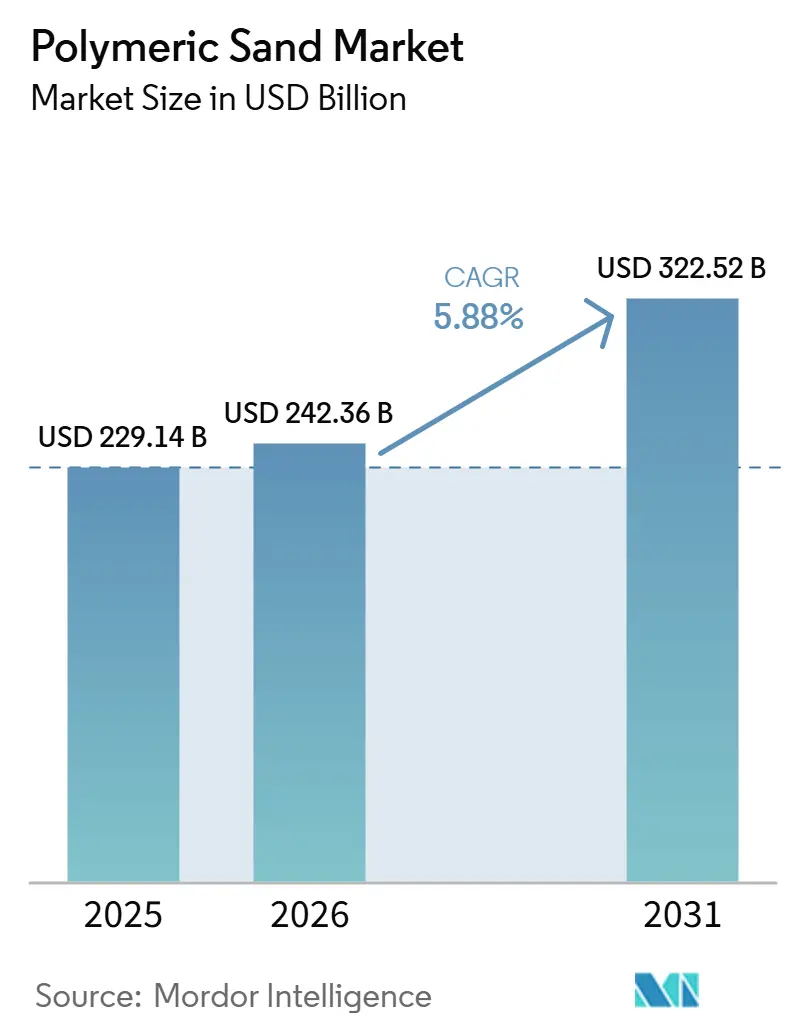
The Polymeric Sand Market size is expected to grow from USD 229.14 billion in 2025 to USD 242.36 billion in 2026 and is forecast to reach USD 322.52 billion by 2031 at 5.88% CAGR over 2026-2031. The polymeric sand market is supported by steady paving activity across residential, commercial, and public settings, where bonded joining remains a required part of interlocking surface installation. Demand remains firm as polymeric sand stabilizes paver joints, limits weed intrusion, and performs better than conventional fill materials in climates with freeze-thaw cycles. The market is also benefiting from municipal preference for permeable hardscape systems, particularly where stormwater compliance has become part of public project specifications. Competition is spread across specialist suppliers and broader building materials companies, driving both price competition and formulation upgrades. The key market opportunities are in low-volatile organic compound (VOC) systems, all-weather resin technologies, and premium jointing products for permeable paving, narrow joints, and large-format outdoor surfaces.
Key Report Takeaways
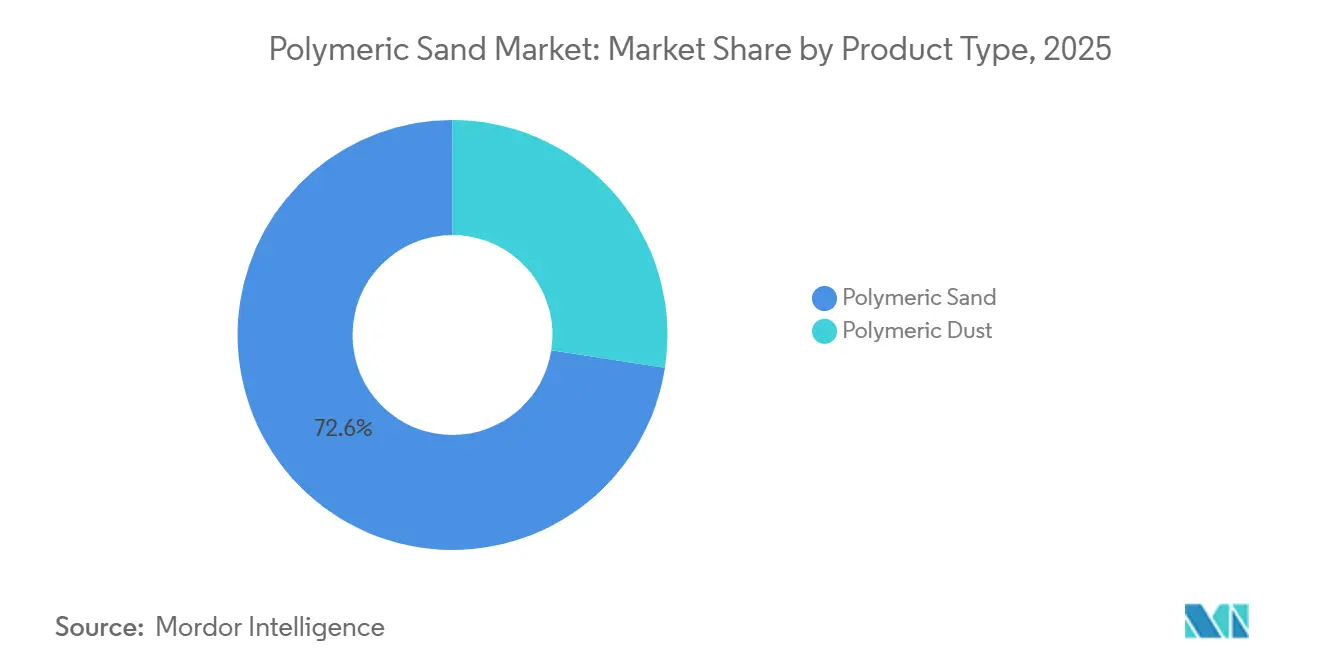
- By product type, polymeric sand held 72.56% of the polymeric sand market share in 2025, while polymeric dust is forecast to expand at a 6.72% CAGR through 2031.
- By color, gray accounted for 48.23% of demand in 2025, while black and other colors are projected to grow at a 6.39% CAGR through 2031.
- By application, residential hardscaping accounted for 44.12% of the polymeric sand market size in 2025, while public infrastructure is projected to grow at a 6.61% CAGR through 2031.
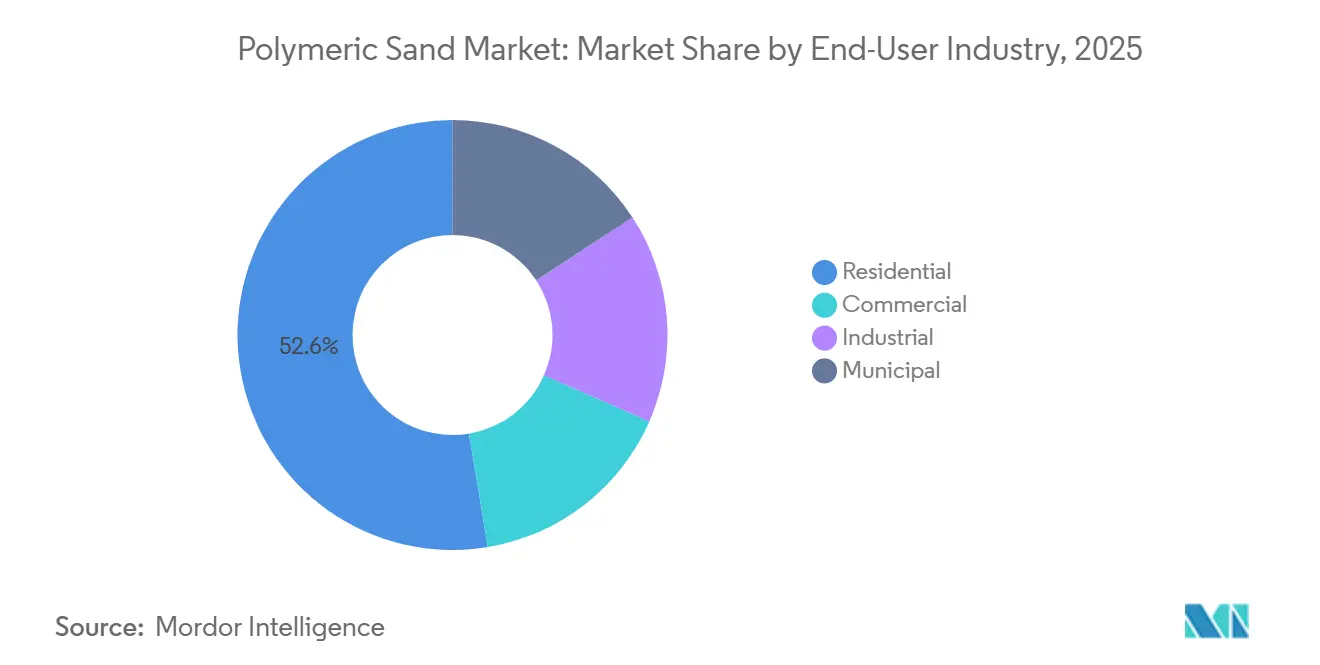
- By end-user industry, residential accounted for 52.63% of demand in 2025, while municipal is expected to record the highest CAGR of 6.54% through 2031.
- By geography, North America held 46.82% of the polymeric sand market share in 2025, while Asia-Pacific is projected to grow at a 7.08% CAGR through 2031.
Note: Market size and forecast figures in this report are generated using Mordor Intelligence’s proprietary estimation framework, updated with the latest available data and insights as of January 2026.
Market Trends and Insights
Drivers Impact Analysis of Polymeric Sand Market*
| Drivers | (~) % Impact on CAGR Forecast | Geographic Relevance | Impact Timeline |
|---|---|---|---|
| Rising Investment in Residential and Commercial Construction | +1.8% | North America, Europe, APAC core | Short term (≤ 2 years) |
| Expansion of Municipal Infrastructure Development | +1.2% | North America, APAC core, spillover to MEA | Medium term (2-4 years) |
| Increasing Demand for Low-Maintenance Landscaping and Hardscaping | +1.0% | North America, Japan, South Korea, Western Europe | Short term (≤ 2 years) |
| Growing Consumer Expenditure on Outdoor Living Spaces | +0.8% | North America, Western Europe | Short term (≤ 2 years) |
| Rising Adoption of Low-Volatile Organic Compound (VOC) and Eco-Friendly Formulations | +0.6% | Europe, North America, California, Oregon | Long term (≥ 4 years) |
| Source: Mordor Intelligence | |||
Rising Investment in Residential and Commercial Construction
U.S. residential construction reached a seasonally adjusted annual rate of USD 929.7 billion in March 2026, after a full-year 2025 total of USD 905.2 billion. This level of construction activity directly supports the polymeric sand market, as paver systems require bonded jointing material as part of installation[1]U.S. Census Bureau, “Construction Spending, March 2026,” U.S. Department of Commerce, census.gov. The polymeric sand market benefits each time driveways, patios, pool surrounds, and pedestrian paving are specified in new housing and commercial projects, particularly across North America, where interlocking pavers are a standard hardscape choice. Demand is also supported by the installed base laid in the late 1990s and early 2000s, as many of those surfaces are now entering re-jointing cycles, creating a maintenance layer on top of fresh construction demand. This gives the polymeric sand market a steadier demand profile than construction categories that rely solely on new builds. Commercial paving in mixed-use, hospitality, and retail settings adds another demand layer, as developers use upgraded outdoor finishes to enhance visual appeal and property positioning.
Expansion of Municipal Infrastructure Development
Municipal hardscape renewal is becoming a stronger part of the polymeric sand market, as paving upgrades are increasingly included in broader infrastructure programs and public budget priorities. New York State announced its largest Department of Transportation paving investment for 2026, covering more than 600 projects and hundreds of miles of roadway, while the National League of Cities identified infrastructure backlog clearance as a leading budget focus for U.S. city governments in April 2026. Hayward, California, also allocated USD 10 million for 129 lane-miles of street repair in its FY 2026 Pavement Improvement Project, indicating that resurfacing and streetscape work are progressing at the city level as well. The polymeric sand market receives an additional lift where stormwater regulations require permeable public hardscape, as contractors and municipalities need jointing systems compatible with drainage-oriented bases rather than conventional sealed surfaces. Products such as HydroSweep and ROMPOX Jointing Sand NP are positioned for that demand, as they are marketed around permeability, all-weather performance, and compliance-oriented use cases.
Increasing Demand for Low-Maintenance Landscaping and Hardscaping
The shift away from lawn care is providing the polymeric sand market with a durable source of demand that is not dependent on short renovation cycles. Houzz found in its 2026 U.S. Outdoor Trends Study that 57% of homeowners replacing their lawns chose hardscaping, up 7 percentage points from 2024, and 24% cited easier maintenance as a renovation objective, up 3 percentage points from 2024. The same study showed greater use of professional contractors, including stone, paver, and concrete specialists, which supports more formal specification of bonded jointing products rather than loose-fill alternatives. Every new hardscaped surface that uses pavers also becomes part of a future maintenance cycle, so current outdoor renovation choices build recurring demand for the polymeric sand market over the next 10 to 15 years. That recurring base reduces demand exposure to short-term pauses in discretionary spending once surfaces have already been installed.
Growing Consumer Expenditure on Outdoor Living Spaces
Consumers are treating patios, paths, kitchens, stairs, and pool decks as functional living areas, which supports the premium end of the polymeric sand market. Houzz reported that 71% of renovating homeowners hired professional help for outdoor projects in 2026, 6 percentage points higher than in 2024, and outdoor kitchen projects were mostly new builds rather than replacements. The same study showed that paths, stairs, and steps were featured in 45% of outdoor projects, tying lifestyle spending directly to the installed paving area. This is relevant for the polymeric sand market because higher-end projects are more likely to specify performance-oriented or aesthetics-focused jointing materials rather than entry-level fills. Premium products, including air-cure reactive resin sands and dust-free intelligent-polymer formulations, are positioned for that environment, as buyers show less resistance to higher material costs when appearance, durability, and contractor productivity are priorities.
Restraints Impact Analysis of Polymeric Sand Market*
| Restraints | (~) % Impact on CAGR Forecast | Geographic Relevance | Impact Timeline |
|---|---|---|---|
| Performance Sensitivity to Temperature, Moisture, and UV Exposure | -1.2% | Canada, Northern Europe, Northern China, Russia | Short term (≤ 2 years) |
| Availability of Low-Cost Alternative Jointing Materials | -0.9% | Global, concentrated in price-sensitive Asia-Pacific and South America | Medium term (2-4 years) |
| VOC, Dust, and Site-Handling Constraints | -0.7% | North America, Europe, global spill-over | Long term (≥ 4 years) |
| Source: Mordor Intelligence | |||
Performance Sensitivity to Temperature, Moisture, and UV Exposure
A notable limitation of the polymeric sand market is that standard water-activated products require dry conditions and temperatures above 35°F during installation. QUIKRETE clearly states this minimum threshold for its HardScapes Polymeric Jointing Sand, which narrows the viable installation window in Canada, Scandinavia, Russia, and Northern China[2]QUIKRETE, “QUIKRETE HardScapes Polymeric Jointing Sand, Product Information,” QUIKRETE, quikrete.com. Humid environments pose a distinct challenge: premature activation during storage or installation can lead to hazing and bonding issues, increasing the risk of contractor callbacks. Prolonged UV exposure and repeated thermal cycling can also reduce service life on highly exposed surfaces, particularly in the Middle East and the U.S. Southwest, which weakens the durability argument against lower-cost alternatives. Newer systems, such as HydroSweep, address some of these issues, but higher pricing slows adoption among cost-sensitive installers.
Availability of Low-Cost Alternative Jointing Materials
The polymeric sand market faces competition from stone dust, dry-packed mortar, and unsealed sand, which remain common choices where budgets are tight and specialty distribution is limited. This is most apparent in parts of Asia-Pacific and South America, where installer networks are less formal and local alternatives are easier to source than branded polymeric systems. Imported polymeric products also face landed-cost pressure in markets such as Brazil, Indonesia, and Vietnam, making premium positioning difficult outside larger commercial and public projects. Correct application presents an additional barrier, as installers must manage compaction, joint depth, and water activation in sequence. This skill requirement can push less experienced crews toward simpler unbonded fills. Even where suppliers make a strong durability case, adoption can remain slow if contractors weigh installation risk above long-term maintenance savings, which continues to constrain the polymeric sand market in less mature channels.
*Our forecasts treat driver/restraint impacts as directional, not additive. The impact forecasts reflect baseline growth, mix effects, and variable interactions.
Polymeric Sand Market Segment Analysis
By Product Type:
Interlocking Paver Formats Sustain Sand DominancePolymeric sand accounted for 72.56% of demand in 2025, maintaining its position as the largest product type in the polymeric sand market. This reflects its long-standing fit with standard interlocking concrete paver applications for driveways, patios, plazas, and walkways. Its sweep, compact, and active process suits both contractors and homeowners, supporting repeat purchasing across supply house channels. Compatibility with common graded-sand specifications also reinforces polymeric sand as the default product in mature paving markets. The segment benefits simultaneously from installer familiarity, established purchasing habits, and wide availability.
Polymeric dust is projected to expand at a 6.72% CAGR through 2031, making it the fastest-growing product sub-segment in the polymeric sand market. Its finer texture performs better in narrow joints, large-format porcelain, thin natural stone, and false-joint layouts where standard polymeric sand can be too coarse. This is increasingly relevant as outdoor design moves toward larger slab formats and more refined visual finishes in North America and Europe. Alliance Designer Products addressed this need with GATOR NITRO-X, an extra-fine air-cure resin sand built for joints from 1/8 inch to 2 inches and offered in 5 colors. The rise of polymeric dust has not yet displaced mainstream sand volumes, but it indicates where premium specification growth is moving within the polymeric sand industry.



By Color:
Gray’s Structural Dominance Contrasts with a Faster Accent SegmentGray accounted for 48.23% of segment demand in 2025, making it the largest color category in the polymeric sand market. Contractors continue to favor gray because it blends easily with standard charcoal and graphite pavers that remain common in residential and commercial installations. This keeps the segment anchored in repeat specification rather than design-driven selection. Beige holds a stable role in natural stone and tan-paver projects, particularly in the US South, the Southwest, and parts of Mediterranean Europe. The overall color mix continues to reflect the installed base and established contractor preferences more than rapid product rotation.
Black and other colors are projected to grow at a 6.39% CAGR through 2031, indicating that color is becoming a more active specification choice in the polymeric sand market. Demand is strongest in upscale patios, pool decks, and retail streetscapes where buyers want a joint tone to complement the overall finish. The shift is gradual but meaningful, as it adds fragmentation and premium-margin potential to what was previously a largely functional buying decision. Techniseal responded with localized production, including Rocky Tan and Prairie Grey in Colorado and Ash Grey in North Carolina, to shorten lead times and expand color availability more efficiently. This response suggests the polymeric sand market is becoming more design-aware without losing its contractor-led base.
By Application:
Outdoor Living Supports Core Demand While Public Projects Add PaceResidential hardscaping accounted for 44.12% of the polymeric sand market in 2025, making it the largest application segment. Patios, driveways, pool decks, and walkways remain the primary demand base, driven by outdoor living upgrades and ongoing home renovation activity. Houzz data showed that stone, paver, and concrete specialists were engaged in 20% of renovating homeowner projects, supporting formal hardscape installation rather than temporary fixes. The segment also benefits from re-jointing requirements on previously installed surfaces, giving the residential side of the polymeric sand market both first-install and replacement demand.
Public infrastructure is projected to grow at a 6.61% CAGR through 2031, making it the fastest-growing application in the polymeric sand market. The primary drivers are permeable paving and stormwater compliance, particularly for construction and reconstruction projects that must meet drainage performance requirements under updated permit rules. Commercial hardscaping remains the second-largest application layer, driven by retail parks, hospitality sites, and corporate campuses seeking durable outdoor finishes with lower maintenance requirements. Landscaping adds incremental volume as homeowners replace turf with paved pathways and other hardscape features, broadening the installed base even as large core paving jobs remain the primary revenue source. ROMEX JOINTING SAND NP and SEK-Surebond HydroSweep are directly aligned with this segment, as both products are promoted around permeability and all-weather installation in public-facing paving settings.
By End-User Industry:
Residential Leads While Municipal Buying Sets the Growth PaceResidential end users accounted for 52.63% of demand in 2025, making them the largest segment in the polymeric sand market. Homebuilding activity contributes to demand, but the larger structural support comes from the combination of new installations and re-jointing cycles across older paved surfaces. This makes residential demand more layered than a simple housing-starts relationship. The segment also benefits from the growing inclusion of permanent, professionally installed hardscape elements in outdoor living projects. As a result, the residential base remains the largest-volume anchor for the polymeric sand market, even as growth shifts to other segments.
Municipal end users are projected to grow at a 6.54% CAGR through 2031, placing them at the forefront of expansion in the polymeric sand market. Public buyers are responding to stormwater requirements, walkway renewal, and climate-resilience initiatives, all of which favor certified and documented jointing systems in paving projects. Commercial demand remains steady in logistics centers, hospitality properties, and retail parks where well-finished surfaces reduce maintenance disruption and trip-risk concerns. Industrial use is smaller but consistent, as bonded joints perform better than loose fills in heavy-traffic paved areas such as distribution yards and port-adjacent surfaces. This mix indicates that the polymeric sand market remains led by residential end users in volume terms, while public-sector requirements are increasingly shaping product development and compliance standards.
Geography Analysis
North America Polymeric Sand Market
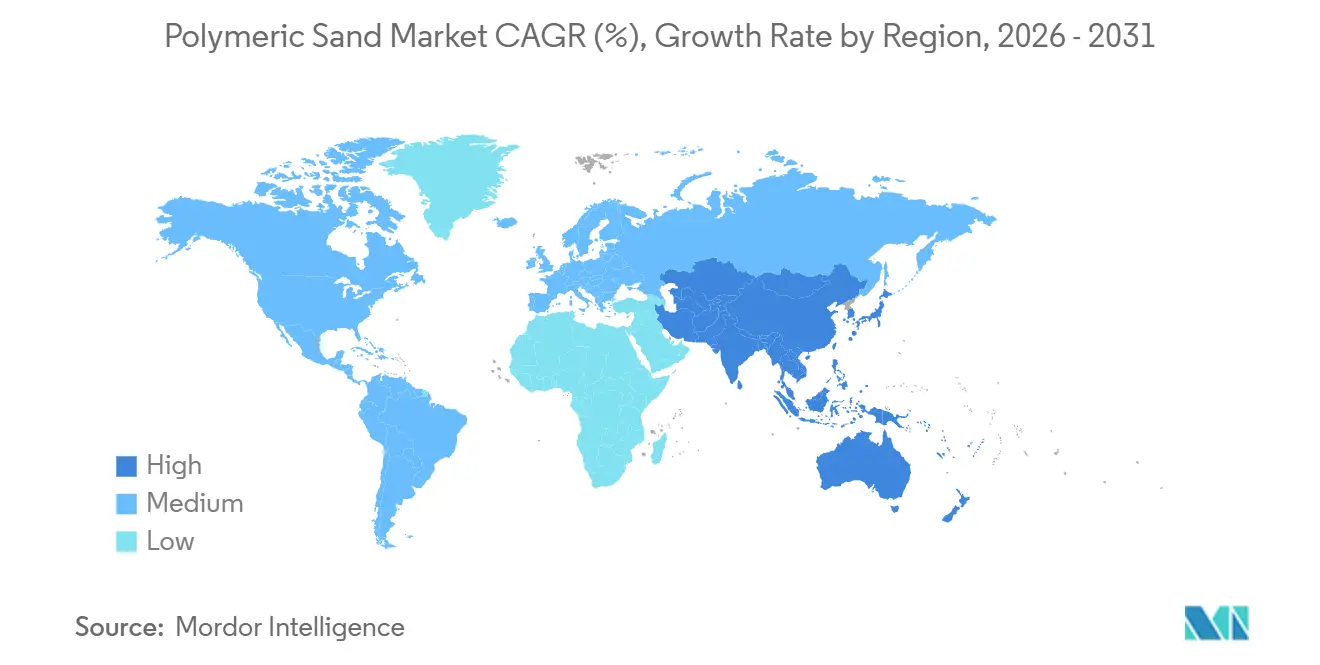
North America accounted for 46.82% of demand in 2025, making it the largest regional share in the polymeric sand market. The United States is the primary driver, with residential construction reaching a seasonally adjusted annual rate of USD 929.7 billion in March 2026, sustaining demand for paving applications such as patios, driveways, and walkways. Canada contributes through a mature hardscape channel, strong contractor distribution, and established retail access for packaged paving materials. The region also records higher municipal adoption of permeable interlocking systems compared to many other markets, creating a specification-led demand stream beyond retail sales. Mexico represents an earlier-stage growth opportunity, as urban development and demand for higher-quality outdoor finishes grow in commercial and upper-income residential projects.
APAC Polymeric Sand Market
Asia-Pacific is projected to grow at a 7.08% CAGR through 2031, making it the fastest-growing regional market for polymeric sand. China remains a significant contributor, with early-2026 project plans across connectivity and urban environment categories totaling CNY 300 billion (USD 42 billion), indicating continued infrastructure-led outdoor construction demand. India adds momentum through infrastructure spending and growing middle-class interest in premium residential and commercial outdoor surfaces. The World Bank projected regional growth in East Asia and the Pacific at 4.2% in 2026, with public investment expected to recover in markets such as the Philippines and Indonesia, providing a broader foundation for hardscape expansion.
EMEA and South America Polymeric Sand Market
Europe, South America, the Middle East, and Africa each present distinct demand patterns in the polymeric sand market. Germany anchors the European market through green infrastructure standards and sustainability requirements that favor certified, low-emission jointing products. In South America, Brazil and Argentina lead demand, though imported specialty products face cost pressure from currency volatility and limited premium penetration. In the Middle East and Africa, Saudi Arabia and South Africa are key demand sources, with Mapei's reported growth in Saudi Arabia indicating a gradually expanding base for premium outdoor construction materials.

Competitive Landscape
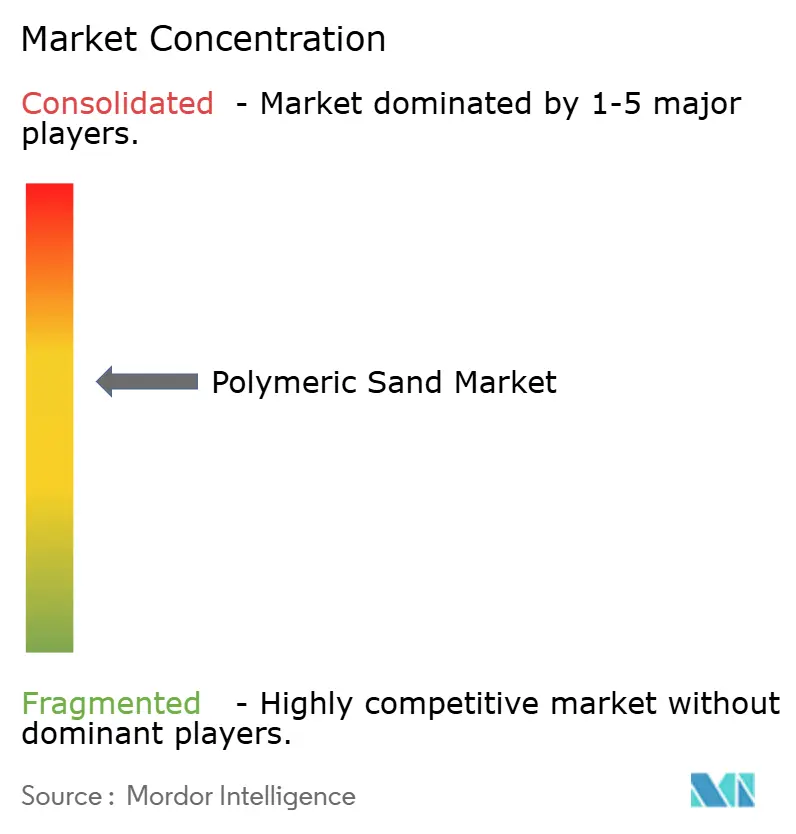
The polymeric sand market is moderately consolidated, with specialist brands competing against broader construction materials companies that bundle polymeric products into larger portfolios. No single supplier holds a dominant global position, which keeps competition active across product performance, color options, contractor support, and channel access. TECHNISEAL, SEK-Surebond, Alliance Designer Products, and Sable Marco represent the specialist segment, while QUIKRETE, Sakrete, and Mapei represent broader platform players with greater logistics reach. Specialists tend to compete through formulation depth and installer loyalty, while larger companies compete on distribution scale and product breadth. This balance keeps the market open to innovation even as consolidation increases the buying power of multi-category suppliers.
QUIKRETE's acquisition of Summit Materials in February 2025 for approximately USD 11.5 billion expanded vertical integration from aggregates to packaged hardscape products. The February 2026 asset exchange with Martin Marietta further strengthened that supply position by adding scale in aggregates, which can improve cost control across related product lines. SEK-Surebond introduced HydroSweep to address an all-weather performance gap by eliminating the need for water activation during installation. Alliance Designer Products strengthened its position with intelligent-polymer and fine-joint systems that reduce haze and dust while serving narrow-joint premium surfaces.
Technology and regulatory compliance are now the primary ways suppliers defend margins in the polymeric sand market. ROMEX has focused on low-emission and bio-based positioning with ECOFINE, which addresses procurement requirements that increasingly include environmental documentation and sustainability criteria. TECHNISEAL has used regional production expansion to improve response times and align color supply more closely with local demand patterns. The most underserved areas in the polymeric sand market remain extreme-cold formulations, drainage-compatible systems for public permeable paving, and distributor-led expansion in India and Southeast Asia, where branded penetration remains low. These opportunities align with the current market structure, as buyers are evaluating not only price but also performance reliability, regulatory compliance, and ease of installation.
Polymeric Sand Industry Leaders
The QUIKRETE Companies
Sakrete
TECHNISEAL
Alliance Designer Products Inc.
SRW PRODUCTS
- *Disclaimer: Major Players sorted in no particular order
Polymeric Sand Market Companies Covered in this Report
- Alliance Designer Products Inc.
- Basalite Concrete Products, LLC
- Brampton Brick
- Gagne & Son LLC
- Mapei S.p.A.
- Pavestone, LLC
- Romex GmbH
- Sable Marco Inc.
- Sakrete
- SEK-Surebond
- SRW PRODUCTS
- TCC Materials
- TECHNISEAL
- The QUIKRETE Companies

Recent Industry Developments in Polymeric Sand Market
- March 2026: Mapei inaugurated its first manufacturing plant in Belgium, located in Grâce-Hollogne, Liège province, dedicated to concrete admixtures production. The facility includes a concrete R&D laboratory, training center, and showroom. It strengthens Mapei Benelux's supply chain, reduces delivery lead times, and supports major Belgian projects, including Brussels Airport Zaventem and NATO Headquarters in Evere.
- May 2025: Alliance Designer Products (Alliance Gator) updated formulations and technical data sheets for Gator Super Sand G2, effective May 6, 2025, and Gator Maxx Sand G2. The updates confirm dust-free and haze-free polymer technology that eliminates post-installation blower requirements. The updates reflect a manufacturing process refinement, incorporating calibrated sand mixed with polymers that neutralize haze on contact, reducing contractor installation time and callback risk on commercial projects.


Global Polymeric Sand Market Report Scope
Polymeric sand is a blend of fine sand, polymers, and binding agents used to fill and lock joints between brick, stone, and concrete pavers. When swept into gaps and activated with water, it hardens into a durable, flexible seal that prevents weed growth, erosion, and insect burrowing.
The polymeric sand market is segmented by product type, color, application, end-use industry, and geography. By product type, the market is segmented into polymeric sand and polymeric dust. By color, the market is segmented into beige, gray, and black and other colors. By application, the market is segmented into residential hardscaping, commercial hardscaping, public infrastructure and landscaping. By product type, the market is segmented into residential, commercial, industrial, and municipal. The report also covers market size and forecasts for polymeric sand across 16 countries in major regions. The market sizes and forecasts are provided in terms of value (USD).
| Polymeric Sand |
| Polymeric Dust |
| Beige |
| Gray |
| Black and Other Colors |
| Residential Hardscaping |
| Commercial Hardscaping |
| Public Infrastructure |
| Landscaping |
| Residential |
| Commercial |
| Industrial |
| Municipal |
| Asia-Pacific | China |
| India | |
| Japan | |
| South Korea | |
| Rest of Asia-Pacific | |
| North America | United States |
| Canada | |
| Mexico | |
| Europe | Germany |
| United Kingdom | |
| France | |
| Italy | |
| Russia | |
| Rest of Europe | |
| South America | Brazil |
| Argentina | |
| Rest of South America | |
| Middle-East and Africa | Saudi Arabia |
| South Africa | |
| Rest of Middle-East and Africa |
| By Product Type | Polymeric Sand | |
| Polymeric Dust | ||
| By Color | Beige | |
| Gray | ||
| Black and Other Colors | ||
| By Application | Residential Hardscaping | |
| Commercial Hardscaping | ||
| Public Infrastructure | ||
| Landscaping | ||
| By End-Use Industry | Residential | |
| Commercial | ||
| Industrial | ||
| Municipal | ||
| By Geography | Asia-Pacific | China |
| India | ||
| Japan | ||
| South Korea | ||
| Rest of Asia-Pacific | ||
| North America | United States | |
| Canada | ||
| Mexico | ||
| Europe | Germany | |
| United Kingdom | ||
| France | ||
| Italy | ||
| Russia | ||
| Rest of Europe | ||
| South America | Brazil | |
| Argentina | ||
| Rest of South America | ||
| Middle-East and Africa | Saudi Arabia | |
| South Africa | ||
| Rest of Middle-East and Africa | ||


Key Questions Answered in the Report
What is current market size of Polymeric Sand Market?
The Polymeric Sand Market size is expected to grow from USD 229.14 billion in 2025 to USD 242.36 billion in 2026 and is forecast to reach USD 322.52 billion by 2031 at 5.88% CAGR over 2026-2031.
Which region leads to global demand for polymeric sand?
North America led with 46.82% demand in 2025, supported by strong residential paving activity and the broader adoption of permeable hardscape systems in municipalities.
Which region is growing the fastest through 2031?
Asia-Pacific is projected to grow at 7.08% CAGR through 2031, driven by urban infrastructure activity in China, India, and other developing hardscape markets.
Which product type contributes the most revenue?
Polymeric sand remained the largest product type, accounting for 72.56% of demand in 2025, as it remains the default option for standard interlocking paver installations.
Page last updated on:





