
Poland Liquid Packaging Cartons Market Size and Share
Market Overview
| Study Period | 2021 - 2032 |
|---|---|
| Forecast Data Period | 2027 - 2032 |
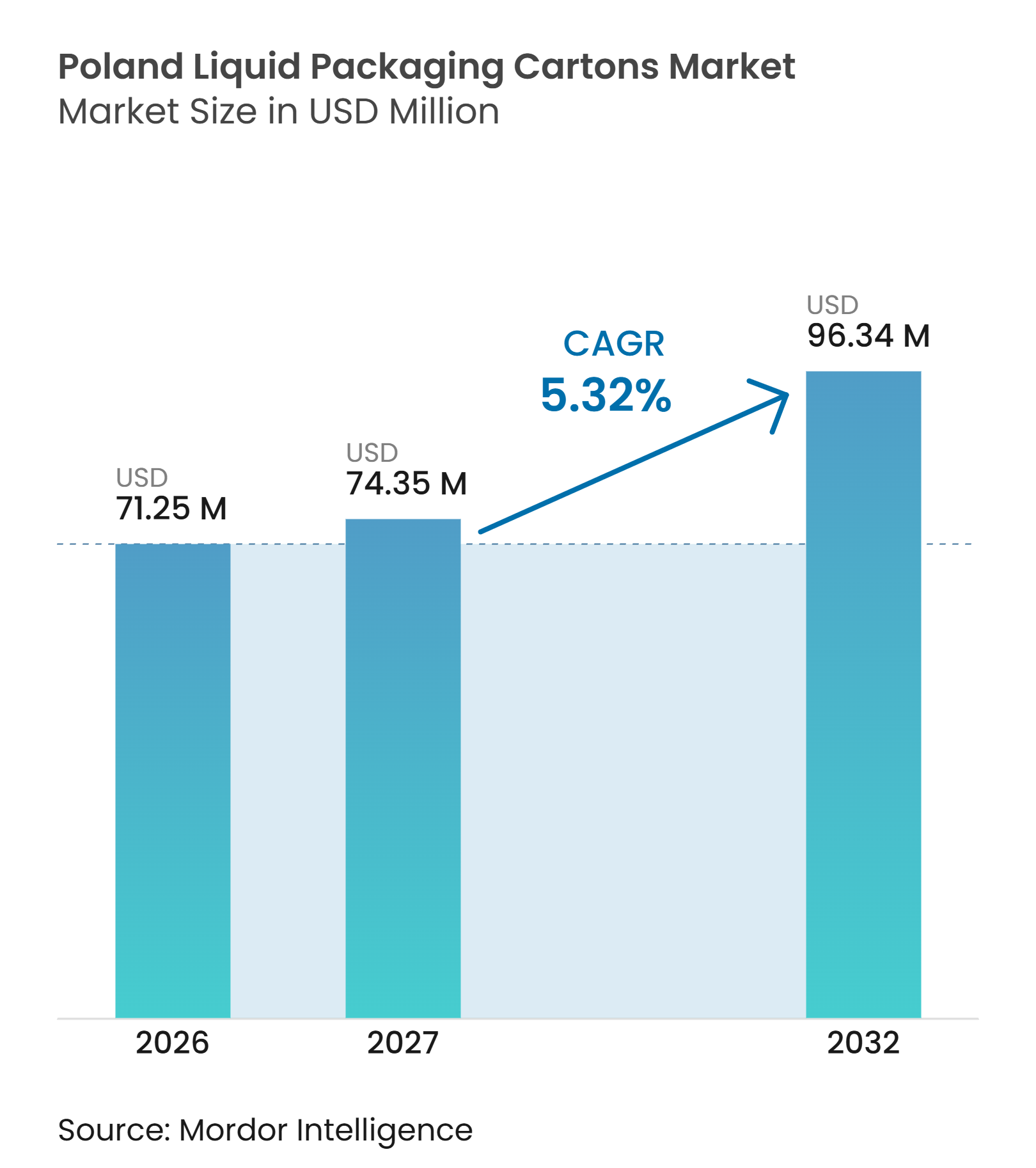
| Base Year Market Size (2026) | USD 71.25 Million |
| Market Size (2027) | USD 74.35 Million |
| Market Size (2032) | USD 96.34 Million |
| Growth Rate (2027 - 2032) | 5.32 % |
| Market Concentration | High |
Major Players *Disclaimer: Major Players sorted in no particular order Image © Mordor Intelligence. Reuse requires attribution under CC BY 4.0. | |
Poland Liquid Packaging Cartons Market Analysis by Mordor Intelligence
The Poland liquid packaging cartons market size is projected to expand from USD 71.25 million in 2026 and USD 74.35 million in 2027 to USD 96.34 million by 2032, registering a CAGR of 5.32% between 2027 to 2032. The Poland liquid packaging cartons market is supported by the country’s large dairy-processing base and established ambient distribution system. Regulation (EU) 2025/40 requires packaging placed on the EU market to be recyclable from August 12, 2026, which raises the importance of documented recycling routes for carton suppliers. Aseptic cartons are well placed in long-life dairy, juice, and plant-based drinks because they support storage and transport without refrigeration. The Poland liquid packaging cartons market also benefits when dairy exporters add capacity for UHT products, since export-oriented filling lines require dependable carton supply. Collection incentives remain uneven because cartons sit outside the national deposit-return system, which may concentrate investment in formats with clear recycling and value-added credentials.
Key Report Takeaways
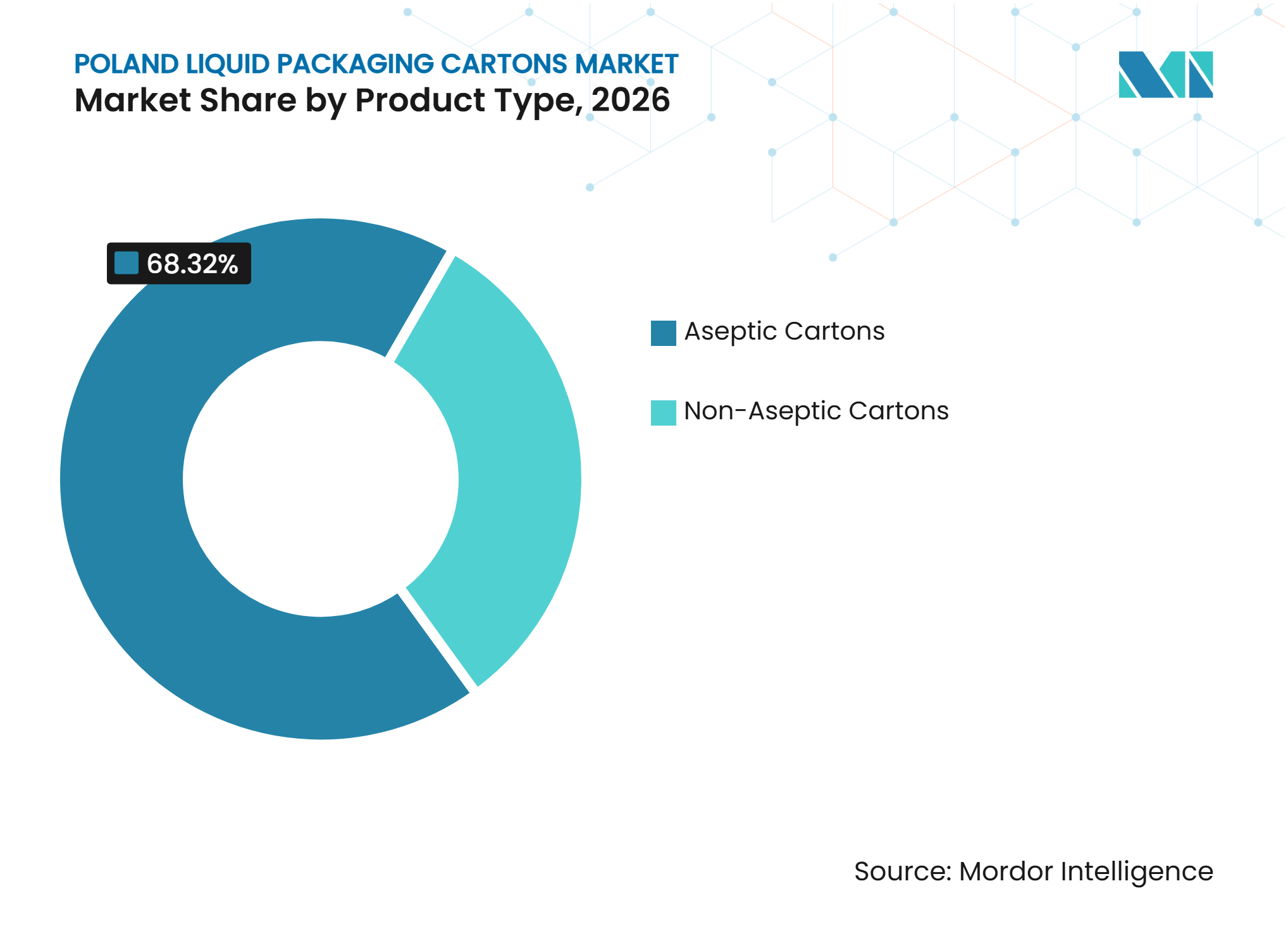
- By product type, aseptic cartons held 68.32% of the Poland liquid packaging cartons market share in 2026.
- By application, milk accounted for 46.04% of the Poland liquid packaging cartons market size in 2026, while plant-based beverages are projected to expand at a 6.34% CAGR through 2032.
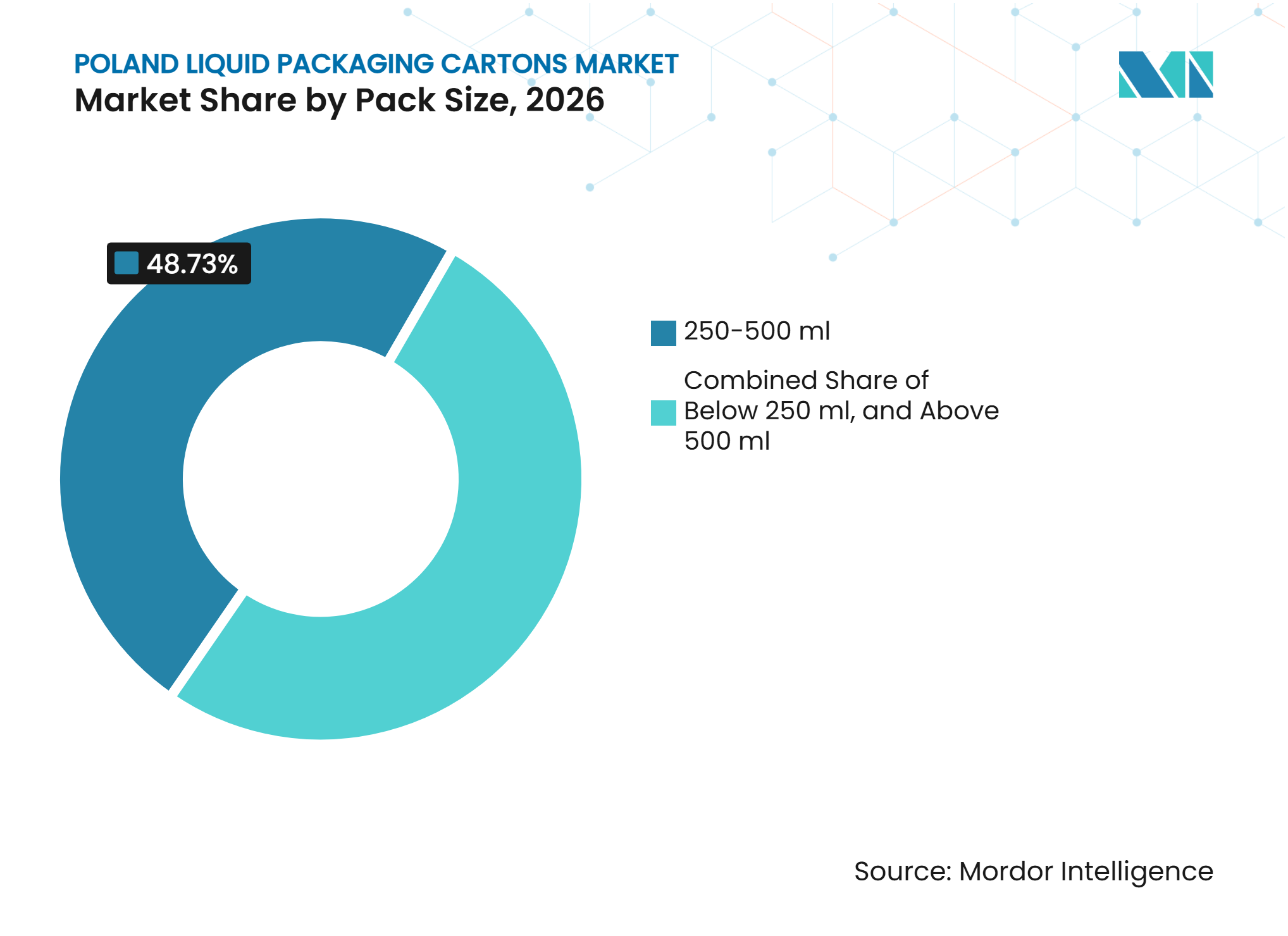
- By pack size, the 250-500 ml segment held 48.73% revenue share in 2026, while below-250 ml formats are projected to expand at a 5.89% CAGR through 2032.
Note: Market numbers in this report are based on Mordor Intelligence's proprietary estimation framework, which combines nine months of actuals with Q4 projections for base year 2026.
Market Trends and Insights
Drivers Impact Analysis of Poland Liquid Packaging Cartons Market*
| Driver | (~) % Impact on CAGR Forecast | Geographic Relevance | Impact Timeline |
|---|---|---|---|
| Expansion of Ambient Dairy and Juice Distribution | +1.5% | National, with highest intensity in Podlaskie, Warmia-Masuria, and Mazowieckie dairy belts | Long term (≥ 4 years) |
| Growth of Plant-Based Beverage Portfolios | +1.2% | National, with early gains in Warsaw, Kraków, and Tri-City urban markets | Medium term (2-4 years) |
| Retail Demand for Convenient Portion Packs | +0.9% | National, anchored in convenience and hypermarket retail channels | Medium term (2-4 years) |
| Investment in Polish Beverage-Carton Recycling Capacity | +0.6% | National, centered on the Ostrołęka hub serving Poland and neighboring Central and Eastern European markets | Long term (≥ 4 years) |
| Aluminum-Free Barrier Adoption by Polish Dairy Fillers | +0.4% | National, led by large-scale aseptic fillers in northeastern dairy-processing zones | Medium term (2-4 years) |
| Retailer-Led Premiumization of Sustainable Carton Formats | +0.3% | National, with spillover to premium grocery networks across major urban centers | Long term (≥ 4 years) |
| Source: Mordor Intelligence | |||
Expansion of Ambient Dairy and Juice Distribution
Poland’s UHT and long-life dairy network provides a substantial demand base for aseptic cartons. Mlekovita shipped 192 million liters of UHT milk to 107 countries in 2025 and reported PLN 2.8 billion (USD 700.6 million) in revenue. Higher exports to markets that depend on ambient-stable products increase utilization of domestic filling lines. Refrigerated PET or glass systems would require cold-chain infrastructure that is not always available in distant destination markets. This favors packaging that protects UHT milk during long transport and storage periods. The Poland liquid packaging cartons market, therefore, remains linked to dairy exporters’ decisions regarding production capacity and overseas distribution.
Growth of Plant-Based Beverage Portfolios
Plant-based drinks remain the fastest-expanding application in the Poland liquid packaging cartons market, with a projected CAGR of 6.34% through 2032. The Polish Association of Plant-Based Food Producers reported that total plant-based food sales exceeded PLN 1 billion (USD 250.21 million) as of April 2025.[1] Ambient cartons support national retail distribution without the refrigeration burden associated with chilled products. They also give producers sufficient surface area for product information and sustainability communication. Barista products and foodservice-oriented formats can raise demand for multi-serve aseptic packs in the 250-750 ml range. The category expands the number of products run on existing aseptic lines rather than displacing UHT dairy volumes that already use them.
Retail Demand for Convenient Portion Packs
Below-250 ml cartons are projected to expand at a 5.89% CAGR through 2032, making portion packs the fastest-growing pack-size group. Żabka operated more than 13,403 proximity stores in Poland in 2025, which supports broad availability for on-the-go food and beverage formats.[2] Small ambient cartons can be displayed without refrigeration and are suitable for quick purchases in convenience stores. Their higher value per liter can support converter revenue even when the increase in physical volume is more limited. The Poland liquid packaging cartons market can gain from formats used in ready-to-drink dairy, plant-based beverages, functional drinks, soups, and broths. Tetra Pak’s Pure-Fill modular platform lowers the need for dedicated machinery when fillers introduce smaller formats.
Investment in Polish Beverage-Carton Recycling Capacity
Stora Enso’s Ostrołęka production unit is Central and Eastern Europe’s largest specialized liquid-food carton recycling facility. Tetra Pak and Stora Enso invested EUR 29 million (USD 31 million) in the facility, which has annual processing capacity of 50,000 tonnes.[3] The site tripled Poland’s previous capacity and can process cartons from Poland and nearby markets. Its stated countrywide ceiling is 75,000 tonnes, which can cover domestic carton volumes as well as material from the Czech Republic, Hungary, Slovakia, and the Baltic states. The facility gives food producers and retailers a local end-of-life route as PPWR compliance becomes more central to procurement. It also strengthens the Poland liquid packaging cartons market by making recycling documentation more accessible to regional filling operations.
Restraints Impact Analysis of Poland Liquid Packaging Cartons Market*
| Restraint | (~) % Impact on CAGR Forecast | Geographic Relevance | Impact Timeline |
|---|---|---|---|
| Competition From Lightweight PET and Beverage Cans | -1.6% | National, sharpest in private-label juice and chilled dairy segments at major retailers | Medium term (2-4 years) |
| Volatile Board, Polymer, and Energy Input Costs | -1.1% | National, amplified for smaller independent fillers with limited hedging capacity | Short term (≤ 2 years) |
| Insufficient Carton-Specific Collection and Sorting Incentives | -0.6% | National, most acute outside major urban selective-collection networks | Long term (≥ 4 years) |
| Packaging-Line Lock-In and Conversion Costs for Smaller Fillers | -0.4% | National, concentrated among regional dairy cooperatives and independent juice producers | Long term (≥ 4 years) |
| Source: Mordor Intelligence | |||
Competition From Lightweight PET and Beverage Cans
PET bottles and aluminum cans place direct pressure on cartons in juice, energy drinks, chilled dairy, and private-label ranges. These formats are familiar to consumers and can be attractive where unit cost or visual differentiation is decisive. Poland’s deposit-return system began on October 1, 2025 and covers PET bottles, metal cans, and reusable glass bottles, but does not include liquid food cartons. The system may make covered formats appear easier to return, while cartons depend on the separate collection stream. Cartons still offer a recyclable fiber-based option, but supplier communication must explain the route clearly. The Poland liquid packaging cartons market is consequently most exposed in products where ambient shelf life offers a smaller advantage.
Volatile Board, Polymer, and Energy Input Costs
Liquid cartons combine liquid packaging board, polyethylene coatings, and, in many formats, aluminum foil layers. Each input follows a separate cost cycle, leaving converters exposed to pulp, petrochemical, and energy costs at the same time. Smaller fillers may have less ability to hedge these costs or pass them into multiyear supply agreements. Poland’s evolving extended producer responsibility framework adds further uncertainty to packaging costs. PPWR also requires suppliers to demonstrate recyclability, which can raise the value of material changes but require upfront investment. The Poland liquid packaging cartons market may therefore see stronger adoption among large fillers that can absorb conversion costs and work with established systems providers.
*Our forecasts treat driver/restraint impacts as directional, not additive. The impact forecasts reflect baseline growth, mix effects, and variable interactions.
Poland Liquid Packaging Cartons Market Segment Analysis
By Product Type:
Aseptic Cartons Lead Ambient DistributionAseptic cartons held 68.32% of the Poland liquid packaging cartons market share in 2026. Their position reflects the role of ambient dairy and juice distribution in domestic retail and export channels. Aseptic packaging gives UHT products a 12-month ambient shelf life without refrigeration. This makes it suitable for shipments to Africa, Southeast Asia, and the Middle East, where cold-chain coverage can be limited. Mlekovita’s exports to 107 countries illustrate the importance of long-distance distribution for Polish dairy producers.The Poland liquid packaging cartons industry uses this format as a core option for products that need stable storage and transport.
SIG stated that 3 large producers in Poland were already using alu-layer-free aseptic carton technology in 2025, with other producers testing the material. This change allows fillers to address material and carbon-footprint requirements without abandoning the aseptic format. Non-aseptic cartons serve extended-shelf-life chilled dairy, fresh juice, and other products with shorter storage requirements. These formats face more substitution pressure from PET and gable-top plastic packs, especially in pasteurized milk and private-label lines. Regulation (EU) 2025/40 makes recyclable packaging a direct requirement across the EU, which increases the value of verifiable end-of-life pathways. The Ostrołęka facility gives aseptic suppliers an additional compliance argument in customer discussions.



By Application:
Milk Anchors Volume and Plant-Based Drinks ExpandMilk accounted for 46.04% of the liquid packaging carton market in Poland in 2026. This is supported by high UHT consumption and a dairy manufacturing base that serves both Polish buyers and export markets. UHT milk runs on established aseptic lines, providing a stable source of carton demand. Mlekovita’s large export reach shows why ambient packaging continues to matter for Polish dairy operations. Plant-based beverages are projected to expand at a 6.34% CAGR through 2032. The category adds more products to aseptic filling lines rather than simply replacing conventional milk cartons.
The Polish Association of Plant-Based Food Producers reported that plant-based food sales exceeded PLN 1 billion (USD 250.21 million) in April 2025. Ambient cartons are suitable for the broad retail distribution required by plant-based drinks and can accommodate product labeling. Juices remain a highly contested category because mainstream products face pressure to reformulate and competition from other beverage formats. Premium not-from-concentrate and cold-pressed lines retain a role for cartons where shelf life and product positioning support the format. Dairy products other than milk, including cream and functional kefir beverages, can use cartons when producers seek ambient export routes. Energy drinks, functional drinks, soups, broths, and plant-based cooking liquids remain smaller applications, but convenience retail can expand their use of ambient-stable packaging.
By Pack Size:
Mid-Range Packs Retain Scale as Smaller Formats AdvanceThe 250-500 ml category held 48.73% of the Poland liquid packaging cartons market size in 2026. This range serves individual dairy portions, school milk, and plant-based café formats. Its position reflects the usefulness of a pack that can serve both personal consumption and multi-serve occasions. The format can also support premium product lines through portions that are more convenient than 1-liter family packs. The Poland liquid packaging cartons industry has scope for innovation in this range because it combines meaningful volume with differentiated product uses. Formats above 500 ml, mainly 1-liter and 1.5-liter UHT milk cartons, continue to provide the volume base of the category.
Below-250 ml packs are projected to expand at a 5.89% CAGR through 2032. Convenience-store expansion, out-of-home consumption, and functional food launches support this smaller format. Tetra Pak’s Pure-Fill modular system allows fillers to run sub-250 ml packs without the need for dedicated equipment, reducing a barrier for mid-sized cooperatives. In April 2026, Tetra Pak and Sterilgarda Alimenti introduced a 1-liter aseptic carton with a paper-based barrier. The pack increased renewable content to 90% and had a carbon-footprint reduction of up to 50% that was verified by the Carbon Trust. The material change may influence sustainability positioning across Poland’s large-format UHT milk packs.

Geography Analysis
Northeastern Poland: Dairy Manufacturing Core
Northeastern Poland, including Podlaskie and Warmia-Masuria, has a high concentration of large UHT milk processors and is a major demand center for the Poland liquid packaging cartons market. Mlekpol in Grajewo and Mlekovita in Łomża operate high-speed filling systems that serve domestic and export demand. Mlekovita supplied 107 countries in 2025, which reduces the region’s dependence on Polish household spending cycles. Long-distance dairy shipments make aseptic cartons useful because the products can remain stable without refrigeration. SIG reported that 3 large Polish producers had adopted alu-layer-free aseptic technology, while others were in validation. This supports a shift toward lower-material barrier systems in the dairy-processing belt. The nearby Ostrołęka recycling hub also provides a local route to document end-of-life handling under Regulation (EU) 2025/40.
Central Poland and Mazowieckie: Commercial and Logistics Hub
Mazowieckie, centered on Warsaw, is a commercial and logistics hub for the Poland liquid packaging cartons market. It serves as a distribution gateway for carton volumes from the northeastern dairy belt and includes the headquarters of companies such as Hortex Holding. Warsaw’s organized retail and café networks support demand for smaller aseptic cartons used for plant-based drinks and ready-to-drink products. Elopak reported that Roll Fed volumes in Europe, the Middle East, and Africa returned to growth in the first quarter of 2026 and cited onboarding new customers in Poland. The development points to demand for non-aseptic format flexibility among local beverage fillers. Ostrołęka’s 50,000-tonne annual capacity makes the region a national recycling infrastructure center. Material collected from Warsaw-area retail networks can enter this recycling circuit, supporting supplier compliance narratives.
Regional Dynamics Beyond Core Markets
Southern Poland, including Silesia and Małopolska, is a large consumer cluster outside Warsaw and is home to Maspex, the producer of Tymbark juices. Retailer interest in sustainability labeling can support aseptic carton use in regional juice production. Greater Poland around Poznań adds non-aseptic and extended-shelf-life demand from regional cooperatives, including operations near Łódź. Western Poland’s proximity to Germany supports cross-border logistics and can link local collection networks with regional material flows. Tetra Pak states that the Ostrołęka site can process cartons from neighboring countries, making the facility relevant to these routes. Eastern Poland has lower carton intensity, but improved rural logistics can extend access to ambient products. Across these areas, PPWR recyclability requirements create an incentive for suppliers to offer traceable fiber sourcing and clear recovery pathways.
Competitive Landscape
Market Concentration
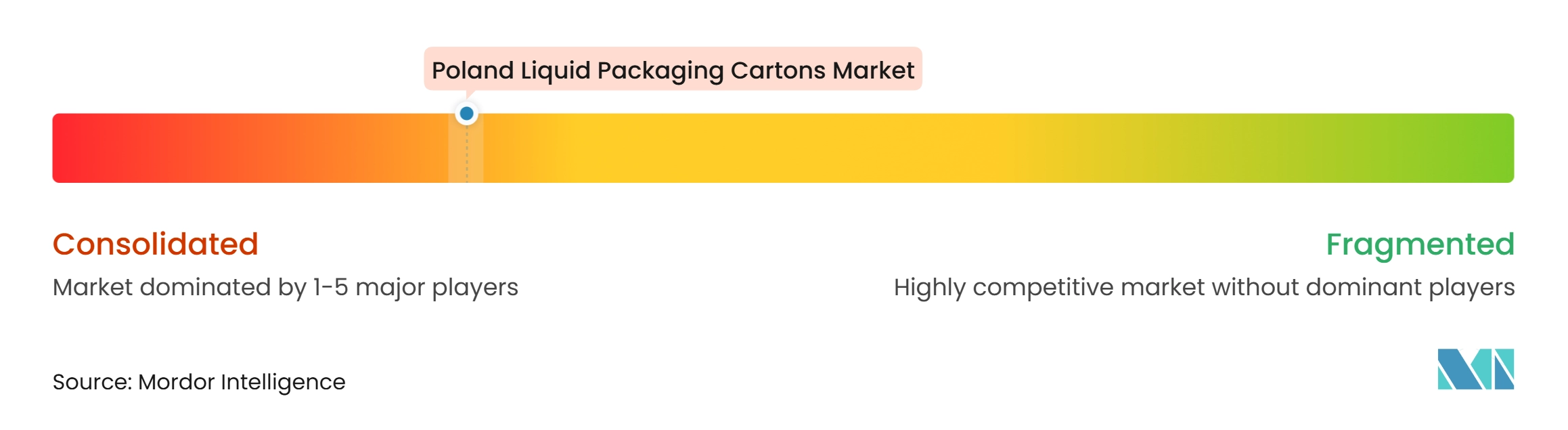
The Poland liquid packaging cartons market has a concentrated systems-provider layer led by Tetra Pak, SIG Group, and Elopak. These companies supply filling equipment and carton materials to large dairy and juice fillers. Their position means competition centers on filling compatibility, material performance, and technical service rather than carton price alone. SIG reported 24% year-over-year sales growth for its alu-layer-free aseptic cartons in 2025. SIG also stated that more than 10% of food packed in Europe used SIG Terra solutions in 2025. Its Terra Alu-free plus Full Barrier solution can reduce a carton’s carbon footprint by up to 61% when used with forest-based polymers.
Tetra Pak introduced the first 1-liter aseptic carton with a paper-based barrier with Sterilgarda Alimenti in April 2026. The company said the design delivered a verified carbon-footprint reduction of up to 50%, giving Polish UHT milk fillers a reference point for future material upgrades. SIG produced 54 billion packs and generated EUR 3.2 billion (USD 3.5 billion) in revenue in 2025. Elopak reported consolidated revenue above EUR 1.2 billion (USD 1.3 billion) in 2025. Greatview became Wintipak AG in March 2025 and opened a manufacturing facility in Perugia, Italy, for its 200 ml Slim Brick Plus with a polymer barrier.
Smaller providers can compete where independent fillers seek alternatives to proprietary filling systems. IPI Srl, part of Coesia Group, addresses this need among fillers that want more equipment flexibility. Extended producer responsibility changes may favor materials with stronger recyclability scores, particularly alu-free and paper-barrier systems. FSC chain-of-custody certification and ISO 14001 environmental management practices can also be relevant in retailer procurement. These factors reinforce the advantage of suppliers that can demonstrate material traceability and recovery infrastructure. The Poland liquid packaging cartons market will likely continue to distinguish competitors by their ability to combine filling technology, barriers, recycling evidence, and support for food producers.
Poland Liquid Packaging Cartons Industry Leaders
-
Tetra Pak International SA
-
SIG Group AG
-
Elopak ASA
-
Greatview Aseptic Packaging Co. Ltd.
-
Pactiv Evergreen Inc.
- *Disclaimer: Major Players sorted in no particular order
Poland Liquid Packaging Cartons Market Companies Covered in this Report
- Tetra Pak International SA
- SIG Group AG
- Elopak ASA
- Greatview Aseptic Packaging Co. Ltd.
- Pactiv Evergreen Inc.
- Nippon Paper Industries Co., Ltd.
- UFlex Limited
- IPI Srl
- Visy Industries
- Klabin S.A.
- Nampak Limited
- Stora Enso Oyj
- Mondi plc
- Billerud AB (publ)
- Mlekpol Spółdzielnia Mleczarska
- Grupa Mlekovita
- Maspex Sp. z o.o.
- Hortex Holding S.A.
- Okręgowa Spółdzielnia Mleczarska w Łowiczu
- Grupa Polmlek
Recent Industry Developments in Poland Liquid Packaging Cartons Market
- October 2026: SIG launches SIG CleanClic Connect, a bag-in-box fitment innovation for foodservice dispensing, targeting the HoReCa channel, a secondary but growing carton-adjacent application relevant to Polish foodservice liquid food fillers.
- October 2026: SIG introduces the new SIG Neo filling machine portfolio for aseptic cartons, targeting high-output, high-flexibility production without facility expansion and enabling Polish dairy and beverage fillers to upgrade line capacity without replacing filling machines.
- April 2026: Tetra Pak and Italian dairy Sterilgarda Alimenti launch the world’s first 1-liter aseptic carton with a paper-based barrier, Tetra Brik Aseptic 1000 Edge, increasing renewable content to 90% and reducing carbon footprint by up to 50% as verified by the Carbon Trust. The format is directly applicable to Poland’s dominant 1-liter UHT milk carton segment.
- December 2025: Tetra Pak and Spanish juice producer García Carrión launch the world’s first paper-based barrier aseptic carton for juice packaging, the first use of this barrier technology outside dairy, with direct implications for Poland’s juice carton filler base considering format upgrades.
Poland Liquid Packaging Cartons Market Report Scope
The Poland Liquid Packaging Cartons Market encompasses the manufacturing and supply of paperboard-based packaging solutions designed for the safe storage, transportation, and distribution of liquid beverages and food products. These cartons provide product protection, extended shelf life, and convenient handling while supporting efficient packaging and distribution. The market includes packaging solutions designed to maintain product freshness, prevent contamination, and meet evolving food safety and sustainability requirements. Growing consumption of packaged beverages, increasing demand for convenient and shelf-stable products, and the shift toward recyclable packaging materials drive market growth across India.
The Poland Liquid Packaging Cartons Market Report is Segmented by Product Type (Aseptic Cartons, and Non-Aseptic Cartons), Applications (Milk, Juices, Plant Based Beverages, Dairy Products Excluding Milk, Energy and Functional Drinks, Liquid Food, and Other Applications), and Pack Size (Below 250 ml, 250-500 ml, and Above 500 ml). The Market Forecasts are Provided in Terms of Value (USD).
Segmentation Overview
| Aseptic Cartons |
| Non-Aseptic Cartons |
| Milk |
| Juices |
| Plant Based Beverages |
| Dairy Products (Excluding Milk) |
| Energy and Functional Drinks |
| Liquid Food |
| Other Applications |
| Below 250 ml |
| 250-500 ml |
| Above 500 ml |
| By Product Type | Aseptic Cartons |
| Non-Aseptic Cartons | |
| By Applications | Milk |
| Juices | |
| Plant Based Beverages | |
| Dairy Products (Excluding Milk) | |
| Energy and Functional Drinks | |
| Liquid Food | |
| Other Applications | |
| By Pack Size | Below 250 ml |
| 250-500 ml | |
| Above 500 ml |
Key Questions Answered in the Report
What is the current value of Poland's liquid packaging cartons category?
Poland's liquid packaging cartons category is projected to increase from USD 71.25 million in 2026 to USD 96.34 million by 2032, at a 5.32% CAGR from 2027 to 2032. The 2027 estimate is USD 74.35 million, reflecting continued demand from ambient dairy, juice, and plant-based beverage filling. The outlook also reflects a regulatory setting in which recyclable packaging and recycling infrastructure are becoming more important purchasing considerations for retailers, fillers, and their packaging suppliers.
Which carton format leads in Poland?
Aseptic cartons led with 68.32% share in 2026 because they support ambient storage and long-distance distribution for UHT dairy and beverage products. This format also benefits from local recycling capacity at Ostro??ka and supports exporters that serve markets with limited refrigeration infrastructure.
What application is expanding fastest in Poland's liquid carton sector?
Plant-based beverages are projected to record the fastest application CAGR at 6.34% through 2032. Milk remains the largest application, with 46.04% share in 2026, supported by established UHT production and export-oriented dairy operations.
Which pack size is projected to expand fastest?
Below-250 ml packs are projected to expand at a 5.89% CAGR through 2032, supported by convenience retail and out-of-home consumption. The 250-500 ml range led by value with 48.73% share in 2026, serving individual dairy portions and plant-based beverage formats.
How does PPWR affect carton suppliers in Poland?
Regulation (EU) 2025/40 requires packaging placed on the EU market to be recyclable, which increases demand for documented collection and recycling pathways. Suppliers with paper-based or alu-free barrier options can respond to these requirements while supporting customer requests for traceability and recovery evidence.
Who are the key carton systems providers serving Poland?
Tetra Pak, SIG Group, and Elopak are the main integrated suppliers of carton materials and filling systems to large Polish dairy and juice fillers. Their competition centers on material innovation, equipment compatibility, technical service, and the ability to support stated sustainability targets.