
Podcast Marketing Services Market Size and Share
Market Overview
| Study Period | 2020 - 2031 |
|---|---|
| Market Size (2026) | USD 2.94 Billion |
| Market Size (2031) | USD 5.12 Billion |
| Growth Rate (2026 - 2031) | 11.66 % |
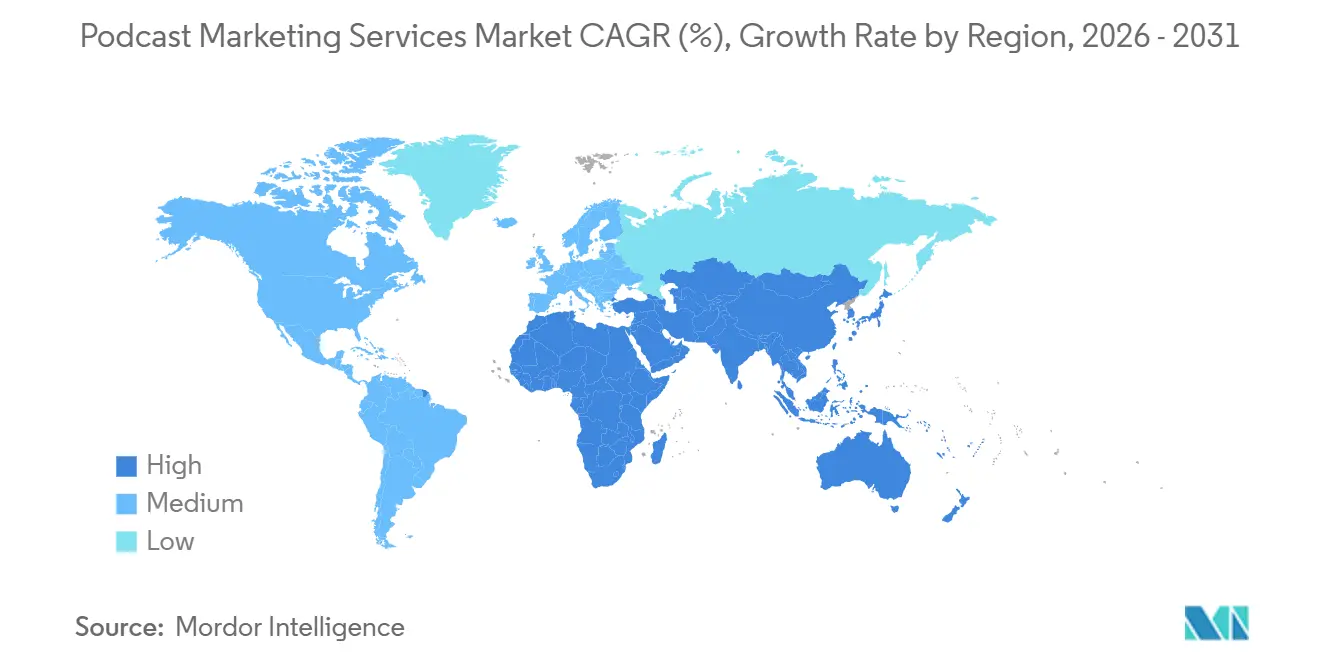
| Fastest Growing Market | Asia-Pacific |
| Largest Market | North America |
| Market Concentration | Medium |
Major Players *Disclaimer: Major Players sorted in no particular order Image © Mordor Intelligence. Reuse requires attribution under CC BY 4.0. | |
Podcast Marketing Services Market Analysis by Mordor Intelligence
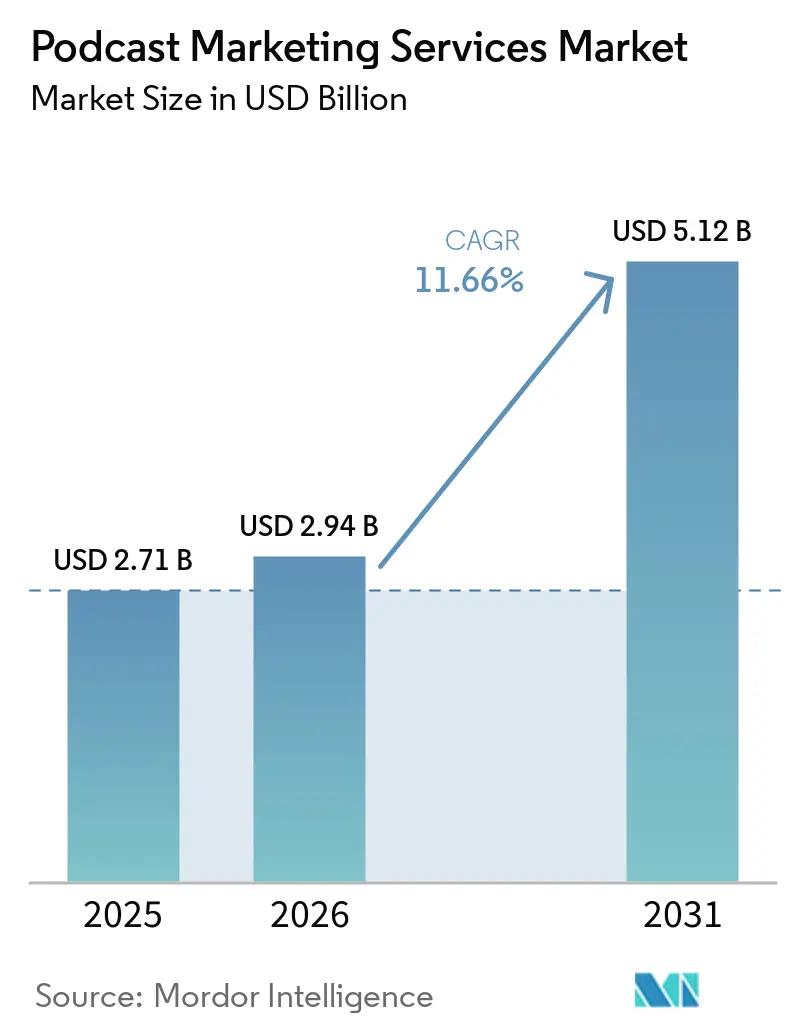
The podcast marketing services market size was valued at USD 2.71 billion in 2025 and is estimated to grow from USD 2.94 billion in 2026 to reach USD 5.12 billion by 2031, at a CAGR of 11.66% during the forecast period 2026-2031. The podcast marketing services market is expanding as brands move budgets toward audio and video programs that support sustained audience relationships and measurable campaign activity. This shift favors service partners that can organize several connected activities around a program instead of treating recording, advertising, and reporting as separate assignments with limited coordination. Video consumption has expanded the work required of service providers, since a single show may now require recording, editing, distribution, promotion, and measurement across several formats. Clients must decide early how visual material will be created and approved, where it will appear, and which version will lead audiences to the longer episode. Host-read advertising, programmatic access, branded shows, and subscription tools are increasing the range of commercial models available to clients. Each model has a different relationship to content ownership, audience development, pricing, sales activity, and the information needed to demonstrate results to internal decision makers. The podcast marketing services market also faces a clear measurement challenge, because brands need reliable evidence of reach, response, and revenue across audio, video, and platform environments.
Key Report Takeaways
- By service type, Production and Post-Production accounted for 29.06% of the podcast marketing services market in 2025, while Analytics and Attribution are projected to expand at a 12.31% CAGR through 2031.
- By revenue model, Sponsorship Management accounted for 60.12% of revenue in 2025, while Subscription and Membership Strategy is projected to grow at a 12.55% CAGR through 2031.
- By end-user industry, Media and Entertainment held a 24.31% share in 2025, while Retail and E-commerce is projected to advance at a 12.49% CAGR through 2031.
- By geography, North America accounted for a 48.23% share in 2025, while Asia-Pacific is projected to grow at a 12.44% CAGR through 2031.
Note: Market size and forecast figures in this report are generated using Mordor Intelligence’s proprietary estimation framework, updated with the latest available data and insights as of January 2026.
Market Trends and Insights
Drivers Impact Analysis of Podcast Marketing Services Market*
| Driver | (~) % Impact on CAGR Forecast | Geographic Relevance | Impact Timeline |
|---|---|---|---|
| Demand for Host-Read and Creator-Led Advertising | +2.8% | Global, with highest intensity in North America | Short term (≤ 2 years) |
| Branded Podcast Expansion in Business and Enterprise Marketing | +2.3% | North America and Europe, with Asia-Pacific emerging | Medium term (2-4 years) |
| Growth of Video Podcast Consumption Across Platform Ecosystems | +1.9% | Global, with Asia-Pacific growing fastest | Short term (≤ 2 years) |
| Programmatic Buying and Audience Targeting for Audio Inventory | +1.5% | North America and Europe | Medium term (2-4 years) |
| Content Repurposing Across Full-Funnel Packages | +0.9% | Global | Medium term (2-4 years) |
| Corporate Internal and Private Podcasting | +0.7% | North America, Europe, and Asia-Pacific corporate hubs | Long term (≥ 4 years) |
| Source: Mordor Intelligence | |||
Rising Demand for Authentic Host-Read and Creator-Led Advertising
Host-read advertising supports the podcast marketing services market because listeners often view a host's recommendation differently from a standard commercial message. This makes the relationship between the brand, the host, and the intended audience central to campaign design, rather than treating each placement as interchangeable inventory or a standard media placement. The agency must understand the client’s objectives, the host’s voice, the audience’s interests, and any claim that needs careful review. A well-developed integration needs a clear commercial purpose, language that suits the show, and enough time for the host to understand the product before recording. Service providers must therefore assess host fit, develop clear briefs, negotiate usage, and protect the natural character of an endorsement. The model also requires transparent disclosure where a commercial relationship exists, especially for clients in regulated categories. As brands seek host partnerships at greater scale, agencies that can preserve audience trust while managing campaign operations have a practical advantage, particularly when a campaign needs consistent delivery across multiple shows, hosts, and release dates.
Expansion of Branded Podcasts in Business and Enterprise Marketing
Branded programs are extending the podcast marketing services market beyond seasonal advertising purchases and into longer-term content planning. New podcast advertisers spent USD 39,231 in their first month in 2025 and USD 64,616 per month during the following 6 months, compared with USD 18,200 at launch and USD 30,445 per month during the following 6 months in 2024. The spending pattern reflects a larger commitment from new entrants once they begin using podcasts as part of an ongoing communication program. It also suggests that the first months of a program are often used to establish production routines, test formats, and identify the audience topics that merit continued investment. A branded show can support executive visibility, customer education, and subject-focused conversations without relying only on a short campaign window. This approach also raises the importance of editorial planning, consistent publishing, guest coordination, and distribution support across the full life of a program. It makes the choice of themes and guests both a commercial and a content decision. Financial services and healthcare clients require additional attention to disclosures and advertising standards, which can favor providers with relevant compliance experience and documented review processes that clients can apply before publishing an episode.
Growth of Video Podcast Consumption Across Platform Ecosystems
Video podcasting is expanding the podcast marketing services market by changing how audiences discover and consume shows. YouTube reported that it had more than 1 billion monthly active viewers of podcast content in February 2025.[1] The same shift requires agencies to plan for visual production, clips, thumbnails, channel management, and audio distribution together rather than as separate activities. Video also changes the range of assets that can be used across social channels, email, search, and creator pages. A complete distribution plan must decide which moments should become short clips, how visuals will represent the brand, and how each asset will direct viewers back to the full program. This broader format requirement can increase the value of a client engagement, but it also increases production coordination and quality-control needs across lighting, sound, editing, captions, and final distribution files. The podcast marketing services market is therefore placing greater value on teams that can maintain a coherent program across both audio and visual channels while retaining a consistent editorial identity for the client.
Better Programmatic Buying and Audience Targeting for Audio Inventory
Programmatic buying is widening access to the podcast marketing services market for advertisers who do not want to arrange every placement through direct sales teams. IAB Australia reported that 78% of agencies intended to buy digital audio programmatically in 2025, compared with 72% in 2024 and 63% in 2023. Spotify expanded programmatic access in October 2025 through partnerships that included Google DV360, Amazon DSP, and Yahoo DSP. These connections can lower entry barriers and give buyers more flexibility in planning, targeting, and reporting. They also make campaign setup, inventory decisions, brand suitability, and performance interpretation more important services. Buyers still need help translating audience targets into suitable shows and checking whether automated placements meet the client’s commercial and brand requirements, especially when inventory, show context, and reporting differ across platforms. Agencies that understand demand-side workflows can help advertisers use automated buying without losing the editorial context that distinguishes podcast advertising or the relationship between the host and regular listeners.
Restraints Impact Analysis of Podcast Marketing Services Market*
| Restraint | (~) % Impact on CAGR Forecast | Geographic Relevance | Impact Timeline |
|---|---|---|---|
| Measurement and Attribution Gaps Beyond Downloads | -2.1% | Global, most acute in North America where YouTube dominates | Short term (≤ 2 years) |
| Ongoing Investment Needed for Branded Podcast Audiences | -1.5% | Global, particularly for smaller and mid-market brands | Medium term (2-4 years) |
| Platform Dependency and Walled-Garden Discovery | -1.0% | Global | Medium term (2-4 years) |
| Rights, Music, and Cross-Border Compliance Complexity | -0.6% | Asia-Pacific, Europe, and South America | Long term (≥ 4 years) |
| Source: Mordor Intelligence | |||
Measurement and Attribution Gaps Beyond Downloads
Measurement limitations can constrain the podcast marketing services market because a download or a view does not capture the full commercial impact of a campaign. The challenge is more pronounced when a campaign appears across RSS feeds, video platforms, social clips, and paid media channels, each using different reporting methods. Spotify introduced a new plays standard in June 2026 that counts an episode after at least 30 seconds of consumption, and it also expanded creator analytics. The update provides a more consistent activity signal, but it does not resolve every question about conversion, revenue, or cross-platform exposure. Service providers often need to combine audience data, post-purchase surveys, promo codes, and client sales data to form a fuller view. This creates additional operating work and can slow decisions when clients require clear evidence before committing larger budgets. It also means that campaign reports must explain what each measure can show, where its limits remain, and how several measures fit together in a practical account of campaign performance for the client.
High Ongoing Investment Needed to Build and Sustain Branded Podcast Audiences
Branded shows can constrain the podcast marketing services market when clients underestimate the ongoing investment required for publishing, promotion, and audience development. Production costs arrive before a show has earned a regular audience or demonstrated commercial results. A program also needs a consistent release schedule, distribution activities, relevant guests, and content useful to a defined listener group. Internal podcast programs add further requirements because they may need access controls, employee privacy safeguards, and separate reporting arrangements. Smaller brands can find it difficult to maintain these activities alongside their other marketing priorities. They may also struggle to assign a clear owner for editorial decisions, guest approvals, distribution tasks, and the long-term review of audience feedback for returning audiences. Providers can reduce this burden by setting realistic scopes, creating reusable assets, and aligning the show with wider communication activities, but the time-to-return challenge remains, particularly where a client expects immediate audience growth from a new show.
*Our forecasts treat driver/restraint impacts as directional, not additive. The impact forecasts reflect baseline growth, mix effects, and variable interactions.
Podcast Marketing Services Market Segment Analysis
By Service Type:
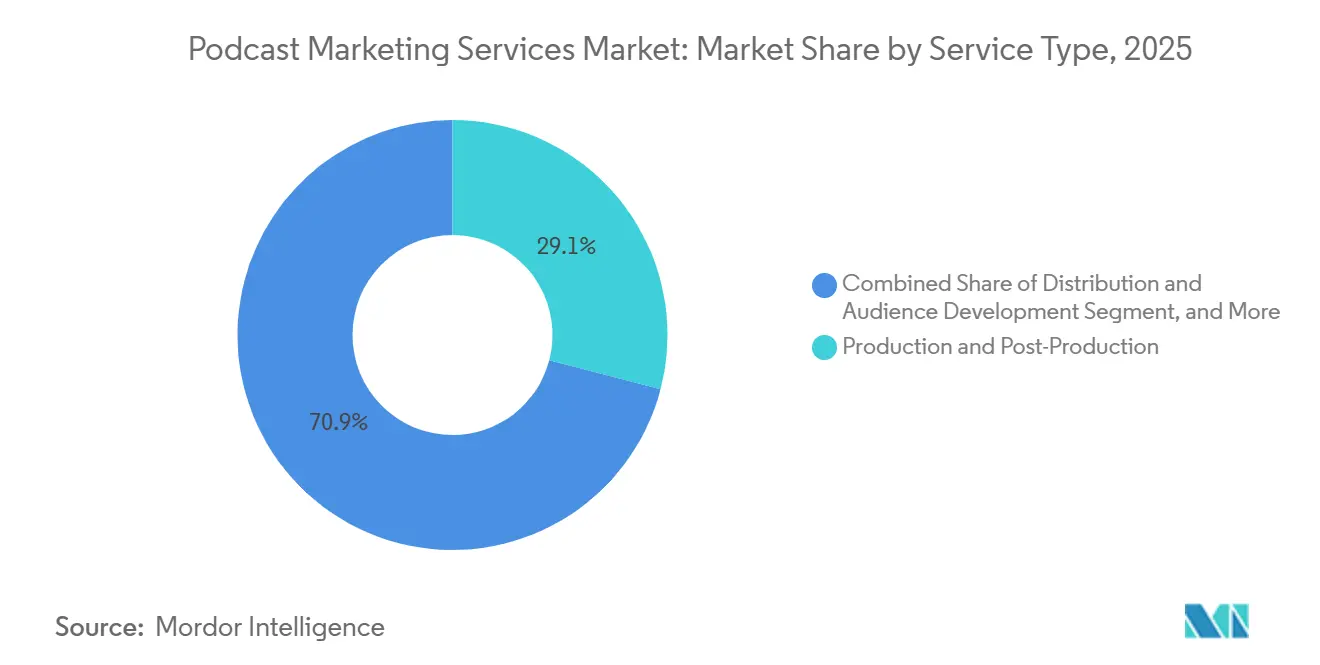
Analytics and Attribution Reshape Production LeadershipProduction and Post-Production accounted for 29.06% of the market in 2025, supported by demand for coordinated audio and video output. Brands increasingly need studios, agencies, and specialists that can take a show from planning through editing and final distribution, with clear responsibilities for creative approval, technical quality, and publishing timing. Production work remains necessary whether the objective is brand awareness, customer education, internal communication, or sponsorship revenue. High-quality recording, visual presentation, editing, and publishing are important because audiences encounter the same show across multiple platforms and form opinions about the client from every version of the content. Strategy and Show Development, Distribution and Audience Development, Sponsorship and Host-Read Ad Sales, and Content Repurposing make up the other service categories, showing that a podcast program needs a connected operating model rather than isolated production support.
Analytics and Attribution is projected to grow at a 12.31% CAGR through 2031, making it the fastest-growing service category in the podcast marketing services market. This activity is gaining importance because clients need to explain results to senior marketing, finance, and operating teams. Spotify’s June 2026 plays standard gives creators a common activity measure for episodes consumed for at least 30 seconds. Video distribution adds further reporting surfaces, and this makes download-centered measurement less complete than it was for audio-only campaigns. Providers that can join platform reporting with client data, surveys, and promotion codes can offer more useful campaign reviews. Content repurposing supports this work because 1 recording can inform social posts, email material, and search-focused assets, although each output still needs suitable reporting and governance that links activity to the wider program.

By Revenue Model:
Subscription Growth Diversifies Sponsorship-Led RevenueSponsorship Management held 60.12% of the podcast marketing services market share in 2025, reflecting the established role of host-read placements, direct advertiser relationships, and programmatic inventory. This model has supported the commercial development of many shows by connecting creators, networks, and advertisers through familiar media-buying arrangements, defined inventory, and regular reporting discussions. Agencies working in this category manage host selection, campaign terms, creative approvals, inventory availability, and reporting. Sponsorship can provide predictable income when buyers commit over multiple episodes or quarters, but it can also expose providers to changes in advertising budgets and platform policies when too much of their revenue depends on a single monetization channel. Affiliate Marketing remains part of the revenue mix, particularly when a promo code provides a direct path to track consumer action.
Subscription and Membership Strategy is projected to grow at a 12.55% CAGR through 2031 within the podcast marketing services market. Fox Corporation’s Tubi Media Group acquired Supercast in February 2026, and Fox stated that Supercast’s top 10 podcasters had collectively generated more than USD 26 million in annual subscription revenue.[2] Spotify also introduced Creator Sponsorship tools in May 2026 to help eligible video podcast creators manage brand sponsorships within its program. These developments show that providers can increasingly combine advertising and direct listener payments within a single program. Subscription services require decisions on premium content, audience messaging, platform choice, pricing, and retention, and they can reduce reliance on advertising alone when content gives listeners a clear reason to pay.
By End-User Industry:
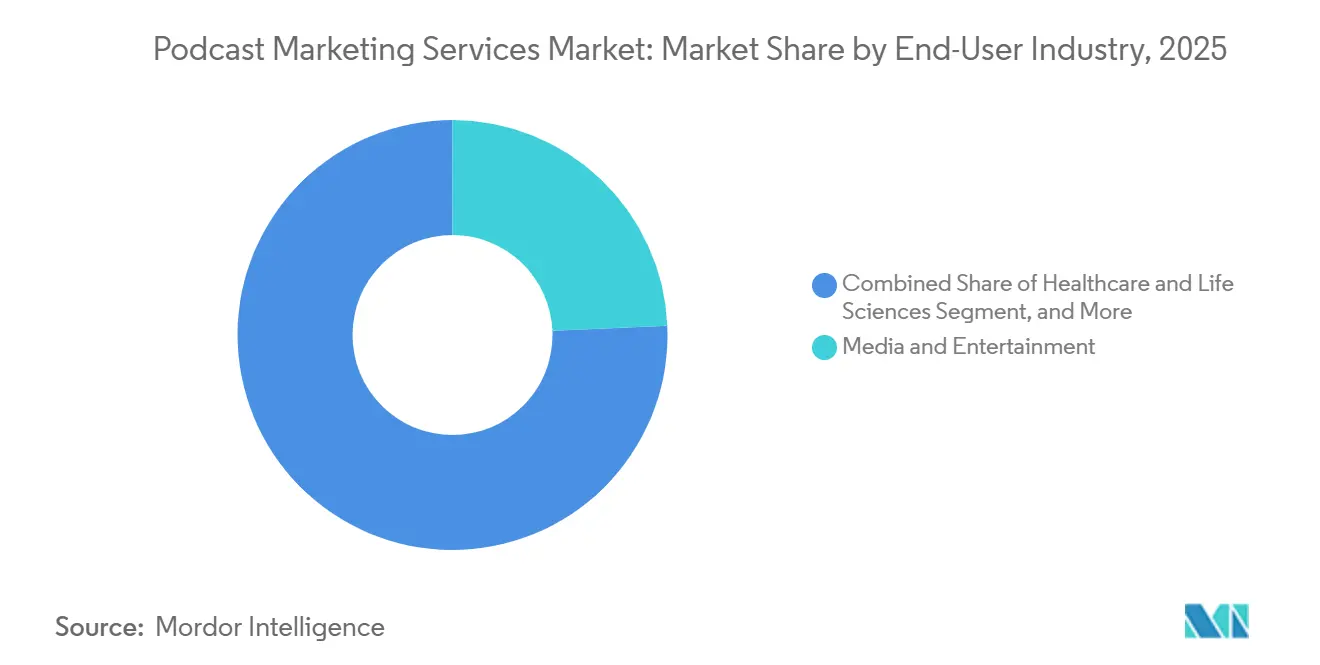
Retail and E-Commerce Build New DemandMedia and Entertainment accounted for 24.31% of the podcast marketing services market size in 2025, making it the largest end-user industry. This position reflects the sector’s existing investment in programming, talent, distribution, television, streaming, and audience promotion. Podcast production can support a broader content portfolio by extending the lifespan of established franchises or creating a low-barrier entry point for new formats. The segment also has experience managing audiences across multiple media channels, supporting cross-promotion, advertiser sales, release planning, community engagement, and sponsorship management. These requirements keep the segment important even as other verticals increase their activity.
Retail and e-commerce are projected to expand at a 12.49% CAGR through 2031 in the podcast marketing services market. The category is drawing attention as large retailers and digital commerce businesses seek ways to connect content, product discovery, and customer relationships without relying solely on short-form promotional messages. Podcast activity can support product education, founder-led conversations, customer stories, and creator partnerships that continue beyond a single retail campaign. It can also work alongside promotional codes and other methods that help advertisers identify customer response. BFSI, Healthcare and Life Sciences, and IT and Telecommunications each bring distinct compliance needs to their podcast programs, while Education, government communications, and nonprofit organizations are included in Other End-User Industries, where internal and mission-focused programs can offer an alternative to email-led communication.
Geography Analysis
North America Podcast Marketing Services Market
North America held 48.23% of the podcast marketing services market share in 2025, supported by a mature advertising infrastructure, high listener participation, and established programmatic buying tools. The region has a broad mix of networks, platforms, production companies, agencies, and measurement specialists, serving established audio buyers and newer brands testing video podcast formats. This range of participants offers clients several routes to market, but it also makes specialist advice useful when comparing platform terms, production models, and campaign reporting. North American service providers are also responding to the need for combined audio-and-video campaign planning.
APAC Podcast Marketing Services Market
Asia-Pacific is projected to grow at a 12.44% CAGR through 2031, making it the fastest-growing region in the podcast marketing services market. The region’s expansion is linked to mobile-first listening in India and Southeast Asia, corporate adoption in Japan, and paid content activity in China. These conditions increase the need for local-language production, audience development, and distribution support, while providers must also account for differing platform preferences, commercial practices, and regulatory requirements across the region. Demand can favor agencies that combine local market understanding with the ability to coordinate regional programs for multinational clients.
EMEA and South America Podcast Marketing Services Market
Europe, South America, the Middle East, and Africa represent smaller regional segments of the podcast marketing services market. Europe has regulated advertising environments that can create demand for providers with experience in disclosure, rights, and data-protection requirements, while South America’s larger podcast audiences are concentrated in Brazil and Argentina, where younger mobile-centered audiences can support advertiser interest. Cross-border rights issues and currency volatility can make regional direct-response campaigns harder to scale. The Middle East and Africa remain earlier-stage markets where branded content from multinational companies is building the supply of English- and Arabic-language programming, and operating conditions differ widely between countries.
Competitive Landscape
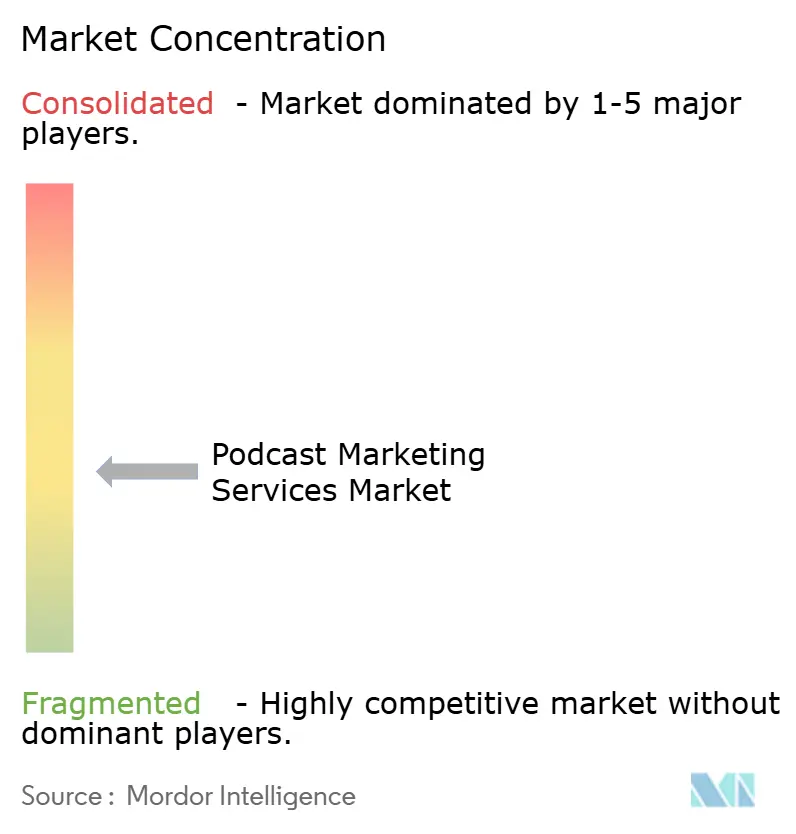
The podcast marketing services market is moderately fragmented, with platform operators, full-service agencies, and analytics specialists competing across related service areas. The competitive environment is moving toward more integrated offers that combine content development, production, distribution, advertising sales, performance reporting, audience access, advertising technology, and direct relationships with creators and buyers. Smaller agencies can remain relevant by focusing on specific sectors, host relationships, local markets, or services that platforms do not provide in depth, such as detailed creative planning and client-specific compliance support. Competition, therefore, depends on service capability and client fit as much as broad platform scale.
Platform investment is increasing the operating requirements for firms in the podcast marketing services market. Spotify expanded access to its audio and video inventory through advertising partnerships in October 2025. Integral Ad Science launched AI-driven brand safety and suitability solutions for podcast advertising on Spotify’s Audience Network in May 2025, with episode-level content classification in more than 90 languages.[3] These developments raise expectations around safe placement, targeting, and reporting, particularly for advertisers in regulated categories. They also make it harder for a production-only provider to meet the full needs of a large advertiser, while boutique firms can respond by partnering with technology providers or by concentrating on higher-value creative, compliance, and strategic work.
Strategic moves during 2025 and 2026 also point to closer connections between content, monetization, and distribution. Fox Corporation’s Tubi Media Group acquired Supercast in February 2026 to bring subscription capabilities into its creator services activity. Spotify’s May 2026 Creator Sponsorship tools combined brand sponsorship management with creator monetization support for video podcasts. Spotify’s June 2026 plays standard and expanded creator analytics added another shared measurement reference for the format, increasing the value of firms that can help clients select platforms, manage rights, develop content, and interpret reporting. They also leave openings in private enterprise podcasts, subscription strategy, non-U.S. analytics, and content repurposing workflows.
Podcast Marketing Services Industry Leaders
-
Acast AB
-
Ad Results Media LLC
-
Audacy, Inc.
-
Build Freedom LLC
-
Podcasting Ltd
- *Disclaimer: Major Players sorted in no particular order
Podcast Marketing Services Market Companies Covered in this Report
- Acast AB
- Ad Results Media LLC
- Audacy, Inc.
- Build Freedom LLC
- Podcasting Ltd
- Fresh Air Production Ltd
- JAR Podcast Solutions Inc.
- Lower Street Media Ltd
- Pacific Content Inc.
- Pod People LLC
- Podbean Tech Inc.
- Podfly Productions, LLC
- Podigy LLC
- Quill Inc.
- Resonate Recordings, LLC
- iHeartMedia, Inc.
- Sirius XM Holdings Inc.
- Studiopod Media LLC
- Sweet Fish Media, LLC
- True Native Media, LLC
Recent Industry Developments in Podcast Marketing Services Market
- June 2026: Spotify introduced a new standard for podcast plays, defined as content consumed for at least 30 seconds, developed in collaboration with the Alliance for Measurement in Podcasting. The update also launched upgraded creator analytics covering historical data, audience segmentation, and episode trend benchmarking across the Spotify for Creators platform.
- May 2026: Spotify launched Creator Sponsorship tools for video podcast creators on the Partner Program, enabling direct management of brand sponsorships alongside subscription monetization on a single platform, with plans for audience portability and open-access subscription distribution.
- February 2026: Red Seat Ventures, a division of Fox Corporation’s Tubi Media Group, acquired Supercast, a podcast subscription platform who's top 10 podcasters collectively grossed over USD 26 million annually in subscription revenue. The acquisition unified advertising and subscription monetization under a single creator services umbrella.
- January 2026: Spotify announced updates to its Partner Program expanding video podcast monetization, with plans to introduce creator sponsorship management tools, subscriber data portability, and open-access subscription distribution in partnership with Acast, Audioboom, Libsyn, Omny, and Podigee.
Global Podcast Marketing Services Market Report Scope
The podcast marketing services market comprises agencies, platforms, and service providers that help brands, creators, and advertisers promote podcasts, expand audience reach, improve listener engagement, and monetize podcast content through strategies such as advertising, influencer partnerships, social media promotion, search optimization, analytics, and campaign management.
The Podcast Marketing Services Market Report is Segmented by Service Type (Strategy and Show Development, Production and Post-Production, Distribution and Audience Development, Sponsorship and Host-Read Ad Sales, Analytics and Attribution, and Content Repurposing), Revenue Model (Sponsorship Management, Subscription and Membership Strategy, and Affiliate Marketing), End-User Industry (Retail and E-commerce, BFSI, Healthcare and Life Sciences, IT and Telecommunications, Media and Entertainment, and Other End-User Industries), and Geography (North America, South America, Europe, Asia-Pacific, Middle East, and Africa). The Market Forecasts are Provided in Terms of Value (USD).
| Strategy and Show Development |
| Production and Post-Production |
| Distribution and Audience Development |
| Sponsorship and Host-Read Ad Sales |
| Analytics and Attribution |
| Content Repurposing |
| Sponsorship Management |
| Subscription and Membership Strategy |
| Affiliate Marketing |
| Retail and E-commerce |
| BFSI |
| Healthcare and Life Sciences |
| IT and Telecommunications |
| Media and Entertainment |
| Other End-User Industries |
| North America | United States |
| Canada | |
| Mexico | |
| South America | Brazil |
| Argentina | |
| Chile | |
| Rest of South America | |
| Europe | Germany |
| United Kingdom | |
| France | |
| Italy | |
| Spain | |
| Rest of Europe | |
| Asia-Pacific | China |
| Japan | |
| India | |
| South Korea | |
| Australia | |
| Rest of Asia-Pacific | |
| Middle East | United Arab Emirates |
| Saudi Arabia | |
| Qatar | |
| Rest of Middle East | |
| Africa | South Africa |
| Egypt | |
| Nigeria | |
| Rest of Africa |
| By Service Type | Strategy and Show Development | |
| Production and Post-Production | ||
| Distribution and Audience Development | ||
| Sponsorship and Host-Read Ad Sales | ||
| Analytics and Attribution | ||
| Content Repurposing | ||
| By Revenue Model | Sponsorship Management | |
| Subscription and Membership Strategy | ||
| Affiliate Marketing | ||
| By End-User Industry | Retail and E-commerce | |
| BFSI | ||
| Healthcare and Life Sciences | ||
| IT and Telecommunications | ||
| Media and Entertainment | ||
| Other End-User Industries | ||
| By Geography | North America | United States |
| Canada | ||
| Mexico | ||
| South America | Brazil | |
| Argentina | ||
| Chile | ||
| Rest of South America | ||
| Europe | Germany | |
| United Kingdom | ||
| France | ||
| Italy | ||
| Spain | ||
| Rest of Europe | ||
| Asia-Pacific | China | |
| Japan | ||
| India | ||
| South Korea | ||
| Australia | ||
| Rest of Asia-Pacific | ||
| Middle East | United Arab Emirates | |
| Saudi Arabia | ||
| Qatar | ||
| Rest of Middle East | ||
| Africa | South Africa | |
| Egypt | ||
| Nigeria | ||
| Rest of Africa | ||
Key Questions Answered in the Report
What is the podcast marketing services market size?
The podcast marketing services market size is estimated at USD 2.94 billion in 2026 and is forecast to reach USD 5.12 billion by 2031 at an 11.66% CAGR.
Which service category leads podcast marketing services?
Production and Post-Production led service demand with a 29.06% share in 2025, supported by the need for coordinated audio and video production, careful editing, and consistent publishing across several channels.
Which revenue model is growing fastest for podcast services?
Subscription and Membership Strategy is projected to grow at a 12.55% CAGR through 2031 in the podcast marketing services market as creators and platforms expand direct listener-payment options.
Why is video important for podcast promotion?
Video broadens discovery and requires agencies to manage visual production, clips, channel presentation, and audio distribution as a connected program. This work can support a fuller content plan, but it also raises technical and editorial coordination needs that agencies must manage from preproduction through publication and later performance review, including consistent branding, suitable audience prompts, and a review process for every format released.
Which region is expected to grow fastest?
Asia-Pacific is projected to grow at a 12.44% CAGR through 2031, supported by mobile-first listening, corporate adoption, and paid content activity. Its varied languages, platforms, and commercial settings also make local execution capability important for regional and multinational client programs.
What limits spending on podcast campaigns?
Brands may delay larger commitments when cross-platform measurement, revenue attribution, audience growth, or compliance requirements remain difficult to manage. Service providers can help clients address these issues with clear reporting plans, realistic release schedules, and processes that consider disclosure and data requirements before a campaign begins, reducing avoidable work after launch for internal teams and external clients.