
Plaster Board Liner Market Size and Share
Market Overview
| Study Period | 2021 - 2031 |
|---|---|
| Market Size (2026) | USD 7.23 Billion |
| Market Size (2031) | USD 9.74 Billion |
| Growth Rate (2026 - 2031) | 6.14 % |
| Fastest Growing Market | Asia-Pacific |
| Largest Market | Asia-Pacific |
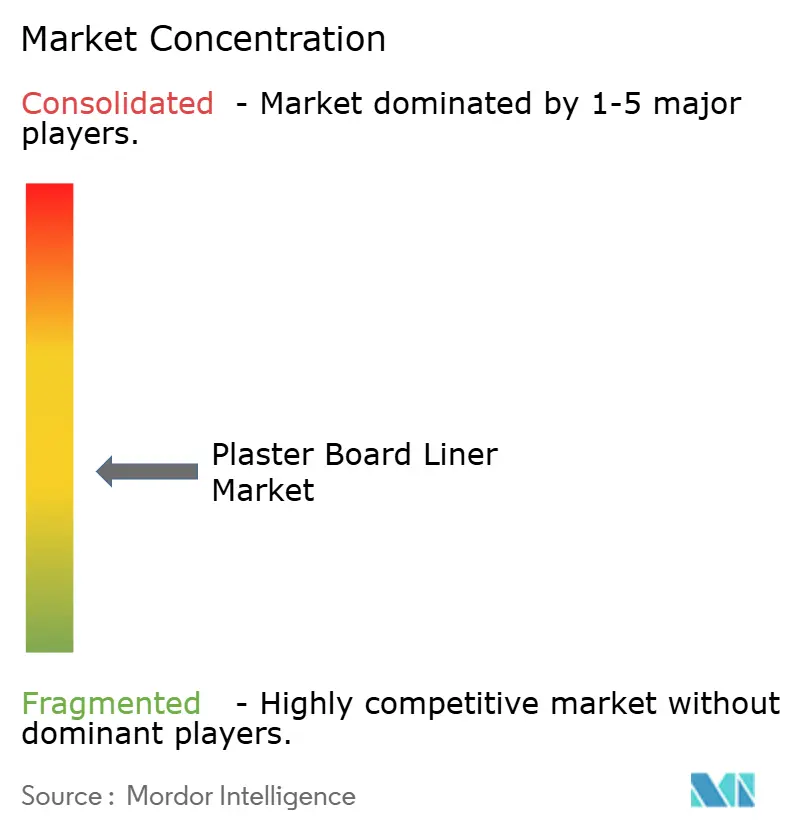
| Market Concentration | Medium |
Major Players *Disclaimer: Major Players sorted in no particular order Image © Mordor Intelligence. Reuse requires attribution under CC BY 4.0. | |
Plaster Board Liner Market Analysis by Mordor Intelligence
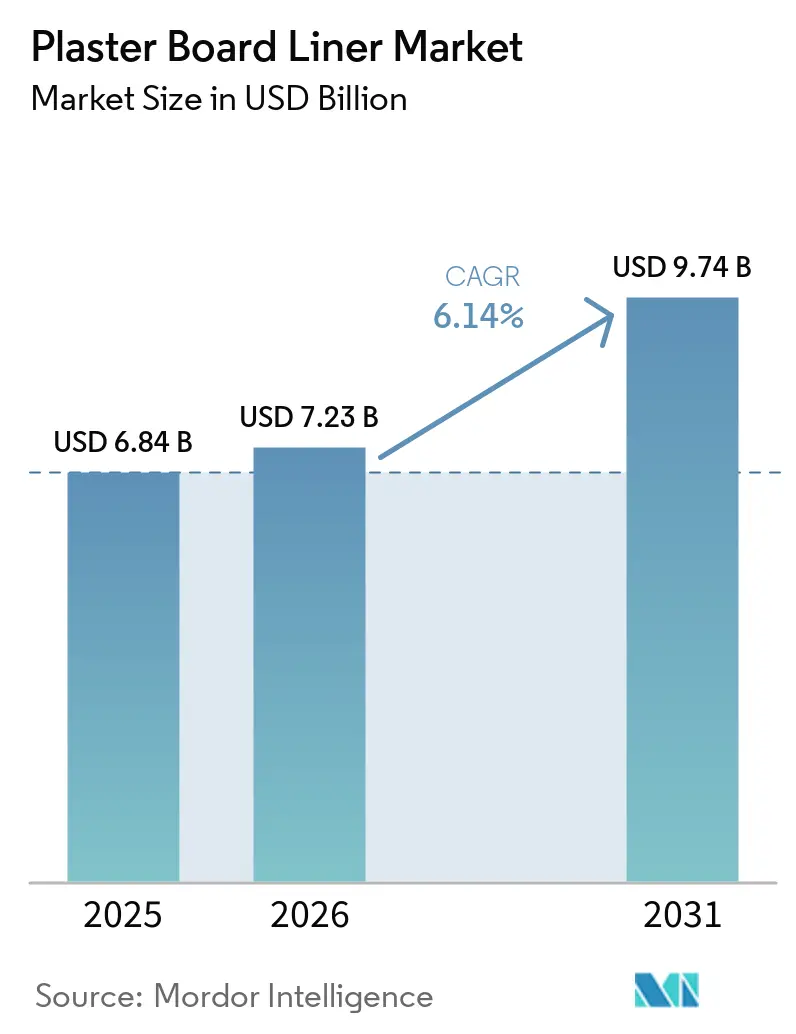
The plaster board liner market size was estimated at USD 6.84 billion in 2025 and is estimated to grow from USD 7.23 billion in 2026 to USD 9.74 billion by 2031, at a CAGR of 6.14% during the forecast period (2026-2031). Growth follows the broader shift from wet plastering to dry construction, which requires paper-faced materials for gypsum boards. Lightweight board designs increase requirements for dimensional stability, core adhesion, and surface quality, favoring engineered liner grades. Procurement is also shifting toward recycled and lower-carbon materials as builders seek documented environmental performance. Integrated producers can use direct fiber sourcing and captive board relationships to protect supply, manage costs, and serve higher-specification projects. Energy costs and housing cycles remain material constraints, as liner consumption closely tracks board output, although renovation work provides some output support.
Key Report Takeaways
- By type, Plasterboard Liner Face held 55.56% of the share of the plaster board liner market in 2025 and is forecast to grow at a 6.83% CAGR through 2031.
- By material, Recycled Fiber-Based liner held 64.12% of the share of the plaster board liner market in 2025, while Mixed Fiber-Based liner is forecast to expand at a CAGR of 7.06% through 2031.
- By application, Walls and Partitions accounted for 53.83% of the share of the plaster board liner market in 2025, while Ceilings are projected to advance at a 6.97% CAGR through 2031.
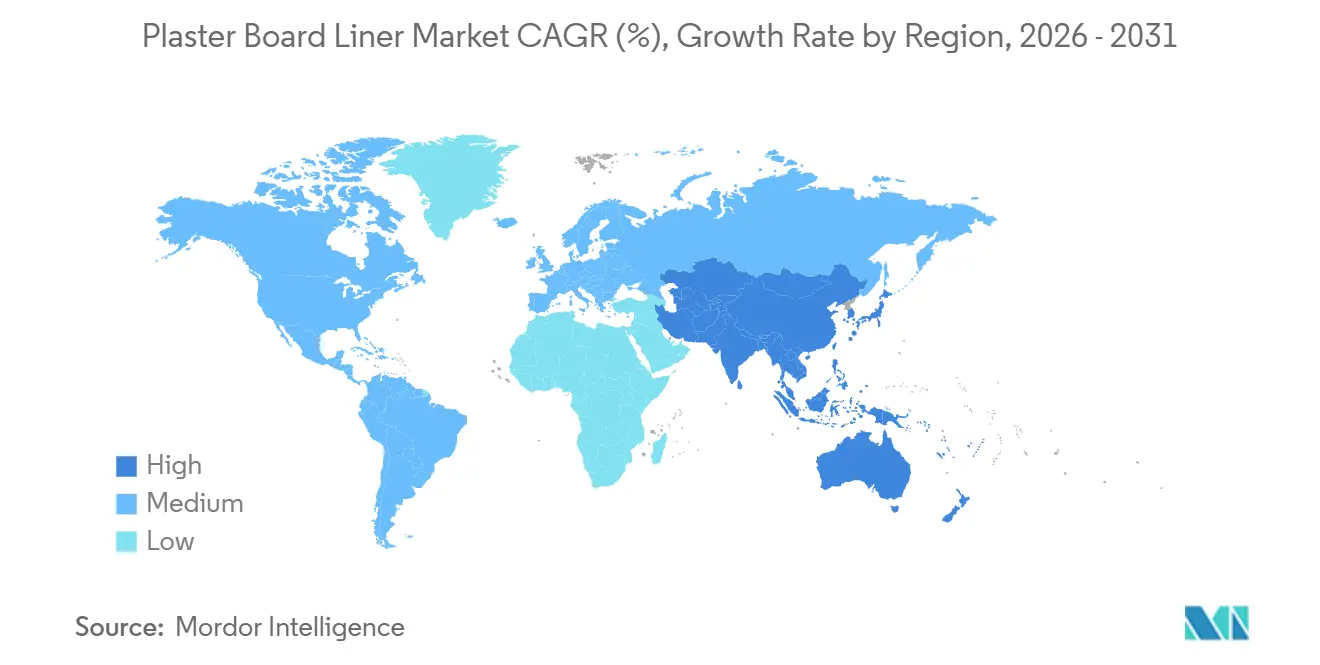
- By geography, Asia-Pacific held 45.31% of the share of the plaster board liner market in 2025 and is forecast to expand at a 7.12% CAGR through 2031.
Note: Market size and forecast figures in this report are generated using Mordor Intelligence’s proprietary estimation framework, updated with the latest available data and insights as of January 2026.
Market Trends and Insights
Drivers Impact Analysis of Plaster Board Liner Market*
| Drivers | (~) % Impact on CAGR Forecast | Geographic Relevance | Impact Timeline |
|---|---|---|---|
| Expansion of Lightweight Drywall Construction | +1.8% | Global, most pronounced in North America and the Asia-Pacific | Short term (≤ 2 years) |
| Rising Demand for Recycled and Low-Carbon Building Materials | +1.5% | EU-led, expanding globally | Medium term (2-4 years) |
| Growth of Fire-Rated and Acoustic Board Specifications | +1.2% | North America and the EU, spreading to the Asia-Pacific | Medium term (2-4 years) |
| Accelerating Renovation and Interior Retrofit Activity | +1.3% | North America and the EU mature building stock | Short term (≤ 2 years) |
| Captive Liner Supply Integration by Gypsum Board Producers | +0.8% | Global, concentrated in the EU and the Asia-Pacific | Long term (≥ 4 years) |
| Source: Mordor Intelligence | |||
Expansion of Lightweight Drywall Construction
The shift toward lightweight gypsum board systems raises performance requirements beyond standard liner tensile strength. Lower board weight requires greater dimensional stability and stronger bonding at reduced grammage. This combination supports demand for engineered face papers with tighter control over basis weight. Lightweight boards are especially relevant in renovation projects with structural load limits. Such projects favor dry construction because it reduces pressure on existing building structures. The plasterboard liner market, therefore, benefits when board makers use lightweight designs to differentiate their products.
Panel-weight reductions of 20% to 30% have been recorded in certain lightweight formulations. Hollow-microsphere aggregates represent one approach used in commercial board designs. These changes increase the importance of liner performance at the board surface and around the gypsum core. Face paper must support direct decoration while maintaining consistent adhesion during manufacture. The back paper must continue to support core adhesion even where board weight is reduced. This creates opportunities for suppliers that can meet technical specifications without unnecessarily increasing material use.
Board makers can use lightweight products in residential upgrades, tenant improvements, and institutional refurbishment. These projects often face restrictions that are less relevant in new-build shell construction. A change in project mix can lift demand for liner grades with improved strength and surface characteristics. It also creates a stronger link between board innovation and liner selection. Suppliers with testing capability and stable fiber inputs are better positioned to respond. The liner market gains value when technical performance becomes a specified requirement rather than a generic paper purchase.
Rising Demand for Recycled and Low-Carbon Building Materials
Recycled fiber has become central to liner production because it aligns material recovery with building sustainability requirements. Recycled pulp represented 58% of global gypsum-facing paper fiber input, diverting more than 1.8 million tons of waste paper from landfills each year. These figures illustrate the role of recovered fiber in the plasterboard liner market. Producers must still control fiber quality because recycled furnish can vary across collection streams. Liner grades require consistent strength, formation, and surface properties to ensure reliable board production.
A 2026 Scientific Reports study found that recycled paper fibers changed the fracture behavior of gypsum composites from brittle to ductile. The study reported improved load resistance comparable to that of glass-fiber reinforcement in the tested composites[1]. This evidence addresses a longstanding performance concern regarding the use of high-recycled-content materials. It supports the use of recovered fiber where product designs require mechanical reliability. It also reinforces the commercial value of mills capable of effectively cleaning, sorting, and blending recovered inputs. The plasterboard liner market can therefore benefit from recycled content when process control protects functional performance.
The growing importance of recycled gypsum and circular material flows in Europe is highlighted by French plasterboard manufacturers reintegrating 237,000 tons of gypsum waste in 2025, reflecting a 15% year-over-year increase toward a processing ceiling of 395,000 tons. These developments place liner procurement within a wider circular construction system. Buyers increasingly require documentation showing recycled content, recyclability, and lifecycle performance. This requirement favors suppliers with traceable fiber systems and credible environmental product information.
Growth of Fire-Rated and Acoustic Board Specifications
Fire safety and acoustic comfort create a specification-led channel for premium liner grades. Tested wall assemblies define the board configurations used to meet sound and fire-performance requirements. The liner must perform consistently within the approved board design. This reduces the scope for substituting unqualified paper after a system has been specified. It also increases the importance of documentation, testing, and production consistency. The plasterboard liner market benefits from projects where compliance depends on a defined board-and-liner combination.
PABCO Gypsum's 2025 Sound Design Guide covers more than 220 tested wall configurations spanning steel and wood framing systems, guiding architects in meeting required sound ratings. The product-selection process can therefore become more prescriptive in acoustic projects. Each tested board design places specific demands on the liner used during manufacturing. This raises the value of repeatable surface quality and controlled physical properties. It can also extend supply continuity once a board system receives project approval.
New fire-rated or acoustic board stock-keeping units can create dedicated liner specifications. Once a board is tested, manufacturers often require continuity in the input materials that support its performance. That continuity can protect margins for approved liner suppliers and can also make technical service more important than price competition alone. Suppliers need to balance fiber efficiency with surface uniformity and runnability. The market opportunity is strongest where specialized boards are used in renovation, healthcare, education, commercial interiors, and higher-standard residential projects.
Accelerating Renovation and Interior Retrofit Activity
Renovation and retrofit work can stabilize demand when new construction slows. U.S. residential improvement and repair spending has exceeded USD 400 billion annually. These projects create recurring needs for drywall replacement, interior reconfiguration, and acoustic improvements. They can support liner output even when single-family starts weaken. Renovation also tends to use lightweight and specialty board products more often than basic new-build shell projects, which can improve the mix of liner demand rather than merely maintaining output.
Adaptive reuse in European cities represents another source of demand. Hybrid workspace conversions have repurposed 40 million square meters of office stock. Such projects use gypsum board because partitions can be reconfigured relatively quickly. Liner paper is needed across both standard partitions and specialized acoustic assemblies. The renovation setting may require careful management of dead loads and existing building conditions. These constraints favor products that can meet performance needs without adding unnecessary weight.
Tenant-improvement and renovation projects represent higher-margin construction activity than new-build shell work. This supports the use of specified products where finish quality, acoustics, moisture resistance, or fire performance are required. The resulting board mix can sustain liner demand during housing-cycle volatility and can also make customer relationships more important, as projects are often customized. Suppliers that work closely with board manufacturers can respond to changing product requirements. The plasterboard liner market benefits when upgrades replace lower-value, basic interior construction work.
Restraints Impact Analysis of Plaster Board Liner Market*
| Restraints | (~) % Impact on CAGR Forecast | Geographic Relevance | Impact Timeline |
|---|---|---|---|
| Volatility in Recovered Paper and Energy Costs | -1.4% | EU is most severe, with North America and global spillover | Short term (≤ 2 years) |
| Construction-Cycle and Housing-Start Sensitivity | -0.9% | North America and the EU primarily | Short term (≤ 2 years) |
| Recycled-Fiber Contamination and Performance Variability | -0.6% | Global, most acute in emerging Asia-Pacific markets | Medium term (2-4 years) |
| Source: Mordor Intelligence | |||
Volatility in Recovered Paper and Energy Costs
Input cost volatility is a persistent challenge for liner manufacturers. Recycled-fiber paper grades have a 68% dependence on natural gas. European natural gas prices rose 18% in the second quarter of 2025 compared with the second quarter of 2024. Energy price changes can affect pulping, drying, and transport costs simultaneously. Recovered fiber costs can also move quickly when collection rates or competing board demand change. These movements make pricing and margin management difficult for suppliers without effective purchasing controls.
Each EUR 10 per MWh increase could add up to EUR 20 per ton in variable production costs for highly exposed grades. This operational exposure affects the ability to invest in capacity, quality systems, and product development. Producers may seek hedged energy contracts or more efficient mill operations to reduce this effect. However, not every company has the same scale or contracting position. Smaller merchant suppliers can face greater pressure when costs rise rapidly. The liner market, therefore, remains sensitive to both input cost management and construction demand.
Recovered fiber availability is another source of uncertainty for mills. North American containerboard capacity closures in 2025 tightened recovered-fiber supply and increased Old Corrugated Containers (OCC) price swings. Liner producers compete with other paper and packaging grades for usable material. Fiber quality also varies, especially when collection systems are under pressure. Higher recycled-content targets can become harder to meet without advanced sorting and cleaning. This creates an advantage for integrated suppliers with established recovery networks and technical processing capability.
Construction-Cycle and Housing-Start Sensitivity
Plasterboard liner demand remains tied to gypsum board consumption and building activity. U.S. domestic gypsum wallboard deliveries fell 9% year over year in the first quarter of 2025, linked to softer single-family housing starts under elevated mortgage rates. This relationship shows that liner demand can decline even when long-term dry-construction adoption remains positive. Renovation activity can offset part of the decline, but cannot fully remove this exposure. Suppliers need to closely monitor project pipelines, board shipments, and housing conditions.
Single-geography suppliers face greater risk when their local construction market slows. Reallocating capacity across regions often requires investment, qualification work, and new customer relationships. Integrated producers with operations in several markets can balance demand more effectively. They may also use their board manufacturing links to retain output levels during weak periods. This does not eliminate cyclical exposure, but it can reduce dependence on one housing market. The plasterboard liner market favors companies that combine geographic coverage with diverse end-use exposure.
Mortgage rates, housing starts, and commercial construction budgets remain relevant indicators of demand. A fall in board deliveries can quickly affect liner orders because paper supply is closely linked to board output. Forecasting should therefore distinguish between new construction and renovation activity, as well as between basic wallboard demand and specialized board demand. Acoustic, fire-rated, and moisture-resistant products may be more resilient in refurbishment work. However, their output levels cannot fully compensate for the broad weakness in new residential construction. Supply strategies need to account for both cyclical demand and product-mix shifts.
*Our forecasts treat driver/restraint impacts as directional, not additive. The impact forecasts reflect baseline growth, mix effects, and variable interactions.
Plaster Board Liner Market Segment Analysis
By Type:
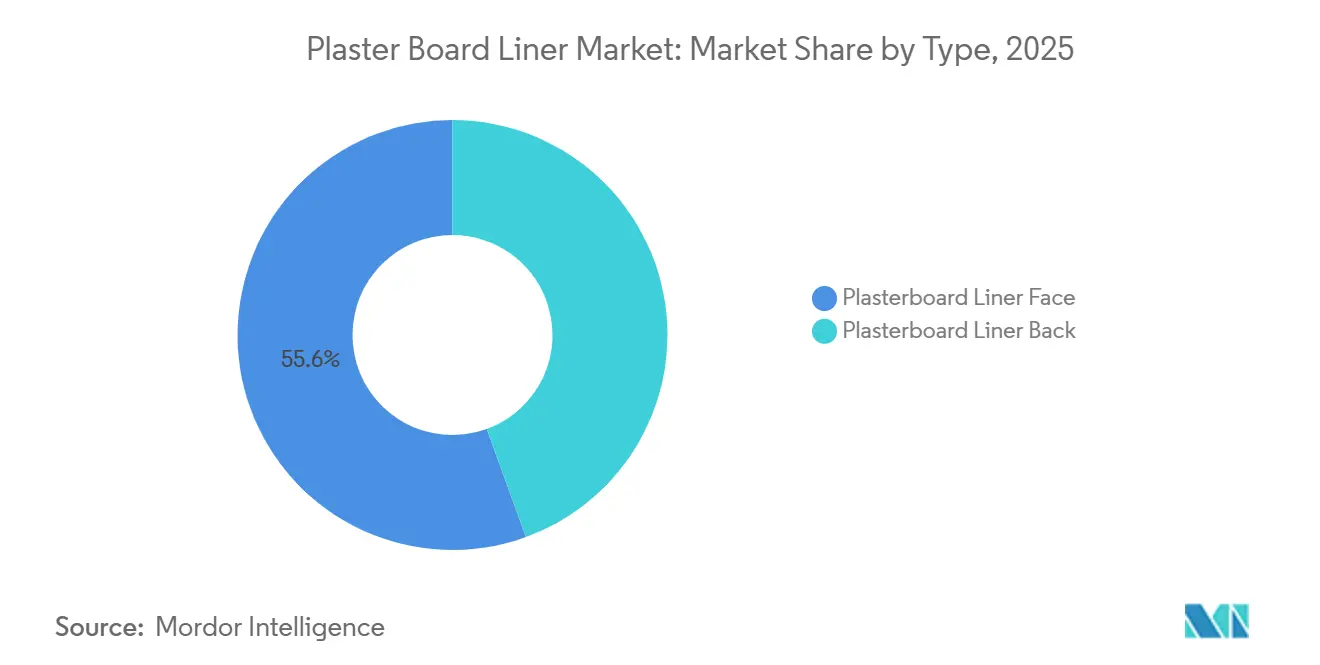
Face Paper Accounts for the Largest Share Driven by PremiumizationPlasterboard liner face paper held 55.56% of the plasterboard liner market share in 2025 and is projected to grow at a 6.83% CAGR through 2031. Each gypsum board requires a face sheet and a back sheet, which supports the basic share position of face paper. Face paper also serves as direct decoration, making surface quality commercially important. Face paper tensile strength exceeded 7 kN/m, compared with 5.8 kN/m for standard grades. This requirement can call for multilayer kraft technology and tighter basis-weight tolerances. Higher technical requirements support the shift toward engineered face paper grades in the plasterboard liner market.
Fire-rated, acoustic, and moisture-resistant boards expand the use of high-specification face paper. Board makers use the outer paper layer to support finish quality and product differentiation. National Gypsum's 2025 EVOLVE line uses 100% recycled paper encasing across three variants, including a mold- and moisture-resistant product. This example shows how liner selection can form part of a board's product proposition. Face paper, therefore, combines shared leadership with a path toward higher-value specifications.
Plasterboard liner back paper remains technically important despite receiving less attention than face paper. Back paper is increasingly specified at reduced grammage to contain board weight. It must preserve core adhesion while supporting a lighter finished board. This creates a separate development path for suppliers serving back paper grades. Reduced grammage can lower fiber use but also increases requirements for consistent strength and machine performance. Back paper suppliers remain relevant as board makers seek to reduce weight without compromising product reliability.

By Material:
Recycled Fiber Dominance Coexists with Mixed Fiber GrowthRecycled fiber-based liner held 64.12% of the plasterboard liner market share in 2025. Its position reflects circular-economy policy, environmental documentation requirements, and the cost role of secondary fiber. Recycled fiber can reduce dependence on virgin pulp while supporting recovery systems. However, quality variation is a growing constraint for mills using a single recovered paper grade, as tensile properties can vary across batches when incoming material is inconsistent. The dominant material category, therefore, requires strong sorting, cleaning, and process control to maintain product quality.
Mixed fiber-based liner is projected to grow at a 7.06% CAGR through 2031, making it the fastest-growing material segment. It combines controlled virgin fiber with post-consumer recycled content, which can provide a more reproducible strength-to-weight profile than pure recycled furnish. This approach addresses strength consistency while retaining recycled material in the product. It can be valuable where board manufacturers need documented performance for premium applications. The plasterboard liner market size for mixed fiber is therefore supported by both technical control and sustainability requirements.
Virgin fiber-based liner remains useful in applications where surface uniformity and moisture resistance are essential, such as export markets with demanding building-code certification requirements. Virgin inputs can provide controlled characteristics where variability is unacceptable, allowing this category to retain a role even as recycled content becomes more important. Suppliers must balance this performance need against buyer expectations for lower-carbon materials. The relevant commercial question is not simply whether the input is recycled or virgin fiber, but how each supports the required board specification.
By Application:
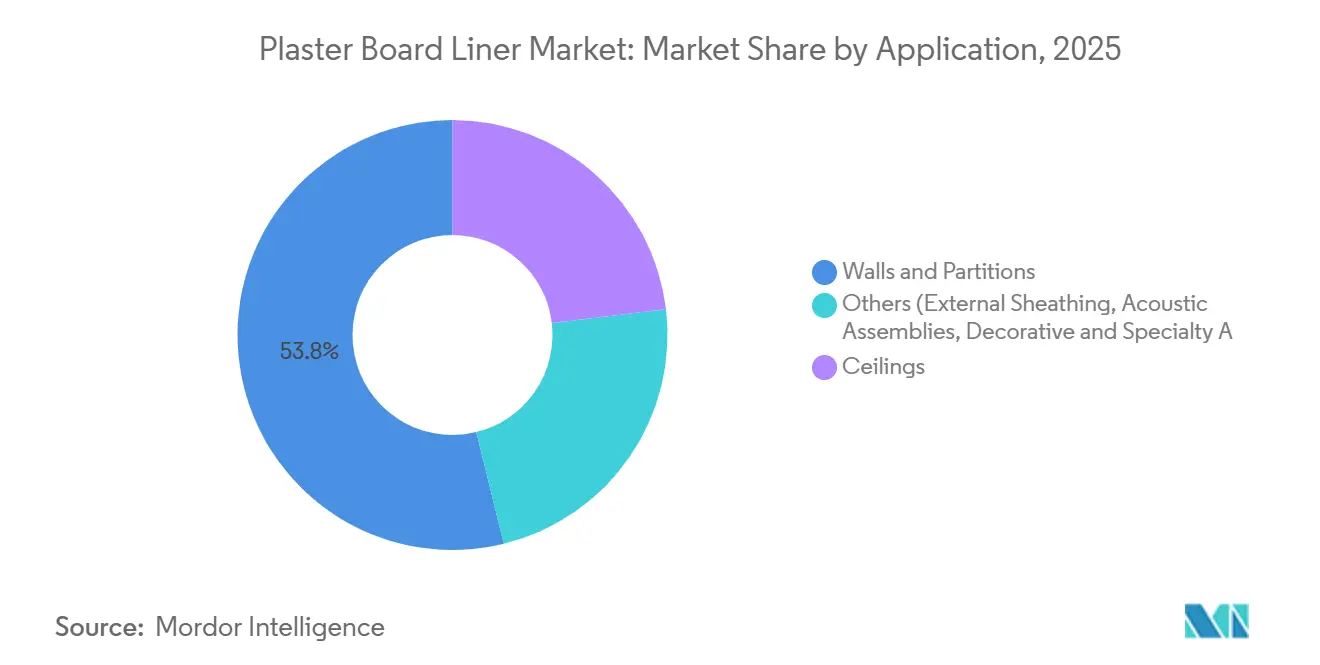
Walls Account for the Largest Share, While Ceiling Retrofit Shifts the Overall MixWalls and partitions accounted for 53.83% of the plasterboard liner market share in 2025. The segment serves new construction in residential, commercial, healthcare, and education. Interior partitions represent a large output base due to their use throughout building layouts. The shift from masonry to dry-partition construction in South and Southeast Asia is driving demand for standard liners, thanks to the speed and flexibility of dry systems. Walls and partitions, therefore, remain the core output application for the plasterboard liner market.
Brazil illustrates this construction shift, with the country's drywall market growing at 13% annually, according to an industry association. Dry construction can replace wet methods where project schedules and labor efficiency are priorities. This change can increase demand for standard liner grades at scale and opens opportunities for board makers to introduce specialized wall products. The application remains sensitive to new construction activity, but its broad use across building types supports its leading position.
Ceilings are forecast to grow at a 6.97% CAGR through 2031, the fastest rate among applications. Growth is driven by adaptive reuse and renovation work rather than solely new construction. Office conversions to residential or mixed-use buildings can require acoustic ceiling upgrades. Suspended ceiling systems also have dead-load constraints that favor lightweight engineered boards, lifting demand for liner grades that offer strength at lower grammage. Ceiling applications, therefore, support a higher-value product mix in the plasterboard liner market.
Geography Analysis
APAC Plaster Board Liner Market
Asia-Pacific held 45.31% of the plasterboard liner market share in 2025 and is forecast to grow at a 7.12% CAGR through 2031. China's urban densification and India's formal construction expansion are key regional drivers. Indian marking mandates and Chinese formaldehyde emission limits are shaping procurement toward certified liner products. Suppliers without verified quality records may find it harder to compete for specified board programs. Asia-Pacific, therefore, combines high base demand with growing product assurance requirements. The plasterboard liner market size in the region is supported by growth in board capacity and wider adoption of certified products.
North America and Europe Plaster Board Liner Market
North America and Europe form the second-largest combined demand area, with a demand profile more closely linked to renovation activity and regulatory-driven premiumization. U.S. improvement and repair spending exceeds USD 400 billion annually, supporting drywall replacement and interior upgrades even when housing starts soften. European markets have the highest recycled-content intensity in the global liner value chain, favoring suppliers with recovered-fiber capability, stable technical performance, and environmental documentation.
France and Germany Plaster Board Liner Market
France reintegrated 237,000 tons of secondary gypsum material in 2025, representing a 15% year-over-year increase. Germany's coal phase-out by 2038 is reducing the availability of flue gas desulfurization (FGD) gypsum, a historically significant input source. These conditions are increasing attention to circular material systems and traceable input supplies. Environmental product declarations can influence access to public-sector tenders across European markets, and liner producers with credible data and recycling links are better positioned for this procurement approach.
MEA and South America Plaster Board Liner Market
South America, the Middle-East, and Africa are construction-program-led demand areas with limited domestic liner production. Brazil's drywall expansion is creating opportunities in South America as dry construction systems replace traditional wet methods. Saint-Gobain is investing in a new production line in Feira de Santana, Bahia, designed to increase capacity by 75% and become Latin America's largest drywall facility upon completion. This investment underscores the importance of local board capacity for liner demand[2]. Regional suppliers may benefit where new board plants require reliable paper inputs and technical support.
Competitive Landscape
The plasterboard liner market is moderately fragmented, with large integrated suppliers competing alongside regional specialists. Key participants include SCG Packaging, WEIG Group, W. Hamburger GmbH, Alier, and DS Smith. Competitive position is shaped by access to recovered fiber, mill capability, technical documentation, and relationships with board producers. Integrated companies can manage supply more closely than pure merchant liner suppliers, which can be an advantage when energy and recovered-fiber costs shift sharply.
SCG Packaging supports its Asia-Pacific position with plasterboard liner made from 100% recycled paper. Its product documentation includes a Carbon Footprint Reduction certification, which may be relevant to integrated board producers seeking to substantiate sustainability claims. WEIG Group's certified product carbon footprint information for Germany and Paraguay has also been identified as a differentiator. These capabilities highlight the growing importance of traceability and feedstock control in competitive positioning.
Saint-Gobain represents the captive integration model through direct relationships that secure liner supply for board manufacturing. In July 2026, the company commissioned a gypsum wallboard plant in Kaiping, Guangdong, with a capacity of 64 million square meters per year. The facility incorporates waste-heat recovery, closed-loop water recycling, and captive renewable power. This expansion illustrates how board capacity investments can anchor liner supply relationships in growing regions. Saint-Gobain also completed the acquisition of Phu My Innovative Materials in Vietnam in July 2026, extending its integrated plasterboard position in Southeast Asia. Such moves can reduce distributor involvement and strengthen direct control over material specifications.
Plaster Board Liner Industry Leaders
-
SCG PACKAGING
-
Visy
-
WEIG Group
-
DS Smith
-
W. Hamburger GmbH
- *Disclaimer: Major Players sorted in no particular order
Plaster Board Liner Market Companies Covered in this Report
- Alier S.A.
- ASIA PAPER MFG.CO.,LTD
- DS Smith
- Gulf Ply
- INDEVCO Paper Making
- National Gypsum Services Company
- PABCO Gypsum
- Republic Paperboard Company, LLC
- Saint-Gobain
- SCG PACKAGING
- Sure Paper Co., Ltd.
- Visy
- W. Hamburger GmbH
- WEIG Group
- Yoshino Gypsum Co., Ltd.
Recent Industry Developments in Plaster Board Liner Market
- July 2026: Saint-Gobain completed the acquisition of Phu My Innovative Materials (PMIM) in Vietnam, one of the country's largest plasterboard facilities, expanding its integrated liner-to-board presence across Southeast Asia.
- September 2025: WEIG Group subsidiary Yaguarete Papeles (Paraguay) was executing Project KM9, which involved relocating a paper production unit from Raubling, Germany, to Villeta, Paraguay. The unit was intended to produce plasterboard liner and testliner from recycled fiber for the Central and South American markets. Dismantling and shipment were scheduled for completion by mid-2026.
Global Plaster Board Liner Market Report Scope
A plasterboard liner is a specialized heavy-duty paper facing bonded to the front and back of a gypsum drywall core. It provides structural tensile strength, a smooth painting surface, and core protection.
The plaster board liner market is segmented by type, material, application, and geography. By type, the market is segmented into plasterboard liner face and plasterboard liner back. By material, the market is segmented into recycled fiber-based, virgin fiber-based, mixed fiber-based, and others. By application, the market is segmented into walls and partitions, ceilings, and others (external sheathing, acoustic assemblies, decorative and specialty applications). The report also covers market size and forecasts for plaster board liner across 15 countries in major regions. The market sizes and forecasts are provided in terms of value (USD).
Segmentation Overview
| Plasterboard Liner Face |
| Plasterboard Liner Back |
| Recycled Fiber-Based |
| Virgin Fiber-Based |
| Mixed Fiber-Based |
| Others |
| Walls and Partitions |
| Ceilings |
| Others (External Sheathing, Acoustic Assemblies, Decorative and Specialty Applications) |
| Asia-Pacific | China |
| India | |
| Japan | |
| South Korea | |
| ASEAN Countries | |
| Rest of Asia-Pacific | |
| North America | United States |
| Canada | |
| Mexico | |
| Europe | Germany |
| United Kingdom | |
| France | |
| Italy | |
| NORDIC Countries | |
| Rest of Europe | |
| South America | Brazil |
| Argentina | |
| Rest of South America | |
| Middle-East and Africa | Saudi Arabia |
| South Africa | |
| Rest of Middle-East and Africa |
| By Type | Plasterboard Liner Face | |
| Plasterboard Liner Back | ||
| By Material | Recycled Fiber-Based | |
| Virgin Fiber-Based | ||
| Mixed Fiber-Based | ||
| Others | ||
| By Application | Walls and Partitions | |
| Ceilings | ||
| Others (External Sheathing, Acoustic Assemblies, Decorative and Specialty Applications) | ||
| By Geography | Asia-Pacific | China |
| India | ||
| Japan | ||
| South Korea | ||
| ASEAN Countries | ||
| Rest of Asia-Pacific | ||
| North America | United States | |
| Canada | ||
| Mexico | ||
| Europe | Germany | |
| United Kingdom | ||
| France | ||
| Italy | ||
| NORDIC Countries | ||
| Rest of Europe | ||
| South America | Brazil | |
| Argentina | ||
| Rest of South America | ||
| Middle-East and Africa | Saudi Arabia | |
| South Africa | ||
| Rest of Middle-East and Africa | ||
Key Questions Answered in the Report
What is current market size of Plaster Board Liner Market?
The plaster board liner market size was estimated at USD 6.84 billion in 2025 and is estimated to grow from USD 7.23 billion in 2026 to USD 9.74 billion by 2031, at a CAGR of 6.14% during the forecast period (2026-2031).
Which product type leads plaster board liner demand?
Plasterboard Liner Face led with a 55.56% share in 2025 and is projected to grow at a 6.83% CAGR through 2031.
Why is recycled fiber important for plasterboard liner production?
Recycled fiber supports circular material use, but producers need controls on sorting and blending to maintain reliable tensile strength and surface quality.
Which material category is expanding fastest through 2031?
Mixed Fiber-Based liner is forecast to record a 7.06% CAGR because it combines recycled content with controlled virgin fiber for more consistent performance.