
Plant Based Butter Market Size and Share
Market Overview
| Study Period | 2021 - 2031 |
|---|---|
| Market Size (2026) | USD 3.15 Billion |
| Market Size (2031) | USD 4.39 Billion |
| Growth Rate (2026 - 2031) | 6.87 % |
| Fastest Growing Market | Asia-Pacific |
| Largest Market | North America |
| Market Concentration | Medium |
Major Players
*Disclaimer: Major Players sorted in no particular order Image © Mordor Intelligence. Reuse requires attribution under CC BY 4.0. |
|
Plant Based Butter Market Analysis by Mordor Intelligence
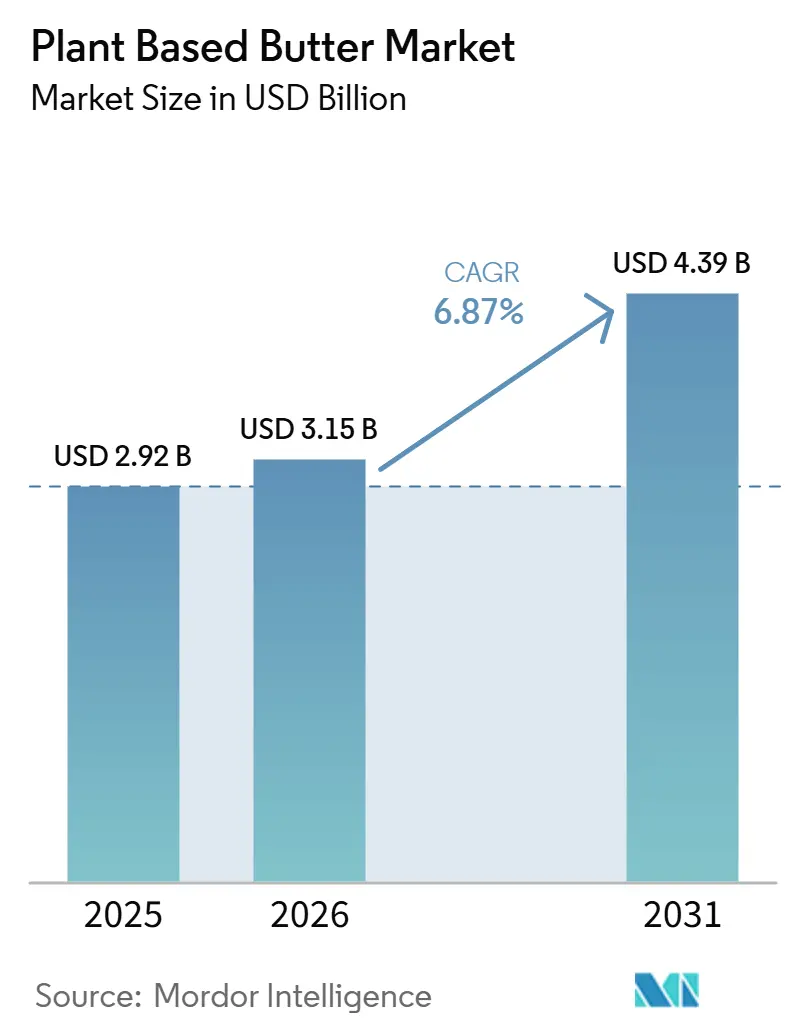
The plant-based butter market size is projected to expand from USD 2.9 billion in 2025 and USD 3.1 billion in 2026 to USD 4.4 billion by 2031, registering a CAGR of 6.8% between 2026 to 2031. The plant-based butter market is supported by sustained demand for dairy-free foods rather than short-lived dietary preferences. Reduced lactase persistence affects 68% of the global population, with prevalence reaching 90% in East Asia, expanding the potential consumer base for dairy-free alternatives. Flexitarian purchasing is also moving these products beyond specialist stores, as plant-based food buyers often continue to purchase animal-based products[1]Source: Plant-Based Foods Association, "The future is plant-based." plantbasedfoods.org. Retail access remains critical to volume growth, while foodservice use can introduce products through bakery and culinary applications before household demand develops. Product performance, ingredient transparency, and reliable oil sourcing will determine which suppliers convert trial purchases into repeat demand.
Key Report Takeaways
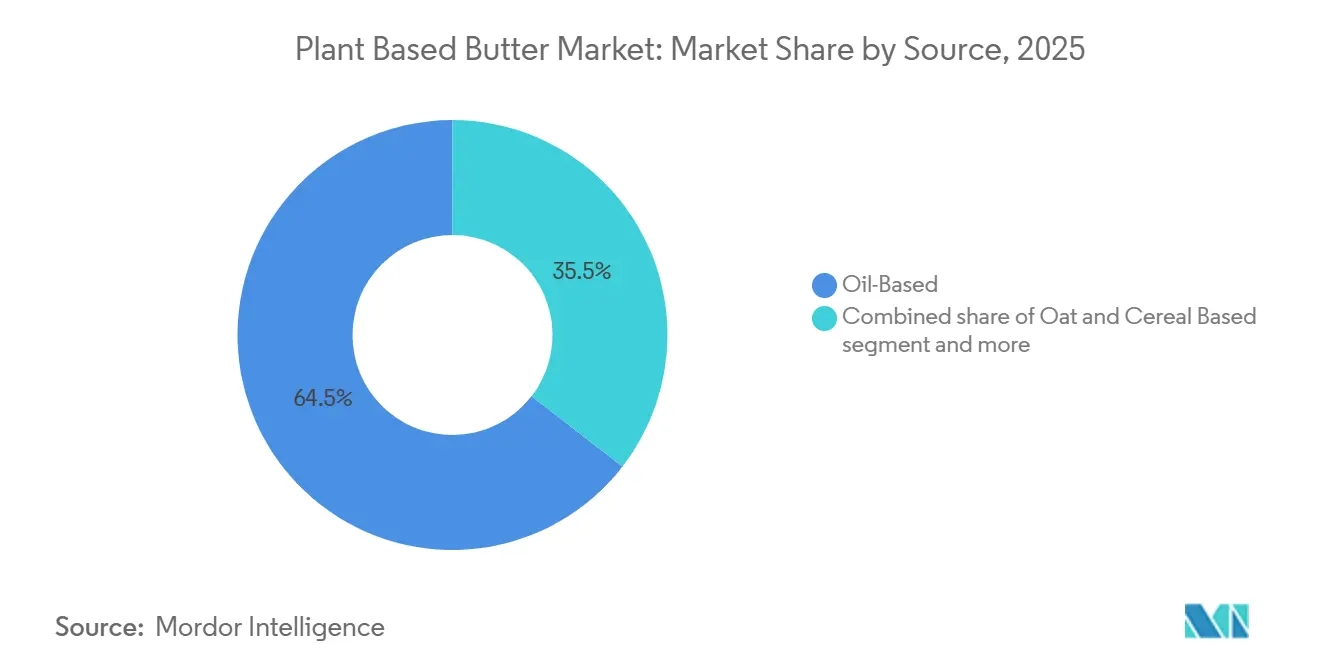
- By source, oil-based formats accounted for the largest share of the plant-based butter market, at 64.5% in 2025, while oat and cereal-based formats are projected to grow at the fastest CAGR of 7.78% during 2026-2031.
- By nature, conventional products accounted for the largest share of the plant-based butter market, at 79.4% in 2025, while organic products are projected to grow at the fastest CAGR of 7.91% during 2026-2031.
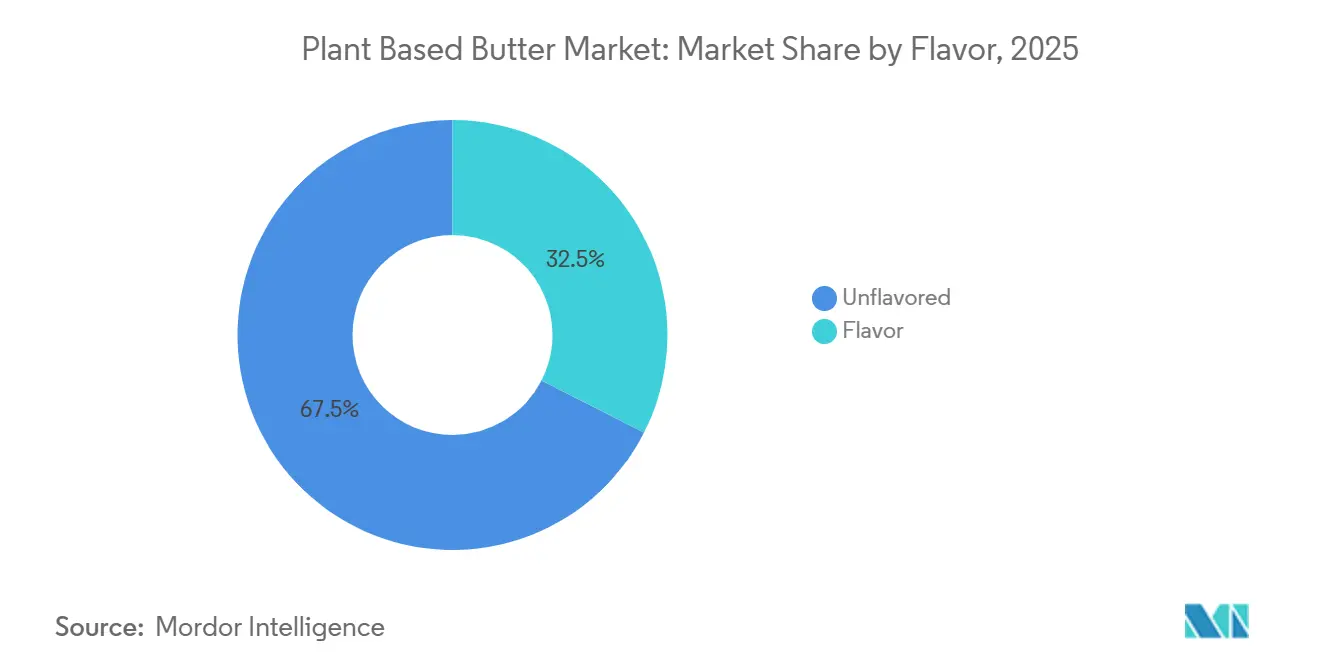
- By flavor, unflavored products accounted for the largest share of the plant-based butter market, at 67.5% in 2025, while flavored products are projected to grow at the fastest CAGR of 7.22% during 2026-2031.
- By distribution channel, retail accounted for the largest share of the plant-based butter market, at 62.8% in 2025, while foodservice is projected to grow at the fastest CAGR of 8.19% during 2026-2031.
- By geography, North America accounted for the largest share of the plant-based butter market, at 39.7% in 2025, while Asia-Pacific is projected to grow at the fastest CAGR of 7.62% during 2026-2031.
Note: Market size and forecast figures in this report are generated using Mordor Intelligence’s proprietary estimation framework, updated with the latest available data and insights as of January 2026.
Market Trends and Insights
Drivers Impact Analysis of Plant Based Butter Market*
| Driver | (~) % Impact on CAGR Forecast | Geographic Relevance | Impact Timeline |
|---|---|---|---|
| Rising lactose intolerance and dairy-free demand | +1.5% | Global, highest in Asia-Pacific and Sub-Saharan Africa | Long term (≥ 4 years) |
| Vegan and flexitarian adoption | +1.3% | Global, led by North America, Northern and Western Europe | Medium term (2-4 years) |
| Mainstream retail and foodservice expansion | +1.1% | North America, Europe, and Asia-Pacific metropolitan centers | Medium term (2-4 years) |
| Formulation improvements in taste, texture and nutrition | +1.0% | Global, with research concentrated in Europe and North America | Short term (≤ 2 years) |
| Bakery and pastry performance parity | +0.8% | Europe, North America, and urban Asia-Pacific | Medium term (2-4 years) |
| Cultured and fermentation-led premiumization | +0.6% | North America and Europe | Long term (≥ 4 years) |
| Source: Mordor Intelligence | |||
Rising Lactose Intolerance and Dairy-Free Demand Expanding the Consumer Base
Reduced lactase persistence makes dairy-free options relevant to a large share of the global population. The supplied material cites a global prevalence of 68%, with the highest rates in East Asia, Africa, and South Asia. East Asian prevalence reaches 90%, compared with 5% to 28% in European populations. This gap creates growth opportunities for the plant-based butter market beyond its current North American and European base, as dairy avoidance can be driven by digestive comfort as well as dietary preferences. Consumers in emerging regions may require oil blends that align with local food preferences, cooking practices, flavor expectations, and price sensitivities. Suppliers that adapt formulations to regional tastes can reduce the barrier to first purchase and improve repeat adoption by offering products suited to everyday cooking applications.
Vegan and Flexitarian Adoption Mainstreaming Demand Beyond Specialty Channels
The plant-based butter market increasingly relies on flexitarian consumers, not only vegan consumers. In 2025, 60% of U.S. households purchased plant-based foods, and 78% of those households returned to the category[2]Source: Plant-Based Foods Association "Plant-Based Foods Are a Staple in American Households", plantbasedfoods.org. The same source reported that 95% to 96% of plant-based meat buyers also purchased animal protein, indicating that many shoppers use plant-based options alongside conventional animal-based products rather than as complete substitutes. In Germany, 47% of adults reduced or removed meat from their diets in 2025, reflecting a broader shift toward dietary moderation. The United Kingdom also had a broad buyer base that purchased plant-based foods during the preceding year (GFIEUROPE.ORG). These patterns make repeat purchases, familiar taste profiles, pricing, availability, and everyday usability more important than a narrowly defined dietary identity.
Mainstream Retail and Foodservice Expansion Widening Product Access
Foodservice is the fastest-growing channel in the plant-based butter market, registering a projected CAGR of 8.2% through 2031. Food operators use these products in baked goods, sauces, and prepared meals, where consistent performance can matter more than consumer-facing branding. Conagra positioned Earth Balance bulk spreads as a 1:1 replacement for dairy butter in baking and culinary applications. Foodservice exposure can familiarize consumers with a product before they select it at retail. This effect may be more pronounced in Asian cities, where food courts, café chains, and casual restaurants are testing plant-based ingredients. Therefore, institutional supply contracts can support later retail demand as well as near-term sales volumes.
Formulation Improvements in Taste, Texture and Nutrition Closing the Sensory Gap
Taste, texture, and melting behavior remain key barriers to repeat purchases in the plant-based butter market. Bunge developed Beleaf PlantBetter for industrial bakery applications and reported sensory testing across three countries. Improved oil blending can reduce saturated fat, increase Omega-3 ALA content, and eliminate cholesterol in some products. Shorter ingredient lists that avoid soy, palm oil, and synthetic emulsifiers can appeal to consumers who closely examine product labels. These formulation changes also support bakery production, where lamination requires controlled plasticity and thermal behavior. Naturli’ and Puratos have developed plant-based fats for lamination, broadening the range of viable commercial applications.
Restraints Impact Analysis of Plant Based Butter Market*
| Restraint | (~) % Impact on CAGR Forecast | Geographic Relevance | Impact Timeline |
|---|---|---|---|
| Price premium versus dairy butter | -1.2% | Global, most acute in price-sensitive emerging markets | Short term (≤ 2 years) |
| Vegetable oil, nut and seed yield volatility | -0.9% | Global, most acute for oil-based and nut-based formats | Medium term (2-4 years) |
| Protected dairy terminology and labeling ambiguity | -0.7% | Europe and North America | Medium term (2-4 years) |
| Allergen, sustainability-claim and traceability complexity | -0.5% | Global, particularly in multi-ingredient supply chains | Long term (≥ 4 years) |
| Source: Mordor Intelligence | |||
Price Premium Versus Dairy Butter Constraining Mass-Market Conversion
Price remains an immediate barrier for buyers without a medical or dietary need to avoid dairy. The supplied material indicated that plant-based products carried a 40% to 100% retail premium over dairy equivalents during the early 2020s. Oil-based formats can narrow this gap as ingredient sourcing improves and production scales. Precision-fermentation products can remain expensive because they require specialized production equipment. Price-sensitive buyers are likely to compare plant-based butter with conventional dairy butter based on everyday value. Greater oil-blending capacity and expanded oat-based production can improve the value proposition over the next 12 to 24 months.
Vegetable Oil, Nut and Seed Yield Volatility Exposing Input Cost Vulnerability
Plant-based butter producers rely on several agricultural inputs with yields and prices that can shift rapidly. The FAO Vegetable Oil Price Index is projected to rise by 5.9% in April 2026, reaching its highest level since July 2022[3]Source: Food and Agriculture Organization, "World Food Situation", fao.org. Palm, soybean, sunflower, and rapeseed oils all influence the cost of common formulations. Weather conditions can have delayed effects on palm oil yields in Indonesia and Malaysia. Manufacturers can mitigate this exposure through multi-origin sourcing and forward procurement contracts. Labeling rules, allergen declarations, sustainability claims, and traceability requirements add further complexity when products contain multiple ingredients.
*Our forecasts treat driver/restraint impacts as directional, not additive. The impact forecasts reflect baseline growth, mix effects, and variable interactions.
Plant Based Butter Market Segment Analysis
By Source:
Oil-Based Formats Lead While Oat and Cereal Formats Grow FasterOil-based products are expected to account for 64.5% of the plant-based butter market share in 2025. This position reflects established vegetable oil supply chains and familiar formulation methods. Oil blends support spreading, cooking, and industrial baking applications, enabling manufacturers to serve retail and foodservice customers with related base formulations. Their lower formulation complexity also supports broader price accessibility. These characteristics make oil-based products the default choice for large-scale retail distribution. Nut-based products remain more concentrated in premium and specialty outlets, with growth constrained by allergen concerns and exposure to raw material costs. Seed-based products address some allergen-free needs but remain focused on artisan and direct-to-consumer channels. The broad use of oil-based products explains why this segment continues to define the category’s volume base.
Oat and cereal-based formats are forecast to record a 7.8% CAGR from 2026 to 2031, the fastest rate among source types. These products offer an alternative for buyers who avoid tree nuts or soy. Manufacturers are also adapting oat-based formulations for baking applications. Miyoko’s Creamery used mesophilic bacterial cultures in oat milk butter to develop a buttery flavor without tree nuts. Oat cultivation can also fit organic production systems more readily than some tree-nut supply chains. This advantage helps oat-based products appeal to both allergen-conscious and organic-focused buyers. The segment remains smaller than oil-based products, making continued formulation work important for broader adoption. Successful products must maintain stable texture across spreading and baking applications. The plant-based butter market size for oat and cereal formats can expand as manufacturers meet these performance requirements. The combination of practical use and a familiar grain base supports the segment’s faster growth pace.



By Nature:
Conventional Products Retain Scale While Organic Products Add Premium GrowthConventional products are expected to account for 79.4% of category revenue in 2025. Their leading position indicates that price accessibility continues to influence most purchasing decisions. Mainstream retail distribution gives conventional products broad visibility across North America and Europe. Large-scale manufacturing also helps suppliers produce consistent formats for everyday use. Private-label programs have further expanded access through established grocery channels. These formats generally compete on familiar use cases rather than specialized certifications. Their broad availability makes them important for household adoption beyond premium consumer groups. Conventional products also provide a volume base for retailers that stock multiple plant-based spread options. The segment’s scale will remain important even as buyers trade up in selected cases. Therefore, conventional products continue to anchor total demand in the plant-based butter market.
Organic products are projected to record a 7.9% CAGR through 2031, the fastest growth rate by nature. This rate indicates that some buyers are shifting toward more differentiated products after entering the category. Organic certification provides a clear signal for consumers who evaluate ingredients and sourcing practices. In the United States, the National Organic Program administers organic requirements. European organic regulations also provide a common product framework across the region. Naturli’ Foods reported a record annual net profit of DKK 17.9 million, equivalent to USD 2.6 million, in 2024, supported by growth in exports of its organic spreadable butter to Germany and the United Kingdom. Organic products can command higher retail prices when certification and ingredient claims are credible. This pricing power supports smaller brands that cannot initially match conventional producers on volume. The faster growth rate points to a premium tier that can attract new entrants through 2031.
By Flavor:
Unflavored Products Support Everyday Use While Flavored Products Extend Occasion DemandUnflavored products are expected to account for 67.5% of category revenue in 2025. Their leadership reflects their role as a neutral replacement for dairy butter. Bakers and chefs often require a fat that does not introduce a competing flavor into recipes. As a result, unflavored formats work across spreading, cooking, baking, and foodservice preparation. This broad functionality makes them a practical default for retail and institutional buyers. They also reduce the need for buyers to modify familiar recipes. Their neutral profile can lower hesitation among households trying the category for the first time. Retailers benefit because a single unflavored product can address several consumer use cases. Manufacturers can also use the format as a base for larger production runs. These factors support the segment’s continued position as the largest flavor category.
Flavored products are forecast to grow at a 7.2% CAGR through 2031, the highest rate by flavor. Garlic, herb, smoked, and browned-butter-style varieties position these products as ingredients rather than only substitutes. This positioning can appeal to consumers who are neither vegan nor lactose intolerant. Miyoko’s Creamery introduced Garlic Parm and Cinnamon Brown Sugar oat milk butter flavors through Whole Foods in 2024. Flavor extensions can give returning buyers another reason to purchase after their initial utility-driven purchase. They can also support premium placement in specialty food retail. The segment requires careful ingredient sourcing because buyers may review the origin of flavoring components. Product developers must preserve cooking and baking performance despite the addition of these ingredients. Professional bakery offerings also show that the boundary between flavored and premium unflavored formats is becoming less distinct. The plant-based butter market can benefit from this broader set of usage occasions.
By Distribution Channel:
Retail Provides Volume While Foodservice Delivers the Fastest GrowthRetail is expected to account for 62.8% of category revenue in 2025, supported by supermarkets, hypermarkets, convenience stores, online stores, and specialty retailers. Mainstream shelf placement across North America and Northern Europe has increased consumer exposure. Large brands, including Country Crock, Flora, Earth Balance, and Naturli’, have secured multi-format retail listings. Supermarkets and hypermarkets remain the primary retail channels because they attract high household traffic. Online sales allow small specialty brands to gain national access without incurring the same listing costs, helping clean-label suppliers test demand before pursuing broad in-store distribution. Retail also provides direct visibility for certification claims and ingredient information. Its established scale makes retail the central volume channel for the plant-based butter market.
Foodservice is forecast to record an 8.2% CAGR through 2031, making it the fastest-growing distribution channel. Restaurants, hotels, airlines, and institutional bakeries can use plant-based butter in high-volume preparation. The supplied material identified shelf life and texture consistency as key operational advantages for these users. Dedicated foodservice formulations can help operators achieve consistent baking and cooking results. Conagra has promoted Earth Balance bulk spreads for foodservice baking and culinary applications. AAK’s earlier acquisition of ForA Foods highlighted ingredient suppliers’ interest in aquafaba-based butter for industrial croissant lamination. Foodservice procurement can involve longer contracts and larger volumes than household retail purchasing. Suppliers that lack formats designed for professional kitchens may lose access to this faster-growing channel. Foodservice also introduces products to consumers, which can support later retail trial. Therefore, this channel remains important for both direct sales and broader category familiarity.
Geography Analysis
North America Plant Based Butter Market
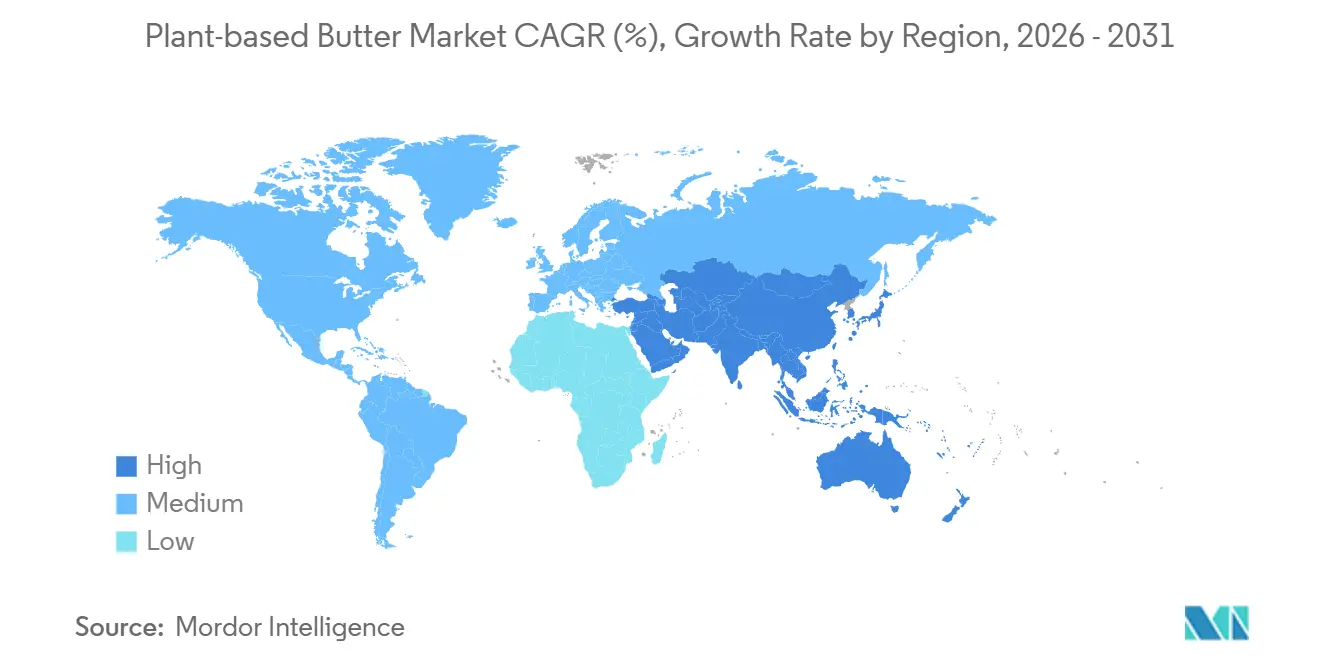
North America is expected to account for 39.68% of the plant-based butter market share in 2025, making it the largest region. Mature plant-based retail infrastructure and strong household familiarity with dairy alternatives support the region’s leading position. The United States represents most of the regional value, with products distributed through grocery, natural-food, and club-store channels. Canada presents a developing opportunity for local allergen-free products, including UnButter’s planned 2025 expansion in Ontario. Regulatory discussions around dairy-related product names may influence how brands communicate their products in the United States.
APAC Plant Based Butter Market
Asia-Pacific is projected to grow at a CAGR of 7.62% from 2026 to 2031, making it the fastest-growing region. The high prevalence of lactose intolerance supports demand for dairy-free options in several Asian countries. Urbanization is also increasing the number of consumers visiting Western-style bakeries and café chains. China and India offer the largest opportunities due to their population scale and evolving dining formats. Australia and Singapore provide international brands with practical entry points before broader regional expansion.
EMEA and South America Plant Based Butter Market
Europe remains the second-largest regional base, led by Germany and the United Kingdom. Plant-based food and beverage sales across six European countries are expected to reach EUR 16.3 billion in 2025, following 5.1% growth from 2024. Nordic markets support export growth from smaller domestic bases, while Belgium, the Netherlands, and Sweden remain key areas for supermarket expansion. South America, the Middle East, and Africa account for smaller shares but offer long-term opportunities, including halal-compatible coconut- and seed-based products in parts of the Middle East.

Competitive Landscape
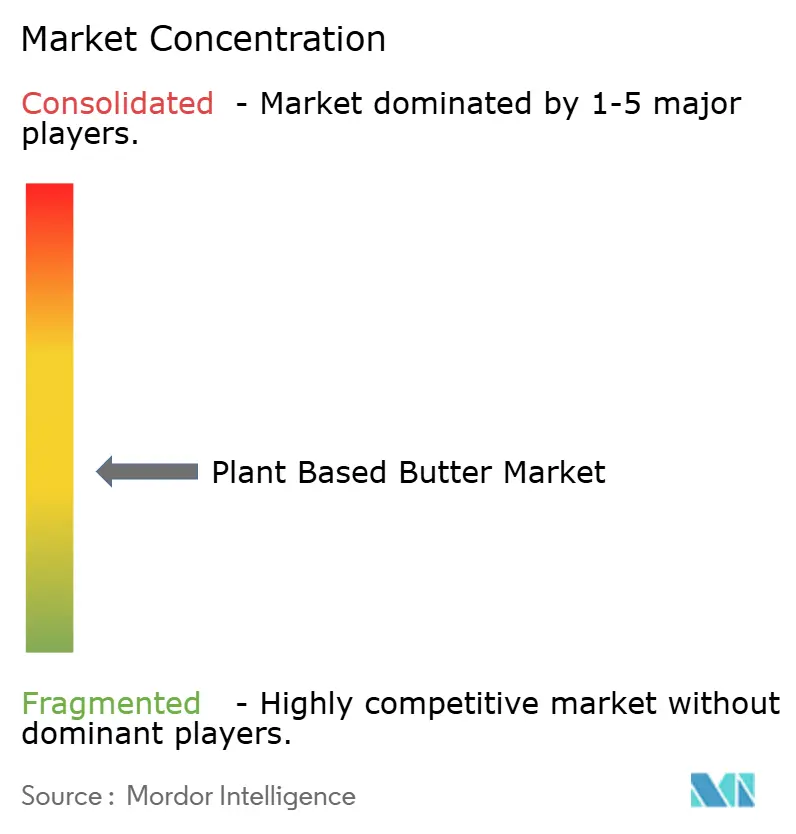
The plant-based butter market has a concentration, indicating a fragmented market with no single dominant supplier. Flora Food Group leads through Country Crock, Flora, and I Can’t Believe It’s Not Butter. Earth Balance remains an established North American challenger, supported by broad retail and foodservice access. Naturli’, WayFare, Melt Organic, Milkadamia, Nutiva, and Pure Blends compete through more targeted consumer propositions. Oatly also intensifies competition through oat-based spreads and foodservice relationships.
Leading suppliers differentiate their offerings through packaging, distribution, and formulation. Flora Food Group introduced a recyclable paper tub for plant-based spreads, developed with Footprint and first scaled from Austria in 2024. Conagra positioned Earth Balance bulk formats for professional baking and culinary applications. Naturli’ has focused on organic products and exports to Germany and the United Kingdom. These strategies combine product claims with channel access and specific usage occasions.
Smaller brands can gain consumer attention through clean-label ingredients, allergen-free positioning, and premium flavors. However, limited production scale can constrain their ability to meet rising demand, as the changes involving Miyoko’s Creamery during 2024 and 2025 illustrate. Oatly reported Q2 2026 revenue of USD 240.1 million, up 15.2% year over year, and raised its full-year constant-currency revenue outlook to 8% to 10%. New production technologies may expand the competitive field, but suppliers must achieve reliable commercial scale.
Plant Based Butter Industry Leaders
-
Upfield Holdings B.V.
-
Miyoko's Creamery
-
Califia Farms, LLC
-
Conagra Brands, Inc.
-
Naturli' Foods A/S
- *Disclaimer: Major Players sorted in no particular order
Plant Based Butter Market Companies Covered in this Report
- Upfield Holdings B.V.
- Miyoko's Creamery
- Califia Farms, LLC
- Conagra Brands, Inc.
- Naturli' Foods A/S
- Melt Organic
- WayFare Foods
- The Forager Project
- Milkadamia Co.
- Nutiva, Inc.
- ForA Foods
- Kite Hill
- Pure Blends
- Prosperity Organic Food Inc.
- Premier Organics
- Daisya Fine Food Ltd.
- Goodmylk Ltd.
- Nuts For Cheese
- Treeline Cheese Co.
- Tofutti Brands Inc.
- Wildbrine
- Oatly AB

Recent Industry Developments in Plant Based Butter Market
- January 2026: Brown Sugar 1st Inc. launched Better Than Butter, a coconut-based, seed-oil-free vegan butter, through Misfits Market.The brand positions the product for cooking, baking, spreading, and whipping, reflecting its focus on versatile plant-based use.
- September 2025: UnButter launched its shea-based butter alternative at Healthy Planet stores across Ontario, Canada. The Canadian-made, female-owned brand positioned the product as a plant-based option for consumers seeking a healthier alternative to traditional butter.
- July 2024: Bunge introduced Beleaf PlantBetter in North America as a plant-based butter alternative for food manufacturers and bakers. The product was designed to match the taste, texture, and functionality of dairy butter while offering vegan, dairy-free, lactose-free, palm-free, and soy-free benefits. Bunge positioned it for bakery applications first, with future expansion planned into other dairy and confectionery uses.


Global Plant Based Butter Market Report Scope
| Oil Based |
| Nut Based |
| Oat and Cereal Based |
| Seed Based |
| Conventional |
| Organic |
| Flavored |
| Unflavored |
| Foodservice | |
| Retail | Supermarkets/Hypermarkets |
| Convenience/Grocery Stores | |
| Online Retail Stores | |
| Other Distribution Channel |
| North America | United States |
| Canada | |
| Mexico | |
| Rest of North America | |
| Europe | Germany |
| United Kingdom | |
| Italy | |
| France | |
| Spain | |
| Netherlands | |
| Belgium | |
| Sweden | |
| Poland | |
| Rest of Europe | |
| Asia-Pacific | China |
| India | |
| Japan | |
| Australia | |
| Singapore | |
| Rest of Asia-Pacific | |
| South America | Brazil |
| Argentina | |
| Colombia | |
| Rest of South America | |
| Middle East and Africa | South Africa |
| Saudi Arabia | |
| Rest of Middle East and Africa |
| By Source | Oil Based | |
| Nut Based | ||
| Oat and Cereal Based | ||
| Seed Based | ||
| By Nature | Conventional | |
| Organic | ||
| By Flavor | Flavored | |
| Unflavored | ||
| By Distribution Channel | Foodservice | |
| Retail | Supermarkets/Hypermarkets | |
| Convenience/Grocery Stores | ||
| Online Retail Stores | ||
| Other Distribution Channel | ||
| By Geography | North America | United States |
| Canada | ||
| Mexico | ||
| Rest of North America | ||
| Europe | Germany | |
| United Kingdom | ||
| Italy | ||
| France | ||
| Spain | ||
| Netherlands | ||
| Belgium | ||
| Sweden | ||
| Poland | ||
| Rest of Europe | ||
| Asia-Pacific | China | |
| India | ||
| Japan | ||
| Australia | ||
| Singapore | ||
| Rest of Asia-Pacific | ||
| South America | Brazil | |
| Argentina | ||
| Colombia | ||
| Rest of South America | ||
| Middle East and Africa | South Africa | |
| Saudi Arabia | ||
| Rest of Middle East and Africa | ||


Key Questions Answered in the Report
What is driving demand in the plant-based butter market?
Reduced lactase persistence, flexitarian purchasing, wider retail access, and improved taste and baking performance are supporting demand. These factors matter because they make dairy-free products relevant to both dietary-need consumers and households that use several food formats.
Reduced lactase persistence, flexitarian purchasing, wider retail access, and improved taste and baking performance are supporting demand. These factors matter because they make dairy-free products relevant to both dietary-need consumers and households that use several food formats.
Oil-based products led with 64.5% share in 2025 because they use established supply chains and work across several applications. Their formulation flexibility allows suppliers to serve spread, cooking, and bakery needs with closely related product platforms.
Which distribution channel is growing fastest in the plant-based butter market?
Foodservice is projected to grow at an 8.2% CAGR during 2026-2031 as restaurants and bakeries increase use of dairy-free ingredients. Professional buyers also need consistent handling and baking results, which encourages suppliers to develop dedicated formats.
Which region has the largest sales base?
North America led with 39.7% share in 2025, supported by mature retail distribution and high household familiarity with plant-based foods. The region contains established mass-retail, natural-food, and club-store channels that provide broad product visibility.
Which region is expected to grow fastest in the plant-based butter market?
Asia-Pacific is projected to grow at a 7.6% CAGR through 2031, supported by lactose intolerance prevalence, urbanization, and foodservice development. Western-style bakeries and café chains can introduce products through prepared foods before some households purchase them at retail.
Page last updated on:





