
Physical AI For Food Handling and Processing Market Size and Share
Market Overview
| Study Period | 2021 - 2032 |
|---|---|
| Market Size (2027) | USD 0.94 Billion |
| Market Size (2032) | USD 3.45 Billion |
| Growth Rate (2027 - 2032) | 29.70 % |
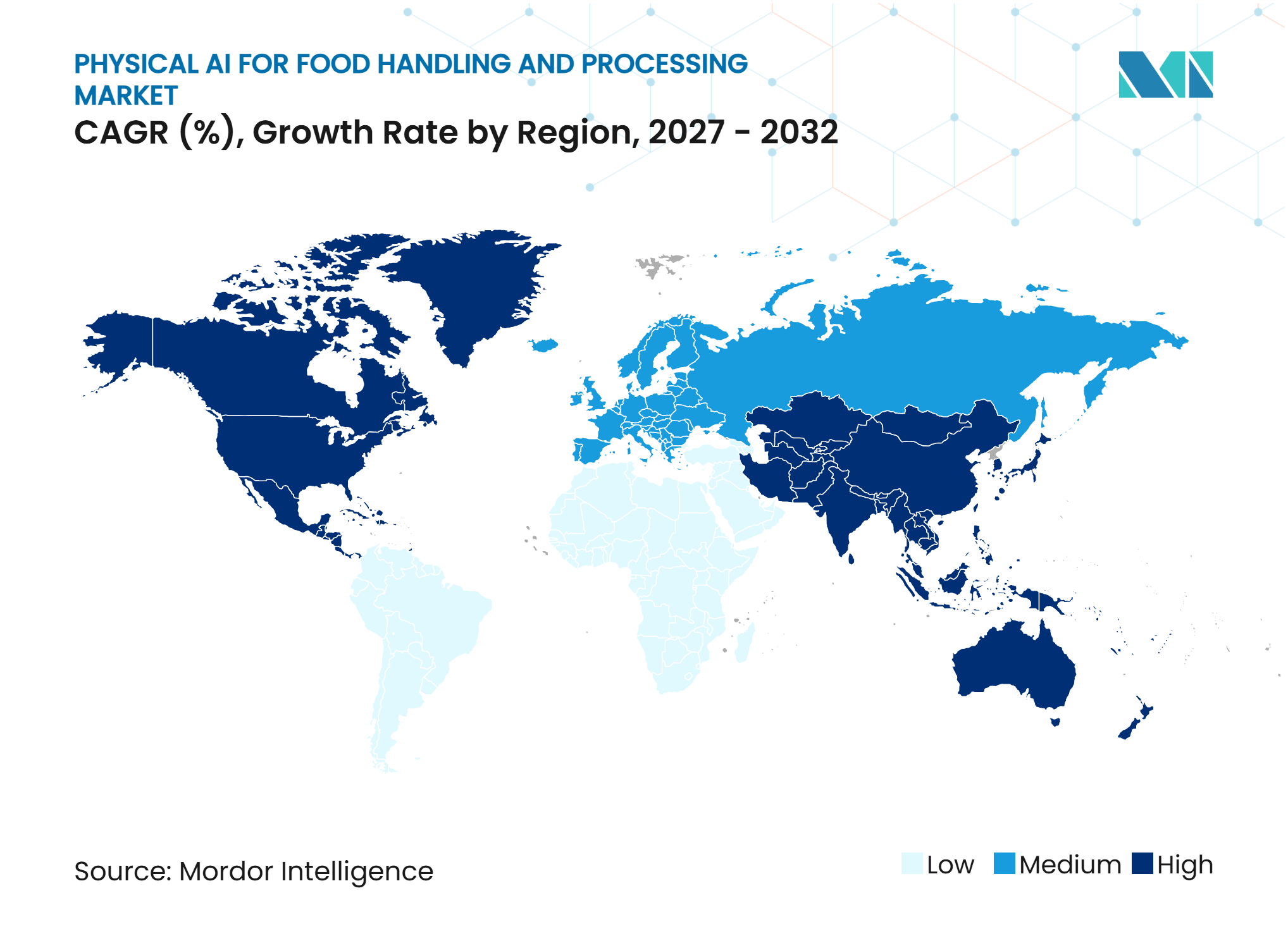
| Fastest Growing Market | North America |
| Largest Market | Asia-Pacific |
| Market Concentration | Medium |
Major Players *Disclaimer: Major Players sorted in no particular order Image © Mordor Intelligence. Reuse requires attribution under CC BY 4.0. | |
Physical AI For Food Handling and Processing Market Analysis by Mordor Intelligence
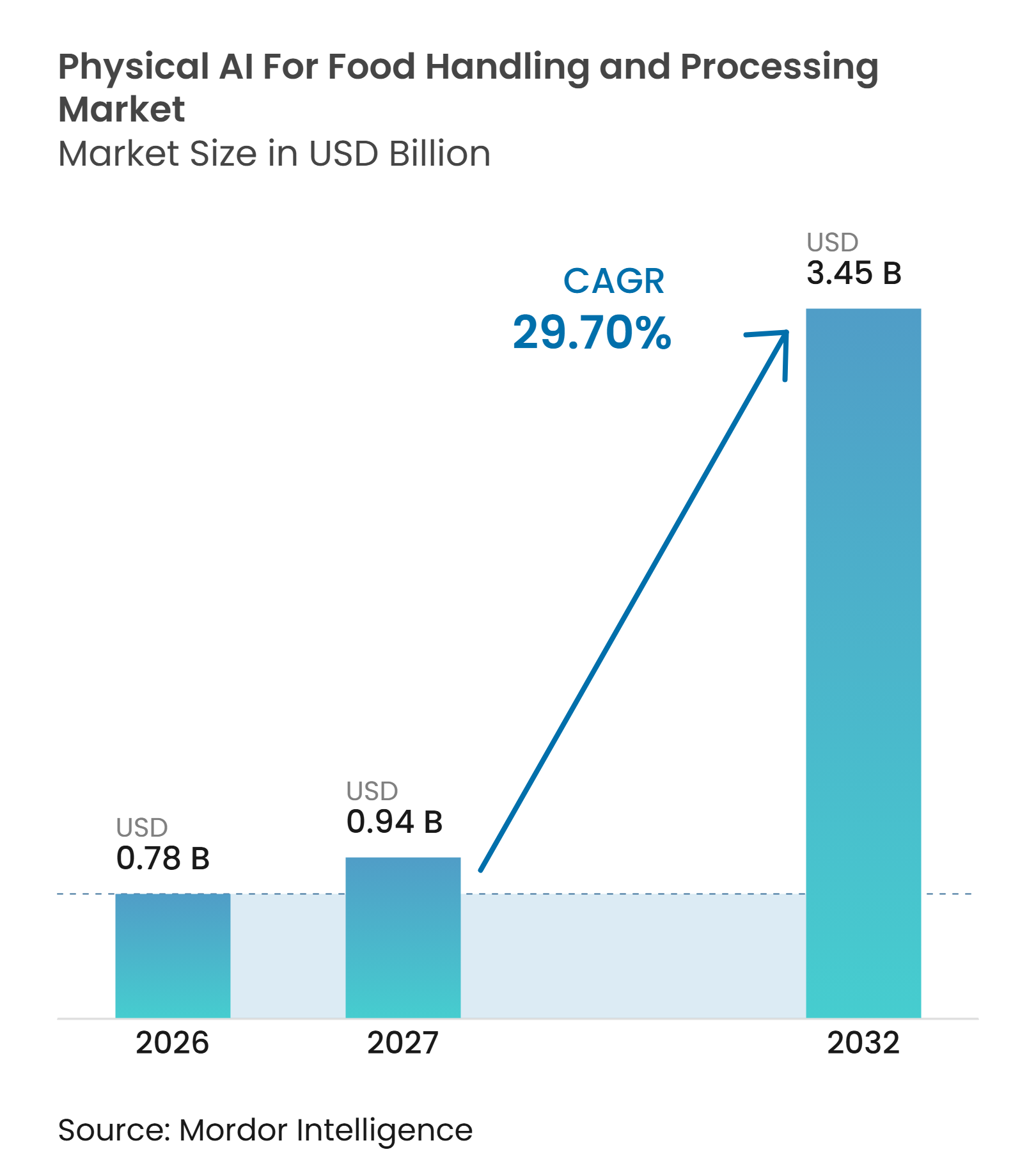
The Physical AI For Food Handling And Processing Market size is expected to increase from USD 0.78 billion in 2026 to USD 0.94 billion in 2027 and reach USD 3.45 billion by 2032, growing at a CAGR of 29.70% over 2027-2032.
The physical AI for food handling and processing market is moving beyond limited trials as food manufacturers deploy systems across protein, bakery, and prepared-meal operations. Installed robots produce handling data that can improve the performance of future models, which makes production deployment more valuable over time. Foundation models, lower-cost edge computing, and washdown-ready robotic hardware are narrowing the gap between specialized automation and more adaptable robotic handling. Labor constraints, traceability requirements, and demand for flexible production lines are strengthening the investment case. The physical AI for food handling and processing market also enables suppliers to integrate hardware, software, and recurring service models.
Key Report Takeaways
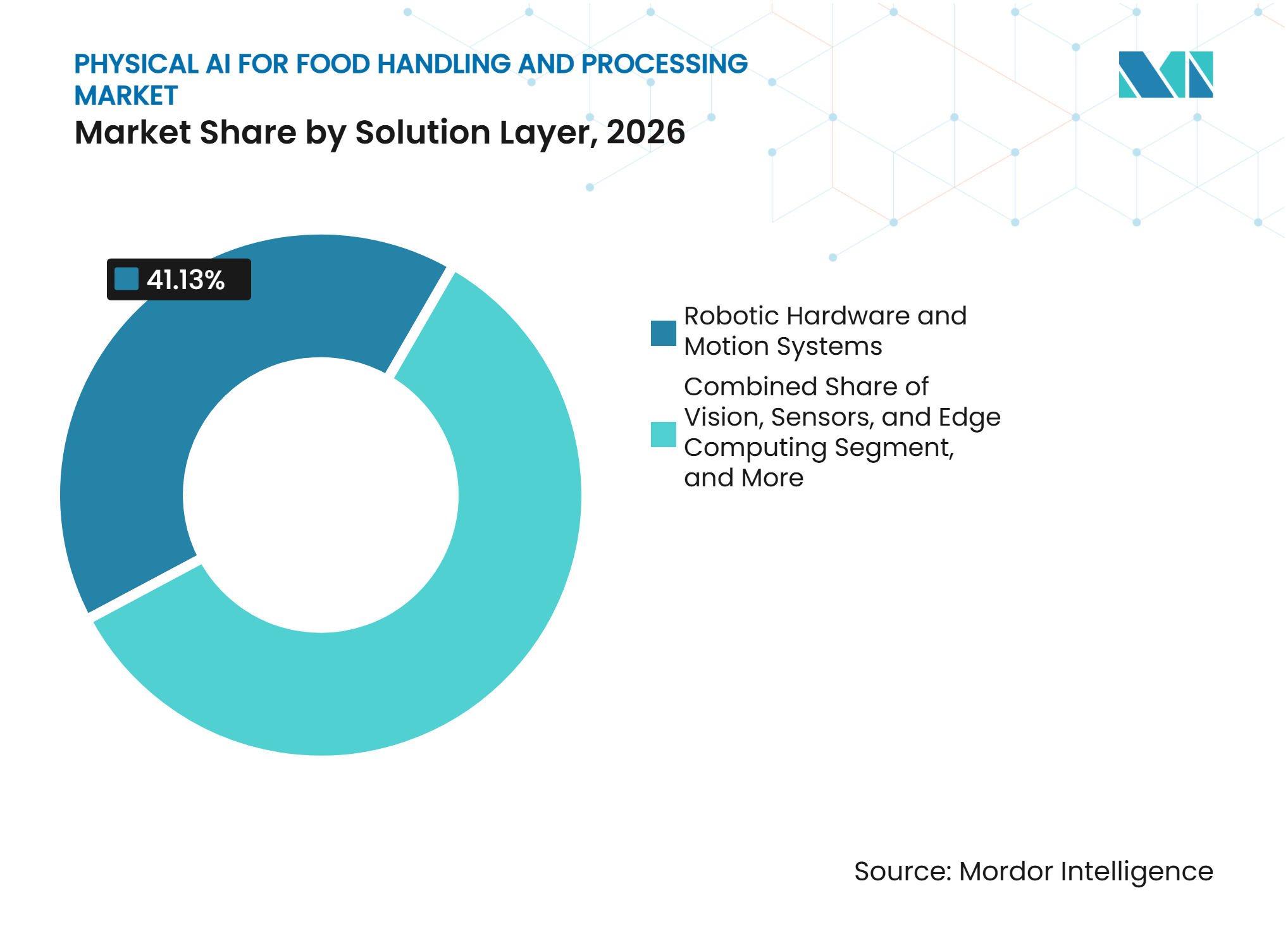
- By solution layer, Robotic Hardware and Motion Systems held 41.13% revenue share in 2026, while Physical AI Software and Control Platforms is projected to expand at a 30.13% CAGR through 2032.
- By robot embodiment, Articulated Robots held 37.56% revenue share in 2026, while Delta and Parallel Robots is projected to expand at a 31.76% CAGR through 2032 in the Physical AI for Food Handling and Processing Market.
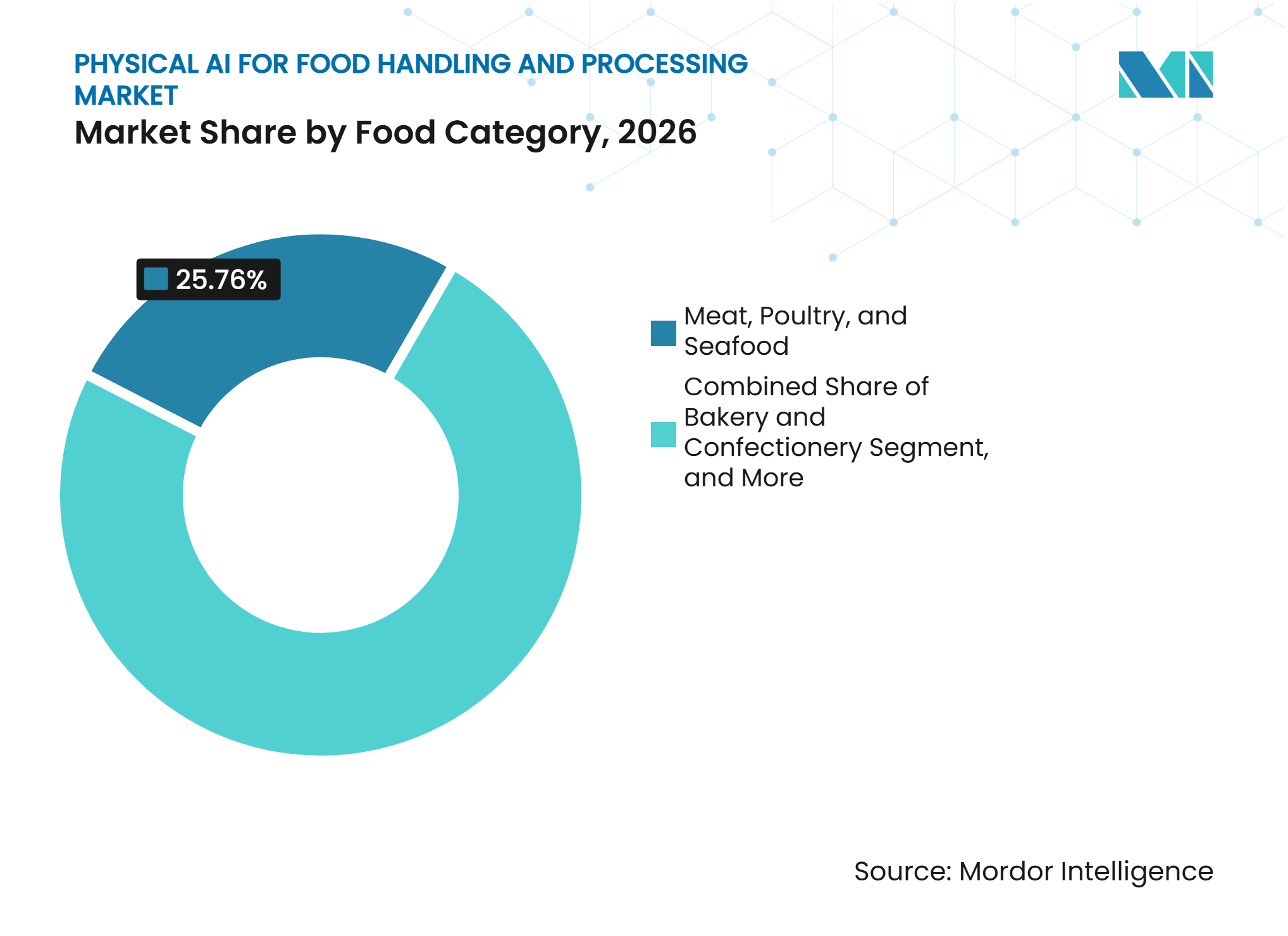
- By food category, Meat, Poultry, and Seafood held 25.76% revenue share in 2026, while Fruits and Vegetables is projected to expand at a 30.87% CAGR through 2032.
- By deployment model, Capital Equipment Purchase accounted for 22.16% of revenue in 2026, while Robotics-as-a-Service is projected to expand at a 31.99% CAGR through 2032 in the Physical AI for Food Handling and Processing Market.
- By geography, Asia-Pacific held 23.87% revenue share in 2026, while North America is projected to expand at a 31.22% CAGR through 2032.
Note: Market numbers in this report are based on Mordor Intelligence's proprietary estimation framework, which combines nine months of actuals with Q4 projections for base year 2026.
Market Trends and Insights
Drivers Impact Analysis of Physical AI For Food Handling and Processing Market*
| Driver | (~) % Impact on CAGR Forecast | Geographic Relevance | Impact Timeline |
|---|---|---|---|
| Labor Shortages and Workforce Continuity | +9.5% | Global, strongest in North America and Western Europe | Short term (≤ 2 years) |
| Demand for High-Mix, Low-Volume Food Production | +7.2% | North America and Europe, with spillover to Asia-Pacific organized foodservice | Medium term (2-4 years) |
| Rising Requirements for Food Safety and Traceability | +5.8% | Global, with strong regulatory pressure in North America and Europe | Medium term (2-4 years) |
| Ready-to-Eat and Prepared-Meal Production Growth | +4.6% | North America, Europe, and Asia-Pacific | Short term (≤ 2 years) |
| Real-Time Vision-Guided Handling of Variable Ingredients | +3.4% | Global | Medium term (2-4 years) |
| Production Data Flywheels from Deployed Food-Manipulation Robots | +2.1% | North America, Japan, and South Korea | Long term (≥ 4 years) |
| Source: Mordor Intelligence | |||
Labor Shortages and Workforce Continuity
Food production facilities face staffing gaps that standard hiring methods have failed to resolve. PMMI reported that 95% of consumer packaged goods companies struggled to recruit skilled operators in 2025, and nearly 60% expected conditions to worsen.[1] The same pressure is evident in demanding processing roles, where turnover can interrupt operating knowledge and training routines. The physical AI for food handling and processing market benefits when processors need more predictable staffing for repetitive handling work. Operator demonstrations can help teach robotic systems how food behaves during manipulation, thereby retaining some plant knowledge within a digital workflow. This makes workforce continuity a practical reason to assess automation rather than a narrow labor-reduction measure.
Demand for High-Mix, Low-Volume Food Production
Retail assortment expansion and private-label prepared meals have shortened production runs in many plants. Fixed automation performs well in stable, repetitive formats, but it becomes less effective when product geometry, packaging, or recipes change often. Vision-led robotics can identify variable ingredients and adjust handling without a complete mechanical rebuild. Chef Robotics states that its piece-picking system uses AI segmentation and RGBD cameras for meal assembly, produce packing, and meatpacking. This capability supports the physical AI market for food handling and processing by addressing the need to process diverse products within the same facility. It also shifts attention from robot motion alone toward the quality of perception and control software.
Rising Requirements for Food Safety and Traceability
The Food Traceability Rule requires covered entities to maintain Key Data Elements for specified Critical Tracking Events and to provide records to the FDA within 24 hours upon request.[2] The compliance date is July 20, 2028, which gives processors time to improve sensing and data capture.[3] Digital records from production systems can support quality checks and more consistent process documentation. A 2026 study of a process-aware robotic salad-packing system completed 10 of 10 trials without sequence errors and produced time-stamped records for each step. The physical AI for food handling and processing market can therefore benefit from food safety investments that also build a usable operational data layer. These systems still need to align with plant sanitation procedures and HACCP-based controls.
Ready-to-Eat and Prepared-Meal Production Growth
Prepared meals require reliable portioning, assembly, packaging, and chilled fulfillment across a wide range of ingredient combinations. Café Spice operates 2 nearly fully automated production lines using Chef Robotics through a Robotics-as-a-Service subscription.[4] The deployment shows how a service model can support commercial food assembly across protein and produce categories. Flexible robotic cells also fit cloud kitchens and direct-to-consumer meal-kit operations that do not always need a full traditional production line. The physical AI market for food handling and processing has the potential to serve these operations through reconfigurable work cells. Demand depends on whether systems can sustain food safety, throughput, and product consistency in daily use.
Restraints Impact Analysis of Physical AI For Food Handling and Processing Market*
| Restraint | (~) % Impact on CAGR Forecast | Geographic Relevance | Impact Timeline |
|---|---|---|---|
| High Upfront Cost and Brownfield Integration Complexity | -4.8% | Global, most acute for SMEs in developing markets | Short term (≤ 2 years) |
| Food-Contact Hygiene and Cleaning-Validation Requirements | -3.2% | Global, strictest in Europe and North America | Medium term (2-4 years) |
| Limited Generalizable Dexterity for Deformable Food Products | -2.4% | Global | Long term (≥ 4 years) |
| Shortage of Food-Specific Robotics and OT-AI Skills | -1.8% | Global, most acute in developing Asia-Pacific markets and South America | Medium term (2-4 years) |
| Source: Mordor Intelligence | |||
High Upfront Cost and Brownfield Integration Complexity
Initial spending extends well beyond the price of a robot arm. A brownfield installation may require vision systems, custom tooling, hygienic conveyor changes, safety guarding, and validation records. Older plants can contain equipment from multiple vendors and different control generations, which complicates the connection of a new physical AI system. ISO 10218:2025 and the EU Machinery Regulation also require cell-level safety attention that can lengthen implementation. These conditions can limit near-term adoption in smaller plants within the physical AI-for-food-handling-and-processing market. Retrofit and modular approaches are relevant because they allow processors to focus on one constrained operation before committing to a larger redesign.
Food-Contact Hygiene and Cleaning-Validation Requirements
Food-contact applications require designs that tolerate washdown and cleaning chemicals while avoiding places where soil can collect. Food-grade lubricants, sealed joints, and IP69K-rated protection are important design features in this setting. Hygienic design expectations also make certification an important procurement factor, especially in Europe. The requirement can favor established suppliers with tested materials, documented cleaning procedures, and experience in food-grade engineering. It can restrain the physical AI for food handling and processing market when smaller entrants cannot absorb certification and validation costs. It also means that fast cycle times alone are not sufficient for a successful food-handling installation.
*Our forecasts treat driver/restraint impacts as directional, not additive. The impact forecasts reflect baseline growth, mix effects, and variable interactions.
Physical AI For Food Handling and Processing Market Segment Analysis
By Solution Layer:
Hardware Anchors Revenue as AI Software AcceleratesRobotic Hardware and Motion Systems are projected to hold a 41.13% share of the physical AI for food handling and processing market in 2026. This share reflects the significant investment required for articulated arms, delta cells, SCARA platforms, end effectors, and related motion equipment. These systems provide the physical foundation for primary processing, packing, and other material-handling applications. Food plants require reliable mechanical platforms that can operate in humid, washdown, and temperature-controlled environments. Therefore, the physical AI for food handling and processing market continues to depend on robust robot designs, even as software gains greater attention.
Vision, Sensors, and Edge Computing provide the perception and local processing capabilities required for adaptive handling. These technologies enable robotic cells to locate ingredients, assess their orientation, and select an appropriate grasp under changing operating conditions. KUKA is set to demonstrate its Flexrobot concept, featuring three KR AGILUS robots performing AI-guided pick-and-place tasks in confined food production spaces, in May 2026. Physical AI Software and Control Platforms are projected to expand at a CAGR of 30.13% through 2032. This software enables systems to adapt to different ingredient types without requiring operators to program each task from the beginning.



By Robot Embodiment:
Articulated Arms Lead, Delta Robots Redefine SpeedArticulated Robots are projected to account for 37.56% of revenue in 2026. Their six-axis movement supports protein handling, tray packing, palletizing, and other applications involving variable product geometries. These robots provide the reach and dexterity required to operate within irregular work areas. JBT Marel states that its RoboPacker can handle up to 180 poultry pieces and 80 catch-weight trays per minute. SCARA robots also remain well established in dairy filling and bakery decoration applications, where compact footprints and rapid, repeatable motion are essential.
Cartesian and Gantry systems remain relevant for large, continuous production lines, where payload capacity, travel distance, and stable motion are more important than compact cell designs. Delta and Parallel Robots are projected to expand at a CAGR of 31.76% through 2032. Their speed supports sorting, placement, and packaging applications, particularly when vision systems can identify varying product formats. FANUC is scheduled to present its IP69K-rated DR-3iB/6 Stainless delta robot alongside a food-grade SCARA robot for sausage-link tray packing in October 2026. Improved grasp planning and product-aware motion control will support broader adoption of this robot type.
By Food Category:
Protein Processing Anchors Volume, Produce Lines Drive GrowthMeat, Poultry, and Seafood are projected to account for 25.76% of the physical AI for food handling and processing market size in 2026. Protein processors face labor constraints, demanding working conditions, and significant pressure to maintain high throughput. Automation can also improve consistency in tasks such as deboning support, tray packing, portioning, and palletizing. A 2025 study reported a 93.8% grasping success rate for poultry legs in simple scenes and a 75.0% success rate in cluttered conditions using a real-time six-degree-of-freedom (6-DoF) grasp-pose method. This difference highlights why clutter, product overlap, and deformable surfaces remain significant technical challenges.
Fruits and Vegetables are projected to expand at a CAGR of 30.87% through 2032. Produce lines must accommodate variation in size, texture, ripeness, and fragility, making basic pick-and-place automation less effective. Tactile sensing and vision systems can work together to regulate grip force and protect delicate items. Soft-gripper deployments have been validated for peppers, salad leaves, and berries. The physical AI for food handling and processing industry can use these capabilities to improve fresh-product handling while reducing reliance on manual sorting.

By Deployment Model:
Capital Equipment Dominates as RaaS Gains MomentumCapital Equipment Purchase is projected to account for 22.16% of revenue in 2026. Large processors with dedicated production lines and internal maintenance teams may prefer ownership because it provides direct control over equipment and operational schedules. This model suits applications with stable volumes, established layouts, and long equipment life cycles. Outcome-Based Automation Contracts provide an alternative approach by linking supplier payments to throughput, yield, or quality metrics. These contracts can reduce perceived risk when processors remain uncertain about integration complexity or system performance in unproven applications.
Robotics-as-a-Service is projected to expand at a CAGR of 31.99% through 2032. This model replaces substantial upfront capital expenditure with recurring payments that can cover hardware, software updates, service, and maintenance. Chef Robotics states that its subscription model enabled Café Spice to expand from four to 16 robots across two automated production lines. FingerVision offers a food-plating service plan starting at JPY 250,000 per month (USD 1,670), with no upfront cost and a three-month trial. By enabling processors to procure automation as an operating service, the physical AI for food handling and processing market can expand its reach among mid-sized operations.
Geography Analysis
Asia-Pacific
Asia-Pacific is projected to account for 23.87% of the physical AI for food handling and processing market in 2026. Japan has an established base of food robotics suppliers, while South Korea has a growing culinary AI ecosystem, and China continues to develop central-kitchen infrastructure for organized foodservice. The General Incorporated Association of Japanese Delicatessen Industry is expected to complete a four-year program in March 2025 that deploys 17 integrated robotic systems for bento and prepared-food assembly. The program includes robotic noodle and side-dish plating, sushi-bento packing, and autonomous mobile transport to cold storage. These applications indicate a shift from standalone workstations toward connected prepared-food workflows. Japan remains both a technology provider and an adoption market for systems designed to address labor constraints and high food quality expectations.
North America
North America is projected to expand at a CAGR of 31.22% through 2032. Limited labor availability in protein processing and a substantial prepared-meal manufacturing base are supporting demand for food automation. Food manufacturers expect labor and material costs per product to increase by an average of 11% each in 2025, while 54% plan to increase their equipment and software budgets. Chef Robotics is expected to raise USD 43.1 million in Series A funding in March 2025, including USD 22.5 million in equipment financing structured for Robotics-as-a-Service deployment. FDA traceability requirements are also driving investments in sensing technologies and digital recordkeeping ahead of the July 2028 compliance deadline. The regional physical AI for the food-handling and processing market can leverage this data infrastructure to develop more integrated quality-control and food-handling systems.
Europe, South America, the Middle East, and Africa
Europe is characterized by stringent hygiene design requirements and the updated EU Machinery Regulation, which may favor suppliers capable of certifying complete robotic cells. Germany uses delta robots in bakery and dairy applications, where food-contact surface requirements are particularly important. REWE Region West is scheduled to pilot Circus Group's CA-1 AI meal-preparation robot in Düsseldorf stores in 2025 and 2026. Meanwhile, Brazil's agri-food sector is adopting robotic sorting and inspection systems for export-quality produce. Argentina's dairy and beef processing operations offer related opportunities for suppliers, while Saudi Arabia and the UAE are aligning food security objectives with investments in automated processing. Africa remains an early-stage market, with South Africa serving as an entry point for vendors targeting broader regional adoption.
Competitive Landscape
Market Concentration
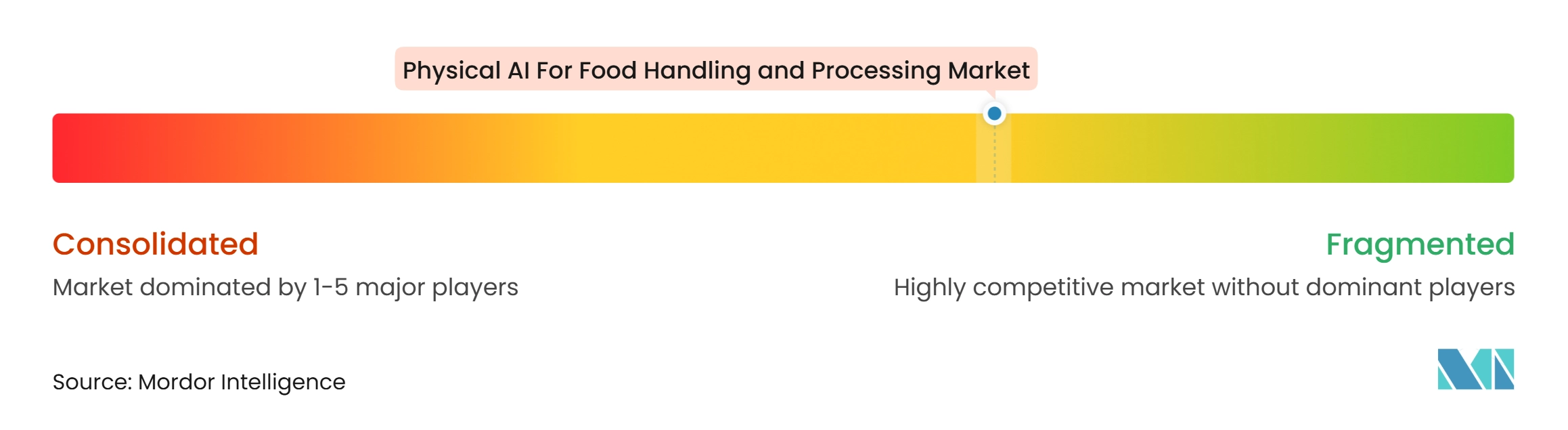
The physical AI for food handling and processing market comprises three broad competitive groups. Global robotics OEMs include ABB, FANUC, KUKA, and Yaskawa. Food-processing equipment specialists include JBT Marel, GEA, and Bühler. Purpose-built physical AI companies include Chef Robotics and Miso Robotics. While these groups serve overlapping customer segments, their core strengths differ in robotic hardware, food-processing expertise, and AI control capabilities.
Leading companies are increasingly targeting applications that combine perception, handling, and food-grade engineering. Chef Robotics is expected to expand its physical AI food models into meatpacking applications for raw, frozen, and precooked proteins in April 2026. In September 2025, Chef Robotics and JBT Marel's Proseal are expected to form a joint solution partnership for meal-assembly automation. FANUC is expected to demonstrate food-grade, washdown-ready packaging robots at PACK EXPO International in October 2026. These developments indicate that suppliers are combining robot platforms with food-specific end effectors, packaging equipment, and application software.
Compliance requirements under ISO 10218:2025 and the EU Machinery Regulation may favor companies that coordinate hardware, integration, safety, and commissioning, as suppliers must document complete cell safety. Outcome-based contracts can benefit processors seeking to align vendor incentives with operational performance. Suppliers with operational food-handling data can develop models that improve through production use, while smaller companies may enter the market through software licensing partnerships with established robot manufacturers. The physical AI for food handling and processing market continues to offer opportunities among mid-sized food manufacturers and in hygienic primary-processing cells for high-moisture protein environments.
Physical AI For Food Handling and Processing Industry Leaders
-
ABB Ltd.
-
FANUC Corporation
-
KUKA AG
-
Universal Robots A/S
-
Yaskawa Electric Corporation
- *Disclaimer: Major Players sorted in no particular order
Physical AI For Food Handling and Processing Market Companies Covered in this Report
- ABB Ltd.
- FANUC Corporation
- KUKA AG
- Yaskawa Electric Corporation
- Mitsubishi Electric Corporation
- Universal Robots A/S
- Kawasaki Heavy Industries, Ltd.
- OMRON Corporation
- Rockwell Automation, Inc.
- Schneider Electric SE
- Siemens AG
- JBT Marel Corporation
- Bühler Holding AG
- Tetra Pak International S.A.
- GEA Group Aktiengesellschaft
- Key Technology, Inc.
- Ishida Co., Ltd.
- MULTIVAC Sepp Haggenmüller SE & Co. KG
- BAADER Global SE
- Chef Robotics, Inc.
- Miso Robotics, Inc.
- Stäubli International AG
- Festo SE & Co. KG
- Emerson Electric Co.
- Honeywell International Inc.
- Bosch Rexroth AG
Recent Industry Developments in Physical AI For Food Handling and Processing Market
- October 2026: JBT Marel showcased an expanded end-to-end portfolio at PACK EXPO International 2026, including OneFlow automated poultry fillet reinsertion, RoboPacker catch-weight tray packing, SingleFeed singulation, and an integrated Tray Packing and Sealing Line that combines RoboPacker, Proseal sealing, and WPL9000+ weighing and labeling, directly addressing labor shortages in protein processing.
- October 2026: FANUC America demonstrated AI-powered food-packaging robots at PACK EXPO International 2026, featuring the DR-3iB/6 Stainless IP69K-rated delta robot, the food-grade SR-12iA/C SCARA robot, and the M-710/50-26D palletizing robot with NVIDIA Isaac Sim digital-twin integration. All platforms featured NSF-H1 food-grade lubricants and washdown-capable designs.
- October 2026: Yaskawa Electric announced the integration of AWS-based generative AI into its MOTOMAN NEXT physical AI robot platform, enabling food factory operators to issue human-language instructions converted into executable robot task sequences without manual programming.
- September 2026: SoftBank Robotics Group acquired a global exclusive commercial IP license from Yo-Kai Express for the STEAMA steam-cooking robot, which prepares frozen noodle dishes in 90 seconds, to support international deployment, including North America.
Global Physical AI For Food Handling and Processing Market Report Scope
The Physical AI for Food Handling and Processing Market Report is Segmented by Solution Layer (Robotic Hardware and Motion Systems, Vision, Sensors, and Edge Computing, Physical AI Software and Control Platforms, and Integration, Deployment, and Support Services), Robot Embodiment (Articulated Robots, Delta and Parallel Robots, SCARA Robots, and Cartesian and Gantry Robots), Food Category (Meat, Poultry, and Seafood, Dairy and Cheese, Bakery and Confectionery, Fruits and Vegetables, and Beverages), Deployment Model (Capital Equipment Purchase, Robotics-as-a-Service, Outcome-Based Automation Contracts, and Retrofit and Modular Cell Deployment) and Geography (North America, South America, Europe, Asia-Pacific, and the Middle East and Africa). The Market Forecasts are Provided in Value (USD).
Segmentation Overview
| Robotic Hardware and Motion Systems |
| Vision, Sensors, and Edge Computing |
| Physical AI Software and Control Platforms |
| Integration, Deployment, and Support Services |
| Articulated Robots |
| Delta and Parallel Robots |
| SCARA Robots |
| Cartesian and Gantry Robots |
| Other Robot Embodiments |
| Meat, Poultry, and Seafood |
| Dairy and Cheese |
| Bakery and Confectionery |
| Fruits and Vegetables |
| Beverages |
| Other Food Categories |
| Capital Equipment Purchase |
| Robotics-as-a-Service |
| Outcome-Based Automation Contracts |
| Retrofit and Modular Cell Deployment |
| North America | United States |
| Canada | |
| Mexico | |
| South America | Brazil |
| Argentina | |
| Rest of South America | |
| Europe | Germany |
| United Kingdom | |
| France | |
| Italy | |
| Spain | |
| Rest of Europe | |
| Asia-Pacific | China |
| Japan | |
| South Korea | |
| India | |
| Australia | |
| Rest of Asia-Pacific | |
| Middle East | Saudi Arabia |
| United Arab Emirates | |
| Rest of Middle East | |
| Africa | South Africa |
| Nigeria | |
| Rest of Africa |
| By Solution Layer | Robotic Hardware and Motion Systems | |
| Vision, Sensors, and Edge Computing | ||
| Physical AI Software and Control Platforms | ||
| Integration, Deployment, and Support Services | ||
| By Robot Embodiment | Articulated Robots | |
| Delta and Parallel Robots | ||
| SCARA Robots | ||
| Cartesian and Gantry Robots | ||
| Other Robot Embodiments | ||
| By Food Category | Meat, Poultry, and Seafood | |
| Dairy and Cheese | ||
| Bakery and Confectionery | ||
| Fruits and Vegetables | ||
| Beverages | ||
| Other Food Categories | ||
| By Deployment Model | Capital Equipment Purchase | |
| Robotics-as-a-Service | ||
| Outcome-Based Automation Contracts | ||
| Retrofit and Modular Cell Deployment | ||
| By Geography | North America | United States |
| Canada | ||
| Mexico | ||
| South America | Brazil | |
| Argentina | ||
| Rest of South America | ||
| Europe | Germany | |
| United Kingdom | ||
| France | ||
| Italy | ||
| Spain | ||
| Rest of Europe | ||
| Asia-Pacific | China | |
| Japan | ||
| South Korea | ||
| India | ||
| Australia | ||
| Rest of Asia-Pacific | ||
| Middle East | Saudi Arabia | |
| United Arab Emirates | ||
| Rest of Middle East | ||
| Africa | South Africa | |
| Nigeria | ||
| Rest of Africa | ||
Key Questions Answered in the Report
What is the size of the physical AI for food handling and processing market?
The physical AI for food handling and processing market is projected to be USD 0.78 billion in 2026, USD 0.94 billion in 2027, and USD 3.45 billion by 2032.
What CAGR is projected for physical AI in food handling and processing?
The physical AI for food handling and processing market is projected to register a 29.70% CAGR between 2027 and 2032, supported by flexible automation, food traceability needs, and persistent workforce constraints.
Which solution layer has the largest revenue share?
Robotic Hardware and Motion Systems held 41.13% of revenue in 2026, reflecting the cost and operational importance of food-grade robots and motion systems.
Which food category is expected to expand fastest?
Fruits and Vegetables is projected to expand at a 30.87% CAGR through 2032 as producers use vision and tactile systems to handle varied and fragile produce.
Why is Robotics-as-a-Service becoming more relevant to food processors?
Robotics-as-a-Service is projected to expand at a 31.99% CAGR through 2032 because it can reduce upfront investment and include support, maintenance, and software updates.
Which region is expected to expand fastest?
North America is projected to expand at a 31.22% CAGR through 2032, supported by labor pressures, prepared-meal production, and investment in sensing and digital records.