
Philippines Pet Treats Market Size and Share
Market Overview
| Study Period | 2021 - 2031 |
|---|---|
| Forecast Data Period | 2026 - 2031 |
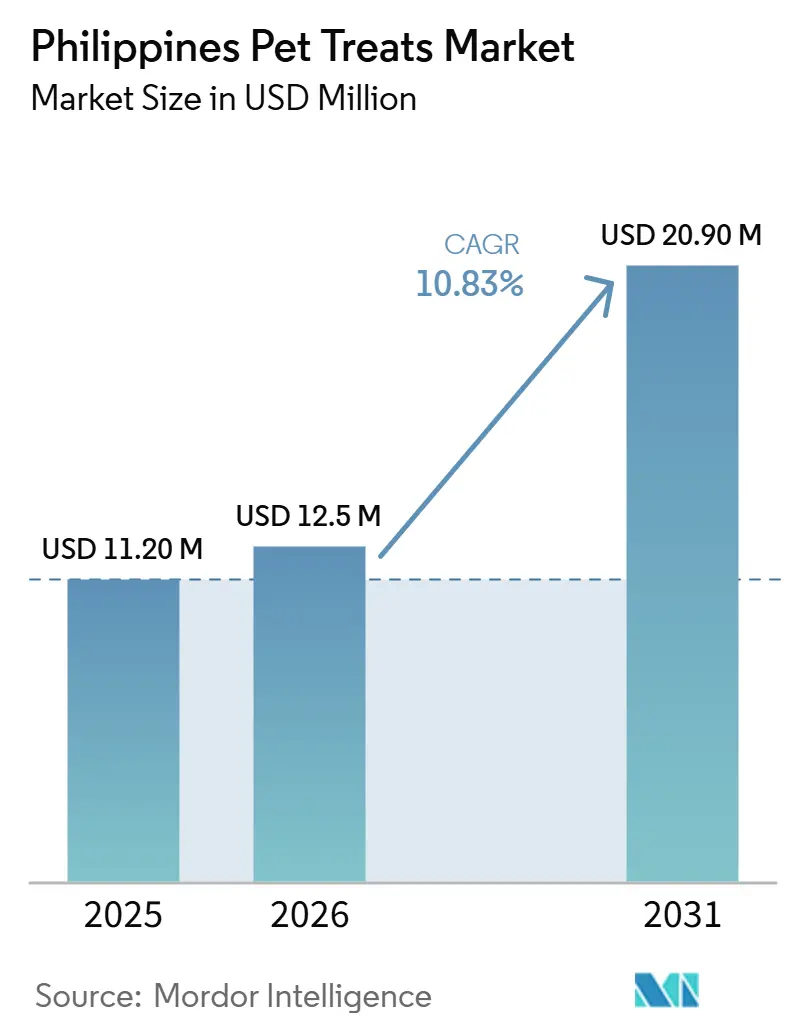
| Base Year Market Size (2025) | USD 11.20 Million |
| Market Size (2026) | USD 12.5 Million |
| Market Size (2031) | USD 20.90 Million |
| Growth Rate (2026 - 2031) | 10.83 % |
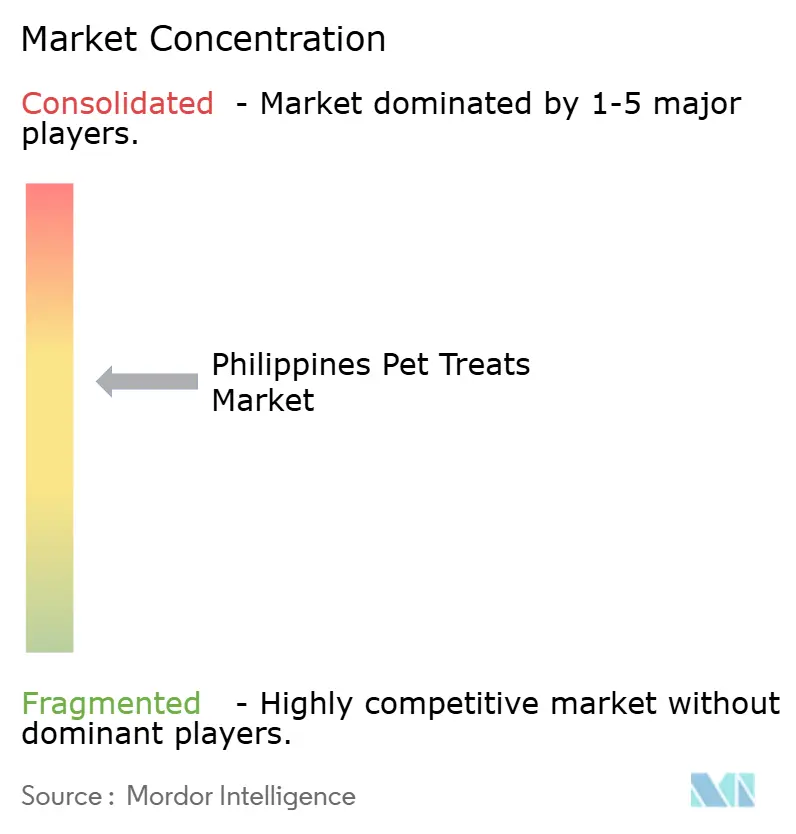
| Market Concentration | Medium |
Major Players *Disclaimer: Major Players sorted in no particular order Image © Mordor Intelligence. Reuse requires attribution under CC BY 4.0. | |
Philippines Pet Treats Market Analysis by Mordor Intelligence
The Philippines Pet Treats Market size was valued at USD 11.20 million in 2025 and is estimated to grow from USD 12.50 million in 2026 to reach USD 20.90 million by 2031, at a CAGR of 10.83% during the forecast period (2026-2031). The Philippines pet treats market is supported by a broad base of pet-owning households. The United States International Trade Administration's 2024 survey showed that 94% of Filipino households owned at least one pet. The market is also benefiting from greater product visibility across online platforms and modern retail, which is helping premium and imported treat formats reach buyers beyond specialty stores. Urban pet ownership patterns are shifting demand toward products with a defined purpose, particularly treats linked to training, dental care, and premium feeding routines. Interest in local production is also rising as feed manufacturers redirect underused capacity toward pet nutrition, which is anticipated to improve supply depth and price competitiveness over the next few years. The market still faces pressure from price sensitivity and counterfeit risks, but pet humanization, channel expansion, and supply-side investment support a favorable growth outlook through 2031.
Key Report Takeaways
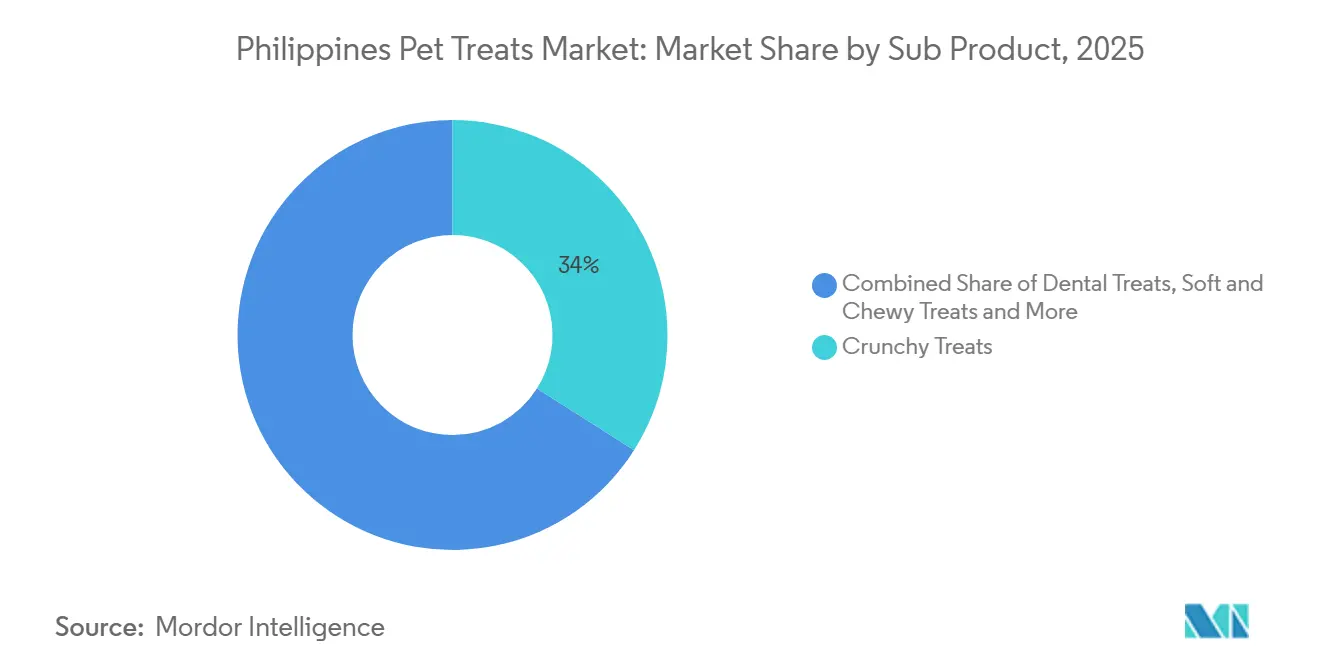
- By sub product, crunchy treats held 34.0% of the Philippines pet treats market size in 2025, while freeze-dried and jerky treats recorded the highest projected CAGR at 14.8% through 2031.
- By pet type, dogs accounted for 57.0% of Philippines pet treats market share in 2025, while cats posted the fastest projected CAGR at 11.2% through 2031.
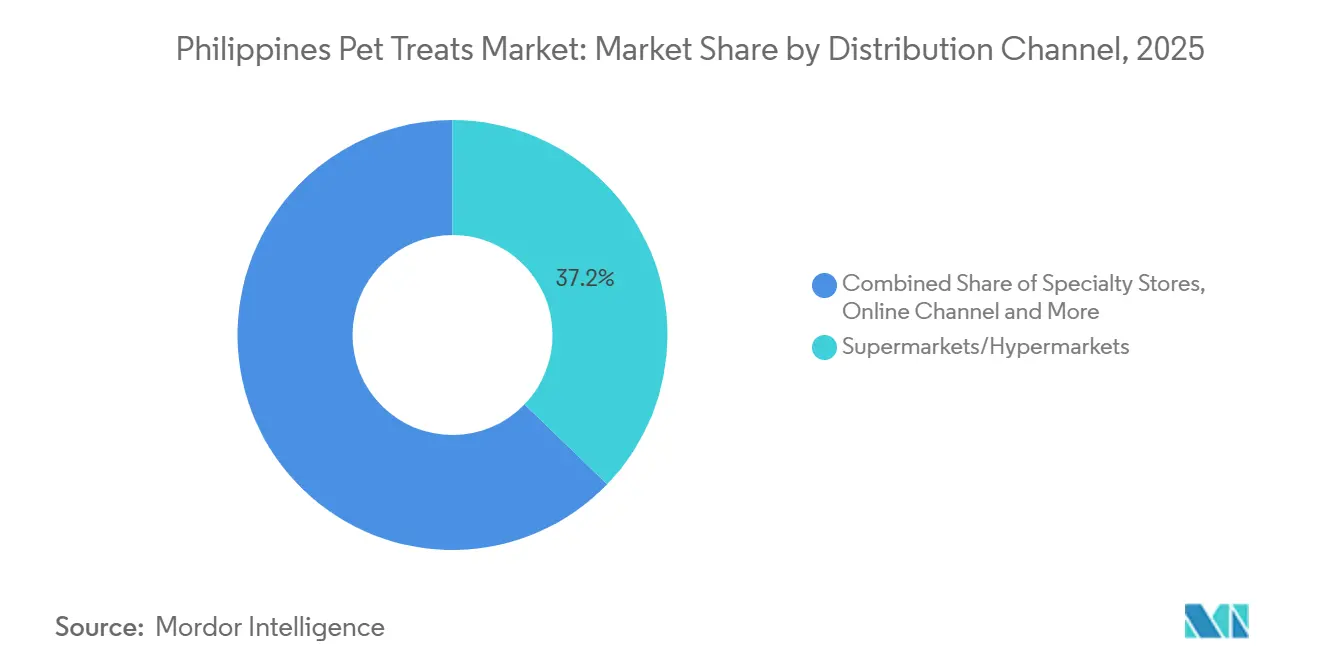
- By distribution channel, supermarkets/hypermarkets captured 37.2% of value in 2025, while the online channel is forecast to expand at a 12.8% CAGR through 2031.
Note: Market size and forecast figures in this report are generated using Mordor Intelligence’s proprietary estimation framework, updated with the latest available data and insights as of January 2026.
Philippines Pet Treats Market Trends and Insights
Drivers Impact Analysis*
| Driver | (~) % Impact on CAGR Forecast | Geographic Relevance | Impact Timeline |
|---|---|---|---|
| Rising pet humanization and premium treat spending | +2.5% | Metro Manila, Cebu, Davao, and major urban centers nationwide | Short term (≤ 2 years) |
| Rapid growth of e-commerce and modern pet retail | +2.0% | National, urban-led adoption with provincial extension | Short term (≤ 2 years) |
| Expanding dog and cat ownership in urban households | +1.8% | Metro Manila, Calabarzon, and Central Luzon core cities | Medium term (2-4 years) |
| Local feed millers converting idle capacity into treat production | +1.5% | National, concentrated in Luzon and Mindanao agricultural corridors | Medium term (2-4 years) |
| Rising demand for functional dental and training treats | +1.4% | Metro Manila and secondary urban centers including Cebu and Davao | Medium term (2-4 years) |
| Growth of shelf-stable freeze-dried formats in humid climates | +1.2% | National, led by urban specialty retail and online channels | Long term (≥ 4 years) |
| Source: Mordor Intelligence | |||
Rising Pet Humanization and Premium Treat Spending
Pet ownership in the Philippines has shifted closer to family spending than basic animal care for many households. The United States International Trade Administration's 2024 survey found that 94% of Filipino households owned at least one pet, establishing a broad consumer base for the category[1]Source: U.S. International Trade Administration, “Philippines Upscale Pet Food and Supplies,” U.S. International Trade Administration, trade.gov. Treats are typically among the first discretionary items added after food and hygiene essentials. Younger pet owners are more willing to spend on products perceived as safer, more specialized, and suitable for daily care routines. A 2024 Mars study covered by Philstar reported high satisfaction levels among Gen Z and millennial dog owners, supporting repeat purchases of branded and premium treat formats. These trends are shifting the Philippines pet treats market away from low-cost biscuits and toward products that reflect affection, quality, and specific purpose. Brands with stronger ingredient claims and clearer packaging are positioned to benefit from this shift in consumer behavior.
Rapid Growth of E-Commerce and Modern Pet Retail
The Philippines pet treats market is expanding through a broader retail network compared to a few years ago. Online marketplaces now play a significant role in product discovery, price comparison, and repeat purchases, particularly for imported and premium products that are not consistently available in nearby stores. In 2025, the Bureau of Animal Industry flagged unregistered pet food products, including pet treats, being sold on Shopee and Lazada, underscoring how central digital channels have become to category traffic. Specialty retail is also gaining visibility through branded engagement and pet-centered events. Robinsons Retail Holdings highlighted this trend through Pet Lovers Centre activities in 2026, reinforcing the role of organized retail in everyday pet care and buyer education. This combination gives the Philippines pet treats market a broader reach across both planned and impulse purchases, and also helps smaller premium brands build awareness without relying solely on traditional shelf placement.
Expanding Dog and Cat Ownership in Urban Households
A growing and increasingly urban pet population is generating a steady flow of first-time and repeat buyers for treats. Dogs represent the larger commercial opportunity, driving more spending across training, reward, and dental use cases. Cats, however, are gaining importance as apartment living and smaller homes make them easier to keep in dense urban areas. The Philippines pet treats market is therefore expanding in two directions simultaneously, with dogs supporting current value and cats contributing to future growth. This dual pattern gives brands a reason to diversify textures, portion sizes, and flavor formats rather than treating the country as a single-species demand pool. Over time, this is anticipated to deepen purchase frequency rather than simply increase one-off transactions.
Local Feed Millers Converting Idle Capacity into Pet Treats Production
Supply-side changes are emerging as a growth factor in the Philippines pet treats market. Philippine feed manufacturers have been seeking new demand after livestock disease pressures weakened parts of their traditional customer base. In October 2024, member companies of the Philippine Association of Feed Millers were already shifting significant shelf space and business focus toward pet food, including pet treats. This is relevant because local production can reduce lead times, lower import dependence, and introduce more price points into the category. Universal Robina Corporation also disclosed plans in 2025 to develop a PHP 400 million (USD 7 million) animal feed milling plant in Mindanao, linked to the expansion of its pet nutrition business. As more production capacity shifts toward pet products, the Philippines pet treats market is anticipated to benefit from a more stable supply in mainstream formats. This will intensify competition in crunchy and chewy treats, while imported brands shift focus toward premium and specialized segments.
Restraints Impact Analysis*
| Restraint | (~) % Impact on CAGR Forecast | Geographic Relevance | Impact Timeline |
|---|---|---|---|
| High price sensitivity in mass-market pet owners | -2.2% | National, with greater impact outside Metro Manila and major urban centers | Long term (≥ 4 years) |
| Lengthy product registration and compliance processes | -1.5% | National, with greater burden on imported and novel-format products | Medium term (2-4 years) |
| Counterfeit and gray-market product risk | -1.2% | E-commerce and informal trade channels across the Philippines | Short term (≤ 2 years) |
| Limited premium assortment outside major urban centers | -1.0% | Provincial Philippines beyond Metro Manila, Cebu, and Davao | Long term (≥ 4 years) |
| Source: Mordor Intelligence | |||
High Price Sensitivity in Mass-Market Pet Owners
A large segment of consumers in the Philippines pet treats market remains highly price-sensitive. This pressure is most pronounced outside Metro Manila, where owners are using table scraps or low-cost alternatives instead of branded treats. In April 2026, veterinarians and nutrition experts were still urging Filipino households to move away from table-scrap feeding, indicating that branded nutrition habits are not yet fully established. This slows penetration for premium treats, as many buyers compare them against informal substitutes rather than other branded products. The issue is more pronounced in crunchy and chewy formats, where local value brands and low-priced imports can narrow the visible gap between safe and unsafe options. Premium brands can respond through functional positioning, but this does not eliminate the affordability barrier for many households. As long as mass-market incomes remain constrained, value messaging will remain nearly as important as product quality in the Philippines pet treats market.
Lengthy Product Registration and Compliance Processes
Regulation presents a significant commercial barrier for both importers and smaller local producers in the Philippines pet treats market. The Animal Industry Development and Competitiveness Act restructured oversight of animal health and related products in 2025, transferring responsibility from the Food and Drug Administration to the Bureau of Animal Industry under the Department of Agriculture. This transition has created uncertainty around timelines, documentation, and review expectations for novel treat formats. The Bureau of Animal Industry also issued public warnings in 2025 about unregistered pet food products being sold across major online channels, indicating that enforcement pressure is increasing. For large multinationals, compliance is a manageable cost. For niche importers and local artisanal brands, the same process can delay product launches long enough to weaken the business case. As a result, innovation in the Philippines pet treats market is advancing more slowly than demand would otherwise allow.
*Our forecasts treat driver/restraint impacts as directional, not additive. The impact forecasts reflect baseline growth, mix effects, and variable interactions.
Segment Analysis
By Sub Product: Crunchy Treats Dominates as Freeze-Dried and Jerky Treats Emerges
Crunchy Treats held 34.0% of the Philippines pet treats market size in 2025, benefiting from Filipino consumers' preference for convenient, shelf-stable products that align with tropical-climate considerations, budget-conscious purchasing behavior, and the practical demands of urban living in densely populated cities such as Metro Manila, Cebu, and Davao. Soft and Chewy Treats are well-suited for training and reward routines in urban households. Dental Treats represent an important segment, as oral-care-led products have already gained meaningful traction in the category, especially among cat owners for caring about their teeth, which are vulnerable to plaque.
The Philippines pet treats market is shifting toward the freeze-dried and jerky segment, which is projected to expand at a 14.8% CAGR through 2031, driven by storage advantages and premium positioning. Freeze-dried products are better aligned with humid conditions and longer shelf life expectations, which supports their distribution through both online and offline channels. In cat-focused niches, Inaba Foods Co., Ltd. continues to expand the premium treat opportunity through formats such as CIAO Churu and newer freeze-dried and dental-related launches[2]Source: Inaba Foods, “CIAO Churu Crunchy Dental Health Treats New Release,” PRTimes, prtimes.jp. As a result, the Philippines pet treats market is moving from a biscuit-led offering toward a more occasion-based sub-product structure.



By Pet Type: Dog Segment Anchors Demand as Cat Ownership Accelerates
Dogs accounted for 57.0%, representing the largest pet type in the Philippines pet treats market share, while cats are forecast to post the fastest CAGR at 11.2% through 2031. Dog demand remains strong because treats are used for training, daily rewards, and dental care, thereby increasing purchase frequency. Cats have a lower market share, but urban living conditions continue to make them more attractive to first-time pet owners in smaller homes, and millennials and Gen Z are concerned about cats' health and nutrition.
The Philippines pet treats market is becoming more balanced as cat-focused product innovation accelerates. Cat-related treat demand shows strong momentum, and company activity supports this trend. Inaba Foods Co., Ltd. expanded cat treat visibility through new variety packs and format extensions in 2025 and 2026, helping normalize premium cat snacking beyond specialist buyers. The Philippines pet treats market is positioned to retain its dog-led value base while gaining future growth from an expanding urban cat-owning population.
By Distribution Channel: Modern Trade Leads as Online Reshapes the Purchase Journey
Supermarkets/hypermarkets accounted for 37.2% of the Philippines pet treats market in 2025, while the online channel is forecast to grow at a 12.8% CAGR through 2031. Specialty stores are also growing, driven by curated assortments and product advice. Convenience stores are popular primarily due to impulse purchases and small-pack formats in dense urban areas. Other channels, including veterinary clinics, grooming salons, and farm supply stores, remain relevant for premium product trials despite their smaller base.
The purchase path in the Philippines pet treats market is becoming increasingly mixed, with discovery and fulfillment no longer occurring in the same place. Consumers often encounter premium products online first, compare prices digitally, and then purchase either on-platform or in a physical store, depending on urgency. Royal Canin Philippines used veterinary partnerships and its 2026 Puppy and Kitten Con event to strengthen specialist and clinic-led engagement, demonstrating that consumer education supports premium conversion. This gives the Philippines pet treats market a more omnichannel shape, where retail scale, online reach, and trust-building all influence final sales.
Geography Analysis
Metro Manila is the largest region in the Philippines pet treats market in 2025 and represents the primary center of organized demand. The region has the widest access to supermarkets, specialty pet stores, warehouse clubs, and clinic-led channels. This retail depth supports both basic treat turnover and premium product discovery. Pet humanization is also most pronounced in the capital region, where younger households are more willing to prioritize pet-related spending. These factors keep Metro Manila at the forefront of the Philippines pet treats market in terms of both value and new-format adoption.
Calabarzon and Central Luzon form the next layer of demand, benefiting from population spillover, retail expansion, and stronger logistics links with the capital. These regions are attracting households seeking branded pet care products, but who tend to shop more selectively than Metro Manila buyers. Bureau of Animal Industry monitoring has also been active across these areas, reflecting their growing commercial importance in regulated pet product sales. As a result, they are likely to remain the most practical near-term expansion zones for companies targeting the Philippines pet treats market.
Visayas and Mindanao remain the frontier regions for the Philippines pet treats market. Cebu provides Visayas with a meaningful urban base, but the branded product assortment remains narrower than in Metro Manila. Mindanao presents the strongest long-term supply-side opportunity, as in 2025, Universal Robina Corporation disclosed plans for a USD 7 million (PHP 400 million) feed milling facility there to support its growing pet nutrition business. San Miguel Foods also used outreach and livelihood-linked distribution activity in 2026 to expand familiarity with pet nutrition beyond core trade channels. These regions are projected to add volume over time, but premium adoption will continue to depend on broader retail depth, stronger consumer trust, and more consistent buyer education.
Competitive Landscape
The Philippines pet treats market is moderately concentrated in 2025, with the top five players being Mars, Incorporated, Nestlé Purina PetCare (Nestlé S.A.), International Pet Food Company Limited (Charoen Pokphand Foods Public Company Limited), Hill's Pet Nutrition, Inc. (Colgate-Palmolive Company), and Blue Buffalo (General Mills, Inc.). Mars, Incorporated maintains a strong position through a portfolio that covers both mass and premium demand across Pedigree, Whiskas, Temptations, and Greenies. Nestlé S.A. supports its position through the Purina range and by expanding local visibility through product launches and consumer activations. In June 2026, Purina (Nestlé S.A.) launched Friskies Dog in Manila, signaling a direct push into the Filipino dry dog food mass segment and strengthening brand relevance across adjacent treat occasions[3]Source: Philippines Graphic Staff, “Nestlé Purina Launches Friskies Dog, Offers 100% Complete Nutrition,” Philippines Graphic, philippinesgraphic.com.ph. Together, these developments indicate that the Philippines pet treats market is being shaped by portfolio breadth, retail execution, and brand familiarity.
Local and regional challengers are increasingly difficult to ignore in the Philippines pet treats market. Aboitiz Foods completed the acquisition of Diasham Resources in January 2026, adding specialty nutrition capabilities across several Asian markets and improving its technical depth. Century Pacific Food also maintained PHP 8 billion to PHP 9 billion (USD 141 million to USD 158 million) in capital expenditure in 2026, with part of that program supporting pet food expansion under the Goodest brand. These investments indicate that domestic players are building the scale needed to compete beyond entry-level products.
Strategy in the Philippines pet treats market now centers on three practical levers: omnichannel visibility, functional product development, and stronger technical credibility. Hill's Pet Nutrition, Inc. and Bond Pet Foods received a United States Food and Drug Administration (US FDA) no-objection letter for a precision-fermented protein for dog food in 2024, pointing to the kind of higher-specification ingredient positioning that may eventually reach markets such as the Philippines. Royal Canin's clinic-linked programs demonstrate why veterinary and specialist channels are important when brands seek to justify premium pricing. White space remains strongest in affordable functional treats, regionally adapted training formats, and private-label programs for organized retailers. The Philippines pet treats market is not closed to new entrants, but success will depend on trust, consistency, and channel fit rather than on low price alone.
Philippines Pet Treats Industry Leaders
Mars, Incorporated
Hill's Pet Nutrition, Inc. (Colgate-Palmolive Company)
International Pet Food Company Limited (Charoen Pokphand Foods Public Company Limited)
Blue Buffalo (General Mills, Inc.)
Nestlé Purina PetCare (Nestlé S.A.)
- *Disclaimer: Major Players sorted in no particular order

Recent Industry Developments
- May 2026: Mars, Incorporated and Big Idea Ventures launched the 2026 Global Pet Food Innovation Program to support the development of next-generation, sustainable pet nutrition technologies that can strengthen Mars' future pet food and treats portfolio across Asia-Pacific markets, including the Philippines.
- May 2026: Nestlé Purina PetCare (Nestlé S.A.) launched Friskies Dog at the Camp 100 event at the Glorietta Activity Center in Manila, marking a direct entry into the Filipino mass-market dry dog food market. The launch included a partnership with Biyaya Animal Care and interactive nutrition education booths, targeting both premium and economy pet food buyers.
- January 2026: Aboitiz Foods completed the full equity acquisition of Diasham Resources Pte. Ltd., a Singapore-based manufacturer with nearly 50 years of expertise in animal nutrition and health solutions. The acquisition expands Aboitiz Foods' footprint in the pet treats industry across Southeast Asia, including the Philippines.


Philippines Pet Treats Market Report Scope
Pet treats are food items or snacks given to animals as rewards, for training, or to show affection. They are not intended to be a source of complete and balanced nutrition.
The Philippines pet treats market is segmented by sub product (crunchy, dental, freeze-dried and jerky, soft and chewy, and other treats), by pet type (dogs, cats, and other pets), by distribution channel (supermarkets/hypermarkets, specialty stores, online channel, and other channels). The market forecasts are in terms of value (USD) and volume (metric tons).
| Crunchy Treats |
| Dental Treats |
| Freeze-Dried and Jerky Treats |
| Soft and Chewy Treats |
| Other Pet Treats |
| Dogs |
| Cats |
| Other Pets |
| Supermarkets and Hypermarkets |
| Specialty Stores |
| Online Channel |
| Convenience Stores |
| Other Channels |
| By Sub Product | Crunchy Treats |
| Dental Treats | |
| Freeze-Dried and Jerky Treats | |
| Soft and Chewy Treats | |
| Other Pet Treats | |
| By Pet Type | Dogs |
| Cats | |
| Other Pets | |
| By Distribution Channel | Supermarkets and Hypermarkets |
| Specialty Stores | |
| Online Channel | |
| Convenience Stores | |
| Other Channels |


Key Questions Answered in the Report
What is the current size of pet treats sales in the Philippines?
The Philippines pet treats market is valued at USD 12.50 million in 2026 and is forecast to reach USD 20.90 million by 2031 at a 10.83% CAGR.
Which product type leads treat demand in the Philippines?
Crunchy Treats lead with a 34.0% share in 2025, reflecting their wide availability and lower price barriers across channels.
Which treat format is growing the fastest?
Freeze-Dried and Jerky Treats are the fastest-growing sub product, with a projected 14.8% CAGR through 2031.
Are dog treats or cat treats growing faster in the Philippines?
Dogs still lead with 57.0% of value in 2025, but cat treats are growing faster, with the Cat segment projected to expand at an 11.2% CAGR through 2031.
Page last updated on:





