
Pharmacy Inventory Management Software Solutions And Cabinets Market Size and Share
Market Overview
| Study Period | 2020 - 2031 |
|---|---|
| Market Size (2026) | USD 7.49 Billion |
| Market Size (2031) | USD 11.28 Billion |
| Growth Rate (2026 - 2031) | 8.53 % |
| Fastest Growing Market | Asia Pacific |
| Largest Market | North America |
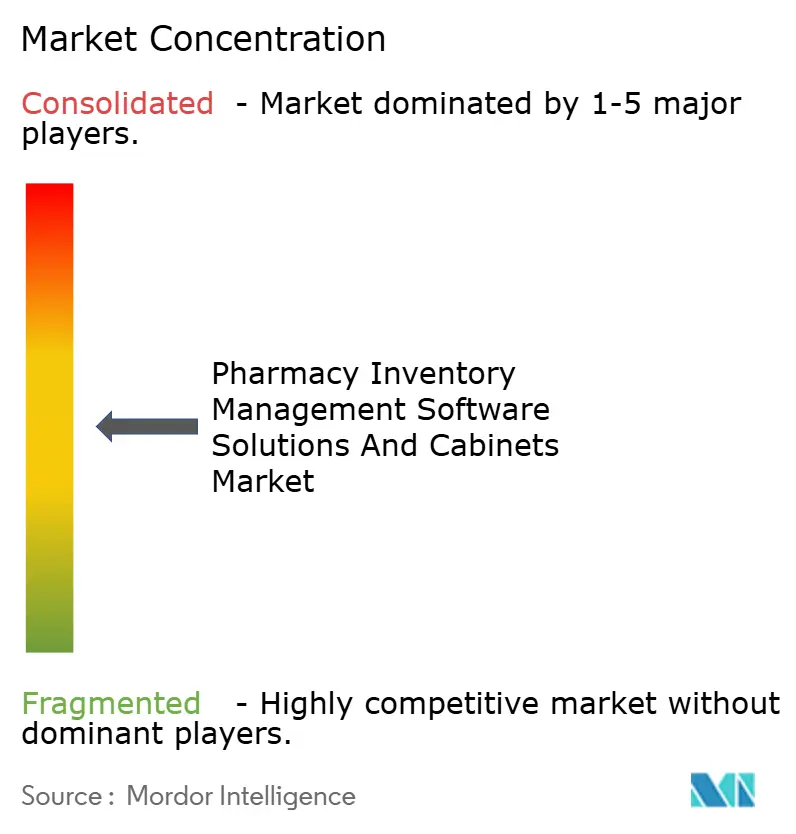
| Market Concentration | Medium |
Major Players *Disclaimer: Major Players sorted in no particular order Image © Mordor Intelligence. Reuse requires attribution under CC BY 4.0. | |
Pharmacy Inventory Management Software Solutions And Cabinets Market Analysis by Mordor Intelligence
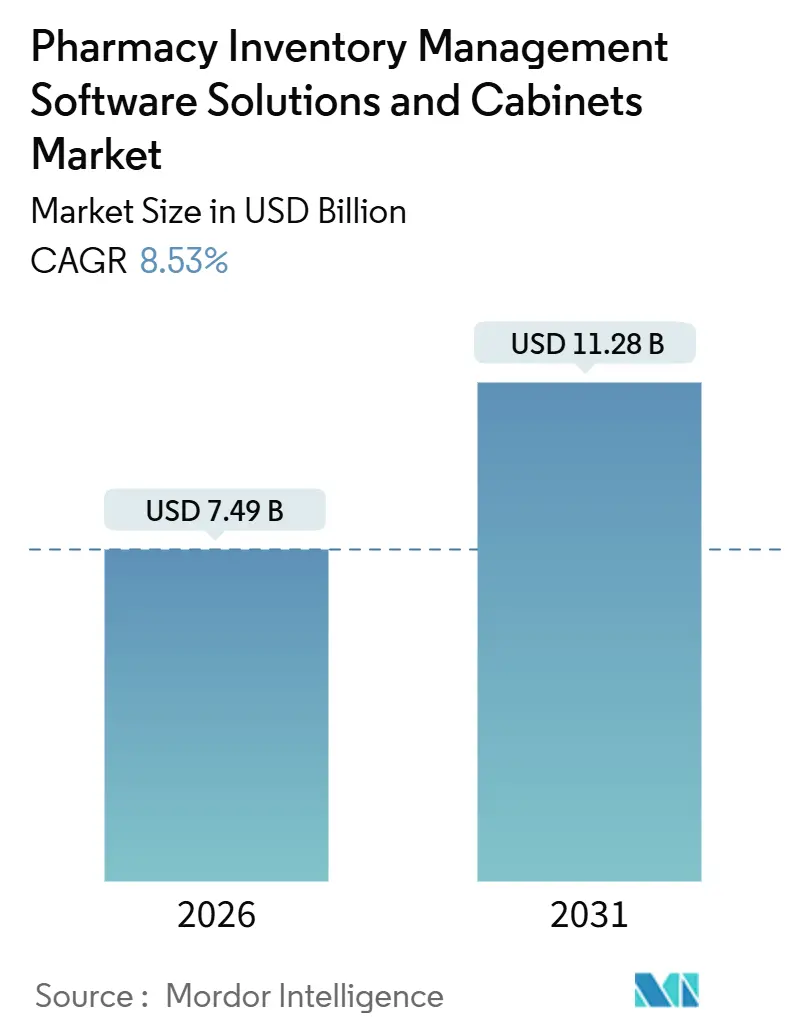
The Pharmacy Inventory Management Software Solutions And Cabinets Market size is estimated at USD 7.49 billion in 2026, and is expected to reach USD 11.28 billion by 2031, at a CAGR of 8.53% during the forecast period (2026-2031).
Robust growth stems from tighter traceability rules, persistent pharmacy-technician shortages, and the shift toward artificial-intelligence-enabled workflows that lower carrying costs and improve dispensing accuracy. In the United States, the Drug Enforcement Administration’s October 2024 rule obliges every controlled-substance transaction to be logged in real time, a standard impractical for manual processes. Parallel FDA Drug Supply Chain Security Act milestones, fully enforced since November 2024, require serialization and interoperable data exchange, accelerating software adoption. Health-system budgets also favor subscription software that overlays intelligence on legacy cabinets, a strategy that avoids USD 150,000-500,000 replacement outlays and shortens deployment cycles. Meanwhile, Asia-Pacific’s hospital modernization drives, notably China’s CNY 120 billion allocation for the Healthy China 2030 pharmacy upgrade, underpin demand for both cabinets and cloud platforms.
Key Report Takeaways
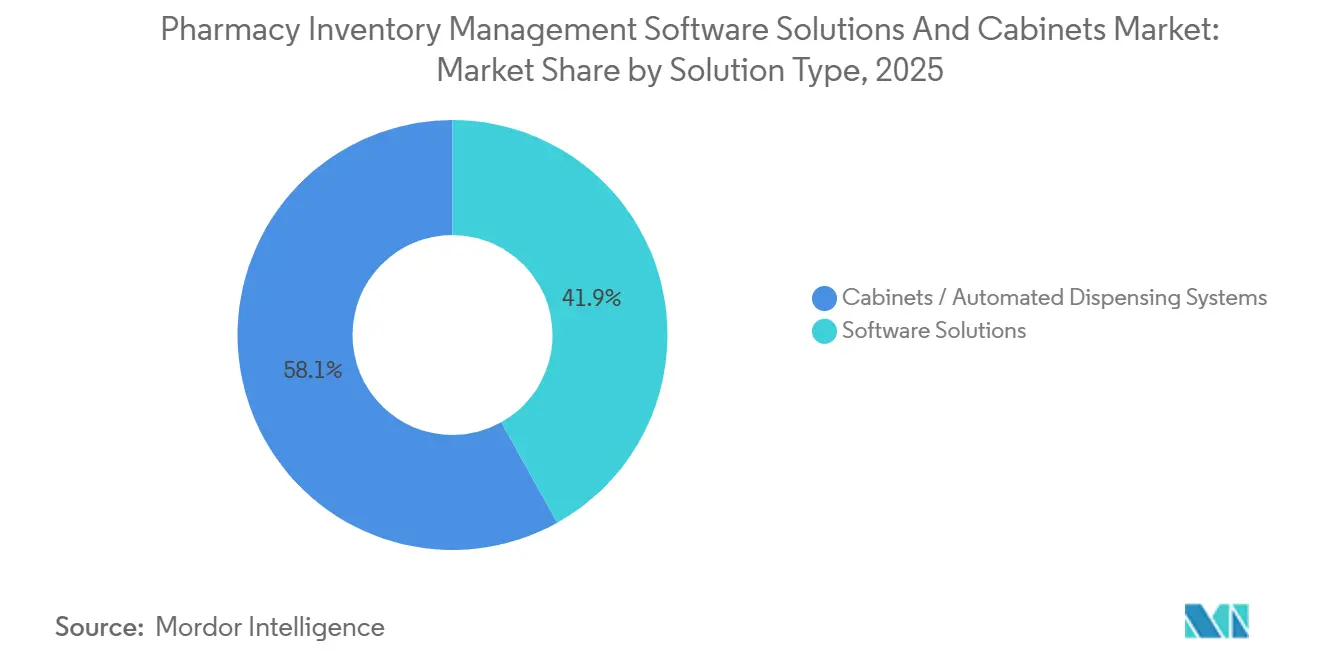
- By solution type, cabinets and automated dispensing systems accounted for 58.11% of the pharmacy inventory management software solutions market in 2025, while software solutions are expanding at a 10.06% CAGR through 2031.
- By mode of operation, centralized dispensing systems led with a 60.73% share in 2025, whereas decentralized systems posted the fastest 10.72% CAGR to 2031.
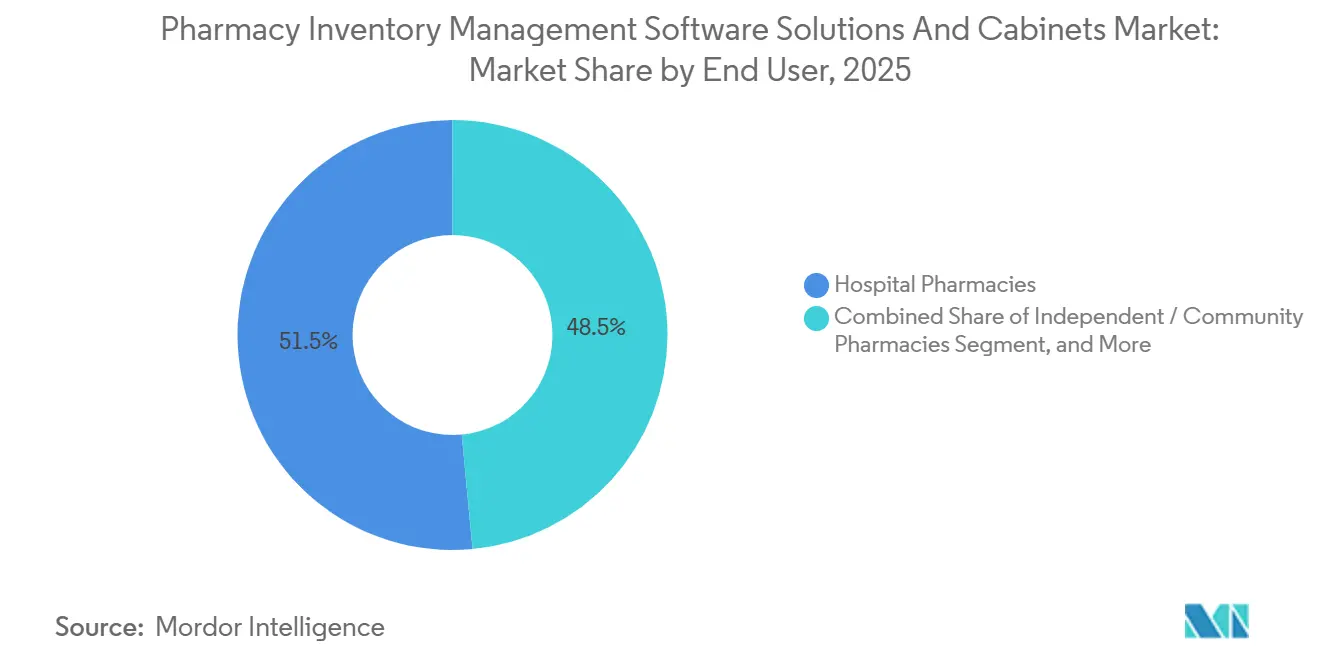
- By end user, hospital pharmacies commanded 51.48% of the market share for pharmacy inventory management software solutions and cabinets in 2025, yet mail-order and online pharmacies are advancing at an 8.91% CAGR through 2031.
- By geography, North America captured 44.64% of revenue in 2025, but Asia-Pacific is forecast to grow at a 11.53% CAGR to 2031, the fastest regional pace.
Note: Market size and forecast figures in this report are generated using Mordor Intelligence’s proprietary estimation framework, updated with the latest available data and insights as of January 2026.
Global Pharmacy Inventory Management Software Solutions And Cabinets Market Trends and Insights
Drivers Impact Analysis*
| Driver | (~) % Impact on CAGR Forecast | Geographic Relevance | Impact Timeline |
|---|---|---|---|
| Rising demand to reduce medication errors and enhance patient safety | +1.8% | North America, Western Europe, global roll-out | Medium term (2-4 years) |
| Expanding prescription volumes and chronic disease prevalence | +2.1% | Asia-Pacific, North America, global | Long term (≥4 years) |
| Regulatory mandates for drug traceability and controlled-substance compliance | +1.5% | North America, Europe, Asia-Pacific | Short term (≤2 years) |
| Centralized prescription-fulfillment models tackling technician shortages | +1.2% | North America, Australia, United Kingdom | Medium term (2-4 years) |
| AI-driven predictive inventory analytics unlocking new ROI | +1.0% | North America, Europe, urban Asia-Pacific | Medium term (2-4 years) |
| Expansion of tele-pharmacy services | +0.9% | North America, India, Brazil | Long term (≥4 years) |
| Source: Mordor Intelligence | |||
Rising Demand to Reduce Medication Errors & Enhance Patient Safety
Medication errors cost U.S. hospitals USD 42 billion each year, and wrong-drug or wrong-dose incidents make up 37% of events.[1]Institute for Safe Medication Practices, “Medication Error Cost Analysis 2024,” ismp.org Automated dispensing cabinets with barcode and biometric verification reduce such errors by 68% compared with manual cart-fill approaches. The Joint Commission’s July 2024 standards require closed-loop verification for high-alert agents, prompting hospitals to prioritize automation even under budget pressure. Systems that pair cabinets with real-time software analytics cut near-miss events by 22% within a year, improving malpractice risk profiles and CMS star ratings. European regulators mirror this stance; the European Medicines Agency’s 2025 guidance cites automated dispensing as a core risk-mitigation control, spurring installations in Germany, France, and the Netherlands.
Expanding Prescription Volumes & Chronic Disease Prevalence
Global prescription volumes climbed 4.8% year-on-year in 2025, driven by aging populations and the growth of chronic disease. In the United States, 133 million people managed at least one chronic condition in 2025, driving 14.2 prescriptions per capita and stretching throughput capacity. China recorded 530 million citizens with hypertension or diabetes in 2025, a 9.1% jump from 2023, intensifying demand for automation in tier-2 and tier-3 hospitals. India’s chronic-care prescription volume is projected to reach 2.8 billion units by 2028, a level that is unsustainable for manual processes. Japan dispensed 1.9 billion prescriptions in 2025, with polypharmacy affecting 34% of older adults, heightening the need for software that screens interactions and forecasts stock requirements.
Regulatory Mandates for Drug Traceability & Controlled-Substance Compliance
Full DSCSA enforcement since November 2024 obliges U.S. dispensers to verify product identifiers at the package level, a labor-intensive task that requires manual entry without automated software. Non-compliance risks exclusion from federal reimbursement. The DEA’s October 2024 rule mandates two-factor authentication and audit trails for Schedule II-V drugs, pushing hospitals to replace cabinets lacking integrated controls.[2]U.S. Drug Enforcement Administration, “Regulations for Controlled Substance Tracking,” dea.gov In Europe, the Falsified Medicines Directive’s tightening audits require serialization decommissioning at dispense, a process that automated solutions complete in 4.2 seconds versus 38 seconds manually.
Centralized Prescription-Fulfillment Models Tackling Technician Shortages
U.S. pharmacy-technician vacancies reached 12% in 2025, with rural hospitals experiencing turnover above 28%.[3]U.S. Bureau of Labor Statistics, “Occupational Employment Statistics for Pharmacy Technicians 2025,” bls.gov Hub-and-spoke fulfillment facilities reduce on-site technician needs by 40% while lifting fill accuracy to 99.7% across 18 surveyed health systems. Kaiser Permanente’s Northern California hub processes 2.1 million monthly prescriptions, freeing 120 full-time equivalents for clinical duties. Australia’s hospital networks report AUD 1.80 labor savings per prescription after shifting to centralized models. The United Kingdom’s NHS pilots achieved 19% reductions in stock-outs and 23% faster discharge prescriptions, validating the model.
Restraints Impact Analysis*
| Restraint | (~) % Impact on CAGR Forecast | Geographic Relevance | Impact Timeline |
|---|---|---|---|
| High upfront capital cost and integration complexity | -1.4% | Global, acute in independents and long-term care | Short term (≤2 years) |
| Cyber-security and data-privacy vulnerabilities | -0.8% | North America, Europe, Asia-Pacific | Medium term (2-4 years) |
| Tariff-driven hardware cost volatility | -0.6% | North America, Europe | Short term (≤2 years) |
| FHIR interoperability gaps with next-gen EHRs | -0.5% | North America, Europe, Asia-Pacific | Medium term (2-4 years) |
| Source: Mordor Intelligence | |||
High Upfront Capital Cost & Integration Complexity
A turnkey automated cabinet suite costs USD 150,000-500,000 for a 300-bed hospital, a hurdle for independent pharmacies whose median annual revenue falls below USD 3 million. Integration adds 180-240 IT labor hours and can delay go-live by seven months, eroding ROI projections. Long-term care facilities lag adoption; only 18% of U.S. nursing homes deployed cabinets by 2024. Rural independents averaging 150 daily scripts remain below the 250-script break-even threshold identified by the Pharmacy Quality Alliance.
Cyber-Security & Data-Privacy Vulnerabilities
Seventy-nine U.S. pharmacy system breaches in 2024-2025 exposed 4.3 million records and triggered USD 28.4 million in HIPAA fines. Pen-tests show exploitable vulnerabilities in 41% of cabinets, including hardcoded credentials. Ransomware attacks targeting pharmacy databases rose 52% in 2024, with average demands of USD 1.2 million. GDPR fines of up to 4% of global revenue amplify vendor spending on encryption and intrusion detection, increasing license fees 12-18%.
*Our forecasts treat driver/restraint impacts as directional, not additive. The impact forecasts reflect baseline growth, mix effects, and variable interactions.
Segment Analysis
By Solution Type: Software Outpaces Hardware on Subscription Economics
Software solutions expanded at a 10.06% CAGR through 2031, well above the 6.12% CAGR for hardware. Hospitals leverage subscriptions priced at USD 800-3,500 per site to add analytics, expiration alerts, and EHR integration to existing cabinets, avoiding new-build capex. Becton Dickinson booked 1,840 incremental software-only contracts during 2024-2025. The pharmacy inventory management software solutions and cabinets market size for software reached USD 3.14 billion in 2026, and predictive add-ons are lifting average revenue per site by 17%.
Hardware remains indispensable for greenfield facilities and decadal replacements. The American Hospital Association’s 2024-2025 construction wave added 87 new hospitals and 340 expansions, each requiring 8-22 cabinets. Omnicell’s XT Series, launched in September 2024, sold 420 units in its first year, highlighting compliance-driven refresh demand.



By Mode of Operation: Decentralized Systems Gain Traction in Ward-Level Care
Centralized hubs accounted for 60.73% of revenue in 2025, yet decentralized ward cabinets are growing at a 10.72% CAGR. Emergency departments cut drug retrieval time from 12 minutes to 90 seconds after installing ward-level units, improving stroke and sepsis bundle performance.
Centralized hubs still deliver unmatched scale for 10,000-plus daily scripts, achieving a per-fill cost of USD 2.10 versus USD 4.80 for decentralized flows. Hybrid architectures pairing hubs for maintenance fill with ward cabinets for stat doses proliferated to 22% of U.S. hospitals in 2025, doubling the 2022 penetration.
By End User: Mail-Order Pharmacies Drive Fastest Growth
Hospital pharmacies accounted for 51.48% of 2025 demand, driven by inpatient expansion and stringent audit requirements. Formulary compliance improved 41% in academic centers using integrated cabinet-software platforms.
Mail-order and online players show the swiftest 8.91% CAGR as Medicare Part D sponsors migrate chronic medications to 90-day home delivery, raising mail-order share to 38% of maintenance prescriptions in 2025. CVS Health processed 1.2 billion mail-order scripts in 2024, 87% of which were processed via robotics. Amazon Pharmacy’s 12 automated sites handle 300 units per hour, underscoring e-commerce's scaling potential.
Geography Analysis
North America retained 44.64% of revenue in 2025, expanding at a 7.8% CAGR below the global pace as installed bases mature. Canada earmarked CAD 420 million for rural pharmacy automation in 2024-2025.
Asia-Pacific shows 11.53% CAGR through 2031, the fastest globally. China funded CNY 120 billion upgrades and added 1,840 county-hospital systems in 2024-2025. India’s 450 million digital-health IDs force dispensaries to reconcile stock with electronic prescriptions. Japan shipped 2,340 automated units to community pharmacies in 2024-2025, serving an older-adult share of 29.1%. South Korea’s mandatory electronic prescribing, implemented in January 2024, triggered 1,620 pharmacy software deployments by mid-2025. Australia’s real-time claims system yielded 340 new installations in the same span.


Competitive Landscape
Moderate concentration defines the pharmacy inventory management software solutions and cabinets market. Omnicell bought FDS Amplicare for USD 275 million in October 2024, gaining traction in long-term care. Becton, Dickinson, and Company added 1,840 cloud subscriptions during 2024-2025, extending the life cycles of legacy cabinets for customers. Baxter expanded sterilization-component capacity in 2025 to shorten cabinet lead times.
Technology competition centers on AI, interoperability, and cyber-resilience. Vendors offering machine-learning demand forecasting command 12-18% price premiums, according to ECRI’s 2024 pricing review. Only 34% of systems shipped in 2024-2025 were fully FHIR-compliant, but procurement teams increasingly list it as a must-have, influencing tender outcomes. ISO 27001 and HITRUST certifications now appear in over 70% of U.S. request-for-proposal documents, reflecting buyer sensitivity after 4.3 million record breaches in 2024-2025.
Regional specialists exploit gaps in culture, language, and reimbursement rules. Yuyama leads Japan’s small-footprint cabinet niche, while Swisslog Healthcare pairs robotics with BD software in European hospitals. ScriptPro targets long-term care with compact units, securing 78 U.S. installations in 2024-2025.
Pharmacy Inventory Management Software Solutions And Cabinets Industry Leaders
Baxter International Inc.
Becton, Dickinson and Company
Cerner Corporation
McKesson Corporation
Omnicell Inc.
- *Disclaimer: Major Players sorted in no particular order

Recent Industry Developments
- December 2025: Bluesight announced partnerships spanning 3,000 U.S. hospital sites, underlining adoption momentum at the ASHP Midyear meeting.
- June 2025: BIG Caring Group chose RISE with SAP on AWS to integrate inventory across 500 Malaysian outlets.
- December 2024: Swisslog Healthcare and BD formed a co-marketing pact to deliver end-to-end medication automation.
- November 2024: Bluesight reported record new-client additions and revenue growth, driven by predictive software modules.


Global Pharmacy Inventory Management Software Solutions And Cabinets Market Report Scope
| Software Solutions |
| Cabinets / Automated Dispensing Systems |
| Centralized Dispensing Systems |
| Decentralized Dispensing Systems |
| Hospital Pharmacies |
| Independent / Community Pharmacies |
| Long-Term Care Centers |
| Mail-Order / Online Pharmacies |
| North America | United States |
| Canada | |
| Mexico | |
| Europe | Germany |
| United Kingdom | |
| France | |
| Italy | |
| Spain | |
| Rest of Europe | |
| Asia-Pacific | China |
| Japan | |
| India | |
| Australia | |
| South Korea | |
| Rest of Asia-Pacific | |
| Middle East & Africa | GCC |
| South Africa | |
| Rest of Middle East & Africa | |
| South America | Brazil |
| Argentina | |
| Rest of South America |
| By Solution Type | Software Solutions | |
| Cabinets / Automated Dispensing Systems | ||
| By Mode of Operation | Centralized Dispensing Systems | |
| Decentralized Dispensing Systems | ||
| By End User | Hospital Pharmacies | |
| Independent / Community Pharmacies | ||
| Long-Term Care Centers | ||
| Mail-Order / Online Pharmacies | ||
| By Geography | North America | United States |
| Canada | ||
| Mexico | ||
| Europe | Germany | |
| United Kingdom | ||
| France | ||
| Italy | ||
| Spain | ||
| Rest of Europe | ||
| Asia-Pacific | China | |
| Japan | ||
| India | ||
| Australia | ||
| South Korea | ||
| Rest of Asia-Pacific | ||
| Middle East & Africa | GCC | |
| South Africa | ||
| Rest of Middle East & Africa | ||
| South America | Brazil | |
| Argentina | ||
| Rest of South America | ||


Key Questions Answered in the Report
What is the current value of the pharmacy inventory management software solutions and cabinets market?
The market stood at USD 7.49 billion in 2026 and is forecast to reach USD 11.28 billion by 2031.
Which segment is expanding fastest in this market?
Software solutions are advancing at a 10.06% CAGR through 2031 as hospitals add intelligence layers to existing cabinets.
Why is Asia-Pacific projected to grow the quickest?
Government funding for hospital upgrades in China, India’s digital-health mandate, and Japan’s aging population drive an 11.53% regional CAGR.
How do centralized hubs benefit health systems?
Hub-and-spoke models reduce on-site technician needs by 40% or more, lowering per-prescription labor costs to USD 2.10 versus USD 4.80 in decentralized flows.
What are the main barriers to adoption for small pharmacies?
Upfront capital of USD 150,000-500,000 and complex EHR integration extend payback periods, deterring independents and long-term care facilities.
Page last updated on:





