
Pharmaceutical-Grade Lithium Carbonate Market Size and Share
Market Overview
| Study Period | 2022 - 2032 |
|---|---|
| Market Size (2027) | USD 163.97 Million |
| Market Size (2032) | USD 214.91 Million |
| Growth Rate (2027 - 2032) | 5.56 % |
| Fastest Growing Market | Asia-Pacific |
| Largest Market | North America |
| Market Concentration | Medium |
Major Players *Disclaimer: Major Players sorted in no particular order Image © Mordor Intelligence. Reuse requires attribution under CC BY 4.0. | |
Pharmaceutical-Grade Lithium Carbonate Market Analysis by Mordor Intelligence
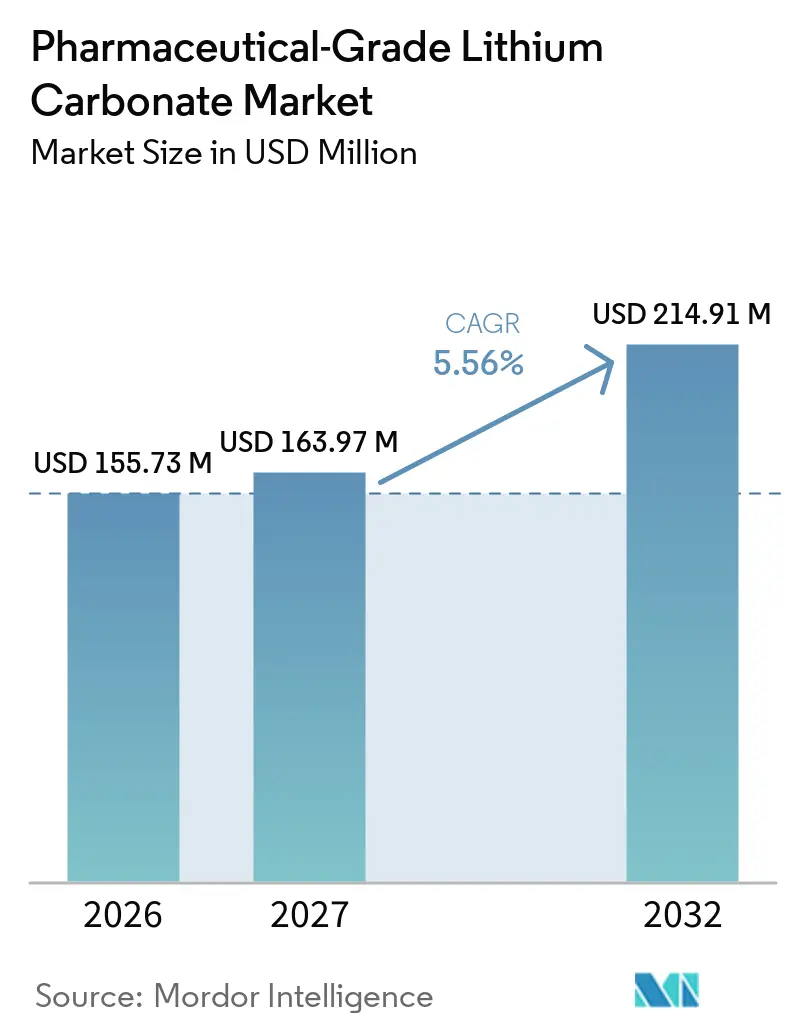
The Pharmaceutical-Grade Lithium Carbonate Market size was valued at USD 155.73 million in 2026 and is estimated to grow from USD 163.97 million in 2027 to reach USD 214.91 million by 2032, at a CAGR of 5.56% during the forecast period (2027-2032). Demand is tied to the continuing treatment need for bipolar disorder, which affects an estimated 40 million people worldwide, while wider screening is bringing more patients into care. The pharmaceutical-grade lithium carbonate market remains separate from battery and industrial supply because drug products must meet the assay and impurity limits set by the United States Pharmacopeia, the European Pharmacopeia, and the Japanese Pharmacopeia. This qualification requirement limits rapid supplier substitution and gives established producers an advantage when commodity lithium prices change. The pharmaceutical-grade lithium carbonate market also benefits from demand for longer-acting formulations, broader primary-care screening, and a growing need for qualified supply sources across North America, Europe, and Asia-Pacific.
Key Report Takeaways
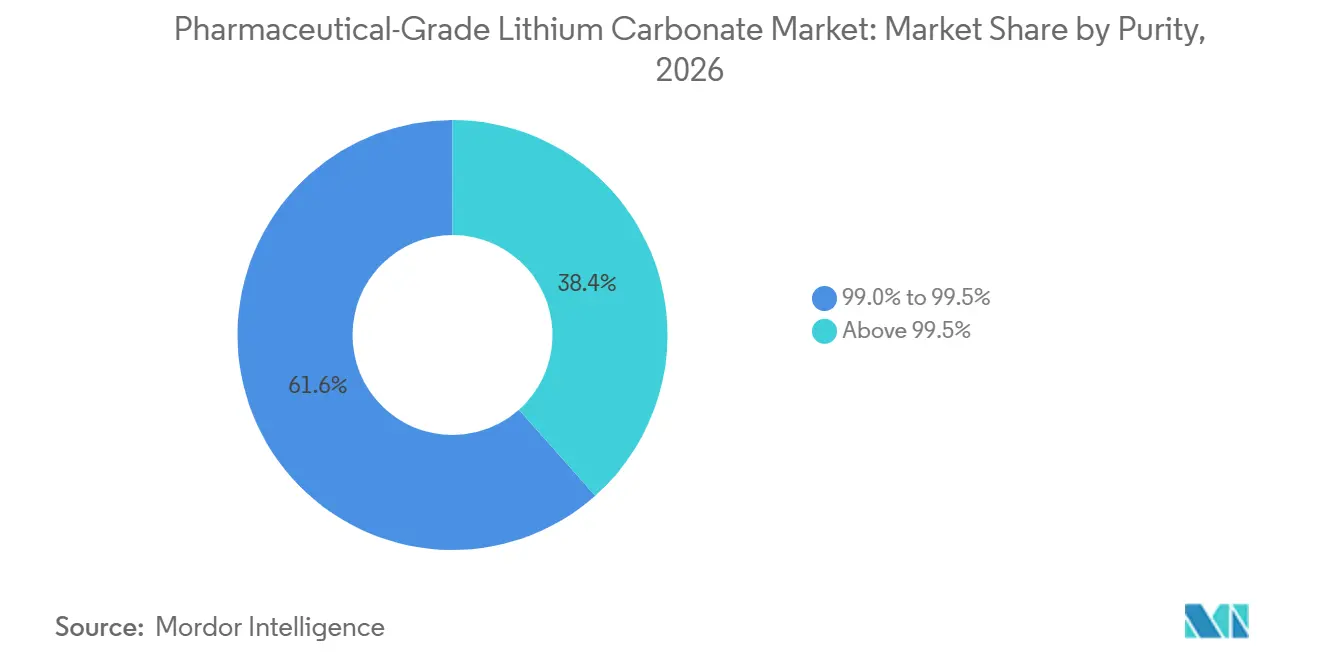
- By purity, the 99.0% to 99.5% segment held 61.56% of the pharmaceutical-grade lithium carbonate market share in 2026, while the above 99.5% segment is forecast to advance at a 6.12% CAGR through 2032.
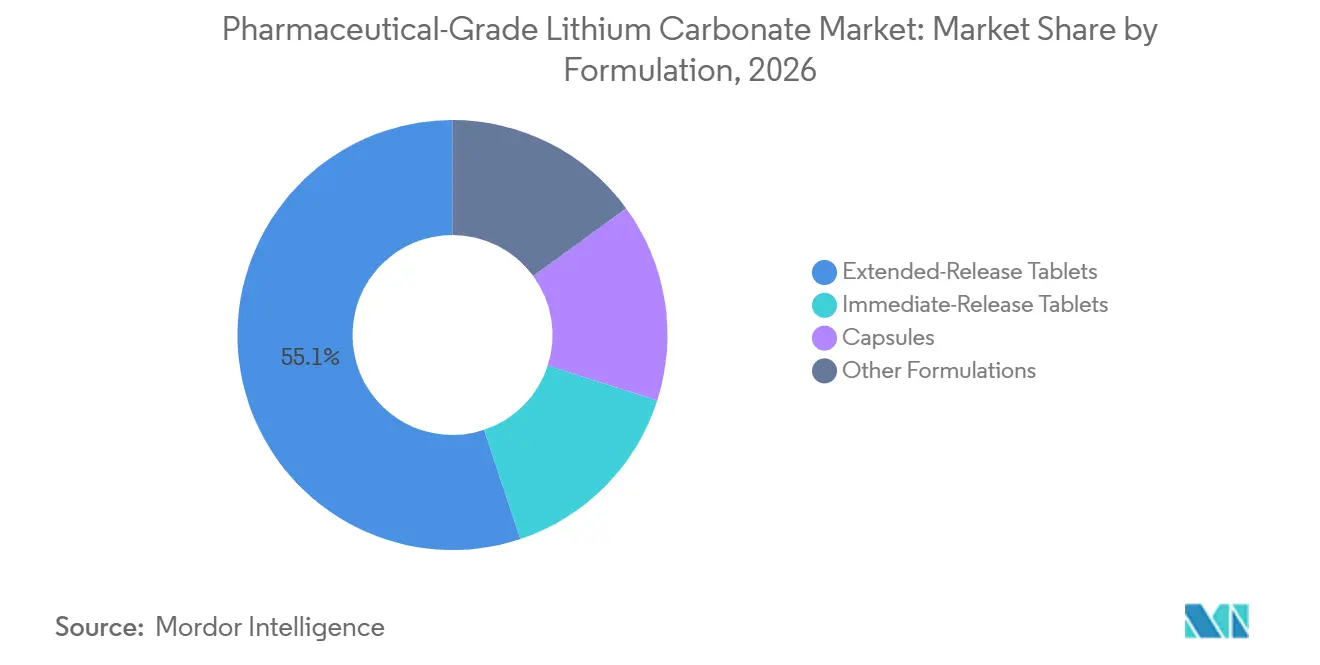
- By formulation, extended-release tablets held 55.12% of the pharmaceutical-grade lithium carbonate market share in 2026 and are forecast to advance at a 6.51% CAGR through 2032.
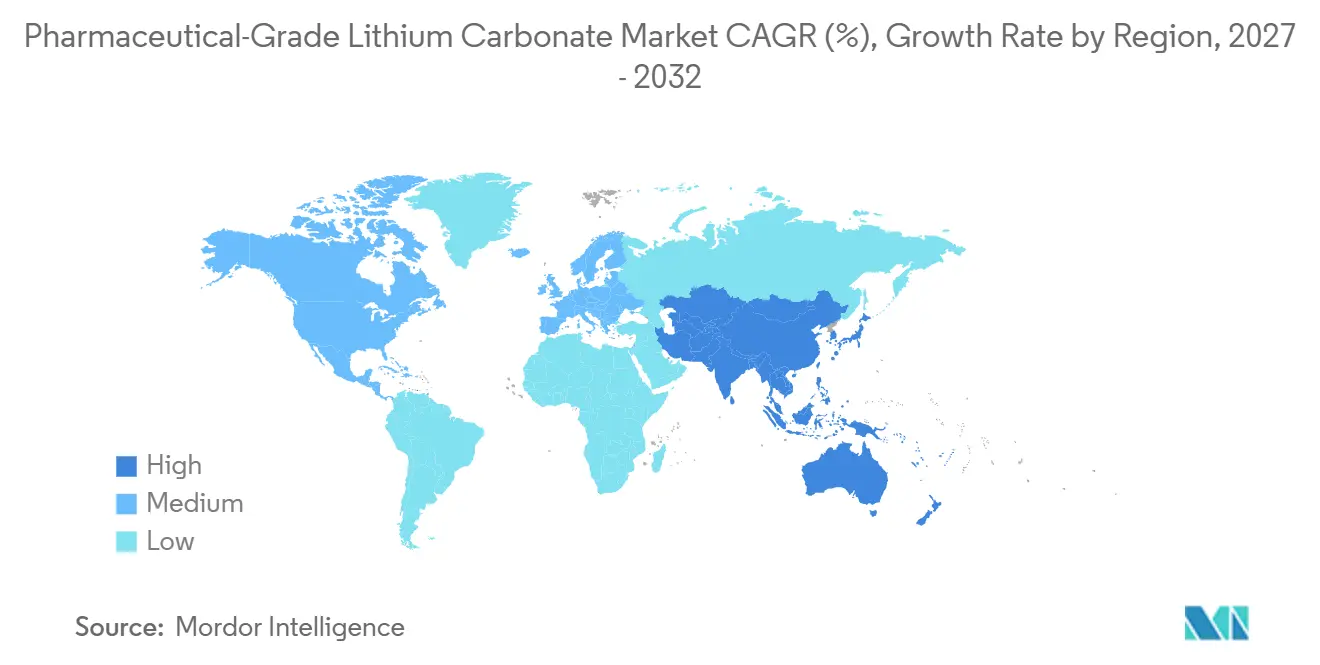
- By geography, North America held 42.68% of the pharmaceutical-grade lithium carbonate market share in 2026, while Asia-Pacific is forecast to advance at a 6.44% CAGR through 2032.
Note: Market numbers in this report are based on Mordor Intelligence's proprietary estimation framework, which combines nine months of actuals with Q4 projections for base year 2026.
Market Trends and Insights
Drivers Impact Analysis of Pharmaceutical-Grade Lithium Carbonate Market*
| Driver | (~) % Impact on CAGR Forecast | Geographic Relevance | Impact Timeline |
|---|---|---|---|
| Rising Diagnosis and Treatment of Bipolar Disorder | +2.1% | Global, with pronounced effect in North America and Western Europe | Short term (≤ 2 years) |
| Expansion of Mental-Health Access and Screening | +1.6% | APAC core, spillover to MEA and Latin America | Medium term (2-4 years) |
| Preference for Extended-Release Therapy and Adherence Support | +1.3% | Global, led by North America and Europe | Short term (≤ 2 years) |
| Pharmaceutical-Grade Supply Qualification and Multi-Source Procurement | +0.8% | North America & EU | Medium term (2-4 years) |
| Pharmaceutical Manufacturing Expansion in Asia-Pacific | +0.6% | APAC core (India, China) | Long term (≥ 4 years) |
| Source: Mordor Intelligence | |||
Rising Diagnosis and Treatment of Bipolar Disorder
Bipolar disorder creates a durable treatment need because it requires continuing management rather than a one-time course of therapy. The World Health Organization reported that 40 million people were living with bipolar disorder in 2019, and the condition was associated with major disability and elevated risk of suicide[1]. The pharmaceutical-grade lithium carbonate market gains from efforts to shorten the time between symptom onset and a formal diagnosis. Wider psychiatric training and digital screening can move treatment decisions into primary care settings where maintenance medicines are prescribed more consistently. Lithium use in initial treatment may face competition from newer medicines, but long-term maintenance cohorts continue to create recurring demand. This pattern supports demand for qualified active pharmaceutical ingredient supply, even where the mix of new prescriptions changes.
Expansion of Mental-Health Access and Screening
The World Health Organization launched the second phase of its Special Initiative for Mental Health in November 2025 to strengthen services for mental, neurological, and substance-use conditions through 2028. The program targets service expansion across priority countries in Asia, Africa, and Latin America. The pharmaceutical-grade lithium carbonate market can benefit as primary-care providers identify and treat patients who previously had limited access to formal services. The World Health Organization also reported that 71% of countries had integrated mental health into primary care against at least 3 of its 5 criteria. Immediate-release tablets and capsules can be more suitable in early-stage service expansion because they fit lower-complexity care settings. Peru's centralized procurement of lithium carbonate 300 mg in April 2025 shows how public purchasing can formalize demand in markets that had relied on less consistent distribution.
Preference for Extended-Release Therapy and Adherence Support
Extended-release lithium is gaining attention because stable blood concentrations can reduce some challenges associated with immediate-release dosing. A 2025 two-year study of 143 patients found that prolonged-release lithium was associated with fewer tremors and gastrointestinal adverse events than immediate-release lithium, with better treatment adherence. The pharmaceutical-grade lithium carbonate market, therefore, has a route to higher-value demand through formulations that support continued use. Better adherence can reduce discontinuation, relapse, and repeat hospitalization among patients who remain appropriate candidates for lithium therapy. More stable trough concentrations may also assist careful dose adjustment for patients who require closer clinical monitoring. Formulation developers need consistent active pharmaceutical ingredient quality because release profiles depend on reliable material attributes across production batches.
Pharmaceutical-Grade Supply Qualification and Multi-Source Procurement
Drug manufacturers must use controlled processes when they qualify an active pharmaceutical ingredient supplier. The United States’ Current Good Manufacturing Practice (GMP) requirements cover the manufacture, processing, packaging, and holding of drug products under 21 Code of Federal Regulations (CFR) Parts 210 and 211[2]. The pharmaceutical-grade lithium carbonate market benefits when finished-dose manufacturers qualify more than one supplier after earlier supply disruptions exposed the limits of single-source purchasing. Qualification can require audits, analytical method validation, stability evidence, and product testing before a source can be used at scale. These steps make supplier relationships more durable and broaden demand across qualified producers. Albemarle Corporation reported that its Specialties business serves life-science customers within a global customer base, showing the relevance of established quality systems for specialty lithium supply.
Restraints Impact Analysis of Pharmaceutical-Grade Lithium Carbonate Market*
| Restraint | (~) % Impact on CAGR Forecast | Geographic Relevance | Impact Timeline |
|---|---|---|---|
| High-Purity Lithium Feedstock Volatility and Supply Concentration | -1.2% | Global, most acute for producers without integrated raw-material supply | Medium term (2-4 years) |
| Narrow Therapeutic Window and Monitoring Burden | -0.9% | Global; most constraining in LMIC settings with limited laboratory capacity | Long term (≥ 4 years) |
| Renal, Thyroid, Pregnancy, and Drug-Interaction Safety Constraints | -0.5% | Global, with particular impact on female patient cohorts and elderly populations | Long term (≥ 4 years) |
| Source: Mordor Intelligence | |||
High-Purity Lithium Feedstock Volatility and Supply Concentration
Pharmaceutical-grade lithium carbonate requires separate manufacturing controls from battery-grade and industrial-grade material. Each batch must meet documented pharmacopeial assay and impurity requirements before it can enter the drug supply chain. The pharmaceutical-grade lithium carbonate market is therefore not able to change feedstock or supplier sources as quickly as a commodity supply chain. A manufacturer may need regulatory assessments and supporting quality data before using a new input source. Lithium extraction remains concentrated in a limited number of producing regions, which can expose nonintegrated producers to input uncertainty. Long-term supply agreements can limit the speed at which higher feedstock costs are passed to medicine customers.
Narrow Therapeutic Window and Monitoring Burden
Lithium treatment requires blood testing because the effective dose range is narrow and excessive concentrations can be harmful. The pharmaceutical-grade lithium carbonate market faces slower uptake where laboratories and follow-up services are limited. A 2025 feasibility study assessed point-of-care lithium testing as a way to improve adherence to monitoring guidance. Such work shows that monitoring remains a practical barrier, especially in lower-resource healthcare settings. Community programs without on-site testing capacity may choose other medicines even when lithium is clinically appropriate. This constraint can limit demand growth in rural areas of South Asia and in parts of sub-Saharan Africa.
*Our forecasts treat driver/restraint impacts as directional, not additive. The impact forecasts reflect baseline growth, mix effects, and variable interactions.
Pharmaceutical-Grade Lithium Carbonate Market Segment Analysis
By Purity:
99.0% to 99.5% Leads, While Above 99.5% ExpandsThe 99.0% to 99.5% segment held a 61.56% share in 2026. This tier meets the baseline requirements of many established generic approvals and supports a large share of conventional lithium carbonate products. United States Pharmacopeia specifications require a minimum lithium carbonate assay of 99.0% on a dried basis, along with defined limits for relevant impurities. The tier offers a balance between compliant material quality and the added processing cost associated with very high purity routes. Albemarle Corporation maintains specialty materials operations that serve life-science applications, which illustrates the need for controlled production and lot documentation. For many generic manufacturers, this grade remains the practical choice for established formulations.
The above 99.5% segment is projected to advance at a 6.12% CAGR through 2032. This pharmaceutical-grade lithium carbonate market size for higher-purity material is supported by tighter impurity expectations and the need for reproducible dissolution performance in advanced formulations. Higher-specification material can help formulators maintain more consistent performance across batches when they produce extended-release products. It can also be required for development work in newer therapeutic programs where material quality requirements are more demanding. A 2025 randomized study assessed lithium augmentation against quetiapine augmentation in treatment-resistant depression, keeping attention on potential uses beyond conventional bipolar treatment. Current good manufacturing practice and International Council for Harmonisation Q7 expectations remain central to qualification for both purity tiers.
By Formulation:
Extended-Release Tablets Combine Current Scale with Faster GrowthExtended-release tablets held a 55.12% share in 2026. The same formulation is projected to advance at a 6.51% CAGR through 2032, making it the leading format in both current value and projected growth. Its position is linked to the need for steadier serum concentrations and better tolerability during long-term treatment. The 2025 comparative study found that prolonged-release lithium was associated with fewer tremors and gastrointestinal effects over 2 years. Payers and formulary committees can favor extended-release products when they see a path to stronger adherence and fewer treatment interruptions. Hikma Pharmaceuticals USA Inc. and Glenmark Pharmaceuticals Inc. have approved products in lithium carbonate extended-release strengths for the United States market.
Immediate-release tablets and capsules remain relevant for dose titration and for patients who need different administration options. Hikma Pharmaceuticals USA Inc. lists lithium carbonate tablets and capsules in several strengths through the United States drug labeling system. Capsules can support patients who have difficulty swallowing tablets, while other formulations include oral solutions for some pediatric uses. These products help the pharmaceutical-grade lithium carbonate market address clinical requirements that cannot be met by one dosage format. Producers are also working with controlled-release excipients, including hypromellose and sodium alginate matrices, to create consistent dissolution profiles. The need to satisfy dissolution testing and finished-product quality standards keeps active pharmaceutical ingredient consistency important across all formulation categories.

Geography Analysis
North America
North America held a 42.68% share in 2026. The region has established psychiatric care systems, a large pool of generic drug approvals, and mature pharmacy distribution channels. The United States Food and Drug Administration uses drug quality sampling and testing programs to monitor medicine quality, including products and active ingredients in the supply chain. These compliance factors make quality documentation and reliable supply important competitive requirements. The United States supports recurring demand through a broad maintenance-treatment patient base. Canada adds demand through domestic and imported medicines, including exceptional importation processes during shortages. Hikma Pharmaceuticals USA Inc. announced a USD 1 billion investment by 2030 in United States manufacturing and research facilities, supporting supply capacity for essential generic medicines. The pharmaceutical-grade lithium carbonate market in North America remains shaped by regulatory review, established generic portfolios, and the ability to sustain quality oversight.
Asia-Pacific
Asia-Pacific is projected to advance at a 6.44% CAGR through 2032. China and India support growth through pharmaceutical manufacturing, wider healthcare access, and demand from both domestic and export customers. Jiangsu Nhwa Pharmaceutical Co., Ltd. reported that lithium carbonate sustained-release tablets were active commercial products and noted international registration work in its 2025 annual report. Jiangsu Lianhuan Pharmaceutical Co., Ltd. reported CNY 1,280 million in revenue for the first half of 2025, which was a 14.12% increase from the prior year, with overseas business supporting its pharmaceutical activities. Japan and South Korea add demand for higher-specification lots because local pharmacopeial standards guide quality expectations. The region is developing a broader base of qualified manufacturing options, which can reduce dependence on a small group of supply sources. Regulatory compliance and international registration remain necessary before regional output can enter more tightly regulated export markets.
Europe, South America, and Middle East and Africa
Europe has established consumption in Germany, France, and the United Kingdom, where medicine quality oversight follows European Pharmacopeia requirements. Essential Pharma Limited maintains specialty medicine distribution in Europe, including lithium-related products for patients who require continuing supply. The European Medicines Agency uses good manufacturing practice inspections to assess manufacturing compliance for medicines and active substances. This regulatory influence favors suppliers that can maintain audit-ready quality systems. South America is building more structured demand through government procurement, including Peru's 2025 lithium carbonate tender. The Middle East and Africa have lower current demand, but expanded screening and primary-care programs can support future treatment access. The World Health Organization's second mental-health initiative includes priority countries across Africa and Latin America, creating an institutional route for service development. These regions present longer-term opportunities where clinical monitoring infrastructure and medicine procurement systems improve together.
Competitive Landscape
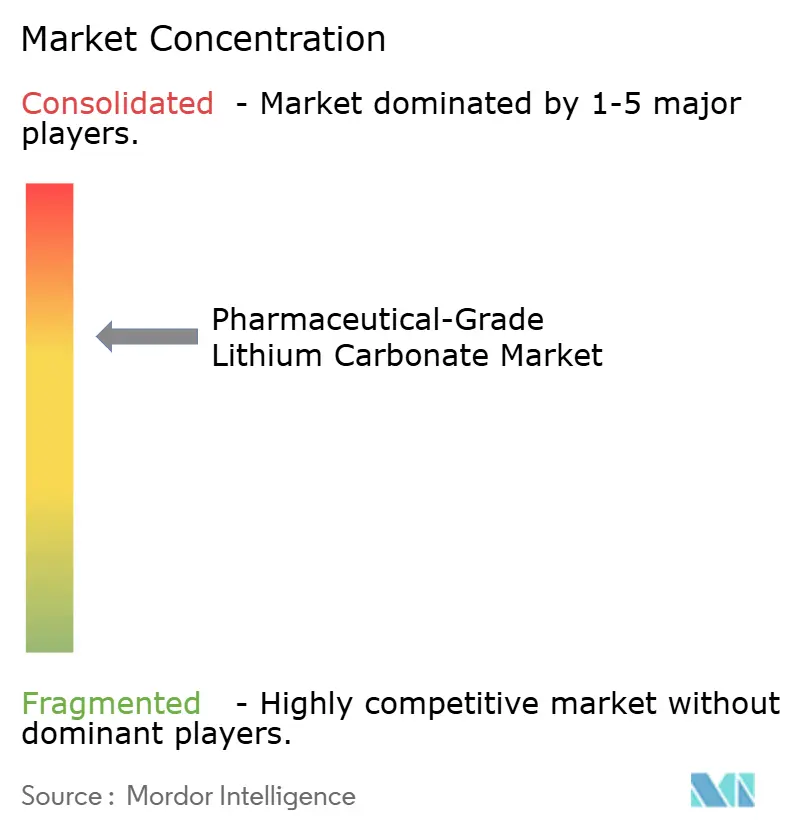
The pharmaceutical-grade lithium carbonate market is moderately concentrated, with the top five players including Albemarle Corporation, Rio Tinto, Jiangsu Lianhuan Pharmaceutical Co., Ltd., Jiangsu Nhwa Pharmaceutical Co., Ltd., and Blanver. Integrated lithium producers have advantages when they can manage extraction, purification, batch segregation, and quality documentation within one supply chain. Albemarle Corporation serves pharmaceutical and life-science customers through its Specialties business, alongside a broader lithium portfolio. Rio Tinto expanded its lithium position after acquiring Arcadium Lithium PLC in 2025 and has continued to develop lithium projects in Argentina and Canada. These suppliers can support longer-term qualification relationships because they have greater control over upstream material and processing. Their scale does not remove the need for individual pharmaceutical qualification of material and facilities.
Finished-dose competition is more distributed across generic medicine companies that compete through approved dosage forms, supply continuity, and compliance performance. Hikma Pharmaceuticals USA Inc., Glenmark Pharmaceuticals Inc., ANI Pharmaceuticals, Inc., and Viatris Inc. are relevant to the formulation side of the pharmaceutical-grade lithium carbonate market. The Food and Drug Administration issued a warning letter to Glenmark Pharmaceuticals Limited's Pithampur facility in July 2025 after identifying significant current good manufacturing practice violations. This action shows why inspection results can affect commercial standing in the generic supply. Hikma's planned manufacturing investment is a second example of how companies are strengthening domestic production capacity. Product breadth across immediate-release, extended-release, capsule, and liquid formats can further separate suppliers in procurement decisions.
Opportunities remain for active pharmaceutical ingredient producers that can achieve pharmaceutical-grade qualification in India and other developing manufacturing hubs. Pediatric and liquid oral formats are another area where limited product availability may support new development. Research into lithium in treatment-resistant depression may also increase interest in very high-purity material if future clinical and regulatory work supports broader use. International Council for Harmonisation Q7 guidance, United States current good manufacturing practice requirements, and European Medicines Agency inspection expectations remain barriers for smaller firms. The pharmaceutical-grade lithium carbonate market is therefore fragmented in formulation supply but has meaningful entry barriers around validated quality systems and qualified upstream material.
Pharmaceutical-Grade Lithium Carbonate Industry Leaders
-
Albemarle Corporation
-
Rio Tinto
-
Jiangsu Lianhuan Pharmaceutical Co., Ltd.
-
Jiangsu Nhwa Pharmaceutical Co., Ltd.
-
Blanver
- *Disclaimer: Major Players sorted in no particular order
Pharmaceutical-Grade Lithium Carbonate Market Companies Covered in this Report
- Albemarle Corporation
- American Elements
- ANI Pharmaceuticals, Inc.
- AXIOM CHEMICALS PVT. LTD
- Blanver
- Essential Pharma Limited
- Glenmark Pharmaceuticals Inc.
- Hikma Pharmaceuticals USA Inc.
- Hubei Rison Chemical Co., Ltd.
- Jiangsu Lianhuan Pharmaceutical Co., Ltd.
- Jiangsu Nhwa Pharmaceutical Co., Ltd.
- Mylan Inc.
- Panchsheel Organics Ltd
- Rio Tinto
- Zhenjiang Poworks Co., Ltd.
Recent Industry Developments in Pharmaceutical-Grade Lithium Carbonate Market
- October 2026: Rio Tinto inaugurated the Sal de Vida lithium facility and the Fénix 1B expansion in Argentina, with the projects expected to add a combined 25,000 metric tonnes of annual lithium carbonate equivalent production. The developments support the broader lithium carbonate supply chain by expanding production capacity
- September 2026: E3 Lithium signed a non-binding memorandum of understanding with India-based Epsilon CAM to explore supplying up to 5,000 metric tonnes of lithium carbonate annually over five years from its proposed Clearwater project in Alberta, Canada. The potential agreement supports the pharmaceutical-grade lithium carbonate market by highlighting the development of international lithium carbonate supply partnerships and the expansion of supply-chain opportunities.
Global Pharmaceutical-Grade Lithium Carbonate Market Report Scope
Pharmaceutical-grade lithium carbonate is a high-purity lithium compound manufactured to meet quality requirements for pharmaceutical use. It is used as an active pharmaceutical ingredient in medicines prescribed for the management of certain mood disorders.
The Pharmaceutical-Grade Lithium Carbonate Market is segmented by purity, formulation, and geography. By purity, the market is segmented into 99.0% to 99.5% and above 99.5%. By formulation, the market is segmented into extended-release tablets, immediate-release tablets, capsules, and other formulations. The report also covers the market size and forecasts for pharmaceutical-grade lithium carbonate across 15 countries. For each segment, the market sizing and forecasts have been done on the basis of value (USD).
Segmentation Overview
| 99.0% to 99.5% |
| Above 99.5% |
| Extended-Release Tablets |
| Immediate-Release Tablets |
| Capsules |
| Other Formulations |
| Asia-Pacific | China |
| India | |
| Japan | |
| South Korea | |
| ASEAN Countries | |
| Rest of Asia-Pacific | |
| North America | United States |
| Canada | |
| Mexico | |
| Europe | Germany |
| United Kingdom | |
| France | |
| Italy | |
| NORDIC Countries | |
| Rest of Europe | |
| South America | Brazil |
| Argentina | |
| Rest of South America | |
| Middle East and Africa | Saudi Arabia |
| South Africa | |
| Rest of Middle East and Africa |
| By Purity | 99.0% to 99.5% | |
| Above 99.5% | ||
| By Formulation | Extended-Release Tablets | |
| Immediate-Release Tablets | ||
| Capsules | ||
| Other Formulations | ||
| By Geography | Asia-Pacific | China |
| India | ||
| Japan | ||
| South Korea | ||
| ASEAN Countries | ||
| Rest of Asia-Pacific | ||
| North America | United States | |
| Canada | ||
| Mexico | ||
| Europe | Germany | |
| United Kingdom | ||
| France | ||
| Italy | ||
| NORDIC Countries | ||
| Rest of Europe | ||
| South America | Brazil | |
| Argentina | ||
| Rest of South America | ||
| Middle East and Africa | Saudi Arabia | |
| South Africa | ||
| Rest of Middle East and Africa | ||
Key Questions Answered in the Report
What is the size of the pharmaceutical-grade lithium carbonate market?
The pharmaceutical-grade lithium carbonate market size was valued at USD 155.73 million in 2026 and is estimated to grow from USD 163.97 million in 2027 to reach USD 214.91 million by 2032, at a CAGR of 5.56% during the forecast period (2027-2032).
What is driving demand for pharmaceutical-grade lithium carbonate?
Demand is supported by bipolar disorder treatment needs, broader mental-health screening, and the preference for extended-release lithium products that can improve adherence.
Which purity held the largest share in 2026?
The 99.0% to 99.5% purity segment held 61.56% of the market share in 2026 because it meets baseline pharmacopeial requirements for many established generic products.
Which formulation is expected to grow fastest through 2032?
Extended-release tablets are projected to advance at a 6.51% CAGR through 2032 because they support steadier serum concentrations and better tolerability.