
Pharma Digital Engagement Services Market Size and Share
Market Overview
| Study Period | 2020 - 2031 |
|---|---|
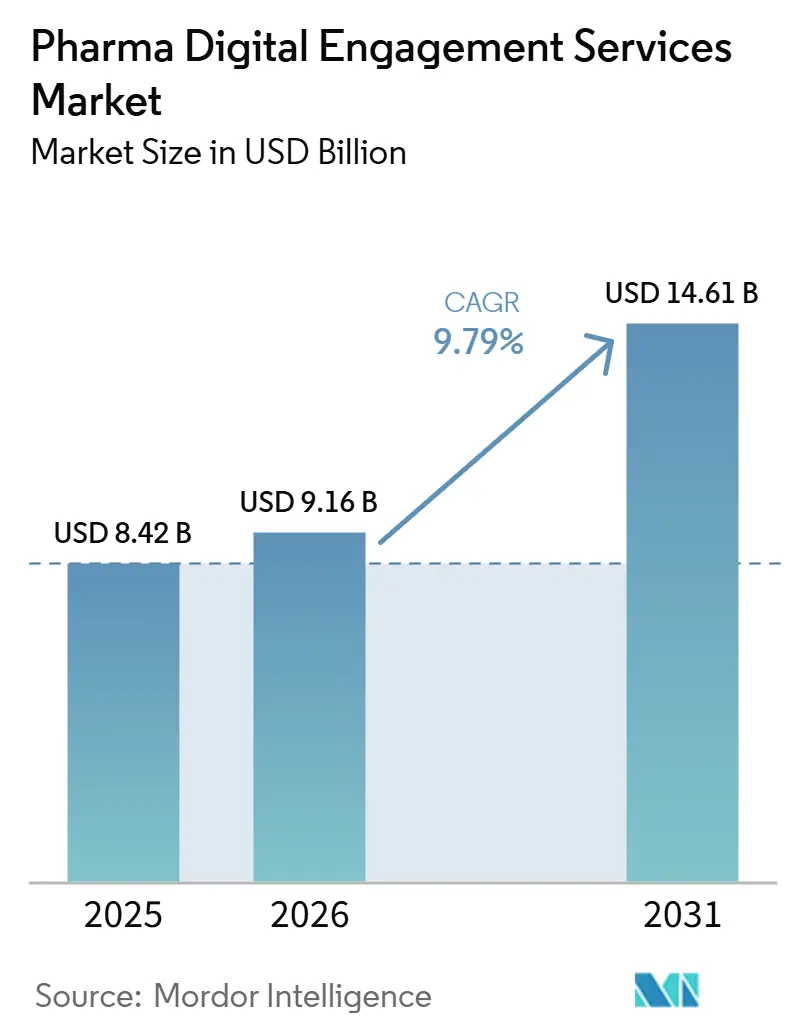
| Market Size (2026) | USD 9.16 Billion |
| Market Size (2031) | USD 14.61 Billion |
| Growth Rate (2026 - 2031) | 9.79 % |
| Fastest Growing Market | Asia-Pacific |
| Largest Market | North America |
| Market Concentration | Medium |
Major Players *Disclaimer: Major Players sorted in no particular order Image © Mordor Intelligence. Reuse requires attribution under CC BY 4.0. | |
Pharma Digital Engagement Services Market Analysis by Mordor Intelligence
The Pharma digital engagement services market size is projected to expand from USD 8.42 billion in 2025 to USD 9.16 billion in 2026, and to USD 14.61 billion by 2031, registering a CAGR of 9.79% between 2026 and 2031. The Pharma digital engagement services market is being reshaped by a lasting reduction in access to physicians and by the growing role of digital channels in commercial and medical communications. Digital interactions accounted for 51% of pharma-HCP contacts in 2025, shifting spending toward programs that deliver relevant information when an in-person discussion is unavailable. Generative AI is also becoming another route for clinical information, creating a need for accurate scientific content that can be found and understood in digital environments. Providers are therefore competing on their ability to integrate HCP data, content, channel delivery, and compliance controls into a single service model. The Pharma digital engagement services market also faces slower deployment, where privacy requirements and disconnected commercial systems make measurement and coordination more difficult.
Key Report Takeaways
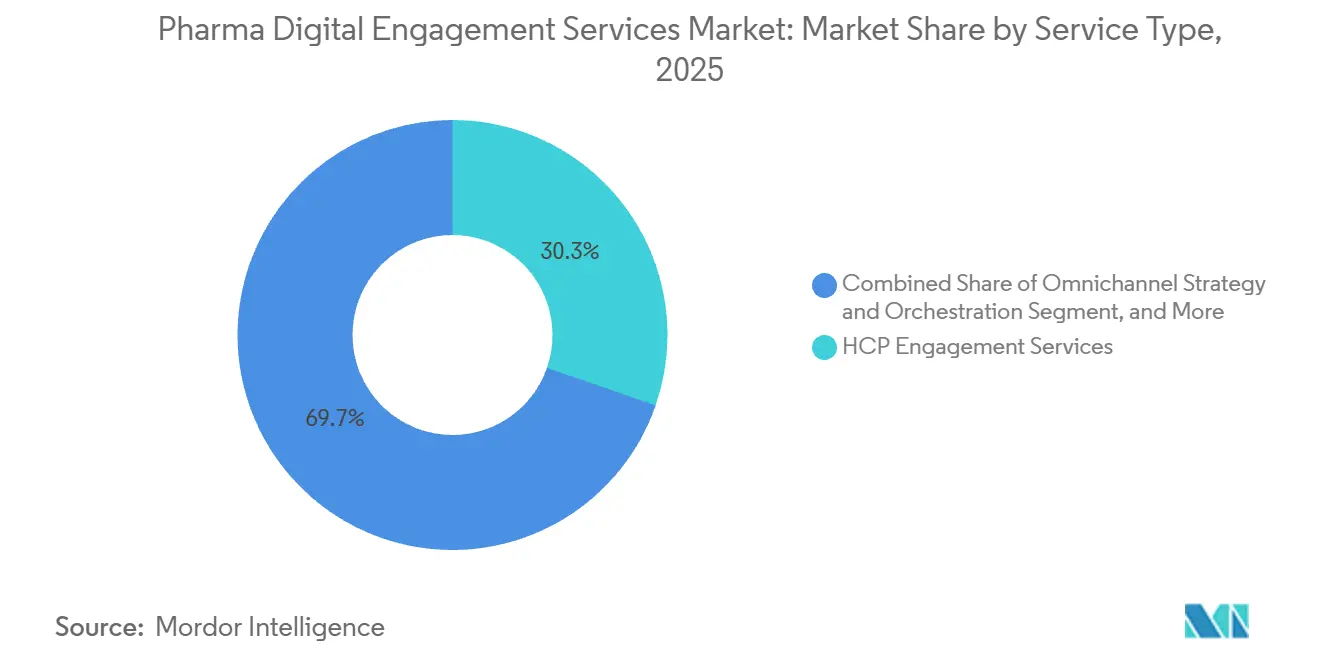
- By service type, HCP Engagement Services held a 30.31% revenue share in the Pharma digital engagement services market in 2025, while Omnichannel Strategy and Orchestration Services is projected to expand at a 10.11% CAGR through 2031.
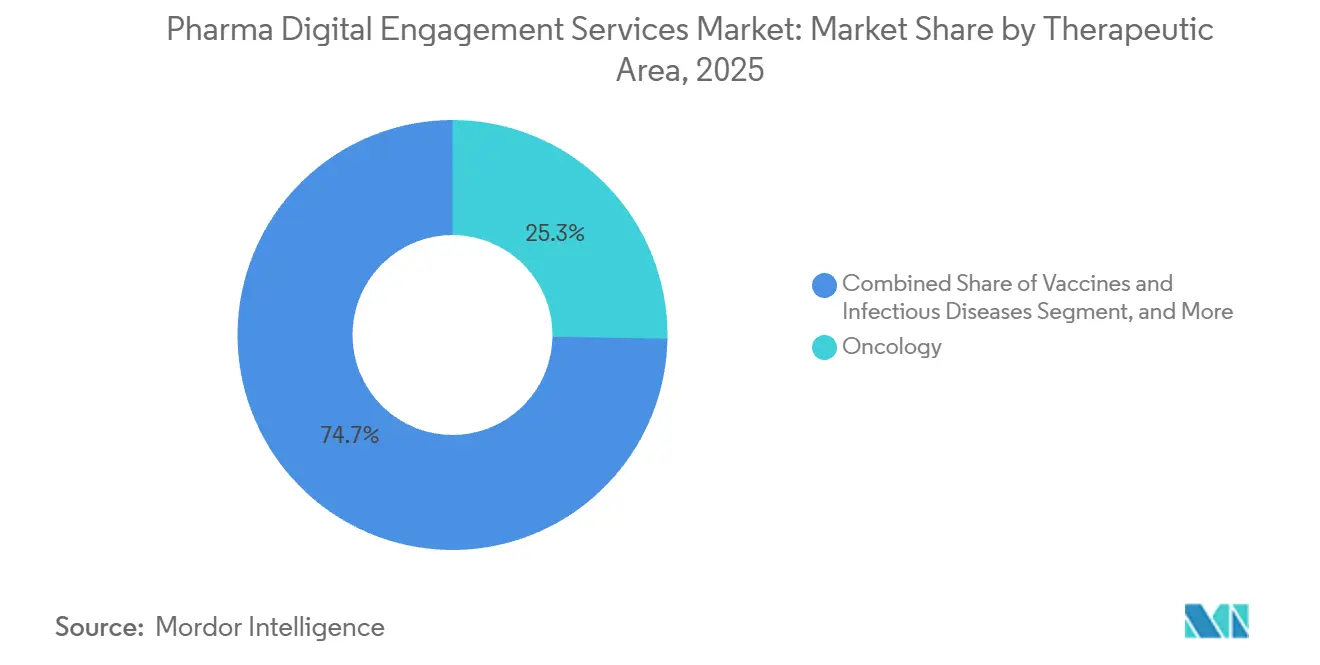
- By therapeutic area, Oncology accounted for 25.28% of revenue in 2025, while Vaccines and Infectious Diseases are projected to expand at a 10.23% CAGR through 2031.
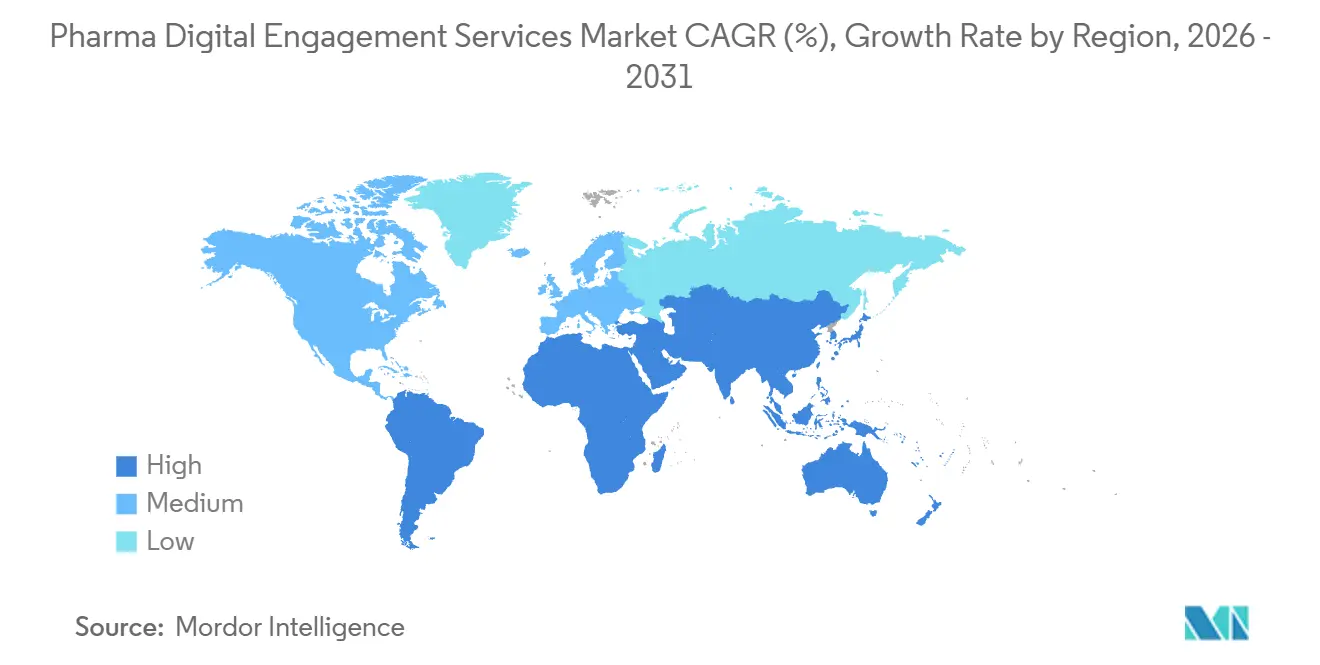
- By geography, North America accounted for 42.39% of revenue in the Pharma digital engagement services market in 2025, while Asia-Pacific is projected to expand at a 10.19% CAGR through 2031.
Note: Market size and forecast figures in this report are generated using Mordor Intelligence’s proprietary estimation framework, updated with the latest available data and insights as of January 2026.
Market Trends and Insights
Drivers Impact Analysis of Pharma Digital Engagement Services Market*
| Driver | (~) % Impact on CAGR Forecast | Geographic Relevance | Impact Timeline |
|---|---|---|---|
| Declining HCP Access Raises Demand for Digital-First Engagement | +2.8% | Global, strongest in North America and Europe | Short term (≤ 2 years) |
| Omnichannel Budget Reallocation Across HCP and Patient Journeys | +2.1% | North America and Europe, with expansion into Asia-Pacific | Medium term (2-4 years) |
| Specialty and Rare Disease Launches Need Precision Education at Scale | +1.5% | North America and Europe, with expansion into Asia-Pacific | Medium term (2-4 years) |
| Medical Affairs Digitalization Expands Scientific Engagement Outsourcing | +1.1% | Global, with early gains in the United States and Europe | Medium term (2-4 years) |
| Consent and Identity Infrastructure Unlocks Logged-In HCP Reach | +0.8% | North America and Europe | Short term (≤ 2 years) |
| AI-Native Modular Content Operations Improve Speed-to-Channel Economics | +0.7% | Global | Long term (≥ 4 years) |
| Source: Mordor Intelligence | |||
Declining HCP Access Raises Demand for Digital-First Engagement
The Pharma digital engagement services market is responding to a structural reduction in face-to-face access to prescribers. Veeva reported that U.S. HCP access fell from 60% to 45% between 2023 and 2024, requiring commercial teams to give digital contact a larger role.[1]Veeva Systems, “2026 Media Buying Trends for Biopharma Marketers,” Veeva Systems, veeva.com Digital interactions accounted for 51% of pharma-HCP engagements in 2025, but increased activity did not automatically lead to better experiences. Simplicity, trust, and relevance now differentiate providers as brands move beyond basic email and website programs. This supports demand for personalized portals, clear authentication, and clinically relevant content sequencing. The Pharma digital engagement services market benefits as brands replace isolated channel activity with programs designed around the HCP journey.
Omnichannel Budget Reallocation Across HCP and Patient Journeys
The Pharma digital engagement services market is gaining support as companies reconsider the balance between in-person, digital, and hybrid promotion. A CSL Vifor analysis across 8 European markets found that 81% of promotional spending went to in-person channels, while reallocation improved return on investment from 5.1 times to 5.8 times. The same analysis reported a 10% increase in incremental sales in Germany after the revised allocation. HCP and direct-to-consumer spending often remain in separate organizational groups, even when connected physician and patient education is needed. Orchestration services organize scientific information and patient support across channels while preserving the distinct requirements of each audience. AI-supported next-best-action tools are more useful when unified data connects approved content, field activity, and digital engagement signals.
Specialty and Rare Disease Launches Need Precision Education at Scale
Specialty and rare disease launches require education that is detailed, targeted, and available outside traditional representative visits. More than 95% of rare diseases lacked approved treatments, leaving many clinicians with limited familiarity with new conditions and therapies. The relevant audience can include pathologists, geneticists, specialists, and nursing professionals who see the condition infrequently.[2]Egetis Therapeutics, “Egetis Therapeutics Launches Educational Websites on MCT8 Deficiency for Physicians and Caregivers,” Egetis Therapeutics, egetis.com Egetis Therapeutics launched dedicated HCP and caregiver websites for MCT8 deficiency in North America in March 2026, demonstrating the value of condition-specific resources. Sanofi also deployed the AI-based AccelRare tool in India for 310 rare diseases, using a Class I-certified platform with reliability above 88%. The Pharma digital engagement services market gains from demand for scientific review, case-based content, virtual patient tools, and specialized user experiences.
Medical Affairs Digitalization Expands Scientific Engagement Outsourcing
Medical Affairs teams are moving from digital experimentation toward clearer performance expectations. Indegene found that the focus has shifted from whether to use digital channels to where digital activity works and where it breaks down.[3]Indegene, “Medical Affairs Digital Strategy and Maturity Report 2025,” Indegene, indegene.com This requires scientific content, medical information, analytics, and field medical capabilities that organizations may not be able to build internally at the same pace. IQVIA introduced Field Force Agent in September 2025, and early deployments reported 27% less call preparation time and a 17% increase in multichannel-equivalent calls. Digital scientific engagement still requires non-promotional credibility, approved response content, documentation, and safeguards for safety information. The Pharma digital engagement services market benefits when providers can support these workflows alongside the operating needs of field medical teams.[4]IQVIA, “Introducing IQVIA Field Force Agent,” IQVIA, iqvia.com
Restraints Impact Analysis of Pharma Digital Engagement Services Market*
| Restraint | (~) % Impact on CAGR Forecast | Geographic Relevance | Impact Timeline |
|---|---|---|---|
| Privacy and Data-Use Restrictions Limit Cross-Channel Measurement | -1.2% | Global, strongest in Europe and North America | Short term (≤ 2 years) |
| Fragmented Commercial, Medical, and Data Stacks Delay Orchestration | -0.9% | Global | Medium term (2-4 years) |
| HCP Authentication and Consent Friction Suppresses Known-User Scale | -0.7% | Europe and North America | Short term (≤ 2 years) |
| Content Approval Debt Constrains Personalization at Scale | -0.5% | Global | Medium term (2-4 years) |
| Source: Mordor Intelligence | |||
Privacy and Data-Use Restrictions Limit Cross-Channel Measurement
Privacy rules limit the ability to connect information across engagement touchpoints. GDPR Article 9 treats health information as a special category of data, requiring explicit consent and careful controls over processing in Europe. In the United States, scrutiny of tracking tools has increased concern about disclosure of protected health information in patient-facing settings. Brands may need tokenized data, clean-room environments, and additional legal review before they can assess engagement outcomes. Authentication and consent requests can also reduce HCP completion of a digital journey when the process is repeated across platforms. This can lengthen deployment timelines and make privacy-by-design capability a central selection factor.
Fragmented Commercial, Medical, and Data Stacks Delay Orchestration
Disconnected technology systems delay the move from multichannel activity to coordinated engagement. Pharma brand teams used 9 to 14 systems in 2025 across CRM, content approval, HCP targeting, media planning, analytics, and medical information. Separate systems can leave HCP records inconsistent and prevent commercial, Medical Affairs, and patient service teams from sharing relevant signals. The IQVIA and Veeva partnership announced in August 2025 addressed some access barriers through long-term clinical and commercial agreements. Most organizations still have legacy processes, multiple vendor relationships, and content approval debt that require alignment. The Pharma digital engagement services market, therefore, faces longer implementation cycles while clients consolidate technology and governance.
*Our forecasts treat driver/restraint impacts as directional, not additive. The impact forecasts reflect baseline growth, mix effects, and variable interactions.
Pharma Digital Engagement Services Market Segment Analysis
By Service Type:
HCP Engagement Retains Revenue Leadership While Orchestration Gains MomentumHCP Engagement Services held 30.31% market share in the Pharma digital engagement services market in 2025. The segment includes field-force support, digital follow-up, HCP portals, and messaging integrated into electronic health record workflows. OptimizeRx reported that an AI-enabled electronic health record omnichannel strategy for a chemotherapy brand achieved a 10.5% script lift and a 7.4:1 return on investment. Veeva offers HCP measurement that links media exposure with prescribing behavior at the National Provider Identifier level, increasing expectations for accountable programs. Patient education, support services, medical content, and scientific communications also grow as specialty launches require information in multiple approved formats.
Omnichannel Strategy and Orchestration Services is projected to grow at a 10.11% CAGR through 2031 within the Pharma digital engagement services market. It coordinates engagement across commercial, medical, and patient touchpoints rather than operating each channel in isolation. Veeva acquired Ostro in March 2026 for USD 100 million in cash and long-term equity retention grants, adding conversational AI capabilities for HCP and patient interactions. More than 125 companies were undertaking CRM transition projects in 2026, creating implementation and consulting work. The Pharma digital engagement services market depends on connecting channel data, approved content, and workflow rules without creating a burdensome operating model.



By Therapeutic Area:
Oncology Leads While Vaccine Programs ExpandOncology held 25.28% of the Pharma digital engagement services market share in 2025. The therapy area requires updated scientific communication because treatment decisions involve complex evidence and multiple clinical stakeholders. Oncologists, pathologists, payers, and patient advocates may need different information during care. OptimizeRx used AI-driven electronic health record alerts to identify eligible oncology patients at treatment-line change, supporting therapy consideration at a critical point of care. In the Pharma digital engagement services market, these conditions sustain demand for specialized content that addresses biomarker testing, treatment sequencing, and changing evidence.
Vaccines and Infectious Diseases are projected to expand at a 10.23% CAGR through 2031. GSK reported 8% vaccine revenue growth in the second quarter of 2026, with meningitis vaccines up 21% and Arexvy revenue up more than 100%. EnlivenHealth launched VaxReach in 2026 to identify people due for vaccination and automate outreach through pharmacy settings. Immunology, neurology, and cardiometabolic diseases remain substantial areas of focus due to large patient populations and active specialty pipelines. The Pharma digital engagement services industry is supported by disease education, adherence, and access communication working together.
Geography Analysis
North America Pharma Digital Engagement Services Market
North America held 42.39% of regional revenue in 2025. The Pharma digital engagement services market in North America combines large pharmaceutical commercial operations with established HCP data infrastructure, CRM use, electronic health record advertising, and healthcare media networks. U.S. business-to-business pharma digital advertising spending reached USD 2.3 billion in 2026, increasing 9.3% from 2025. Veeva reported that more than 125 customers were live on Vault CRM in March 2026, creating needs in configuration, data transfer, training, and change management. Canada and Mexico add regional demand as multinational affiliates extend the United States platform designs across North America.
Europe and South America Pharma Digital Engagement Services Market
Europe remains a major contributor to the Pharma digital engagement services market because Germany, the United Kingdom, France, Italy, and Spain have significant commercial engagement activity. Within the Pharma digital engagement services market in Europe, consent requirements shape digital measurement and audience management across the region. Italy showed the strongest preference for face-to-face engagement among EU5 markets, at 46% in November 2025. The United Kingdom showed greater digital movement, with email preference rising from 10% in 2023 to 14% in 2024. These differences favor configurable regional services, while Brazil and Argentina support earlier-stage program adoption in South America.
APAC and MEA Pharma Digital Engagement Services Market
Asia-Pacific is projected to expand at a 10.19% CAGR through 2031 in the Pharma digital engagement services market. The Pharma digital engagement services market in Asia-Pacific is supported by China, India, and Japan building HCP engagement infrastructure, and by physicians retaining a strong preference for digital interaction. More than 750 healthcare institutions in China had deployed DeepSeek-R1 by May 2025 to access clinical information within hospital infrastructure. India has expanded its verified HCP audience infrastructure to support targeted programmatic engagement. The Middle East and Africa are smaller developing areas, building verified HCP identity and compliance-aware content systems for later omnichannel deployment.

Competitive Landscape
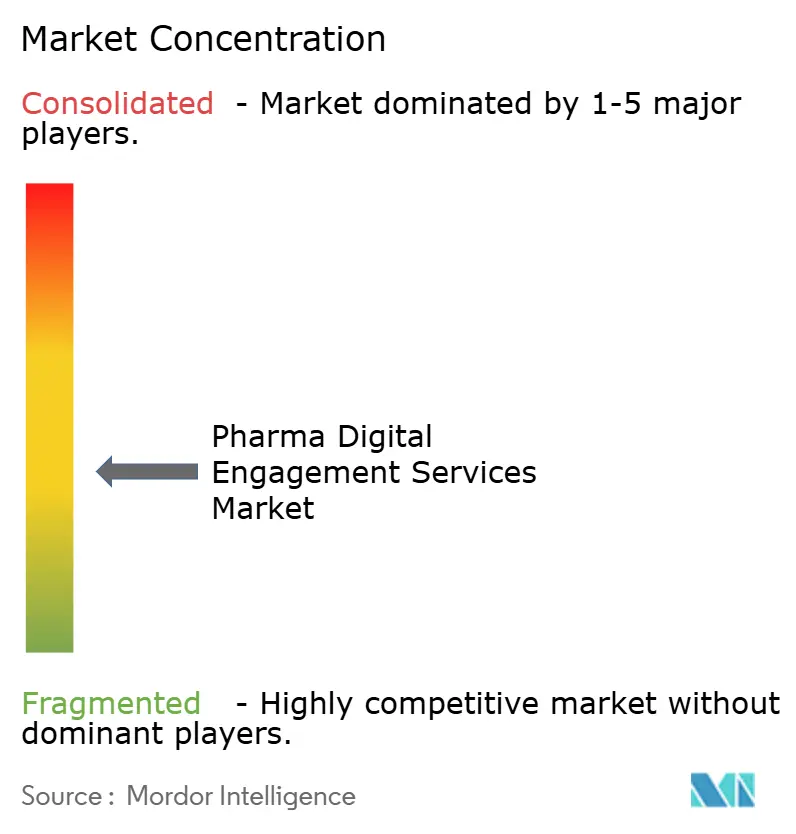
The Pharma digital engagement services market has moderate fragmented among integrated providers. IQVIA Holdings, Veeva Systems, Indegene, and EVERSANA combine HCP data, omnichannel strategy, content operations, and field coordination. OptimizeRx, Aktana, Axtria, and Real Chemistry compete for more defined mandates in point-of-care messaging, next-best-action, analytics, and healthcare communications. This gives pharmaceutical companies a choice between broad integrated service models and specialist capabilities. The Pharma digital engagement services market is becoming increasingly demanding for standalone vendors as clients seek closer integration of data, content, and delivery.
IQVIA and Veeva resolved legal disputes and announced long-term clinical and commercial partnerships in August 2025. The arrangements allow IQVIA data to work with Veeva Network, Nitro, and AI offerings, reducing friction in a multi-vendor data environment. Veeva acquired Ostro in March 2026, adding an AI-driven conversational platform for life sciences brand engagement. Teva Pharmaceuticals committed to Veeva Vault CRM globally in May 2026, including Agentic Call Report for compliant free-text field interactions. These actions combine interoperability, AI tools, and global deployment to strengthen leading positions.
Opportunities remain in consent-native engagement for Europe, AI-mediated scientific content, and coordinated HCP and direct-to-consumer engagement for specialty launches. Generative AI use for clinical information can place scientific questions outside traditional company channels. Healthcare-specific AI platforms and electronic health record-integrated media providers can challenge established suppliers. Leading companies are responding through acquisitions, partnerships, and product expansion, keeping competition active while preserving the advantage of scaled platforms.
Pharma Digital Engagement Services Industry Leaders
IQVIA Holdings Inc.
Accenture plc
Cognizant Technology Solutions Corporation
ZS Associates
Indegene Limited
- *Disclaimer: Major Players sorted in no particular order
Pharma Digital Engagement Services Market Companies Covered in this Report
- IQVIA Holdings Inc.
- Veeva Systems Inc.
- Indegene Limited
- EVERSANA, Inc.
- Syneos Health, Inc.
- Accenture plc
- Cognizant Technology Solutions Corporation
- Salesforce, Inc.
- Adobe Inc.
- Oracle Corporation
- Medidata Solutions, Inc.
- Aktana, Inc.
- Axtria, Inc.
- Appian Corporation
- Anthill Solutions, Inc.
- Inovalon Holdings, Inc.
- WebMD Health Corp.
- Inizio Group Holdings Limited
- Real Chemistry Holdings, Inc.
- OptimizeRx Corporation
- RightSpend Limited
- SpotSource, Inc.

Recent Industry Developments in Pharma Digital Engagement Services Market
- June 2026: OptimizeRx launched CopayCue, a trademark next-generation copay activation solution powered by real-time prescribing intent, designed to surface brand savings information for physicians within EHR clinical workflows at the exact moment of prescribing, addressing the USD 1 billion+ drug affordability challenge for life sciences brands.
- June 2026: OptimizeRx launched its patent-pending Natural Language Audience Builder, an AI-powered tool for embedding within demand-side platforms and agency media planning systems, extending the company's role as an HCP audience infrastructure partner for life sciences manufacturers, agencies, and DSPs.
- May 2026: Veeva Systems announced that Teva Pharmaceuticals committed to Veeva Vault CRM globally, incorporating the Agentic Call Report feature to generate commercial evidence from compliant free-text field interactions, reflecting broader enterprise adoption of agentic commercial platforms.
- May 2026: OptimizeRx launched programmatic access to its authenticated EHR advertising network, enabling media buyers to activate point-of-care campaigns within standard programmatic workflows and opening access to a USD 19 billion+ pharma digital ad market through DSP integration.


Global Pharma Digital Engagement Services Market Report Scope
The pharma digital engagement services market refers to professional services that help pharmaceutical and life sciences companies interact with healthcare professionals (HCPs) and patients through digital channels. This includes omnichannel strategy and consulting, HCP engagement, patient education and support, and medical content and scientific communication. Tailored to specific therapeutic areas such as oncology, immunology, and neurology, these services leverage digital platforms and data analytics to deliver personalized, compliant, and timely information. By moving beyond traditional in-person models, these services enable pharma companies to improve clinical outcomes, build stronger stakeholder relationships, and effectively navigate highly regulated environments.
The Pharma Digital Engagement Services Market Report is Segmented by Service Type (Omnichannel Strategy and Consulting Services, HCP Engagement Services, Patient Education and Support Services, and Medical Content and Scientific Communication Services), Therapeutic Area (Oncology, Immunology, Neurology, Cardiometabolic Diseases, Vaccines and Infectious Diseases, and Other Therapeutic Areas), and Geography (North America, South America, Europe, Asia-Pacific, Middle East, and Africa). The Market Forecasts are Provided in Terms of Value (USD).
| Omnichannel Strategy and Consulting Services |
| HCP Engagement Services |
| Patient Education and Support Services |
| Medical Content and Scientific Communication Services |
| Oncology |
| Immunology |
| Neurology |
| Cardiometabolic Diseases |
| Vaccines and Infectious Diseases |
| Other Therapeutic Areas |
| North America | United States |
| Canada | |
| Mexico | |
| South America | Brazil |
| Argentina | |
| Chile | |
| Rest of South America | |
| Europe | Germany |
| United Kingdom | |
| France | |
| Italy | |
| Spain | |
| Rest of Europe | |
| Asia-Pacific | China |
| Japan | |
| India | |
| South Korea | |
| Australia | |
| Rest of Asia-Pacific | |
| Middle East | United Arab Emirates |
| Saudi Arabia | |
| Qatar | |
| Rest of Middle East | |
| Africa | South Africa |
| Egypt | |
| Nigeria | |
| Rest of Africa |
| By Service Type | Omnichannel Strategy and Consulting Services | |
| HCP Engagement Services | ||
| Patient Education and Support Services | ||
| Medical Content and Scientific Communication Services | ||
| By Therapeutic Area | Oncology | |
| Immunology | ||
| Neurology | ||
| Cardiometabolic Diseases | ||
| Vaccines and Infectious Diseases | ||
| Other Therapeutic Areas | ||
| By Geography | North America | United States |
| Canada | ||
| Mexico | ||
| South America | Brazil | |
| Argentina | ||
| Chile | ||
| Rest of South America | ||
| Europe | Germany | |
| United Kingdom | ||
| France | ||
| Italy | ||
| Spain | ||
| Rest of Europe | ||
| Asia-Pacific | China | |
| Japan | ||
| India | ||
| South Korea | ||
| Australia | ||
| Rest of Asia-Pacific | ||
| Middle East | United Arab Emirates | |
| Saudi Arabia | ||
| Qatar | ||
| Rest of Middle East | ||
| Africa | South Africa | |
| Egypt | ||
| Nigeria | ||
| Rest of Africa | ||


Key Questions Answered in the Report
How large is the Pharma digital engagement services market?
The Pharma digital engagement services market size is USD 9.16 billion in 2026 and is projected to reach USD 14.61 billion by 2031 at a 9.79% CAGR.
What is driving demand for pharma digital engagement services?
Lower access to HCPs, stronger demand for coordinated digital communication, specialized therapy launches, and Medical Affairs digitalization are driving demand.
Which service type leads pharma digital engagement services?
HCP Engagement Services led with 30.31% revenue share in 2025, supported by physician outreach, field support, portals, and point-of-care messaging.
Which therapeutic area is expected to grow fastest?
Vaccines and Infectious Diseases is projected to grow at a 10.23% CAGR through 2031, supported by mRNA and adjuvant technology pipelines.
Which region is expected to grow fastest?
Asia-Pacific is projected to grow at a 10.19% CAGR through 2031 as China, India, and Japan expand digital HCP engagement infrastructure.
What challenges affect pharmaceutical digital engagement programs?
Privacy requirements, consent friction, disconnected data systems, and lengthy content approval processes can delay coordinated engagement programs.
Page last updated on:


 Your data is secure and never sold or shared.


