
Pet Noise Anxiety Market Size and Share
Market Overview
| Study Period | 2020 - 2031 |
|---|---|
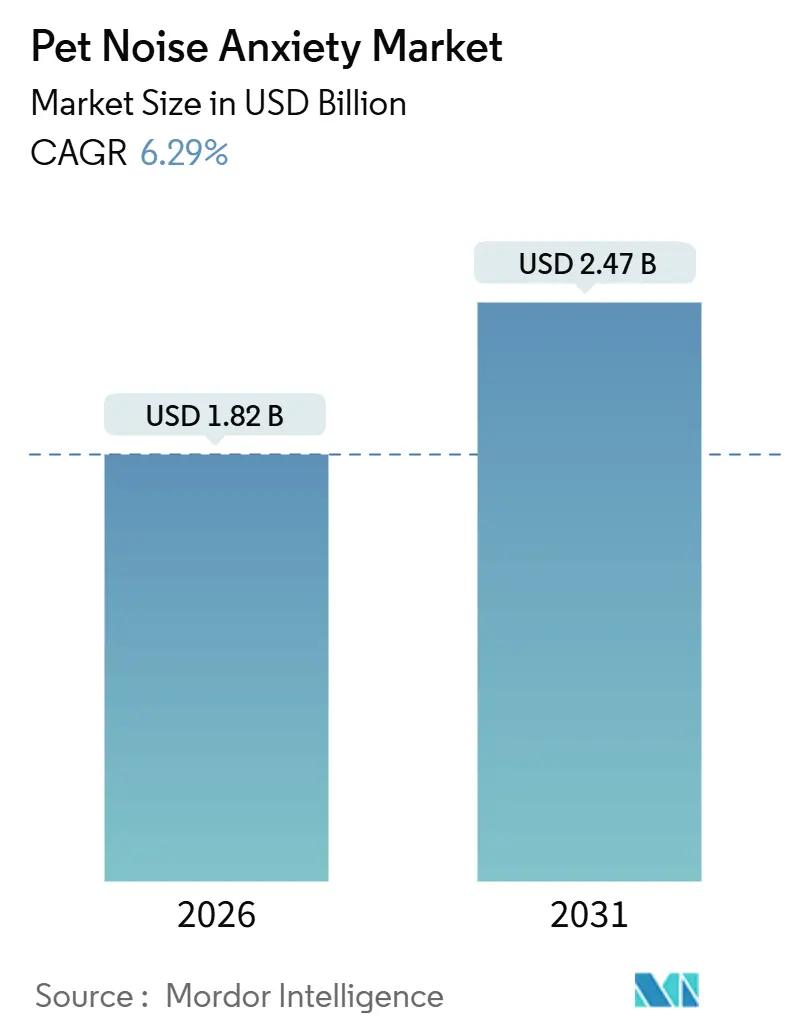
| Market Size (2026) | USD 1.82 Billion |
| Market Size (2031) | USD 2.47 Billion |
| Growth Rate (2026 - 2031) | 6.29 % |
| Fastest Growing Market | Asia Pacific |
| Largest Market | North America |
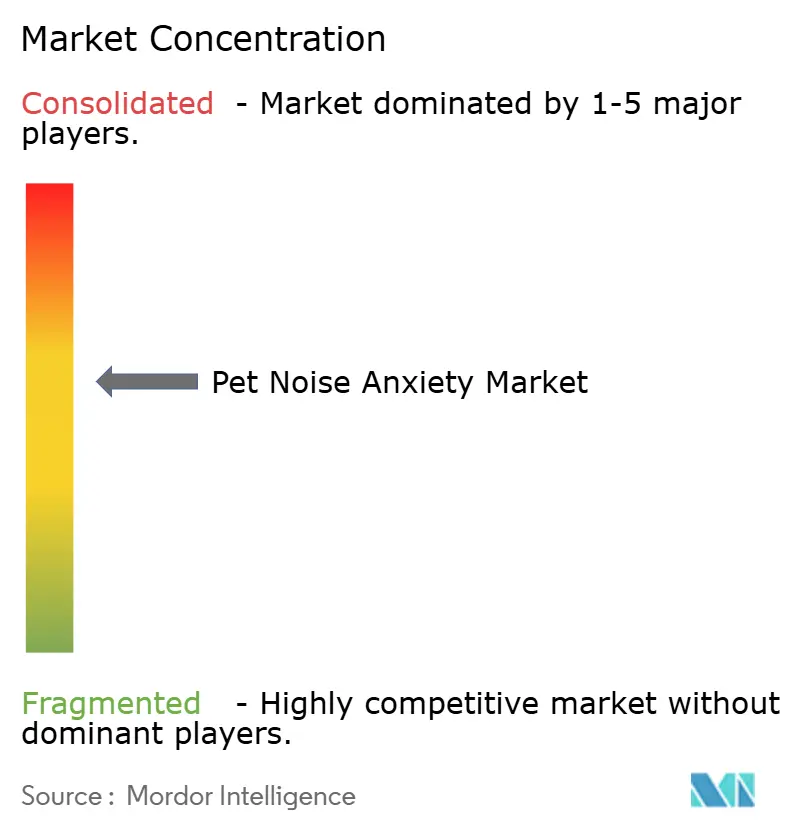
| Market Concentration | Medium |
Major Players *Disclaimer: Major Players sorted in no particular order Image © Mordor Intelligence. Reuse requires attribution under CC BY 4.0. | |
Pet Noise Anxiety Market Analysis by Mordor Intelligence
The Pet Noise Anxiety Market size is estimated at USD 1.82 billion in 2026, and is expected to reach USD 2.47 billion by 2031, at a CAGR of 6.29% during the forecast period (2026-2031).
Pet owners are transitioning from reactive remedies to structured preventive care strategies that integrate prescription medications, nutraceuticals, and AI-powered wearables. Factors such as increasing urban noise levels, broader insurance reimbursements, and employer-sponsored pet wellness programs are driving market expansion. Concurrently, biometric validation studies are addressing concerns about product efficacy. Established multinationals are leveraging FDA-approved formulations to protect their market share, while digital-native players are rapidly scaling by offering bundled solutions, including telehealth services, educational content, and direct-to-consumer delivery models. The adoption of new active ingredients and innovative sales models in the pet noise anxiety market will depend on the outcomes of ongoing regulatory discussions surrounding cannabinoids and the continued development of the e-commerce ecosystem.
Key Report Takeaways
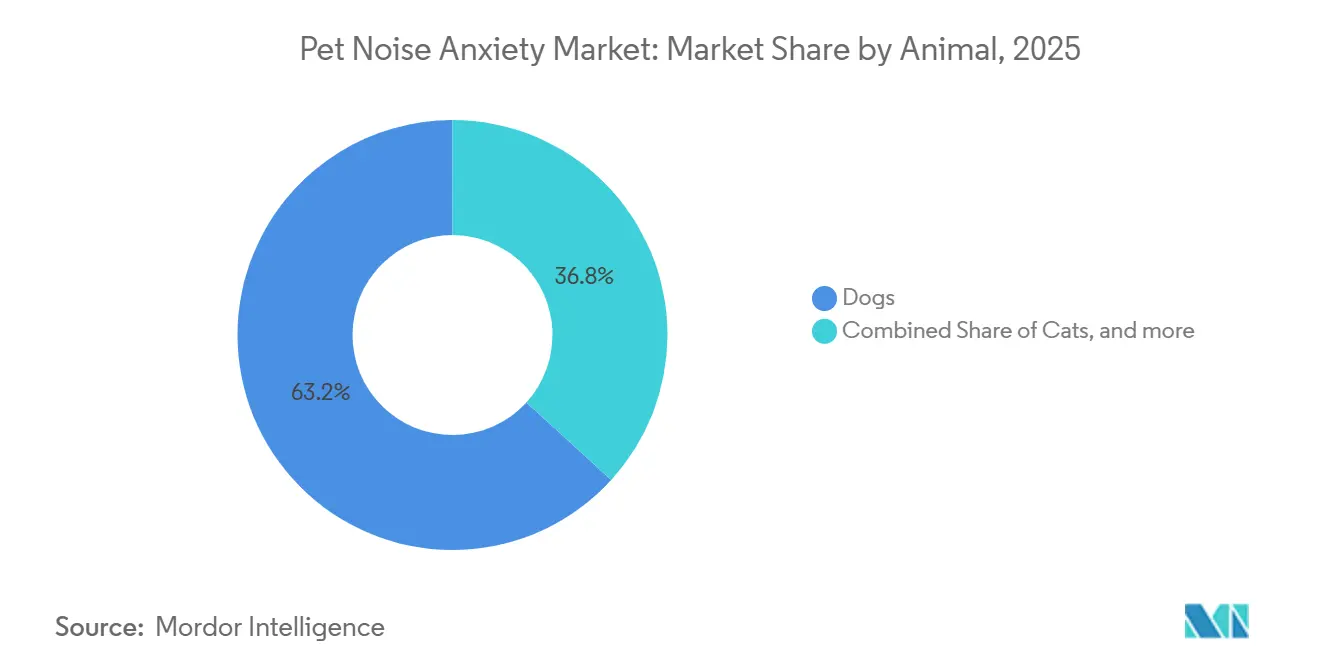
- By animal, dogs led with 63.23% of the pet noise anxiety market share in 2025, whereas cats are advancing at an 8.54% CAGR through 2031.
- By product type, calming supplements accounted for 28.54% share of the pet noise anxiety market size in 2025; sound-therapy devices and mobile applications are forecast to expand at an 8.77% CAGR through 2031.
- By sales channel, veterinary clinics held 48.65% of the revenue share in 2025, while direct-to-consumer brand websites are growing at a 9.32% CAGR through 2031.
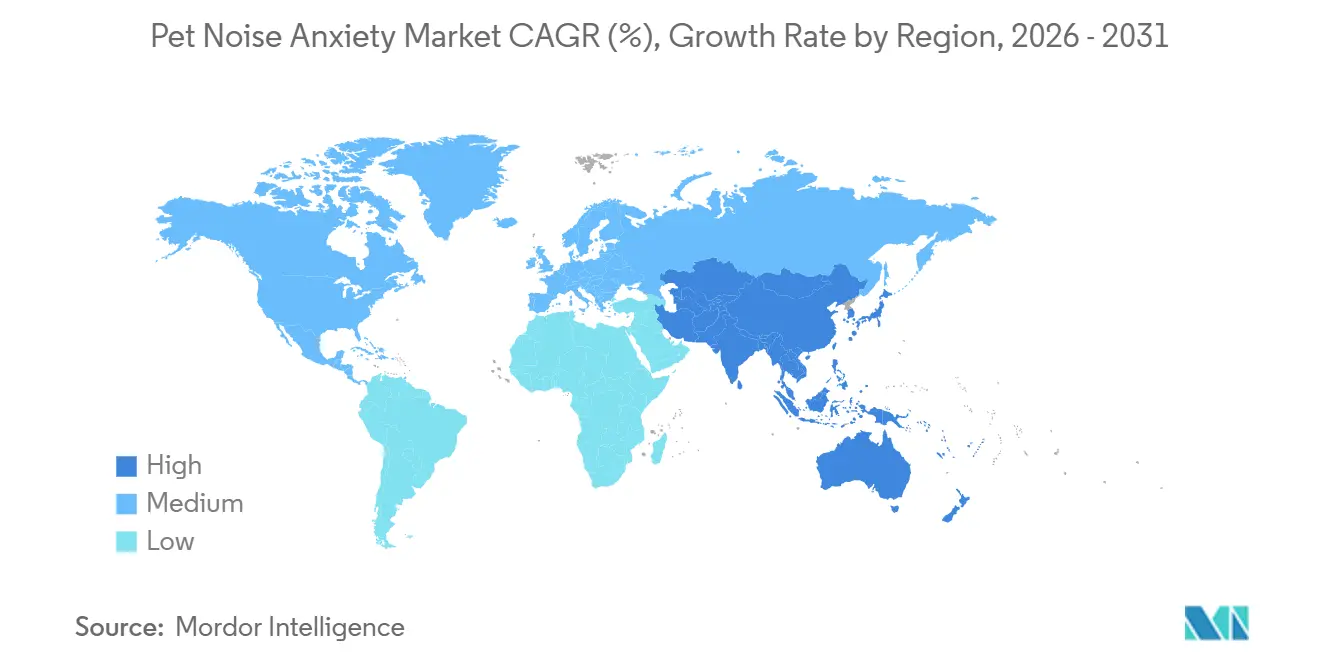
- By geography, North America accounted for 42.45% of the pet noise anxiety market in 2025, but Asia-Pacific is projected to grow at a 7.54% CAGR through 2031.
Note: Market size and forecast figures in this report are generated using Mordor Intelligence’s proprietary estimation framework, updated with the latest available data and insights as of January 2026.
Market Trends and Insights
Drivers Impact Analysis of Pet Noise Anxiety Market*
| Driver | (~) % Impact on CAGR Forecast | Geographic Relevance | Impact Timeline |
|---|---|---|---|
| Pet Humanization Accelerating Demand For Anxiety Management | +2.1% | Global, strongest in North America and Europe | Medium term (2-4 years) |
| Expansion Of E-Commerce And Omni-Channel Pet Retail | +1.6% | Global, most pronounced in North America, rising in APAC cities | Short term (≤2 years) |
| Urban Noise Pollution Escalating Companion Animal Stress | +1.3% | APAC megacities, North American and European metros | Long term (≥4 years) |
| Employer Adoption Of Pet-Inclusive Wellness Benefits | +1.2% | North America, Europe, early adoption in Australia | Medium term (2-4 years) |
| Emergence Of AI-Enabled Wearable Monitors Informing Treatment | +0.9% | North America, Europe, Japan, South Korea | Medium term (2-4 years) |
| Source: Mordor Intelligence | |||
Pet Humanization Accelerating Demand for Anxiety Management
Seventy-three percent of U.S. pet owners now regard their animals as family, and 67% are willing to pay premium prices for wellness products once viewed as luxuries. Calming-product adoption rose 168% among dog owners and 174% among cat owners between 2018 and 2024. Corporate benefit plans that reimburse up to USD 1,000 per year for behavioral care are widening access, shifting demand from reactive fixes toward preventive regimens. Prescription anxiolytics and probiotic supplements, once limited to trained working dogs, have become part of mainstream household routines. Manufacturers that frame offerings as long-term wellness solutions enjoy higher margins and improved lifetime customer value.
Expansion of E-Commerce and Omni-Channel Pet Retail
U.S. online penetration in pet care rose from 24% in 2019 to 39% in 2024, with Chewy posting net sales of USD 11.861 billion in 2024, of which 80.6% came from autoship subscriptions. Digital platforms speed the decision journey by pairing education with one-click fulfillment, compressing purchase cycles from weeks to minutes. Brick-and-mortar retailers counter by integrating click-and-collect and in-store consultation, but long-tail SKUs such as exotic-species supplements and refill pheromone cartridges remain most economical online. Suppliers lacking robust digital infrastructure risk ceding share to direct-to-consumer specialists that treat e-commerce as the core channel.
Urban Noise Pollution Escalating Companion Animal Stress
Chin et al.’s 2025 study showed elevated cortisol in dogs exposed to urban soundscapes, while Abbott quantified heightened stress biomarkers in cats inside noisy clinics[1]Chin et al., “Cortisol Responses of Urban Dogs to City Noise,” sciencedirect.com. Major APAC cities now house 120 million companion animals, yet enforcement of noise ordinances lags. Owners consequently invest in pressure wraps, sound-masking devices, and pheromone diffusers not as discretionary luxuries but as essential safeguards. Because urbanization is structural rather than cyclical, the pet noise anxiety market remains insulated from economic slowdowns that typically curb discretionary pet spending.
Emergence of AI-Enabled Wearable Monitors Informing Treatment
PetPace’s 2024 trial demonstrated a 25-point drop in stress scores when its AI collar integrated heart-rate variability with canine-specific music. Similar products from PetAimate and Tractive track posture, vocalization, and location to predict anxiety episodes before destructive behavior begins. These datasets enable precision dosing of supplements and prescription drugs, turning subjective owner observation into data-driven clinical protocols. Companies that own both sensor platforms and therapeutic interventions can lock in customers through closed-loop ecosystems of hardware, subscriptions, and consumables.
Restraints Impact Analysis of Pet Noise Anxiety Market*
| Restraint | (~) % Impact on CAGR Forecast | Geographic Relevance | Impact Timeline |
|---|---|---|---|
| Limited Clinical Consensus On Best-Practice Therapies | -0.8% | Global, especially emerging markets | Medium term (2-4 years) |
| High Treatment Costs And Minimal Insurance Coverage | -1.1% | Global, most acute in price-sensitive regions | Short term (≤2 years) |
| Variability In Individual Pet Response To Products | -0.7% | Global | Short term (≤2 years) |
| Regulatory Uncertainty On Cannabinoid And Novel Calming Ingredients | -0.9% | United States, European Union, Canada | Medium term (2-4 years) |
| Source: Mordor Intelligence | |||
Limited Clinical Consensus on Best-Practice Therapies
Human psychiatry benefits from strict protocols, whereas veterinary behavioral medicine still relies on practitioner preference. Guidelines from AAHA and AVSAB recommend multimodal care, yet they stop short of identifying first-line agents or defining dosage windows[2]American Veterinary Society of Animal Behavior, “Position Statement on Canine Anxiety,” avsab.org. This ambiguity breeds inconsistent outcomes, eroding owner trust and slowing penetration in emerging regions where only 1,000 certified trainers serve 52.58 million dogs. Suppliers that bankroll rigorous trials can accelerate adoption but also invite stricter scrutiny of competing products.
High Treatment Costs and Minimal Insurance Coverage
A single dose of Sileo retails at USD 37–43, nudging owners to reserve use for fireworks or thunderstorms. Insurance coverage varies widely—Fetch reimburses behavioral therapy up to USD 1,000 per year, while other carriers exclude anxiety products altogether. Price-sensitive owners gravitate toward over-the-counter treats and pheromone diffusers, but inconsistent dosing hampers efficacy. The bifurcation constrains cross-selling potential for brands that cannot straddle both premium and mass-market tiers.
*Our forecasts treat driver/restraint impacts as directional, not additive. The impact forecasts reflect baseline growth, mix effects, and variable interactions.
Pet Noise Anxiety Market Segment Analysis
By Animal:
Feline Acceleration Outpaces Canine ScaleDogs controlled 63.23% of the pet noise anxiety market share in 2025, reflecting entrenched supplement and pressure-wrap penetration. Still, growth is tapering as saturation nears in North America and Europe. Cats, conversely, are forecast to grow at an 8.54% CAGR to 2031, fueled by Zoetis’s FDA-approved Bonqat and rising feline ownership in APAC megacities. The pet noise anxiety market size for cats is projected to reach USD 837 million by 2031, underscoring first-mover advantages for manufacturers investing in feline-specific R&D. Small mammals and birds remain niche yet present untapped potential once clinical data emerge.
Innovation now centers on feline-focused probiotic strains such as Purina’s BL999 and telehealth bundles that collapse consultation and fulfillment into a single digital workflow[3]Nestlé Purina PetCare, “Calming Care BL999 Clinical Data,” nestle-purina.com. Strategically, players who educate veterinarians on feline anxiety while offering turnkey digital platforms can capture early-stage loyalty before copycats enter.



By Product Type:
Supplements Lead, Sound Therapy DisruptsCalming supplements made up 28.54% of 2025 revenue, but commoditization has chipped away at margins due to label-transparency mandates. The pet noise anxiety market size for sound-therapy devices and mobile apps is projected to climb from USD 242 million in 2026 to USD 382 million in 2031, a reflection of 8.77% CAGR. Subscription-based models such as Pet Acoustics+ at USD 9.99 per month turn one-off sales into recurring cash flows.
Pheromone diffusers hold steady through veterinary endorsement, yet pressure wraps struggle to migrate beyond storm phobia. Wearables that validate outcomes stand ready to cannibalize low-evidence modalities. Brands integrating sensor data with adaptive soundscapes are best placed to pivot as owner expectations grow more quantitative.

By Sales Channel:
Clinical Authority Versus Digital ConvenienceVeterinary clinics garnered 48.65% of 2025 global revenue by leveraging professional trust and prescription control. However, appointment scarcity and limited consult time are capping growth. Direct-to-consumer portals are expanding at 9.32% CAGR, as owners appreciate autoship convenience and immediate access to education. The pet noise anxiety market size captured through brand web-stores is projected to exceed USD 610 million by 2031.
Marketplace platforms aggregate refill SKUs and exotic-species items that brick-and-mortar outlets cannot stock profitably. Elanco’s Pet Protect Tranquilify, launched D2C in April 2025, illustrates how brands use speed-to-market advantages to iterate formulations based on real-time feedback. Clinics will retain high-value prescription sales, but share gains hinge on telehealth integration and digital scheduling.
Geography Analysis
North America Pet Noise Anxiety Market
North America supplied 42.45% of 2025 revenue, underpinned by 73% of owners who treat pets as family, robust insurance reimbursement, and advanced behavioral-medicine training. Fetch pays up to USD 1,000 annually for behavioral consults, incentivizing early intervention. Chewy’s autoship share of 80.6% underscores a shift toward subscription models suited to chronic conditions. Regulatory clarity on CBD remains elusive, yet FDA guidance on pregabalin has quickened prescription uptake.
Europe Pet Noise Anxiety Market
Europe mirrors these trends but contends with fragmented cannabinoid laws and slower e-commerce penetration in southern markets. Premiumization persists, although economic headwinds may temper discretionary spend in 2027–2028.
APAC Pet Noise Anxiety Market
Asia-Pacific is the fastest-growing region at 7.54% CAGR, propelled by China’s 120 million urban pets and a care infrastructure still catching up. Pet counts now exceed those of children under age 4, reinforcing long-term demand. UBS expects RMB 756.5 billion in total pet-care by 2030, with anxiety solutions capturing outsized gains as food commoditizes. Virbac’s deals in India and Japan signal a scramble for early distribution before domestic players solidify.
MEA and South America Pet Noise Anxiety Market
Middle East & Africa and South America are nascent but benefit from rising disposable income and urban pet adoption. Gulf Cooperation Council states are dismantling import barriers, while Brazil is upgrading veterinary curricula. Education and localized formulations remain prerequisites for scaling in these regions.

Competitive Landscape
The pet noise anxiety market is moderately concentrated. Zoetis leads with FDA-cleared Bonqat and Sileo, delivering 74.6% efficacy in trials and enjoying regulatory exclusivity. Ceva unified pheromone diffusers and pressure wraps through its ThunderWorks buyout, positioning itself for cross-species bundles. Virbac secured Asian access by purchasing Globion and Sasaeah, while Elanco targeted mass-market supplementation with Tranquilify.
Digital entrants like PetPace and Pet Acoustics differentiate via AI collars and adaptive soundscapes that monetize through subscriptions. Wearable-linked ecosystems generate data moats that legacy brands lack. Regulatory uncertainty over cannabinoids hampers innovation, but once settled, first movers with clinical dossiers will enjoy entry barriers.
Remaining white space lies in feline-centric solutions, exotic-species care, and telehealth bundles. Players controlling both diagnostics and therapeutics are poised to set new standards on treatment protocols and pricing.
Pet Noise Anxiety Industry Leaders
Ceva Santé Animale
ThunderWorks
Zoetis
Nestlé Purina
Vetoquinol
- *Disclaimer: Major Players sorted in no particular order
Pet Noise Anxiety Market Companies Covered in this Report
- Ark Naturals
- Boehringer Ingelheim
- Ceva Santé Animale
- Central Garden & Pet – Comfort Zone
- Elanco
- Feliway
- Nestlé Purina
- Nutramax Laboratories Veterinary Sciences
- Nutravet
- Orion Oyj
- Pet Acoustics
- PetMate – CALMZ System
- PetSafe (Radio Systems Corp)
- ThunderWorks
- Vetoquinol
- VetriScience
- Virbac
- West Paw
- Zesty Paws
- Zoetis

Recent Industry Developments in Pet Noise Anxiety Market
- February 2025: Elanco introduced Pet Protect Tranquilify, a 30-minute-onset supplement aimed at budget-sensitive owners
- December 2024: Dômes Pharma, the animal health company, launched two new products, Tessie and Bonqat, alongside Sileo as part of its growing pet anxiety range. The range now offers vets new options when managing situational anxiety in cats and dogs. Tessie is the first fast-acting dual-purpose solution for separation and noise-related problems for dogs.
- October 2024: Grey Wolf Animal Health Corp., a Canadian diversified animal health company, announced the Canadian commercial launch of SILEO (dexmedetomidine hydrochloride oromucosal gel) to veterinary clinics throughout Canada. SILEO builds on Grey Wolf's portfolio dedicated to behaviour and anxiety health in companion animals.


Global Pet Noise Anxiety Market Report Scope
As per scope of the report, pet noise anxiety is a behavioral condition where pets, especially dogs and cats, become distressed or fearful due to loud noises such as thunderstorms, fireworks, or gunshots. It manifests as symptoms such as barking, trembling, hiding, or destructive behavior. This condition often requires management or treatment to reduce stress and improve the pet's well-being..
The Pet Noise Anxiety Market is Segmented by Animal (Dogs, Cats, Small Mammals, and Birds & Exotics), Product Type (Calming Supplements, Pheromone Diffusers & Sprays, Pressure Wraps & Vests, Sound-Therapy Devices & Mobile Apps, Prescription Anxiolytics, OTC Calming Treats, and Wearable Monitoring Devices), Sales Channel (Veterinary Clinics, Pet-Specialty Stores, Mass Retail, E-Commerce Marketplaces, and D2C Brand Web-Stores), and Geography (North America, Europe, APAC, Middle East & Africa, and South America). The market report also covers the estimated market sizes and trends for 17 countries across major regions globally. The report offers the value (in USD million) for the above segments.
| Dogs |
| Cats |
| Small Mammals (Rabbits, Guinea-Pigs) |
| Birds & Exotics |
| Calming Supplements |
| Pheromone Diffusers & Sprays |
| Pressure Wraps & Vests |
| Sound-Therapy Devices & Mobile Apps |
| Prescription Anxiolytics |
| OTC Calming Treats |
| Wearable Monitoring Devices |
| Veterinary Clinics |
| Pet-Specialty Stores |
| Mass Retail |
| E-Commerce Marketplaces |
| D2C Brand Web-Stores |
| North America | United States |
| Canada | |
| Mexico | |
| Europe | Germany |
| United Kingdom | |
| France | |
| Italy | |
| Spain | |
| Rest of Europe | |
| Asia-Pacific | China |
| Japan | |
| India | |
| Australia | |
| South Korea | |
| Rest of Asia-Pacific | |
| Middle East & Africa | GCC |
| South Africa | |
| Rest of Middle East & Africa | |
| South America | Brazil |
| Argentina | |
| Rest of South America |
| By Animal | Dogs | |
| Cats | ||
| Small Mammals (Rabbits, Guinea-Pigs) | ||
| Birds & Exotics | ||
| By Product Type | Calming Supplements | |
| Pheromone Diffusers & Sprays | ||
| Pressure Wraps & Vests | ||
| Sound-Therapy Devices & Mobile Apps | ||
| Prescription Anxiolytics | ||
| OTC Calming Treats | ||
| Wearable Monitoring Devices | ||
| By Sales Channel | Veterinary Clinics | |
| Pet-Specialty Stores | ||
| Mass Retail | ||
| E-Commerce Marketplaces | ||
| D2C Brand Web-Stores | ||
| Geography | North America | United States |
| Canada | ||
| Mexico | ||
| Europe | Germany | |
| United Kingdom | ||
| France | ||
| Italy | ||
| Spain | ||
| Rest of Europe | ||
| Asia-Pacific | China | |
| Japan | ||
| India | ||
| Australia | ||
| South Korea | ||
| Rest of Asia-Pacific | ||
| Middle East & Africa | GCC | |
| South Africa | ||
| Rest of Middle East & Africa | ||
| South America | Brazil | |
| Argentina | ||
| Rest of South America | ||


Key Questions Answered in the Report
How big is the pet noise anxiety market today?
The pet noise anxiety market reached USD 1.82 billion in 2026 and is on track for USD 2.47 billion by 2031 at a 6.29% CAGR.
Which animal segment is growing fastest in noise anxiety solutions?
Cats are advancing at an 8.54% CAGR through 2031, propelled by FDA-approved Bonqat and increasing feline ownership in Asia-Pacific.
What product category is disrupting traditional calming supplements?
Sound-therapy devices linked to AI collars and mobile apps are expanding at an 8.77% CAGR and converting one-off sales into subscriptions.
How important is e-commerce to future growth?
Direct-to-consumer web-stores are rising at 9.32% CAGR as owners favor autoship subscriptions and instant access to education and fulfillment.
Which region represents the next wave of demand?
Asia-Pacific, particularly China, is projected to grow at 7.54% CAGR thanks to a 120 million urban pet population and infrastructure gaps.
What is hindering broader adoption of CBD-based pet anxiety products?
Regulatory uncertainty persists, as the FDA has yet to approve any animal CBD formulations and is still reviewing public feedback from docket FDA-2024-N-5976.
Page last updated on:


 Your data is secure and never sold or shared.


