
Performance Marketing Services Market Size and Share
Market Overview
| Study Period | 2020 - 2031 |
|---|---|
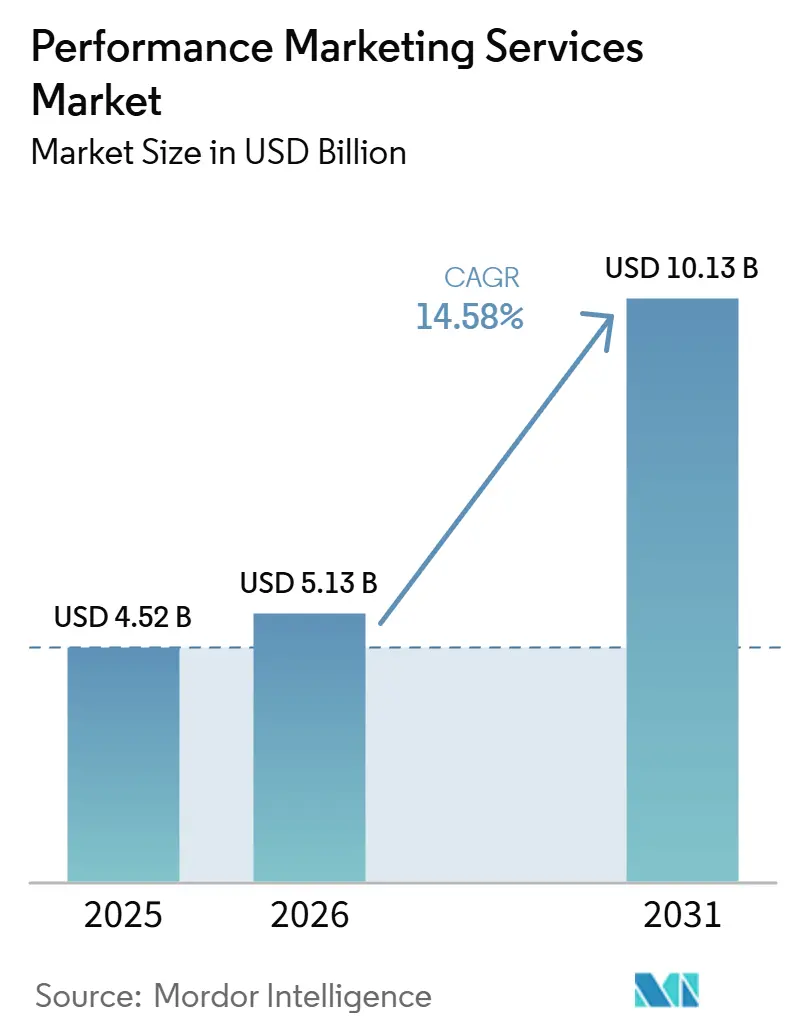
| Market Size (2026) | USD 5.13 Billion |
| Market Size (2031) | USD 10.13 Billion |
| Growth Rate (2026 - 2031) | 14.58 % |
| Fastest Growing Market | North America |
| Largest Market | Asia-Pacific |
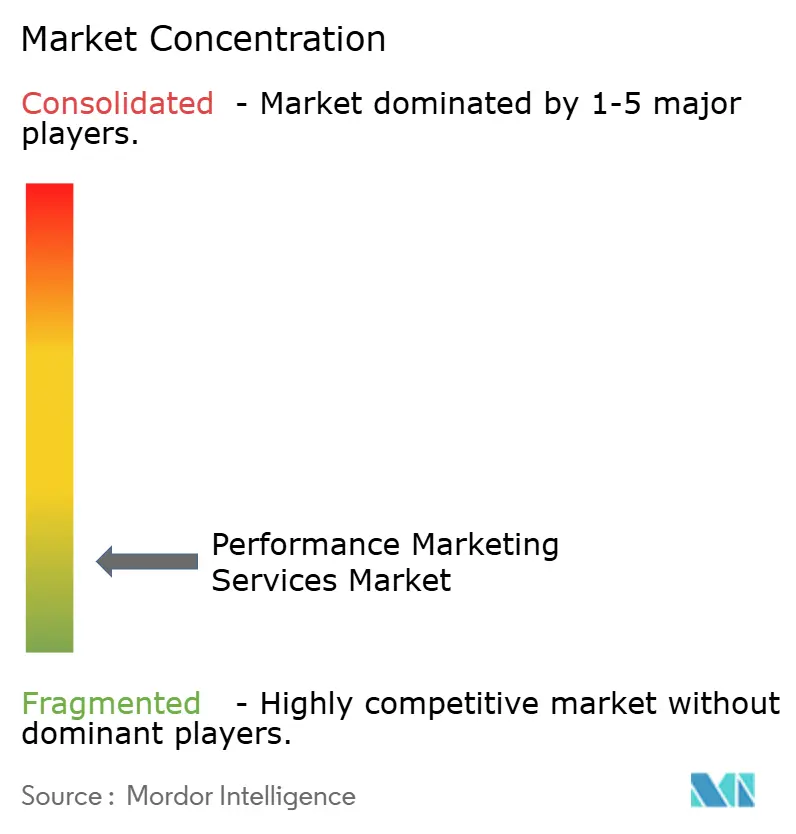
| Market Concentration | Low |
Major Players *Disclaimer: Major Players sorted in no particular order Image © Mordor Intelligence. Reuse requires attribution under CC BY 4.0. | |
Performance Marketing Services Market Analysis by Mordor Intelligence
The Performance marketing services market size is projected to expand from USD 4.52 billion in 2025 and USD 5.13 billion in 2026 to USD 10.13 billion by 2031, registering a CAGR of 14.58% between 2026 and 2031. Advertising budgets are moving toward channels where spend can be connected to inquiries, purchases, app installs, or other business results. That shift makes measurement, creative testing, and data collection more important parts of agency work. Retail media, social commerce, and mobile acquisition are widening the range of channels that agencies manage for clients. Larger agency groups are building data and identity capabilities through acquisitions, while specialized firms compete through channel expertise and faster use of automation. Privacy rules, higher auction costs, and weaker visibility across platforms are increasing the value of firms that can improve measurement and make spending decisions clear to finance teams.
Key Report Takeaways
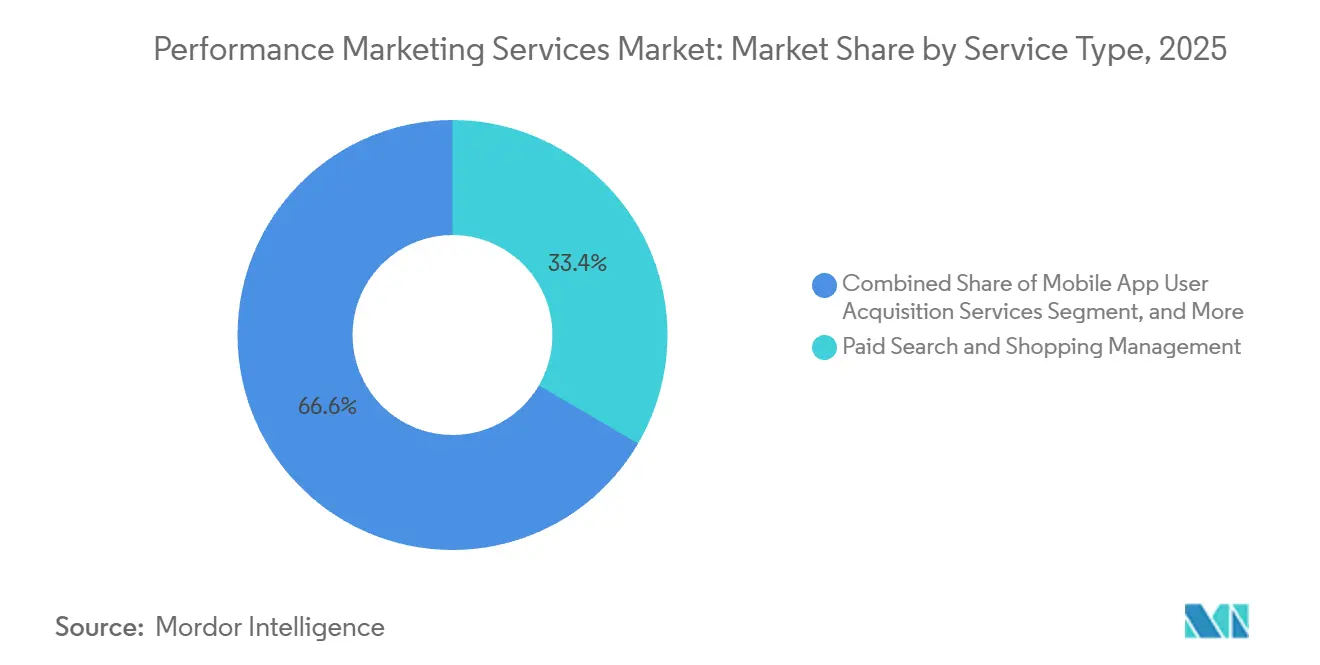
- By service type, Paid Search and Shopping Management accounted for 33.42% of the Performance marketing services market in 2025, while Mobile App User Acquisition Services is projected to expand at a 17.12% CAGR through 2031.
- By enterprise size, Large Enterprises held 62.18% in the Performance marketing services market 2025, while Small and Medium Enterprises are projected to record the highest CAGR of 16.84% through 2031.
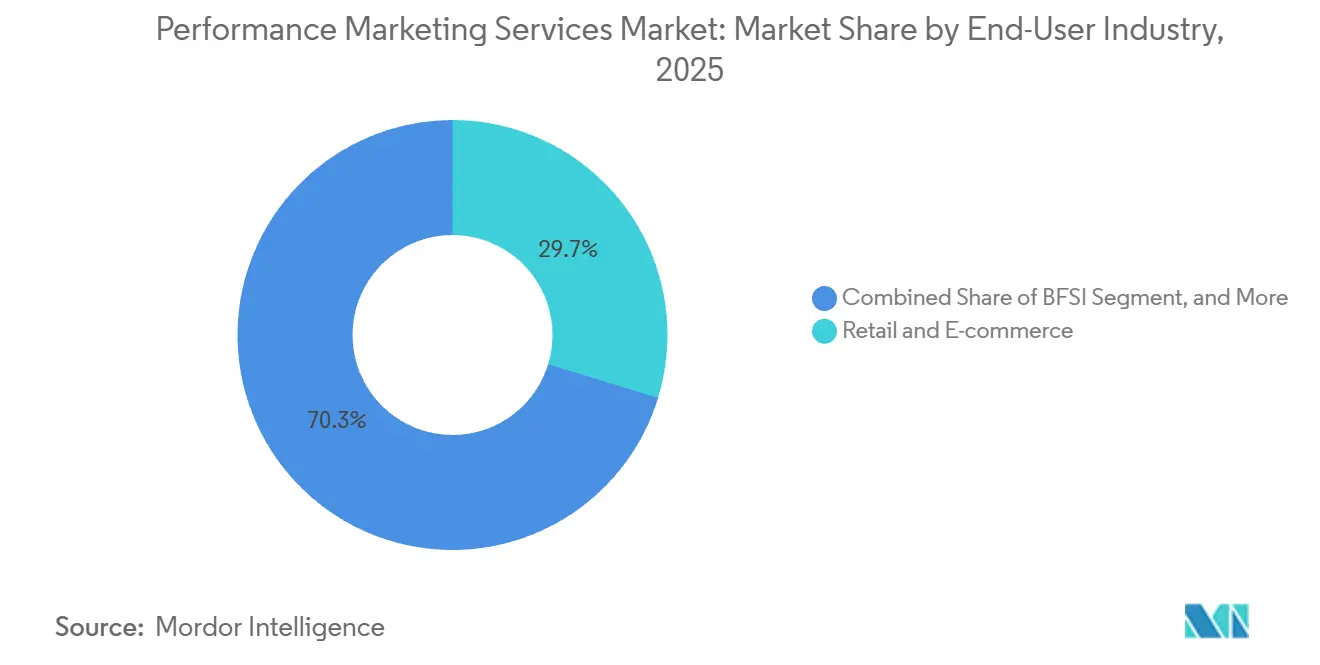
- By end-user industry, Retail and E-commerce accounted for 29.72% in 2025, while BFSI is projected to grow at a 16.32% CAGR through 2031.
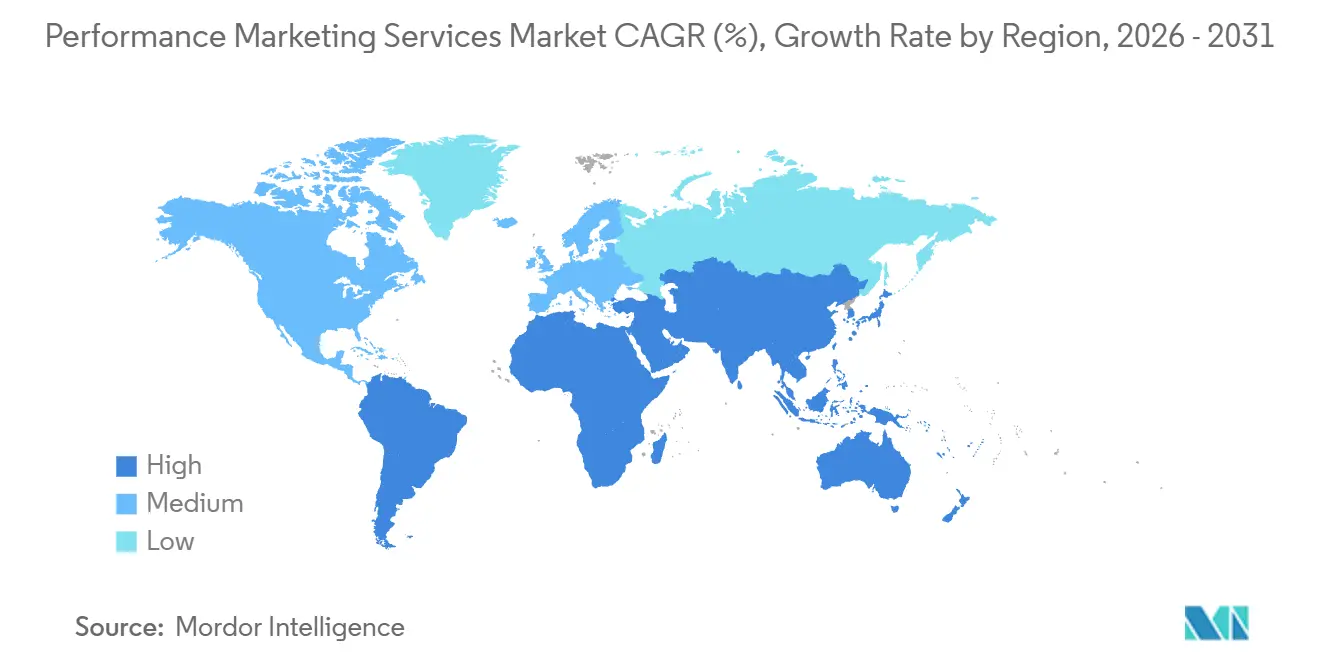
- By geography, North America held 40.12% of the Performance marketing services market in 2025, while Asia-Pacific is projected to grow at a 15.04% CAGR through 2031.
Note: Market size and forecast figures in this report are generated using Mordor Intelligence’s proprietary estimation framework, updated with the latest available data and insights as of January 2026.
Market Trends and Insights
Drivers Impact Analysis of Performance Marketing Services Market*
| Driver | (~) % Impact on CAGR Forecast | Geographic Relevance | Impact Timeline |
|---|---|---|---|
| Demand for Measurable ROI and Revenue Accountability | +3.2% | Global, strongest in North America and the United Kingdom | Medium term (2-4 years) |
| Social Commerce and Performance-Led Paid Social Expansion | +2.8% | Global, led by Asia-Pacific and North America | Short term (≤ 2 years) |
| Retail Media Network and Offsite Commerce Media Growth | +2.2% | North America, with expansion into Europe and Asia-Pacific | Short term (≤ 2 years) |
| AI-Enabled Creative Testing and Personalization | +1.9% | Global | Medium term (2-4 years) |
| Ad Inventory Expansion in AI Search Experiences | +1.5% | North America and Europe | Short term (≤ 2 years) |
| Finance-Led Adoption of Incrementality Measurement | +1.1% | North America and Europe | Medium term (2-4 years) |
| Source: Mordor Intelligence | |||
Demand for Measurable ROI and Revenue Accountability
Finance leaders have placed greater scrutiny on marketing budgets as businesses seek clearer proof of revenue contribution. The Performance marketing services market benefits when advertisers need results that can be explained beyond a platform dashboard. Incrementality testing and media mix modeling help determine whether advertising created new demand rather than simply receiving credit for an existing purchase. Google lowered the minimum budget for certain incrementality experiments from USD 100,000 to USD 5,000 in 2025 through Bayesian methods, making controlled testing more accessible to smaller advertisers. Agencies can use that lower entry point to combine experiments with attribution reporting and communicate results in financial terms. This capability supports longer client relationships by delivering paid media management, testing design, and interpretation together.[1]Google, “Experimentation and the Value of Marketing,” Think with Google, business.google.com.
Social Commerce and Performance-Led Paid Social Expansion
Social platforms are becoming direct commerce environments rather than only channels for awareness and audience building. This development provides the Performance marketing services market with more opportunities to manage paid social, creator partnerships, product feeds, and conversion measurement within a single program. Brands are treating creative volume as a practical operating need because automated campaign tools require a steady supply of new images, video, and copy. TikTok Shop's domestic expansion, Meta's integration of WhatsApp Shops, and Pinterest's product discovery tools have strengthened social platforms' role in product discovery. The change shifts agency staffing toward creative testing and measurement because automated campaign structures reduce the manual setup required. It also raises the importance of monitoring affiliate commissions and conversion quality as commerce activity moves through social channels.
Retail Media Network and Offsite Commerce Media Growth
Retail media has become a core allocation for advertisers seeking media exposure tied to transactions. This shift supports the Performance marketing services market because clients need help with retailer-specific bidding, product information, and closed-loop reporting. Amazon remains a major retail media participant, while Walmart Connect, Kroger Precision Marketing, and Target Roundel are expanding their advertising and measurement offerings. Offsite retail media extends a retailer's data and advertising capabilities beyond its own digital properties. This expansion creates roles that combine retail media planning, programmatic buying, and audience management. Agencies with experience in both areas can be better placed to serve brands that want a coordinated commerce media plan.
AI-Enabled Creative Testing and Personalization
Generative AI is reducing the time needed to produce advertising variations for performance programs. Tinuiti launched AdCopy AI in November 2025 on Google Gemini models within its Bliss Point platform, and reported at least a 15% performance lift in controlled beta tests across software, retail, and home design clients.[2]Tinuiti, “Tinuiti Launches AdCopy AI, Driving Over 15% Performance Lift for Early Adopters,” Tinuiti, tinuiti.com. The Performance marketing services market can benefit when agencies use these tools to test more relevant copy and creative without slowing campaign delivery. Greater creative output also makes evaluation more difficult because a larger number of variants can obscure which messages actually produce incremental results. Agencies still need controlled tests and clear reporting to distinguish real performance gains from platform attribution effects. The advantage, therefore, rests with firms that combine automated production with careful measurement rather than treating AI only as a cost-saving tool.
Restraints Impact Analysis of Performance Marketing Services Market*
| Restraint | (~) % Impact on CAGR Forecast | Geographic Relevance | Impact Timeline |
|---|---|---|---|
| Signal Loss From Privacy Rules and Cross-Platform Attribution Gaps | -1.8% | Global, with greater exposure in Europe and North America | Long term (≥ 4 years) |
| Cost Inflation From Auction Automation and Walled-Garden Bidding | -1.4% | Global | Medium term (2-4 years) |
| AI Overview Click Compression on Search Campaigns | -1.0% | North America and Europe | Short term (≤ 2 years) |
| Affiliate Fraud, Coupon Leakage, and Conversion Quality Risk | -0.7% | Global, especially e-commerce channels | Medium term (2-4 years) |
| Source: Mordor Intelligence | |||
Signal Loss From Privacy Rules and Cross-Platform Attribution Gaps
Privacy requirements have made incomplete customer signals a lasting operating condition for advertisers. Apple App Tracking Transparency has reduced access to mobile identifiers, leaving iOS reporting dependent on aggregated, privacy-preserving methods that are delayed. The Performance marketing services market faces higher implementation needs as clients build first-party data collection, consent management, and server-side measurement. Google Consent Mode v2 and regional privacy requirements have made compliant data practices a necessary part of campaign delivery rather than a separate technology task. Agencies that connect consent, data collection, and reporting can provide more reliable views of campaign outcomes across platforms. Firms that continue to rely solely on browser pixels experience weaker visibility into conversions and less confidence in their optimization decisions.
Cost Inflation From Auction Automation and Walled-Garden Bidding
Automated bidding can improve conversion delivery, but it can also direct competing budgets toward the same valuable placements. Higher prices in competitive auctions reduce the efficiency gains that first made automation attractive. The Performance marketing services market must respond by improving landing pages, creative relevance, and audience strategy rather than relying solely on additional media spend. Limited visibility inside closed advertising platforms can make it difficult to identify weak placements without disrupting automated optimization. Agencies managing several clients must show how their work offsets rising media costs through stronger measurement and conversion improvement. This pressure favors partners that can coordinate search, social, affiliate, and retail media activity rather than optimize each channel in isolation.
*Our forecasts treat driver/restraint impacts as directional, not additive. The impact forecasts reflect baseline growth, mix effects, and variable interactions.
Performance Marketing Services Market Segment Analysis
By Service Type:
Paid Search Maintains Scale While Mobile Acquisition Grows FasterPaid Search and Shopping Management accounted for 33.42% of the Performance marketing services market in 2025. The segment remains important because search queries and shopping listings can be close to a purchase decision. Google and Amazon inventory give advertisers access to consumers who are already comparing products or looking for a service. Search management also requires continuous work on bids, product feeds, landing pages, and conversion reporting. AI search experiences are changing the format of search results and may reduce traffic for some established campaign structures. They may also create new paid inventory, requiring agencies to adapt their search planning and reporting practices.
Mobile App User Acquisition Services is projected to grow at a 17.12% CAGR through 2031, the highest rate among the listed service types. The Performance marketing services industry is seeing app advertisers shift their attention from installation volume toward users who remain active and generate value over time. AppsFlyer identified privacy, AI, and more selective measurement as central considerations in mobile growth planning for 2026.[3]AppsFlyer, “Top Data Trends of 2025 Shaping 2026 Strategy,” AppsFlyer, appsflyer.com. Affiliate and Partner Marketing Services are expanding as social commerce and retail media introduce more performance-linked commission structures. Programmatic Display and Retargeting Services face pressure from concentrated platform inventory and reduced tracking visibility. Conversion Rate Optimization and Landing Page Services are receiving greater attention because advertisers need to derive more value from traffic as acquisition costs rise.



By Enterprise Size:
Large Enterprises Retain Spending Scale While SMEs Increase AdoptionLarge Enterprises held 62.18% of the Performance marketing services market share in 2025. Their position reflects the concentration of managed media budgets among retail, BFSI, and technology companies with broad channel needs. These clients often use identity resolution, first-party data, and advanced reporting systems that require sizable budgets and specialized support. Omnicom's Omni platform and Publicis capabilities through Marcel and Epsilon illustrate the data infrastructure available to large agency clients. Large accounts also tend to require coordinated campaign management across countries, brands, and advertising platforms. This creates a stable base of demand for firms that can combine strategic planning with operational execution.
Small and Medium Enterprises is projected to grow at a 16.84% CAGR through 2031. Self-service tools such as Google Performance Max and Meta Advantage+ have lowered the starting point for bid management, audience selection, and creative testing. The Performance marketing services industry can use these tools to serve smaller firms without applying the same operating model used for the largest accounts. Adjoe reported that 70% of mobile app developers increased paid user acquisition budgets in 2025, reflecting broader demand from early-stage and growth-stage app businesses.[4]adjoe, “Definitive Mobile User Acquisition Guide 2026,” adjoe, adjoe.io. Smaller clients are moving beyond basic paid search toward programs that may include paid social, affiliate activity, and in-app acquisition. Agencies that can offer focused measurement and practical channel support are better suited to retain these clients as budgets grow.
By End-User Industry:
Retail Leads Current Demand While BFSI Expands Its Use of Performance ChannelsRetail and E-commerce accounted for 29.72% of the Performance marketing services market in 2025. Retailers can link media activity to products, orders, and repeat purchases more directly than many other end users. Retail media networks and social commerce tools give these clients additional places to manage product-led campaigns. Closed-loop measurement is becoming increasingly important as retailers seek to determine whether advertising drives incremental sales. Albertsons Media Collective introduced an in-store incrementality framework in early 2026, showing that measurement is moving beyond digital transactions alone. IT and Telecommunications, Media and Entertainment, and Travel and Hospitality are also material user groups, although their campaigns often compete more on attribution quality than on newly available channels.
BFSI is projected to record a 16.32% CAGR through 2031, the highest rate among the listed end-user categories. Digital-first banks and insurers are using performance programs to attract depositors, borrowers, policyholders, and other customers amid competition. The Financial Brand reported in 2025 that digital channels accounted for 62% of bank marketing spend, indicating the importance of online engagement in financial services. The Performance marketing services industry must address compliance, longer consideration periods, and the need for secure first-party data. Healthcare and Life Sciences, Manufacturing and Industrials, Automotive, and Public Sector users are expanding more gradually because compliance requirements and extended sales cycles make attribution more difficult. These sectors still offer room for agencies that can adapt reporting and conversion definitions to their specific customer journeys.
Geography Analysis
North America Performance Marketing Services Market
North America held 40.12% of the Performance marketing services market share in 2025. The region has deep digital advertising infrastructure, a large retail media presence, and an established agency base. U.S. advertisers have adopted incrementality testing, media mix modeling, and first-party data practices earlier than many other regions. This experience supports the demand for agencies that can link campaign activity to business results. Canada and Mexico participate in the regional ecosystem, although the United States remains the main center for platform spending and agency capability.
APAC Performance Marketing Services Market
Asia-Pacific is projected to grow at a 15.04% CAGR through 2031. India is an important source of regional momentum as advertising moves further into digital channels and commerce-led formats. Dentsu and exchange4media reported that India's digital advertising market reached INR 71,621 crore in 2025, accounting for 59% of the country's advertising expenditure. China is also shifting attention toward measurable performance formats as brands prioritize direct-response activity. Japan, South Korea, and Australia are more mature markets where advertisers are adopting AI-supported targeting and retail media tools. The Performance marketing services market has opportunities across the region, but agency strategies need to reflect local platforms, languages, and commerce behavior.
EMEA and South America Performance Marketing Services Market
Europe plays a significant role in the Performance marketing services market, though privacy requirements make measurement more difficult. IAB Europe reported that European digital advertising spending reached EUR 131.1 billion in 2025, with video and retail media accounting for substantial new investment. France's digital advertising market reached EUR 12.4 billion in 2025, according to SRI France and Observatoire de l'ePub. GDPR and ePrivacy compliance create additional campaign management requirements, which favor firms with strong consent and server-side tracking capabilities. South America is developing through Brazil's social commerce and mobile app activity, while Argentina and Chile offer smaller opportunities. The Middle East, especially the United Arab Emirates and Saudi Arabia, is seeing demand from retail and financial services. Africa remains earlier in the adoption cycle, although mobile commerce and fintech are driving demand in South Africa, Egypt, and Nigeria.

Competitive Landscape
The Performance marketing services market is fragmented among large holding companies and fragmented among smaller agencies. Omnicom completed its USD 13.5 billion acquisition of Interpublic Group in November 2025, creating a larger organization with broader marketing and sales capabilities. Publicis Groupe agreed in May 2026 to acquire LiveRamp for an enterprise value of USD 2.167 billion, strengthening its data collaboration capabilities. These moves show how large groups are using data, identity resolution, and measurement infrastructure to support client relationships. EU privacy obligations also make compliant consent and data practices a competitive requirement for agencies serving regional clients.
Independent and mid-sized agencies compete by specializing more narrowly and adopting new tools faster. Tinuiti's 2025 AdCopy AI launch is one example of a specialist agency packaging AI-enabled creative work as a proprietary offering. The Performance marketing services market continues to reward firms that can connect incrementality measurement, retail media execution, and social commerce activity in a single client plan. This combination remains difficult to provide consistently, particularly for mid-market clients with limited internal data resources. S4 Capital's digital-only approach and BlueFocus Intelligent Communications' global expansion from China represent different responses to the changing agency model. Technology-native providers also place pressure on agencies that depend mainly on media management fees rather than measurement and advisory work.
Omnicom expanded its partnership with Adobe in April 2026 to develop an AI Agentic Operating Model that combines Omni's tools with Adobe's across strategy, creative work, activation, and measurement. Accenture agreed to acquire creator and social agency Whalar in 2026, adding performance-linked creator marketing capabilities to Accenture Song. These examples show that large service organizations are adding data, creator, and automation capabilities through partnerships and acquisitions. The Performance marketing services market will remain competitive, as clients can choose among global groups, specialists, and technology-led providers. Agency differentiation will depend on practical evidence that creative, channel, and measurement decisions improve business results. Client retention is likely to favor partners that can make those results understandable despite privacy and platform constraints.
Performance Marketing Services Industry Leaders
Accenture plc
Publicis Groupe S.A.
WPP plc
Omnicom Group Inc.
Dentsu Group Inc.
- *Disclaimer: Major Players sorted in no particular order
Performance Marketing Services Market Companies Covered in this Report
- Accenture plc
- Omnicom Group Inc.
- Publicis Groupe S.A.
- WPP plc
- Dentsu Group Inc.
- Havas N.V.
- Stagwell Inc.
- S4 Capital plc
- Hakuhodo DY Holdings Inc.
- BlueFocus Intelligent Communications Group Co., Ltd.
- DEKUPLE S.A.
- ad pepper media International N.V.
- Mobvista Inc.
- Jellyfish Group Limited
- Brainlabs Digital Limited
- Tinuiti, Inc.
- NP Digital, LLC
- Power Digital Marketing, Inc.
- Acceleration Partners LLC
- Gen3 Marketing, LLC
- PartnerCentric, Inc.
- Rise Interactive Holdings, LLC

Recent Industry Developments in Performance Marketing Services Market
- July 2026: Tinuiti was named Media Agency of Record for Wolverine World Wide to lead unified brand and performance marketing across its North American portfolio. The partnership covers paid search, paid social, programmatic, and measurement strategy, reflecting demand for integrated brand and performance media programs under a single agency relationship.
- June 2026: Tinuiti was named Agency of Record for Serta Simmons Bedding, covering integrated media strategy including paid search, paid social, television and streaming, affiliate marketing, and analytics. The appointment followed Tinuiti's earlier work with Carter's, Inc. and expanded the agency's presence in consumer goods.
- May 2026: Publicis Groupe entered an agreement to acquire LiveRamp, a data collaboration platform, for a total enterprise value of USD 2.167 billion in an all-cash transaction at USD 38.50 per share. The acquisition was positioned to extend Publicis data co-creation capabilities alongside Epsilon and Marcel.
- April 2026: Omnicom expanded its global partnership with Adobe at Adobe Summit to develop an enterprise AI Agentic Operating Model. The work integrates Omnicom's Omni platform with Adobe's creative and marketing technology stack for strategy, creative development, planning, activation, and measurement.


Global Performance Marketing Services Market Report Scope
The performance marketing services market refers to the ecosystem of professional and outsourced agency services focused on executing, managing, and optimizing digital marketing campaigns where success is directly tied to measurable outcomes and specific actions, such as clicks, leads, conversions, or sales. This market encompasses a wide array of services, including paid search and shopping management, paid social advertising, affiliate and partner marketing, programmatic display, mobile app user acquisition, and conversion rate optimization. Unlike traditional digital advertising, which primarily focuses on brand awareness or ad impressions, performance marketing services are highly data-driven, leveraging advanced targeting, bid management, creative testing, and attribution modeling to maximize return on ad spend (ROAS). These services cater to organizations of all sizes across diverse industries, including retail, BFSI, IT, and healthcare, helping them navigate complex digital ecosystems, adapt to evolving privacy regulations, and drive quantifiable revenue growth through accountable, results-based marketing channels.
The Performance Marketing Services Market Report is Segmented by Service Type (Paid Search and Shopping Management, Paid Social Advertising Services, Affiliate and Partner Marketing Services, Programmatic Display and Retargeting Services, Mobile App User Acquisition Services, Conversion Rate Optimization and Landing Page Services, and Others Services), Enterprise Size (Large Enterprises, and Small and Medium Enterprises), End-User Industry (Retail and E-commerce, IT and Telecommunications, BFSI, Healthcare and Life Sciences, Media and Entertainment, Travel and Hospitality, Manufacturing and Industrials, and Other End-User Industries (Automotive, Public Sector, amongst Others), and Geography (North America, South America, Europe, Asia-Pacific, Middle East, and Africa). The Market Forecasts are Provided in Terms of Value (USD).
| Paid Search and Shopping Management |
| Paid Social Advertising Services |
| Affiliate and Partner Marketing Services |
| Programmatic Display and Retargeting Services |
| Mobile App User Acquisition Services |
| Conversion Rate Optimization and Landing Page Services |
| Others Service Types |
| Large Enterprises |
| Small and Medium Enterprises |
| Retail and E-commerce |
| IT and Telecommunications |
| BFSI |
| Healthcare and Life Sciences |
| Media and Entertainment |
| Travel and Hospitality |
| Manufacturing and Industrials |
| Other End-User Industries (Automotive, Public Sector, amongst Others) |
| North America | United States |
| Canada | |
| Mexico | |
| South America | Brazil |
| Argentina | |
| Chile | |
| Rest of South America | |
| Europe | Germany |
| United Kingdom | |
| France | |
| Italy | |
| Spain | |
| Rest of Europe | |
| Asia-Pacific | China |
| Japan | |
| India | |
| South Korea | |
| Australia | |
| Rest of Asia-Pacific | |
| Middle East | United Arab Emirates |
| Saudi Arabia | |
| Qatar | |
| Rest of Middle East | |
| Africa | South Africa |
| Egypt | |
| Nigeria | |
| Rest of Africa |
| By Service Type | Paid Search and Shopping Management | |
| Paid Social Advertising Services | ||
| Affiliate and Partner Marketing Services | ||
| Programmatic Display and Retargeting Services | ||
| Mobile App User Acquisition Services | ||
| Conversion Rate Optimization and Landing Page Services | ||
| Others Service Types | ||
| By Enterprise Size | Large Enterprises | |
| Small and Medium Enterprises | ||
| By End-User Industry | Retail and E-commerce | |
| IT and Telecommunications | ||
| BFSI | ||
| Healthcare and Life Sciences | ||
| Media and Entertainment | ||
| Travel and Hospitality | ||
| Manufacturing and Industrials | ||
| Other End-User Industries (Automotive, Public Sector, amongst Others) | ||
| By Geography | North America | United States |
| Canada | ||
| Mexico | ||
| South America | Brazil | |
| Argentina | ||
| Chile | ||
| Rest of South America | ||
| Europe | Germany | |
| United Kingdom | ||
| France | ||
| Italy | ||
| Spain | ||
| Rest of Europe | ||
| Asia-Pacific | China | |
| Japan | ||
| India | ||
| South Korea | ||
| Australia | ||
| Rest of Asia-Pacific | ||
| Middle East | United Arab Emirates | |
| Saudi Arabia | ||
| Qatar | ||
| Rest of Middle East | ||
| Africa | South Africa | |
| Egypt | ||
| Nigeria | ||
| Rest of Africa | ||


Key Questions Answered in the Report
What is the Performance marketing services market size?
The Performance marketing services market was valued at USD 4.52 billion in 2025, stands at USD 5.13 billion in 2026, and is projected to reach USD 10.13 billion by 2031.
What is driving demand for performance marketing services?
Advertisers are seeking clearer links between spending and business outcomes, while retail media, social commerce, and mobile acquisition add new channels to manage.
Which service type leads performance marketing services?
Paid Search and Shopping Management led service types with 33.42% in 2025, supported by commercial-intent search and shopping activity.
Which end-user category is projected to grow fastest?
BFSI is projected to grow at a 16.32% CAGR through 2031 as digital-first banks and insurers increase customer acquisition activity.
Which region has the largest position?
North America held 40.12% in 2025 because of its mature advertising platforms, retail media activity, and established agency ecosystem.
How do privacy rules affect performance advertising?
Privacy rules reduce access to customer signals, making first-party data, consent management, server-side tracking, and testing more important for campaign measurement.
Page last updated on:





