
Pay-Per-Click Services Market Size and Share
Market Overview
| Study Period | 2020 - 2031 |
|---|---|
| Market Size (2026) | USD 234.10 Billion |
| Market Size (2031) | USD 357.5 Billion |
| Growth Rate (2026 - 2031) | 8.84 % |
| Fastest Growing Market | Asia-Pacific |
| Largest Market | North America |
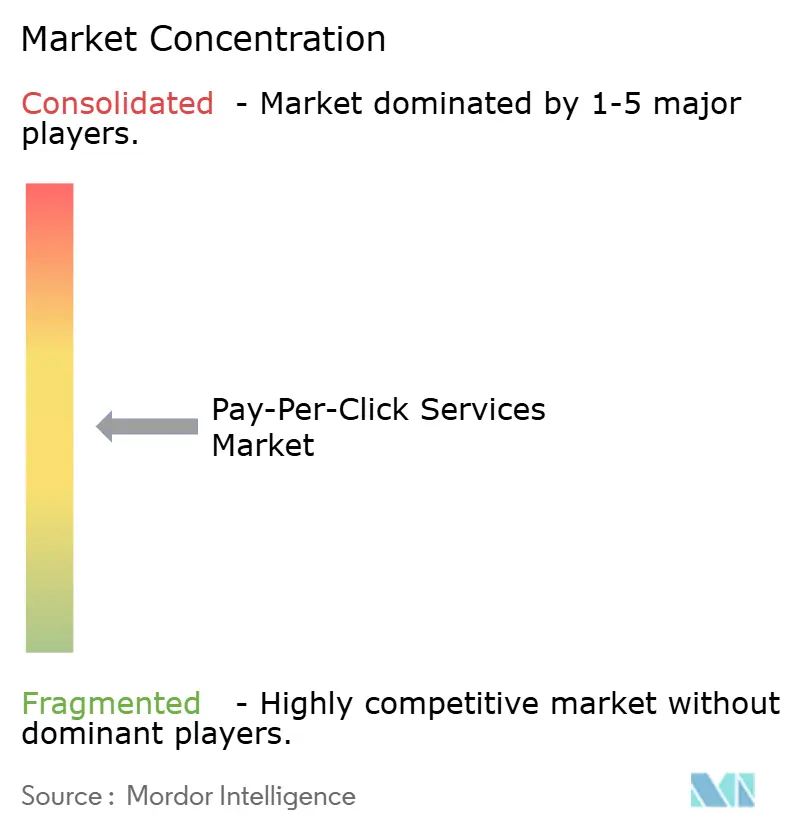
| Market Concentration | Medium |
Major Players *Disclaimer: Major Players sorted in no particular order Image © Mordor Intelligence. Reuse requires attribution under CC BY 4.0. | |
Pay-Per-Click Services Market Analysis by Mordor Intelligence
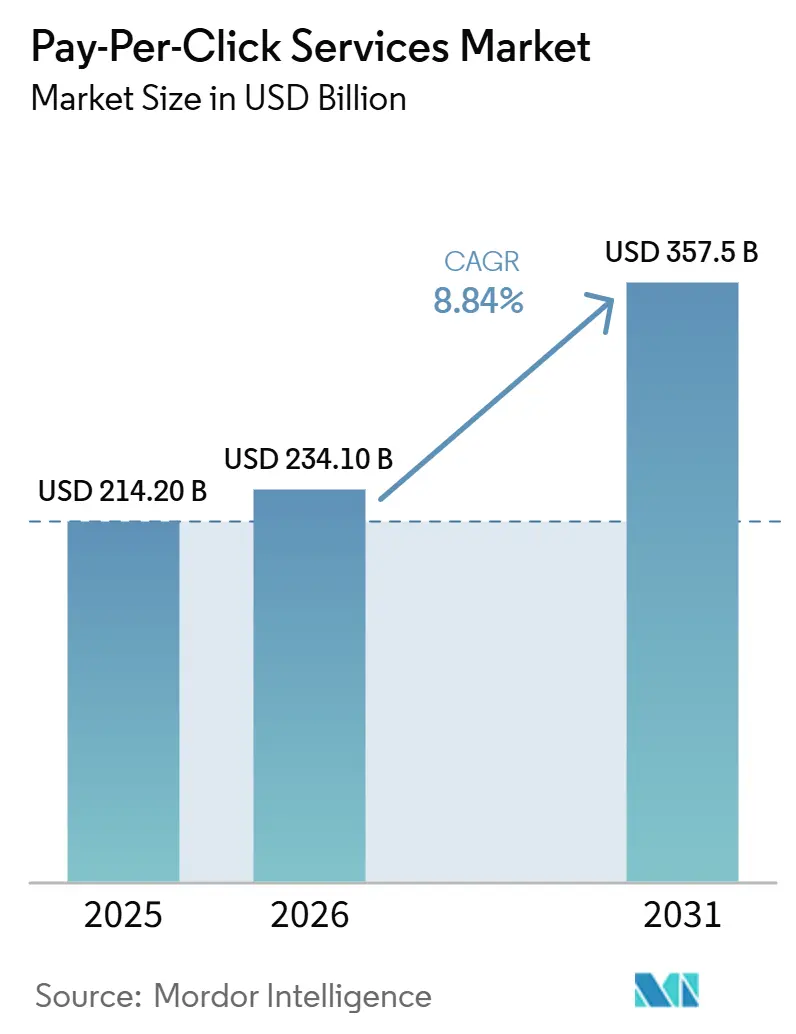
The pay-per-click services market size is projected to expand from USD 214.20 billion in 2025 and USD 234.10 billion in 2026 to USD 357.50 billion by 2031, registering a CAGR of 8.84% between 2026 to 2031. The pay-per-click services market is moving toward advertising programs that can be measured against acquisition and conversion outcomes. Brands with established organic demand still need to compete in search auctions to remain visible when buyers are ready to act. This makes professional campaign management important in the pay-per-click services market, even when marketing budgets are under pressure and campaign priorities change. Automation is changing the work performed by agencies, with more attention moving to data quality, audience design, measurement, and creative choices. Retail media, privacy requirements, and conversational search formats are broadening the range of platforms that advertisers must manage.
Key Report Takeaways
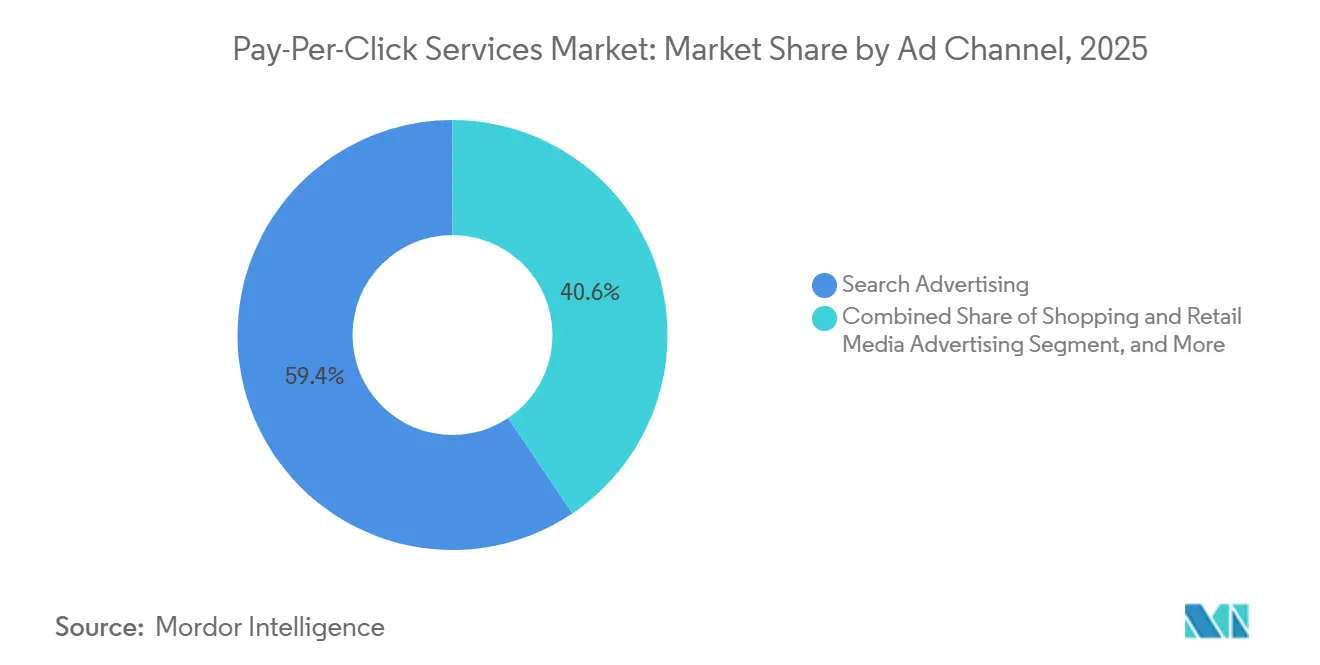
- By ad channel, search advertising led with 59.42% of the pay-per-click services market share in 2025, while shopping and retail media advertising is projected to expand at a 9.89% CAGR through 2031.
- By enterprise size, large enterprises held 54.36% of the global market in 2025, while small and medium-sized enterprises are projected to grow at a 9.23% CAGR through 2031.
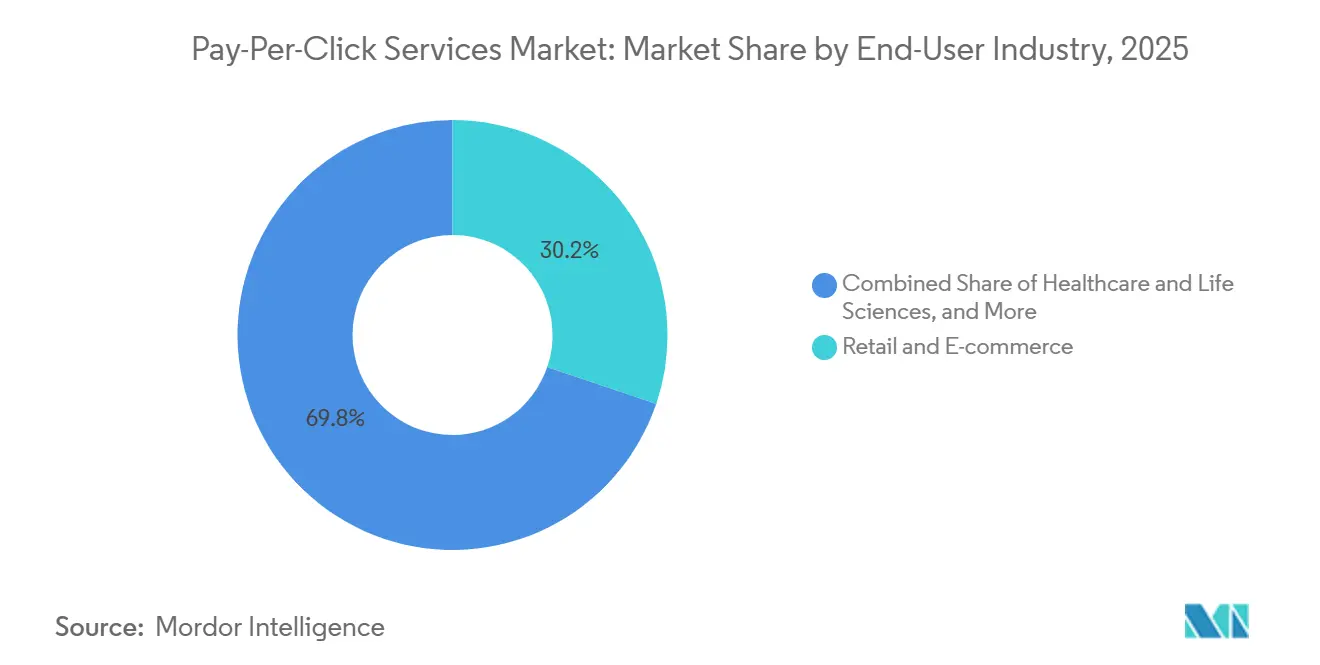
- By end-user industry, retail and e-commerce accounted for 30.19% of the pay-per-click services market size in 2025, while healthcare and life sciences is projected to grow at a 10.09% CAGR through 2031.
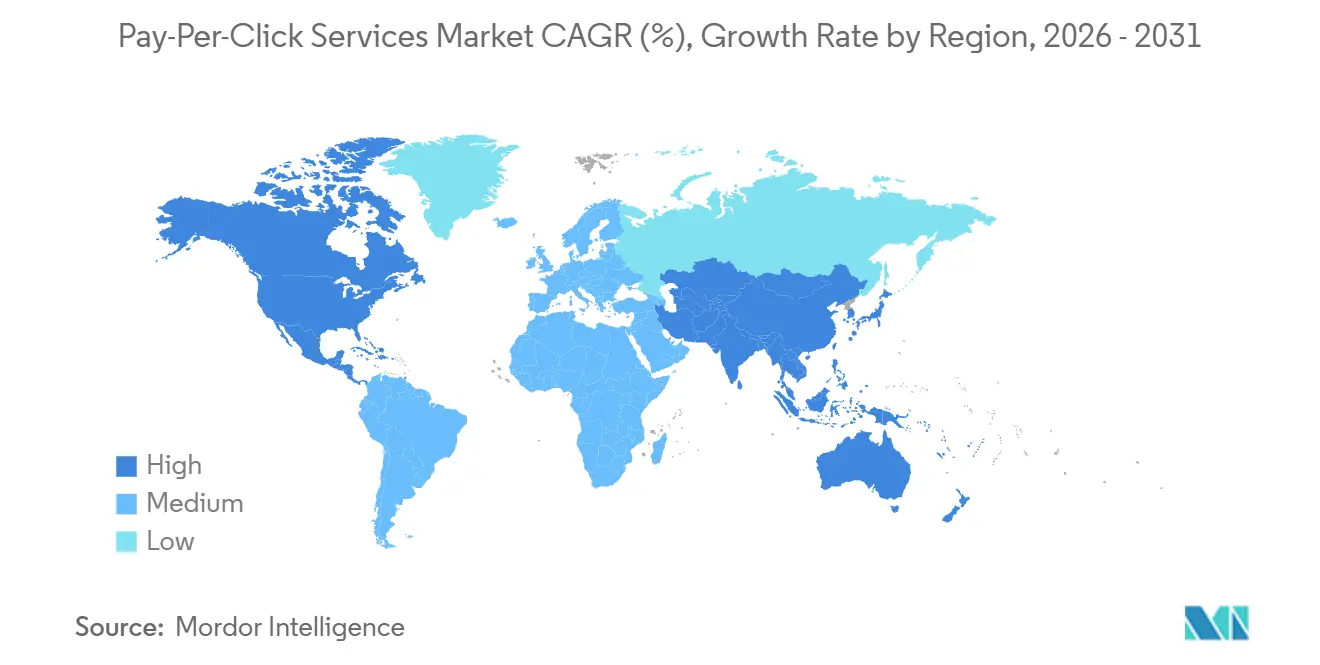
- By geography, North America held 38.73% of the global market in 2025, while Asia-Pacific is projected to advance at a 10.34% CAGR through 2031.
Note: Market size and forecast figures in this report are generated using Mordor Intelligence’s proprietary estimation framework, updated with the latest available data and insights as of January 2026.
Market Trends and Insights
Drivers Impact Analysis of Pay-Per-Click Services Market*
| Driver | (~) % Impact on CAGR Forecast | Geographic Relevance | Impact Timeline |
|---|---|---|---|
| Rising Performance-Based Advertising Budgets | +2.1% | Global | Short term (≤ 2 years) |
| Expansion of Retail Media and Commerce Media | +1.8% | North America core, spillover to Asia-Pacific and Europe | Medium term (2-4 years) |
| Growing Adoption of AI-Led Bid and Creative Automation | +1.5% | Global | Short term (≤ 2 years) |
| Increasing SME Outsourcing for Multichannel PPC Management | +1.0% | North America, Europe, Asia-Pacific | Medium term (2-4 years) |
| AI Search and Conversational Ad Formats Expanding Paid Search Complexity | +0.8% | Global | Medium term (2-4 years) |
| First-Party Data and Measurement Stack Rebuilds Raising Managed-Service Demand | +0.7% | North America and Europe | Long term (≥ 4 years) |
| Source: Mordor Intelligence | |||
Rising Performance-Based Advertising Budgets
Advertisers are directing more spending to channels where acquisition costs and returns can be tracked. Search advertising revenue at Alphabet increased in every quarter of 2025, supporting the continued role of paid search in measurable media plans.[1]Alphabet Inc., “Investor Relations,” Alphabet, abc.xyz Tinuiti reported that search spending among its clients rose 14% year over year in the first quarter of 2026, its fastest pace in nearly 2 years. When economic conditions become uncertain, companies often protect spending that can be tied to outcomes while reviewing broader brand spending. The pay-per-click services market benefits because paid search gives advertisers a visible way to monitor return on ad spend, compare results across campaigns, and explain budget decisions through common outcome measures. WPP’s 2025 restructuring centralized more than USD 60 billion in annual media investment, showing why large networks seek shared auction data and coordinated buying decisions.
Expansion of Retail Media and Commerce Media
Retail media networks now operate as a distinct performance channel that often needs dedicated management. U.S. retail media advertising spending is USD 71.98 billion in 2026 and grew 18.7% year over year, while global retail media spending is projected to exceed USD 300 billion by 2030.[2]WPP plc, “WPP Acquires InfoSum in Major Investment in Its AI-Driven Data Offer,” WPP, wpp.com Amazon Sponsored Products remains important, but Target Roundel, Instacart, and other networks also offer closed-loop measurement. Agencies therefore need to coordinate spending across retailer search, sponsored listings, and other commerce placements. WPP Media expected USD 9.4 billion of USD 10.5 billion in incremental U.S. retail media spending in 2026 to flow to Amazon Ads and Walmart Connect. Smaller networks can leave advertisers with a more fragmented set of choices, which increases the need for specialist allocation and reporting work in the pay-per-click services market, especially when the same products are promoted through several retailer systems.
Growing Adoption of AI-Led Bid and Creative Automation
Automated bidding strategies manage 88% of Google Ads spending in 2026, compared with 71% in 2024. Google stated that AI Max for Search has been adopted by more than 500,000 advertisers since leaving beta in mid-2026.[3]Google LLC, “Google Ads,” Google Ads, ads.google.com The product evaluates more than 70 million signals in an auction, including device, location, browsing context, and conversion likelihood. Google also reported an average 15% conversion lift at similar return on ad spend for advertisers using AI Max or Performance Max. This shifts agency work away from manual bid adjustments and toward campaign design, useful audience signals, creative direction, and a clearer review of whether automated outcomes match the advertiser’s stated objectives in the pay-per-click services market. PPC practitioners still cite quality and accuracy as obstacles to autonomous agents, so human oversight remains important when campaigns run through automated systems.
Increasing SME Outsourcing for Multichannel PPC Management
Small and medium-sized enterprises often need support to manage Google Search, Microsoft Ads, Meta, Amazon, and retail media programs at the same time. These platforms require current product knowledge, monitoring, and reliable conversion tracking that can be costly for a smaller business to sustain internally. A 2024 peer-reviewed study found that digital marketing adoption was associated with stronger financial outcomes and market presence for small and medium-sized enterprises. Outsourcing lets these businesses access specialist skills without hiring a separate team for each platform. White-label fulfillment also allows delivery teams to serve agencies that offer paid media management under their own brands. That model can increase service volumes in the pay-per-click services market without requiring each agency to build every capability in-house, while allowing client-facing agencies to retain a consistent relationship with smaller advertisers.
Restraints Impact Analysis of Pay-Per-Click Services Market*
| Restraint | (~) % Impact on CAGR Forecast | Geographic Relevance | Impact Timeline |
|---|---|---|---|
| Rising CPC Inflation in High-Intent Auctions | -1.2% | Global | Short term (≤ 2 years) |
| Privacy Regulation and Signal Loss Reducing Targeting Precision | -0.9% | Europe and North America core, expanding to Asia-Pacific and South America | Medium term (2-4 years) |
| Generative Search Zero-Click Behavior Weakening Click-Through Efficiency | -0.8% | Global | Medium term (2-4 years) |
| Platform Automation Compressing Manual Agency Scope | -0.6% | Global | Long term (≥ 4 years) |
| Source: Mordor Intelligence | |||
Rising CPC Inflation in High-Intent Auctions
Higher prices for valuable search terms can reduce the return available to advertisers. Average Google Search cost per click reached USD 5.42 in 2026, compared with USD 4.66 in 2024, based on a benchmark covering more than 13,000 active campaigns. Legal services averaged USD 9.21 per click in the first quarter of 2026, while B2B software categories approached USD 6.92. Search spending among Tinuiti clients increased 14% year over year in the first quarter of 2026, while the number of prominent paid positions remained limited. Automated bidding can focus competing bids on the same high-conversion searches. Advertisers may respond by moving to lower-intent terms or by seeking more advanced management to protect efficiency, creating mixed effects for the pay-per-click services market and making account-level decisions more dependent on accurate conversion measurement.
Privacy Regulation and Signal Loss Reducing Targeting Precision
PPC programs must operate under GDPR and Consent Mode v2 in Europe, CCPA and CPRA in the United States, the Digital Personal Data Protection Act in India, PDPL in Saudi Arabia, and LGPD in Brazil. Google enforced Consent Mode v2 in July 2025, and advertisers without compliant implementations lost access to conversion measurement, remarketing audiences, and ad personalization for UK and EEA traffic. The UK Competition and Markets Authority found that advertiser spending fell 14% on DV360 and 11% on Google Ads in Privacy Sandbox testing against third-party cookie settings. The authority also found that publisher revenue per impression declined 27% on Google Ad Manager in the same testing. Lower signal quality can weaken automated optimization and make campaign performance harder to interpret. Separate consent and measurement arrangements raise the operating cost for agencies serving advertisers across several jurisdictions, but they also make proven compliance and implementation skills more important when clients select support in the pay-per-click services market.
*Our forecasts treat driver/restraint impacts as directional, not additive. The impact forecasts reflect baseline growth, mix effects, and variable interactions.
Pay-Per-Click Services Market Segment Analysis
By Ad Channel:
Search Retains Its Central Role While Commerce Media ExpandsSearch advertising held 59.42% of the pay-per-click services market share in 2025, reflecting its ability to reach users who have expressed interest through a query. This format supports direct response programs because a search can indicate a need, product comparison, or intent to buy. Google’s AI Max for Search and Performance Max extend available inventory through broader query matching and landing-page selection. Social media advertising remains a useful prospecting channel when search terms are too expensive for discovery activity. Display and programmatic campaigns add retargeting and audience-based reach to managed PPC programs that can use search data for better audience selection.
Shopping and retail media advertising is forecast to grow at a 9.89% CAGR from 2026 to 2031 in the pay-per-click services market. The segment brings search, product listings, and sponsored placements together near the point of purchase, where retailer transaction data can clarify sales outcomes. Video formats are becoming more relevant as connected TV inventory supports performance-based buying. WPP Media projected generative search advertising to reach USD 5.1 billion globally in 2026 and USD 32 billion by 2028. Remarketing remains useful, although server-side tools such as Meta Conversions API and Google Enhanced Conversions are increasingly important where browser tracking is restricted.



By Enterprise Size:
SMEs Gain Momentum While Large Accounts Sustain SpendingLarge enterprises accounted for 54.36% of the pay-per-click services market size in 2025. Their spending is concentrated in large managed accounts where agencies support extensive campaign portfolios and complex data environments. These advertisers are investing in customer data platform connections, clean-room settings, and server-side tagging to provide stronger inputs for automated bidding. Omnicom expanded its partnership with Adobe on April 21, 2026, to develop an AI operating model linking Omni with Adobe marketing technology. The work targets retail, financial services, pharmaceutical, and automotive clients that need coordinated strategy, activation, and measurement.
Small and medium-sized enterprises are projected to record a 9.23% CAGR from 2026 to 2031. Platform automation makes advanced campaign execution more accessible, but it does not remove the need for effective setup, tracking, and review. Outsourcing can cost less than maintaining equivalent internal teams when businesses advertise across several platforms. The academic evidence on SME digital marketing also supports the link between adoption and financial and market outcomes, including the practical value of using outside specialists when internal resources are limited. This supports wider use of managed programs in the pay-per-click services market. Tinuiti’s late-2025 brand outcome pods show how agencies can combine strategy, creative, data, and channel skills to serve larger clients and expanding smaller accounts.
By End-User Industry:
Retail Leads Spending While Healthcare and Life Sciences AdvancesRetail and e-commerce captured 30.19% of the global market in 2025. Product discovery, price comparison, and checkout activity create recurring demand for search and commerce media programs in this sector. Retailers use search for high-intent conversion, retail media for purchase-stage placement, and remarketing to reconnect with visitors who leave before buying. BFSI is another large user of specialist services because customer value is high and advertising content faces strict compliance review. IT and telecommunications advertisers continue to invest in costly software-related auctions when qualified search leads justify the cost of the click.
Healthcare and life sciences is forecast to grow at a 10.09% CAGR from 2026 to 2031. Pharmaceutical advertising has shifted spending from linear television toward digital paid channels. U.S. healthcare and pharmaceutical digital advertising spending reached USD 24.77 billion in 2025 and grew 13.3% year over year, while paid search accounted for an estimated 54% of pharmaceutical digital budgets. Social media exceeded linear television for pharmaceutical ad spending for the first time in 2025, which expanded the need for coordinated paid media work. Media and entertainment, travel and hospitality, manufacturing and industrials, automotive, and public sector users add further demand, but their spending conditions vary with travel, consumer confidence, procurement activity, and public information needs.
Geography Analysis
The Americas Pay-Per-Click Services Market
North America held 38.73% of the global market in 2025. The United States accounted for 41% of global PPC spending in 2026, reflecting dense auction activity and mature agency capabilities. Search spending among Tinuiti’s North American clients increased 14% year over year in the first quarter of 2026. The region’s growth depends more on higher spending per account and broader service requirements than on first-time advertiser adoption. South America is an emerging area as e-commerce development encourages domestic businesses to use managed multichannel programs, particularly in Brazil, Chile, and Argentina.
Europe Pay-Per-Click Services Market
Europe requires services that can address different privacy and data rules across markets. France’s digital advertising market reached EUR 12.4 billion (USD 13.7 billion), in 2025 and grew 11% year over year. Search generated EUR 4.93 billion (USD 5.5 billion), or 40% of French digital advertising revenue. Social media grew 15% in France in 2025 and is forecast to exceed search revenue in late 2026 or early 2027. Germany’s cost per click was 12-18% higher than comparable U.S. levels, while Performance Max adoption reached 58% of active German Google Ads accounts in 2026, compared with 34% in 2024.
APAC and MEA Pay-Per-Click Services Market
Asia-Pacific is projected to grow at a 10.34% CAGR through 2031, the fastest regional rate in the pay-per-click services market. India’s digital media advertising spending grew 20% in 2025. Australia’s internet advertising market reached AUD 18.4 billion (USD 12.2 billion), in 2025 and grew 11.5% year over year, while search advertising reached AUD 8.0 billion (USD 5.3 billion). China’s retail media platforms support the region’s large search advertising base, while the UAE, Saudi Arabia, South Africa, Nigeria, and Egypt are developing digital and mobile-first search activity.

Competitive Landscape
The pay-per-click services market has a concentrated group of global networks and a much wider group of mid-sized and specialist agencies. Omnicom completed its acquisition of Interpublic Group in November 2025, creating a combined organization with pro forma revenue above USD 25 billion and bringing media buying, audience data, commerce, and customer relationship management capabilities together through Omni. This scale can strengthen auction data use and cross-channel execution for large accounts. Publicis expanded its Microsoft partnership in April 2026, becoming Microsoft’s global media agency of record and linking Epsilon identity capabilities with Microsoft Azure AI services. These moves show how the leading networks are combining media operations with data and technology capabilities.
WPP acquired InfoSum in April 2025 to support data collaboration without moving client data into a central environment. This gives its clients another option for first-party data activation where privacy expectations are high. Specialist independents compete through focused measurement methods and vertical knowledge rather than the buying scale of holding companies. Tinuiti’s Bliss Point Intelligence uses first-party information from Shopify and Klaviyo to update media-mix decisions more frequently. Agencies that combine Consent Mode v2 implementation, server-side conversion tools, industry-specific creative services, and practical reporting can offer a more complete managed program.
Dentsu partnered with Adthena in the United Kingdom in July 2026 for AI-based competitive intelligence in ChatGPT advertising placements. The move addresses conversational advertising conditions where the source draft identified cost-per-click movement of 278% without clear platform explanations. It shows how competition is expanding beyond traditional search mechanics toward new AI advertising formats. Smaller agencies may need partnerships or proprietary tools to keep pace, while the EU AI Act encourages clearer oversight and audit features in algorithmic advertising tools.
Pay-Per-Click Services Industry Leaders
WPP plc
Omnicom Group Inc.
Publicis Groupe S.A.
Dentsu Group Inc.
Tinuiti
- *Disclaimer: Major Players sorted in no particular order
Pay-Per-Click Services Market Companies Covered in this Report
- WPP plc
- Omnicom Group Inc.
- Publicis Groupe S.A.
- Dentsu Group Inc.
- Tinuiti
- NP Digital
- WebFX
- Disruptive Advertising
- Ignite Visibility
- JumpFly, Inc.
- Power Digital
- Directive
- Rise, a Quad agency
- 97th Floor
- Socium Media
- Wolfgang Digital
- Loud Mouth Media
- SmartSites
- Code3
- PBJ Marketing

Recent Industry Developments in Pay-Per-Click Services Market
- July 2026: Dentsu and Adthena announced a strategic partnership in the United Kingdom to deliver AI-powered competitive intelligence across ChatGPT advertising placements, where cost-per-click volatility reached 278% without platform-level transparency. The partnership gives Dentsu early data on emerging generative AI ad inventory dynamics, reinforcing its position as a first-mover in conversational search advertising.
- April 2026: Omnicom Group expanded its global partnership with Adobe to co-develop an enterprise-grade AI Agentic Operating Model, integrating Omnicom’s Omni intelligence platform with Adobe’s enterprise marketing and creative technology stack. The solution is purpose-built for Retail, Financial Services, Pharmaceuticals, and Automotive enterprises, enabling orchestration across strategy, creative development, planning, activation, and measurement at enterprise scale, per Omnicom’s official announcement dated April 21, 2026.
- April 2026: Microsoft and Publicis Groupe expanded their strategic partnership, with Publicis appointed as Microsoft’s global media agency of record effective April 8, 2026. Under the partnership, Publicis will deploy Microsoft 365 Copilot to all 114,000+ employees and adopt Microsoft Azure as a preferred cloud provider, integrating Epsilon’s identity intelligence with Azure AI agents to enable autonomous campaign deployment and real-time spend optimization.
- February 2026: OpenAI began accepting paid advertisers on its platform on February 6, 2026, with WPP Media, Omnicom, and Dentsu signing as inaugural launch partners. This gave all 3 holding companies months of live ChatGPT campaign data before self-serve access opened the broader market, creating a measurable first-mover advantage in conversational AI advertising intelligence.


Global Pay-Per-Click Services Market Report Scope
The Global Pay-Per-Click (PPC) Services Market comprises agencies, digital marketing firms, consulting providers, and technology-enabled service vendors that plan, manage, optimize, and monitor paid online advertising campaigns in which advertisers pay a fee each time a user clicks on an advertisement.
The Pay-Per-Click Services Market Report is Segmented by Ad Channel (Search Advertising, Social Media Advertising, Display and Programmatic Advertising, Shopping and Retail Media Advertising, Video Advertising, and Remarketing and Retargeting), Enterprise Size (Small and Medium-Sized Enterprises, and Large Enterprises), End-User Industry (Retail and E-commerce, IT and Telecommunications, BFSI, Healthcare and Life Sciences, Media and Entertainment, Travel and Hospitality, Manufacturing and Industrials, and Other End-User Industries (Automotive, Public Sector, Others)), and Geography (North America, South America, Europe, Asia-Pacific, Middle East, and Africa). The Market Forecasts are Provided in Terms of Value (USD).
| Search Advertising |
| Social Media Advertising |
| Display and Programmatic Advertising |
| Shopping and Retail Media Advertising |
| Video Advertising |
| Remarketing and Retargeting |
| Small and Medium-Sized Enterprises |
| Large Enterprises |
| Retail and E-commerce |
| IT and Telecommunications |
| BFSI |
| Healthcare and Life Sciences |
| Media and Entertainment |
| Travel and Hospitality |
| Manufacturing and Industrials |
| Other End-User Industries (Automotive, Public Sector, Others) |
| North America | United States |
| Canada | |
| Mexico | |
| South America | Brazil |
| Argentina | |
| Chile | |
| Rest of South America | |
| Europe | Germany |
| United Kingdom | |
| France | |
| Italy | |
| Spain | |
| Rest of Europe | |
| Asia-Pacific | China |
| Japan | |
| India | |
| South Korea | |
| Australia | |
| Rest of Asia-Pacific | |
| Middle East | United Arab Emirates |
| Saudi Arabia | |
| Qatar | |
| Rest of Middle East | |
| Africa | South Africa |
| Egypt | |
| Nigeria | |
| Rest of Africa |
| By Ad Channel | Search Advertising | |
| Social Media Advertising | ||
| Display and Programmatic Advertising | ||
| Shopping and Retail Media Advertising | ||
| Video Advertising | ||
| Remarketing and Retargeting | ||
| By Enterprise Size | Small and Medium-Sized Enterprises | |
| Large Enterprises | ||
| By End-User Industry | Retail and E-commerce | |
| IT and Telecommunications | ||
| BFSI | ||
| Healthcare and Life Sciences | ||
| Media and Entertainment | ||
| Travel and Hospitality | ||
| Manufacturing and Industrials | ||
| Other End-User Industries (Automotive, Public Sector, Others) | ||
| By Geography | North America | United States |
| Canada | ||
| Mexico | ||
| South America | Brazil | |
| Argentina | ||
| Chile | ||
| Rest of South America | ||
| Europe | Germany | |
| United Kingdom | ||
| France | ||
| Italy | ||
| Spain | ||
| Rest of Europe | ||
| Asia-Pacific | China | |
| Japan | ||
| India | ||
| South Korea | ||
| Australia | ||
| Rest of Asia-Pacific | ||
| Middle East | United Arab Emirates | |
| Saudi Arabia | ||
| Qatar | ||
| Rest of Middle East | ||
| Africa | South Africa | |
| Egypt | ||
| Nigeria | ||
| Rest of Africa | ||


Key Questions Answered in the Report
What is the pay-per-click services market size?
The pay-per-click services market is USD 234.10 billion in 2026 and is projected to reach USD 357.50 billion by 2031 at an 8.84% CAGR.
Which ad channel holds the largest share of pay-per-click services?
Search advertising led with 59.42% share in 2025 because it reaches users with stated search intent.
Which pay-per-click service segment is growing fastest?
Healthcare and life sciences is projected to grow at a 10.09% CAGR through 2031, the fastest rate among the stated end-user segments.
Why are retail media networks important for PPC providers?
Retail media connects sponsored placements with purchase-stage activity and closed-loop measurement, creating a need for multichannel management.
How does AI affect paid search management?
AI Max and Performance Max automate many auction decisions, so agencies are placing more emphasis on data signals, campaign design, measurement, and creative work.
Which region is expanding fastest for managed PPC services?
Asia-Pacific is projected to grow at a 10.34% CAGR through 2031, supported by growing digital advertising activity in India, Australia, China, and other markets.
Page last updated on:





