
Parcel Management and Multi-Carrier Shipping Software Market Size and Share
Market Overview
| Study Period | 2020 - 2031 |
|---|---|
| Market Size (2026) | USD 2.93 Billion |
| Market Size (2031) | USD 4.98 Billion |
| Growth Rate (2026 - 2031) | 11.16 % |
| Fastest Growing Market | Asia-Pacific |
| Largest Market | North America |
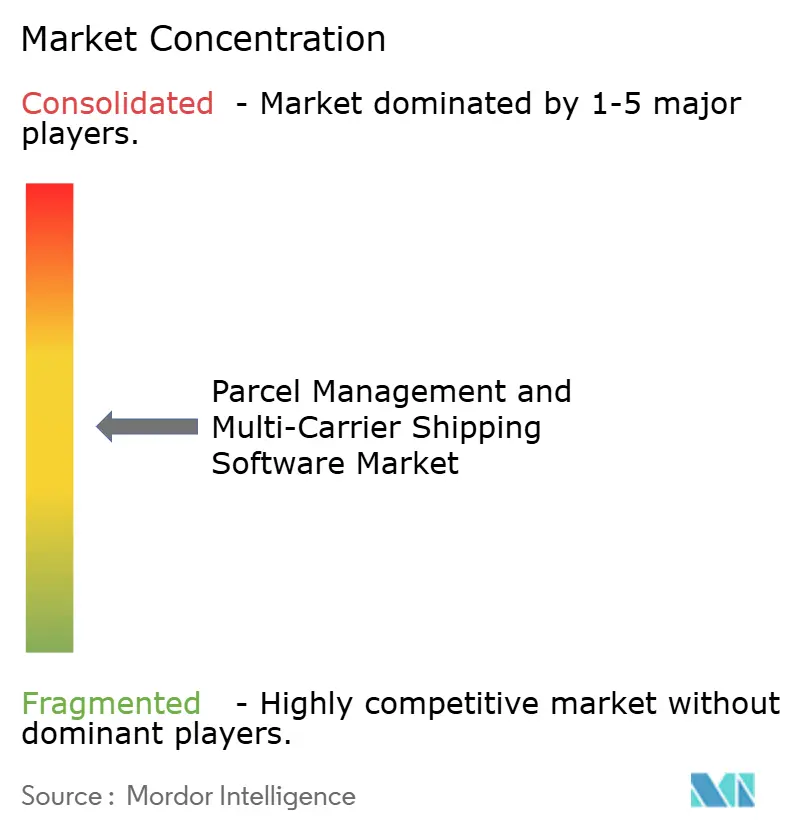
| Market Concentration | Medium |
Major Players *Disclaimer: Major Players sorted in no particular order Image © Mordor Intelligence. Reuse requires attribution under CC BY 4.0. | |
Parcel Management and Multi-Carrier Shipping Software Market Analysis by Mordor Intelligence
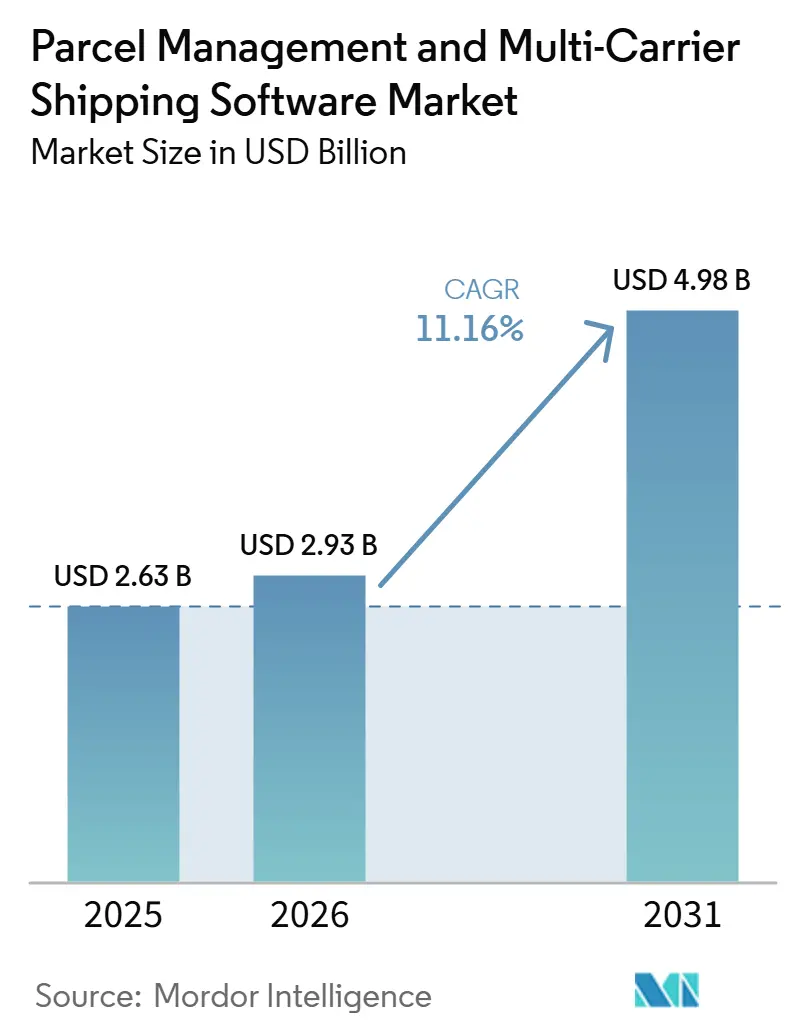
The parcel management and multi-carrier shipping software market size is projected to expand from USD 2.63 billion in 2025 and USD 2.93 billion in 2026 to USD 4.98 billion by 2031, registering a CAGR of 11.16% between 2026 to 2031. Higher e-commerce order volume is increasing the number of carrier options merchants must manage for each shipment, especially when product characteristics, service commitments, destination coverage, and carrier pricing do not point to a single delivery option. Platforms that connect multiple carriers are becoming part of daily shipping operations for businesses serving different delivery locations and meeting customer expectations, strengthening the parcel management and multi-carrier shipping software market across routine fulfillment activities. Carrier coverage, rate selection, delivery performance, and compliance are now closely linked within a single workflow, which underscores the value of platforms that maintain consistent decisions across warehouses, sales channels, and customer destinations. Vendors are responding through cloud delivery models, broader carrier networks, and product features that support predictive routing and documentation, as the parcel management and multi-carrier shipping software market increasingly depends on reliable connections between data, carrier services, and fulfillment operations that customers can use without interrupting day-to-day warehouse work. The parcel management and multi-carrier shipping software market therefore gives providers an opportunity to serve both established enterprise shippers and smaller businesses that need simpler access to carrier connectivity, while allowing the same provider to develop functions for different operating needs and shipment volumes.
Key Report Takeaways
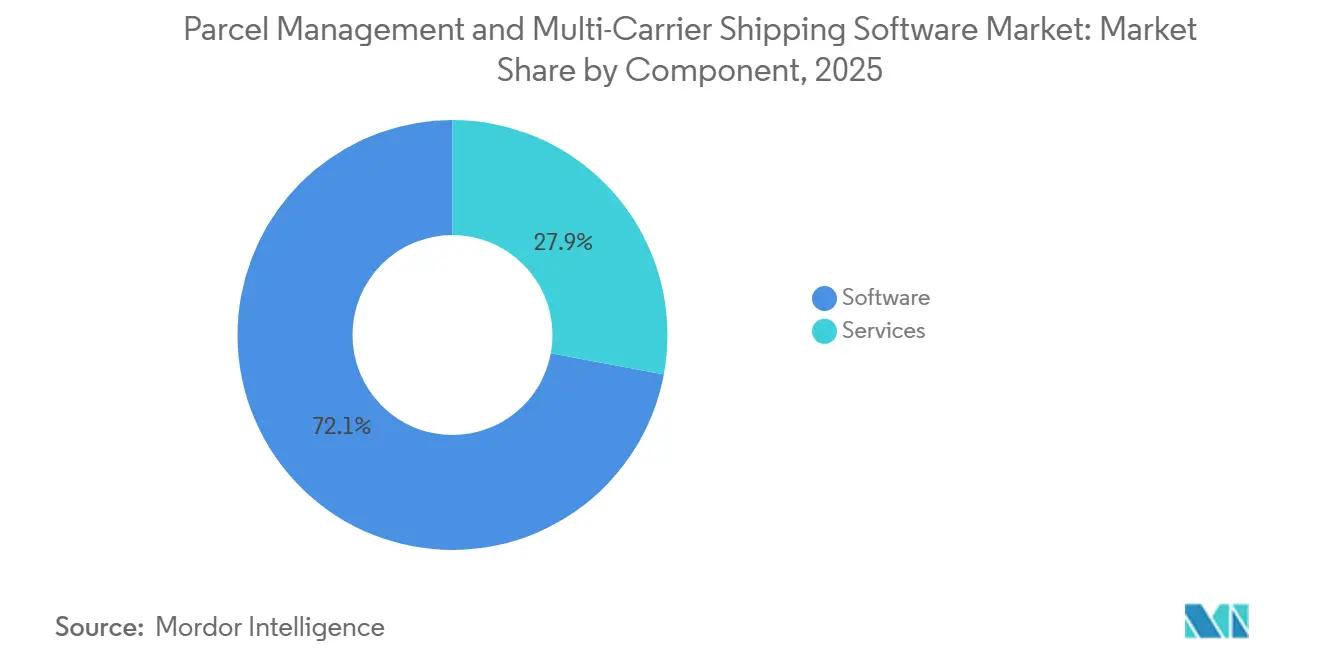
- By component, software held 72.06% share of the parcel management and multi-carrier shipping software market size in 2025, while services are projected to expand at a CAGR of 11.61% through 2031.
- By deployment mode, cloud deployment accounted for 64.89% of revenue in 2025 and is projected to grow at a CAGR of 12.33% through 2031.
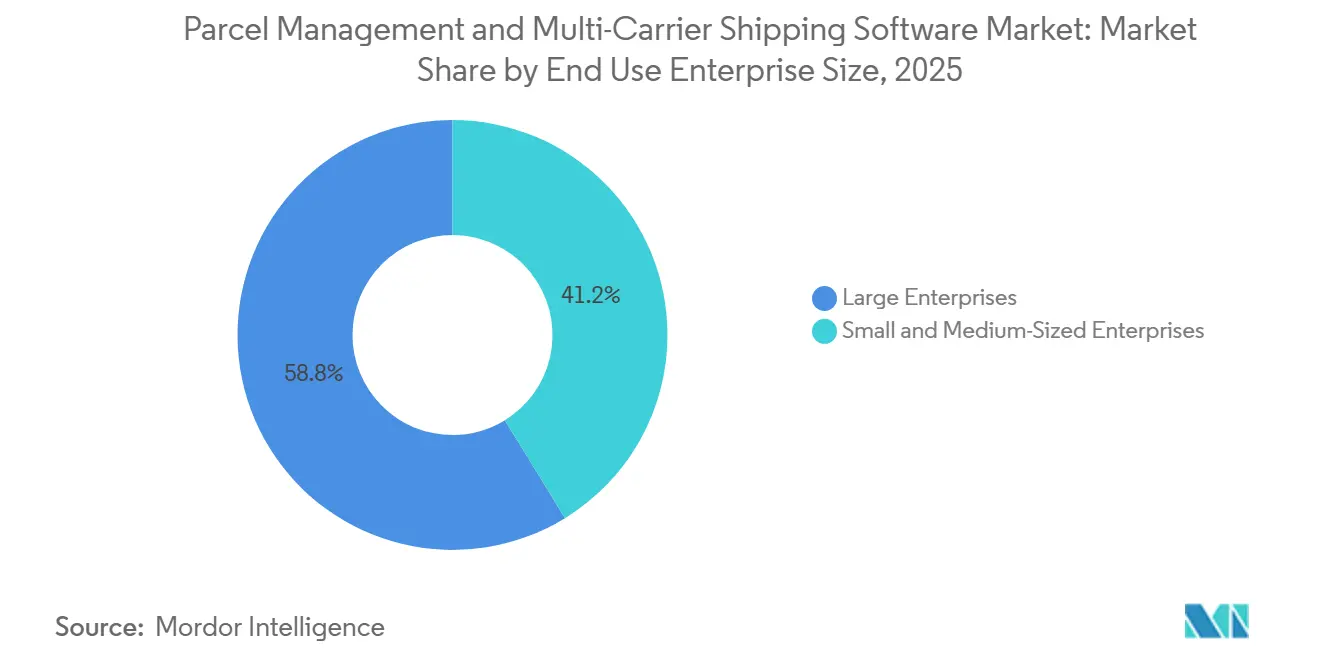
- By enterprise size, large enterprises held 58.77% share of the parcel management and multi-carrier shipping software market size in 2025, while small and medium-sized enterprises are projected to expand at a CAGR of 11.72% through 2031.
- By end-user industry, retail and e-commerce held 38.08% of revenue in 2025, while healthcare and life sciences are projected to expand at a CAGR of 14.26% through 2031.
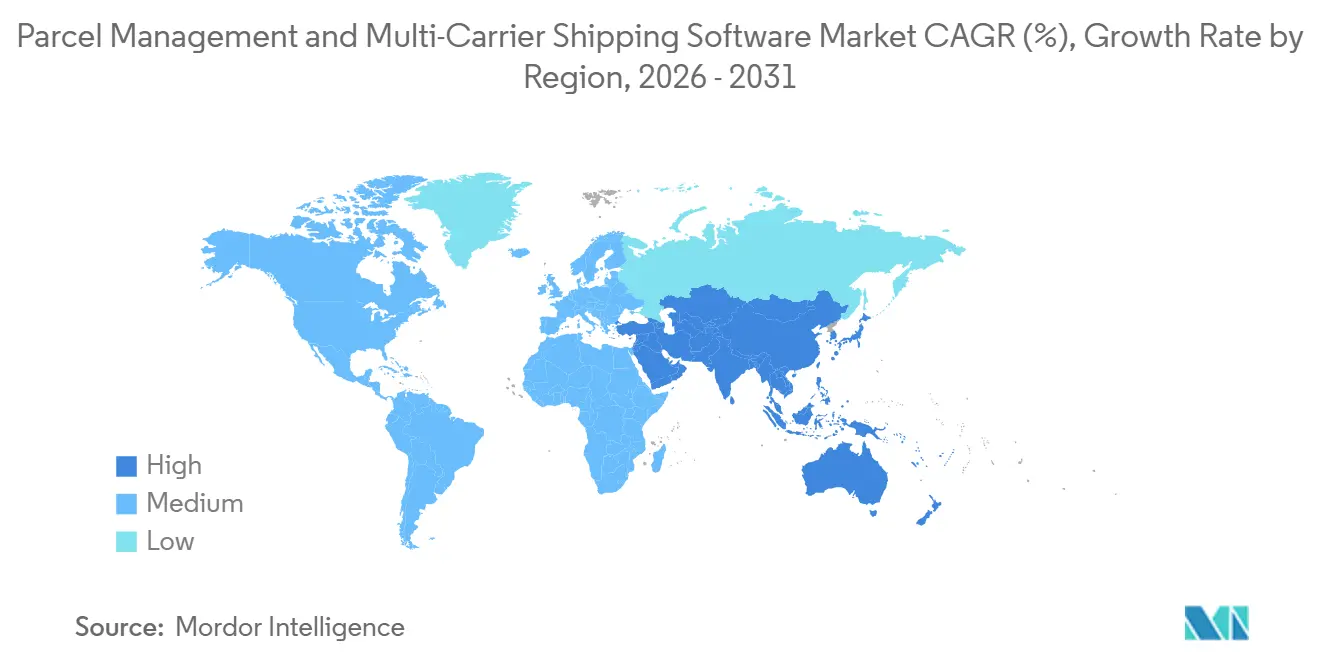
- By geography, North America held 39.12% share of the parcel management and multi-carrier shipping software market size in 2025, while Asia-Pacific is projected to expand at a CAGR of 13.38% through 2031.
Note: Market size and forecast figures in this report are generated using Mordor Intelligence’s proprietary estimation framework, updated with the latest available data and insights as of January 2026.
Market Trends and Insights
Drivers Impact Analysis of Parcel Management and Multi-Carrier Shipping Software Market*
| Driver | (~) % Impact on CAGR Forecast | Geographic Relevance | Impact Timeline |
|---|---|---|---|
| E-Commerce Parcel-Volume Expansion | +3.2% | Global | Short term (≤ 2 years) |
| AI-Enabled Rate Shopping and Carrier Routing | +2.1% | North America and Europe, spill-over to Asia-Pacific | Medium term (2-4 years) |
| Cloud and SaaS Adoption by SMEs | +1.8% | Global, strong in Asia-Pacific and South America | Short term (≤ 2 years) |
| Cross-Border Customs and Documentation Digitization | +1.5% | EU, North America, spill-over to Asia-Pacific | Medium term (2-4 years) |
| Carrier-API Abstraction for Regional Network Resilience | +0.9% | North America and Europe | Medium term (2-4 years) |
| Parcel Data Exhaust Monetization | +0.6% | North America and Europe | Long term (≥ 4 years) |
| Source: Mordor Intelligence | |||
E-Commerce Parcel-Volume Expansion
E-commerce order growth is increasing parcel volumes and adding more delivery decisions to the shipping process. The parcel management and multi-carrier shipping software market benefits when merchants need to compare carrier options across size, weight, delivery speed, and destination. Germany illustrates this pattern, as Asian marketplace platforms such as Temu and Shein grew 27% faster than the overall German market in 2025, generating EUR 3.7 billion (USD 4.1 billion).[1]Bundesverband Paket und Expresslogistik, “VOR ORT. FLEXIBEL. ZUVERLÄSSIG. KEP-Studie 2026,” Bundesverband Paket und Expresslogistik, bpex-ev.de These flows increase diversity in shipment origins and place added demands on carrier networks. A business that ships at a meaningful scale may need to choose among 3 to 30 carriers for an individual shipment. The resulting need for consistent carrier selection is strengthening demand for platforms that bring rate, service, and routing decisions into a single operating environment, particularly when a merchant must manage carrier contracts and delivery commitments across a diverse customer base.
AI-Enabled Rate Shopping and Carrier Routing
Machine learning is changing career selection from a simple rate comparison to a broader decision about delivery and performance. Shipium's Rating Engine uses data from more than 350 million shipments to consider both cost and delivery speed, while accounting for carrier performance. EasyPost's Luma AI Select evaluates shipments against carrier performance data by region and service category, and EasyPost processes more than 1 billion API calls annually. These capabilities enable placing greater weight on the probability of on-time delivery rather than the published rate alone. This can help shippers reduce customer contact and returns stemming from poor delivery experiences. C.H. Robinson launched Lean AI Engineer in June 2026, and the system autonomously handled 92% of its 4PL shipments globally from order creation through delivery and carrier payment.[2]C.H. Robinson, “Lean AI Engineer Redefines Global Supply Chain Operations,” C.H. Robinson, chrobinson.com The parcel management and multi-carrier shipping software market is likely to face higher buyer expectations as larger shippers make AI-supported routing part of their standard logistics processes, enabling buyers to compare platforms on both service outcomes and shipping-cost control.
Cloud and SaaS Adoption by SMEs
Cloud deployment accounted for 64.89% of revenue in 2025, indicating that the parcel management and multi-carrier shipping software market has already moved well beyond early cloud adoption. Subscription models lower the upfront technology barrier for smaller businesses that need carrier connectivity. Per-transaction pricing can give merchants shipping 500 to 10,000 orders a month access to multi-carrier functions without a large infrastructure investment. Metapack reported in 2026 that 90% of global retailers planned to increase AI investment for operational optimization. Leading providers have reduced onboarding to fewer than 14 days, which shortens the time required to establish carrier connections. Self-service onboarding can also reduce customer-acquisition costs for cloud-native providers while allowing smaller merchants to use tools that were once mainly available to larger shippers, including centralized label production and routine carrier performance reviews.
Cross-Border Customs and Documentation Digitization
Cross-border shipping is placing greater importance on customs data, duty calculation, product classification, and shipping documentation. The EU’s removal of the EUR 150 (USD 171) de minimis duty exemption in July 2026 has made duty calculation, HS code classification, and ICS2 Phase 3 documentation more important in labeling and manifesting workflows. The parcel management and multi-carrier shipping software market can address this need by embedding customs functions into the core shipping process rather than handling them after a label is created. EasyPost announced a partnership with Zonos in March 2026 to integrate landed cost data, while Shippo added automated HS code suggestions to its label creation flow in 2025. The direction of product development indicates that vendors are adding customs logic closer to the point where a shipment is selected and labeled. Mid-market retailers that serve more than 2 countries have a stronger reason to assess whether their platforms can support changing cross-border requirements without relying only on downstream broker processes, as missing data at the label stage can create work later in the fulfillment cycle and affect the parcel management and multi-carrier shipping software market's ability to support cross-border fulfillment.
Restraints Impact Analysis of Parcel Management and Multi-Carrier Shipping Software Market*
| Restraint | (~) % Impact on CAGR Forecast | Geographic Relevance | Impact Timeline |
|---|---|---|---|
| Legacy-System Integration Complexity | -2.3% | Global, most acute in manufacturing-heavy economies of EU and North America | Short term (≤ 2 years) |
| Cybersecurity and Data-Privacy Exposure | -1.8% | Global, with EU most impacted by NIS2 and GDPR compliance obligations | Medium term (2-4 years) |
| Carrier API Throttling and Commercial Access Restrictions | -1.1% | North America | Short term (≤ 2 years) |
| Marketplace-Controlled Shipping Stack Disintermediation | -0.9% | North America, spill-over to EU and Asia-Pacific | Long term (≥ 4 years) |
| Source: Mordor Intelligence | |||
Legacy-System Integration Complexity
Legacy systems remain a practical barrier when a company tries to connect modern shipping software with established ERP, warehouse management, and order management environments. These environments can rely on batch processing, older programming languages, and database-level business rules that do not readily support real-time carrier requests or label generation. Each new connection can increase the effort required to maintain data and process consistency across the shipping workflow. For mid-market organizations, this requirement can preserve a single-carrier relationship because the middleware work for additional carriers competes with other technology priorities. The parcel management and multi-carrier shipping software market must therefore provide implementation support and integration tools that reduce disruption to existing operations. Companies that could realize the greatest value from broader carrier options may still delay adoption when the integration project requires scarce technology resources, leaving providers with a need to make deployment less disruptive to operations and internal teams.
Cybersecurity and Data-Privacy Exposure
Multi-carrier platforms hold negotiated carrier pricing, shipment volumes, customer addresses, and trade-route data. This information underscores the importance of security controls and vendor oversight in a buyer's evaluation process. European buyers also need to consider obligations connected with the NIS2 Directive, GDPR vendor processing agreements, and ISO/IEC 27001 security management practices. These requirements can lengthen enterprise procurement cycles and raise the standards that vendors must meet before a platform is approved, since buyers must assess the provider's controls and the security practices of connected parties.
*Our forecasts treat driver/restraint impacts as directional, not additive. The impact forecasts reflect baseline growth, mix effects, and variable interactions.
Parcel Management and Multi-Carrier Shipping Software Market Segment Analysis
By Component:
Software Layer Sustains Revenue, Services Accelerate at the MarginSoftware held 72.06% of the parcel management and multi-carrier shipping software market share in 2025, which reflects the importance of recurring platform subscriptions in this field. The software layer is often the primary contractual link between a shipper and its carrier management provider. nShift Ship connects more than 1,000 carriers and more than 450 ERP, warehouse management, and e-commerce integrations. Once a platform is built into the warehouse and order processes, changing providers can involve substantial operational work. This gives established software platforms a durable role in enterprise customer relationships and makes the underlying operating workflow central to those relationships.
Services are projected to grow at a CAGR of 11.61% through 2031, supported by demand for implementation, integration, and managed logistics support. Service work becomes more important when a customer needs to bridge legacy systems or coordinate several carrier relationships. Managed-service contracts can also include carrier negotiation, compliance monitoring, and carrier onboarding. The June 2026 combination of WWEX Group and Auctane brought together freight brokerage across parcel, LTL, truckload, and global shipping with shipping software capabilities. The transaction reflects the value of combining software subscriptions with services that can broaden customer relationships and make them harder to replace, particularly when customers use one provider across multiple shipping needs. This positioning gives the parcel management and multi-carrier shipping software market a service-led route to address complex deployment requirements.


By Deployment Mode:
Cloud Remains the Default, Hybrid Absorbs Regulated DemandCloud deployment held 64.89% of revenue in 2025 and is projected to grow at a CAGR of 12.33% through 2031. Cloud systems can quickly update carrier rates, support real-time AI functions, and connect more directly with e-commerce platforms. These features reduce the manual technology work that can slow changes in an on-premises setting. In 2026, Metapack stated that 90% of global retailers planned to increase AI investment for operational optimization. The continuing shift toward cloud delivery supports the wider use of carrier data and automated decision tools across shipping operations, while enabling product updates to reach users without the same level of local technology effort and keeping the parcel management and multi-carrier shipping software market aligned with retailers that want new operational functions without a full infrastructure refresh.
On-premises systems remain relevant for defense, pharmaceuticals, and financial services, where data sovereignty requirements can limit the use of shared infrastructure. Some organizations need to retain tighter control over shipping records because of regulatory or internal audit requirements. Hybrid deployment combines cloud-based rate shopping and label generation with on-premises data storage. This structure gives large enterprises access to cloud functions while keeping selected data within their own environments. The approach is especially relevant in Europe, where vendor security assessment requirements raise attention to how logistics data is stored and managed, and where businesses need to balance operating speed with internal control, while giving the parcel management and multi-carrier shipping software market a practical option for organizations that cannot move all operational records to a shared environment.
By End Use Enterprise Size:
Large Enterprises Anchor Revenue Base, SMEs Define Future VolumeLarge enterprises accounted for 58.77% of revenue in 2025, supported by their multi-site operations and higher carrier-contract volumes. These organizations need to coordinate shipping decisions across warehouses, markets, and service levels. ProShip provides advanced date shopping that can evaluate fuel surcharges, dimensional-weight rules, and carrier-service eligibility across hundreds of options in milliseconds. Such functionality has greater operational value when a shipper handles more than 100,000 shipments per month. Large accounts also tend to require deeper integrations and governance functions, which help sustain their position in the revenue base and reinforce the platform's role in multi-site shipping coordination.
Small and medium-sized enterprises are projected to grow at a CAGR of 11.72% through 2031. Providers have reduced onboarding to fewer than 14 days and commonly connect 3 to 4 carriers for each merchant in this group. This level of connectivity can support businesses that ship between 500 and 10,000 orders each month. Self-service cloud onboarding can reduce the effort required for a smaller business to adopt multi-carrier processes, including the initial work of connecting carrier accounts and setting common shipping rules. The resulting change in vendor economics places greater emphasis on acquiring and serving mid-market and smaller customers rather than relying solely on enterprise retention, and the parcel management and multi-carrier shipping software market can therefore expand through simpler products that support routine shipping decisions without the implementation burden of a large enterprise program.
By End-User Industry:
Healthcare Changes Retail's Long-Standing LeadRetail and e-commerce accounted for 38.08% of the parcel management and multi-carrier shipping software market share in 2025, as consumer purchases directly drive parcel demand. Retailers need carrier choices that reflect customer location, price expectations, delivery speed, and product type. The high volume of consumer shipments keeps this end-user group central to carrier-management demand. Retail also requires reliable post-purchase visibility, because delivery performance can affect customer service contacts and returns. These requirements support continued use of platforms that connect checkout, label generation, tracking, and carrier performance information in a workflow that can be monitored after an order is placed, preserving retail and e-commerce as the primary demand base for the parcel management and multi-carrier shipping software market.
Healthcare and life sciences are projected to grow at a CAGR of 14.26% through 2031, making them the fastest-growing end-user group in the parcel management and multi-carrier shipping software industry. Pharmaceutical and temperature-sensitive shipments need stronger chain-of-custody controls at every carrier handoff. Good Distribution Practice guidelines and US FDA reporting requirements increase the importance of documentation and traceability. General-purpose platforms may need vertical modules to meet these needs rather than offering only standard parcel functions, since standard rate and label tools do not by themselves provide the required shipping record. Logistics and transportation providers, industrial manufacturers, consumer packaged goods shippers, and other end users make up the remaining revenue base, with logistics providers seeking to manage parcel carrier selection alongside other freight modes through a single platform.
Geography Analysis
North America Parcel Management and Multi-Carrier Shipping Software Market
North America accounted for 39.12% of global revenue in 2025, the largest regional share in the parcel management and multi-carrier shipping software market. The United States has a complex carrier landscape that includes UPS, FedEx, USPS, DHL, and many regional last-mile providers, creating a broad set of options for the parcel management and multi-carrier shipping software market. This mix results in frequent carrier-selection decisions for each shipment, including decisions that must account for service availability, pricing, delivery expectations, and the terms of individual carrier contracts. Amazon Freight extended its Less-Than-Truckload service to eligible United States shippers in June 2026, which added to the technology connections needed across the domestic logistics environment. Canada and Mexico also support regional demand through cross-border manufacturing and retail trade under the USMCA framework.
Europe Parcel Management and Multi-Carrier Shipping Software Market
Europe has a different operating pattern because carrier networks are fragmented by country. DPD, GLS, DHL Parcel, Evri, PostNL, and many domestic providers use different API standards. Germany's KEP sector generated EUR 28.4 billion (USD 31.2 billion) in revenue in 2025, and grew 2.6% year over year, while B2C growth was 0.6%.[3]Bundesverband Paket und Expresslogistik, “VOR ORT. FLEXIBEL. ZUVERLÄSSIG. KEP-Studie 2026,” Bundesverband Paket und Expresslogistik, bpex-ev.de This setting requires country-specific integration work and makes local carrier knowledge important. nShift, Sendcloud, and Metapack have developed carrier portfolios suited to this fragmented last-mile environment, while documentation changes are encouraging European retailers and logistics providers to review older platform capabilities.
APAC, MEA and South America Parcel Management and Multi-Carrier Shipping Software Market
Asia-Pacific is projected to grow at a CAGR of 13.38% through 2031, making it the fastest-growing regional area. Chinese manufacturers are expanding routes into Southeast Asia, Africa, and the Middle East, increasing the need for cross-border shipment coordination. India, Japan, and South Korea also offer growth opportunities through direct-to-consumer e-commerce and retailer-led digitization of last-mile operations. South America, the Middle East, and Africa remain smaller in absolute terms, but Brazil's maturing e-commerce activity and public logistics investments in the UAE and Saudi Arabia are supporting incremental software procurement.

Competitive Landscape
The parcel management and multi-carrier shipping software market has a moderately fragmented supplier base, with competition shaped by carrier-network reach, technology depth, and the ability to address local operating requirements. nShift, EasyPost, and ShipStation Global stand out through the breadth of their carrier networks. nShift connects more than 1,000 carriers, EasyPost connects more than 100 carriers, and Metapack, now part of ShipStation Global, connects more than 350 carriers. The broader field also includes regional specialists who focus on specific locations or customer groups. This makes carrier coverage, integration quality, and local operating knowledge important competitive factors.
WWEX Group and Auctane completed their merger in June 2026 to create ShipStation Global, bringing together shipping brands that include ShipStation, Stamps.com, Metapack, and Packlink. The combined organization serves more than 3 million customers and processes more than 3 billion shipments each year. This move combines freight brokerage, parcel software, and international logistics capabilities within one organization. Descartes has followed a different path by developing AI features for freight visibility and operational performance. In March 2026, Descartes expanded MacroPoint OpsForce and reported a 50% average improvement in shipment-tracking check calls, a 30% increase in automated no-touch tracking, and a 15% faster billing process through automated proof-of-delivery capture.[4]Descartes Systems Group, “Descartes Expands AI Innovation on Global Logistics Network with AI Agents for Freight Visibility,” Descartes Systems Group, descartes.com
Smaller providers such as Scurri, Sorted Group, and ShippyPro maintain a position with European small and medium-sized enterprises, where local carrier portfolios matter more than global scale. Healthcare documentation, simpler AI-supported rate shopping for smaller merchants, and returns optimization remain areas where providers can improve their offerings, especially because few platforms include returns as a fully integrated capability despite its cost to e-commerce retailers. Descartes released AuditLog in June 2026 to create auditable carrier-selection records within SAP Global Trade Services environments. This product direction shows that compliance records and ERP integration are becoming competitive areas alongside rate selection, while the parcel management and multi-carrier shipping software market continues to be shaped by consolidation among larger providers and specialized product development among focused vendors that concentrate on particular regional or operational needs.
Parcel Management and Multi-Carrier Shipping Software Industry Leaders
Pitney Bowes Inc.
EasyPost, Inc.
Shippo, Inc.
Sendcloud B.V.
ShipStation Global
- *Disclaimer: Major Players sorted in no particular order
Parcel Management and Multi-Carrier Shipping Software Market Companies Covered in this Report
- ShipStation Global
- EasyPost, Inc.
- Shippo, Inc.
- Sendcloud B.V.
- nShift Group AB
- ShipHawk, Inc.
- Scurri Web Services Limited
- Sorted Group Limited
- ShippyPro S.r.l.
- Shippit Pty Ltd
- Starshipit Limited
- Shipmondo ApS
- Easyship Global Pte. Ltd.
- V-Technologies, LLC
- ProShip, Inc.
- Pierbridge, Inc.
- Logistyx Technologies
- Metapack Limited
- ShipWorks, LLC
- FreightPOP, Inc.
- The Descartes Systems Group Inc.
- ShipperHQ
- Shipium Corp.
- Ehrhardt + Partner Group GmbH & Co. KG

Recent Industry Developments in Parcel Management and Multi-Carrier Shipping Software Market
- June 2026: WWEX Group and Auctane completed their merger on June 1, 2026, forming ShipStation Global, an AI-powered logistics platform serving over 3 million customers and processing more than 3 billion annual shipments. Backed by Thoma Bravo, the combined company unites freight brokerage, parcel shipping software, and international logistics across brands including ShipStation, Stamps.com, Metapack, and Packlink.
- June 2026: C.H. Robinson launched Lean AI Engineer on June 3, 2026, an AI system that autonomously handled 92% of 4PL shipments globally across trucking, ocean, air, and rail from order creation through carrier payment. Carrier-performance monitoring across lanes and transportation modes was scheduled for deployment in the following weeks.
- March 2026: Descartes expanded MacroPoint OpsForce on March 4, 2026, achieving a reported 50% average efficiency improvement in shipment tracking check calls, a 30% increase in automated no-touch tracking, and a 15% acceleration in billing through automated proof-of-delivery capture, with live customer deployments.
- February 2026: Metapack launched new AI-powered delivery tools on February 18, 2026. The suite includes Ask Metapack for natural-language delivery-data queries, Predict with AI for early identification of missed delivery dates, Build with AI for report and visualization creation, and Intelligent Checkout for validated carrier options. Metapack connects to more than 350 carriers and handles more than 1 billion annual parcels.


Global Parcel Management and Multi-Carrier Shipping Software Market Report Scope
The Parcel Management and Multi-Carrier Shipping Software Market refers to the global industry focused on software platforms and related services that enable organizations to manage, automate, and optimize parcel shipping operations across multiple carrier networks through a unified system. These solutions streamline the end-to-end shipping lifecycle by facilitating carrier selection, shipment processing, label generation, rate comparison, tracking, returns management, customs documentation, and shipping analytics. The market is driven by the growing need for efficient shipping operations, rising e-commerce volumes, increasing demand for delivery visibility, and the adoption of cloud-based logistics technologies.
The Parcel Management and Multi-Carrier Shipping Software Market Report is Segmented by Component (Software, and Services), Deployment Mode (Cloud-Based, On-Premises, and Hybrid), End-User Enterprise Size (Small and Medium-Sized Enterprises, and Large Enterprises), End-User Industry (Retail and E-Commerce, Logistics and Transportation, Industrial Manufacturing, Healthcare and Life Sciences, Consumer Packaged Goods, and Other End-User Industries), and Geography (North America, South America, Europe, Asia-Pacific, Middle East, and Africa). The Market Forecasts are Provided in Terms of Value (USD).
| Software |
| Services |
| Cloud-Based |
| On-Premises |
| Hybrid |
| Small and Medium-Sized Enterprises |
| Large Enterprises |
| Retail and E-Commerce |
| Logistics and Transportation |
| Industrial Manufacturing |
| Healthcare and Life Sciences |
| Consumer Packaged Goods |
| Other End-User Industries |
| North America | United States |
| Canada | |
| Mexico | |
| South America | Brazil |
| Argentina | |
| Rest of South America | |
| Europe | Germany |
| United Kingdom | |
| France | |
| Italy | |
| Russia | |
| Rest of Europe | |
| Asia-Pacific | China |
| India | |
| Japan | |
| South Korea | |
| Australia | |
| Rest of Asia-Pacific | |
| Middle East | United Arab Emirates |
| Saudi Arabia | |
| Turkey | |
| Rest of Middle East | |
| Africa | South Africa |
| Egypt | |
| Nigeria | |
| Rest of Africa |
| By Component | Software | |
| Services | ||
| By Deployment Mode | Cloud-Based | |
| On-Premises | ||
| Hybrid | ||
| By End Use Enterprise Size | Small and Medium-Sized Enterprises | |
| Large Enterprises | ||
| By End-User Industry | Retail and E-Commerce | |
| Logistics and Transportation | ||
| Industrial Manufacturing | ||
| Healthcare and Life Sciences | ||
| Consumer Packaged Goods | ||
| Other End-User Industries | ||
| By Geography | North America | United States |
| Canada | ||
| Mexico | ||
| South America | Brazil | |
| Argentina | ||
| Rest of South America | ||
| Europe | Germany | |
| United Kingdom | ||
| France | ||
| Italy | ||
| Russia | ||
| Rest of Europe | ||
| Asia-Pacific | China | |
| India | ||
| Japan | ||
| South Korea | ||
| Australia | ||
| Rest of Asia-Pacific | ||
| Middle East | United Arab Emirates | |
| Saudi Arabia | ||
| Turkey | ||
| Rest of Middle East | ||
| Africa | South Africa | |
| Egypt | ||
| Nigeria | ||
| Rest of Africa | ||


Key Questions Answered in the Report
What is the projected size of the parcel management and multi-carrier shipping software market?
The sector is projected to expand from USD 2.93 billion in 2026 to USD 4.98 billion by 2031, at a CAGR of 11.16%, as shipping operations need more coordinated carrier-selection tools.
What is driving adoption of multi-carrier shipping software?
Growing e-commerce shipments, carrier fragmentation, cloud adoption, AI-supported routing, and cross-border documentation needs are supporting adoption.
Which component holds the largest revenue position?
Software held 72.06% of revenue in 2025, while services are projected to grow at a CAGR of 11.61% through 2031.
Which deployment option is growing fastest?
Cloud deployment is projected to grow at a CAGR of 12.33% through 2031 and held 64.89% of revenue in 2025.
Which end-user group is expected to grow the fastest?
Healthcare and life sciences are projected to grow at a CAGR of 14.26% through 2031, supported by documentation and chain-of-custody requirements.
Which region has the largest position and which is growing fastest?
North America held 39.12% of global revenue in 2025, while Asia-Pacific is projected to grow at a CAGR of 13.38% through 2031.
Page last updated on:





