
Packaged Salad Market Size and Share
Market Overview
| Study Period | 2021 - 2031 |
|---|---|
| Market Size (2026) | USD 15.83 Billion |
| Market Size (2031) | USD 22.28 Billion |
| Growth Rate (2026 - 2031) | 7.07 % |
| Fastest Growing Market | Asia-Pacific |
| Largest Market | North America |
| Market Concentration | Medium |
Major Players *Disclaimer: Major Players sorted in no particular order Image © Mordor Intelligence. Reuse requires attribution under CC BY 4.0. | |
Packaged Salad Market Analysis by Mordor Intelligence
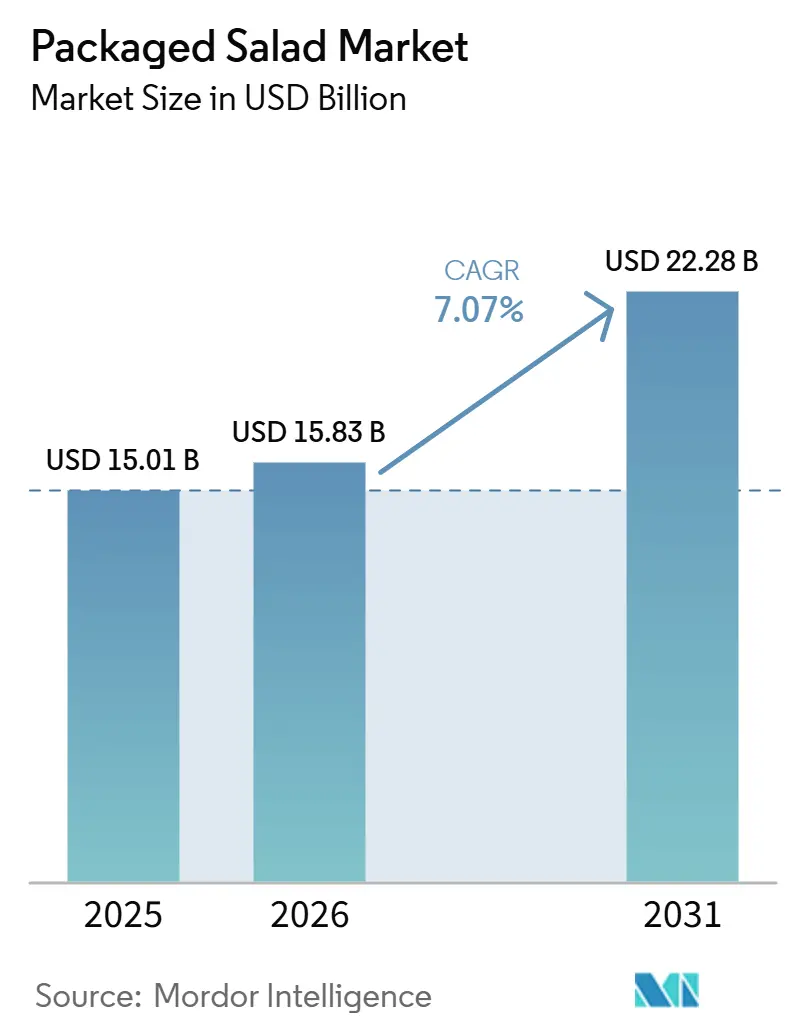
The packaged salad market size is projected to grow from USD 15.01 billion in 2025 and USD 15.83 billion in 2026 to USD 22.28 billion by 2031, registering a CAGR of 7.07% during 2026-2031. The market is moving beyond its traditional role as a side dish, as urban consumers increasingly choose complete salad kits for weekday meals. Modern grocery infrastructure and stronger refrigerated distribution networks are expanding the availability of chilled products. National dietary guidance that promotes vegetable consumption also provides retailers and brands with a consistent basis for health-focused positioning. Growth opportunities favor suppliers that can combine convenience, protein content, freshness, and dependable food safety while keeping prices within retailer expectations. Competition is expected to remain shaped by the balance between the scale advantages of integrated growers and the freshness claims of controlled-environment suppliers. The packaged salad market also relies on effective execution across farming, washing, packing, transportation, and store handling, as failures at any stage can affect product quality and increase waste. Suppliers that develop reliable retail partnerships are better positioned to introduce higher-value kits while maintaining the availability of core bagged products. The market is therefore expected to reward companies that improve operations without making assortments difficult for shoppers to understand.
Key Report Takeaways
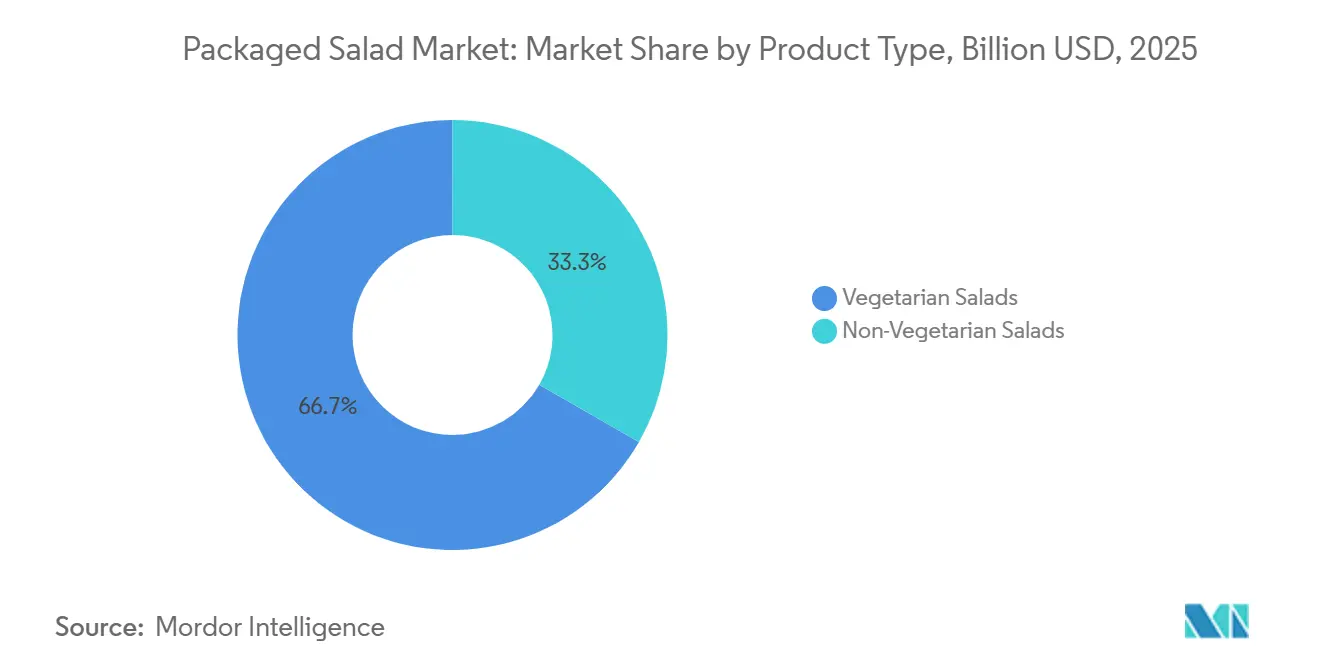
- By product type, vegetarian salads held 66.71% of the packaged salad market share in 2025, while non-vegetarian salads are forecast to grow at an 8.46% CAGR through 2031.
- By nature, conventional products held 69.51% share in 2025, while organic products are forecast to grow at a 9.88% CAGR through 2031.
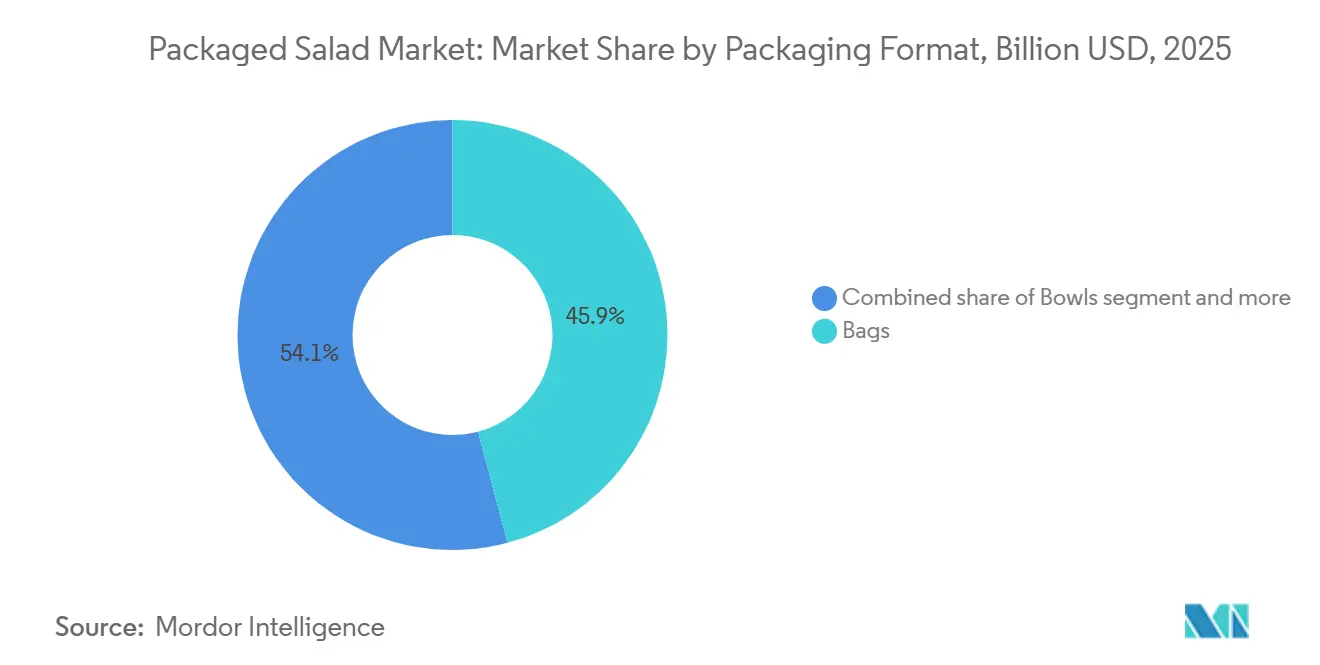
- By packaging format, bags held 45.89% share in 2025, while bowls are forecast to grow at an 8.54% CAGR through 2031.
- By distribution channel, retail held 87.13% share in 2025, while foodservice is forecast to grow at a 9.51% CAGR through 2031.
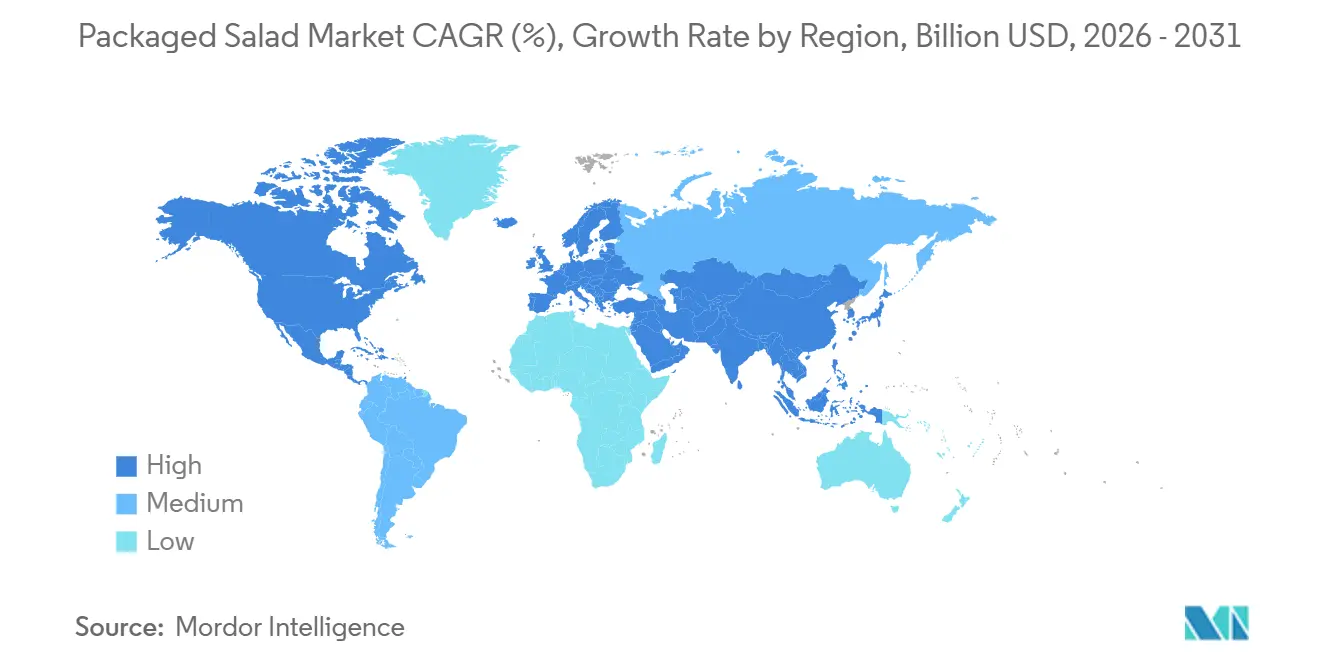
- By geography, North America held 43.9% share in 2025, while Asia-Pacific is forecast to grow at a 9.68% CAGR through 2031.
Note: Market size and forecast figures in this report are generated using Mordor Intelligence’s proprietary estimation framework, updated with the latest available data and insights as of January 2026.
Market Trends and Insights
Drivers Impact Analysis of Packaged Salad Market*
| Driver | (~) % Impact on CAGR Forecast | Geographic Relevance | Impact Timeline |
|---|---|---|---|
| Health and wellness orientation | +1.8% | Global | Long term (≥ 4 years) |
| Convenience-led meal replacement demand | +1.2% | North America and Europe | Medium term (2–4 years) |
| Expansion of modern grocery and food-to-go retail | +0.9% | The Asia-Pacific South America | Medium term (2–4 years) |
| Plant-based and protein-enriched product innovation | +0.7% | Global | Medium term (2–4 years) |
| Retailer private-label and meal-deal expansion | +0.8% | Europe and North America | Short term (≤ 2 years) |
| Controlled-environment agriculture and local supply windows | +0.6% | North America and Europe | Long term (≥ 4 years) |
| Source: Mordor Intelligence | |||
Health and wellness orientation
Health and wellness motivation remains the deepest structural driver in the packaged salad market, and its influence is shifting from surface-level positioning to genuine product reformulation. According to the Organic Produce Network, US organic produce retail sales are expected to reach USD 10.6 billion in 2025, growing approximately five times faster than conventional produce, with packaged salads ranking second among all organic produce categories at USD 1.4 billion in sales[1]Source: Organic Produce Network, “State of Organic Produce 2025: Packaged Salads No. 2 in Sales,” Organic Produce Network, organicproducenetwork.com.. Functional salad development represents the more consequential trend. Products formulated around specific health outcomes, such as gut health through fermented ingredients, immune support from superfood greens, and energy support through high-protein add-ons, are capturing a disproportionate share of new product launches. In November 2025, Factor and Sakara are expected to partner to launch a range of high-protein, high-fiber, ready-to-eat salads designed to support energy and cognitive function, signaling that performance nutrition is entering the packaged salad format, according to businesswire.com. The implication for manufacturers is clear: generic “fresh and healthy” positioning is no longer sufficient, and clinical or functional credentialing represents the next frontier of differentiation.
Convenience-led meal replacement demand
Convenience is expanding the addressable occasion for packaged salads, moving the category beyond lunch supplements into primary weekday meal slots. In France, the SVFPE (Syndicat des fabricants de produits végétaux prêts à l'emploi) reported a 10% year-on-year increase in bagged salad and ready-to-use vegetable sales through supermarkets, hypermarkets, and drive channels during the first four months of 2025 compared with the same period in 2024. The organization also noted that 64% of French buyers cited ready-to-use convenience as their primary purchase rationale. Meal-kit salad formats, which combine greens, toppings, protein, and dressing in a single package, are capturing incremental demand that conventional grocery categories cannot address. The corporate wellness channel is also emerging as a secondary, underappreciated growth driver. As hybrid work models become more established, cafeteria operators and third-party catering firms are standardizing pre-portioned salad components to manage variable footfall and reduce overproduction. This shift in B2B foodservice sourcing gives producers access to higher-volume revenue streams with lower marketing costs compared with branded retail channels.
Controlled-environment agriculture and local supply windows
Controlled-environment agriculture (CEA) investment is reshaping competitive advantage in the packaged salad category by shortening harvest-to-shelf timelines and reducing weather-related supply volatility. In March 2026, Taylor Farms is expected to acquire Equinox Growers, the largest commercial greenhouse in the Mid-Atlantic region (Louisa, Virginia), marking its largest CEA investment to date. The company noted that the CEA lettuce segment is expanding by approximately 25% year-over-year across packaged salad SKUs. In July 2026, Hippo Harvest, an organic leafy greens grower powered by robotics and machine learning, is expected to close a USD 30 million Series C funding round led by Cox Farms, North America’s largest greenhouse operator. The funding will support a 30-acre expansion designed to scale indoor spinach and butter lettuce production. Hippo Harvest’s system uses 92% less water and 94% less land than field agriculture. Strategically, CEA-sourced inventory, while currently representing a small share of total volume, acts as a pricing hedge during field crop disruptions and supports differentiation for freshness-premium SKUs. As a result, large-scale salad producers are prioritizing CEA integration.
Plant-based and protein-enriched product innovation
Protein enrichment is the product innovation vector most likely to increase the ready-to-eat salad market’s per-occasion value and attract new consumer cohorts. Producers must bridge the gap between the category’s leafy green core, which is inherently low in protein, and consumer expectations shaped by high-protein diet trends. Several producers are addressing this gap through kitted formats that combine chicken, seafood, egg, or plant-based protein add-ons within a single packaged salad unit. This trend supports the strong growth of Non-Vegetarian Salads, which are expected to be the fastest-growing product type in the market (8.46% CAGR, 2026-2031), even as Vegetarian Salads hold the dominant share. On the plant-based side, Wildbrine’s planned early-2025 launch of the first-ever packaged fermented bean salad at Whole Foods Markets, a chickpea-based format offering protein, fiber, and live fermentation, demonstrates that fermentation technology is emerging as a credible innovation pathway within the packaged salad category. For manufacturers, protein-enriched formats create meaningful pricing power, as kitted salads command substantial premiums over standard bagged greens and improve category economics.
Restraints Impact Analysis of Packaged Salad Market*
| Restraint | (~) % Impact on CAGR Forecast | Geographic Relevance | Impact Timeline |
|---|---|---|---|
| Short shelf life and perishability | -0.6% | Global | Short term (≤ 2 years) |
| Food safety and microbial contamination exposure | -0.4% | North America and Europe | Medium term (2–4 years) |
| Retail waste, markdown, and margin pressure | -0.5% | North America and Europe | Medium term (2–4 years) |
| Packaging sustainability and compliance costs | -0.3% | Europe core, spill-over to North America | Long term (≥ 4 years) |
| Source: Mordor Intelligence | |||
Food safety and microbial contamination exposure
Microbial contamination remains the most significant structural restraint in the packaged salad category, as each outbreak, regardless of its isolated origin, weakens purchase intent across the category. Between 2015 and 2024, the U.S. FDA classified recalls for approximately 240 packaged salad products due to potential Listeria monocytogenes contamination. During the same period, eight United States listeriosis outbreaks were directly linked to packaged salads. The most recent concurrent outbreaks, published in CDC Emerging Infectious Diseases in 2025, involved 30 illnesses, 27 hospitalizations, and four deaths across two genetically unrelated strains traced to separate facilities[2]Source: J. M. Ogorek et al., “Two Concurrent Outbreaks of Listeria monocytogenes Infections Linked to Packaged Salads,” CDC Emerging Infectious Diseases, cdc.gov.. In Australia, a 2025 mass recall covering more than 20 SKUs across Coles, Woolworths, Aldi, and IGA due to Shiga toxin-producing E. coli (STEC) contamination showed that this hazard is not confined to a single geography or supply chain model, according to Food Standards Australia New Zealand[3]Source: Food Standards Australia New Zealand, “Woolworths Various Fresh Cut Salad Products: Recall Notice,” Food Standards Australia New Zealand, foodstandards.gov.au.. Contamination creates hidden costs beyond recall logistics by suppressing category trial in the months following a high-profile event. This dynamic disproportionately affects new market entrants, which often lack the brand equity needed to rebuild consumer trust quickly. The FDA’s expanded FSMA Produce Safety Rule compliance requirements are increasing baseline pathogen-monitoring expenditure for all producers, particularly compressing margins among mid-tier players.
Short shelf life and perishability
Standard modified atmosphere packaged (MAP) salads have a shelf life of 5-7 days, creating a persistent tension between supply-chain length and product quality. This constraint becomes more limiting as the market expands into geographies with less mature cold-chain infrastructure. In Italy alone, consumers purchase approximately 84 million salad bags each month. However, consumer-level waste averages 88 discarded bags per household annually, reflecting a mismatch between pack sizes and actual consumption occasions, according to Preprints.org. This waste burden affects retailers through frequent markdowns and unsaleable shrink, both of which erode producer margins through return or destruction credits. In emerging markets, cold-chain gaps, particularly last-mile refrigeration deficits in smaller-format stores, limit category penetration to modern trade clusters in tier-1 cities. As a result, large addressable populations remain effectively unreachable without infrastructure investment. Advanced MAP gas formulations and bio-based barrier films are gradually extending shelf life, but cost constraints continue to limit their widespread adoption in cost-sensitive segments.
*Our forecasts treat driver/restraint impacts as directional, not additive. The impact forecasts reflect baseline growth, mix effects, and variable interactions.
Packaged Salad Market Segment Analysis
By Product Type:
Non-Vegetarian Formats Accelerate Above CategoryThe non-vegetarian salads segment is expected to be the fastest-growing product type, registering an 8.46% CAGR during 2026-2031, driven by consumer demand for high-protein, meal-complete salad formats. Chicken- and turkey-based kits have become retail staples across North America and Western Europe, where QSR chains, supermarket prepared-food sections, and direct-to-consumer meal delivery services have positioned protein-inclusive salads as primary lunch options. Seafood- and egg-based variants are expanding from smaller bases, with seafood options gaining notable traction in Japan and coastal European markets, where fresh fish integration is culturally embedded. The Factor × Sakara partnership (November 2025) is expected to highlight how premium non-vegetarian ready-to-eat (RTE) salad formats are moving into performance nutrition positioning, with products designed for energy management and cognitive function. This positioning supports higher ticket prices and attracts a consumer cohort that is unlikely to purchase standard bagged greens.
Vegetarian salads accounted for a 66.71% share in 2025, with leafy green salads remaining the dominant sub-format. Vegetable salads and grain-based salads are expanding within the vegetarian bracket as consumers seek more textured and filling options beyond simple lettuce mixes. Fruit salads, while a smaller segment, are benefiting from crossover demand tied to snacking occasions in Asia-Pacific markets. The key structural challenge within the vegetarian segment is commoditization. Standard leafy green bags face intense private-label competition and offer limited differentiation potential, while grain-based salads and specialty green blends support stronger margin profiles. Producers that shift consumers from commodity bagged greens to chef-curated vegetarian kits or certified organic blends are expected to capture disproportionately higher value during the forecast period.


By Nature:
Organic Premium Resilient Despite Near-Term Price SensitivityOrganic is projected to be the fastest-growing nature segment, registering a CAGR of 9.88% during 2026-2031. It is expected to outpace the conventional segment, which is projected to maintain a structurally dominant share of 69.51% in 2025. US organic packaged salad retail sales are expected to reach USD 2.9 billion in 2025, with the Organic Trade Association indicating that organic produce, as a whole, is set to grow approximately five times faster than conventional produce in the same year. This growth gap is significant. Organic packaged salads carry a 68.8% price premium over conventional equivalents, yet volume growth is expected to remain resilient because organic buyers show stronger brand loyalty and lower price sensitivity than occasional category purchasers. Olivia's Organics' planned launch of its Organic Greenhouse Salad Program in 2025, which targets freshness and nutrient density through CEA sourcing, shows how organic and CEA investments are converging into a single premium proposition.
Conventional salads are expected to remain dominant by volume, but the segment is becoming increasingly bifurcated. Standard commodity formats face sustained margin compression from the expansion of retailer own-label products, while premium conventional variants, such as chef-curated kits and heritage green blends, generate better economics. USDA Organic certification serves as a critical compliance framework for producers seeking access to natural/specialty retail channels and health-positioned foodservice operators. The key risk for conventional producers is that erosion from organic products at the premium end and lower-cost private-label products at the value end may create a "margin middle" with limited defensibility during the 2026-2031 forecast period.
By Packaging Format:
Bowl Formats Redefine the Meal-Salad ExperienceBags are expected to retain the largest share among packaging formats, at 45.89% in 2025, supported by their dominance in value-segment retail and bulk foodservice supply. Bowls are projected to be the fastest-growing format, registering an 8.54% CAGR during 2026-2031. Their growth is driven by structural advantages in premium-positioned, meal-complete salad kits. Transparent PET or RPET bowls with integrated dressing compartments allow consumers to assess freshness before purchase while keeping ingredients separated until consumption. Clamshell containers and trays serve distinct market niches. Clamshells are better suited to single-serve, on-the-go formats in convenience and travel retail, while trays are preferred for value-added prepared salad lines in Europe’s chilled food-to-go category. Other packaging formats continue to account for a minor segment.
Packaging evolution is not solely driven by consumer preference, as sustainability regulations are reshaping material choices across formats. The EU’s PPWR (Regulation 2025/40) is expected to require all packaging to be recyclable by 2030, accelerating trials of mono-material MAP films that replace multi-layer laminates and bio-based paper bowls with hermetic sealing. Duni Group’s planned 2026 launch of its Sealable Ronda paper bowl for ready-to-eat salads demonstrates this shift, combining FSC-certified materials with MAP functionality. For producers, the bowl-versus-bag dynamic ultimately depends on channel economics. Bags remain the most cost-effective option for volume retail and foodservice supply, while bowls serve as the preferred format for premium branded positioning and convenience-channel SKUs.

By Distribution Channel:
Foodservice Demand Accelerates Behind Labour EconomicsRetail is projected to command an 87.13% share in 2025, with supermarkets and hypermarkets dominating physical shelf allocation for both branded and private-label packaged salads. Within the retail sub-segment, online grocery is expected to be the fastest-growing retail channel. However, cold-chain logistics and product perishability continue to constrain fulfillment models compared to ambient grocery categories. Specialty stores and convenience formats are also growing as grab-and-go meal occasions increase, with convenience retail now offering multi-component salad kits at price points historically limited to full-service supermarkets.
Foodservice is projected to be the fastest-growing channel, registering a 9.51% CAGR during 2026-2031. A key structural driver, often underappreciated, is that packaged salad components help foodservice operators, from QSR chains to corporate cafeterias, reduce in-house vegetable preparation labor while maintaining consistent menu quality. In the healthcare and education sectors, nutrition mandates are driving institutional adoption of pre-portioned, calorie-labeled salad formats that comply with dietary guidelines without requiring skilled kitchen staff. The B2B foodservice channel also gives producers a pathway to absorb supply that would otherwise face markdowns in retail, providing a volume buffer during periods of oversupply. Private label in foodservice, where operators source unbranded salad kits under their own café or canteen brands, is becoming a growing revenue stream for mid-size producers seeking to diversify beyond branded retail accounts.
Geography Analysis
North America Packaged Salad Market
North America is expected to account for 43.9% of global sales in 2025, supported by established cold-chain logistics, extensive supermarket refrigeration infrastructure, and long-standing consumer familiarity with chilled convenience foods. California's Central Valley remains an important supply base for field-grown leafy greens used in branded and private-label programs. Taylor Farms' expected 2026 purchase of Equinox Growers in Virginia highlights the growing value of supply sources located close to eastern population centers. Canada offers a smaller growth area as local greenhouse suppliers strengthen retail relationships around domestic production, while Mexico presents longer-term potential as modern grocery stores expand. The region's scale gives established suppliers a logistics advantage, but recalls can quickly influence retailer buying decisions.
Europe Packaged Salad Market
Europe is the second-largest regional area for the packaged salad market, supported by the United Kingdom's meal-deal culture and mature demand in France, Germany, Spain, and other Western European countries. France produced 109,000 tonnes of ready-to-use vegetables in 2023, supporting an established production base. Germany generates meaningful demand for organic and sustainably sourced products, while Spain plays an important role as both a production location and a private-label market. Primaflor is expected to report EUR 205 million in 2025 revenue, equivalent to USD 222 million, and produce more than 500 million salads annually from the supplied material. European producers also face the immediate task of changing packaging formats to meet the 2030 recyclability requirement.
APAC, South America and MEA Packaged Salad Market
Asia-Pacific is forecast to grow at a CAGR of 9.7% through 2031, making it the fastest-growing region in the packaged salad market. China and India are expected to contribute much of the added volume as modern retail expands in major cities. Urban consumers are becoming more familiar with convenient refrigerated food, although cold-chain coverage remains less consistent than in North America or Western Europe. Japan and Australia have more mature demand, where functional greens, organic products, and specialty lettuce varieties can support value growth. South America presents a smaller emerging opportunity, led by Brazil and a strengthening supermarket base. The Middle East and Africa remain early-stage markets, with the United Arab Emirates, Saudi Arabia, Nigeria, Egypt, and Morocco supported by urbanization, retail development, and gradually improving refrigerated logistics.

Competitive Landscape
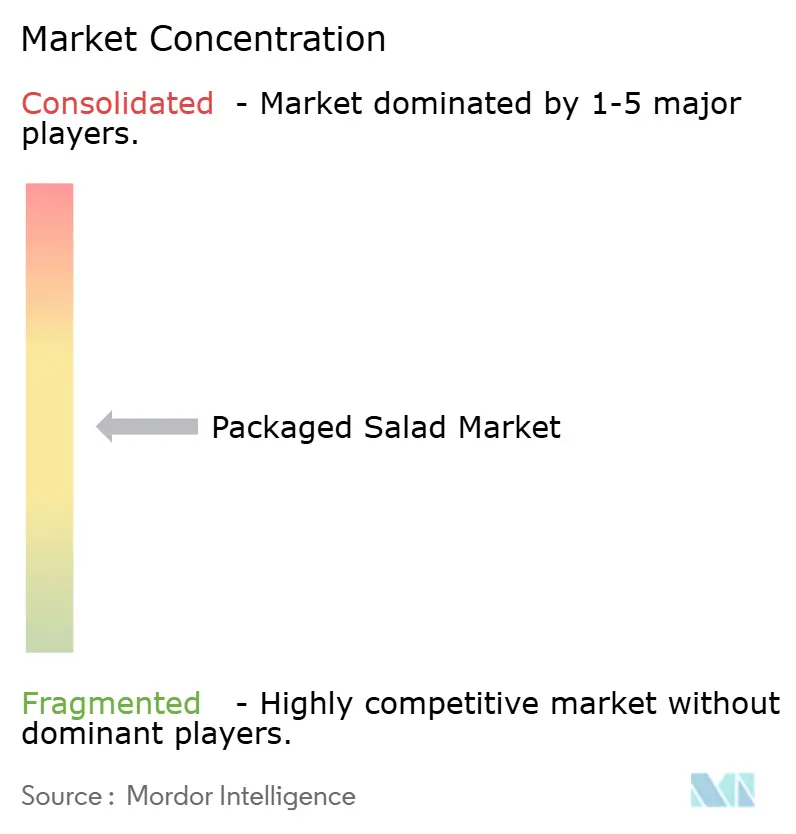
The packaged salad market is moderately concentrated in high-volume supply but remains fragmented across regional, premium, and controlled-environment producers. Vertically integrated companies hold an advantage because they coordinate field cultivation, processing, branded supply, and large private-label contracts. This structure reduces logistics costs and helps suppliers meet retailer requirements for consistent volume. The supplied material cites Taylor Farms and Foodiverse’s acquisition of Bonduelle's two German salad plants in April 2025, with the facilities operating under the Greenfresh brand. The transaction highlights how leading suppliers are pursuing cross-border scale in European private-label manufacturing. Smaller companies can compete by offering distinct freshness, provenance, or product propositions rather than trying to match the scale of large field growers.
Controlled-environment suppliers, such as Hippo Harvest, Haven Greens, and BrightFarms, offer retailers a different supply model. Their short harvest-to-shelf cycles strengthen freshness and traceability claims, which are especially valuable after food safety events. Taylor Farms' Equinox acquisition provides a clear example of an incumbent investing in this model. The supplied material also identifies Hippo Harvest’s July 2026 USD 30 million funding round as support for additional indoor spinach and butter lettuce capacity. These operators still need to demonstrate that their higher-cost production models can meet the price expectations of mainstream retailers.
Product development remains another major competitive route in the packaged salad market. Brands are using protein, fermented ingredients, organic certification, and globally inspired flavors to differentiate finished kits. The supplied material cites Fresh Express’ nationwide launch of its Mediterranean Herb Chopped Salad Kit in September 2025. It also cites Local Bounti’s introduction of its Romano Caesar Family-Size Salad Kit across 89 Walmart stores in the Pacific Northwest in October 2025. Automation, temperature tracking, and freshness monitoring can improve consistency and reduce processing contact points. As the source material does not provide a combined top-player share, a numeric concentration score cannot be assigned without introducing unsupported data.
Packaged Salad Industry Leaders
Taylor Fresh Foods, Inc.
Dole plc
Fresh Express Incorporated
Bonduelle Group
Fresh Del Monte Produce Inc.
- *Disclaimer: Major Players sorted in no particular order
Packaged Salad Market Companies Covered in this Report
- Taylor Fresh Foods, Inc.
- Dole plc
- Fresh Express Incorporated
- Bonduelle Group
- Fresh Del Monte Produce Inc.
- Bakkavor Group plc
- Gotham Greens Farms LLC
- BrightFarms, Inc.
- Earthbound Farm
- ORGANICGIRL, LLC
- Misionero, Inc.
- Apio, Inc.
- Ready Pac Foods, Inc.
- Green Giant
- Florette Group
- United Salad Co.
- Zina’s Salads, Inc.
- Saladworks, LLC
- Mann Packing Company, Inc.
- Bonduelle Fresh Americas

Recent Industry Developments in Packaged Salad Market
- March 2026: Taylor Farms acquired Equinox Growers, the largest commercial greenhouse in the Mid-Atlantic (Louisa, Virginia), from Generate Capital. This is Taylor Farms' largest CEA investment to date, expanding its leafy greens supply capacity and cold-chain integration for fresh packaged salad SKUs across Eastern US retailers.
- October 2025: Green Factory (Poland) completed the acquisition of Eisberg's Central and Eastern European subsidiaries (Poland, Hungary, Romania) from Bell Food Group. The combined entity operates 8 production facilities across 12 regional markets, with projected consolidated annual revenue exceeding PLN 1.3 billion (~USD 330 million), establishing Green Factory as the dominant ready-to-eat salad producer across CEE.
- April 2025: Taylor Farms and Foodiverse completed the acquisition of two of Bonduelle Group's German packaged salad production plants (Straelen and Reutlingen). The three German facilities now operate under the "Greenfresh" corporate brand, with Foodiverse managing European operations. Bonduelle retained a licensing agreement for packaged salad branding in Germany.


Global Packaged Salad Market Report Scope
A packaged salad is a convenience-based consumer food product consisting of pre-washed, pre-cut, and ready-to-eat leafy greens, vegetables, fruits, and meat products. The packaged salad market is segmented by product type, nature, packaging format, distribution channel, and geography. By product type, the market is segmented into vegetarian salads and non-vegetarian salads. The vegetarian salads segment is further sub-segmented into leafy green salads, vegetable salads, grain-based salads, fruit salads, and other vegetarian salads. Similarly, the non-vegetarian salads segment is further sub-segmented into chicken and turkey-based salads, seafood-based salads, and egg-based salads. By nature, the market is segmented into conventional and organic. By packaging format, the market is segmented into bags, bowls, trays, clamshell containers, and other packaging formats. By distribution channel, the market is segmented into foodservice and retail. The retail segment is further sub-segmented into supermarkets/hypermarkets, convenience stores, specialty stores, online retail stores, and other distribution channels. By geography, the market is segmented into North America, Europe, Asia-Pacific, South America, and the Middle East and Africa. The market forecasts are provided in terms of value (USD).
| Vegetarian Salads | Leafy Green Salads |
| Vegetable Salads | |
| Grain-Based Salads | |
| Fruit Salads | |
| Other Vegetarian Salads | |
| Non-Vegetarian Salads | Chicken and Turkey-based Salads |
| Seafood-based Salads | |
| Egg-Based Salads |
| Conventional |
| Organic |
| Bags |
| Bowls |
| Trays |
| Clamshell Containers |
| Other Packaging Formats |
| Foodservice | |
| Retail | Supermarkets/Hypermarkets |
| Convenience Stores | |
| Specialty Stores | |
| Online Retail Stores | |
| Other Distribution Channels |
| North America | United States |
| Canada | |
| Mexico | |
| Rest of North America | |
| Europe | United Kingdom |
| Germany | |
| France | |
| Italy | |
| Spain | |
| Sweden | |
| Belgium | |
| Poland | |
| Netherlands | |
| Rest of Europe | |
| Asia-Pacific | China |
| Japan | |
| India | |
| Thailand | |
| Singapore | |
| Indonesia | |
| South Korea | |
| Australia | |
| Rest of Asia-Pacific | |
| South America | Brazil |
| Argentina | |
| Colombia | |
| Peru | |
| Chile | |
| Rest of South America | |
| Middle East and Africa | United Arab Emirates |
| South Africa | |
| Saudi Arabia | |
| Nigeria | |
| Egypt | |
| Morocco | |
| Turkey | |
| Rest of Middle East and Africa |
| Product Type | Vegetarian Salads | Leafy Green Salads |
| Vegetable Salads | ||
| Grain-Based Salads | ||
| Fruit Salads | ||
| Other Vegetarian Salads | ||
| Non-Vegetarian Salads | Chicken and Turkey-based Salads | |
| Seafood-based Salads | ||
| Egg-Based Salads | ||
| Nature | Conventional | |
| Organic | ||
| Packaging Format | Bags | |
| Bowls | ||
| Trays | ||
| Clamshell Containers | ||
| Other Packaging Formats | ||
| Distribution Channel | Foodservice | |
| Retail | Supermarkets/Hypermarkets | |
| Convenience Stores | ||
| Specialty Stores | ||
| Online Retail Stores | ||
| Other Distribution Channels | ||
| Geography | North America | United States |
| Canada | ||
| Mexico | ||
| Rest of North America | ||
| Europe | United Kingdom | |
| Germany | ||
| France | ||
| Italy | ||
| Spain | ||
| Sweden | ||
| Belgium | ||
| Poland | ||
| Netherlands | ||
| Rest of Europe | ||
| Asia-Pacific | China | |
| Japan | ||
| India | ||
| Thailand | ||
| Singapore | ||
| Indonesia | ||
| South Korea | ||
| Australia | ||
| Rest of Asia-Pacific | ||
| South America | Brazil | |
| Argentina | ||
| Colombia | ||
| Peru | ||
| Chile | ||
| Rest of South America | ||
| Middle East and Africa | United Arab Emirates | |
| South Africa | ||
| Saudi Arabia | ||
| Nigeria | ||
| Egypt | ||
| Morocco | ||
| Turkey | ||
| Rest of Middle East and Africa | ||


Key Questions Answered in the Report
What is the projected size of the packaged salad category by 2031?
The category is forecast to reach USD 22.28 billion by 2031, growing at a 7.07% CAGR from 2026. This outlook reflects broader use of ready-to-eat kits as complete meals and the continuing expansion of refrigerated grocery formats.
Which product type is growing fastest?
Non-vegetarian salads are forecast to grow at an 8.46% CAGR through 2031, supported by demand for complete, protein-inclusive meals. Chicken, turkey, egg, seafood, and plant-based additions help make a salad a more filling lunch or evening meal option.
Why are organic packaged salads growing faster than conventional products?
Organic products are forecast to grow at a 9.88% CAGR, supported by certification, brand loyalty, and premium positioning. Suppliers also use greenhouse sourcing and product provenance to explain the higher price compared to conventional alternatives.
Which sales channel has the strongest growth outlook?
Foodservice is forecast to expand at a 9.51% CAGR because pre-portioned components can reduce preparation labor for operators. Cafeterias, quick-service restaurants, schools, and healthcare providers can use them to maintain portions and menu consistency.
Page last updated on:





