
Packaged Currants Market Size and Share
Market Overview
| Study Period | 2022 - 2032 |
|---|---|
| Market Size (2027) | USD 1.20 Billion |
| Market Size (2032) | USD 1.59 Billion |
| Growth Rate (2027 - 2032) | 5.80 % |
| Fastest Growing Market | Asia-Pacific |
| Largest Market | Europe |
| Market Concentration | Low |
Major Players *Disclaimer: Major Players sorted in no particular order Image © Mordor Intelligence. Reuse requires attribution under CC BY 4.0. | |
Packaged Currants Market Analysis by Mordor Intelligence
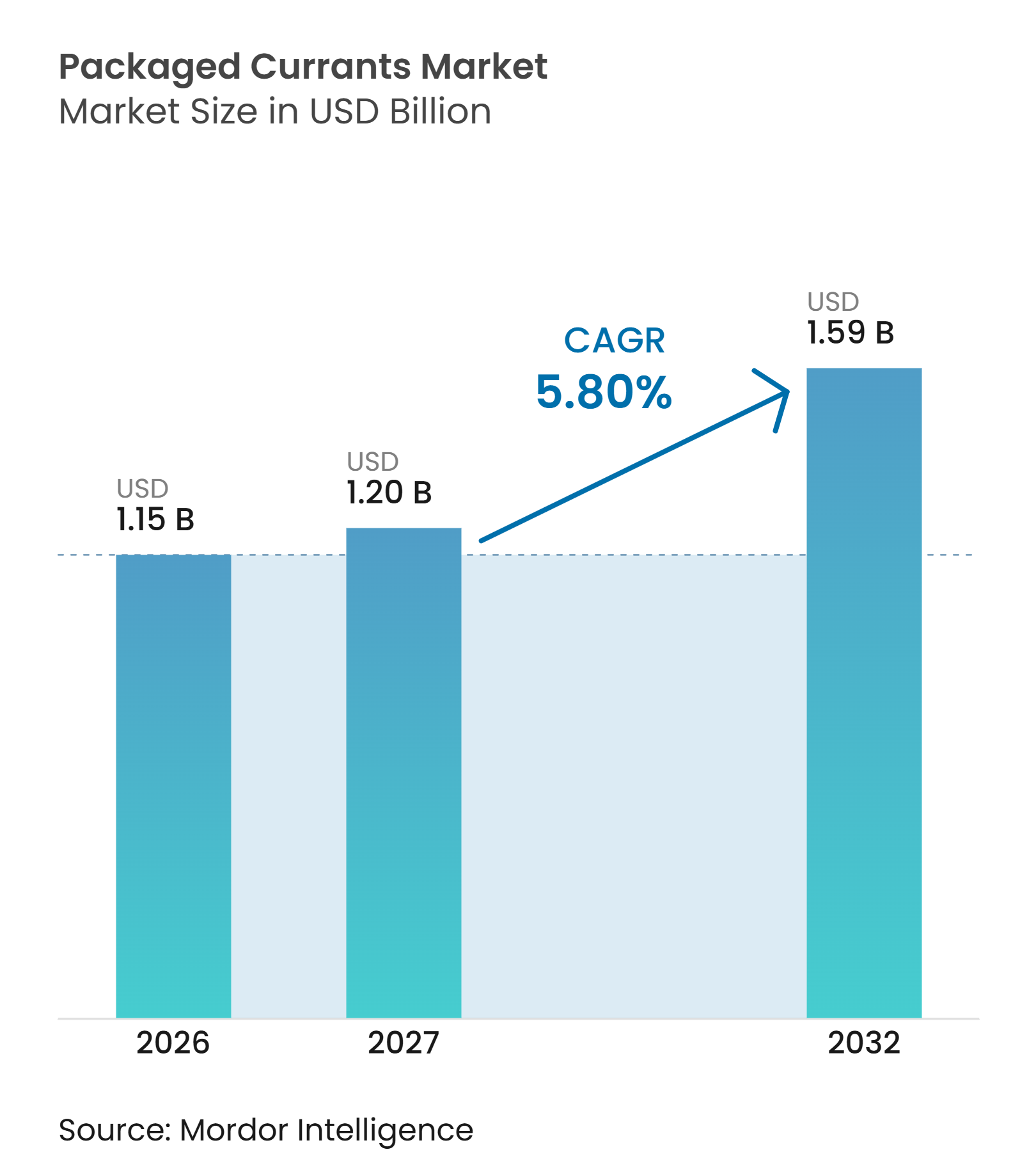
The packaged currants market size was valued at USD 1.15 billion in 2026 and is estimated to grow from USD 1.2 billion in 2027 to reach USD 1.59 billion by 2032, at a CAGR of 5.8% during the forecast period (2027-2032). The packaged currants market is moving from a seasonal berry category toward year-round retail, foodservice, and ingredient use. Blackcurrants, redcurrants, and white currants support different applications, including snacking, baking, juice concentrates, confectionery, and nutritional products. Investment in drying, freezing, refrigerated handling, and product processing is making supply available in more formats and locations, although output remains sensitive to weather in key growing areas and the harvest calendar remains concentrated. Demand for clean-label foods and products with naturally occurring color and flavor supports premium positioning, while synthetic flavorings limit adoption in price-sensitive processed applications. The packaged currants market remains fragmented, which leaves room for suppliers that can combine consistent sourcing, traceability, and suitable formats for customers across retail, foodservice, and industrial ingredient channels.
Key Report Takeaways
-
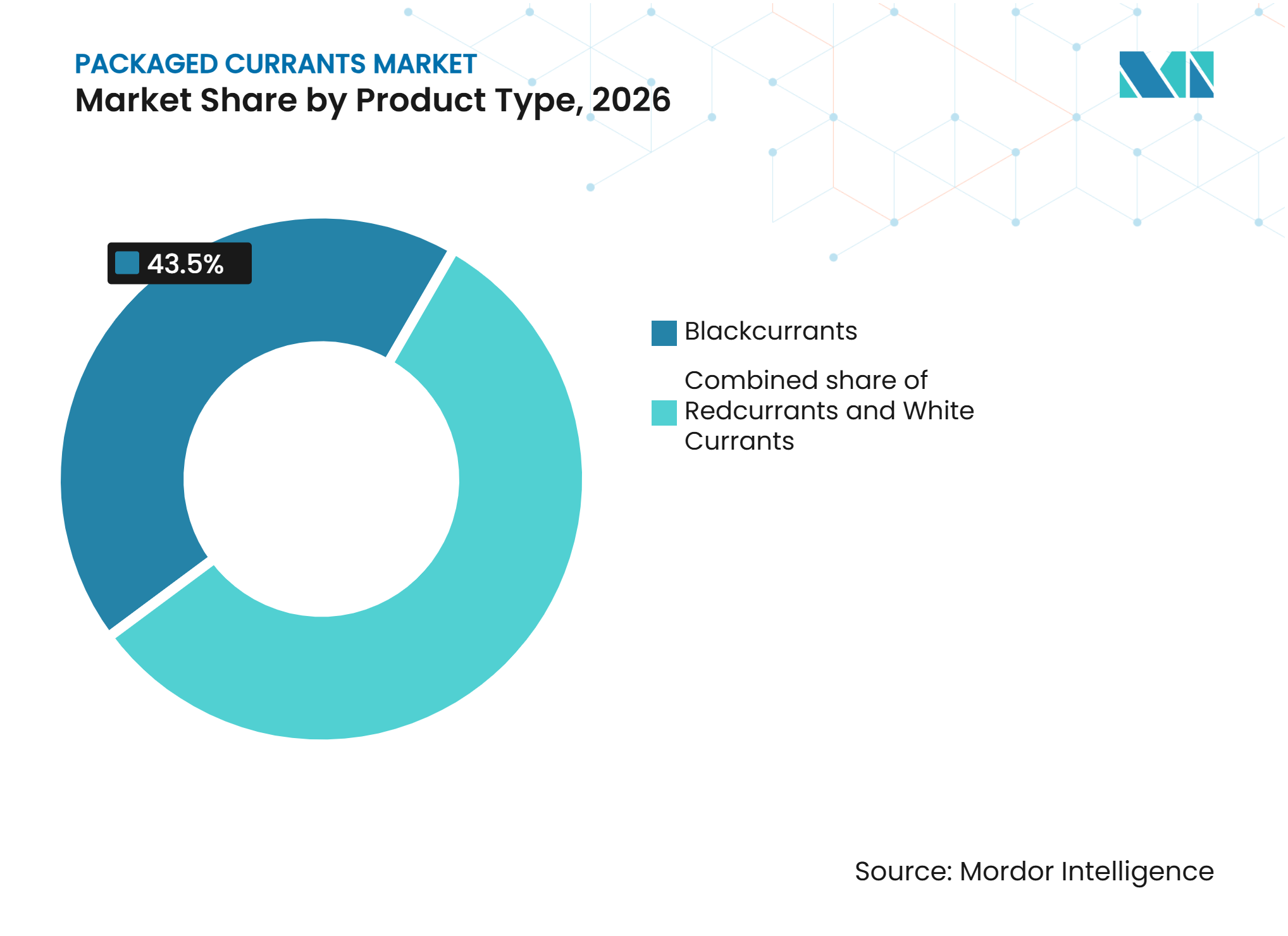
By product type, blackcurrants held 43.5% of the packaged currants market share in 2026, while white currants are projected to grow at a CAGR of 6.7% through 2032.
-
By category, conventional products accounted for 75.6% of the packaged currants market share in 2026, while organic currants are forecast to expand at a CAGR of 7.2% through 2032.
-
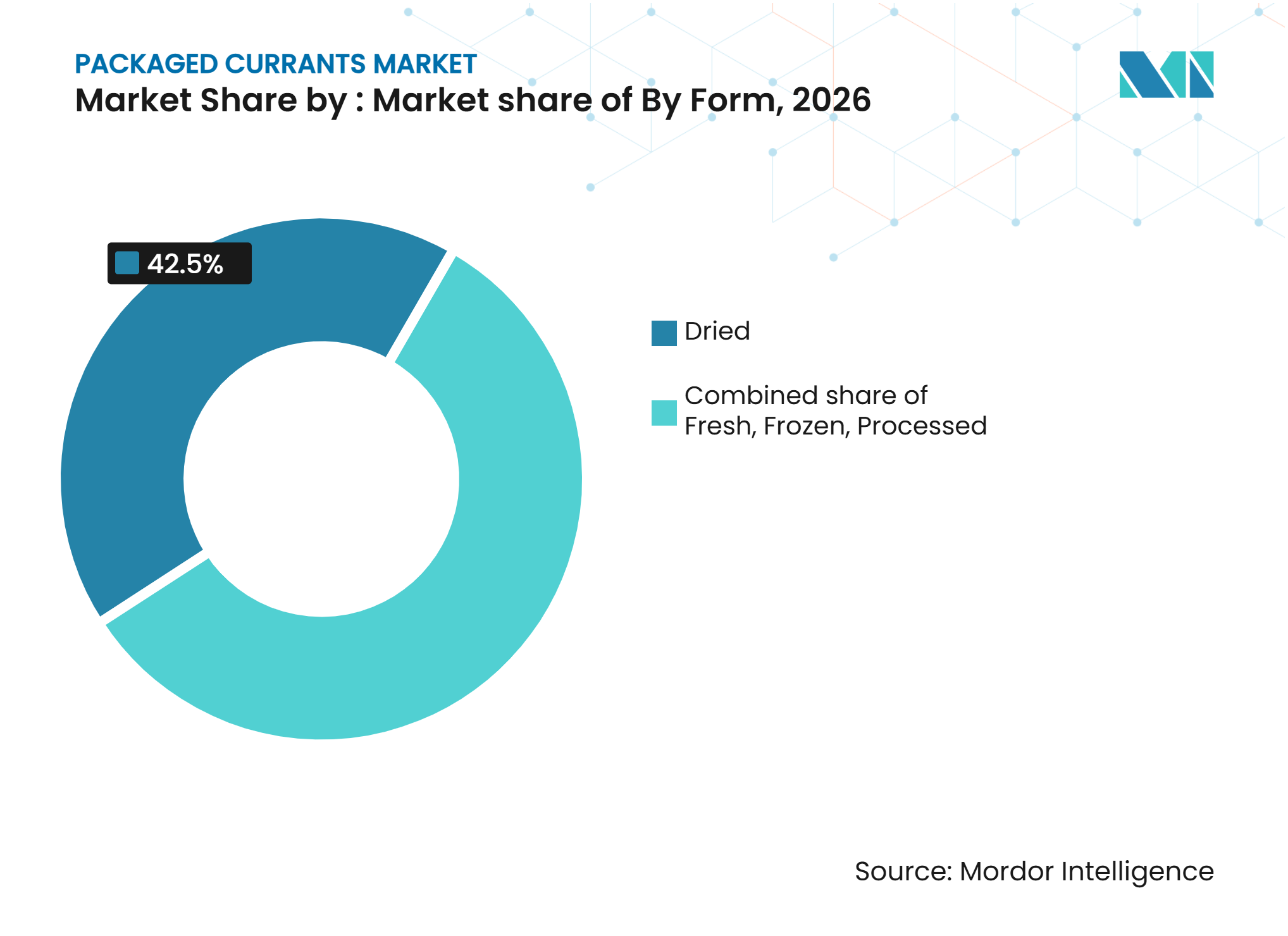
By form, dried currants accounted for 42.5% of the packaged currants market size in 2026, while fresh currants are projected to advance at a CAGR of 7.8% through 2032.
-
By end user, retail held 56.3% of the packaged currants market share in 2026, while foodservice is forecast to grow at a CAGR of 6.8% through 2032.
-
By geography, Europe accounted for 38.7% of the packaged currants market size in 2026, while Asia-Pacific is expected to grow at a CAGR of 7.5% through 2032.
Note: Market numbers in this report are based on Mordor Intelligence's proprietary estimation framework, which combines nine months of actuals with Q4 projections for base year 2026.
Market Trends and Insights
Drivers Impact Analysis of Packaged Currants Market*
| Driver | (~) % Impact on CAGR Forecast | Geographic Relevance | Impact Timeline |
|---|---|---|---|
| Expansion of Functional and Fortified Foods | +1.2% | Global, with early gains in North America, the United Kingdom, Germany, and Japan | Medium term (2-4 years) |
| Rising Demand for Clean-Label and Natural Ingredients | +1.0% | North America and Western Europe, including the United Kingdom, Germany, and France | Medium term (2-4 years) |
| Growth of Plant-Based and Vegan Diets | +0.7% | North America, Northern Europe, and urban Asia-Pacific | Long term (≥ 4 years) |
| Product Innovation and New Formats | +0.6% | North America, the United Kingdom, Australia, and South Korea | Medium term (2-4 years) |
| Convenience and On-The-Go Snacking | +0.5% | Asia-Pacific, with spillover to the Middle East and Africa and established demand in North America and Europe | Short term (≤ 2 years) |
| Expansion of E-Commerce and Online Retail | +0.4% | Asia-Pacific, including China, India, and Southeast Asia, and North America | Short term (≤ 2 years) |
| Source: Mordor Intelligence | |||
Expansion of Functional and Fortified Foods
The packaged currants market benefits when blackcurrants are bought as functional ingredients rather than only as seasonal fruit. Their established use in juice concentrates, confectionery, and nutrition-focused formulations broadens demand beyond retail packs. FranceAgriMer reports that more than 80% of domestically produced French blackcurrants enter processed products such as jam, pastry, and crème, showing the importance of industrial demand to the category. This processor demand can support higher-value uses for blackcurrant formats, including concentrates and extracts. A concentrated buying base can also reduce spot availability when contracted processors secure supply in advance. The packaged currants market therefore depends on processors balancing ingredient requirements with retail demand during tighter harvest years.
Rising Demand for Clean-Label and Natural Ingredients
Clean-label requirements are strengthening the importance of traceability and residue management in the packaged currants market. Retailers and food manufacturers increasingly require documented sourcing and testing records before placing berries in premium food products. The European Union framework governing pesticide residues provides a compliance reference for berry suppliers serving European food channels. In Baden-Württemberg, certified organic currant area represented 12% of shrub berry area in 2025, and organic blackcurrant production increased 84% year over year[1]. These requirements can raise sourcing and certification costs for processors that lack established certified suppliers. They also support higher-value positions for organic packs and ingredient products when buyers can verify origin and production practices.
Growth of Plant-Based and Vegan Diets
The packaged currants market is supported by wider demand for plant-sourced foods with simple ingredient lists. Currants offer natural tartness, color, and fruit content in bars, dairy alternatives, and other foods that seek plant-based positioning. The European Commission continues to position the Farm to Fork Strategy around a fair, healthy, and environmentally friendly food system. That policy direction supports investment and shelf space for plant-derived and organic food choices across Europe. The shift also supports ingredient selection that relies on recognizable plant-derived components rather than artificial flavor systems. The opportunity for currant suppliers lies in formats that fit these purchasing occasions without relying only on conventional dried-fruit uses.
E-Commerce Growth Opens Underserved Distribution Corridors
Online retail reduces the need for a packaged currant supplier to secure immediate national shelf distribution. Digital grocery and marketplace channels can carry specialty dried, frozen, and premium berry products where physical store assortment remains limited. These channels give suppliers a practical route to test pack formats and product descriptions before investing in a wider physical rollout. They also allow specialty currants to reach buyers outside established grocery catchment areas. Suppliers can use online channels to explain origin, variety, preparation, and storage in more detail than a small retail shelf label permits. These channels allow suppliers to test demand in markets where currants have limited retail history. They also increase the value of pack sizes, shelf-life performance, and clear product information because consumers cannot inspect the product before purchase.
Restraints Impact Analysis of Packaged Currants Market*
| Restraint | (~) % Impact on CAGR Forecast | Geographic Relevance | Impact Timeline |
|---|---|---|---|
| Seasonal Availability and Supply Volatility | -0.9% | Global, most acute in Poland, Ukraine, Germany, France, and New Zealand | Short term (≤ 2 years) |
| Regulatory Compliance Complexity | -0.4% | European Union and United Kingdom, with relevance in North America and Asia-Pacific import markets | Medium term (2-4 years) |
| Competition from Synthetic and Artificial Flavorings | -0.7% | Global, most pronounced in price-sensitive Asia-Pacific and Middle East and Africa segments | Medium term (2-4 years) |
| Technological Adoption Challenges | -0.3% | Emerging producers in Asia-Pacific and South America, and smaller European processors | Long term (≥ 4 years) |
| Source: Mordor Intelligence | |||
Seasonal Availability and Supply Volatility
The packaged currants market faces supply risk because blackcurrant production is concentrated and harvest windows are short. Poland supplied 78.7% of EU-27 blackcurrant production during 2021 through 2025, making the region important to European processors and buyers. France produced enough domestic blackcurrants to cover 38% of its estimated need, leaving 62% reliant on Polish imports. The 2024 heat wave damaged half of the French cassis harvest, illustrating how weather can affect ingredient availability in a single season. Suppliers with multi-origin procurement and processing capacity are better placed to manage these swings. Smaller buyers may face higher input costs or interrupted availability when harvest conditions change.
Competition from Synthetic and Artificial Flavorings
Synthetic blackcurrant flavoring competes with natural currant ingredients in processed foods and beverages. Manufacturers can use flavor systems when they seek the cassis taste at a lower ingredient cost than natural fruit inputs. This is most relevant where price has greater influence over formulation decisions, including some Asia-Pacific and Middle East and Africa markets. The constraint is less severe in premium retail, foodservice, and clean-label applications, where buyers value real-fruit content and origin information. Conventional products held 75.6% of sales in 2026, while premium and organic suppliers must demonstrate a clear benefit beyond flavor alone. The packaged currants market can limit substitution risk by emphasizing formats that deliver visible fruit pieces, natural color, and documented sourcing.
*Our forecasts treat driver/restraint impacts as directional, not additive. The impact forecasts reflect baseline growth, mix effects, and variable interactions.
Packaged Currants Market Segment Analysis
By Product Type:
Blackcurrant Leads in Volume, White Currant Redefines the Premium TierBlackcurrants held 43.5% of packaged currant sales in 2026, giving them the leading product position. The segment’s scale reflects its established role across juice concentrates, confectionery, and packaged formats. Processing operations in Poland and Germany help make blackcurrants available as dried fruit, frozen fruit, and processed ingredients through the year. France’s processing sector directs more than 80% of domestic blackcurrant volume into products such as jam, pastry, and crème. This broad processing base supports both ingredient demand and retail supply. Blackcurrants also carry a strong functional-food position because of their use in nutrition-oriented applications. Their established industrial role makes the largest product segment less dependent on a single retail use case.
White currants are forecast to grow at a CAGR of 6.7% through 2032, the highest rate among product types. Their mild flavor and lower tannin profile support use in premium desserts, artisanal preserves, and culinary garnishes. The limited scale of commercial white currant cultivation creates a tighter supply base than blackcurrants or redcurrants. That condition supports premium pricing when specialty retailers and foodservice operators seek berry differentiation. Redcurrants remain relevant in bakery and premium jam applications because of their tart-sweet taste. However, their retail positioning is narrower than blackcurrants, which have deeper processing demand. The packaged currants market therefore combines a high-volume blackcurrant base with smaller varietal formats that create premium opportunities.



By Category:
Conventional Sustains Industrial Supply, Organic Captures Consumer PremiumConventional products accounted for 75.6% of sales in 2026, making them the core supply base for the category. The conventional packaged currants market size is supported by established farming and processing networks in Poland, Ukraine, and Germany. Industrial buyers often prioritize consistent volumes and stable procurement terms, which favors conventional supply. In France, Bourgogne-Franche-Comté accounted for 44% of national blackcurrant area and supplied processing uses including crème de cassis, jam, pastry, and ice cream. This supply base remains important for mainstream dried, frozen, and processed product applications. Yet conventional suppliers can face pressure when customers choose lower-cost synthetic flavor systems for processed products. They must therefore protect demand through reliable supply, visible fruit content, and practical formats.
Organic currants are forecast to grow at a CAGR of 7.2% through 2032. The segment is linked to buyers seeking certified inputs for clean-label retail and ingredient products. In Baden-Württemberg, organic currant cultivation accounted for 12% of total shrub berry area in 2025, and organic blackcurrants represented 17% of organic production following a 5% expansion in area. EU Organic Regulation 2018/848 sets production and certification requirements for products marketed as organic in the European Union. Certification can raise operating requirements, but it can also support a stronger value proposition for suppliers selling to premium buyers[2]. The organic currant category is therefore growing from a smaller base while conventional supply remains necessary for large-volume processing.
By Form:
Dried Form Anchors the Category, Fresh Signals a Consumer Preference ShiftDried currants accounted for 42.5% of packaged currant sales in 2026, making dried products the largest form segment. Their leading position reflects a long shelf life and established use in baking, snacking, and trail mixes. Dried fruit also provides a practical format for retailers because it is easier to store and distribute than fresh berries. The format can deliver natural sweetness and fruit content in prepared foods without the handling requirements of fresh fruit. Frozen currants occupy an important role for processors that need year-round specification and reliable ingredient inputs. FranceAgriMer reports that imported cassis is consumed primarily as juice or concentrate for syrups and beverages, underlining the role of processed forms in the supply chain. Dried, frozen, and processed formats together provide the stable availability needed for broad commercial use.
Fresh currants are projected to expand at a CAGR of 7.8% through 2032, the highest rate across the segmentation types. The fresh packaged currants market share remains smaller than dried products, but its growth reflects interest in premium and minimally processed fruit. Cold-chain development is essential because fresh currants require faster distribution and closer inventory management. Germany’s 2025 harvest produced 9,300 tonnes of red and white currants, a 37.3% increase from 2024 and the country’s largest output since 2012. That larger harvest improves the supply base for fresh-format development in continental Europe. Suppliers will need to align quality control, packaging, and distribution with the short shelf life of the product. The faster growth of fresh currants does not remove the central role of dried formats in the wider category.

By End User:
Retail Commands Volume, Foodservice Defines the Margin FrontierRetail held 56.3% of packaged currant sales in 2026, giving it the largest end-user position. Supermarkets, hypermarkets, convenience stores, specialty retailers, and online platforms all contribute to retail volume. Mainstream grocery stores offer dried currants in baking and health-food aisles, while specialty stores are more suited to organic and varietal products. Retail demand is shaped by package size, shelf life, health positioning, and price. Whitworths formed a strategic partnership with the British Dietetic Association in July 2025 to collaborate on nutrition policy, product development, and educational resources related to dried fruits, nuts, and seeds. Such activity shows how suppliers are strengthening the nutritional context of dried-fruit products sold through retail channels. The packaged currants market relies on retail for volume because it serves everyday snacking and home-baking occasions.
Foodservice is forecast to grow at a CAGR of 6.8% through 2032. The segment includes premium cafés, artisanal bakeries, composed-dessert concepts, and health-focused quick-service operators. Culinary teams can create repeat ingredient demand when a currant format becomes part of a menu or recipe range. This creates a more durable demand pattern than a single retail promotional period. Foodservice applications can also support premium pricing because the berry can contribute flavor, color, and a visible fruit element. Sun-Maid introduced Charcuterie Pairings in September 2026 as portioned dried-fruit and berry pouches aimed at social eating occasions. The release shows the broader dried-fruit category’s move toward entertaining and premium snacking occasions. Foodservice growth reinforces the value of flexible formats that work across desserts, bakery items, and plated dishes.
Geography Analysis
Europe
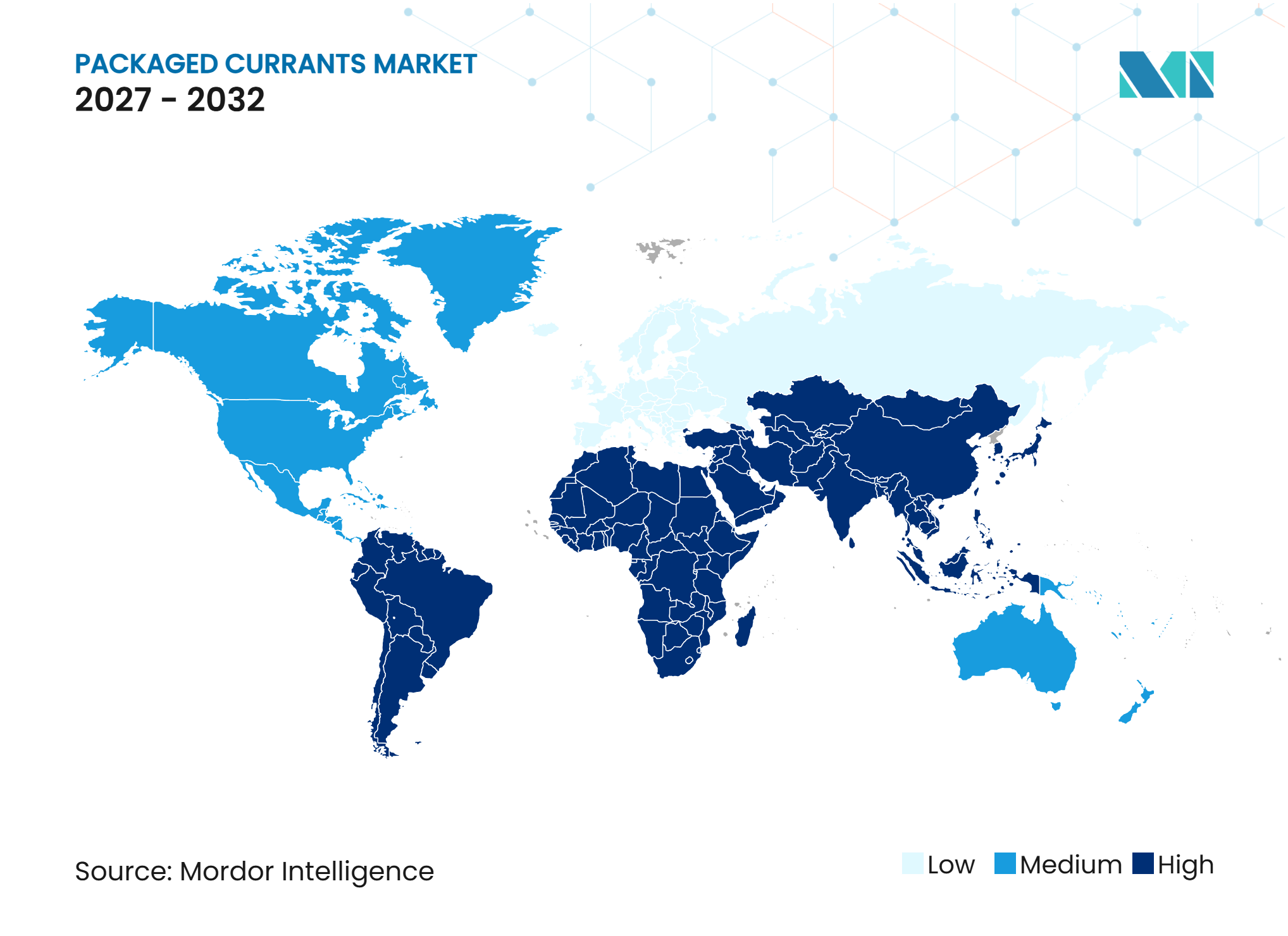
Europe held 38.7% of the packaged currants market share in 2026. The region has processing infrastructure across Poland, Germany, the United Kingdom, and France, supporting retail and ingredient demand. Poland supplied 78.7% of EU-27 blackcurrant output during 2021 through 2025. Germany harvested 45,700 tonnes of shrub berries in 2025, 23.5% more than in 2024 and the highest volume since 2012. Its blackcurrant harvest reached 5,900 tonnes, increasing 107.4% year over year, while red and white currants reached 9,300 tonnes, increasing 37.3%. France’s domestic production covers 38% of estimated blackcurrant need, leaving 62% dependent on imports from Poland. This dependence makes supply resilience and multi-origin sourcing important for European processors. EU pesticide-residue and organic rules add compliance requirements that support traceable, documented procurement.
Asia-Pacific
Asia-Pacific is forecast to grow at a CAGR of 7.5% through 2032. The region has lower established currant penetration than Europe, which creates room for new retail and online demand. E-commerce is a key access route because it lets suppliers reach consumers before broad physical distribution is built. Online channels can show consumers product formats, origin details, and serving ideas before the category gains a large in-store presence. This makes digital availability particularly useful for premium imported berry products and smaller specialty packs. India’s dry-fruit category is moving from bulk trading toward branded retail, which provides a relevant route for packaged fruit suppliers. China offers access to premium European berry products through cross-border e-commerce channels. Japan and South Korea provide receptive settings for nutrition-focused blackcurrant positioning in supplements and related products. Suppliers that provide clear origin, premium formats, and digital-ready packs are better aligned with this regional demand pattern.
Emerging Demand Pockets Complete the Global Picture
North America has historically had lower currant familiarity because blackcurrant cultivation was restricted across much of the United States during the 20th century over white pine blister rust concerns. State-level changes have gradually allowed cultivation to return in places including New York and Connecticut. Ocean Spray launched Sour Blueberry Lemon and Chili Lime Craisins at Walmart in June 2025, showing continued flavor innovation in adjacent dried berry products. South America is more relevant as an emerging supply origin than as a major current consumption center. Middle East and Africa demand remains early stage and is concentrated in premium gifting and specialty food channels. These mixed geographies require different approaches because domestic supply, consumer familiarity, and route-to-market conditions vary widely. Premium positioning may work in specialty channels, while supply-origin development depends on processing capability and access to European buyers.
Competitive Landscape
Market Concentration
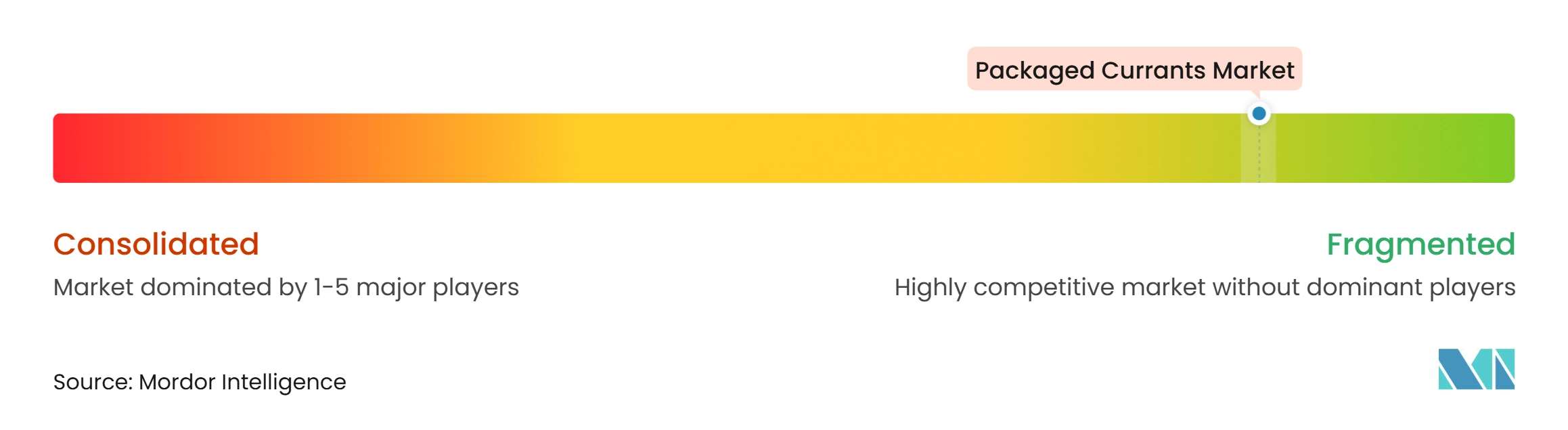
The packaged currants market is fragmented across product formats, origin regions, and distribution channels. Diversified food companies compete through broad dried-fruit portfolios and wider distribution reach, while regional specialists rely on sourcing knowledge, traceability, and organic credentials. This structure allows suppliers to compete in multiple ways without requiring a single global product model. Companies that secure raw materials across different origins reduce exposure to weather-related shortages, and those serving premium channels can use certification and product quality to support margins.
Compliance requirements are increasingly important to procurement decisions. FSSC 22000 and ISO 22000 certification are often required by major food buyers in Europe and North America, raising operational expectations for smaller processors. Larger suppliers can use established quality systems, processing capacity, and logistics networks to serve multiple customer types. In April 2026, ofi opened a 574,000-square-foot East Coast Distribution Center in East Greenwich Township, New Jersey, to serve private-label retail and ingredient customers across North America, improving supply dependability.
Product development also shapes competition in adjacent packaged-fruit occasions. Sun-Maid's September 2026 Charcuterie Pairings launch and Ocean Spray's September 2026 extensions, including Cranberry Cider Juice Drink, Sour Apple Flavored Craisins Dried Cranberries, and Cranberry Spread, show how berry suppliers use portioning, flavor, and seasonal releases to create new purchasing occasions. Currant suppliers face similar expectations from retailers and foodservice customers, and will need to align product innovation with supply reliability, quality assurance, and appropriate channel execution. No individual supplier holds a dominant position across the full category.
Packaged Currants Industry Leaders
-
Sun-Maid Growers of California
-
Couniniotis Group
-
Geobres S.A.
-
Traina Foods
-
Australian Premium Dried Fruits
- *Disclaimer: Major Players sorted in no particular order
Packaged Currants Market Companies Covered in this Report
- Sun-Maid Growers of California
- Couniniotis Group
- Geobres S.A.
- Traina Foods
- Australian Premium Dried Fruits
- Sunbeam Foods
- Lion Raisins
- National Raisin Company
- Graceland Fruit
- Mariani Packing Company
- Dole Packaged Foods, LLC
- Del Monte Foods
- Ocean Spray Cranberries, Inc.
- Whitworths
- Hellenic Dried Fruits
- Corves S.A.
- Arimex
- Isik Tarim
- Ofi
- Royal Nut Company
Recent Industry Developments in Packaged Currants Market
- September 2026: Sun-Maid Growers of California launched its Charcuterie Pairings product line in 4 varieties of perfectly portioned dried fruit and berry pouches, entering distribution at select Walmart and Target locations. The launch reflects Sun-Maid's strategic push into premium snacking and entertaining formats that expand the dried fruit category beyond traditional baking and lunchbox contexts.
- September 2026: Ocean Spray extended its fall seasonal portfolio with the launch of limited-edition Cranberry Cider Juice Drink, Sour Apple Flavored Craisins Dried Cranberries, and limited-edition Cranberry Spread, available via Amazon and select Walmart stores. The expansion demonstrates Ocean Spray's strategy of using limited-time offerings to drive retail trial across both beverage and dried fruit formats.
- April 2026: ofi opened a 574,000 sq ft East Coast Distribution Center in East Greenwich Township, New Jersey, to service private label retail and ingredient customers across North American markets. The facility supports ofi's global sourcing and manufacturing network spanning over 110 manufacturing facilities worldwide.
Global Packaged Currants Market Report Scope
The Packaged Currants Market refers to the market for currants, including blackcurrants, redcurrants, and white currants, that are commercially processed, packaged, and distributed in various forms for retail consumption, foodservice preparations, and industrial food applications. By product type, the market is segmented into blackcurrants, redcurrants, and white currants. By category, the market is divided into conventional and organic products. By form, the market is segmented into fresh, frozen, dried, and processed currants. By end-user, the market is divided into foodservice, industrial, and retail. The retail segment is further categorized into supermarkets and hypermarkets, convenience and grocery stores, specialty food stores, online retail stores, and others. Geographically, the market covers North America, Europe, Asia-Pacific, South America, and the Middle East and Africa, with country-level coverage across major markets, including the United States, Canada, Mexico, Germany, the United Kingdom, Italy, France, Spain, the Netherlands, Poland, Belgium, Sweden, China, India, Japan, Australia, Indonesia, South Korea, Thailand, Singapore, Brazil, Argentina, Colombia, Chile, Peru, South Africa, Saudi Arabia, the United Arab Emirates, Nigeria, Egypt, Morocco, and Turkey, along with the respective regional rest-of-country categories. Market size and growth forecasts are presented in terms of value (USD).
Segmentation Overview
| Blackcurrants |
| Redcurrants |
| White Currants |
| Conventional |
| Organic |
| Fresh |
| Frozen |
| Dried |
| Processed |
| Foodservice | |
| Industrial | |
| Retail | Supermarkets and Hypermarkets |
| Convenience and Grocery Stores | |
| Specialty Food Stores | |
| Online Retail Stores | |
| Others |
| North America | United States |
| Canada | |
| Mexico | |
| Rest of North America | |
| Europe | Germany |
| United Kingdom | |
| Italy | |
| France | |
| Spain | |
| Netherlands | |
| Poland | |
| Belgium | |
| Sweden | |
| Rest of Europe | |
| Asia-Pacific | China |
| India | |
| Japan | |
| Australia | |
| Indonesia | |
| South Korea | |
| Thailand | |
| Singapore | |
| Rest of Asia-Pacific | |
| South America | Brazil |
| Argentina | |
| Colombia | |
| Chile | |
| Peru | |
| Rest of South America | |
| Middle East and Africa | South Africa |
| Saudi Arabia | |
| United Arab Emirates | |
| Nigeria | |
| Egypt | |
| Morocco | |
| Turkey | |
| Rest of Middle East and Africa |
| By Product Type | Blackcurrants | |
| Redcurrants | ||
| White Currants | ||
| By Category | Conventional | |
| Organic | ||
| By Form | Fresh | |
| Frozen | ||
| Dried | ||
| Processed | ||
| By End-User | Foodservice | |
| Industrial | ||
| Retail | Supermarkets and Hypermarkets | |
| Convenience and Grocery Stores | ||
| Specialty Food Stores | ||
| Online Retail Stores | ||
| Others | ||
| By Geography | North America | United States |
| Canada | ||
| Mexico | ||
| Rest of North America | ||
| Europe | Germany | |
| United Kingdom | ||
| Italy | ||
| France | ||
| Spain | ||
| Netherlands | ||
| Poland | ||
| Belgium | ||
| Sweden | ||
| Rest of Europe | ||
| Asia-Pacific | China | |
| India | ||
| Japan | ||
| Australia | ||
| Indonesia | ||
| South Korea | ||
| Thailand | ||
| Singapore | ||
| Rest of Asia-Pacific | ||
| South America | Brazil | |
| Argentina | ||
| Colombia | ||
| Chile | ||
| Peru | ||
| Rest of South America | ||
| Middle East and Africa | South Africa | |
| Saudi Arabia | ||
| United Arab Emirates | ||
| Nigeria | ||
| Egypt | ||
| Morocco | ||
| Turkey | ||
| Rest of Middle East and Africa | ||
Key Questions Answered in the Report
What is the projected value of packaged currants by 2032?
The market is projected to reach USD 1.59 billion by 2032, growing at a CAGR of 5.8% from 2027.
Which currant type has the largest share?
Blackcurrants lead by product type with 43.5% of sales in 2026.
Which currant format is growing the fastest?
Fresh currants are forecast to expand at a CAGR of 7.8% through 2032, the highest rate among the listed segment types.
Why are organic currants gaining demand?
Organic currants are forecast to grow at a CAGR of 7.2% as food buyers seek certified inputs for clean-label products.
Which region leads packaged currant demand?
Europe leads with 38.7% of sales in 2026, supported by processing capacity and Poland’s large blackcurrant supply base.