
Packaged Cactus Water Market Size and Share
Market Overview
| Study Period | 2021 - 2031 |
|---|---|
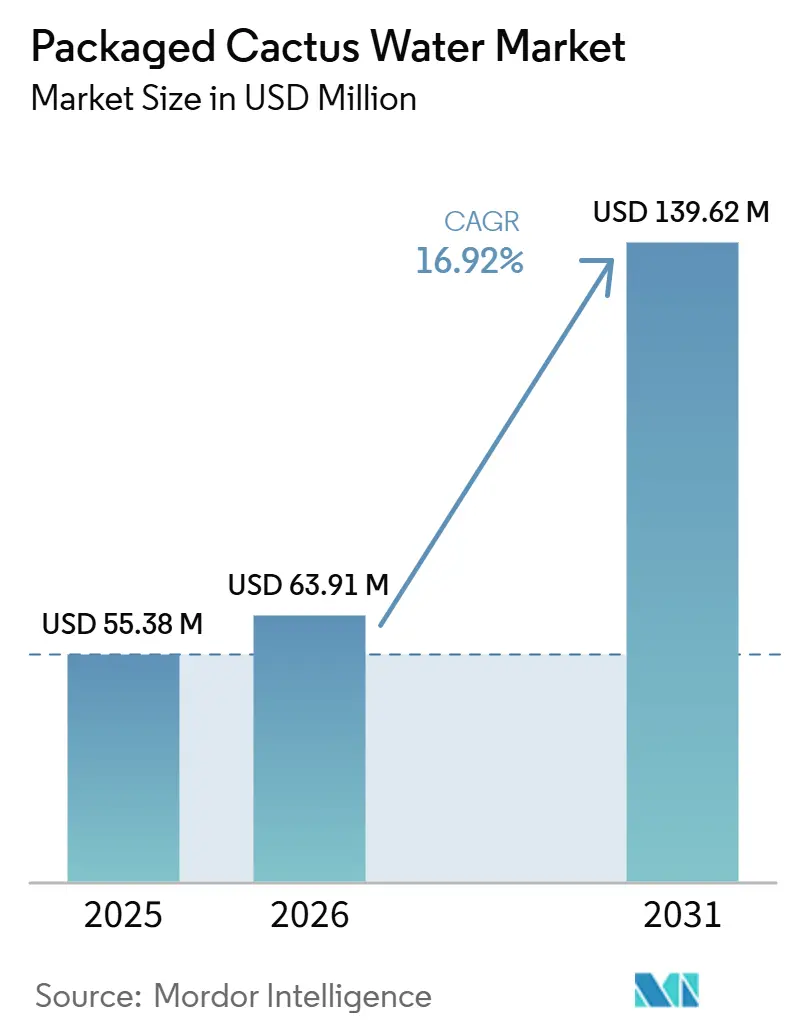
| Market Size (2026) | USD 63.91 Million |
| Market Size (2031) | USD 139.62 Million |
| Growth Rate (2026 - 2031) | 16.92 % |
| Fastest Growing Market | Asia-Pacific |
| Largest Market | North America |
| Market Concentration | Medium |
Major Players *Disclaimer: Major Players sorted in no particular order Image © Mordor Intelligence. Reuse requires attribution under CC BY 4.0. | |
Packaged Cactus Water Market Analysis by Mordor Intelligence
The packaged cactus water market size is expected to increase from USD 55.38 million in 2025 to USD 63.91 million in 2026 and reach USD 139.62 million by 2031, growing at a CAGR of 16.92% over 2026-2031. The packaged cactus water market is gaining attention because consumers are choosing beverages with less sugar and recognizable ingredients. Prickly pear offers naturally occurring electrolytes and betalains, which give brands a clear functional position without relying on conventional sports-drink cues. Demand is also widening beyond routine hydration as flavored products enter foodservice, mocktail, and cocktail occasions. Retail availability, online product testing, and premium positioning support expansion, although familiar plant waters still hold an advantage in shopper awareness. The packaged cactus water market also faces limits from concentrated nopal sourcing, variable fruit quality, and a health evidence base that remains stronger for Opuntia supplements than for commercial beverages.
Key Report Takeaways
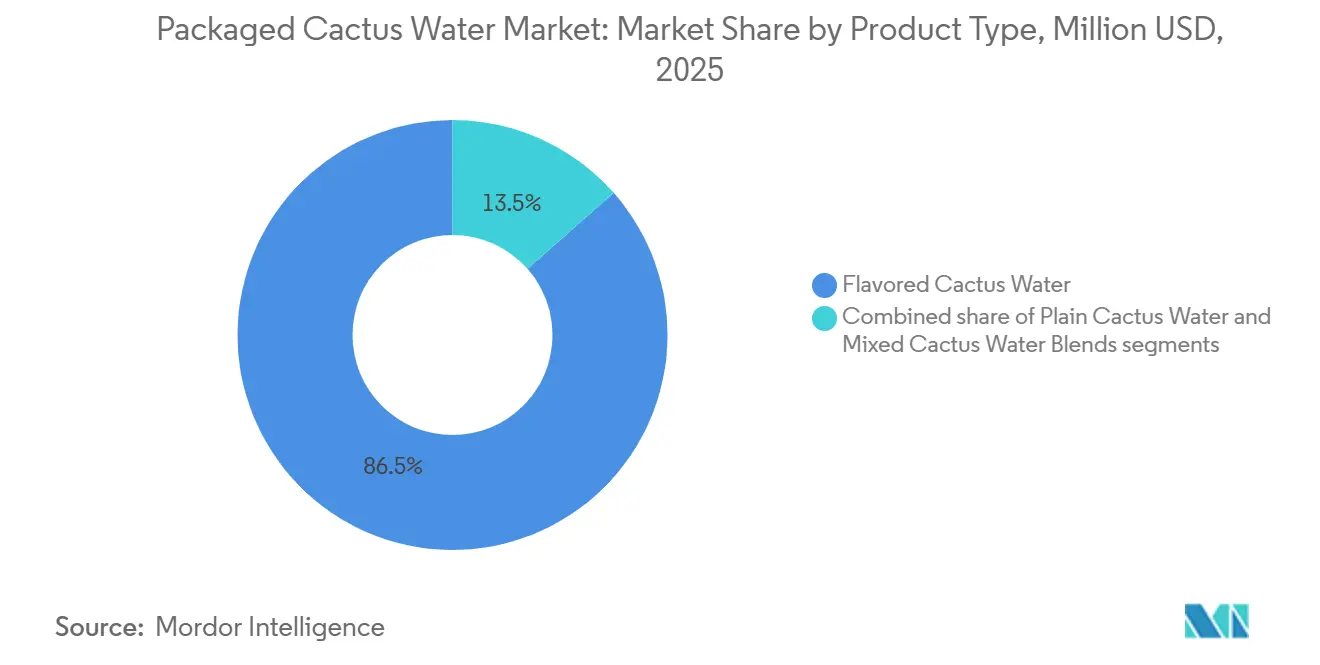
- By product type, flavored cactus water led with 86.51% of packaged cactus water market share in 2025, while plain cactus water is forecast to expand at a 17.46% CAGR through 2031.
- By nature, conventional products held 89.62% of the packaged cactus water market share in 2025, while organic cactus water recorded the highest projected CAGR at 18.11% through 2031.
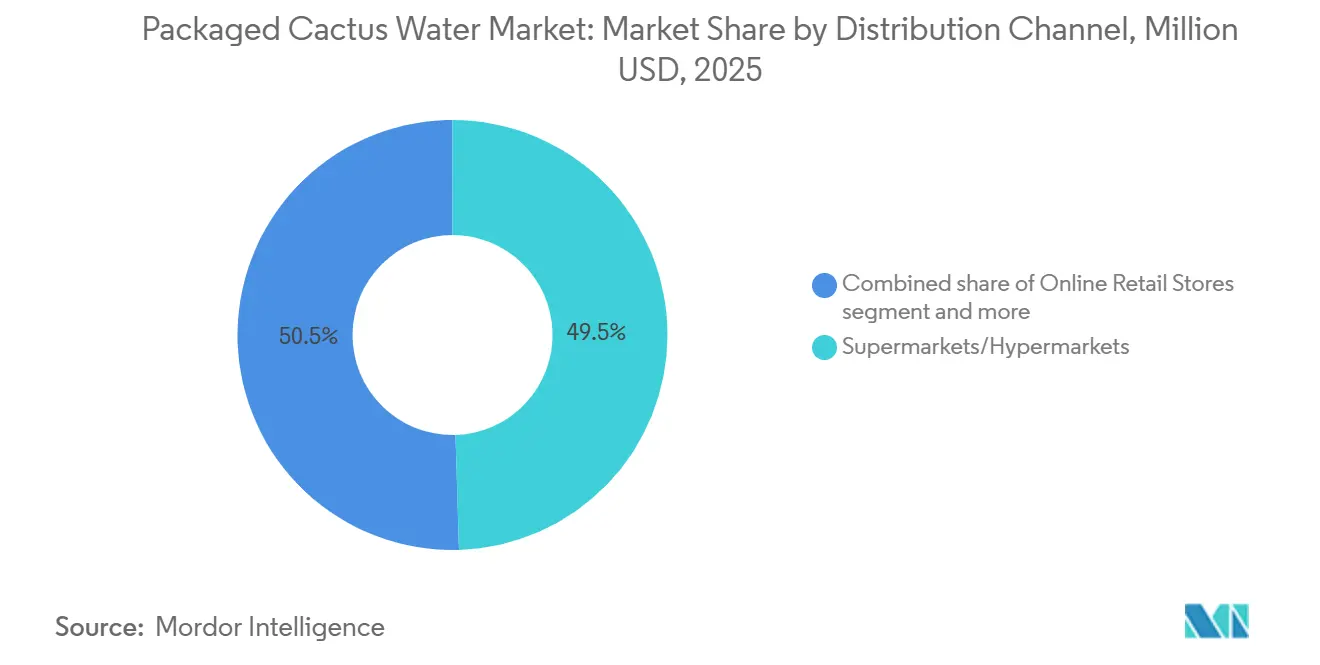
- By distribution channel, supermarkets and hypermarkets accounted for 49.51% of the packaged cactus water market size in 2025, while online retail stores are advancing at a 17.88% CAGR through 2031.
- By geography, North America accounted for 49.9% of the packaged cactus water market size in 2025, while Asia-Pacific is forecast to grow at a 17.98% CAGR through 2031.
Note: Market size and forecast figures in this report are generated using Mordor Intelligence’s proprietary estimation framework, updated with the latest available data and insights as of January 2026.
Market Trends and Insights
Drivers Impact Analysis of Packaged Cactus Water Market*
| Driver | (~) % Impact on CAGR Forecast | Geographic Relevance | Impact Timeline |
|---|---|---|---|
| Rising demand for low-sugar functional hydration | +5.2% | Global, concentrated in North America, and Western Europe | Short term (≤ 2 years) |
| Expansion of plant-based and clean-label beverages | +3.8% | North America, Western Europe, and the Asia-Pacific urban markets | Medium term (2-4 years) |
| Retail and e-commerce access to niche wellness beverages | +3.5% | North America, the Asia-Pacific core, and spill-over to the Middle East and Africa | Short term (≤ 2 years) |
| Flavor innovation and cocktail-mixer use cases | +2.4% | North America, Europe, and early adoption in the Asia-Pacific | Medium term (2-4 years) |
| Cactus crop resource efficiency as a sustainability proposition | +1.8% | Global, the strongest resonance in Europe, and North America | Long term (≥ 4 years) |
| Shelf-stable formats for active and on-the-go consumption | +2.1% | North America, the Asia-Pacific, the Middle East and Africa urban centers | Short term (≤ 2 years) |
| Source: Mordor Intelligence | |||
Rising demand for low-sugar functional hydration
Consumer migration away from sugar-sweetened beverages is the single most powerful structural tailwind for the packaged cactus water category, and it has been measurably accelerated by fiscal policy. In Mexico, a critical market given its role as both the world's largest nopal producer and an emerging consumer base, the Impuesto Especial sobre Producción y Servicios (IEPS) excise tax on high-sugar drinks is actively redirecting consumption toward low-calorie functional alternatives; Statista data reported through Merca20 shows that Mexican electrolyte beverage sales reached 47.84 million liters in April 2025 alone, representing 19% year-on-year growth. Cactus water occupies a distinct niche within this demand shift: with fewer calories and roughly half the sugar of leading coconut water formats, it simultaneously satisfies hydration, antioxidant, and electrolyte functional claims without sacrificing taste. A second-order effect is that regulatory influence from the UK's Sugar Drinks Industry Levy (SDIL) and similar European sugar-tax frameworks is structurally redirecting grocery-channel shelf space away from traditional soft drinks and toward zero-to-low-sugar functional hydration products, creating a retailer-level pull effect that emerging brands have not yet fully exploited. The compliance factor is also visible at the ingredient level: brands formulating without artificial sweeteners are finding SDIL-free positioning a meaningful commercial advantage in UK retail.
Expansion of plant-based and clean-label beverages
Cactus water benefits from, but is not reducible to, the broader plant-based beverage expansion wave. The U.S. organic beverage market reached USD 10.2 billion in 2025 with 7.2% growth, driven significantly by clean-label formulations; the sub-category of soft drinks, enhanced drinks, and powders within organics grew 11.5%, outpacing the broader segment, according to the Organic Trade Association, 2026 Organic Market Report, March 2026[1]Source: Organic Trade Association, “U.S. Organic Marketplace Achieved Significant Growth in 2025,” Organic Trade Association, ota.com. What distinguishes cactus water within this landscape is source scarcity and provenance specificity: prickly pear requires no irrigation in arid regions and has a documented cultural and ecological heritage in Mexico and parts of North Africa, which gives brands an authentic supply-chain narrative that mass-produced ingredient beverages cannot replicate. The compliance framework supporting clean-label claims, particularly USDA National Organic Program (NOP) certification, is increasingly serving as a purchase-decision signal for Millennial and Gen Z consumers, and Organic Trade Association's research confirms that younger cohorts (13–44 years old) are now the fastest-growing segment of the U.S. organic buyer base, skewing the addressable market directly toward cactus water's core demographic. Brands that achieve USDA NOP certification early, as True Nopal has done with its organic line, secure a durable competitive moat that takes competing private-label entrants 3 years of farm-level transition to replicate.
Retail and E-commerce access to niche wellness beverages
The packaged cactus water category has historically been constrained to premium specialty retail, but recent shelf expansions signal that the category has crossed the threshold into mainstream distribution. True Nopal expanded its U.S. presence to 2,362 Walmart stores in October 2024, adding 914 locations in a single move, demonstrating that mass-market retail buyers have validated cactus water as a category with sufficient consumer demand to hold shelf space against established beverages. E-commerce channels are compounding this effect: subscription models, influencer-driven direct-to-consumer (D2C) pipelines, and Amazon shelf placement allow smaller brands to build national awareness without the capital requirements of traditional retail slotting. The underappreciated strategic implication is that e-commerce data, search volumes, basket composition, and repeat-purchase rates give cactus water brands granular demand intelligence that traditional grocery brands lack, enabling flavor and format iteration cycles measured in months rather than years. Pricklee's deployment of Mixed Wildberry and Juicy Watermelon flavors first as online-only SKUs before mass rollout exemplifies this data-first product development approach.
Flavor innovation and cocktail-mixer use cases
Flavor innovation is performing a dual function in the packaged cactus water category: it drives trial among consumers who reject the plain-water taste profile, and it creates a cocktail-mixer positioning that substantially broadens the beverage occasion set. Kun Yang, CEO of Pricklee, has publicly described cactus water as "a mixer in cocktails and mocktails" that delivers flavor without the crash, a positioning validated by premium bartenders who prize prickly pear's betalain-driven magenta pigment for visually distinctive low-ABV drinks. Bacardi's 2026 Cocktail Trends Report identifies a consumer behavioral shift in which daytime health rituals and evening social occasions are converging, with wellness-aligned mixers gaining sustained traction[2]Source: Bacardi Limited, “Connections, Local Flavors, and Luxurious Experiences Top the 2026 Bacardi Cocktail Trends Report,” Bacardi Limited, bacardilimited.com. For cactus water brands, the mixer occasion is structurally high-margin: on-premise foodservice placements command higher per-unit revenue than off-premise retail, and brand associations with premium dining reinforce the wellness-luxury halo that drives repeat retail purchase. Caliwater's November 2025 national foodservice expansion into Gordon Ramsay restaurants and Pura Vida locations represents an early bet on this channel.
Restraints Impact Analysis of Packaged Cactus Water Market*
| Restraint | (~) % Impact on CAGR Forecast | Geographic Relevance | Impact Timeline |
|---|---|---|---|
| Low consumer familiarity with coconut and aloe vera water | -1.5% | Global, most acute in the Asia-Pacific, the Middle East and Africa, where coconut water is entrenched | Medium term (2-4 years) |
| Inconsistent raw material supply and seasonal fruit quality | -1.2% | North America (nopal from Sonora, Mexico), Global sourcing hubs | Medium term (2-4 years) |
| Clinical evidence and health-claim substantiation risk | -0.8% | Global, regulatory risk is highest in Europe and the Asia-Pacific markets with stricter health-claim frameworks | Long term (≥ 4 years) |
| Betalain color and flavor stability during processing and storage | -0.6% | Global, particularly acute for shelf-stable ambient formats | Medium term (2-4 years) |
| Source: Mordor Intelligence | |||
Low consumer familiarity relative to established plant waters
Coconut water and aloe vera water have a decade-long head start in consumer mindshare within the plant-based hydration segment, and this incumbency advantage creates a structural education burden that cactus water brands must overcome before achieving mass-market penetration. The competitive pressure is most acute in Asia-Pacific, where coconut water is both culturally embedded and widely available at commodity price points that cactus water, sourced primarily from Mexico, cannot match on a cost basis. At the retail level, this manifests as a placement challenge: grocery category managers accustomed to coconut water performance metrics apply the same velocity thresholds to cactus water, penalizing early-stage SKUs that have not yet built repeat-purchase rates. Pricklee's strategic decision to rebrand from "cactus water" to "natural hydration" in 2026 reflects a direct response to this challenge. By broadening the category description, the brand attempts to reduce the cognitive friction of trial for consumers unfamiliar with cactus as a beverage ingredient. The category may ultimately need to build consumer trust through on-premise sampling and functional storytelling before offline retail velocities satisfy large-format buyer expectations.
Inconsistent raw material supply and seasonal quality variability
Beverage-grade nopal supply for the North American market is geographically concentrated in Sonora, Mexico, where agricultural cooperatives process the majority of export-quality prickly pear for juice extraction. This concentration creates a dual vulnerability: climate events, particularly drought, in a single Mexican state can simultaneously constrain supply across multiple competing brands and spike raw material costs. The Teotihuacán Valley in the State of Mexico, a secondary production region, faces 15% overexploitation of its water resources, creating long-term aquifer pressure that threatens sustainable yield growth. Betalain content, the key bioactive and colorimetric differentiator of cactus water, varies substantially by soil composition, harvesting season, and post-harvest handling, meaning that batch-to-batch flavor and color inconsistency is not just a processing challenge but a sourcing challenge that demands upstream agricultural standards not yet codified across the supply base. Tamba (2025) in the Journal of Food and Nutrition Sciences noted that low pH (5.3–7.1) and high soluble-solids content make prickly pear juice inherently susceptible to microbial spoilage, and that non-thermal preservation technologies, while promising, lack the industrial validation needed for cost-effective large-scale deployment. Brands that invest in long-term cooperative purchasing agreements or vertically integrated sourcing arrangements will carry a durable input cost and quality advantage over those reliant on spot markets.
*Our forecasts treat driver/restraint impacts as directional, not additive. The impact forecasts reflect baseline growth, mix effects, and variable interactions.
Packaged Cactus Water Market Segment Analysis
By Product Type:
Flavor Proliferation Anchors Category GrowthFlavored Cactus Water dominates the product type segmentation with an 86.51% share in 2025, a commanding lead that reflects the category's ongoing reliance on taste differentiation to drive trial and repeat purchase beyond the core functional-hydration consumer. This concentration in flavored formats is not simply a consumer preference artifact; it reflects brand strategy: Caliwater has expanded to Dragon Fruit, Blood Orange, Watermelon, Pineapple, and Ginger + Lime variants through celebrity-investor collaborations, embedding a flavor-development pipeline directly into its marketing calendar. Plain Cactus Water, while a small minority of current volume, is the fastest-growing sub-segment at a CAGR of 17.46% through 2026-2031 as purist consumers and ingredient-conscious buyers seek unadulterated electrolyte hydration without added flavors or sweeteners. Mixed Cactus Water Blends, formulations combining prickly pear with complementary functional ingredients such as dragon fruit or hibiscus, represent an emerging product tier that occupies the intersection of flavor innovation and clean-label positioning, with the potential to capture both the flavored and plain audiences.
The second-order dynamic in product type is the growing use of Flavored Cactus Water as a cocktail mixer, which opens a non-traditional consumption occasion that skews premium. Unlike sports drinks or plain water, flavored cactus water's betalain pigmentation delivers visual distinctiveness in beverage presentations, and brands such as Pricklee and Caliwater have begun explicitly marketing mixer use cases to on-premise buyers. This expansion of occasion breadth, from gym bag to bar cart, is a structural premium driver that does not depend on further consumer education about cactus-specific health benefits. USDA NOP certification compliance is relevant here as well: organic-certified flavored lines command shelf price premiums in specialty and natural grocery channels where health-oriented shoppers are most concentrated.



By Nature:
Conventional Base Anchors Volume, Organic Tier Grows FasterConventional cactus water holds an overwhelming 89.62% share in 2025, reflecting the commercial reality that most brands have scaled on non-organic formulations to keep costs accessible during a phase of market education and penetration. However, organic cactus water is the fastest-growing nature segment at an 18.11% CAGR through 2026-2031, a rate that exceeds even the overall market CAGR of 16.92%, which indicates that the addressable premium for organic certification in this category is not yet fully priced in. True Nopal, a category pioneer with a USDA NOP-certified organic line, has demonstrated that organic positioning is compatible with mass-market distribution, securing placement across Whole Foods Market and Walmart's organic grocery shelf in parallel. The U.S. organic beverages market grew 7.2% in 2025, with the Organic Trade Association flagging that younger consumers (13–44) are driving organic growth by prioritizing ingredient transparency and supply-chain provenance, a consumer segment that maps directly onto cactus water's core buyer.
The strategic implication of the conventional-to-organic mix shift is pricing power accumulation: as organic share grows from a low base, blended average selling prices rise without requiring the brand to reduce distribution breadth. A counter-intuitive restraint to watch is certification supply lag. USDA NOP requires 3 years of farm transition before certification is granted, meaning rapid scale-up of the organic tier is bounded by upstream agricultural infrastructure rather than consumer demand. Brands that have already built certified organic sourcing agreements are consequently insulated from short-term competitive entry in the premium segment.
By Distribution Channel:
Supermarkets Lead but Online Channels Disrupt AccessSupermarkets and hypermarkets hold a 49.51% distribution channel share in 2025, a figure that reflects both the category's maturation in North America and the importance of physical shelf placement in converting first-time buyers who discover cactus water through browsing rather than targeted search. The channel's dominance also reflects the strategic value of mass-retail partnerships: True Nopal's Walmart presence across 2,362 stores and Caliwater's deployment across 3,500 Walmart locations together represent a category billboard that would otherwise require hundreds of millions in media spending to replicate. Convenience stores hold a smaller but strategically important share, given that impulse hydration decisions made in transit are high-frequency purchase occasions where cactus water's single-serve can and shelf-stable pouch formats compete directly against energy drinks and sports drinks. Specialty stores and other channels serve the early-adopter consumer segment, where willingness to pay a premium is highest and where organic and functional claims receive the most engaged audience.
Online Retail Stores are the fastest-growing distribution channel at a 17.88% CAGR through 2026-2031, driven by three structural enablers: influencer-driven direct-to-consumer acquisition, subscription model economics that improve repeat-purchase economics for brands, and Amazon shelf algorithms that reward new-entrant products in underdeveloped categories. Pricklee's deployment of new flavors as online-exclusive SKUs prior to physical retail rollout is a particularly telling indicator of this channel's role as a test-and-learn laboratory for product development. The broader e-commerce penetration of the organic beverage category, projected to grow from 12–15% of category sales in 2026 to 20–25% by 2035, suggests that online's share of packaged cactus water will compound as category awareness builds and subscription economics mature.
Geography Analysis
North America Packaged Cactus Water Market
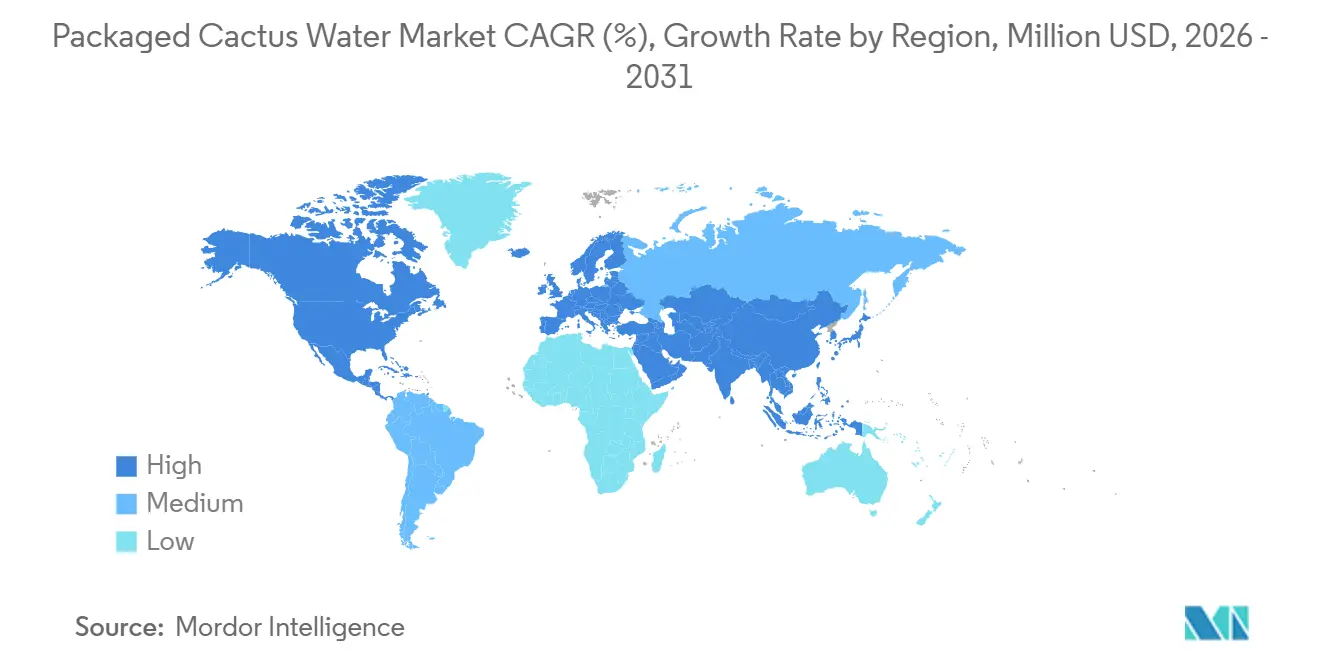
North America held 49.9% of the packaged cactus water market share in 2025. The region combines established functional beverage retail with several category-originating brands. The United States is the main commercial arena, supported by listings in Walmart, Whole Foods Market, Sprouts Farmers Market, and Kroger. Foodservice partnerships can create product trial and support later retail purchases. Mexico has a dual role as a major prickly pear producer and a consumer market shaped by taxes on sugary beverages. The supplied research stated that Milpa Alta accounted for 22% of national nopal production and that the sector generated more than MXN 600 million annually for Mexico City.
Europe Packaged Cactus Water Market
Europe has a smaller current presence but offers room for brands with strong clean-label documentation. The United Kingdom has become an early point of commercialization for Cacto Drinks. The company introduced a still Prickly Pear Cactus Water variant at IFE 2026 in London[3]Source: IFE, “Cacto Drinks Launches Prickly Pear Cactus Water at IFE 2026,” IFE, ife.co.uk. Germany can be a secondary target because consumers are familiar with functional water products. European expansion requires careful attention to regulatory documentation. Brands that can substantiate product composition and claims will be better placed to enter the region.
APAC, South America and MEA Packaged Cactus Water Market
Asia-Pacific is expected to grow at a 18% CAGR through 2031, the fastest rate among the geographic regions. Urban incomes, wellness consumption, and e-commerce infrastructure support this growth. Australia provides an example of local category development through BetterDays, which launched a sparkling cactus water range in 2024. Japan and South Korea may support premium imported products, while India, Thailand, Singapore, and Indonesia remain emerging demand areas. South America offers potential through health-oriented beverage demand and local nopal agricultural capacity. The Middle East and Africa are a longer-term opportunity where sugar taxes, modern retail, and North African prickly pear production can support future development. Gulf markets can offer a starting point because imported functional beverages already reach affluent urban consumers. Morocco and Tunisia may become relevant supply-side locations because prickly pear has an established agricultural presence. A shorter supply route into Europe could become useful if local processing capacity develops. Nigeria, South Africa, and Egypt are later opportunities where modern retail and health-oriented consumption are expanding. The pace of entry will depend on pricing, local distribution partners, and product education.

Competitive Landscape
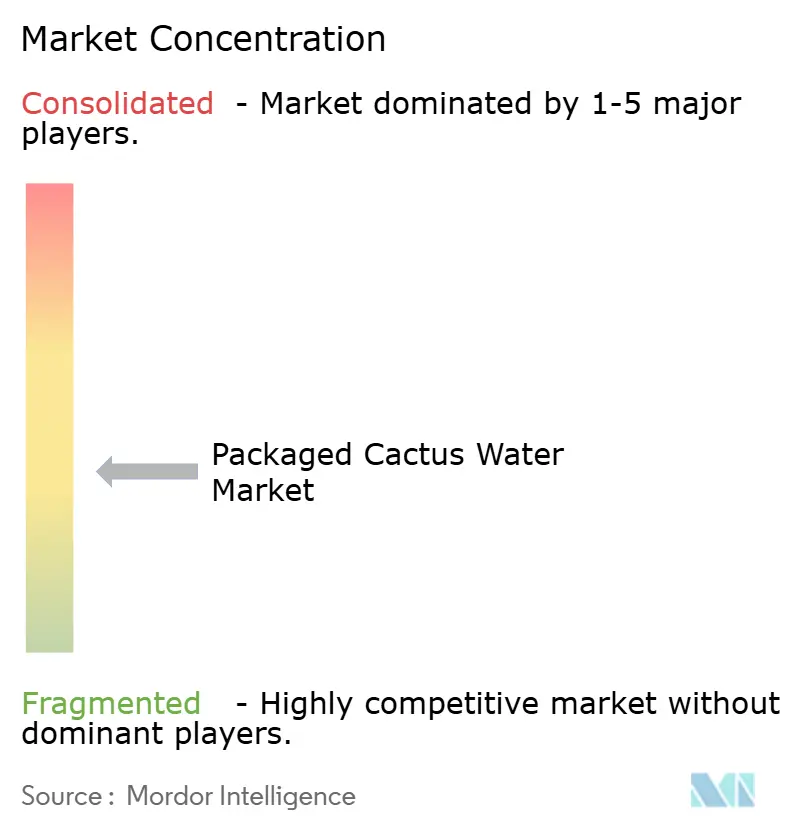
The packaged cactus water market is highly fragmented, with no company identified as having enough share to set category pricing or distribution standards. Caliwater, True Nopal, and Pricklee are among the best-known North American brands. Caliwater has used celebrity investors and frequent flavor launches to build consumer awareness. True Nopal has focused on mass retail distribution alongside an organic product line. Pricklee has sought to broaden its positioning from cactus water toward natural hydration. Regional companies, including Cacto Drinks in the United Kingdom, BetterDays in Australia, and Green-Go in Mexico, can build local relevance where U.S. brands face distribution limits.
Product technology and supply-chain control are becoming more important as the category develops. Shelf-stable formats matter for convenience channels and active consumption. Companies that retain betalain color in ambient packaging without artificial colorants can support both clean-label and premium messaging. Non-thermal preservation and color-stabilization methods may create product differentiation where brands can apply them consistently. The category also depends on reliable prickly pear sourcing and quality controls. Early work on regulatory documentation can reduce friction as brands enter more international markets.
A large beverage company could change the competitive environment through an acquisition or a well-funded market entry. Such a move could expand distribution and raise consumer awareness quickly. It could also make shelf access more difficult for smaller companies. For now, the packaged cactus water market has room for specialized brands with clear flavor, sourcing, or channel strategies. Competition is likely to remain centered on retail reach, format quality, and the ability to make an unfamiliar ingredient easy to try. Brands also need to balance category education with broad hydration messaging. An ingredient-first label may appeal to consumers who already know prickly pear, but it can be less direct for a wider audience. A broader hydration position may increase trial, although it could make the category harder to define. Companies with a clear retail strategy and reliable supply are better placed to navigate that choice. The packaged cactus water market remains open to local entrants because the leading brands do not yet have dominant global distribution.
Packaged Cactus Water Industry Leaders
True Nopal Ventures LLC
Caliwater LLC
Pricklee LLC
STEAZ
EVISSI USA LLC
- *Disclaimer: Major Players sorted in no particular order
Packaged Cactus Water Market Companies Covered in this Report
- Caliwater LLC
- True Nopal Ventures LLC
- Pricklee LLC
- The Cactus Water Co. LLC
- The Lauro Company LLC
- STEAZ (Healthy Beverage LLC)
- EVISSI USA LLC
- BetterDays
- Oka Products LLC
- Green-Go
- PURE KAKTAI
- Lunae Sparkling
- HASK
- CactuSips
- Cacto Water
- Magic Cactus
- Nopali Cactus Water
- Desert King International
- Cactus Botanics Ltd
- Mamma Chia, LLC

Recent Industry Developments in Packaged Cactus Water Market
- June 2026: Caliwater launched Dragon Fruit, its newest functional flavor, co-developed with musician and investor Benson Boone. Each can delivered 30 calories, five naturally occurring electrolytes, and betalain antioxidants from sustainably sourced prickly pear. The launch extended distribution to convenience store channels, broadening the brand's point-of-sale footprint beyond health and specialty retail.
- March 2026: Benson Boone joined Caliwater as an investor and brand representative, becoming the second major musician celebrity to take an equity stake in the brand. The partnership aligned cactus water with a younger Millennial and Gen Z demographic increasingly driving premium functional beverage purchases.
- March 2026: Cacto Drinks (UK) launched its Prickly Pear Cactus Water still variant at IFE 2026 (ExCeL London, March 31), introduced a new category to UK mainstream retail alongside its existing sparkling range in Original Prickly Pear, Ruby Pineapple, White Peach, and Kiwi and Strawberry formats.


Global Packaged Cactus Water Market Report Scope
Packaged cactus water is a ready-to-drink functional beverage made by extracting juice from the fruit and pads of the prickly pear cactus, offering natural electrolytes, antioxidants, and a lower-calorie profile than coconut water. The packaged cactus water market is segmented by product type, nature, distribution channel, and geography. By product type, the market is segmented into flavored, plain, and mixed blends. By nature, the market is segmented into conventional and organic. By distribution channel, the market is segmented into supermarkets/hypermarkets, convenience stores, specialty stores, online retail, and others. By geography, the market is segmented into North America, Europe, Asia-Pacific, South America, and Middle East and Africa). The market forecasts are provided in terms of value (USD).
| Flavored Cactus Water |
| Plain Cactus Water |
| Mixed Cactus Water Blends |
| Conventional |
| Organic |
| Supermarkets/Hypermarkets |
| Convenience Stores |
| Specialty Stores |
| Online Retail Stores |
| Other Distribution Channels |
| North America | United States |
| Canada | |
| Mexico | |
| Rest of North America | |
| Europe | United Kingdom |
| Germany | |
| France | |
| Italy | |
| Spain | |
| Sweden | |
| Belgium | |
| Poland | |
| Netherlands | |
| Rest of Europe | |
| Asia-Pacific | China |
| Japan | |
| India | |
| Thailand | |
| Singapore | |
| Indonesia | |
| South Korea | |
| Australia | |
| Rest of Asia-Pacific | |
| South America | Brazil |
| Argentina | |
| Colombia | |
| Peru | |
| Chile | |
| Rest of South America | |
| Middle East and Africa | United Arab Emirates |
| South Africa | |
| Saudi Arabia | |
| Nigeria | |
| Egypt | |
| Morocco | |
| Turkey | |
| Rest of Middle East and Africa |
| Product Type | Flavored Cactus Water | |
| Plain Cactus Water | ||
| Mixed Cactus Water Blends | ||
| Nature | Conventional | |
| Organic | ||
| Distribution Channel | Supermarkets/Hypermarkets | |
| Convenience Stores | ||
| Specialty Stores | ||
| Online Retail Stores | ||
| Other Distribution Channels | ||
| Geography | North America | United States |
| Canada | ||
| Mexico | ||
| Rest of North America | ||
| Europe | United Kingdom | |
| Germany | ||
| France | ||
| Italy | ||
| Spain | ||
| Sweden | ||
| Belgium | ||
| Poland | ||
| Netherlands | ||
| Rest of Europe | ||
| Asia-Pacific | China | |
| Japan | ||
| India | ||
| Thailand | ||
| Singapore | ||
| Indonesia | ||
| South Korea | ||
| Australia | ||
| Rest of Asia-Pacific | ||
| South America | Brazil | |
| Argentina | ||
| Colombia | ||
| Peru | ||
| Chile | ||
| Rest of South America | ||
| Middle East and Africa | United Arab Emirates | |
| South Africa | ||
| Saudi Arabia | ||
| Nigeria | ||
| Egypt | ||
| Morocco | ||
| Turkey | ||
| Rest of Middle East and Africa | ||


Key Questions Answered in the Report
What is the projected growth rate for packaged cactus water?
The category was forecast to grow at a 16.92% CAGR from 2026 to 2031, rising from USD 63.91 million to USD 139.62 million. Low-sugar demand, wider retail access, and new foodservice occasions supported growth, while retail listings and positioning shaped scale.
Which product type leads packaged cactus water sales?
Flavored cactus water led product sales with 86.51% share in 2025, while plain cactus water is the fastest-growing product type at a 17.46% CAGR through 2031.
Why are consumers choosing cactus water products?
Low-sugar hydration, electrolytes, clean-label demand, and plant-based interest support demand. Flavored formats and cocktail or mocktail use expand its role across active, retail, foodservice, and social occasions. Consistent taste and visual appeal remain critical.
Which sales channel is growing fastest for cactus water?
Online retail stores are forecast to grow at a 17.88% CAGR through 2031, supported by subscriptions, direct-to-consumer sales, and digital product testing. Supermarkets and hypermarkets remain the largest route to consumers, with 49.51% share in 2025.
Page last updated on:





