
Packaged Burgers Market Size and Share
Market Overview
| Study Period | 2021 - 2031 |
|---|---|
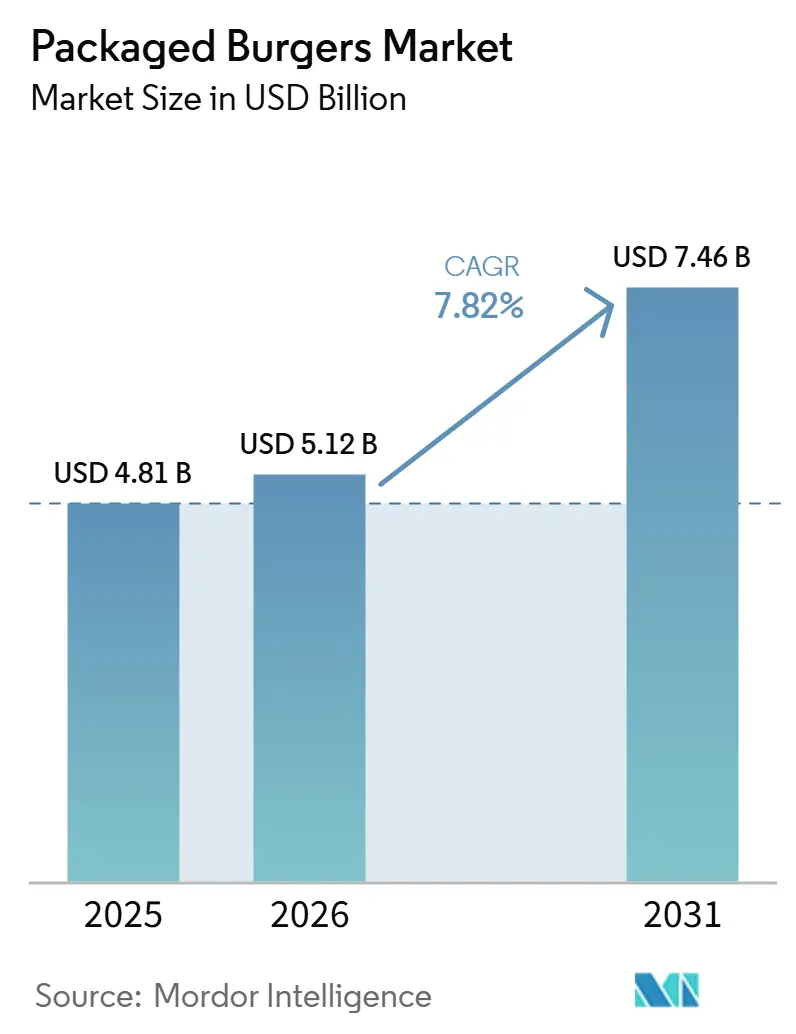
| Market Size (2026) | USD 5.12 Billion |
| Market Size (2031) | USD 7.46 Billion |
| Growth Rate (2026 - 2031) | 7.82 % |
| Fastest Growing Market | Asia-Pacific |
| Largest Market | Europe |
| Market Concentration | Medium |
Major Players *Disclaimer: Major Players sorted in no particular order Image © Mordor Intelligence. Reuse requires attribution under CC BY 4.0. | |
Packaged Burgers Market Analysis by Mordor Intelligence
The packaged burgers market size is projected to expand from USD 4.81 billion in 2025 and USD 5.12 billion in 2026 to USD 7.46 billion by 2031, registering a CAGR of 7.82% between 2026 to 2031. Demand is supported by households that need quick meal options and by consumers who expect convenient proteins to deliver reliable quality. Premium and value products can grow together because shoppers are choosing products that fit a specific meal occasion rather than simply choosing the lowest price. Manufacturers are responding through product design, clearer ingredient information, and formats suited to home preparation. Rising restaurant meal prices can make premium frozen burgers more competitive for meals prepared at home, which gives retailers room to develop private-label lines and gives brands a reason to defend premium formats. Growing use of GLP-1 weight-management therapies in North America may also favor smaller packs and protein-dense offerings during the forecast period, as portion preferences change. The packaged burgers mar
Key Report Takeaways
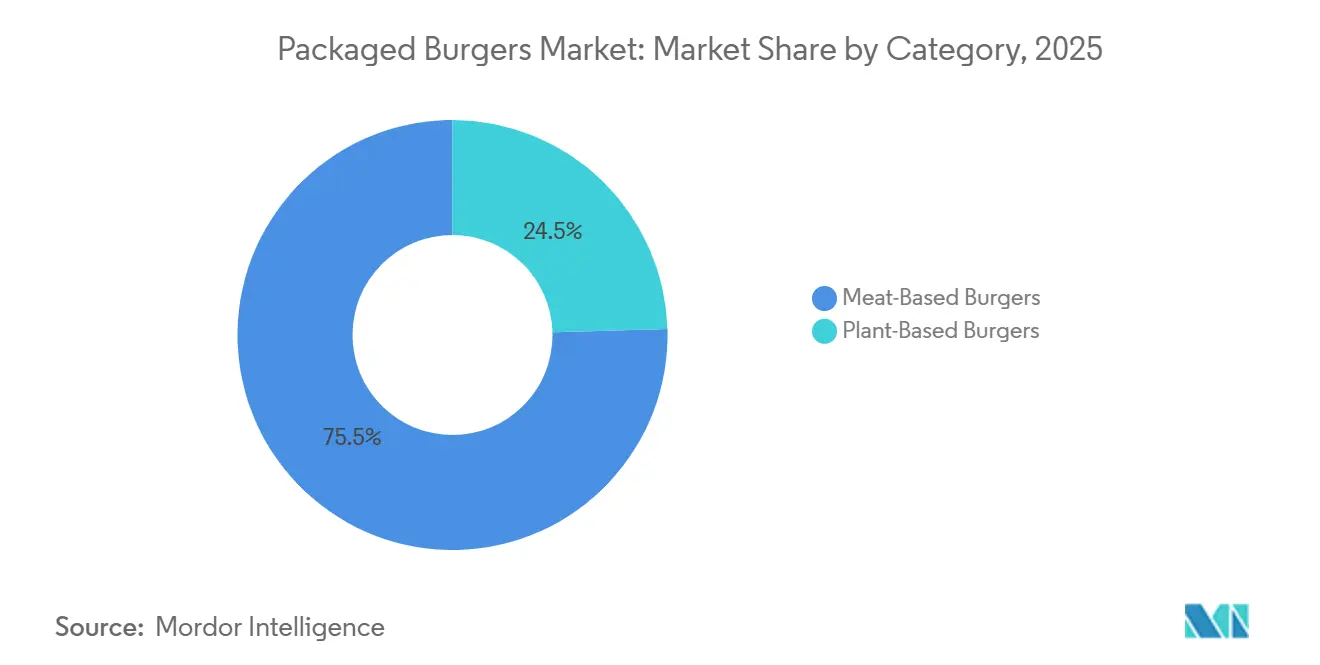
- By category, meat-based burgers held 75.43% of the packaged burgers market share in 2025, while plant-based burgers are forecast to grow at an 8.56% CAGR through 2031.
- By packaging type, boxed packs held 48.32% of sales in 2025, while vacuum packs are forecast to grow at a 9.12% CAGR through 2031.
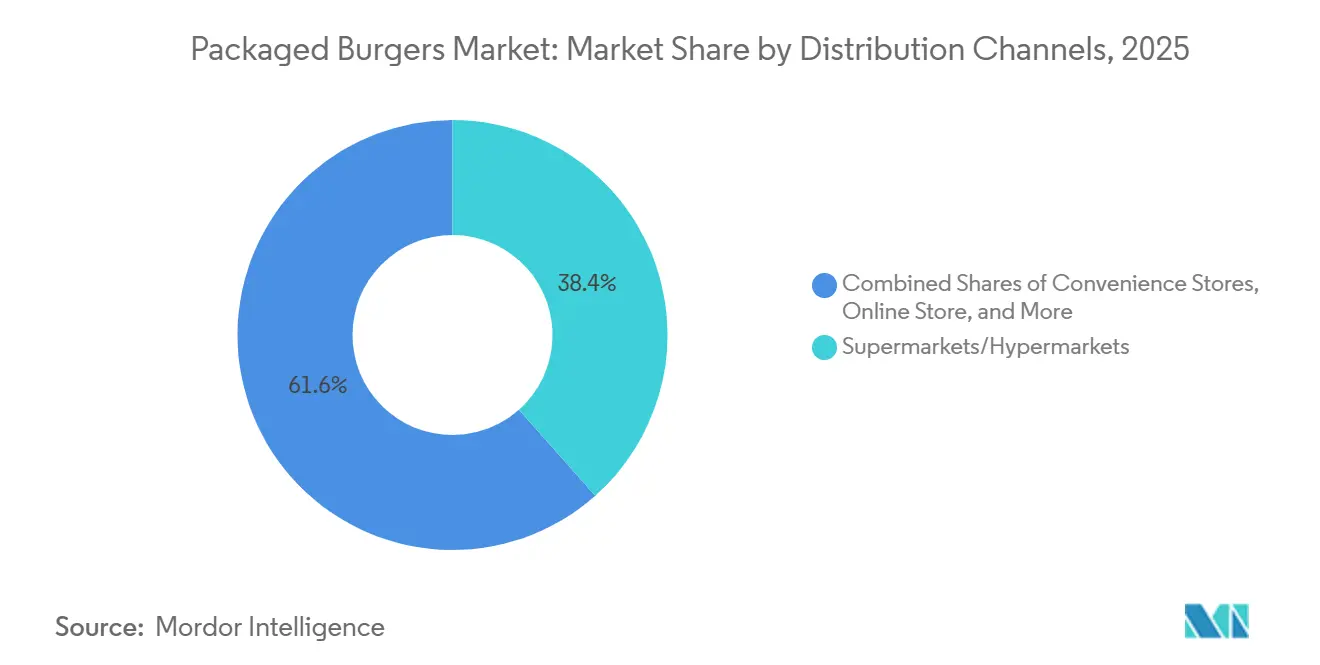
- By distribution channel, supermarkets and hypermarkets held 38.44% of sales in 2025, while online retail is forecast to grow at an 8.85% CAGR through 2031.
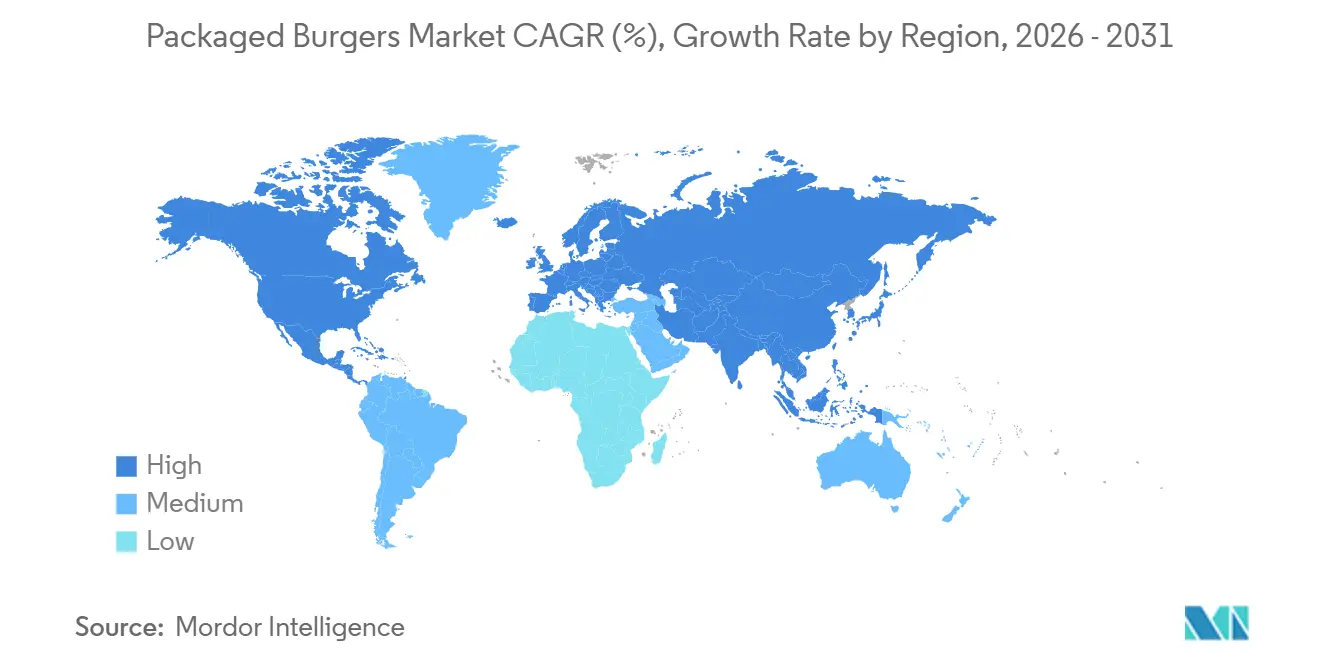
- By geography, Europe held 42.37% of sales in 2025, while Asia-Pacific is forecast to grow at an 8.79% CAGR through 2031.
Note: Market size and forecast figures in this report are generated using Mordor Intelligence’s proprietary estimation framework, updated with the latest available data and insights as of January 2026.
Market Trends and Insights
Drivers Impact Analysis of Packaged Burgers Market*
| Driver | (~) % Impact on CAGR Forecasts | Geographic Relevance | Impact Timeline |
|---|---|---|---|
| Growing Demand for Convenient Ready-to-Cook and Ready-to-Eat Meals | +2.0% | Global | Short term (≤ 2 years) |
| Rising Consumption of Frozen and Processed Foods | +1.7% | Europe, North America, APAC core | Short term (≤ 2 years) |
| Increasing Popularity of Plant-Based and Alternative Protein Burgers | +1.4% | North America & EU, spill-over to APAC | Medium term (2–4 years) |
| Product Innovation in Premium and Functional Burgers | +1.0% | North America, Western Europe | Medium term (2–4 years) |
| Advancements in Food Processing and Packaging Technologies | +0.7% | Global | Medium to Long term (≥ 3 years) |
| Expansion of Modern Retail and Frozen Food Distribution | +0.8% | APAC core, MEA, South America | Long term (≥ 4 years) |
| Source: Mordor Intelligence | |||
Growing Demand for Convenient Ready-to-Cook and Ready-to-Eat Meals
Limited time for cooking continues to support the packaged burgers market, especially in North America and Western Europe. Dual-income households often need proteins that require little preparation and deliver consistent results. Pre-seasoned and par-cooked burgers address this need by combining speed with portion control. In Germany, 62% of respondents used frozen products at least several times each month in a January 2026 survey, which shows that frozen food remains part of regular meal planning [1]Source: Deutsches Tiefkühlinstitut e.V., “dti-Absatzstatistik 2025: Tiefkühlkost weiter auf Wachstumskurs,”, tiefkuehlkost.de.. Air fryers were used by 41% of German consumers to prepare frozen products in the June 2025 TK-Trendbarometer, improving the appeal of frozen patties for home preparation. Better home preparation can make frozen burgers feel closer to restaurant-style options for shoppers who once questioned their texture or quality.
Rising Consumption of Frozen and Processed Foods
The packaged burgers market benefits from the broader use of frozen food in household meals. Germany's frozen food volume reached 4.238 million metric tons in 2025, increasing 2.5% from 4.137 million metric tons in 2024. Food retail and home delivery volumes increased 2.7%, as consumers spent more meals at home. The overall data does not show every product shift within frozen food, but retailers are giving more freezer space to burgers and patties with higher ticket values. Premium and protein-focused formats can therefore benefit more than basic frozen vegetable or potato items. This pattern gives the packaged burgers market a broader demand base while also increasing the importance of product mix and shelf placement.
Increasing Popularity of Plant-Based and Alternative Protein Burgers
Plant-based products are changing the competition in the packaged burgers market even as some consumers remain cautious about alternative proteins. The focus has moved from matching the taste of beef to offering clearer nutritional value and simpler ingredient declarations. Lower saturated fat, cleaner labels, and independent certifications are important to consumers who buy these products for health reasons. In June 2026, Beyond Meat introduced Beyond Steak Filet at Wegmans and H-E-B with mycelium, avocado oil, 28g of plant protein, and 1g of saturated fat per serving. The product also carried Non-GMO Project Verification and Clean Label Project Certification. Products built around protein quality and clean-label credentials give specialists a way to compete for premium freezer space without relying only on beef imitation.
Product Innovation in Premium and Functional Burgers
Premium and functional products can add value in a category that includes many standard burger formats. Manufacturers are reducing sodium, removing synthetic preservatives, and simplifying ingredient lists to meet consumer expectations and regulatory needs. Health Canada's front-of-package nutrition symbol rules apply to foods high in sodium, sugars, or saturated fat and became mandatory in January 2026 [2]Source: Health Canada, “Front-of-Package Nutrition Symbol Labelling,”, canada.ca.. This requirement increases the need for reformulation and packaging changes for products sold in Canada. Maple Leaf Foods reported more than 50 product innovations in 2025, including the Mighty Protein and Musafir brands for health-focused and multicultural consumers. Innovation has become important in retailer discussions because brands need to address both changing shopper preferences and label requirements.
Restraints Impact Analysis of Packaged Burgers Market*
| Restraint | (~) % Impact on CAGR Forecasts | Geographic Relevance | Impact Timeline |
|---|---|---|---|
| Growing Consumer Preference for Fresh and Homemade Foods | -1.5% | Western Europe, North America | Medium term (2-4 years) |
| Stringent Food Safety and Labeling Regulations | -0.8% | EU, North America, APAC | Short term (≤ 2 years) |
| Competition from Fresh Foodservice Burgers | -1.2% | North America, Western Europe | Short term (≤ 2 years) |
| Rising Popularity of Healthier Meal Alternatives | -0.9% | North America and EU | Medium term (2-4 years) |
| Source: Mordor Intelligence | |||
Growing Consumer Preference for Fresh and Homemade Foods
A preference for fresh and homemade food remains a significant constraint for the packaged burgers market. This preference is strongest among older consumers and households managing dietary restrictions, while younger urban consumers often place more value on speed and consistency. The perceived difference between fresh and frozen burgers can discourage shoppers who have not yet tried packaged formats. In Germany, frozen meat sold through food retail and home delivery increased 1.0% in 2025, below the 2.7% rise for the broader frozen category. This result shows that strong demand for frozen food does not automatically translate into equal growth for frozen meat products. Producers need to address quality perceptions and communicate the practical benefits of their products without weakening the appeal of home-cooked meals.
Stringent Food Safety and Labeling Regulations
Food safety and labeling rules create costs that can weigh more heavily on smaller producers in the packaged burgers market. The European Commission's Farm to Fork Strategy links healthier diets with food-system change and supports action on processed food composition[3]Source: European Commission, “Farm to Fork Strategy,” food.ec.europa.eu.. Producers selling frozen burgers may need to invest in reformulation when their sodium or saturated-fat levels do not meet changing retail or policy expectations. Canada's mandatory front-of-package rules add packaging work for each affected product sold in that country. Major European producers also use ISO 22000 food safety systems as an established requirement for retail supply. These requirements can slow product changes, but they can also favor larger companies that have the resources to manage compliance work.
*Our forecasts treat driver/restraint impacts as directional, not additive. The impact forecasts reflect baseline growth, mix effects, and variable interactions.
Packaged Burgers Market Segment Analysis
By Category:
Meat-Based Burgers Lead While Plant-Based Products ExpandMeat-based burgers accounted for 75.43% of the packaged burgers market size in 2025, supported by familiar products, established cold-chain systems, and broad retail distribution. Beef remained the largest revenue contributor within the meat-based category because it is widely used in premium formats in Western markets. Chicken burgers were the fastest-growing animal-protein format, supported by lean-protein positioning and a lower price point than beef. This positioning is relevant to price-conscious consumers in Eastern Europe and emerging Asia-Pacific markets. Pork burgers retained stable volumes in European countries where local protein preferences remain strong. Germany, Poland, and Spain continued to support this demand through established consumer habits and retail availability.
Plant-based burgers are forecast to expand at an 8.56% CAGR from 2026 to 2031, making them the fastest-growing category in the packaged burgers market. Their growth base remains smaller than that of conventional meat products. Product development now emphasizes nutritional credibility through mycelium proteins, precision fermentation, and high-moisture pea protein extrusion. Beyond Meat expanded Beyond Steak Filet to Meijer in July 2026 after earlier launches at Wegmans and H-E-B. Quorn Foods and Schouten Europe hold specialized positions in Europe through mycoprotein and legume-based products. These formats can broaden burger consumption into lunch, snacking, and health-focused meal planning rather than simply replacing meat purchases.


By Packaging Type:
Boxed Packs Lead While Vacuum Packs Gain RelevanceBoxed packs represented 48.32% of category sales in 2025, reflecting their fit with family purchases and efficient retail shelf stacking. The format also aligns well with private-label programs operated by European supermarket chains. Wrapped packs served convenience and single-serve needs, particularly in North America. Other formats included novelty packs and modified atmosphere packaging trays used in foodservice and club-store configurations. These formats give suppliers choices for different shopping missions and product sizes. Packaging format remains important because it affects how products are displayed, shipped, and used at home.
Vacuum packs are forecast to grow at a 9.12% CAGR from 2026 to 2031, the highest rate among packaging formats in the packaged burgers industry. Their adoption is tied to supply-chain needs as well as consumer presentation. A 2026 scientific review found that vacuum skin packaging can extend frozen-food shelf life, reduce plastic use, and improve product presentation relative to some alternatives. Longer delivery windows make these attributes useful for online grocery orders. Premium burger brands have also used advanced vacuum skin packaging solutions shown at IFFA 2025. As frozen e-commerce grows, vacuum formats can become more important for maintaining product condition through distribution.
By Distribution Channel:
Supermarkets Lead While Online Retail ExpandsSupermarkets and hypermarkets accounted for 38.44% of category sales in 2025, supported by frozen aisle visibility, promotions, and weekly shopping trips. These stores remain central to competition between private labels and branded products. Shelf position and price architecture can strongly influence purchase decisions in these locations. Convenience and specialty stores serve impulse purchases and shorter top-up trips. Specialty stores increasingly carry premium and plant-based burgers to make their frozen selection more distinct. Other channels include foodservice distributors, club stores, and institutional suppliers that serve restaurants and healthcare catering.
Online retail is forecast to grow at an 8.85% CAGR from 2026 to 2031 in the packaged burgers market. Better cold-chain logistics, brand investment in direct sales, and quick-commerce expansion support this channel. Quick-commerce operators in Asia-Pacific include Blinkit, Instamart, and Zepto. In October 2025, Beyond Meat expanded its frozen burger distribution to more than 2,000 Walmart stores and introduced a six-pack value format. The product was designed to address price-sensitive shoppers and included 21g of protein and 2g of saturated fat per serving. Manufacturers seeking online volume need insulated, leak-resistant, and temperature-resistant packaging that can meet delivery requirements.

Geography Analysis
Europe Packaged Burgers Market
Europe held 42.37% of regional sales in 2025, making it the largest regional contributor. Mature frozen-food infrastructure, dense retail networks, and established burger consumption supported this position. Germany held 30.00% of the European packaged burgers market in 2025. Per-capita frozen food consumption in Germany reached 51.6 kg in 2025, a record level. The United Kingdom, the Netherlands, Sweden, and Belgium also contributed through developed retail systems. European producers face continued pressure to reduce sodium and saturated fat in processed products as food policies develop.
APAC Packaged Burgers Market
Asia-Pacific is forecast to grow at an 8.79% CAGR from 2026 to 2031, the fastest rate among regions in the packaged burgers market. China is expected to lead regional volume growth as cold-chain infrastructure and urban incomes improve. Consumers in tier-1 and tier-2 cities are increasingly adopting Western food formats. India offers a further opportunity as national supermarket chains and quick-commerce platforms extend frozen burger access beyond major cities. India accounted for 4.30% of global packaged burger demand in 2025. Japan retained a stable position with demand for chicken-based products that fit local preferences.
The Americas and MEA Packaged Burgers Market
North America remains a high-volume region because the United States has strong supermarket, club-store, and QSR-linked consumption patterns. Canada is an active product-development location, and Maple Leaf Foods reported more than 50 product innovations in 2025. South America benefits from protein processing capacity in Brazil and Argentina, where JBS and Marfrig operate integrated burger manufacturing activities. The Middle East and Africa remain earlier-stage markets, with the United Arab Emirates and Saudi Arabia offering near-term demand through expatriate populations and expanding hypermarket networks. Suppliers in these markets need halal-certified products that meet GCC requirements and retailer assortment needs. These regional conditions give the packaged burgers market different growth paths rather than one uniform demand pattern.

Competitive Landscape
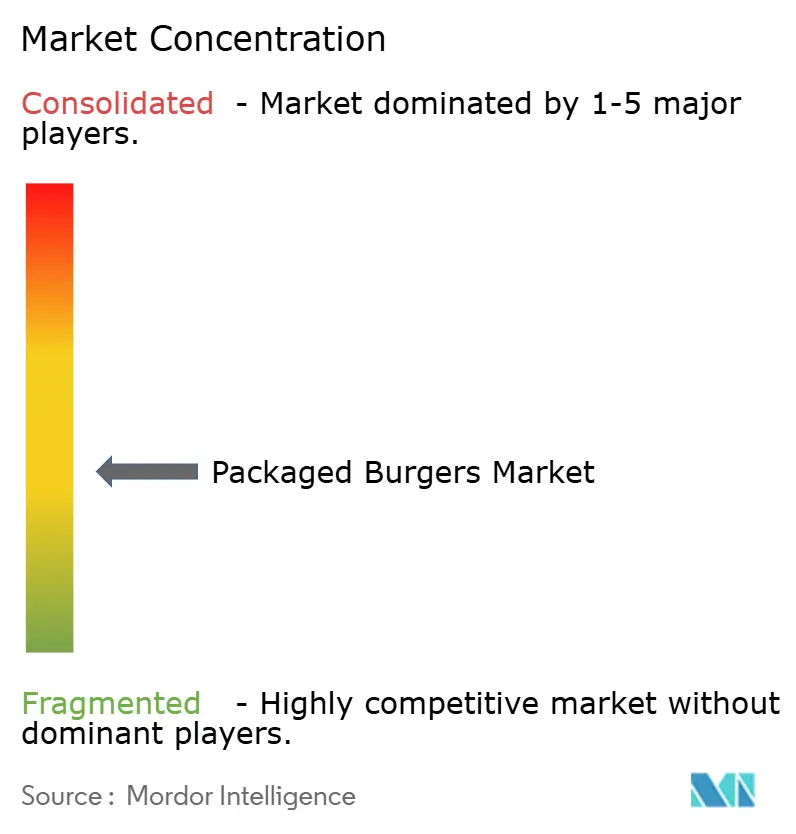
The packaged burgers market has a fragmented structure. No company has a dominant position across every category, geography, and retail channel. Tyson Foods, Nestlé, JBS, Conagra Brands, and Nomad Foods are large multi-regional participants. They compete through production capacity, distribution reach, and private-label manufacturing for major retailers. Protein conglomerates typically treat frozen burgers as one part of a wider protein portfolio. Specialists such as BUBBA Foods, Dr. Praeger's Sensible Foods, and other focused brands compete through category expertise and retail positioning.
Cremonini, Marfrig, and JBS have integrated beef supply chains in Europe and South America. This structure can support their cost position relative to brands that purchase commodity inputs. Competitive differentiation also depends on product development, supply-chain control, and the ability to serve digital channels. In August 2025, JBS agreed to acquire a USD 100 million production facility in Ankeny, Iowa, to expand ready-to-eat prepared-food capacity in the United States. The facility was intended to become the largest ready-to-eat bacon and sausage plant in its U.S. portfolio. The move shows how larger producers are adding prepared-food capacity closer to demand centers.
Beyond Meat used its direct-to-consumer Beyond Test Kitchen to test and refine Beyond Steak Filet before broader retail distribution, using the platform as both a product-testing route and a source of direct consumer feedback before the product moved into major chains. The company then expanded the product to Meijer in July 2026 after prior Wegmans and H-E-B launches, showing how a premium plant-based format can move from direct consumer testing to multi-chain distribution. Maple Leaf Foods also added the Musafir and Mighty Protein brands as part of its 2025 product innovation activity, with the brands aimed at multicultural and health-focused consumer groups and supported by a broader push into U.S. distribution. There is room for mid-premium meat burgers that combine conventional protein with reduced sodium, omega-3 fortification, prebiotic fiber, or other functional ingredients. These products can sit between conventional meat products and specialist functional-food options, although they remain underrepresented at national scale.
Packaged Burgers Industry Leaders
Tyson Foods, Inc.
The Kraft Heinz Company
Beyond Meat, Inc.
Conagra Brands, Inc.
Maple Leaf Foods Inc.
- *Disclaimer: Major Players sorted in no particular order
Packaged Burgers Market Companies Covered in this Report
- Tyson Foods, Inc.
- Nestlé S.A.
- The Kraft Heinz Company
- Conagra Brands, Inc.
- Beyond Meat, Inc.
- Iceland Foods Ltd.
- BUBBA foods, LLC
- Dr. Praeger’s Sensible Foods
- Impossible Foods Inc.
- Maple Leaf Foods Inc.
- JBS S.A.
- Cremonini S.p.A.
- Amy’s Kitchen, Inc.
- Quorn Foods
- Premium Brands Holdings Corporation
- Paragon Quality Foods Ltd.
- Perdue Farms, Inc.
- Marfrig Global Foods S.A.
- The Hain Celestial Group, Inc.
- Monde Nissin Corporation
- Schouten Europe B.V.
- The Vegetarian Butcher
- Nomad Foods Limited
- Hormel Foods Corporation

Recent Industry Developments in Packaged Burgers Market
- May 2026: Reunion Foods, a division of Mosner Family Brands, expanded its retail presence by launching its new Wagyu Beef Burger at Wegmans Food Markets. The launch marks the company's entry into the premium retail burger segment, leveraging growing consumer demand for high-quality Wagyu beef products.
- April 2026: MorningStar Farms expanded its away-from-home and foodservice portfolio by launching the Royal Thai Curry Patty, a plant-based burger designed for restaurants, cafeterias, and other foodservice operators. Made with nine vegetables and featuring authentic Thai curry flavors, the new patty addresses rising demand for globally inspired, vegetable-forward menu options.
- April 2026: REWE Group expanded its sustainable protein portfolio by launching Plant 'n' Beef, a hybrid burger made with 70% beef and 30% textured fava bean protein, produced in partnership with German meat processor Willms. Sold nationwide in REWE stores, the product targets flexitarian consumers by offering lower fat content, a reduced environmental footprint, and a more affordable alternative to conventional beef burgers.


Global Packaged Burgers Market Report Scope
| Meat-Based Burgers | Chicken |
| Pork | |
| Beef | |
| Others | |
| Plant-Based Burgers |
| Boxed Packs |
| Wrapped Packs |
| Vacuum Packs |
| Others |
| Supermarkets/Hypermarkets |
| Convenience/Specialty Stores |
| Online Retail Channels |
| Other Distribution Channels |
| North America | United States |
| Canada | |
| Mexico | |
| Rest of North America | |
| Europe | Germany |
| United Kingdom | |
| France | |
| Italy | |
| Spain | |
| Netherlands | |
| Sweden | |
| Poland | |
| Belgium | |
| Rest of Europe | |
| Asia-Pacific | China |
| India | |
| Japan | |
| Australia | |
| South Korea | |
| Vietnam | |
| Indonesia | |
| Thailand | |
| Singapore | |
| Rest of Asia-Pacific | |
| South America | Brazil |
| Argentina | |
| Chile | |
| Peru | |
| Colombia | |
| Rest of South America | |
| Middle East and Africa | United Arab Emirates |
| Saudi Arabia | |
| South Africa | |
| Nigeria | |
| Egypt | |
| Morocco | |
| Turkey | |
| Rest of Middle East and Africa |
| By Category | Meat-Based Burgers | Chicken |
| Pork | ||
| Beef | ||
| Others | ||
| Plant-Based Burgers | ||
| By Packaging Type | Boxed Packs | |
| Wrapped Packs | ||
| Vacuum Packs | ||
| Others | ||
| By Distribution Channels | Supermarkets/Hypermarkets | |
| Convenience/Specialty Stores | ||
| Online Retail Channels | ||
| Other Distribution Channels | ||
| By Geography | North America | United States |
| Canada | ||
| Mexico | ||
| Rest of North America | ||
| Europe | Germany | |
| United Kingdom | ||
| France | ||
| Italy | ||
| Spain | ||
| Netherlands | ||
| Sweden | ||
| Poland | ||
| Belgium | ||
| Rest of Europe | ||
| Asia-Pacific | China | |
| India | ||
| Japan | ||
| Australia | ||
| South Korea | ||
| Vietnam | ||
| Indonesia | ||
| Thailand | ||
| Singapore | ||
| Rest of Asia-Pacific | ||
| South America | Brazil | |
| Argentina | ||
| Chile | ||
| Peru | ||
| Colombia | ||
| Rest of South America | ||
| Middle East and Africa | United Arab Emirates | |
| Saudi Arabia | ||
| South Africa | ||
| Nigeria | ||
| Egypt | ||
| Morocco | ||
| Turkey | ||
| Rest of Middle East and Africa | ||


Key Questions Answered in the Report
What is the 2026 packaged burgers valuation and forecast?
The packaged burgers market is valued at USD 5.12 billion in 2026 and is forecast to reach USD 7.46 billion by 2031 at a 7.82% CAGR.
Which packaged burger category is growing fastest?
Plant-based burgers are forecast to grow at an 8.56% CAGR from 2026 to 2031, while meat-based burgers held 75.43% share in 2025.
Which packaging format is growing fastest for packaged burgers?
Vacuum packs are forecast to expand at a 9.12% CAGR through 2031. Their growth is linked to longer shelf-life needs, product presentation, lower material use in some applications, and conditions required for online frozen-food delivery.
Which region leads packaged burger demand?
Europe held 42.37% share in 2025, supported by mature frozen-food infrastructure and developed retail networks.
Page last updated on:





