
OTT TV Series Market Size and Share
Market Overview
| Study Period | 2020 - 2031 |
|---|---|
| Market Size (2026) | USD 78.06 Billion |
| Market Size (2031) | USD 126.90 Billion |
| Growth Rate (2026 - 2031) | 10.21 % |
| Fastest Growing Market | Asia-Pacific |
| Largest Market | North America |
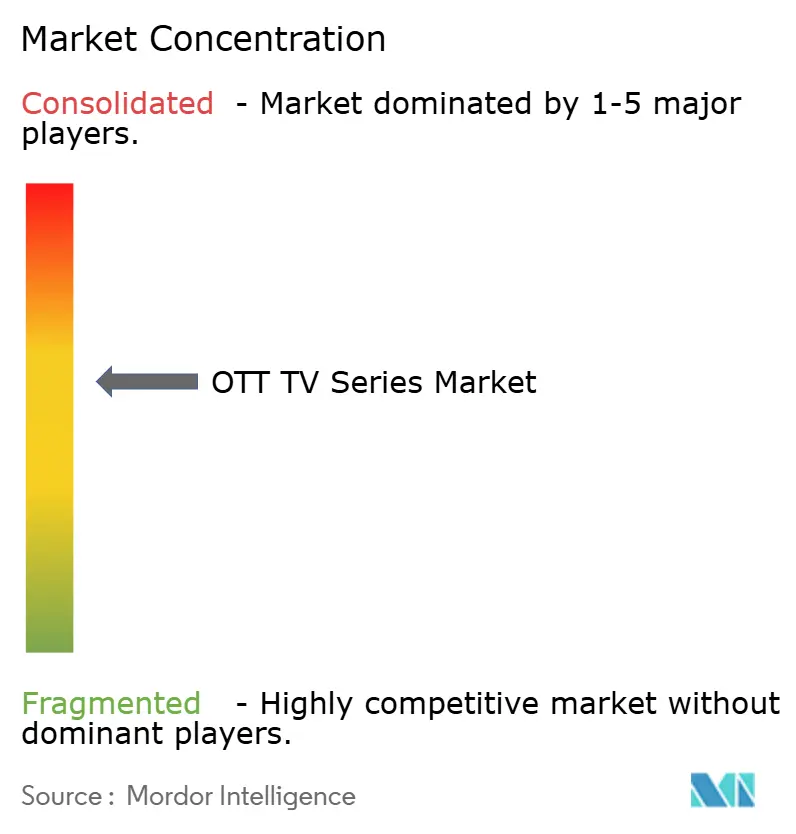
| Market Concentration | Medium |
Major Players *Disclaimer: Major Players sorted in no particular order Image © Mordor Intelligence. Reuse requires attribution under CC BY 4.0. | |
OTT TV Series Market Analysis by Mordor Intelligence
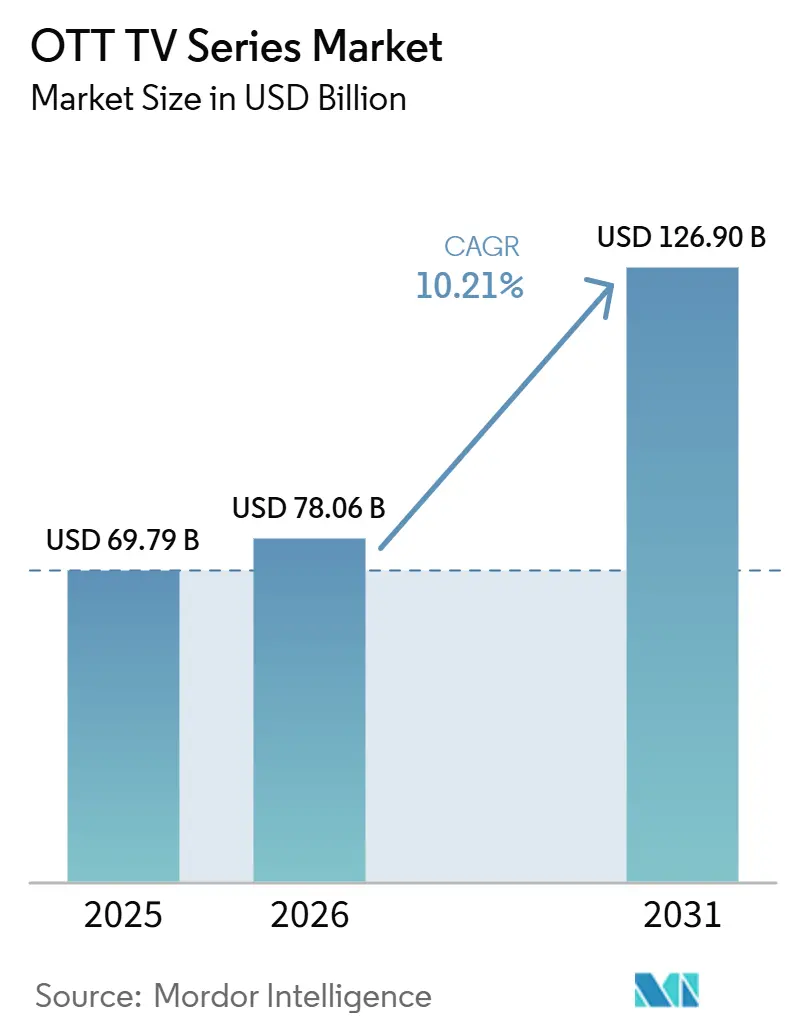
The OTT TV series market size is projected to expand from USD 69.79 billion in 2025 and USD 78.06 billion in 2026 to USD 126.90 billion by 2031, registering a CAGR of 10.21% between 2026 to 2031. The OTT TV series market is growing because viewers now treat on-demand series as a regular part of daily viewing rather than as an occasional alternative to broadcast television. The OTT TV series market is also being supported by a wider revenue base, because subscription plans now sit alongside advertising-supported access and bundled offers. Another important shift in the OTT TV series market is the move toward connected television viewing, which is changing both audience behavior and the way platforms sell advertising. Local-language programming remains central to the OTT TV series market because platforms need stronger domestic relevance as they expand outside early-maturity countries. Competition in the OTT TV series market is becoming more defined by content depth, franchise ownership, recommendation quality, and disciplined spending on original series.
Key Report Takeaways
- By monetization model, SVOD held 42.48% revenue share in 2025, while AVOD is projected to expand at 11.40% CAGR through 2031.
- By genre, drama held 27.32% revenue share in 2025, while action and adventure is projected to expand at 11.80% CAGR through 2031.
- By device type, smart TVs accounted for 41.46% share in 2025, while smartphones and tablets are projected to expand at 11.12% CAGR through 2031.
- By viewer age group, young adults and seniors held 60.68% of viewership in 2025, and this same segment is projected to expand at 11.13% CAGR through 2031.
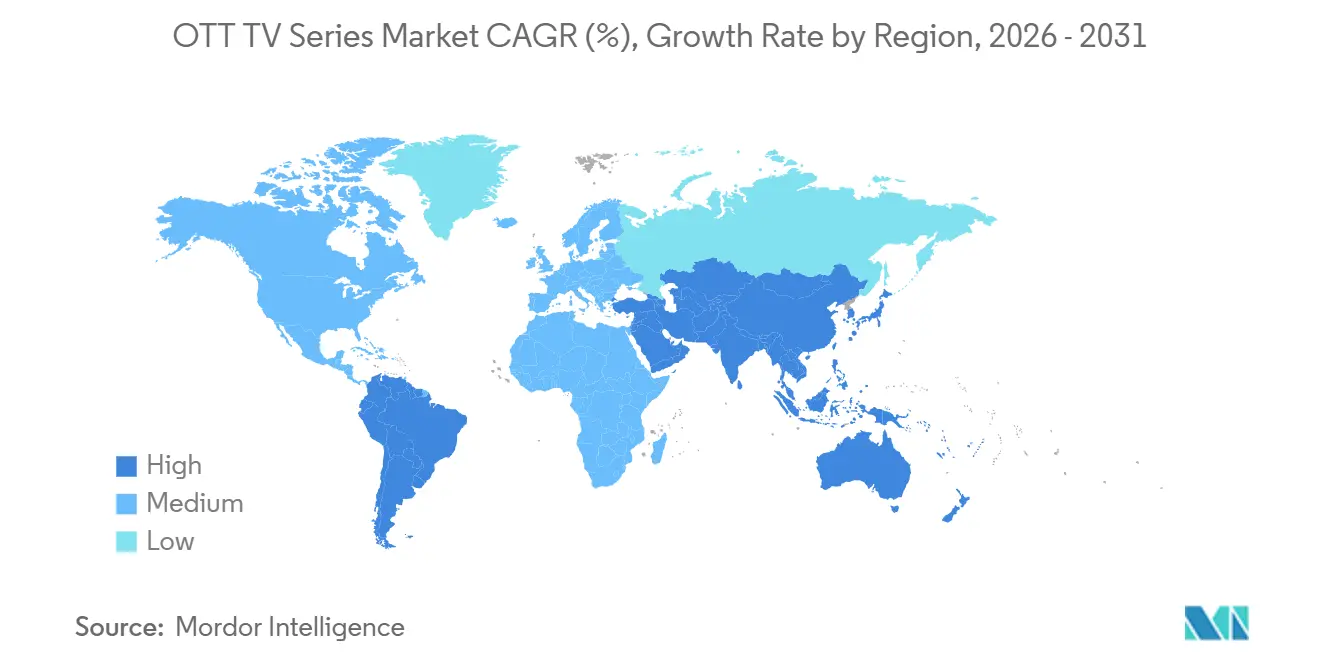
- By geography, North America held 30.34% of the OTT TV series market share in 2025, while Asia-Pacific is projected to expand at 11.45% CAGR through 2031.
Note: Market size and forecast figures in this report are generated using Mordor Intelligence’s proprietary estimation framework, updated with the latest available data and insights as of January 2026.
Market Trends and Insights
Drivers Impact Analysis of OTT TV Series Market*
| Driver | (~) % Impact on CAGR Forecast | Geographic Relevance | Impact Timeline |
|---|---|---|---|
| Rising Global Appetite for Serialized Original Content | +2.5% | Global | Long term (≥ 4 years) |
| Smart TV Penetration and Lean-Back Viewing Shift | +1.8% | North America and Europe, spill-over to Asia-Pacific | Medium term (2-4 years) |
| Multi-Tier Monetization Expands Audience Reach | +2.1% | Global | Short term (≤ 2 years) |
| Platform Differentiation Through Franchise IP Investment | +1.5% | North America and Asia-Pacific core | Long term (≥ 4 years) |
| Local-Language Content Accelerates Subscriber Acquisition | +1.2% | Asia-Pacific core, spill-over to Middle East and Africa and South America | Medium term (2-4 years) |
| AI-Assisted Content Discovery Improves Completion Rates | +0.8% | Global | Short term (≤ 2 years) |
| Source: Mordor Intelligence | |||
Rising Global Appetite for Serialized Original Content
The OTT TV series market continues to benefit from strong demand for serialized storytelling across both mature and emerging viewing regions. Multi-episode originals now work as a core retention tool because viewers are less likely to cancel when they are following returning seasons or longer story arcs. Platforms have responded by keeping original series spending high even as they tighten title-level return thresholds. Netflix reported USD 17.1 billion in content spend for 2025 and targeted USD 18 billion for 2026, which shows that large services still treat premium series as a primary growth lever.[1]Netflix, “Q4 2025 Earnings Release and 10-K,” SEC EDGAR Disney also maintained a FY2026 content budget of USD 24 billion, which supports the same pattern of continued investment in premium programming depth. This keeps the OTT TV series market focused on fewer but more valuable originals that can travel across territories and hold subscriber attention for longer periods.
Smart TV Penetration and Lean-Back Viewing Shift
The OTT TV series market is being reshaped by the rise of smart TVs as the main screen for long-session viewing. This matters because a television screen supports a more traditional lean-back environment, and that tends to lift series completion, repeat viewing, and ad inventory quality. In the United States, 85% of television sets accessed streaming content in Q3 2025, which shows how deeply streaming has moved into the main household screen.[2]Video Advertising Bureau, “2026 Streaming Report,” Video Advertising Bureau The advertising effect is just as important because connected TV ad spend in the United States is expected to reach 43% of total TV ad spend in 2026. As that shift continues, the OTT TV series market gains a stronger bridge between premium viewing behavior and advertising revenue. The result is a more balanced business model for platforms that need both strong engagement and broader monetization.
Multi-Tier Monetization Expands Audience Reach
The OTT TV series market is no longer built around a single payment model, and that change is broadening the addressable audience. Ad-supported tiers across premium subscription services accounted for 57% of gross subscriber additions in Q1 2025, which shows that lower-priced entry points are now doing much of the volume work. Digital video advertising in the United States is projected to reach USD 81.9 billion in 2026, which gives platforms a larger revenue pool outside pure subscriptions.[3]Interactive Advertising Bureau, “Digital Video Ad Spend and Strategy Report,” IAB Netflix also projected advertising revenue of USD 3 billion for 2026, which confirms that major operators now see ads as a core growth channel rather than an add-on. This has lowered the pressure to drive all revenue through price increases on premium plans. It also gives the OTT TV series market more room to serve value-focused households without giving up scale.
Platform Differentiation Through Franchise IP Investment
The OTT TV series market is becoming more selective about where content spending goes, and established franchise properties are getting a larger share of that focus. The reason is simple because recognizable intellectual property lowers discovery friction and can support repeat engagement across seasons, spin-offs, and adjacent formats. Netflix kept its content budget elevated into 2026, while Disney set a USD 24 billion FY2026 budget, and both moves show that major platforms still see owned or controlled franchises as a defensive asset. The value of this approach also extends to production efficiency as rights ownership supports reuse across merchandising, promotion, and international release scheduling. WIPO has identified AI-related media production tools as a fast-growing area within entertainment-related filings, which points to future gains in how large franchises are developed and managed. That favors scaled platforms in the OTT TV series market because they can spread franchise costs across more regions and more monetization channels.
Restraints Impact Analysis of OTT TV Series Market*
| Restraint | (~) % Impact on CAGR Forecast | Geographic Relevance | Impact Timeline |
|---|---|---|---|
| Subscription Fatigue Across Mature Streaming Markets | -1.5% | North America and Europe | Short term (≤ 2 years) |
| Content Cost Inflation Compresses Return on Originals | -1.2% | Global | Medium term (2-4 years) |
| Fragmented Rights Ownership Limits Library Reuse | -0.8% | North America and Europe | Long term (≥ 4 years) |
| Advertising Load Sensitivity Reduces Ad-Supported Monetization Efficiency | -0.6% | North America and Europe | Medium term (2-4 years) |
| Source: Mordor Intelligence | |||
Subscription Fatigue Across Mature Streaming Markets
The OTT TV series market faces a clear limit in mature countries where households already manage several recurring services. Consumers are more willing to switch, pause, or cancel when a platform does not provide enough fresh series value or when pricing changes arrive too quickly. That pressure has also drawn regulatory attention because easier cancellation standards are now part of the broader consumer protection discussion. The U.S. Federal Trade Commission pursued its click-to-cancel rulemaking process, and a bipartisan Unsubscribe Act was introduced in the House of Representatives in January 2026. These developments do not reduce demand for streaming itself, but they do make retention harder for platforms that depend on passive renewals. In the OTT TV series market, this pushes operators toward bundles, lower-priced tiers, and tighter content release planning.
Content Cost Inflation Compresses Return on Originals
The OTT TV series market also remains under pressure from the rising cost of creating and sustaining original programming. Large services continue to spend heavily because original series are central to retention, but the return on each title is getting harder to justify. Netflix disclosed USD 17.1 billion of content spend for 2025 and guided to higher investment in 2026, while Disney budgeted USD 24 billion for FY2026. This level of spending can be absorbed by only a small group of global platforms with strong scale and diversified revenue streams. Smaller and mid-tier operators in the OTT TV series market have less room to recover high production costs through subscriptions alone. That increases pressure to co-produce, license selectively, and favor proven formats over a wider volume of experiments.
*Our forecasts treat driver/restraint impacts as directional, not additive. The impact forecasts reflect baseline growth, mix effects, and variable interactions.
OTT TV Series Market Segment Analysis
By Monetization Model:
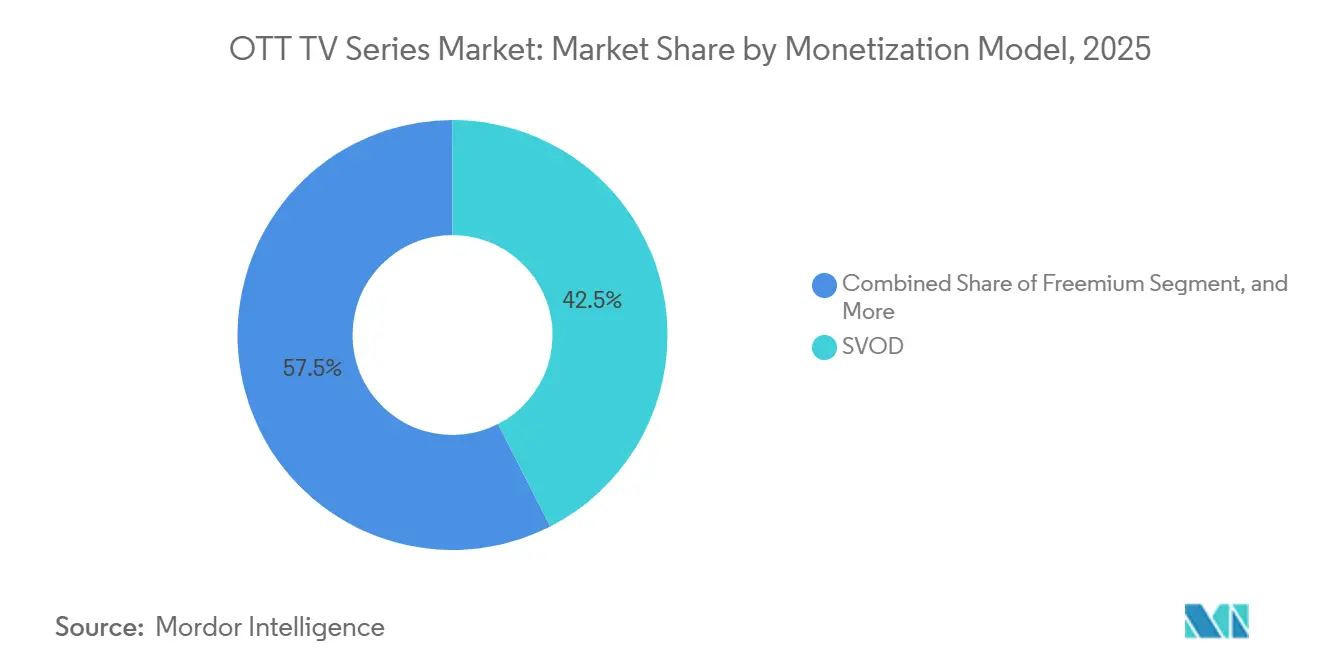
SVOD Keeps the Revenue Base Firm While AVOD Opens the Fastest Expansion PathSVOD held 42.48% of revenue in 2025, which kept it as the largest monetization block in the OTT TV series market. That position reflects the lasting value of subscription libraries built around exclusive and recurring series that viewers cannot easily replace elsewhere. Even so, the center of growth has moved because AVOD is projected to expand at 11.40% CAGR during 2026-2031. Ad-supported plans now work as the main entry tier for many users who want premium catalog access without taking on the full subscription price. Gross additions data already points in that direction, with ad-supported tiers accounting for 57% of additions across premium subscription platforms in Q1 2025. The OTT TV series market is therefore becoming less dependent on pure subscription growth than it was in earlier streaming cycles.
The shift does not weaken SVOD. It changes what SVOD is expected to do inside the platform mix. Premium subscription tiers still carry the strongest link to exclusive tentpole series, early access value, and higher average revenue per user. At the same time, AVOD gives operators a larger funnel and helps them monetize households that would otherwise remain outside the paid stack. Digital video ad spending of USD 81.9 billion in the United States in 2026 supports that path and gives the monetization model real headroom. In practical terms, the OTT TV series industry is moving toward layered monetization where SVOD secures the revenue base and AVOD drives wider reach.



By Genre:
Drama Holds the Largest Position While Action and Adventure Deliver the Fastest LiftDrama captured 27.32% of the OTT TV series market size in 2025, which made it the largest genre in the period under review. Drama remains central because long-form character arcs and season continuity make it one of the strongest tools for retention. Viewers often stay subscribed to follow returning prestige titles, and that keeps drama valuable even when production costs are high. Action and adventure, however, is projected to expand at 11.80% CAGR through 2031, which gives it the strongest growth pace among the listed genres. This growth profile reflects the portability of action-led storytelling across regions because it depends less on language nuance than some comedy formats. In the OTT TV series market, that makes action and adventure a reliable choice for multi-country launches and franchise expansion.
Drama still anchors library depth because it serves both local and global commissioning strategies. European content rules also strengthen this segment because platforms with EU users must keep at least 30% European works in their catalogs. That requirement supports investment in local-language drama and in crime-related scripted formats that can travel within the region. Action and adventure gains from a different advantage because recognizable universes are easier to extend across seasons, spin-offs, and merchandising plans. Reality and lifestyle remains useful in the OTT TV series industry where platforms want a lower-cost category with steady advertiser appeal. The result is a genre mix where drama supports stickiness and action and adventure provides wider cross-border scaling.
By Device Type:
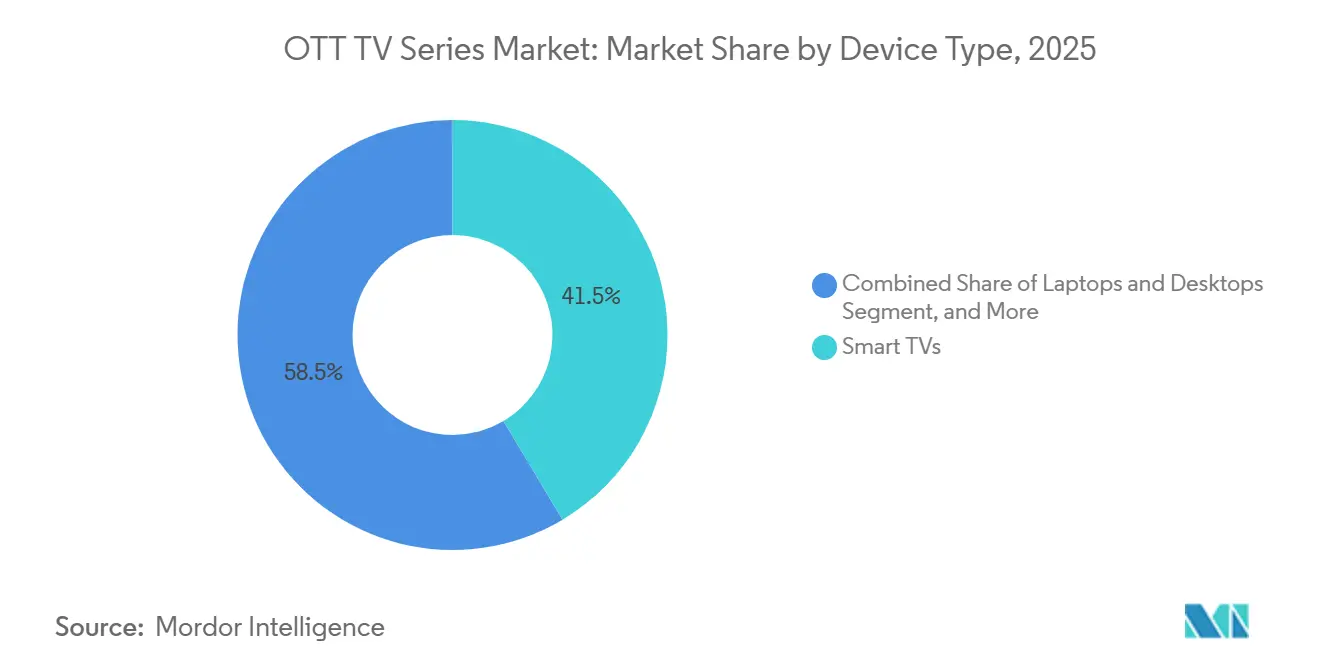
Smart TVs Lead Viewing While Mobile Screens Extend Reach In Emerging EconomiesSmart TVs accounted for 41.46% share in 2025, which kept them as the leading device type in the OTT TV series market. That position reflects how series viewing has moved back into the living room even as on-demand access remains personal and flexible. The main advantage of the smart TV screen is that it fits longer episodes, family co-viewing, and ad-supported lean-back sessions more naturally than smaller devices. In the United States, 85% of television sets accessed streaming content in Q3 2025, which confirms how firmly streaming sits in the main-home screen environment. Smartphones and tablets are still the fastest-growing device category, with 11.12% CAGR expected for 2026-2031. That growth gives the OTT TV series market a strong second screen path for countries where mobile data access improves faster than fixed television infrastructure.
Mobile viewing matters for more than convenience. It also lets platforms address lower-income or younger users with lighter pricing, offline features, and app-first discovery. That is especially relevant in fast-growing regions where the household television is shared or broadband quality is inconsistent. Smart TVs will likely stay the preferred screen for long-session premium viewing, but mobile screens will keep widening the audience base. The OTT TV series market therefore depends on both formats for different reasons, with television screens supporting monetization quality and mobile screens supporting penetration. This two-track device structure helps platforms balance scale with engagement instead of choosing one over the other.
By Viewer Age Group:
Young Adults and Seniors Provide the Strongest Revenue Logic While Children and Teens Support Family RetentionYoung adults and seniors held 60.68% of viewership in 2025, and the same group is projected to expand at 11.13% CAGR through 2031. That makes this the most commercially important age cluster in the OTT TV series market. The segment combines two strong traits because it includes users with higher spending ability and users with steadier completion habits. Completion matters because longer engagement with serialized content usually supports retention better than short bursts of trial viewing. This is why platforms keep aligning drama, crime, and premium event series around adult viewing preferences. In the OTT TV series market, this cohort remains the clearest center of monetization and long-term account stability.
Children and teens still play an important role even though their direct share is smaller. Family content often reduces the risk of household churn because it makes the subscription useful to more than one age group. That is especially relevant when platforms are defending premium plans against cancellation pressure and lower-priced alternatives. Child protection standards also shape how platforms promote and monetize content for younger viewers in the United States and the European Union. The OTT TV series industry therefore uses a two-part age strategy where adult-focused content drives core value and youth programming protects household retention over time. This mix supports both account longevity and a broader release slate across the year.
Geography Analysis
North America OTT TV Series Market
North America held 30.34% of global revenue in 2025, which kept it as the largest regional block in the OTT TV series market. The region remains important because it combines high spending per user, mature platform competition, and deep connected television usage. In the United States, 85% of television sets accessed streaming content in Q3 2025, which confirms how deeply series viewing has moved into the streaming environment. The region is also central to monetization innovation because premium subscriptions, ad-supported tiers, and bundle offers all have meaningful scale there. Netflix guided USD 50.7-51.7 billion in revenue for FY2026 and expected advertising revenue of USD 3 billion, which shows how strongly revenue expansion now depends on dual monetization.
APAC OTT TV Series Market
Asia-Pacific is projected to expand at 11.45% CAGR during 2026-2031, which makes it the fastest-growing regional area in the OTT TV series market. The region is being lifted by a mix of rising digital access, broader smartphone usage, and strong demand for local-language series. Growth also reflects the fact that many households are still earlier in their streaming adoption cycle than those in North America and Western Europe. Competition in this region is shaped more by domestic relevance than by global brand recognition alone. Platforms that invest in regional language content and pricing flexibility are better positioned to capture new viewers as the OTT TV series market grows across India, Japan, China, and nearby countries.
EMEA and South America OTT TV Series Market
Europe continues to hold a significant position in the OTT TV series market because paid streaming penetration is already well established in major countries. In France, 74% of households accessed at least one paid streaming service in 2026, which shows a mature and stable demand base. The European framework also favors local commissioning because platforms serving EU users must maintain a minimum 30% share of European works in their catalogs. South America, the Middle East, and Africa remain earlier-stage markets, but they matter because smartphone viewing and broadband access are improving from lower bases. CANAL+ completed its acquisition of MultiChoice in July 2026, which signals continued confidence in Africa as a longer-term expansion field for the OTT TV series market. Across these regions, growth is more likely to come from better local fit and wider access than from premium pricing alone.

Competitive Landscape
The OTT TV series market has a concentrated top tier and a broad middle layer that remains fragmented by geography, language, and content specialization. Netflix, Prime Video, and Disney+ together held 52% share of U.S. streaming platform positioning in Q1 2026, which shows that a small group still sets the tone on pricing, content investment, and release strategy. Even so, the wider OTT TV series market is not controlled by one model because regional players continue to defend local positions with domestic language content and distribution ties. This creates a structure where scale matters at the top, but local fit still matters below it. The practical result is steady pressure on global services to balance worldwide franchises with local programming depth.
Strategic moves in 2026 show that distribution control is becoming almost as important as content control in the OTT TV series market. Fox announced its agreement to acquire Roku in June 2026, combining Tubi with Roku's large connected TV distribution footprint. Sky also agreed in July 2026 to acquire ITV Media and Entertainment, which would bring ITVX users and Sky's platform reach into one larger UK streaming position. CANAL+ completed its acquisition of MultiChoice in July 2026, strengthening its presence in African pay television and streaming distribution. These transactions show that competitive advantage is being built through both audience ownership and direct access to the screen.
The leading companies are also separating themselves through technology and portfolio discipline. Netflix has publicly discussed AI-supported personalization work, which reflects the growing role of recommendation quality in keeping viewers engaged with long-form series libraries. Disney has kept a large budget while becoming more selective about where high-value content spending goes. Regional services remain relevant when they can pair local storytelling with strong distribution partnerships or regulatory familiarity. That means the OTT TV series market is concentrated in leadership but still open in the middle, especially where language depth and local programming habits create room for domestic platforms.
OTT TV Series Industry Leaders
Netflix, Inc.
The Walt Disney Company
Amazon.com, Inc.
Warner Bros. Discovery, Inc.
Paramount Global
- *Disclaimer: Major Players sorted in no particular order
OTT TV Series Market Companies Covered in this Report
- Netflix, Inc.
- The Walt Disney Company
- Warner Bros. Discovery, Inc.
- Amazon.com, Inc.
- Apple Inc.
- Comcast Corporation
- Paramount Skydance Corporation
- Sony Group Corporation
- Tencent Holdings Limited
- iQIYI, Inc.
- Rakuten Group, Inc.
- Zee Entertainment Enterprises Limited
- Roku, Inc.
- JioStar India Private Limited
- PCCW Limited
- MBC Group
- CANAL+ S.A.
- ITV plc
- ProSiebenSat.1 Media SE
- TelevisaUnivision, Inc.

Recent Industry Developments in OTT TV Series Market
- July 2026: Sky agreed to acquire ITV Media and Entertainment for total consideration of up to GBP 1.6 billion (USD 2.14 billion), combining ITVX's 16.5 million monthly active users with Sky's streaming platform to create a scaled UK OTT competitor to global streaming giants. The transaction includes a five-year, GBP 2.1 billion content supply agreement with ITV Studios and is expected to close in the second half of 2027, pending regulatory approval.
- July 2026: CANAL+ S.A. formally completed its USD 3 billion acquisition of MultiChoice Group on July 10, 2026, securing full ownership of the African pay-TV operator behind DStv after years of stake accumulation. The final cash outlay to acquire remaining public shares totaled USD 1.9 billion, and CANAL+ announced concurrent plans to invest in Showmax and increase African local content production as strategic priorities.
- June 2026: Fox Corporation announced a definitive agreement to acquire Roku Inc. for USD 22 billion, or USD 160 per share in cash and Fox Class A stock, pairing Tubi's AVOD service with Roku's 100 million-household connected TV platform. The deal is expected to close in the first half of 2027 and is intended to accelerate Fox's international market push.
- January 2026: Netflix reported 325 million paying subscribers at year-end 2025 through its Q4 2025 filing, with USD 17.1 billion in content spend and a 24.5% operating margin. The company guided FY2026 revenue of USD 50.7-51.7 billion and projected advertising revenue of USD 3 billion, reinforcing its dual-monetization direction.


Global OTT TV Series Market Report Scope
The Global OTT TV Series Market comprises the production, acquisition, distribution, and monetization of serialized television content delivered directly to viewers through over-the-top (OTT) streaming platforms via the internet, bypassing traditional cable, satellite, and broadcast television networks.
The OTT TV Series Market Report is Segmented by Monetization Model (SVOD, AVOD, TVOD, Hybrid, and Freemium), Genre (Drama, Comedy, Action and Adventure, Crime and Thriller, Reality and Lifestyle, and Other Genres), Device Type (Smartphones and Tablets, Smart TVs, Laptops and Desktops, and Other Device Types), Viewer Age Group (Children/Teens and Young Adults/Seniors), and Geography (North America, South America, Europe, Asia-Pacific, Middle East, and Africa). The Market Forecasts are Provided in Terms of Value (USD).
| SVOD |
| AVOD |
| TVOD |
| Hybrid |
| Freemium |
| Drama |
| Comedy |
| Action and Adventure |
| Crime and Thriller |
| Reality and Lifestyle |
| Other Genres |
| Smartphones and Tablets |
| Smart TVs |
| Laptops and Desktops |
| Other Device Types |
| Children/ Teens |
| Young Adults/ Seniors |
| North America | United States |
| Canada | |
| Mexico | |
| South America | Brazil |
| Argentina | |
| Chile | |
| Rest of South America | |
| Europe | Germany |
| United Kingdom | |
| France | |
| Italy | |
| Spain | |
| Rest of Europe | |
| Asia-Pacific | China |
| Japan | |
| India | |
| South Korea | |
| Australia | |
| Rest of Asia-Pacific | |
| Middle East | Saudi Arabia |
| United Arab Emirates | |
| Qatar | |
| Rest of Middle East | |
| Africa | South Africa |
| Egypt | |
| Nigeria | |
| Rest of Africa |
| By Monetization Model | SVOD | |
| AVOD | ||
| TVOD | ||
| Hybrid | ||
| Freemium | ||
| By Genre | Drama | |
| Comedy | ||
| Action and Adventure | ||
| Crime and Thriller | ||
| Reality and Lifestyle | ||
| Other Genres | ||
| By Device Type | Smartphones and Tablets | |
| Smart TVs | ||
| Laptops and Desktops | ||
| Other Device Types | ||
| By Viewer Age Group | Children/ Teens | |
| Young Adults/ Seniors | ||
| By Geography | North America | United States |
| Canada | ||
| Mexico | ||
| South America | Brazil | |
| Argentina | ||
| Chile | ||
| Rest of South America | ||
| Europe | Germany | |
| United Kingdom | ||
| France | ||
| Italy | ||
| Spain | ||
| Rest of Europe | ||
| Asia-Pacific | China | |
| Japan | ||
| India | ||
| South Korea | ||
| Australia | ||
| Rest of Asia-Pacific | ||
| Middle East | Saudi Arabia | |
| United Arab Emirates | ||
| Qatar | ||
| Rest of Middle East | ||
| Africa | South Africa | |
| Egypt | ||
| Nigeria | ||
| Rest of Africa | ||


Key Questions Answered in the Report
What is the current and forecast value of the OTT TV series market?
The OTT TV series market size is projected at USD 78.06 billion in 2026 and is forecast to reach USD 126.90 billion by 2031, growing at a 10.21% CAGR over 2026-2031.
Which monetization model is growing fastest in OTT TV series?
AVOD is the fastest-growing model with an 11.40% CAGR through 2031, while SVOD remained the largest revenue segment with 42.48% share in 2025.
Which genre leads global OTT TV series revenue?
Drama led with 27.32% revenue share in 2025, while action and adventure is the fastest-growing genre with an 11.80% CAGR through 2031.
Why are smart TVs so important for OTT TV series platforms?
Smart TVs held 41.46% device share in 2025 and support longer viewing sessions, stronger connected TV advertising, and better living-room engagement for serialized content.
Which region is growing fastest for OTT TV series demand?
Asia-Pacific is the fastest-growing region with an 11.45% CAGR through 2031, supported by local-language demand, wider digital access, and mobile-first viewing habits.
How competitive is the OTT TV series space in 2026?
The space has a concentrated top tier led by Netflix, Prime Video, and Disney+, but it still leaves room for regional and language-focused platforms that compete through local programming and distribution strength.
Page last updated on:





