
OTT Subscription Management Market Size and Share
Market Overview
| Study Period | 2020 - 2031 |
|---|---|
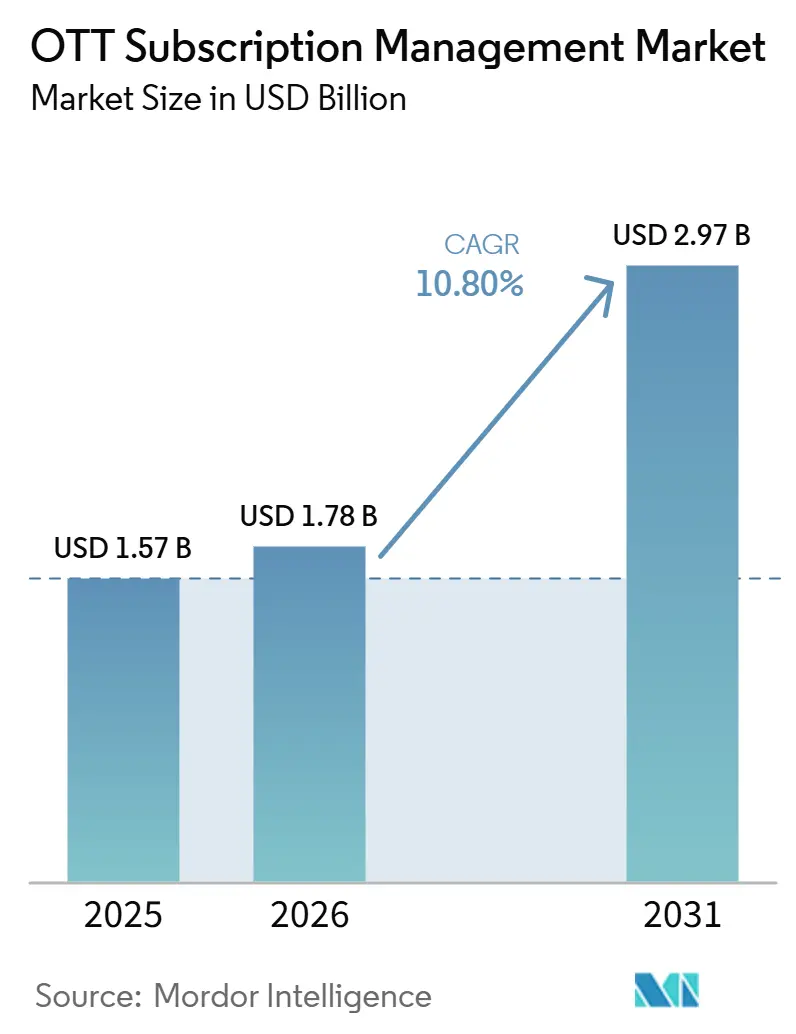
| Market Size (2026) | USD 1.78 Billion |
| Market Size (2031) | USD 2.97 Billion |
| Growth Rate (2026 - 2031) | 10.80 % |
| Fastest Growing Market | Asia-Pacific |
| Largest Market | North America |
| Market Concentration | Medium |
Major Players *Disclaimer: Major Players sorted in no particular order Image © Mordor Intelligence. Reuse requires attribution under CC BY 4.0. | |
OTT Subscription Management Market Analysis by Mordor Intelligence
The OTT subscription management market size is projected to expand from USD 1.57 billion in 2025 and USD 1.78 billion in 2026 to USD 2.97 billion by 2031, registering a CAGR of 10.80% between 2026 to 2031. Growth reflects the need for providers to manage enrollment, payments, renewals, access rights, and cancellations across an expanding range of streaming services. Hybrid offers that combine paid access with advertising increase the number of decisions that must be handled within each subscriber record. Bundles, event passes, and promotional offers also make subscriber management more complex than a standard monthly billing process. Vendors are competing on flexible pricing controls, reliable entitlement management, and integration with payment and distribution partners. The OTT subscription management market, therefore, favors platforms that can support both large-scale services and smaller direct-to-consumer operators without creating access or billing errors.
Key Report Takeaways
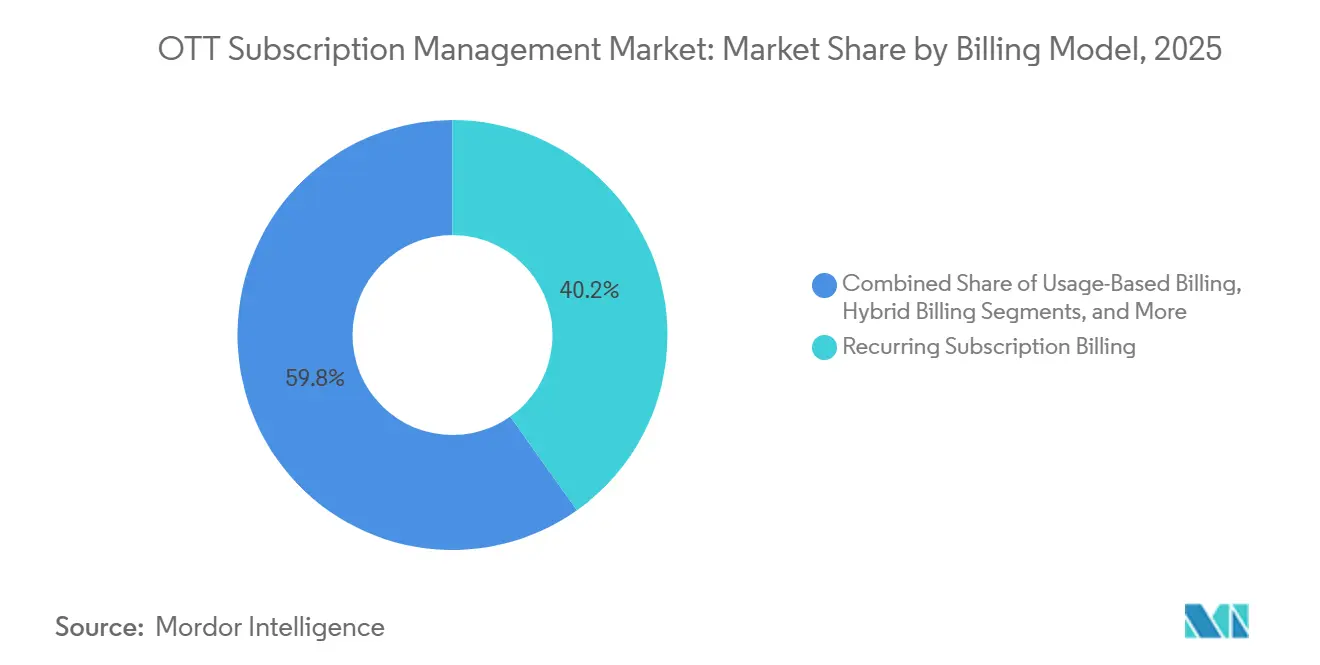
- By billing model, recurring subscription billing held 40.18% of the OTT subscription management market share in 2025, while usage-based billing is projected to expand at an 11.37% CAGR through 2031.
- By application, video streaming accounted for 55.24% of the OTT subscription management market size in 2025, while live streaming is expected to expand at an 11.29% CAGR through 2031.
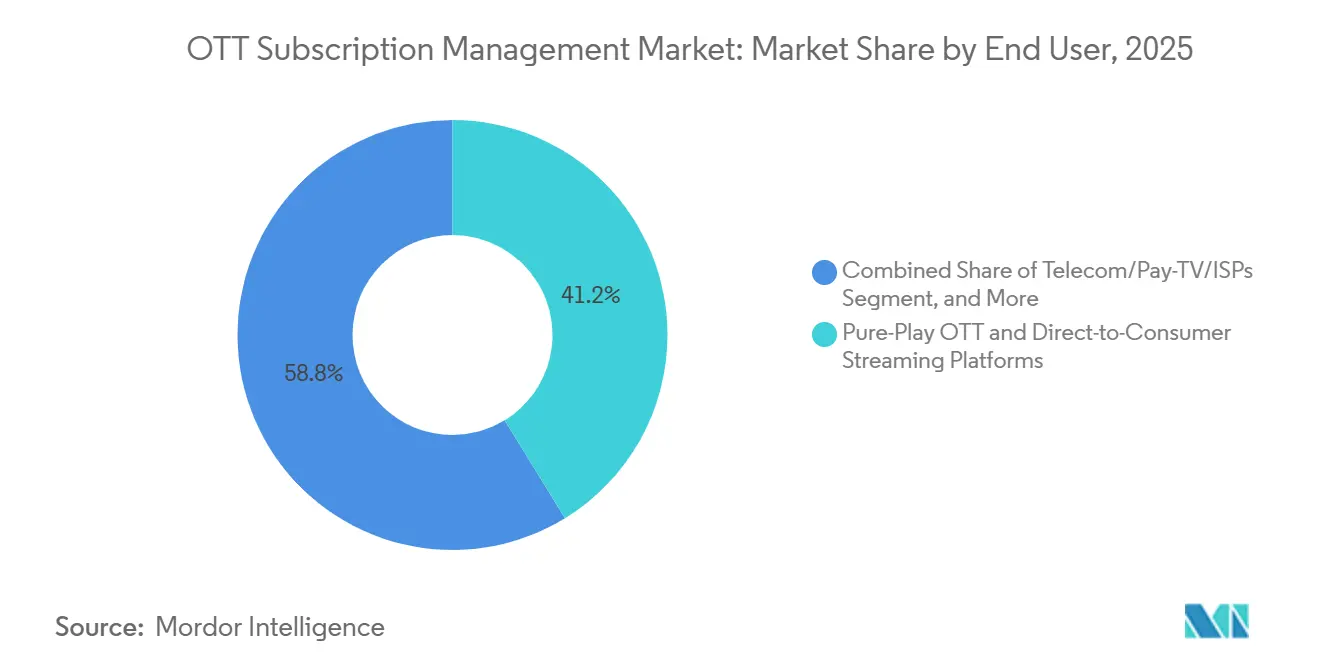
- By end user, pure-play OTT and direct-to-consumer streaming platforms held 41.23% revenue share in 2025, while telecom, Pay-TV, and internet service providers are projected to record the highest CAGR of 11.45% through 2031.
- By geography, North America accounted for 42.11% of revenue in 2025, while Asia-Pacific is expected to grow at an 11.34% CAGR through 2031.
Note: Market size and forecast figures in this report are generated using Mordor Intelligence’s proprietary estimation framework, updated with the latest available data and insights as of January 2026.
Market Trends and Insights
Drivers Impact Analysis of OTT Subscription Management Market*
| Driver | (~) % Impact on CAGR Forecast | Geographic Relevance | Impact Timeline |
|---|---|---|---|
| Expansion of Direct-to-Consumer Streaming Services | +3.1% | Global, concentrated in North America and Western Europe | Short term (≤ 2 years) |
| Hybrid Subscription and Advertising Monetization | +2.5% | North America, Western Europe, and Asia-Pacific mature markets | Short term (≤ 2 years) |
| Cloud-Native Scaling and Multi-Device Delivery | +1.8% | Global | Medium term (2-4 years) |
| AI-Driven Churn Prediction and Revenue Optimization | +1.4% | North America, Europe, and Asia-Pacific | Medium term (2-4 years) |
| App-Store and Local Payment Interoperability | +1.1% | United States, United Kingdom, EEA, Brazil, and spillover to Asia-Pacific | Short term (≤ 2 years) |
| Real-Time Entitlement Orchestration for Live and Event Streaming | +0.9% | Global, with early concentration in North America and Europe | Long term (≥ 4 years) |
| Source: Mordor Intelligence | |||
Expansion of Direct-to-Consumer Streaming Services
Direct-to-consumer streaming expansion remains the largest source of demand for subscription lifecycle tools because every new service must establish accounts, collect payments, and maintain viewing rights across several channels. Netflix ended 2025 with more than 325 million paid memberships and USD 45.2 billion in annual revenue, demonstrating the scale that subscriber systems must support across plan types and territories.[1]Netflix, “Netflix Q4 2025 Earnings,” Netflix, netflix.com Fox One added nearly 3 million subscribers during June 2026 as FIFA World Cup viewing increased demand for its new service and tested the readiness of its subscriber operations.[2]Fox Corporation, “Fox One Added Nearly 3 Million New Subscribers in June for FIFA World Cup Streams,” Fox Corporation, fox.com Such surges require rapid account creation, payment authorization, rights activation, and customer communication without disrupting existing subscribers. The OTT subscription management market is also shaped by the expectation that new services will support local pricing, app-store reconciliation, payment recovery, and clear cancellation processes from launch. Smaller platforms can reach a capability limit as their customer base grows, their promotional campaigns broaden, and their entitlement rules become more varied.
Adoption of Hybrid Subscription and Advertising Monetization
Hybrid services require systems to manage paid access and advertising eligibility within the same customer record. Ad-supported tiers have become an important entry option for large streaming platforms, changing the rules that govern plan selection, promotional eligibility, and subscriber access. A management platform must determine the plan price, ad status, offer terms, viewing rights, and renewal conditions at the same time. It must then apply those rules consistently on mobile devices, connected televisions, web applications, and other distribution endpoints. The OTT subscription management market benefits when operators replace separate billing and advertising workflows with unified subscriber records that can be updated without manual reconciliation. Providers that retain systems designed only for paid video subscriptions may find it difficult to serve operators moving toward mixed monetization models and more frequent price changes.
Cloud-Native Scaling and Multi-Device Delivery Requirements
Cloud-based architecture has become more important as live events create rapid spikes in transactions, payment activity, and access checks that older systems may not process quickly. Amdocs introduced real-time event-based billing in April 2026, allowing providers to process transactions throughout the billing cycle rather than through batch runs.[3]Amdocs, “Partner Ecosystem Management 2026.05 Release Notes,” Amdocs Documentation, docs.saas.amdocs.com Kaltura supported live television streaming for nearly 40 million registered devices across 6 production environments during the 2026 FIFA World Cup. A subscriber may generate separate entitlement requests from a phone, connected television, and gaming console in a single day, even though the underlying plan remains the same. Each request must return the same access result while applying the relevant device credentials and local rights rules. The OTT subscription management market rewards systems that can maintain reliable access decisions during peak traffic and across multiple device ecosystems.
AI-Driven Churn Prediction and Revenue Optimization
Churn tools are becoming part of the operating model for subscription platforms rather than a separate reporting feature that is reviewed after a cancellation occurs. Behavioral signals can include viewing activity, payment failures, completion patterns, plan changes, and use across devices. A 2026 research paper described an OTT churn system using LSTM and CNN-BiLSTM models that produced retention recommendations from behavioral data. When these capabilities sit within the billing layer, teams can connect a risk signal to a relevant offer, a payment retry, a plan change, or a timely customer message. This approach can raise contract value for vendors because it links billing operations to retention activity and makes the operating platform more difficult to replace. The OTT subscription management market is likely to favor vendors that combine pricing tests, involuntary churn recovery, and personalized offers with dependable billing controls.
Restraints Impact Analysis of OTT Subscription Management Market*
| Restraint | (~) % Impact on CAGR Forecast | Geographic Relevance | Impact Timeline |
|---|---|---|---|
| Legacy Billing and Entitlement Migration Risk | -2.3% | Global, concentrated in North America and Western Europe | Medium term (2-4 years) |
| Data Privacy, Digital Tax, and Cross-Border Compliance Complexity | -1.9% | Europe, with spillover to Asia-Pacific and South America | Long term (≥ 4 years) |
| Vertical Integration by Large Content Owners | -1.4% | North America and Western Europe | Medium term (2-4 years) |
| Subscription Fatigue, ARPU Pressure, and Short-Form Attention Fragmentation | -1.1% | North America and Western Europe | Short term (≤ 2 years) |
| Source: Mordor Intelligence | |||
Legacy Billing and Entitlement Migration Risk
Replacing a legacy billing system can be one of the most difficult operational changes for a streaming operator because billing data, payment records, and access rights must remain accurate during the transition. The process can involve several territories, older contract terms, payment gateways, historical promotions, and access rules across many devices. Accedo identifies billing continuity, playback entitlement errors, and payment handoffs as central risks in an OTT platform migration. Operators with outdated systems may need modern infrastructure most, but they can also face the greatest risk when changing it, especially when they operate several applications or distribution partners. This delays purchasing decisions and can preserve dependence on established providers even when the existing system no longer fits new service models. The OTT subscription management market gives an advantage to vendors that support parallel operations, staged migrations, reliable transfers of subscriber data, and clear testing processes before a full changeover.
Data Privacy, Digital Tax, and Cross-Border Compliance Complexity
European rules are increasing the compliance workload for operators and their technology providers. The Court of Justice of the European Union ruled on July 9, 2026, in Sky Österreich Fernsehen, C-234/25, that dynamic streaming subscriptions are digital services under the Consumer Rights Directive. The ruling created 14-day withdrawal rights and new refund obligations across the European Union, which must be reflected in customer-facing subscription processes. EU Directive 2025/516 also requires new digital reporting arrangements for certain cross-border supplies.[4]European Union, “Directive 2025/516 on Digital Reporting Requirements,” EUR-Lex, eur-lex.europa.eu These requirements can extend sales reviews because operators need confidence that a platform can manage refund rules, taxes, records, data requirements, and audit needs across jurisdictions. The OTT subscription management market can become more difficult for smaller vendors that cannot maintain jurisdiction-specific compliance capabilities.
*Our forecasts treat driver/restraint impacts as directional, not additive. The impact forecasts reflect baseline growth, mix effects, and variable interactions.
OTT Subscription Management Market Segment Analysis
By Billing Model:
Recurring Revenue Anchors Adoption While Usage-Based Billing Gains GroundRecurring subscription billing held 40.18% of revenue in 2025, reflecting the continued use of monthly access fees by major streaming services. In the OTT subscription management market, this model gives providers predictable cash flow and a familiar renewal process for subscribers. It also supports established workflows for payment recovery, cancellation tracking, and customer retention. Recurring billing is especially suitable for operators with broad content libraries and steady viewing patterns. Flat-rate billing remains relevant for educational and enterprise media services that sell annual access arrangements.
Usage-based billing is projected to grow at an 11.37% CAGR from 2026 to 2031 within the OTT subscription management market. It supports pay-per-event sports, enterprise application programming interface consumption, and episodic content that does not fit an all-inclusive subscription. Hybrid billing combines a core recurring plan with usage-based purchases, which is useful when telecom providers include base streaming access in mobile plans but sell premium sports passes separately. One-time and add-on billing supports gift subscriptions, access codes, and in-application upgrades. Apple described monthly subscriptions with 12-month commitment options for iOS 26.5 at WWDC 2026, creating a structure that platforms must accommodate in their pricing and entitlement rules.



By Application:
Video Streaming Leads While Live Streaming ExpandsVideo streaming accounted for 55.24% of the OTT subscription management market size in 2025, supported by the large volume of video-on-demand libraries. Its operating requirements are well established and include tier controls, automated renewals, payment recovery, and regional pricing. Vendors have developed these functions across both mid-sized and enterprise offerings. Video-on-demand services can apply consistent rules because viewing does not depend on a fixed event start time. Audio streaming also requires account management across music, podcast, and sports talk services.
Live streaming is expected to grow at an 11.29% CAGR through 2031 in the OTT subscription management market. Sports rights moving to direct services has increased the need for reliable rights checks when audiences arrive at the same time. Kaltura’s 2026 FIFA World Cup deployment showed the scale of device access that a live event can produce. Interactive and event streaming includes esports, virtual concerts, and fan platforms with pay-per-event or premium participation offers. These arrangements require systems that can support nonstandard prices and access windows.
By End User:
Direct Streaming Platforms Lead While Telecom Operators Grow FasterPure-play OTT and direct-to-consumer streaming platforms held 41.23% of revenue in 2025. In the OTT subscription management market, this group includes niche video services, fitness services, and sports platforms that bill their audiences directly. Their commercial model depends on accurate subscriber records and clear insight into customer lifetime value. They need flexible support for offers, renewals, customer recovery, and regional payment preferences. Broadcasters, media networks, studios, and content owners form another important group as they build direct relationships with audiences.
Telecom, Pay-TV, and internet service providers are projected to expand at an 11.45% CAGR from 2026 to 2031. These operators use streaming bundles to retain mobile and broadband customers who might otherwise change providers. Their systems must synchronize the telecom business support system with the streaming platform in real time. This creates demand for partner revenue sharing, carrier billing reconciliation, and prebuilt integrations. NBCUniversal signed an agreement with YouTube to bundle Peacock with YouTube Premium, effective in early 2027, as Peacock passed 48 million subscribers and reported its first profitable quarter in 2026.
Geography Analysis
North America OTT Subscription Management Market
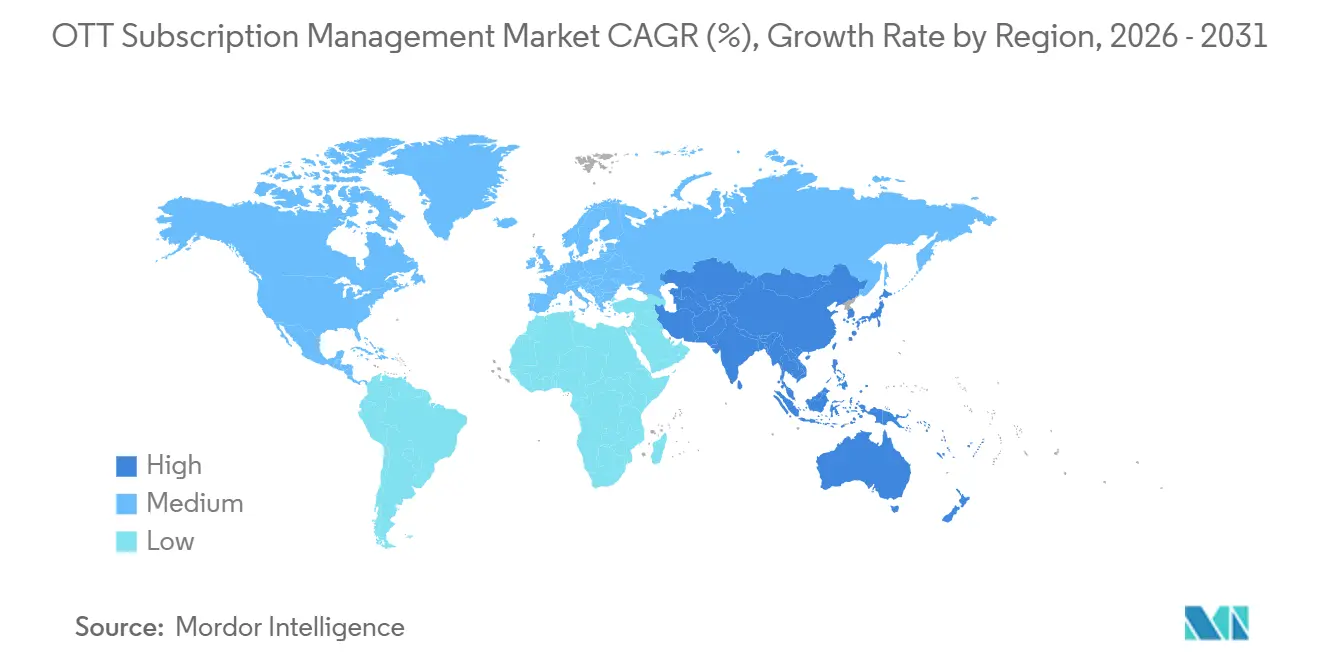
North America accounted for 42.11% of the OTT subscription management market size in 2025. The region has a large number of established streaming services that manage several tiers, app-store channels, and promotional offers, creating substantial operational requirements for entitlement management and billing controls. Ad-supported plan adoption has increased the need to connect advertising eligibility with payment and access records. Google’s June 2026 policy changes reduced the base service fee for auto-renewing subscriptions to 10% and allowed external payment routing in the United States.
Europe and South America OTT Subscription Management Market
Europe is the second-largest regional setting for the OTT subscription management market and faces the most active regulatory environment. The withdrawal-rights ruling, digital reporting requirements, and AI-related rules require vendors to maintain strong compliance functions. Germany, the United Kingdom, and France have high subscription volumes, while Southern and Eastern Europe have earlier-stage monetization systems. Brazil opened iOS payment pathways on June 18, 2026, following a settlement with its competition regulator CADE. The change created a new route for external checkout and local payment connections in South America.
APAC and MEA OTT Subscription Management Market
Asia-Pacific is projected to grow at an 11.34% CAGR from 2026 to 2031 and is the fastest-growing geography, with India’s mobile-first and price-sensitive customer base increasing the need for scalable plan and payment management. Japan’s subscription video-on-demand market grew 14.3% in 2025 to JPY 601.7 billion (USD 3.96 billion), which supports demand for tier migration and pricing-change automation. Southeast Asia’s growing streaming accounts increase the importance of local payment methods and low-friction onboarding. China’s internet television billing requirements also make technical compliance a relevant consideration for service providers. Middle East and Africa remain earlier-stage areas, where adoption depends on local payments and digital-service tax frameworks.

Competitive Landscape
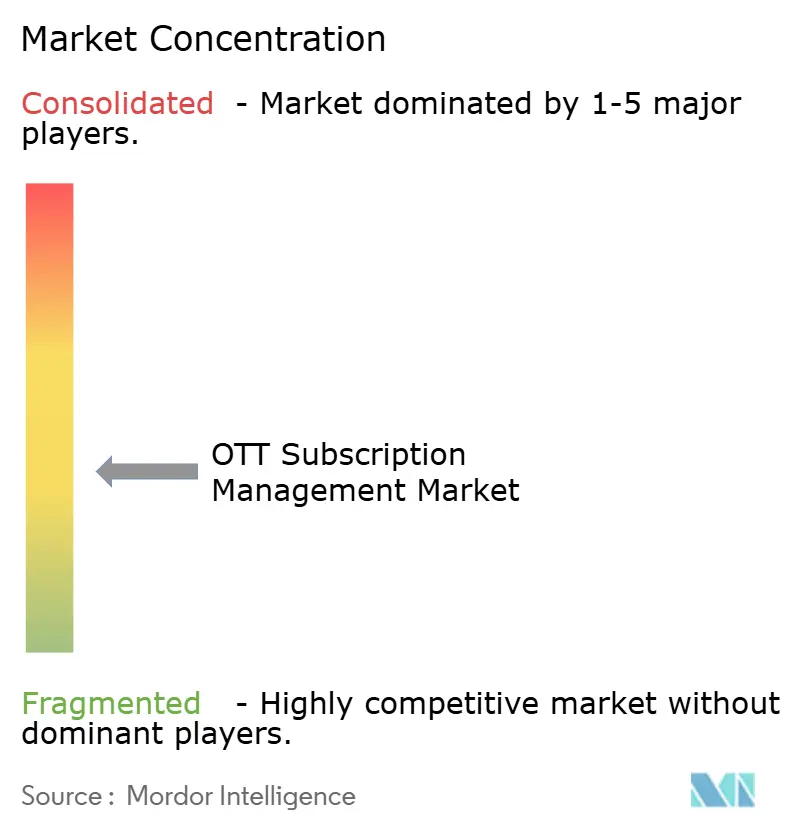
The OTT subscription management market is moderately fragmented, with large integrated platform vendors, dedicated billing platforms, and OTT-focused middleware providers competing for different operator needs. No provider holds a decisive position because requirements range from complex telecom integration to simple direct-to-consumer billing. Amdocs serves enterprise customers that need broader business support system capabilities. Its CES26 suite, introduced at MWC 2026, included agent-driven convergent charging, composable commerce, and real-time billing anomaly detection. This approach addresses the connection between telecom modernization and streaming monetization.
Specialized vendors such as Zuora and Chargebee compete through configurable billing, integration options, and financial controls. Zuora’s 2026 releases added capabilities for order harmonization and unique subscription tokens for multisystem integrations. Chargebee targets audited media businesses with revenue recognition features designed for ASC 606 and IFRS 15 requirements, while the OTT subscription management market also includes smaller providers such as Cleeng, Uscreen, and CRM Software. These firms focus on lower implementation burden and functions for pay-per-view, fan membership, and creator-led services. Their position is strongest where operators need OTT-specific tools without a large enterprise deployment.
Synamedia’s Go platform uses a modular approach that can incorporate monetization components from Cleeng and InPlayer alongside other technology partners. The model lets operators combine technology without relying on a single provider for every capability, while Kaltura acquired PathFactory in April 2026 for USD 22 million to add content intelligence and journey orchestration. Eluvio made its Content Fabric Bucharest Release commercially available in April 2026, combining direct-to-consumer streaming, entitlements, and real-time analytics. Competition will remain tied to payment connectivity, live-event access management, and compliance support.
OTT Subscription Management Industry Leaders
Brightcove Inc.
Kaltura, Inc.
Accedo Broadband AB
Amdocs Limited
Evergent Technologies
- *Disclaimer: Major Players sorted in no particular order
OTT Subscription Management Market Companies Covered in this Report
- Amdocs Limited
- Accedo Broadband AB
- Aria Systems, Inc.
- Evergent Technologies
- Brightcove Inc.
- Chargebee Inc.
- Cleeng B.V.
- CRM.COM Software Ltd.
- Dacast US, Inc.
- Deltatre S.p.A.
- Endeavor Streaming, Inc.
- InPlayer Ltd.
- Kaltura, Inc.
- Muvi Technology Pvt. Ltd.
- Quickplay Media Inc.
- Recurly, Inc.
- Synamedia Limited
- Uscreen, Inc.
- Vimeo, Inc.
- Zuora, Inc.

Recent Industry Developments in OTT Subscription Management Market
- July 2026: Kaltura delivered live TV streaming for approximately 40 million registered devices across 6 production environments during the 2026 FIFA World Cup, deploying an AI agent ecosystem for operational autonomy for the first time in a major live sporting event. The company previewed Agentic Avatar experiences for live sports engagement.
- July 2026: NBCUniversal signed a landmark agreement with YouTube to bundle Peacock within YouTube Premium, effective early 2027, as Peacock surpassed 48 million subscribers and reported its first profitable quarter. The deal represents a significant shift in how major broadcasters distribute subscription streaming access through platform aggregators.
- July 2026: The CJEU issued its judgment in Sky Österreich Fernsehen, C-234/25, on July 9, ruling that dynamic, personalized streaming offerings qualify as digital services under the Consumer Rights Directive, triggering 14-day withdrawal rights across EU markets and requiring operators to overhaul subscriber cancellation and refund workflows.
- June 2026: Google restructured its Play Store billing policy effective June 30, 2026, in the United States, United Kingdom, and EEA, decoupling service fees from billing fees, reducing the base service fee on auto-renewing subscriptions to 10%, and permitting developers to route payments through external processors, directly lowering the cost of OTT subscriber acquisition through Android channels.


Global OTT Subscription Management Market Report Scope
The OTT Subscription Management Market refers to the software and services used by OTT platforms to manage subscriber plans, billing cycles, renewals, cancellations, entitlements, and customer lifecycle workflows. It ensures users can subscribe, upgrade, pause, or cancel services smoothly across devices while platforms maintain control over access and revenue.
The OTT Subscription Management Market Report is Segmented by Billing Model (Flat-Rate, Recurring Subscription, Usage-Based, Hybrid, and One-Time and Add-On), Application (Video, Live, Audio, and Interactive and Event Streaming), End User (Pure-Play OTT and Direct-to-Consumer Streaming Platforms, Broadcasters, Media Networks, Studios, and Content Owners, Telecom, Pay-TV, and Internet Service Providers, and Audio and Other Digital Media Streaming Providers), and Geography (North America, South America, Europe, Asia-Pacific, Middle East, and Africa). The Market Forecasts are Provided in Terms of Value (USD).
| Flat-Rate Billing |
| Recurring Subscription Billing |
| Usage-Based Billing |
| Hybrid Billing |
| One-Time and Add-On Billing |
| Video Streaming |
| Live Streaming |
| Audio Streaming |
| Interactive and Event Streaming |
| Pure-Play OTT and Direct-to-Consumer Streaming Platforms |
| Broadcasters, Media Networks, Studios, and Content Owners |
| Telecom, Pay-TV, and Internet Service Providers |
| Audio and Other Digital Media Streaming Providers |
| North America | United States |
| Canada | |
| Mexico | |
| South America | Brazil |
| Argentina | |
| Rest of South America | |
| Europe | Germany |
| United Kingdom | |
| France | |
| Italy | |
| Spain | |
| Russia | |
| Rest of Europe | |
| Asia-Pacific | China |
| Japan | |
| India | |
| South Korea | |
| Australia | |
| Southeast Asia | |
| Rest of Asia-Pacific | |
| Middle East | Saudi Arabia |
| United Arab Emirates | |
| Turkey | |
| Rest of Middle East | |
| Africa | South Africa |
| Nigeria | |
| Rest of Africa |
| By Billing Model | Flat-Rate Billing | |
| Recurring Subscription Billing | ||
| Usage-Based Billing | ||
| Hybrid Billing | ||
| One-Time and Add-On Billing | ||
| By Application | Video Streaming | |
| Live Streaming | ||
| Audio Streaming | ||
| Interactive and Event Streaming | ||
| By End User | Pure-Play OTT and Direct-to-Consumer Streaming Platforms | |
| Broadcasters, Media Networks, Studios, and Content Owners | ||
| Telecom, Pay-TV, and Internet Service Providers | ||
| Audio and Other Digital Media Streaming Providers | ||
| By Geography | North America | United States |
| Canada | ||
| Mexico | ||
| South America | Brazil | |
| Argentina | ||
| Rest of South America | ||
| Europe | Germany | |
| United Kingdom | ||
| France | ||
| Italy | ||
| Spain | ||
| Russia | ||
| Rest of Europe | ||
| Asia-Pacific | China | |
| Japan | ||
| India | ||
| South Korea | ||
| Australia | ||
| Southeast Asia | ||
| Rest of Asia-Pacific | ||
| Middle East | Saudi Arabia | |
| United Arab Emirates | ||
| Turkey | ||
| Rest of Middle East | ||
| Africa | South Africa | |
| Nigeria | ||
| Rest of Africa | ||


Key Questions Answered in the Report
What is the size of the OTT subscription management market?
The sector was valued at USD 1.78 billion in 2026 and is projected to reach USD 2.97 billion by 2031 at a 10.80% CAGR.
What is driving demand in the OTT subscription management market?
Direct-to-consumer launches, hybrid advertising and paid plans, multi-device access, and live-event streaming are also directly increasing the need for adaptable billing and entitlement controls.
Which billing model leads the OTT subscription management market?
Recurring subscription billing led with 40.18% share in 2025 because it supports predictable payments, renewals, and customer retention processes.
Which application is growing fastest in the OTT subscription management market?
Live streaming is projected to grow at an 11.29% CAGR through 2031, supported by sports and event services that need real-time access validation.
Which end users are expanding fastest?
Telecom, Pay-TV, and internet service providers are projected to grow at an 11.45% CAGR through 2031 as they bundle streaming with connectivity services.
Which region is growing fastest?
Asia-Pacific is projected to grow at an 11.34% CAGR through 2031, supported by mobile-first streaming audiences and demand for local payment options.
Page last updated on:


 Your data is secure and never sold or shared.


