
OTT Streaming Content Protection Market Size and Share
Market Overview
| Study Period | 2020 - 2031 |
|---|---|
| Market Size (2026) | USD 1.33 Billion |
| Market Size (2031) | USD 2.71 Billion |
| Growth Rate (2026 - 2031) | 15.30 % |
| Fastest Growing Market | Asia-Pacific |
| Largest Market | North America |
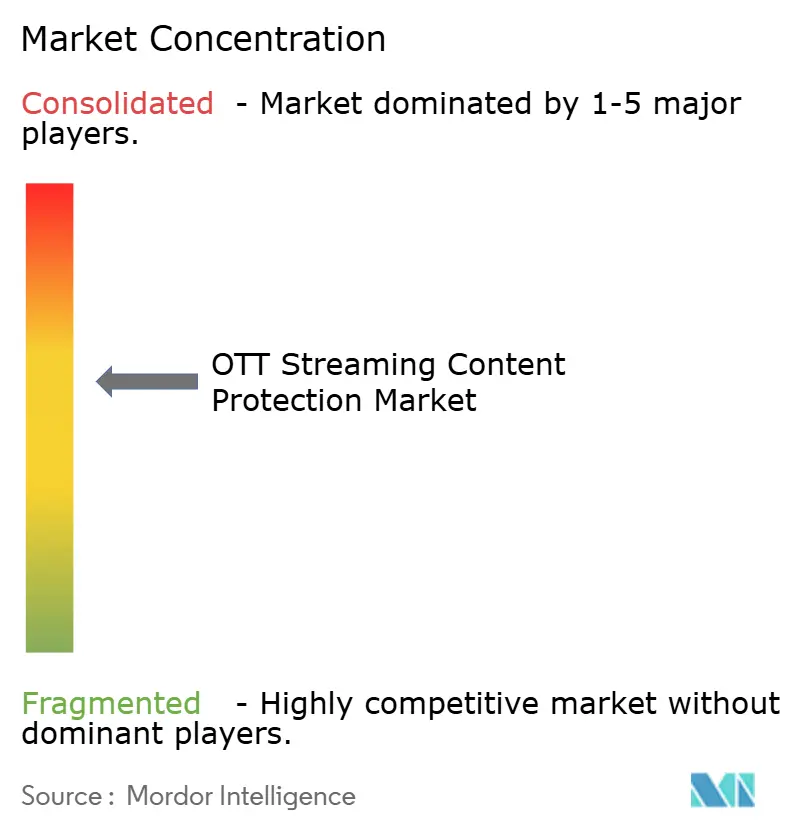
| Market Concentration | Medium |
Major Players *Disclaimer: Major Players sorted in no particular order Image © Mordor Intelligence. Reuse requires attribution under CC BY 4.0. | |
OTT Streaming Content Protection Market Analysis by Mordor Intelligence
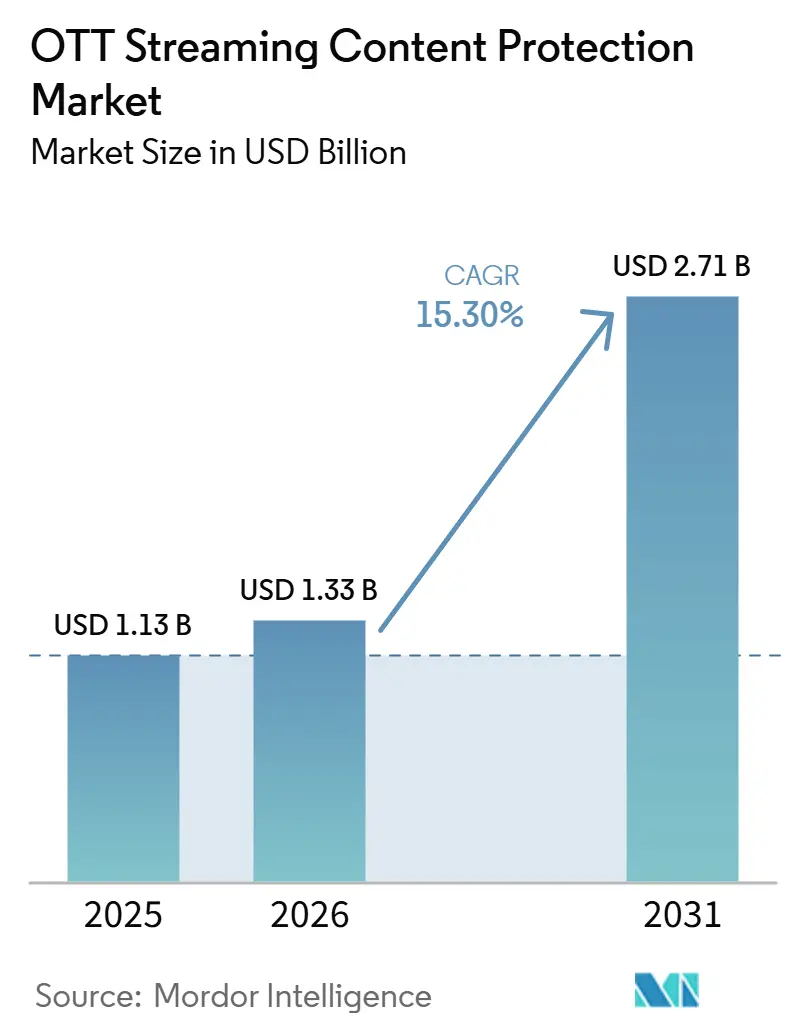
The OTT streaming content protection market size is projected to expand from USD 1.13 billion in 2025 and USD 1.33 billion in 2026 to USD 2.71 billion by 2031, registering a CAGR of 15.30% between 2026 to 2031. Security spending has become a revenue protection priority because unauthorized account access and unlicensed distribution can reduce subscription income, advertising income, the value of premium rights, and the certainty needed to support future content investment. Household access controls have shown that shared-account users can become paying customers when platforms apply consistent rules that distinguish legitimate household use from improper sharing and provide a clear route to continue viewing. Premium live events have also raised the need for fast identification, attribution, and removal of unauthorized streams while the event remains commercially valuable to viewers, advertisers, distributors, and rights holders. Studios and rights holders are asking distributors to meet stricter protection requirements before they license high-value content for early windows, 4K viewing, major live programming, and other releases where unauthorized copying can weaken a planned release strategy. Providers that combine multi-DRM delivery, watermarking, monitoring, entitlement controls, and response services can address these requirements through a more unified operating model that limits disconnected workflows and makes ongoing security management easier.
Key Report Takeaways
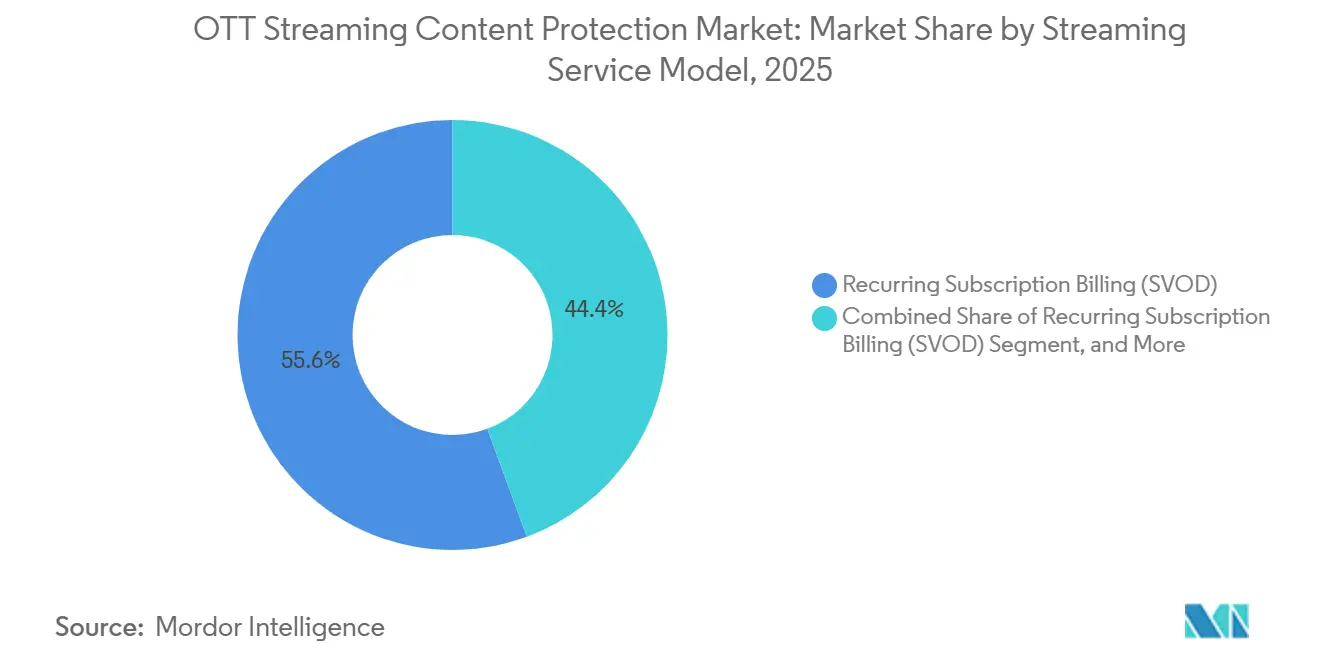
- By streaming service model, Recurring Subscription Billing (SVOD) held 55.63% of the OTT streaming content protection market share in 2025, while Advertising-Supported Billing (AVOD/FAST) is projected to expand at a CAGR of 16.05% through 2031.
- By application, Content Encryption and License Management accounted for 31.57% of the OTT streaming content protection market share in 2025, while Credential-Sharing and Concurrent-Stream Control is projected to grow at a CAGR of 15.74% through 2031.
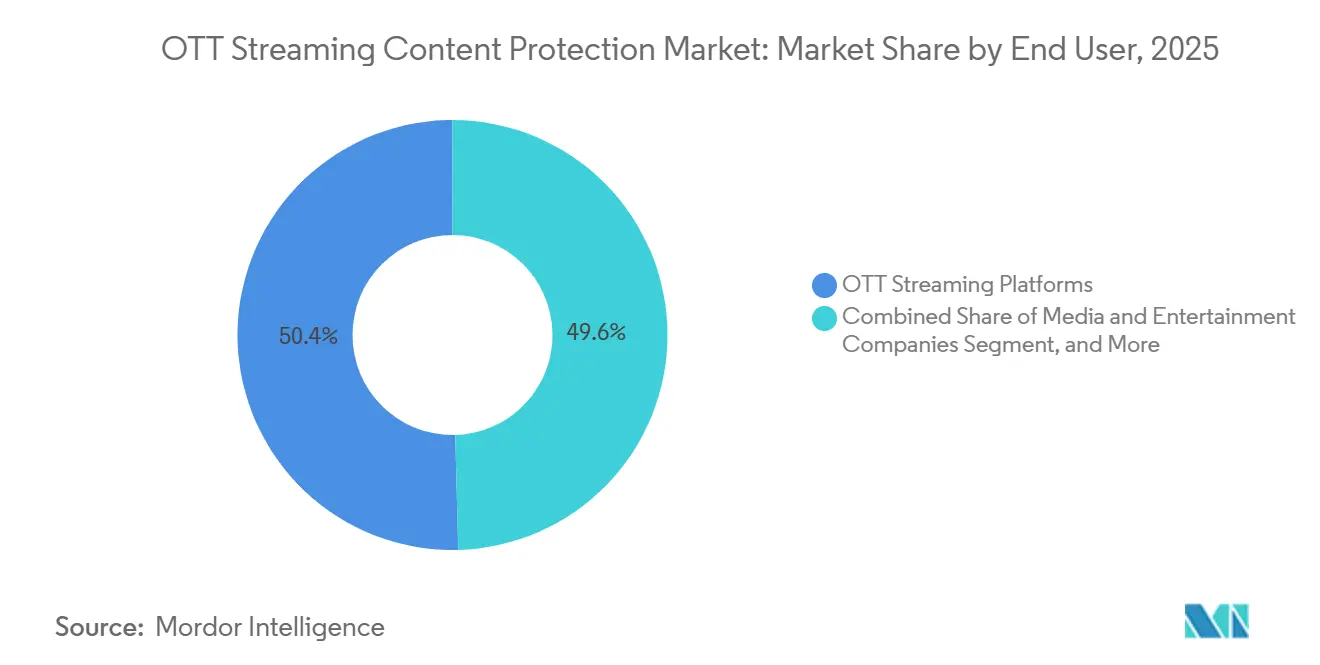
- By end user, OTT Streaming Platforms held 50.42% of revenue in 2025, while Broadcasters are projected to grow at a CAGR of 15.92% through 2031.
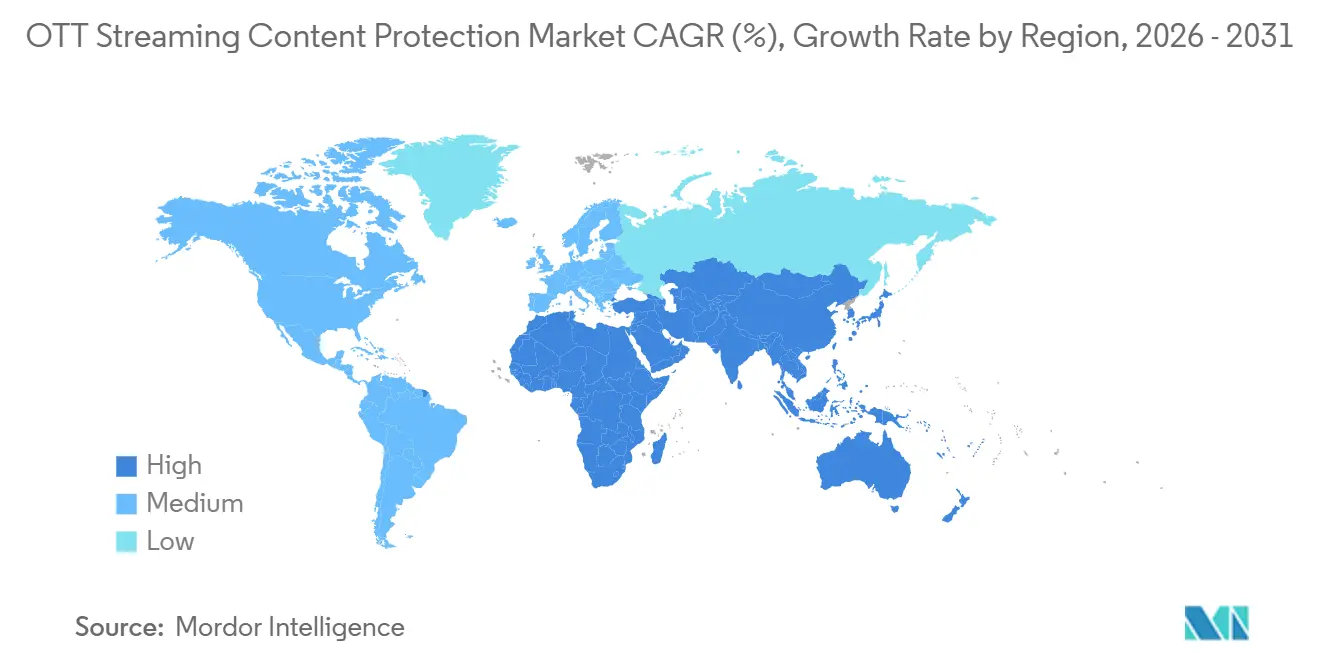
- By geography, North America accounted for 37.86% of revenue in 2025, while the Asia Pacific is projected to expand at a CAGR of 15.98% through 2031.
Note: Market size and forecast figures in this report are generated using Mordor Intelligence’s proprietary estimation framework, updated with the latest available data and insights as of January 2026.
Market Trends and Insights
Drivers Impact Analysis of OTT Streaming Content Protection Market*
| Driver | (~) % Impact on CAGR Forecast | Geographic Relevance | Impact Timeline |
|---|---|---|---|
| Rising Piracy and Credential-Abuse Losses | +3.5% | Global | Short term (≤ 2 years) |
| Expansion of Premium Live Sports and Event Streaming | +3.0% | Global, with stronger activity in North America, Europe, and Asia Pacific | Short term (≤ 2 years) |
| Proliferation of Multi-Device OTT Consumption | +2.8% | Global, led by Asia Pacific and North America | Medium term (2-4 years) |
| Increasing Studio Compliance Requirements for Premium Content | +2.2% | North America and the European Union, with global effects | Medium term (2-4 years) |
| Prevention-First Security for CDN Leeching and Live Restreaming | +1.8% | Global, concentrated in North America and Europe | Short term (≤ 2 years) |
| Hardware-Backed DRM Adoption for 4K, 8K, and HDR Streaming | +1.5% | Global, led by North America, South Korea, and Japan | Long term (≥ 4 years) |
| Source: Mordor Intelligence | |||
Rising Piracy and Credential-Abuse Losses
Piracy and unauthorized account access are shifting content protection from a technical function to a commercial priority in the OTT streaming market. Netflix reported strong paid membership growth after introducing paid sharing, showing that household rules can support subscription conversion rather than just restrict access.[1]Netflix, Inc., “Quarterly Earnings Releases and Shareholder Letters,” Netflix Investor Relations, ir.netflix.net Other platforms are likely to view similar controls as a way to manage access, protect plan terms, and develop new paid-user paths. This creates pressure on mid-sized services to introduce concurrent-stream limits, device controls, location checks, and account verification without creating unnecessary customer complaints. The operational requirement extends beyond the initial policy because platforms need systems that identify unusual use, apply decisions consistently, and avoid interrupting legitimate viewing. Security providers that can combine entitlement management with customer-friendly workflows are therefore positioned to address a broader buyer need across subscription services.
Expansion of Premium Live Sports and Event Streaming
Live sports create a demanding use case for the OTT streaming content protection market because the value of an event declines once the live window has ended. Rights holders need controls that can identify a leak, trace its source, assess its spread, and support an intervention while the event is still in progress. BuyDRM reported that its KeyOS platform combined MultiKey DRM and MultiMark forensic watermarking for official FIFA World Cup 2026 streams. This type of deployment shows why encryption and watermarking must operate together at high audience volumes without disrupting authorized viewers. Distribution agreements increasingly require a prospective service to demonstrate its protection capabilities before a rights deal is completed. Vendors with live-event experience can consequently enter the buying process earlier and may face shorter, more focused implementation cycles.
Proliferation of Multi-Device OTT Consumption
The growth of viewing on smart TVs, connected TV devices, phones, tablets, and game consoles expands the scope of protection for the OTT streaming content market. Each device category can require a different DRM client, playback configuration, and security policy, which increases integration and testing work for services. Amagi reported that global FAST viewing hours increased 55% year over year through mid-2026. The shift of ad-supported and free ad-supported television content to larger connected-TV screens also places more endpoints and distribution pathways within the security program. Unauthorized redistribution can divert advertising impressions to inventory outside the platform’s control, creating a direct revenue issue for ad-supported services and their advertising partners. Multi-DRM deployment is therefore becoming relevant for both subscription and advertising-led offerings that reach audiences across several screens.
Increasing Studio Compliance Requirements for Premium Content
Studio requirements are raising the qualification standard for suppliers serving the OTT streaming content protection market. MovieLabs specifies that enhanced content protection should preserve forensic watermarking through downstream processes such as transcoding, format conversion, and social-media re-encoding. Platforms seeking theatrical-window or 4K UHD content need multi-DRM capabilities, hardware-backed security, forensic watermarking, network controls, and evidence that these controls work in practice. These requirements make lower-cost encryption-only products less suitable for studio-tier workflows that require traceability and consistent device enforcement. They also favor providers that can document security controls, support formal assessments, and work with complex delivery environments. The same standards affect platforms outside the United States because Hollywood licensing requirements are applied across international distribution relationships.
Restraints Impact Analysis of OTT Streaming Content Protection Market*
| Restraint | (~) % Impact on CAGR Forecast | Geographic Relevance | Impact Timeline |
|---|---|---|---|
| Device and Platform Interoperability Complexity | -1.8% | Global | Long term (≥ 4 years) |
| Security Investment and Operating-Cost Burden | -1.4% | Global, most acute in South America, the Middle East, and Africa | Medium term (2-4 years) |
| Viewer-Friction and Playback-Quality Tradeoffs | -0.9% | Global | Short term (≤ 2 years) |
| Shortened Piracy Response Windows for Live Content | -0.7% | Global, most acute in North America and Europe | Short term (≤ 2 years) |
| Source: Mordor Intelligence | |||
Device and Platform Interoperability Complexity
Device interoperability remains a practical restraint for the OTT streaming content protection market because no single DRM system covers every major endpoint. Widevine supports Android, Chrome, and many smart-TV systems, while FairPlay is required for Apple devices, and PlayReady supports Windows Edge and Xbox environments. Operators must maintain separate software updates, security patches, device certifications, license-server configurations, and testing routines for their supported device groups. CMAF packaging with CBCS-mode encryption can reduce duplicate encoding work for newer device fleets and can simplify some packaging operations. It does not remove the need to maintain separate DRM policies or enforce HD and 4K output requirements across platforms. The resulting workload can be especially difficult for broadcasters and regional services that are extending their traditional offerings to OTT distribution.
Security Investment and Operating-Cost Burden
The OTT streaming content protection market also faces cost pressure because multi-DRM, watermarking, anti-piracy monitoring, and CDN security are often supplied through different contracts. New OTT services must fund engineering work, license fees, staffing, audit preparation, and operational processes before they can support some premium content agreements. This pressure is stronger in South America, the Middle East, and Africa, where subscriber economics may not yet support a full enterprise-grade stack. Some operators may select a single DRM system or basic encryption to control costs and shorten their initial deployment. Such choices can satisfy a narrow technical obligation while leaving credential sharing and CDN leeching less well addressed. This creates different protection levels across the content supply chain and complicates coordinated anti-piracy work by rights holders.
*Our forecasts treat driver/restraint impacts as directional, not additive. The impact forecasts reflect baseline growth, mix effects, and variable interactions.
OTT Streaming Content Protection Market Segment Analysis
By Streaming Service Model:
AVOD and FAST Extend Protection Beyond Subscription ContentRecurring Subscription Billing (SVOD) captured 55.63% of revenue in 2025. Subscription services typically host high-value libraries and operate under strict studio requirements for hardware-backed decryption, session-level watermarking, concurrent-stream control, and reliable rights enforcement across supported devices. Those requirements make the segment a large and durable buyer of protection services throughout the delivery lifecycle within the OTT streaming content protection market. Netflix’s experience with paid sharing showed that access controls can support subscription conversion when applied with a clear customer policy. Similar controls are relevant for services that must protect household plan rules across many devices, locations, and viewing sessions.
Advertising-Supported Billing (AVOD/FAST) is projected to grow at a CAGR of 16.05% through 2031. This model extends free viewing to audiences but is funded by advertising revenue and depends on reliable delivery. Unlicensed CDN redistribution can move advertising impressions outside the service’s controlled inventory and reduce confidence in campaign delivery and reporting. Transactional Billing (TVOD/PPV) requires user-level traceability for early-window releases, while hybrid models must manage different protection policies across free and paid tiers. These needs support unified multi-DRM orchestration for several rules within one OTT streaming content protection market service, rather than separate systems for each business model.



By Application:
Encryption Remains Foundational While Access Controls Gain DemandContent Encryption and License Management accounted for 31.57% of the OTT streaming content protection market size in 2025. It manages cryptographic key delivery, license policy enforcement, entitlement validation, and key rotation for live streams and on-demand catalog content. It also supports other protection layers, making it a broadly deployed component of OTT security architecture across service models. Multi-DRM services can simplify delivery through a single interface for Widevine, PlayReady, and FairPlay. This function remains central to the OTT streaming content protection market because operators must set resolution rules, output protection requirements, device-level policies, and renewal procedures for their content libraries.
Credential-Sharing and Concurrent-Stream Control are projected to grow at a CAGR of 15.74% through 2031. The function applies household rules, stream limits, and entitlement checks that can reduce unauthorized use of a paid account. Netflix’s paid-sharing program provided a clear example of how access controls can drive paid membership growth. Forensic Watermarking and Leak Attribution are also important to the OTT streaming content protection market for live sports, where a rights holder needs to associate an unauthorized stream with a source session. Synamedia stated that its ContentArmor Edge Watermarking solution reduced disruption time for pirated live streams to under 5 minutes, supporting faster action in time-sensitive broadcasts
By End User:
Broadcasters Build Protection for Hybrid DistributionOTT Streaming Platforms held 50.42% of revenue in 2025. Large subscription services process extensive DRM license volumes and need a highly available, managed infrastructure to maintain playback continuity. Their scale requires multi-DRM support, real-time entitlement checks, concurrent-stream controls, and clear operational processes for device changes. These platforms generally have the most mature protection deployments among end users in the OTT streaming content protection market. Consolidation can create a smaller group of larger buyers with greater negotiating power, even as deployment volumes, catalog scope, and protection expectations grow.
Broadcasters are projected to grow at a CAGR of 15.92% through 2031 as hybrid broadcast and OTT delivery expands. Broadcasters entering digital distribution often need new protection systems rather than small changes to an established OTT stack. Irdeto and M2A Media partnered to deliver live content security, with forensic watermarks embedded in video streams for broadcasters and sports rights owners.[2]M2A Media, “Irdeto Partners with M2A Media to Enhance Content Security for Live Streaming,” M2A Media, m2amedia.tv Telecom and pay-TV operators also need protection that works across IPTV multicast and OTT unicast delivery, under a common set of security policies. These requirements support demand across the OTT streaming content protection market, including for media and entertainment companies that procure watermarking and monitoring for pre-release, theatrical-window, and premium-window content.
Geography Analysis
North America OTT Streaming Content Protection Market
North America held 37.86% of revenue in 2025. The region combines a large concentration of premium rights, active studio requirements, widespread household access controls, and established streaming infrastructure. Its services have substantial exposure to subscription and advertising-supported distribution, which increases the consequences of unauthorized redistribution and credential abuse. Canada and Mexico add demand for territorial rights management as entertainment and sports libraries are distributed across borders and services. North American studio contracts also influence the broader OTT streaming content protection market, as platforms in other regions license Hollywood content for local audiences.
Europe and South America OTT Streaming Content Protection Market
Europe is the second-largest regional market and has a complex compliance environment. The United Kingdom, Germany, and France support dense subscription-video use outside North America and have important premium-content libraries. European territorial rights requirements support demand for access controls, geo-restriction functions, and session-based protection for premium film libraries. South America is an emerging region for the OTT streaming content protection market, with Brazil leading OTT adoption, advertising-supported streaming growth, and investment as platforms expand their services and local sports rights become more valuable.
APAC and MEA OTT Streaming Content Protection Market
Asia Pacific is projected to grow at a CAGR of 15.98% through 2031. India’s expanding connected-TV audience supports hardware-backed DRM for premium large-screen viewing and wider access to online programming. South Korea’s K-content exports and Japan’s premium local content and sports offerings also support security spending by rights holders. DoveRunner reported 494 million cumulative instances of unauthorized K-content distribution across illegal platforms.[3]DoveRunner, “494 Million Unauthorized K-Content Distributions: 3 OTT Security Challenges,” DoveRunner, doverunner.com The Middle East and Africa remain earlier-stage opportunities for the OTT streaming content protection market, led by Saudi Arabia and the UAE in the Middle East and South Africa and Nigeria in Africa.

Competitive Landscape
The OTT streaming content protection market has a hybrid competitive structure. Google Widevine, Microsoft PlayReady, and Apple FairPlay establish the security capabilities available across major device groups and operating systems. Their device-manufacturer relationships create a technical dependency for commercial security providers that need broad device support. The more fragmented commercial services layer provides multi-DRM management, watermarking, monitoring, CDN security, and managed enforcement. Vendors differentiate through integrated protection functions, device support, operational expertise, and managed response services.
Strategic activity in the OTT streaming content protection market is moving security closer to content creation and media-management workflows. In June 2026, Castlabs integrated DRMtoday and STARDUSTmark into Backlight’s Iconik media asset management platform.[4]Castlabs, “Backlight Brings Studio-Grade Content Security to Iconik Proxy Workflows Using Castlabs’ STARDUSTmark and DRMtoday,” Castlabs, castlabs.com NAGRAVISION launched NAGRA Venturi in June 2026 to combine watermarking, multi-DRM, monitoring, and managed enforcement in a real-time intelligence model. Synamedia introduced ContentArmor Edge Watermarking in March 2026 to insert unique session watermarks at the CDN edge without re-encoding at the headend.
These moves address the need to identify and respond to unauthorized distribution while content is being viewed, particularly during live programming. Compliance remains important in premium studio workflows. MovieLabs’ specification reinforces the need for watermarking that persists through downstream transformations and changes in delivery format. Verimatrix became a contributor member of the Coalition for Content Provenance and Authenticity, and its watermarking algorithm was added to the organization’s soft binding algorithm list for video.
OTT Streaming Content Protection Industry Leaders
Google LLC
Microsoft Corporation
Apple Inc.
Amazon Web Services, Inc.
Verimatrix, Inc.
- *Disclaimer: Major Players sorted in no particular order
OTT Streaming Content Protection Market Companies Covered in this Report
- Google LLC
- Microsoft Corporation
- Apple Inc.
- Amazon Web Services, Inc.
- Verimatrix, Inc.
- Irdeto B.V.
- NAGRAVISION S.à r.l.
- Synamedia Limited
- Castlabs GmbH
- NFA Group Inc. dba BuyDRM
- EZDRM, Inc.
- Bitmovin Inc.
- Axinom GmbH
- Brightcove Inc.
- Akamai Technologies, Inc.
- Edgio, Inc.
- Mux, Inc.
- Kaltura, Inc.

Recent Industry Developments in OTT Streaming Content Protection Market
- July 2026: Castlabs partnered with UniqCast to deliver a streamlined, secure IPTV/OTT content protection solution for broadband and fiber operators, enabling simultaneous DRM deployment alongside legacy TV system migration and addressing US broadband providers looking to add video as a strategic service differentiator. The partnership reduces the integration complexity for operators that need to launch or modernize secure TV services without managing multiple vendor contracts.
- June 2026: NAGRAVISION launched NAGRA Venturi, an intelligence-led streaming security platform designed to counter AI-assisted and automated piracy operations. Venturi unifies NAGRAVISION's streaming security capabilities, forensic watermarking, multi-DRM, anti-piracy monitoring, and managed enforcement, under a single real-time intelligence model, shifting anti-piracy from reactive alert floods to coordinated, data-driven interventions. The launch directly addresses the automation and scalability that criminal piracy operations now deploy against live sports and premium windows.
- June 2026: Castlabs and Backlight announced an integration embedding Castlabs' DRMtoday multi-DRM cloud service and STARDUSTmark single-frame forensic watermarking into Backlight's Iconik media asset management platform. Iconik became the first MAM system to support frame-accurate forensic watermarking, enabling studios, broadcasters, and sports rights holders to apply protection at the proxy workflow stage, before content reaches distribution infrastructure.
- April 2026: NAGRAVISION and Harmonic extended their long-standing partnership with the launch of a fully managed, event-based Watermarking-as-a-Service solution available as an upgrade for existing Harmonic VOS 360 Media SaaS customers. The offering delivers scalable forensic watermarking for live events through an on-demand, managed-service model, lowering the entry threshold for broadcasters seeking studio-grade watermarking without dedicated infrastructure.


Global OTT Streaming Content Protection Market Report Scope
The OTT streaming content protection market covers solutions and services that secure video, audio, and other digital media delivered over internet-based streaming platforms. The scope of the study includes content protection technologies such as digital rights management (DRM), watermarking, encryption, tokenization, and anti-piracy solutions used by OTT service providers, broadcasters, studios, and content owners to prevent unauthorized access, distribution, and piracy across connected devices and streaming environments.
The OTT Streaming Content Protection Market Report is Segmented by Streaming Service Model (Recurring Subscription Billing (SVOD), Transactional Billing (TVOD/PPV), Advertising-Supported Billing (AVOD/FAST), and Hybrid Monetization Billing), Application (Access Control and Entitlement Management [Credential-Sharing and Concurrent-Stream Control, and Geo-Restriction and Rights Enforcement] Content Encryption and License Management, Forensic Watermarking and Leak Attribution, and Anti-Piracy Monitoring and Takedown), End User (OTT Streaming Platforms, Broadcasters, Telecom and Pay-TV Operators, Media and Entertainment Companies, and Other End Users), and Geography (North America, South America, Europe, Asia-Pacific, Middle East, and Africa). The Market Forecasts are Provided in Terms of Value (USD).
| Recurring Subscription Billing (SVOD) |
| Transactional Billing (TVOD/PPV) |
| Advertising-Supported Billing (AVOD/FAST) |
| Hybrid Monetization Billing |
| Access Control and Entitlement Management | Credential-Sharing and Concurrent-Stream Control |
| Geo-Restriction and Rights Enforcement | |
| Content Encryption and License Management | |
| Forensic Watermarking and Leak Attribution | |
| Anti-Piracy Monitoring and Takedown |
| OTT Streaming Platforms |
| Broadcasters |
| Telecom and Pay-TV Operators |
| Media and Entertainment Companies |
| Other End Users |
| North America | United States |
| Canada | |
| Mexico | |
| South America | Brazil |
| Argentina | |
| Chile | |
| Rest of South America | |
| Europe | Germany |
| United Kingdom | |
| France | |
| Italy | |
| Spain | |
| Rest of Europe | |
| Asia-Pacific | China |
| Japan | |
| India | |
| South Korea | |
| Australia | |
| Rest of Asia-Pacific | |
| Middle East | Saudi Arabia |
| United Arab Emirates | |
| Qatar | |
| Rest of Middle East | |
| Africa | South Africa |
| Egypt | |
| Nigeria | |
| Rest of Africa |
| By Streaming Service Model | Recurring Subscription Billing (SVOD) | |
| Transactional Billing (TVOD/PPV) | ||
| Advertising-Supported Billing (AVOD/FAST) | ||
| Hybrid Monetization Billing | ||
| By Application | Access Control and Entitlement Management | Credential-Sharing and Concurrent-Stream Control |
| Geo-Restriction and Rights Enforcement | ||
| Content Encryption and License Management | ||
| Forensic Watermarking and Leak Attribution | ||
| Anti-Piracy Monitoring and Takedown | ||
| By End User | OTT Streaming Platforms | |
| Broadcasters | ||
| Telecom and Pay-TV Operators | ||
| Media and Entertainment Companies | ||
| Other End Users | ||
| By Geography | North America | United States |
| Canada | ||
| Mexico | ||
| South America | Brazil | |
| Argentina | ||
| Chile | ||
| Rest of South America | ||
| Europe | Germany | |
| United Kingdom | ||
| France | ||
| Italy | ||
| Spain | ||
| Rest of Europe | ||
| Asia-Pacific | China | |
| Japan | ||
| India | ||
| South Korea | ||
| Australia | ||
| Rest of Asia-Pacific | ||
| Middle East | Saudi Arabia | |
| United Arab Emirates | ||
| Qatar | ||
| Rest of Middle East | ||
| Africa | South Africa | |
| Egypt | ||
| Nigeria | ||
| Rest of Africa | ||


Key Questions Answered in the Report
What is the OTT streaming content protection market size?
The market size was USD 1.33 billion in 2026 and is projected to reach USD 2.71 billion by 2031, reflecting a CAGR of 15.30% during the forecast period.
What is driving spending on OTT content protection?
Piracy, credential abuse, premium live sports, multi-device use, and studio requirements are supporting spending on DRM, watermarking, entitlement management, monitoring, and response services.
Which application is expected to grow the fastest?
Credential-Sharing and Concurrent-Stream Control is projected to grow at a CAGR of 15.74% through 2031 as platforms seek to enforce household access rules and reduce improper sharing.
Which end user is expected to grow the fastest?
Broadcasters are projected to grow at a CAGR of 15.92% through 2031 as they extend traditional broadcast services into digital, hybrid, and OTT distribution.
Which region is expected to grow the fastest?
Asia Pacific is projected to expand at a CAGR of 15.98% through 2031, supported by connected-TV adoption, premium local content, sports programming, and a growing need for anti-piracy controls.
Page last updated on:





