
OTT Movies Market Size and Share
Market Overview
| Study Period | 2020 - 2031 |
|---|---|
| Market Size (2026) | USD 50.14 Billion |
| Market Size (2031) | USD 69.31 Billion |
| Growth Rate (2026 - 2031) | 6.69 % |
| Fastest Growing Market | Asia-Pacific |
| Largest Market | North America |
| Market Concentration | Medium |
Major Players *Disclaimer: Major Players sorted in no particular order Image © Mordor Intelligence. Reuse requires attribution under CC BY 4.0. | |
OTT Movies Market Analysis by Mordor Intelligence
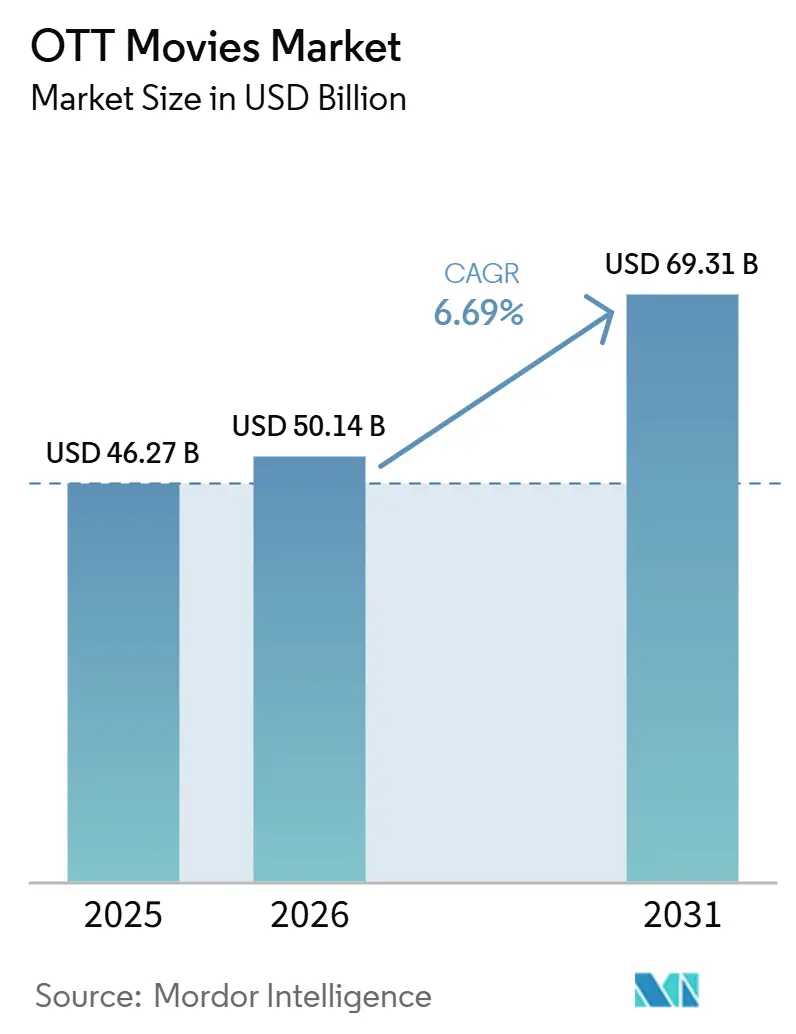
The OTT movies market size is projected to expand from USD 46.27 billion in 2025 and USD 50.14 billion in 2026 to USD 69.31 billion by 2031, registering a CAGR of 6.69% between 2026 to 2031. The shift from theatrical-first monetization toward platform-led film distribution is changing how movie libraries are valued, because premium titles now support subscriber retention, repeat viewing, and wider audience reach instead of serving only as one-time releases. Revenue models in the OTT movies market are also becoming more layered, with platforms combining subscription income, advertising revenue, and transactional purchases around the same content asset. Release-window compression, rising smart TV use, and broader connected-device access continue to support viewing volume even when revenue per title faces pressure. Asia-Pacific remains central to expansion because mobile-first consumption, stronger broadband access, and demand for regional language catalogs are widening the audience base for premium films. Competition in the OTT movies market is intensifying across global and regional platforms, while content cost inflation, piracy, and churn continue to test profitability and make bundling and ad-supported access more important.
Key Report Takeaways
- By monetization model, SVOD held 50.54% revenue share in 2025, while AVOD is projected to expand at 7.50% CAGR through 2031.
- By genre, Drama held 28.32% revenue share in 2025, while Action and Adventure is projected to grow at 7.85% CAGR through 2031.
- By device type, Smart TVs accounted for 43.47% revenue share in 2025, while Smartphones and Tablets are projected to expand at 7.80% CAGR through 2031.
- By geography, North America held 32.36% revenue share in 2025, while Asia-Pacific is projected to advance at 8.10% CAGR through 2031.
Note: Market size and forecast figures in this report are generated using Mordor Intelligence’s proprietary estimation framework, updated with the latest available data and insights as of January 2026.
Global OTT Movies Market Trends and Insights
Drivers Impact Analysis*
| Driver | (~) % Impact on CAGR Forecast | Geographic Relevance | Impact Timeline |
|---|---|---|---|
| Hybrid Monetization Across Premium Film Libraries | +1.5% | Global, concentrated in North America and Western Europe | Medium term (2-4 years) |
| Smart TV and Connected-Device Viewing Expansion | +1.3% | Global, with strong relevance in Asia-Pacific and spillover into Middle East and Africa | Medium term (2-4 years) |
| Regional and Local Language Catalog Demand | +1.1% | Asia-Pacific, South America, and Middle East | Long term (≥ 4 years) |
| Bundling With Telco, Retail, and Device Ecosystems | +0.9% | Global, with strong relevance in North America, Western Europe, and Asia-Pacific | Short term (≤ 2 years) |
| Rollout of Ad-Supported Premium Tiers | +0.8% | Global, with strong pull in North America and Asia-Pacific | Short term (≤ 2 years) |
| AI-Based Content Discovery and Personalization | +0.7% | Global, accelerating in North America and India | Medium term (2-4 years) |
| Source: Mordor Intelligence | |||
Rising Adoption of Hybrid Monetization Across Premium Film Libraries
Hybrid monetization moved from a backup plan to a central operating model across the OTT movies market. Platforms now use the same film library across subscription, ad-supported, and transactional layers instead of treating each title as a one-channel product. This gives the OTT movies market a way to keep users inside the same ecosystem even when household budgets push them away from full-price plans. The model also spreads content spending across several revenue pools, which makes a premium film slate easier to support over time. As more services open lower-priced tiers, the OTT movies market can reach consumers who want premium movies but reject another flat monthly payment. Platforms that can price and sequence titles across multiple viewing paths are likely to defend retention and monetization better than single-model rivals.
Expanding Smart TV and Connected-Device Viewing Habits
Viewing habits in the OTT movies market are moving back toward the largest screen in the home. Smart TVs fit movie viewing because longer runtimes, stronger visuals, and shared household sessions work better in a living room setting than on smaller mobile screens. This raises the value of home screen placement, recommendation rows, and remote-friendly navigation inside the OTT movies market. Mobile devices still matter, especially in mobile-first economies, but they often complement rather than replace television viewing for feature films. As households add more connected devices, the OTT movies market gains more touchpoints for discovery, playback, and account engagement. Platforms that can keep the experience consistent across TV, phone, and tablet are better placed to hold viewing time and reduce friction.
Rising Demand for Regional and Local Language Movie Catalogs
Regional and local language movies have become a core acquisition tool in the OTT movies market, especially across Asia-Pacific and South America. In India, regional language titles represented 52% of total OTT viewing by late 2025, and platforms reported a 40% year-over-year rise in regional language consumption by November 2025. South Indian productions also accounted for 60% of theatrically successful films acquired by OTT platforms across Indian languages in 2025, which showed how film supply was moving toward titles with stronger completion and retention patterns. Southeast Asia showed the same pattern at a regional level, with 4.2 billion hours of premium streaming consumption in Q4 2025 and sharp gains for Indonesian content. This makes language depth a commercial issue, not only a catalog choice, across the OTT movies market. Platforms that can move successful local films across nearby markets can recover production spending faster and reduce dependence on imported English-language titles.
Platform Bundling with Telco, Retail, and Device Ecosystems
Bundling with telecom operators, retailers, and device ecosystems is changing how the OTT movies market reaches paying users. In price-sensitive markets, bundled offers lower the upfront barrier because consumers see video access inside a broader data or household service package. Reliance Jio's Rs 200 OTT Pass combined 15 streaming services with 30 GB of high-speed data and unlimited 5G connectivity for 28 days, showing how bundle pricing can convert free users into paying households.[1]Reliance Industries Limited, “Acquisition of Stake in Sikhya Entertainment Private Limited,” Reliance Industries Limited, ril.com In June 2026, Turkcell launched a single-bill streaming bundle for more than 43 million subscribers, which showed the same logic in another mid-income market. These arrangements give scale and convenience to the OTT movies market, but they also shift bargaining power toward the distribution partner. Services that fail to secure visible bundle placement can lose discovery even when their film catalog remains competitive.
Restraints Impact Analysis*
| Restraint | (~) % Impact on CAGR Forecast | Geographic Relevance | Impact Timeline |
|---|---|---|---|
| Subscription Fatigue from Service Fragmentation | -1.2% | Global, most acute in North America and Western Europe | Short term (≤ 2 years) |
| Content Licensing Pressure and Windowing Constraints | -0.9% | Global, particularly North America, Western Europe, and Asia-Pacific | Medium term (2-4 years) |
| Ad Load Sensitivity in Premium Movie Experiences | -0.6% | North America and Western Europe | Medium term (2-4 years) |
| Rights Leakage and Piracy in High-Growth Emerging Markets | -0.5% | Asia-Pacific, Middle East and Africa, and South America | Long term (≥ 4 years) |
| Source: Mordor Intelligence | |||
Subscription Fatigue from Service Fragmentation
Subscription fatigue is a direct restraint on the OTT movies market because film libraries are now spread across too many separate services. Consumers respond by rotating plans, waiting for specific releases, and canceling once they finish a short viewing cycle. This behavior weakens the long-term payback period for expensive movie licensing and original production in the OTT movies market. It also makes price increases harder to pass through, especially when ad-supported alternatives are readily available. Mid-tier services face the sharpest pressure because they need steady retention but often lack must-watch franchises or broad enough catalogs. Bundles and lower-priced tiers help, but they do not fully solve the underlying problem of fragmented access.
Content Licensing Pressure and Windowing Constraints
Content licensing pressure remains a structural restraint on the OTT movies market because movie rights are rarely sold in a simple global package. A single title can carry different streaming rights, languages, and release windows across North America, Europe, and Asia-Pacific. Shorter theatrical-to-streaming windows have also increased negotiation tension because studios want to protect each revenue stage before a film settles into a library. Local content quotas add another cost layer when platforms must maintain mandated catalog shares in specific markets. Large services can spread legal and licensing costs across broader subscriber bases, but smaller platforms carry the same complexity with less scale. The result is a market where catalog breadth alone is not enough, because rights control and release timing increasingly shape competitiveness.
*Our forecasts treat driver/restraint impacts as directional, not additive. The impact forecasts reflect baseline growth, mix effects, and variable interactions.
Segment Analysis
By Monetization Model: AVOD Disrupts SVOD's Revenue Dominance
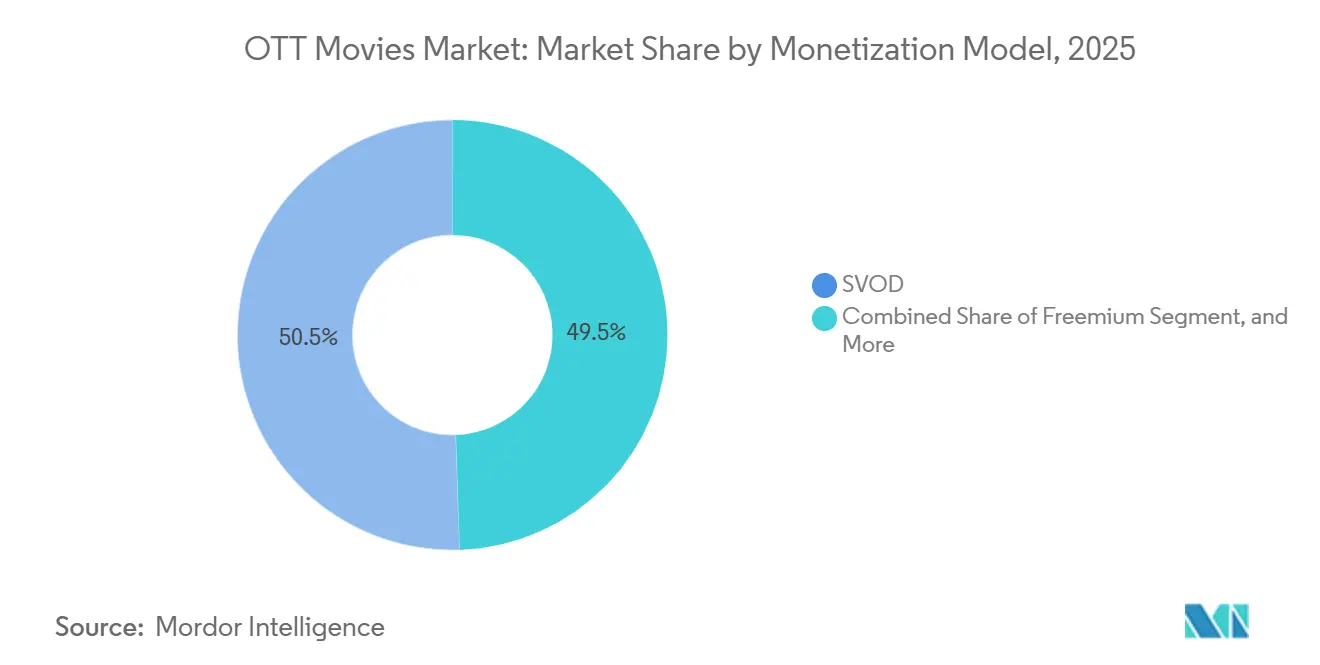
SVOD held 50.54% of the OTT movies market share in 2025, while AVOD is projected to expand at 7.50% CAGR through 2031. Subscription services still anchor this segment because many viewers prefer uninterrupted movie sessions, deeper back catalogs, and simple monthly billing. That preference remains strongest in mature markets where households treat premium streaming as a recurring entertainment expense rather than a one-time purchase. At the same time, AVOD is widening access across the OTT movies market by lowering the entry price for film discovery and repeat viewing. TVOD still keeps a clear role around new-release windows, where high-demand titles can generate rental and purchase revenue before they move into broader subscription libraries.
Hybrid and freemium structures are becoming more important because they let the OTT movies industry capture different willingness-to-pay levels from the same audience. That model also gives the OTT movies market a way to keep users who want to step down from full-price subscriptions without leaving the platform entirely. Studios and services are therefore rethinking rights pricing around sequential revenue pools instead of a single licensing event. This makes monetization more flexible, but it also demands stronger release planning, ad sales capability, and customer segmentation. Platforms that can balance premium subscriptions, advertising, and transactional viewing are likely to protect margins more effectively than services built around only one revenue model.



By Device Type: Smart TVs Anchor Premium Film Consumption
Smart TVs accounted for 43.47% of the OTT movies market size in 2025, while Smartphones and Tablets are projected to expand at 7.80% CAGR through 2031. Smart TVs lead because movies benefit from larger screens, stronger sound setups, and shared household viewing in ways that shorter digital formats do not. The category also fits premium film behavior, since viewers often choose the living room for longer sessions and visually intensive titles. Laptops and desktops continue to serve secondary viewing occasions, especially in personal or non-living-room settings, but they are not the main destination for premium film consumption. Smartphones and tablets are growing faster because they remain the first point of internet access in many emerging markets and because mobile bundles make entry easier for new users in the OTT movies market.
This device shift matters because the OTT movies industry no longer competes only on content, it also competes on interface quality and placement inside the home screen. Smart TV operating systems are becoming gatekeepers for discovery, and that gives platform visibility a direct link to watch time. In mobile-first markets, phone viewing still supports sampling, search, and off-peak consumption, which can later move users toward bigger-screen sessions at home. Other devices, including set-top boxes and streaming players, still matter where households want simpler navigation or legacy television integration. The services best placed in the OTT movies market are those that can carry the same account, recommendations, and playback continuity across every screen without weakening the movie experience.
By Genre: Drama Sustains Scale, Action Leads Growth
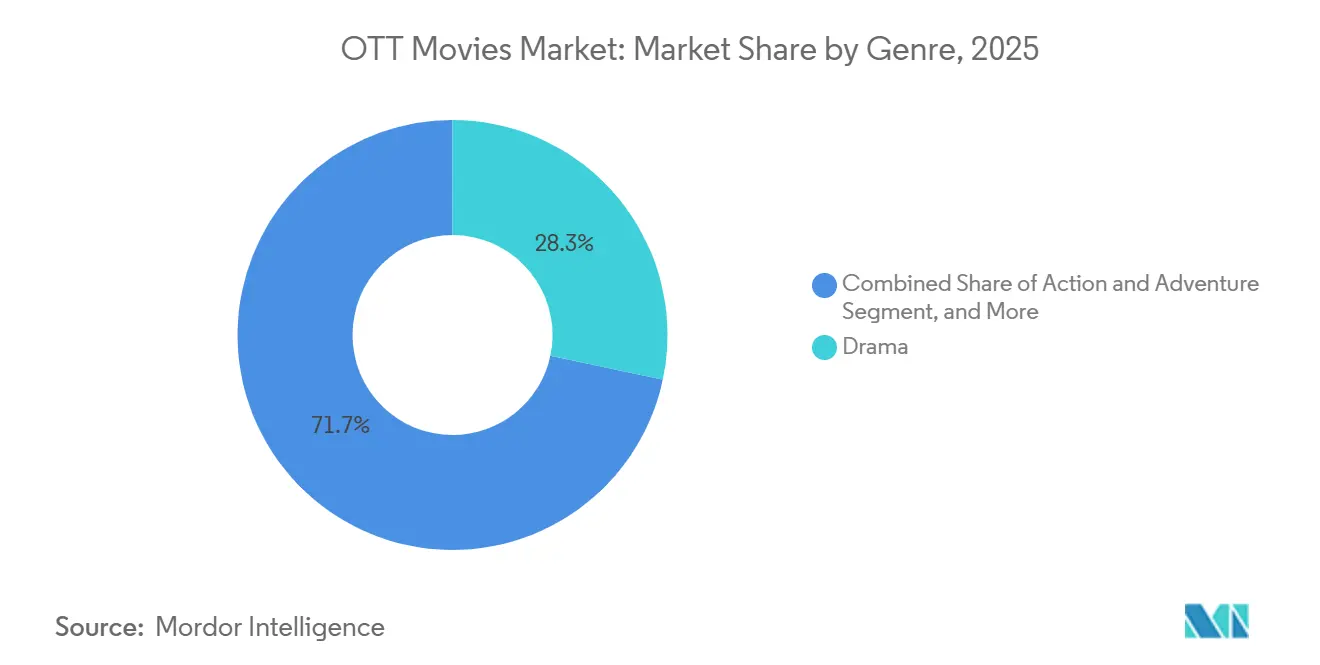
Drama accounted for 28.32% of the OTT movies market size in 2025, while Action and Adventure is projected to expand at 7.85% CAGR through 2031. Drama keeps the broadest base because it has deep catalog depth, steady repeat-viewing appeal, and strong cross-language performance through dubbing and subtitling. Action and Adventure is growing faster because the genre travels more easily across borders and relies less on highly localized humor or dialogue-heavy storytelling. Comedy remains relevant because shorter runtimes and accessible formats suit both mobile and TV viewing, but its performance depends more heavily on local language production. Crime and Thriller continues to matter because tension-driven plots often support stronger completion rates and create viewing momentum inside the OTT movies market.
Genre competition is also changing because discovery is moving away from simple shelf labels and toward intent-based recommendation. That shift helps Action and Adventure because franchise worlds, sequel chains, and recognizable stars pull viewers back into a platform's wider film catalog. Drama still benefits from scale because character-led stories keep long-tail relevance well beyond the first release cycle. Documentary, animation, and world cinema hold smaller shares, but they remain useful for curation-led services that want differentiated audiences instead of broad household reach. The OTT movies market therefore rewards both breadth and focus, since mass genres build volume while specialized genres support retention among viewers with clearer taste profiles.
Geography Analysis
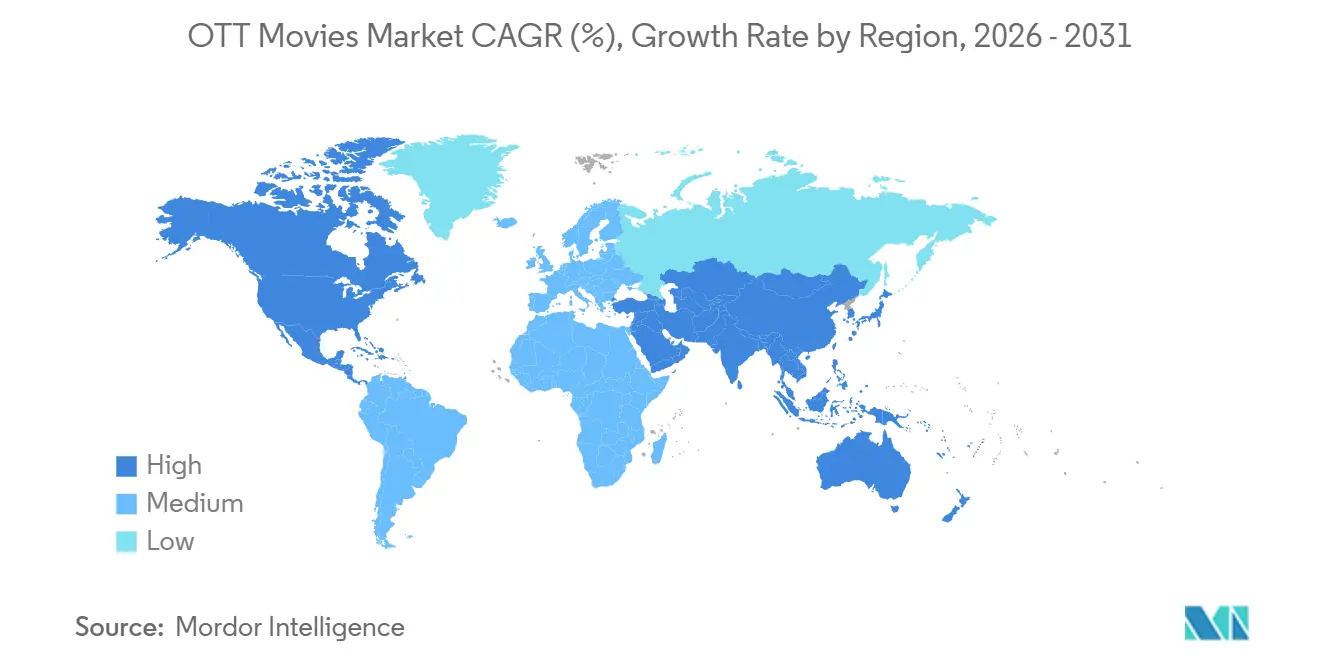
North America retained 32.36% of the OTT movies market share in 2025, supported by high per-user spending and mature broadband access. The United States remained the anchor market, where Netflix held 20% of the streaming market in Q2 2026, followed by Amazon Prime Video at 17% and Disney+ at 15%. This concentration gives major services strong brand power, but it also keeps competition intense around new film releases and library depth. Canada broadly follows the paid subscription model seen in the United States, while Mexico shows stronger dependence on mobile access, lower-priced plans, and bundle-led conversion. South America sits between those patterns, with AVOD and hybrid formats gaining relevance as income sensitivity remains high and local production becomes more important to subscriber growth.
Asia-Pacific is projected to expand at 8.10% CAGR through 2031, making it the fastest-growing geography in the OTT movies market. India shows the region's scale gap between audience reach and monetization, with 601 million OTT users in 2025 but only 119 million paying for at least one subscription. That gap keeps AVOD, mobile-first viewing, and telecom bundles at the center of platform strategy in the OTT movies market. Southeast Asia recorded 4.2 billion hours of premium streaming consumption in Q4 2025, and Indonesian content posted the sharpest regional increase, showing that local films can travel across nearby markets.[2]Asia Video Industry Association, “AVIA 2026 Consumer Survey, In APAC, Piracy Rates Decline but Cyber-Risks Are Still Underestimated,” Piracy Monitor, piracymonitor.org China, Japan, South Korea, and Australia each follow different competitive rules, so scale alone does not support a single regional playbook.
Europe remains a large but slower-growth part of the OTT movies market because high subscription penetration in the largest economies limits easy volume gains. The region also carries stricter catalog obligations, which raise the importance of local production partnerships and disciplined acquisition planning. The Middle East shows stronger premium subscription behavior where telecom bundles and expatriate demand support adoption, while Africa stays earlier in monetization development because payment gaps and piracy still interrupt conversion. Piracy remains a major leak across high-growth markets, with 44% of consumers across 8 Asia-Pacific markets still accessing pirated content in 2026, including 56% in Vietnam and 51% in Indonesia.

Competitive Landscape
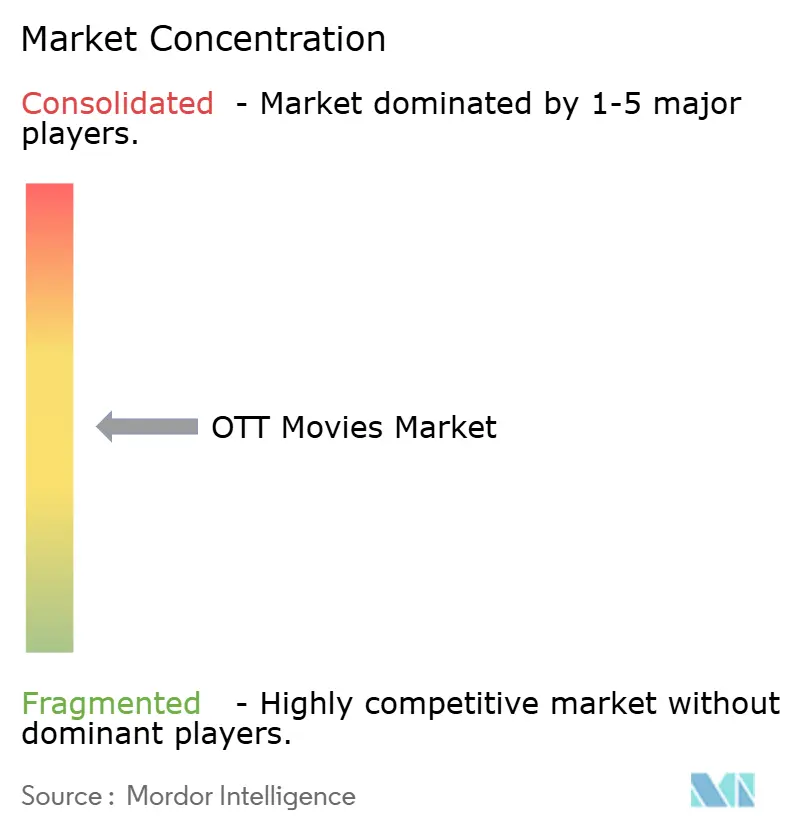
The OTT movies market remains moderately concentrated, with Netflix, Amazon Prime Video, and The Walt Disney Company leading much of the English-language business while regional platforms hold important local positions. This creates a 2-layer structure in the OTT movies market, where global scale matters for content spending but local scale matters for language, pricing, and regulation. iQIYI, Tencent Holdings, JioHotstar, Rakuten Group, and CANAL+ Group stay relevant because they compete where domestic content demand is strong and global catalogs are not enough. Competition now extends beyond title count into discovery, bundling, and release management. Platforms with stronger control over both customer acquisition and film supply can defend retention more effectively than services that rely on only one advantage.
Strategic moves in 2025 and 2026 showed that scale and control over content pipelines are becoming more important in the OTT movies market. In July 2026, Banijay Group and RedBird IMI completed the merger of Banijay Entertainment and All3Media, creating a larger independent supplier of films and series to streaming platforms.[3]Banijay Group, “Combination of Banijay Entertainment and All3Media Completed,” Banijay Group, group.banijay.com In February 2026, Reliance Strategic Business Ventures Limited acquired 50.1% equity in Sikhya Entertainment for ₹150 crore, approximately USD 17.3 million, which strengthened Jio Studios' access to premium film production for digital distribution. In February 2026, JioHotstar partnered with OpenAI to add conversational content discovery across its nearly 500 million monthly users, showing how search and recommendation are becoming part of the competitive layer rather than only a product feature. These moves point to a competitive pattern where ownership, discovery, and distribution are becoming more tightly linked across the OTT movies market.
The clearest open spaces in the OTT movies market remain regional-language originals, niche movie catalogs, and lower-cost monetization of library content. FAST and ad-supported channels are especially attractive because they turn older film rights into recurring revenue without requiring the same production outlay as new originals. At the same time, the OTT movies market is becoming harder for mid-tier services that lack either exclusive content, strong bundle access, or differentiated curation. The companies most likely to gain ground are the ones that can align film acquisition, pricing, and user discovery around clear local demand rather than chase scale in every territory.
OTT Movies Industry Leaders
Netflix, Inc.
Amazon.com, Inc.
The Walt Disney Company
Warner Bros. Discovery, Inc.
Apple Inc.
- *Disclaimer: Major Players sorted in no particular order

Recent Industry Developments
- July 2026: Banijay Group and RedBird IMI completed the USD 8 billion merger of Banijay Entertainment and All3Media, creating one of the world's largest independent content production and distribution companies with Marco Bassetti as CEO and Jeff Zucker as Chair. The combined entity targets approximately USD 60 million in synergies and positions itself as a scaled strategic supplier of original film and series content to global OTT streaming platforms seeking to reduce dependence on in-house studio production.
- July 2026: India's government ordered Telegram to remove 3,100 piracy channels following complaints from JioStar and other OTT operators, marking the largest single enforcement action against messaging-platform-based content piracy in the country. The order forms part of a broader industry-wide campaign to combat IPTV-based piracy networks that distribute premium OTT movie content through unauthorized applications and set-top devices at substantially discounted prices, undermining legitimate subscription revenues.
- February 2026: JioHotstar partnered with OpenAI to embed ChatGPT-powered conversational content discovery across its nearly 500 million monthly users, replacing keyword-driven search with an AI assistant capable of interpreting contextual and emotionally nuanced viewer requests. Over 60% of users chose voice over text during early deployment testing, signaling a shift in how OTT movies are surfaced and selected on large-scale mobile-first platforms in emerging markets.
- February 2026: Reliance Strategic Business Ventures Limited, a subsidiary of Reliance Industries, acquired 50.1% equity in Sikhya Entertainment for ₹150 crore (approximately USD 17.3 million), combining Jio Studios' distribution reach with Sikhya's track record in globally resonant documentary and narrative film production. The acquisition positions Jio Studios to develop premium film content targeting both domestic Indian and international OTT audiences.


Global OTT Movies Market Report Scope
The Global OTT Movies Market refers to the industry comprising internet-based platforms and services that distribute and stream movie content directly to viewers over the internet, bypassing traditional theatrical, cable, satellite, and broadcast distribution channels.
The OTT Movies Market Report is Segmented by Monetization Model (SVOD, AVOD, TVOD, Hybrid, and Freemium), Device Type (Smartphones and Tablets, Smart TVs, Laptops and Desktops, and Other Device Types), Genre (Drama, Comedy, Action and Adventure, Crime and Thriller, and Other Genre), and Geography (North America, South America, Europe, Asia-Pacific, Middle East, Africa). The Market Forecasts are Provided in Terms of Value (USD).
| SVOD |
| AVOD |
| TVOD |
| Hybrid |
| Freemium |
| Smartphones and Tablets |
| Smart TVs |
| Laptops and Desktops |
| Other Device Types |
| Drama |
| Comedy |
| Action and Adventure |
| Crime and Thriller |
| Other Genre |
| North America | United States |
| Canada | |
| Mexico | |
| South America | Brazil |
| Argentina | |
| Chile | |
| Rest of South America | |
| Europe | Germany |
| United Kingdom | |
| France | |
| Italy | |
| Spain | |
| Rest of Europe | |
| Asia-Pacific | China |
| Japan | |
| India | |
| South Korea | |
| Australia | |
| Rest of Asia-Pacific | |
| Middle East | Saudi Arabia |
| United Arab Emirates | |
| Qatar | |
| Rest of Middle East | |
| Africa | South Africa |
| Egypt | |
| Nigeria | |
| Rest of Africa |
| By Monetization Model | SVOD | |
| AVOD | ||
| TVOD | ||
| Hybrid | ||
| Freemium | ||
| By Device Type | Smartphones and Tablets | |
| Smart TVs | ||
| Laptops and Desktops | ||
| Other Device Types | ||
| By Genre | Drama | |
| Comedy | ||
| Action and Adventure | ||
| Crime and Thriller | ||
| Other Genre | ||
| By Geography | North America | United States |
| Canada | ||
| Mexico | ||
| South America | Brazil | |
| Argentina | ||
| Chile | ||
| Rest of South America | ||
| Europe | Germany | |
| United Kingdom | ||
| France | ||
| Italy | ||
| Spain | ||
| Rest of Europe | ||
| Asia-Pacific | China | |
| Japan | ||
| India | ||
| South Korea | ||
| Australia | ||
| Rest of Asia-Pacific | ||
| Middle East | Saudi Arabia | |
| United Arab Emirates | ||
| Qatar | ||
| Rest of Middle East | ||
| Africa | South Africa | |
| Egypt | ||
| Nigeria | ||
| Rest of Africa | ||


Key Questions Answered in the Report
What is the current and forecast value of OTT movies worldwide?
The OTT movies market was valued at USD 46.27 billion in 2025, reaches USD 50.14 billion in 2026, and is projected to reach USD 69.31 billion by 2031 at a 6.69% CAGR.
Which monetization format leads today and which one is growing fastest?
SVOD led with 50.54% share in 2025, while AVOD is projected to grow the fastest at a 7.50% CAGR through 2031.
Why are Smart TVs so important for movie streaming?
Smart TVs held 43.47% share in 2025 because films benefit from larger screens, longer viewing sessions, and a living room setting that supports premium viewing.
What is driving the fastest expansion in Asia-Pacific?
Asia-Pacific is projected to grow at 8.10% CAGR because mobile-first viewing, telecom bundles, regional language content, and rising connected-device access are widening the paid and ad-supported audience base.
What are the main challenges holding back profitability?
The biggest pressures come from subscription fatigue, content licensing complexity, shorter release windows, and piracy in high-growth regions.
How are major companies trying to stay ahead?
Leading companies are using mergers, production acquisitions, AI-led content discovery, and telecom bundling to improve scale, retention, and control over distribution.
Page last updated on:





