
OTT Devices Market Size and Share
Market Overview
| Study Period | 2020 - 2031 |
|---|---|
| Market Size (2026) | USD 5.71 Billion |
| Market Size (2031) | USD 8.28 Billion |
| Growth Rate (2026 - 2031) | 7.72 % |
| Fastest Growing Market | Asia-Pacific |
| Largest Market | North America |
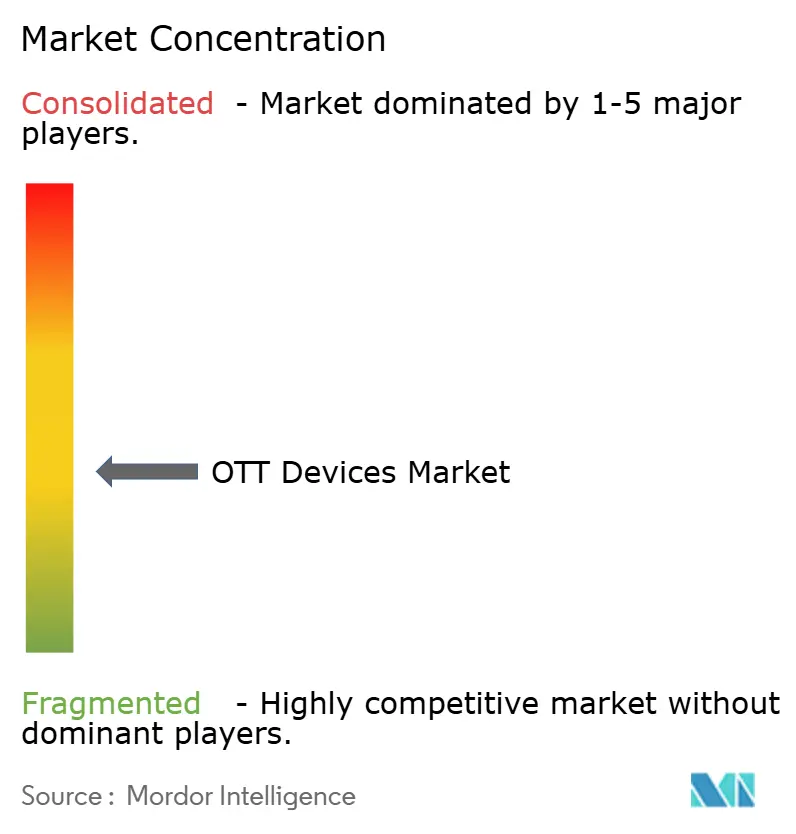
| Market Concentration | Medium |
Major Players *Disclaimer: Major Players sorted in no particular order Image © Mordor Intelligence. Reuse requires attribution under CC BY 4.0. | |
OTT Devices Market Analysis by Mordor Intelligence
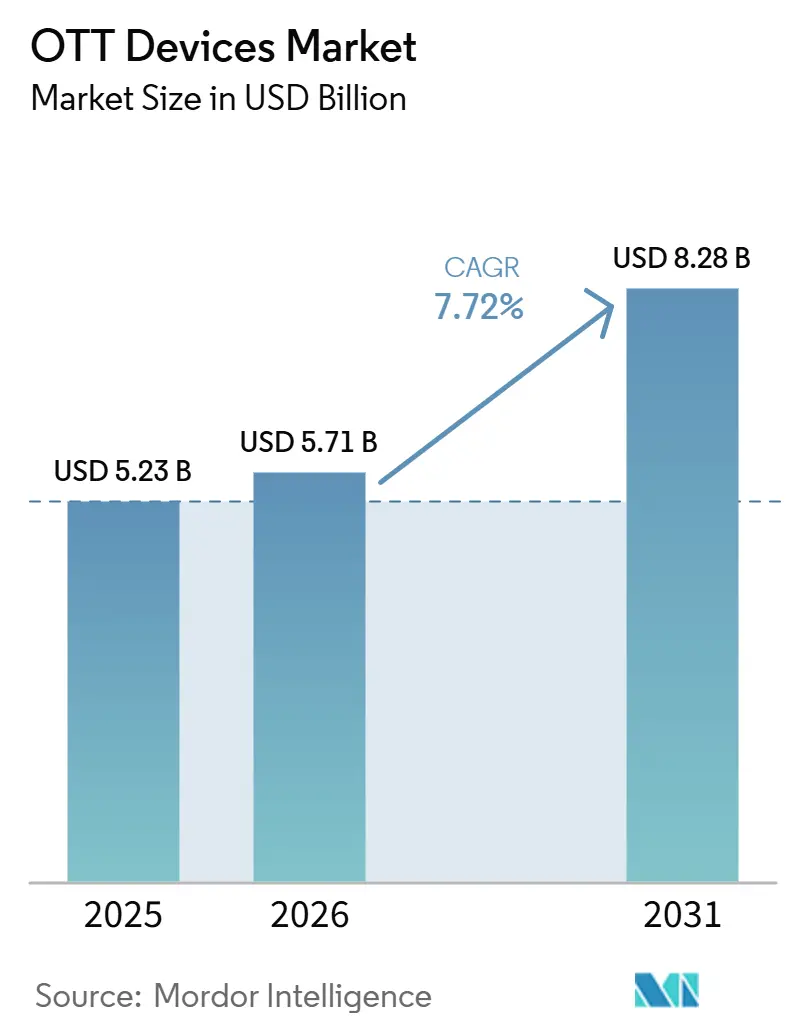
The OTT devices market size is expected to grow from USD 5.23 billion in 2025 to USD 5.71 billion in 2026 and is forecast to reach USD 8.28 billion by 2031 at 7.72% CAGR over 2026-2031. Streaming-first viewing continues to replace linear pay-TV, which supports replacement purchases and first-time device adoption. Device makers are responding by linking hardware to advertising, subscription, and content-discovery revenues rather than relying on unit margins. Smart TV integration limits standalone hardware demand in mature economies, especially where television operating systems receive longer software support. Broadband expansion supports higher-quality streaming and makes premium devices more practical for multi-screen households. The OTT devices market also benefits as streaming hardware takes on roles in smart home, free ad-supported television, and content recommendation.
Key Report Takeaways
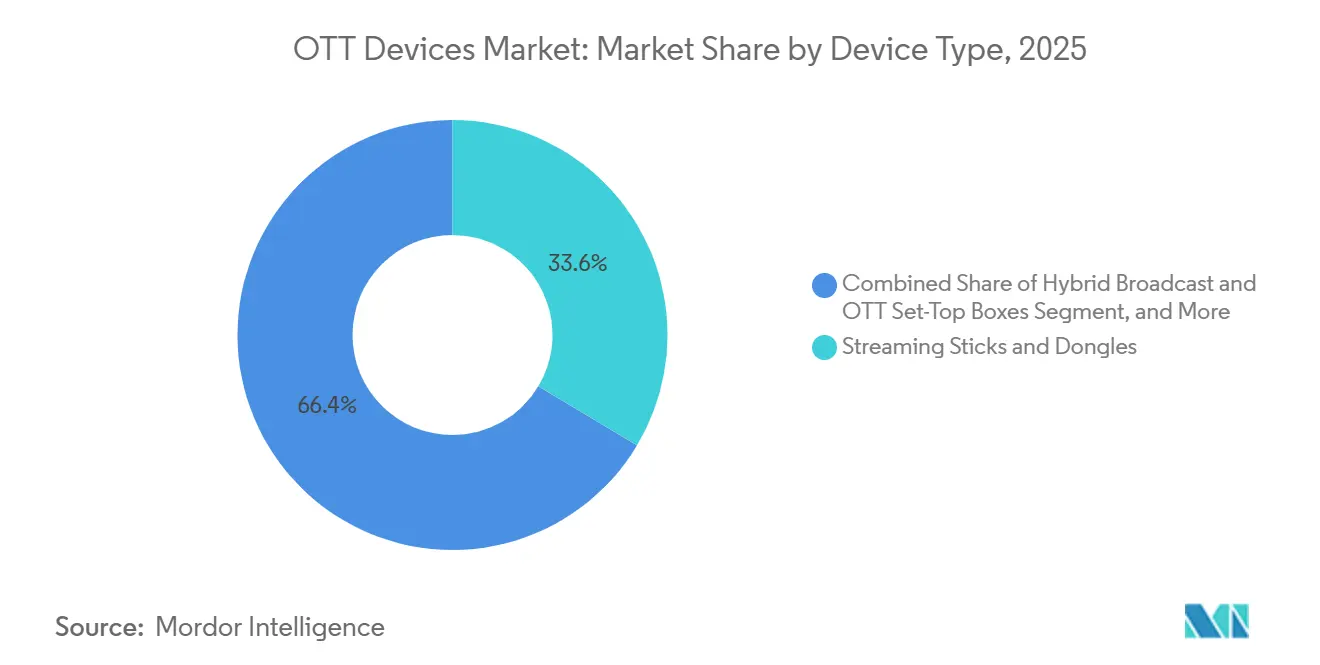
- By device type, streaming sticks and dongles held 33.57% of the OTT devices market share in 2025 and are projected to expand at a 8.52% CAGR through 2031.
- By operating system, Google TV and Android TV held 42.19% of the OTT devices market share in 2025 and are projected to expand at a 8.23% CAGR through 2031.
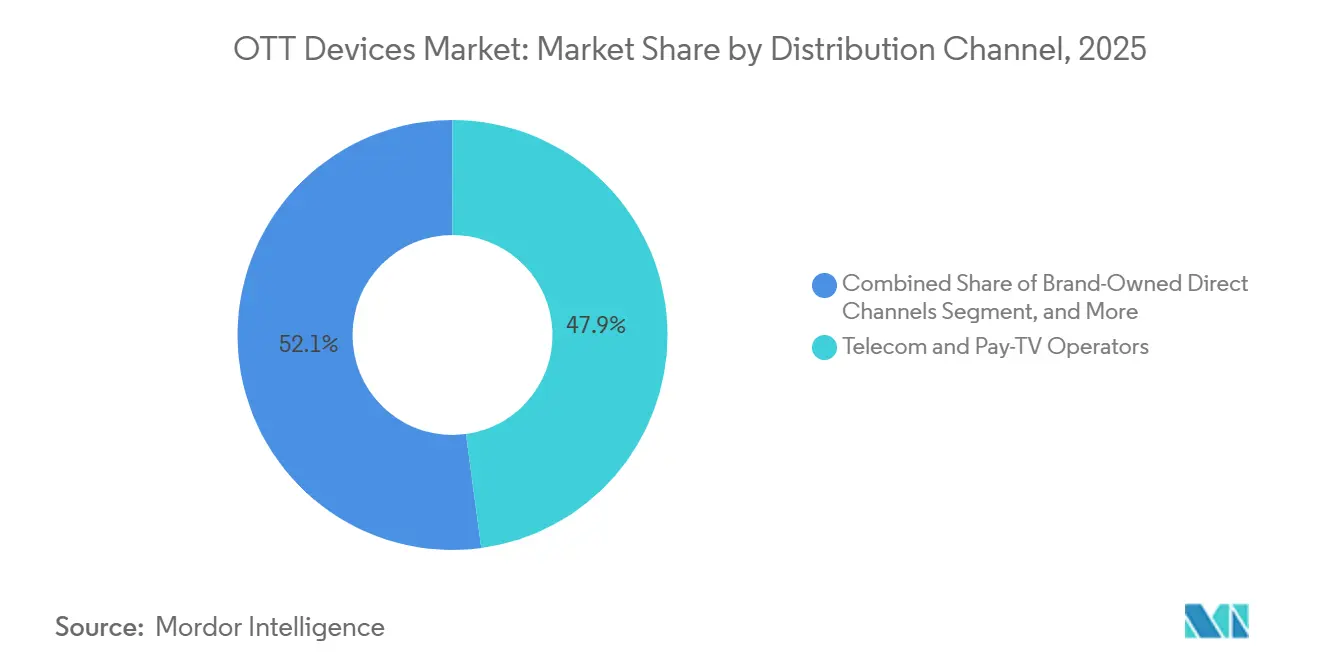
- By distribution channel, telecom and pay-TV operators held 47.86% of the OTT devices market share in 2025, while online retail is expected to grow at a 8.63% CAGR through 2031.
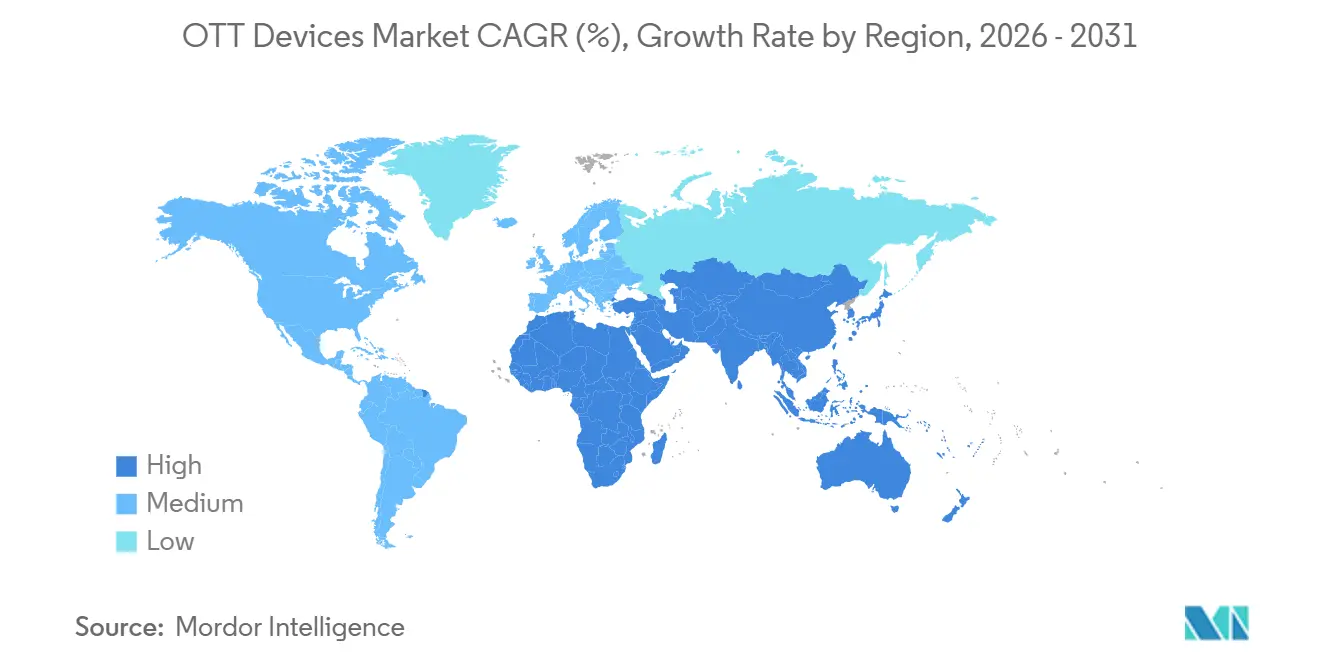
- By geography, North America accounted for 37.68% of revenue in 2025, while Asia-Pacific is projected to grow at a 8.68% CAGR through 2031.
Note: Market size and forecast figures in this report are generated using Mordor Intelligence’s proprietary estimation framework, updated with the latest available data and insights as of January 2026.
Market Trends and Insights
Drivers Impact Analysis of OTT Devices Market*
| Driver | (~) % Impact on CAGR Forecast | Geographic Relevance | Impact Timeline |
|---|---|---|---|
| Rising Cord-Cutting and Cord-Shaving Adoption | +2.2% | North America, Europe, South America | Short term (≤ 2 years) |
| Broadband, Fiber, and 5G Availability Expansion | +1.4% | Asia-Pacific core, spillover to Middle East and Africa and South America | Medium term (2-4 years) |
| Demand for 4K, HDR, and Immersive Audio Streaming | +1.1% | Global | Short term (≤ 2 years) |
| Expansion of FAST Channels and Hardware Subsidization | +0.9% | North America, Europe, Asia-Pacific | Medium term (2-4 years) |
| Low-Cost Upgrade Demand for Legacy Displays | +0.7% | Asia-Pacific, Middle East and Africa, South America | Long term (≥ 4 years) |
| OTT Devices as Multifunctional Home Hubs | +0.5% | North America, Europe | Long term (≥ 4 years) |
| Source: Mordor Intelligence | |||
Rising Cord-Cutting and Cord-Shaving Adoption
Pay-TV penetration in the United States had fallen to 34.4% of households by late 2025, from 82% at its 2011 peak. Nielsen measured streaming at 47.5% of U.S. television viewing in December 2025, showing how streaming had become the leading viewing category. This change shifts household spending away from bundled linear television and toward broadband, applications, and connected playback equipment. In Germany, 31% of households named TV streaming as their main reception route in 2026, compared with 23% for cable, following the prior year's 25% and 28% results. The OTT devices market gains when households retain broadband but discontinue linear television because current hardware supports newer streaming formats, applications, and account-based viewing. This replacement need can occur even where a household already owns an older player, because a new connection or service mix can expose limits in wireless performance, video handling, or application support.
Broadband, Fiber, and 5G Availability Expansion
Ericsson expects global fixed wireless access connections to increase from 185 million at the end of 2025 to 350 million by the end of 2031, with 5G accounting for 90% of those connections. The added connections bring more households within the range needed for stable 4K streaming, rather than only basic internet use. Fiber accounted for 44.6% of fixed broadband connections across OECD countries, while 5G subscriptions grew 48% year over year and accounted for 33% of mobile subscriptions. These networks favor AV1-capable sticks in fixed wireless homes and higher-specification boxes in fiber-connected homes with multiple active screens. Reliance Jio reported that JioAirFiber had exceeded 14 million subscribers in 2026, which shows the scale available to operators that bundle connectivity and entertainment services. The OTT devices market benefits most where new broadband users need a simple way to bring streamed video, local applications, and current software to an existing television.
Demand for 4K, HDR, and Immersive Audio Streaming
New premium streaming content increasingly uses 4K, Dolby Vision, HDR10+, and Dolby Atmos, raising the value of compatible playback hardware. Google launched the Google TV Streamer in 2024 with 4K HDR, Dolby Vision, Dolby Atmos, 32 GB of storage, and a built-in Thread border router.[1]Google, “Introducing Google TV Streamer,” Google Blog, google.com AV1 hardware decoding is required for newly licensed Google TV devices, which creates an upgrade requirement for the Android TV device ecosystem. Large-screen television sales can also raise demand for devices that support higher video and audio specifications without forcing consumers to replace a recently purchased panel. Germany sold 4.8 million television sets in 2025, up 3.2% from 2024, and panel sales over 65 inches increased by 15%. The OTT devices market remains relevant for older smart televisions as well, since a current external device can restore compatible applications, codecs, and digital rights management support.
Expansion of FAST Channels and Hardware Subsidization
Free ad-supported streaming television has increased the value of controlling a device interface and its viewing data. Amagi reported that global FAST viewing hours increased 55% year over year in June 2026. The growth supports platform investment in lower hardware prices because advertising, content promotion, and service revenue can recover value after the sale. Roku reported full-year 2025 revenue of USD 4.74 billion and profit of USD 88.4 million, with hardware accounting for less than 10% of total revenue. That result shows why platform owners can accept limited device margins when the installed base supports additional revenue streams across the life of the product. The OTT devices market is therefore moving toward a model in which hardware distribution builds an audience for advertising, subscriptions, first-party content services, and more relevant content discovery.
Restraints Impact Analysis of OTT Devices Market*
| Restraint | (~) % Impact on CAGR Forecast | Geographic Relevance | Impact Timeline |
|---|---|---|---|
| Smart TV Integration Reducing Standalone Device Need | -1.5% | North America, Europe, Asia-Pacific | Short term (≤ 2 years) |
| Hardware Commoditization and Margin Compression | -1.0% | Global | Medium term (2-4 years) |
| Platform Fragmentation Increasing Application Porting Costs | -0.7% | Global | Long term (≥ 4 years) |
| HDMI, Wi-Fi, and Codec Compatibility Friction in Emerging Markets | -0.5% | Middle East and Africa, South America, Asia-Pacific non-core markets | Long term (≥ 4 years) |
| Source: Mordor Intelligence | |||
Smart TV Integration Reducing Standalone Device Need
Smart television adoption is the most direct constraint on standalone players, as embedded operating systems meet many basic streaming needs. Roku and Fire TV together powered more than half of U.S. streaming viewing environments in 2026, increasingly through televisions with embedded systems rather than separate devices. This development allows platform usage to grow even when standalone unit sales do not, separating operating system reach from the demand for external hardware. Samsung's seven-year software update commitment for Tizen televisions further extends the useful life of embedded platforms and delays the usual replacement trigger. Hardware suppliers that lack operating system licensing or advertising revenue face greater pressure as the installed base of smart televisions expands. The OTT devices market remains exposed, where television makers keep application support up to date, retain key services, and reduce the need for external hardware.
Hardware Commoditization and Margin Compression
The consumer streaming hardware category faces sustained price pressure from low-cost devices and platform-backed pricing. Entry-level streaming sticks have fallen below USD 30, narrowing the room for branded suppliers to protect margins while maintaining expected video and wireless features. Amazon can absorb component cost changes more readily than smaller rivals because it has a broader service and retail ecosystem. This makes hardware-only business models less able to fund recurring work on codecs, connectivity, application support, and product updates. Operator-managed boxes are also typically supplied at no or low upfront cost, so operators rely on service contracts to recover the cost over time. The OTT devices market is less attractive for suppliers that cannot earn advertising, subscription sharing, app-store revenue, or a continuing service return beyond the hardware sale.
*Our forecasts treat driver/restraint impacts as directional, not additive. The impact forecasts reflect baseline growth, mix effects, and variable interactions.
OTT Devices Market Segment Analysis
By Device Type:
Streaming Sticks and Dongles Lead Broad Household AdoptionStreaming sticks and dongles accounted for 33.57% of global category revenue in 2025 and are projected to grow at an 8.52% CAGR through 2031. Their lower entry price, portability, and direct HDMI connection make them a practical upgrade for legacy displays. They also give consumers access to large operating system ecosystems without requiring a television replacement. The OTT devices market is positioned for replacement demand in North America and first-time adoption in Asia-Pacific, South America, and the Middle East. Amazon launched the Fire TV Stick HD in June 2026 as its slimmest device, with direct USB power from television ports. That design supports additional displays in a household and portable use outside the main living room.
Operator-managed OTT boxes and pucks remain important where telecommunications companies include hardware within broadband and content plans. This approach reduces the upfront purchase decision and connects the device to an ongoing subscriber relationship. The OTT devices market retains this channel where operators can use managed boxes to preserve service visibility and provide technical support. NVIDIA's long software support for Shield TV illustrates how durability can support loyalty among users who value extended device life.[2]NVIDIA, “Inside NVIDIA's 10-Year Effort to Make the Shield TV the Most Updated Android Device Ever,” Ars Technica, arstechnica.com Hybrid broadcast and streaming devices also give households access to applications while maintaining familiar television services. Standalone streaming media boxes serve a premium niche that values local storage, gaming, and advanced audio or video support.



By Operating System:
Google TV and Android TV Expand Through OEM ReachGoogle TV and Android TV are projected to expand at an 8.23% CAGR through 2031, the highest rate among the operating systems tracked in the OTT devices market. The platform reaches multiple price points because it is adopted by a broad group of device and television manufacturers, allowing the same software base to serve entry-level, mid-tier, and premium hardware. Google certification requires AV1 hardware decoding for new licensed devices, which raises the technical standard for participating hardware. This requirement supports updates in the mid-tier and premium device range, where manufacturers seek access to a current application catalog. Google's Google TV Streamer also brings smart-home functions into the streaming interface through its Thread border router. The combination of content access and home control gives manufacturers another way to position higher-capability hardware.
Roku OS held 37% of U.S. primary streaming television viewing environments in 2026, reflecting the scale of its platform and television licensing model in the OTT devices market. Fox Corporation announced an agreement to acquire Roku in June 2026 for USD 22 billion in enterprise value, subject to closing in the first half of 2027. The proposed combination would unite Roku's streaming platform and The Roku Channel with Fox's Tubi, sports, and news assets. tvOS continues to serve a premium group of Apple ecosystem households that value close device integration and established software services. Other operating systems, including Tizen, webOS, and operator software, remain relevant where television makers or operators prefer their own licensing and service arrangements. This creates a wide operating system landscape even as platform scale remains concentrated among a limited number of companies.
By Distribution Channel:
Operators Lead Bundled Deployment as Online Retail GrowsTelecom and pay-TV operators accounted for 47.86% of the distribution channel segment in 2025, making them a central route to household deployment in the OTT devices market. Their leading position reflects their ability to place hardware in broadband and content bundles, reducing subscribers' upfront costs and making installation part of a wider service offer. Operators also use boxes to preserve customer relationships as viewers move toward direct streaming services. This route is significant across European IPTV markets and in the Middle East, where regional providers use managed devices as retention tools. The channel aligns the hardware sale with monthly service revenue rather than a one-time retail purchase. It also gives operators control over installation, technical support, and application placement.
Online retail is expected to grow at an 8.63% CAGR through 2031 as direct-to-consumer purchasing expands in India and Southeast Asia. The channel suits entry-level sticks because their prices align with common mobile commerce payment patterns, and consumers can compare basic specifications before buying. Brand-owned online stores give Amazon, Roku, and Apple a setting to test pricing, bundles, and new features before broader distribution. Offline electronics retail remains useful for premium streaming boxes and hybrid set-top boxes that benefit from in-store demonstration. Television purchases can also create an opportunity to add a compatible device at the same time. The OTT devices industry relies on both channels because bundles accelerate installed-base growth while online retail gives consumers more direct choice.
Geography Analysis
North America OTT Devices Market
North America held 37.68% of global revenue in 2025 and remained the revenue center of the OTT devices market. Cord-cutting, broad streaming adoption, and regular consumer electronics replacement demand support, even as many households already own a smart television or a streaming player. Streaming represented 47.5% of all U.S. television viewing in December 2025. The United States has widespread 4K display adoption and deep platform penetration, which keeps upgrades relevant when users want current applications or better performance. Canada follows a similar streaming adoption pattern, while Mexico offers growth potential as fiber availability improves in urban areas.
Europe and South Korea OTT Devices Market
Europe is the second-largest geographic bloc in the OTT devices market, driven by the shift from cable and satellite viewing to internet-delivered television. In 2026, Germany recorded streaming as the main television reception method for 31% of households, compared with 23% for cable. 67% of German streaming households used smart televisions for internet-delivered content. Fiber accounted for 44.6% of fixed broadband connections across OECD countries, with Spain at 88% and Korea at 90%. These network conditions increase expectations for streaming quality, support multi-screen use, and make device updates more relevant for households with older connected displays.
APAC, South America and MEA OTT Devices Market
Asia-Pacific is projected to record an 8.68% CAGR through 2031, making it the fastest-growing regional part of the OTT devices market. India combines broadband expansion with regional-language content and operator-led distribution, supporting demand for hybrid and streaming-ready devices. Reliance Jio's JioAirFiber had more than 14 million subscribers in 2026, showing the reach of the bundled access model.[3]Reliance Jio, “JioAirFiber Subscriber Update,” Reliance Jio, jio.com Japan and South Korea remain premium markets where strong 5G availability supports higher-specification devices. South America, the Middle East, and Africa remain earlier-stage opportunities where improving mobile broadband and online retail extend access to affordable streaming sticks.

Competitive Landscape
The OTT devices market has a concentrated platform layer and a more fragmented hardware layer, which gives the largest software owners significant influence over user access and application distribution. Amazon, Roku, Google, and Apple operate major streaming platforms, while Xiaomi, Hisense, TCL, HUMAX, Sagemcom, and Skyworth compete mainly in hardware supply. These hardware companies often license software from larger platform owners and compete through price, operator relationships, regional reach, product design, and the ability to meet local retail or operator requirements. Fox Corporation's proposed USD 22 billion acquisition of Roku would combine Roku's streaming platform, The Roku Channel, and Tubi with sports rights and news content.[4]Fox Corporation and Roku, “Fox Corporation to Acquire Roku,” Roku Newsroom, roku.com The transaction is expected to close in the first half of 2027, subject to required conditions.
Competitive strategy in the OTT devices market is increasingly shaped by software, advertising, content discovery, and smart-home functions rather than by basic hardware specifications alone. Amazon launched the Fire TV Stick HD in June 2026, featuring a redesigned Fire TV interface and Alexa+ integration. Roku introduced an AI-powered home screen in May 2026 for Roku televisions and streaming devices across its more than 100 million streaming households. Google positions the Google TV Streamer as both a 4K streaming device and a smart-home hub through Thread connectivity. These moves seek to make the platform more useful after the device purchase, reduce the time needed to find content, and deepen the relationship with the household.
Hardware specification alone is less likely to distinguish suppliers when competing products offer similar video formats, wireless capabilities, and access to common streaming applications. Companies with advertising, service, or content revenue can support lower device prices more easily than hardware-only suppliers, which shifts competition toward the installed base instead of a single transaction. This creates pressure on smaller vendors but leaves room for companies with strong operator ties, regional distribution expertise, specialized premium products, or designs that address a clearly defined household use case.
OTT Devices Industry Leaders
Amazon.com, Inc.
Roku, Inc.
Google LLC
Apple Inc.
Xiaomi Corporation
- *Disclaimer: Major Players sorted in no particular order
OTT Devices Market Companies Covered in this Report
- Amazon.com, Inc.
- Roku, Inc.
- Google LLC
- Apple Inc.
- Xiaomi Corporation
- Hisense Co., Ltd.
- TCL Technology Group Corporation
- NVIDIA Corporation
- Samsung Electronics Co., Ltd.
- LG Electronics Inc.
- Sony Corporation
- Panasonic Holdings Corporation
- VIZIO, Inc.
- SHARP Corporation
- Koninklijke Philips N.V.
- ASUSTeK Computer Inc.
- NETGEAR, Inc.
- HUMAX Co., Ltd.
- Sagemcom Broadband SAS
- Skyworth Group Limited
- Dish Network Corporation

Recent Industry Developments in OTT Devices Market
- July 2026: LG Electronics expanded its proprietary FAST service, LG Channels, past 5,000 channels across 37 countries following a new Poland launch. The milestone underscored rising global consumer demand for free ad-supported streaming and LG's intent to generate platform advertising revenue that offsets hardware margin compression.
- June 2026: Fox Corporation and Roku, Inc. announced a definitive agreement under which Fox will acquire Roku for USD 160.00 per share in a combination of cash and Fox Class A common stock, valuing Roku at USD 22 billion in enterprise value. The deal is expected to close in the first half of 2027 and combines Fox's Tubi streaming service and sports and news content with Roku's platform, The Roku Channel, and its direct relationship with more than 100 million global streaming households.
- June 2026: Amazon launched the Fire TV Stick HD, its slimmest streaming device to date, optimized for USB direct power from television ports and shipped with the new Fire TV user interface and Alexa+ integration. The product targeted multi-display household upgrades and travel use cases and expanded the Fire TV lineup globally, including markets across Asia-Pacific.
- May 2026: Roku unveiled a redesigned, AI-powered Home Screen for all Roku TVs and streaming devices across its more than 100 million streaming household base in the United States. The update emphasized behavioral content recommendations and reduced discovery friction, with international expansion planned for subsequent months.


Global OTT Devices Market Report Scope
The OTT devices market refers to the market for hardware devices that enable users to stream over-the-top content, such as movies, TV shows, live events, and other digital media, directly through the internet without relying on traditional cable or satellite television services.
The OTT Devices Market Report is Segmented by Device Type (Streaming Sticks and Dongles, Standalone Streaming Media Boxes, Operator-Managed OTT Boxes and Pucks, and Hybrid Broadcast and OTT Set-Top Boxes), Operating System (Roku OS, Fire OS, Google TV and Android TV, tvOS, and Other Operating Systems), Distribution Channel (Online Retail, Offline Electronics Retail, Telecom and Pay-TV Operators, and Brand-Owned Direct Channels), and Geography (North America, South America, Europe, Asia-Pacific, Middle East, and Africa). The Market Forecasts are Provided in Terms of Value (USD).
| Streaming Sticks and Dongles |
| Standalone Streaming Media Boxes |
| Operator-Managed OTT Boxes and Pucks |
| Hybrid Broadcast and OTT Set-Top Boxes |
| Roku OS |
| Fire OS |
| Google TV and Android TV |
| tvOS |
| Other Operating Systems |
| Online Retail |
| Offline Electronics Retail |
| Telecom and Pay-TV Operators |
| Brand-Owned Direct Channels |
| North America | United States |
| Canada | |
| Mexico | |
| South America | Brazil |
| Argentina | |
| Chile | |
| Rest of South America | |
| Europe | Germany |
| United Kingdom | |
| France | |
| Italy | |
| Spain | |
| Rest of Europe | |
| Asia-Pacific | China |
| Japan | |
| India | |
| South Korea | |
| Australia | |
| Rest of Asia-Pacific | |
| Middle East | Saudi Arabia |
| United Arab Emirates | |
| Qatar | |
| Rest of Middle East | |
| Africa | South Africa |
| Egypt | |
| Nigeria | |
| Rest of Africa |
| By Device Type | Streaming Sticks and Dongles | |
| Standalone Streaming Media Boxes | ||
| Operator-Managed OTT Boxes and Pucks | ||
| Hybrid Broadcast and OTT Set-Top Boxes | ||
| By Operating System | Roku OS | |
| Fire OS | ||
| Google TV and Android TV | ||
| tvOS | ||
| Other Operating Systems | ||
| By Distribution Channel | Online Retail | |
| Offline Electronics Retail | ||
| Telecom and Pay-TV Operators | ||
| Brand-Owned Direct Channels | ||
| By Geography | North America | United States |
| Canada | ||
| Mexico | ||
| South America | Brazil | |
| Argentina | ||
| Chile | ||
| Rest of South America | ||
| Europe | Germany | |
| United Kingdom | ||
| France | ||
| Italy | ||
| Spain | ||
| Rest of Europe | ||
| Asia-Pacific | China | |
| Japan | ||
| India | ||
| South Korea | ||
| Australia | ||
| Rest of Asia-Pacific | ||
| Middle East | Saudi Arabia | |
| United Arab Emirates | ||
| Qatar | ||
| Rest of Middle East | ||
| Africa | South Africa | |
| Egypt | ||
| Nigeria | ||
| Rest of Africa | ||


Key Questions Answered in the Report
What is the OTT devices market size?
The OTT devices market is expected to increase from USD 5.71 billion in 2026 to USD 8.28 billion by 2031, at a 7.72% CAGR. Streaming adoption, broadband availability, and platform-led device strategies support this outlook.
Which device type leads OTT device demand?
Streaming sticks and dongles led with 33.57% revenue share in 2025 and are projected to grow at an 8.52% CAGR through 2031. Low purchase prices, portability, and HDMI connections support their wide use.
Why are telecom operators important to OTT device sales?
Telecom and pay-TV operators held 47.86% of the distribution channel segment in 2025 because bundled hardware reduces upfront purchase barriers. The model also links the device to broadband, content, installation, and ongoing service revenue.
Which region will grow fastest through 2031?
Asia-Pacific is projected to grow at an 8.68% CAGR through 2031, supported by broadband growth and operator-led distribution. India, Japan, and South Korea each support demand through different connectivity and consumer patterns.
How do smart TVs affect standalone streaming devices?
Smart TV integration reduces demand for standalone devices where embedded platforms and software support meet household streaming needs. External devices remain relevant for older displays, software upgrades, and higher video, audio, or smart-home capabilities.
Which companies lead platform competition?
Amazon, Roku, Google, and Apple lead major streaming platforms, while many other companies compete in hardware supply. Their strategies increasingly combine hardware with content discovery, advertising, services, and household connectivity.
Page last updated on:





