
OTT Content Production Market Size and Share
Market Overview
| Study Period | 2020 - 2031 |
|---|---|
| Market Size (2026) | USD 148.84 Billion |
| Market Size (2031) | USD 236.35 Billion |
| Growth Rate (2026 - 2031) | 9.69 % |
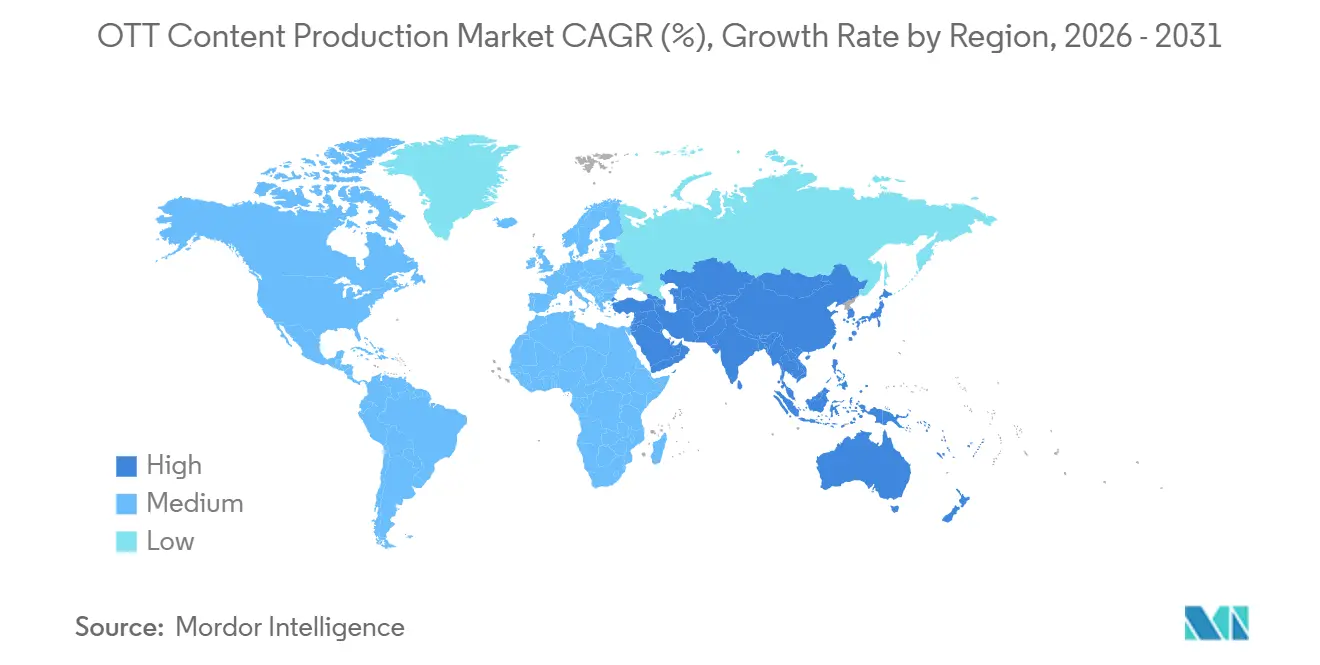
| Fastest Growing Market | Asia-Pacific |
| Largest Market | North America |
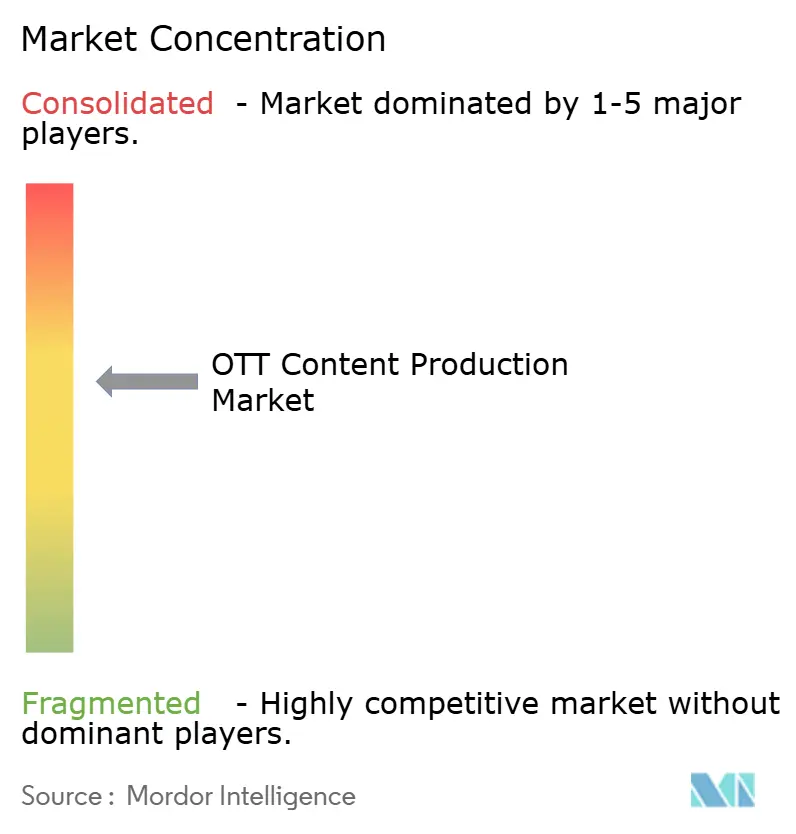
| Market Concentration | Medium |
Major Players *Disclaimer: Major Players sorted in no particular order Image © Mordor Intelligence. Reuse requires attribution under CC BY 4.0. | |
OTT Content Production Market Analysis by Mordor Intelligence
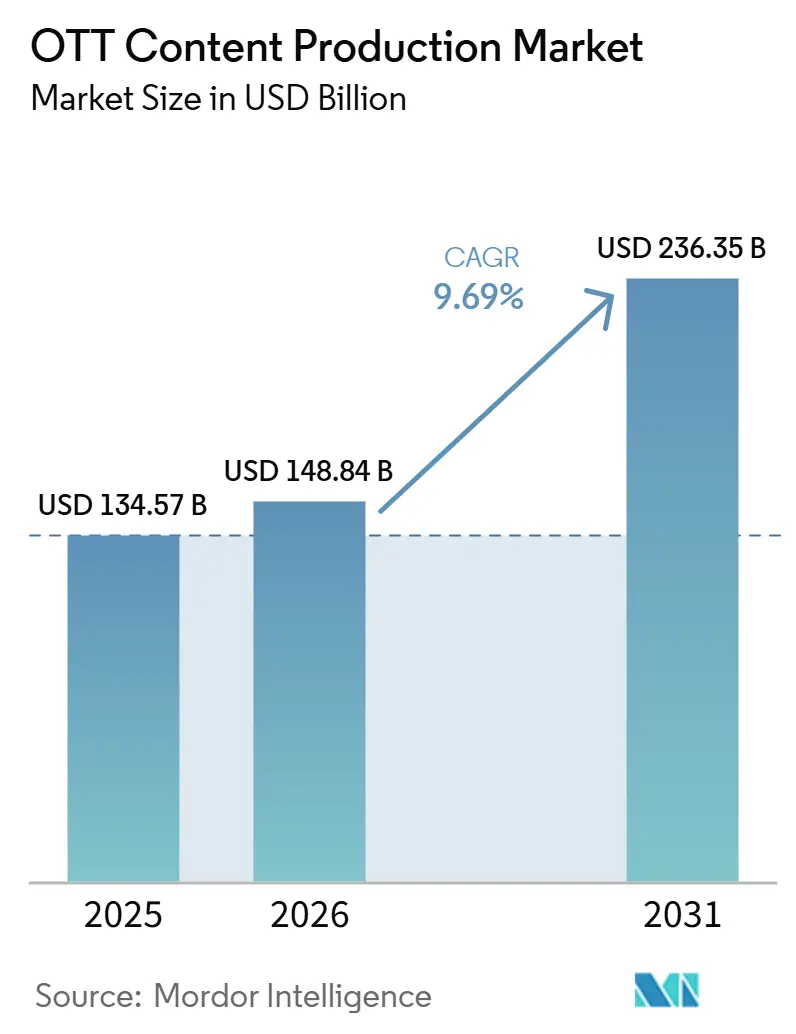
The OTT content production market size is projected to expand from USD 134.57 billion in 2025 and USD 148.84 billion in 2026 to USD 236.35 billion by 2031, registering a CAGR of 9.69% between 2026 to 2031. The OTT content production market is being shaped by the fact that streaming platforms now fund and commission a large share of global scripted and unscripted output, which has moved the center of gravity away from traditional broadcast schedules and toward platform-first release planning. The OTT content production market is also seeing faster production cycles because binge-ready release models often require complete seasons to be delivered before launch, which raises the need for parallel workflows across filming, editing, finishing, and localization. The OTT content production market is gaining additional support from AI-assisted post-production tools and wider multilingual delivery, because these changes are expanding the amount of finishing work needed for each title rather than reducing it. The OTT content production market remains anchored in North America because of its dense studio base and high-budget production ecosystem, while Asia-Pacific is advancing quickly as platforms increase local-language investment and back stories that can travel across borders. The OTT content production market is also facing tighter cost discipline, as large platform consolidation, rising labor costs, and evolving AI governance rules are forcing producers and commissioners to balance scale, speed, compliance, and content quality with greater care.
Key Report Takeaways
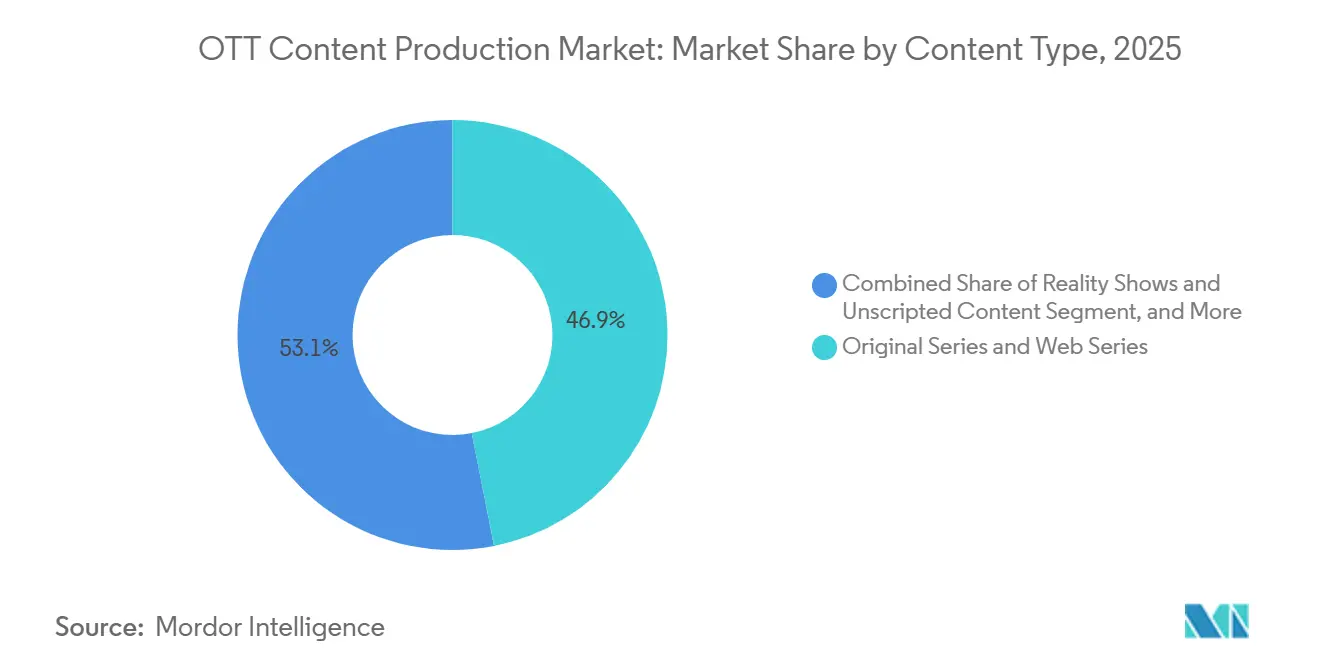
- By content type, Original Series and Web Series held 46.91% of the OTT content production market share in 2025, while Animation and Kids Content are projected to grow at a 10.84% CAGR through 2031.
- By production stage, Production accounted for 57.84% share of the OTT content production market size in 2025, while Post-Production is projected to expand at a 10.75% CAGR through 2031.
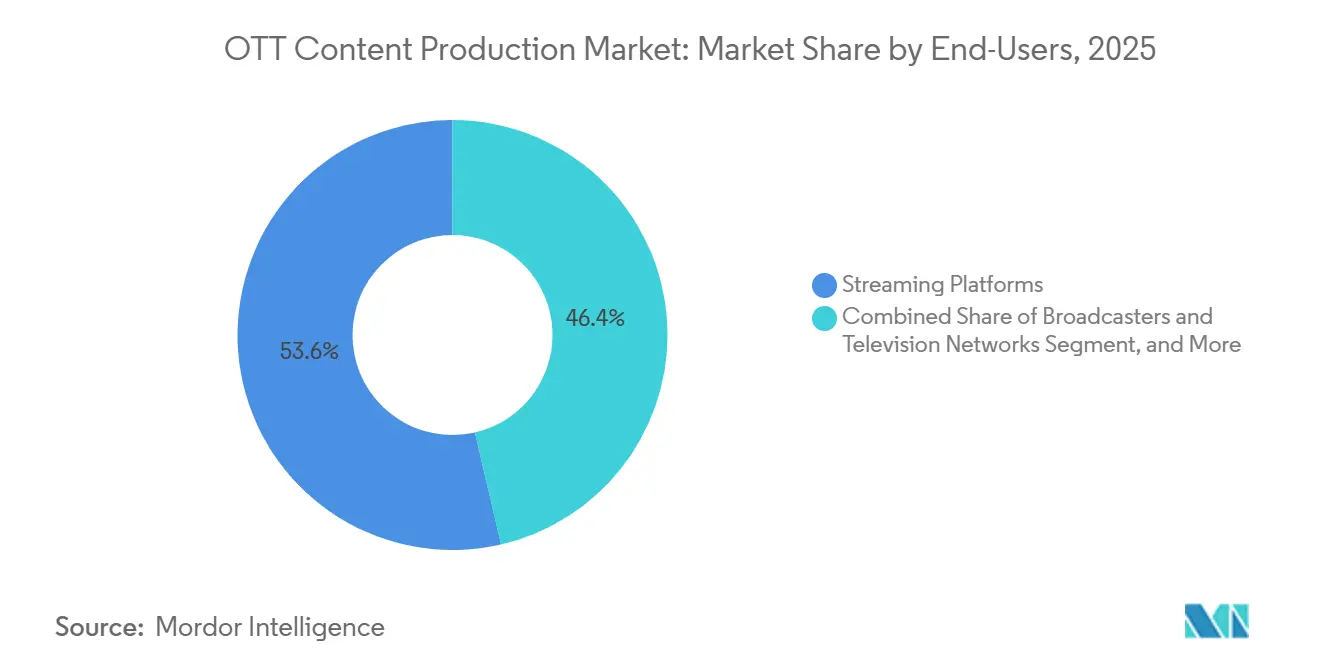
- By end-users, Streaming Platforms held 53.62% of the market in 2025, while Independent Creators is projected to expand at a 10.63% CAGR through 2031.
- By geography, North America held 52.18% of the OTT content production market share in 2025, while Asia-Pacific is projected to expand at an 11.26% CAGR through 2031.
Note: Market size and forecast figures in this report are generated using Mordor Intelligence’s proprietary estimation framework, updated with the latest available data and insights as of January 2026.
Market Trends and Insights
Drivers Impact Analysis of OTT Content Production Market*
| Driver | (~) % Impact on CAGR Forecast | Geographic Relevance | Impact Timeline |
|---|---|---|---|
| Rising Demand for Platform-Exclusive Originals | +3.2% | Global, with concentrated spending in North America, Europe, and Asia-Pacific | Long term (≥ 4 years) |
| Rapid Shift from Linear Scheduling to Binge-Ready Release Models | +2.1% | North America and Europe, with spillover to Asia-Pacific and South America | Medium term (2-4 years) |
| Localization Spend Rises for Language-Specific and Culture-Specific Storytelling | +1.3% | Asia-Pacific core, with spillover to the Middle East, Africa, and South America | Long term (≥ 4 years) |
| Short-Form Spin-Offs Extend Franchise Monetization Across Social and OTT Ecosystems | +0.9% | Global, with early momentum in North America and East Asia | Medium term (2-4 years) |
| AI-Assisted Pre-Production Reduces Script, Planning, And Versioning Cycles | +0.8% | Global, with first-mover gains in North America and South Korea | Short term (≤ 2 years) |
| Virtual Production Expands High-Scale Visual Ambition at Lower On-Set Friction | +0.6% | North America, the United Kingdom, Saudi Arabia, South Korea, and India | Medium term (2-4 years) |
| Source: Mordor Intelligence | |||
Rising Demand for Platform-Exclusive Originals
Platform exclusivity remains one of the strongest forces driving the OTT content production market, as large streaming services use exclusive titles to attract subscribers and reduce churn. In this model, a title is no longer just a programming asset; it is also a retention tool that cannot be shared with a competing service. Netflix confirmed content spend of roughly USD 18 billion for 2025 and guided to approximately USD 20 billion for 2026, which shows that exclusive programming continues to hold a central place in commissioning plans. Disney also guided its direct-to-consumer content spend to approximately USD 24 billion for 2026, up from 2025, with higher sports rights costs adding to the platform content bill.[1]The Walt Disney Company, “Fiscal Year 2025 Annual Report Form 10-K,” The Walt Disney Company Investor Relations, thewaltdisneycompany.com As the OTT content production market grows under this model, producers are being asked to deliver more work on platform-specific terms, which is pushing many studios to think more carefully about how they protect long-term IP value. Recent platform agreements with creator-led and producer-led partners show that exclusivity is extending across scripted series, unscripted formats, and podcast-based video programming, not just traditional television development.
Rapid Shift from Linear Scheduling to Binge-Ready Release Models
The move away from weekly linear scheduling has changed how the OTT content production market plans, finances, and delivers full-season output. A binge-ready release often requires an entire season to be completed before the first episode goes live, shifting more spending and execution risk to the earlier part of the production cycle. That structure increases the value of studios that can handle simultaneous filming, editing, visual effects, and localization across multiple episodes. It also favors companies with stage access, reliable crews, and integrated delivery systems, as delays in one part of the chain can affect the entire release calendar. At the same time, the OTT content production market is not moving to a single release pattern, as some franchise titles still use weekly drops to keep audience attention for longer periods. This mixed release environment is increasing the need for mid-run post-production flexibility, which helps explain why finishing and delivery work is growing faster than many expected.
Localization Spend Rises for Language-Specific and Culture-Specific Storytelling
Localization has moved from a downstream distribution step to an early production decision in the OTT content production market. Platforms now plan many titles for multilingual release from the start, which means dubbing, subtitling, and cultural adaptation are increasingly built into scheduling and budgeting decisions. This shift is especially visible in Asia-Pacific, where regional-language storytelling is often commissioned with wider audience travel in mind rather than only domestic demand. The 2025 APEC Gyeongju Declaration also supported deeper cultural and creative cooperation across East Asia, which strengthens the long-term base for cross-border co-productions and wider language circulation. In India, regional-language demand and content classification requirements continue to support a localization-first approach, which makes multilingual planning more central to commissioning logic in the OTT content production market. As more titles are developed with cross-market reach in mind, studios that can combine production, localization, and delivery with fewer handoffs are likely to win more repeat platform work.
Short-Form Spin-Offs Extend Franchise Monetization Across Social and OTT Ecosystems
Short-form extensions are expanding the production funnel for the OTT content market, as franchise IP can now be activated across both subscription platforms and social video ecosystems. Established long-form titles are increasingly supported by shorter episodic units that serve as promotional, audience-testing, or direct monetization vehicles. TikTok formalized this direction with the launch of its Mini Dramas commercial ecosystem in 2026, which provided brands and content creators with a clearer structure for distributing and monetizing episodic microdramas. Funding activity also moved quickly, with Shortical raising USD 100 million in 2026, which showed that capital is beginning to treat microdrama production as a real content business rather than a side format. Legacy entertainment groups are also moving into this space, as shown by Yash Raj Films' backing of Rusk Media's vertical entertainment effort for younger audiences. This means the OTT content production market is expanding not only through longer premium series but also through format-specific output that requires its own production, creative, and monetization workflows.
Restraints Impact Analysis of OTT Content Production Market*
| Restraint | (~) % Impact on CAGR Forecast | Geographic Relevance | Impact Timeline |
|---|---|---|---|
| Escalating Talent and Union Cost Inflation | -1.8% | North America primary, with secondary effects in the United Kingdom and Australia | Long term (≥ 4 years) |
| Licensing Fragmentation and Rights Reacquisition Complexity | -1.2% | Global, with the strongest pressure in North America and Europe | Medium term (2-4 years) |
| Content Discovery Saturation Raises Monetization Pressure | -0.8% | Global, most visible in mature subscription video markets in North America and Europe | Medium term (2-4 years) |
| AI Governance and Rights Clearance Uncertainty Slows Workflow Automation | -0.6% | North America, the European Union, and the United Kingdom | Short term (≤ 2 years) |
| Source: Mordor Intelligence | |||
Escalating Talent and Union Cost Inflation
Labor cost remains one of the clearest brakes on the OTT content production market, especially in North America, where union agreements directly shape project budgets. The 2026 SAG-AFTRA TV and Theatrical Agreement was ratified with 91.42% member approval and locked in 3% compounded annual minimum rate increases from July 1, 2026, through June 30, 2030. The same agreement also increased pension and health contributions from 21% to 22%, effective September 6, 2026, which adds another layer of cost pressure to each qualifying production hour. For mid-budget producers, the issue is not a single increase, but the cumulative effect of higher wage floors, benefits, and platform-facing margin discipline. AI-related contract provisions also limit near-term cost substitution because productions must follow notice-and-compensation rules when synthetic performers are used. As a result, the OTT content production market is likely to keep expanding, but more of that growth will depend on producers that can absorb or offset labor inflation through scale, tax incentives, or more efficient production planning.
Licensing Fragmentation and Rights Reacquisition Complexity
Rights fragmentation is creating slower and more complex development cycles across the OTT content production market. Over the past several years, many libraries have been split into narrower windows by geography, format, language, and platform tier, making sequel, remake, or spin-off planning harder to execute. When original projects involved several financing or distribution partners, reacquiring rights can push pre-production work into lengthy negotiation cycles. The planned Paramount Skydance and Warner Bros. Discovery combination added another layer to this issue, as large-scale integration can eventually simplify rights control within one company, but the deal process itself introduced near-term uncertainty for project approvals and acquisition activity. This environment is nudging parts of the OTT content production market toward original IP development, since wholly owned concepts often avoid the clearance burden associated with adapted properties. That shift helps companies with strong internal development engines, while smaller producers that rely on licensed source material face a less predictable path to commissioning.
*Our forecasts treat driver/restraint impacts as directional, not additive. The impact forecasts reflect baseline growth, mix effects, and variable interactions.
OTT Content Production Market Segment Analysis
By Content Type:
Original Series Lead, But Animation Drives the Next Growth WaveOriginal Series and Web Series accounted for 46.91% of the segment in 2025, giving this format the leading position in the OTT content production market. This lead reflects the way platforms use serial storytelling to drive subscriber acquisition, build routine viewing behavior, and keep audiences engaged between major film releases. Within the OTT content production industry, originals also carry strategic weight because they create exclusive viewing windows that platforms can market more aggressively than licensed library titles. The expansion of multi-year deals with talent, creators, and production partners shows that platforms continue to rely on original programming as the primary center of commissioning activity. Movies and Feature Films remained the second-largest content type, supported by the steady demand for direct-to-platform premieres that carry the feel of premium event programming. Documentary and Non-Fiction content also continued to expand their role, as ad-supported tiers need larger content libraries with lower unit costs and broader replay value. This keeps factual programming relevant even in a market where scripted originals receive the most public attention. The OTT content production market, therefore, continues to rely on originals for visibility, while films and factual content help balance release calendars and platform economics.
Animation and Kids Content is projected to record a 10.84% CAGR from 2026 to 2031, making it the fastest-growing content type in the OTT content production market. Kids and family programming generated 4.4 billion views on Netflix globally in the second half of 2025, which points to a large audience base that still appears under-served relative to viewing demand. The segment has faced slower commissioning in the past because of long production cycles and tighter monetization limits around child-directed advertising. That balance is starting to change as AI-assisted animation tools shorten some workflows and as proven children's IP becomes easier to extend across games, merchandise, and live experiences. The Bebefinn co-production agreement with Amazon Kids Plus shows how known family brands are being moved into long-form premium streaming output with global distribution potential. Reality Shows and Unscripted Content still matter in the OTT content production market because they give platforms a lower-cost way to sustain output volume while maintaining tighter profitability targets. Other content types also retain a role because platform slates need a mix of high-impact originals and more flexible library fillers across audience groups.



By Production Stage:
Production Dominates, Post-Production AcceleratesProduction accounted for 57.84% of the segment in 2025, making it the largest segment of the OTT content production market. This position is rooted in the basic structure of screen production, since principal photography still demands physical sets, crew time, equipment, and talent coordination at a scale that no other stage matches. Even when AI tools improve pre-visualization or automate routine tasks, filming itself remains labor-intensive and infrastructure-heavy. Capacity spending in 2026 reinforced that reality, with Netflix advancing its Fort Monmouth studio complex in New Jersey and expanding its United Kingdom production footprint, while Amazon also moved forward with studio expansion plans in the UK. These moves show that large platforms are not treating production capacity as a temporary input but as a strategic, long-term asset in the OTT content production market. Pre-Production remains important as well, even if its share of spending is under pressure from automation. Script planning, location choices, budget control, and versioning decisions made early in the process still have outsized effects on schedule reliability and final production cost.
Post-Production is projected to expand at a 10.75% CAGR through 2031, making it the fastest-growing stage in the OTT content production market. This growth reflects more than just editing demand, because each title now carries heavier needs in visual effects, sound finishing, localization coordination, delivery mastering, and version management across multiple formats. The wider use of AI tools is not shrinking this work in a simple way, because better tools also make more ambitious visual and technical output possible within the same budget envelope. That means producers often choose to increase scope rather than simply cut labor hours. In practical terms, the line between production and post-production is becoming less rigid as real-time engines and in-camera tools move more finishing work closer to the set. The OTT content production market is therefore seeing faster growth in finishing services because platforms need content that is both visually richer and ready for multi-market delivery. As release schedules become tighter, post-production partners that can handle speed, scale, and version complexity are becoming more important to the overall supply chain.
By End-Users:
Streaming Platforms Lead, Independent Creators Reshape the Supply ChainStreaming Platforms held 53.62% of the segment in 2025, which kept them at the center of demand in the OTT content production market. Their lead is reinforced by a closed commissioning loop, as platforms can use subscriber viewing data to refine their content strategy and place future production orders with greater confidence. This makes scale an advantage not only in funding, but also in project selection and release timing. Production Studios still hold an important position because they supply development pipelines, physical production capabilities, and co-production structures that many platforms continue to rely on. Broadcasters and Television Networks remain relevant in the OTT content production market as well, especially in countries where public service obligations, local-language mandates, or mixed funding models sustain commissioning outside pure subscription economics. That is why legacy television players have lost share more slowly in some regions than global platform headlines might suggest. The result is a layered end-user structure in which platforms lead spending, but studios and broadcasters still shape key parts of content supply.
Independent Creators are projected to record a 10.63% CAGR from 2026 to 2031, making them the fastest-growing end-user group in the OTT content production market. This growth reflects the fading boundary between creator-economy programming and premium streaming content, especially as platforms search for lower-risk formats with built-in audiences. Tubi's Tubi for Creators program grew to more than 20,000 episodes from more than 300 creators within 12 months of launch, which showed that creator-led production can scale quickly when a platform builds the right support structure.[2]Tubi, “Tubi Announces Multi-Project Slate with Kevin ‘KevOnStage’ Fredericks,” Tubi Corporate, corporate.tubitv.com Creator-focused deals from Fox Creator Studios, Netflix, and other platforms indicate that this is no longer an experimental side category, but an increasingly formal part of content strategy. In the OTT content production industry, this matters because creator-led formats often move faster, work with different economics, and can test audience demand before larger investments are made. It also changes the supplier base, since independent creators often bring their own communities, channels, and marketing power into the production process. The OTT content production market is therefore expanding not only through bigger studio spending, but also through a broader and more flexible creator-led production layer.
Geography Analysis
The Americas OTT Content Production Market
North America held 52.18% of the OTT content production market in 2025, giving the region the largest share. The United States remains the core of this position because it combines platform headquarters, established studio ecosystems, high-budget production capability, and deep pools of creative and technical labor. Canada and Mexico strengthen the regional base through tax incentives and cost advantages that support cross-border project planning. The 2026 SAG-AFTRA wage framework is also widening the split between top-budget productions that can absorb labor inflation and mid-tier productions that must look harder at incentive-backed locations. South America continues to gain relevance in the OTT content production market as Netflix and Amazon expand localized commissioning in Portuguese and Spanish, while Brazilian originals have shown that regional output can travel beyond domestic audiences.
Europe and APAC OTT Content Production Market
Europe remains a mature but shifting base for the OTT content production market, with the United Kingdom, Germany, and France holding key roles in infrastructure and local-language commissioning. The United Kingdom strengthened its position in 2026 as large streamers expanded studio commitments and planning activity, which reinforced its role as a preferred hub for high-budget productions. Germany, France, Italy, and Spain continue to benefit from local content obligations that support commissioning even when platform margin goals become more cautious. Sky's acquisition of ITV also changed the regional competitive picture by combining major distribution reach with a large commercial viewing base and an established streaming outlet. Asia-Pacific is projected to grow at an 11.26% CAGR through 2031, which makes it the fastest-growing geography in the OTT content production market size.
APAC and MEA OTT Content Production Market
India is attracting deeper platform infrastructure and creator activity, including Netflix's Eyeline Studios expansion in Hyderabad, while South Korea and Japan remain important because their IP increasingly travels across borders rather than staying local.[3]Journal of the Korea Contents Association, “Transnational Cultural-Creative Industries, Trends in International Co-production Within the Korean OTT Market and Types of Korea-Japan Co-production,” Journal of the Korea Contents Association, doi.org The Middle East is emerging more clearly in the OTT content production market as governments and local institutions support content ecosystems, co-production frameworks, and production infrastructure. Saudi Arabia and the UAE are central to this shift because both are trying to build long-term screen sectors rather than only host isolated projects. Africa remains earlier in development, but Nigeria and South Africa stand out because they combine local production capacity with growing relevance for platform commissioning. Egypt also remains important as an Arabic-language production gateway, while public-sector backed digital platforms in emerging economies are creating new institutional demand for production support and localized programming.

Competitive Landscape
The OTT content production market is moderately concentrated at the platform commissioning layer, but it remains much more fragmented across the wider network of studios, broadcasters, service providers, and creator-led producers. Netflix, Amazon, and Comcast Corporation continue to shape spending by influencing what gets commissioned, how quickly projects move, and which formats receive priority. The planned Paramount Skydance and Warner Bros. Discovery combination adds more consolidation pressure because it would create a larger scaled platform with a broad library and stronger direct-to-consumer reach. The main strategic patterns in the OTT content production market are becoming clearer, with leading players investing in physical studio capacity, broadening ties with creators, and adopting tools that improve production speed or multilingual delivery.
Netflix's Fort Monmouth build-out and UK expansion showcase the infrastructure side of that strategy, while Amazon's Bray Film Studios proposal underscores the same need for controlled capacity near key production centers.[4]Amazon.com, Inc., “Annual Report on Form 10-K for the Fiscal Year Ended December 31, 2025,” Amazon Investor Relations, aboutamazon.comThe OTT content production market also shows a second competitive track in which companies seek to connect premium commissioning with creator-led output and new distribution forms. Tubi's creator program, Netflix's creator and publisher licensing moves, and the broader rise of short-form serial content all show that platforms want more flexible sources of audience-tested programming. Fox's planned Roku acquisition also points to a stronger link between content ownership and distribution control, which could matter more if ad-supported and hybrid viewing models keep growing. White space remains visible in mid-budget documentary and non-fiction programming for AVOD and FAST services, where inventory demand can outpace dedicated production focus. Banijay and Fremantle are well placed in unscripted formats, but there is still room in the OTT content production market for specialists that can deliver factual content at scale for streaming-first channels.
Africa and Southeast Asia also remain under-capitalized relative to rising platform interest, which leaves room for regional production ecosystems to grow if financing and distribution support deepen. A separate competitive pressure is coming from newer format-led entrants that operate outside older studio models. Shortical's financing round showed that mobile-first microdrama is gaining institutional backing, while STAGE's progress in regional dialect content showed that hyper-local audiences can support viable digital content economics. Disney+ Japan's co-development agreement with The Seven is another example of how major companies are using local partnerships to secure culturally specific programming with wider distribution potential. The OTT content production market is therefore moving toward a structure where a small group of global platforms still sets the pace, but a wider mix of local studios, creator networks, and format specialists competes for share within that larger commissioning system.
OTT Content Production Industry Leaders
Netflix, Inc.
The Walt Disney Company
Comcast Corporation
Warner Bros. Discovery, Inc.
Amazon.com, Inc.
- *Disclaimer: Major Players sorted in no particular order
OTT Content Production Market Companies Covered in this Report
- Netflix, Inc.
- The Walt Disney Company
- Comcast Corporation
- Warner Bros. Discovery, Inc.
- Amazon.com, Inc.
- Apple Inc.
- Paramount Global
- Sony Group Corporation
- Alphabet Inc.
- Tencent Holdings Limited
- iQIYI, Inc.
- Bilibili Inc.
- Zee Entertainment Enterprises Limited
- PCCW Limited
- Banijay Group
- Fremantle Limited
- Lions Gate Entertainment Corp.
- Viaplay Group AB

Recent Industry Developments in OTT Content Production Market
- July 2026: Amazon submitted a formal expansion proposal for Bray Film Studios in the UK, extending its GBP 1.1 billion (USD 1.4 billion) UK studio infrastructure commitment into the planning stages. The expansion is designed to increase stage capacity for Prime Video originals and third-party productions.
- July 2026: Shortical, a microdrama app based in Israel, raised USD 100 million in user-acquisition financing from PvX Partners, marking PvX's third investment in the microdrama format and signaling institutional capital's expanding appetite for AI-assisted, mobile-first content production.
- July 2026: Netflix and Spotify jointly announced a multiyear partnership for Jay Shetty's On Purpose podcast, reported at USD 100 million, positioning video-first podcast content as a premium OTT production category.
- June 2026: Fox Corp. announced the acquisition of Roku for USD 22 billion in a cash-and-stock deal, creating an integrated streaming distribution and content platform expected to close in H1 2027.


Global OTT Content Production Market Report Scope
The OTT content production market refers to the creation, development, and production of video content distributed through over-the-top platforms that deliver media directly to viewers via the internet, bypassing traditional cable, satellite, and broadcast television distribution. The report analyzes key market trends, growth drivers, challenges, and opportunities across major content types, platform models, and geographic regions.
The OTT Content Production Market Report is Segmented by Content Type (Movies and Feature Films, Original Series and Web Series, Documentary and Non-Fiction, Reality Shows and Unscripted Content, Animation and Kids Content, and Other Content Types), Production Stage (Pre-Production, Production, and Post-Production), End-Users (Streaming Platforms, Production Studios, Broadcasters and Television Networks, Independent Creators, and Other End-Users), and Geography (North America, South America, Europe, Asia-Pacific, Middle East, and Africa). The Market Forecasts are Provided in Terms of Value (USD).
| Movies and Feature Films |
| Original Series and Web Series |
| Documentary and Non-Fiction |
| Reality Shows and Unscripted Content |
| Animation and Kids Content |
| Other Content Types |
| Pre-Production |
| Production |
| Post-Production |
| Streaming Platforms |
| Production Studios |
| Broadcasters and Television Networks |
| Independent Creators |
| Other End-Users |
| North America | United States |
| Canada | |
| Mexico | |
| South America | Brazil |
| Argentina | |
| Chile | |
| Rest of South America | |
| Europe | Germany |
| United Kingdom | |
| France | |
| Italy | |
| Spain | |
| Rest of Europe | |
| Asia-Pacific | China |
| Japan | |
| India | |
| South Korea | |
| Australia | |
| Rest of Asia-Pacific | |
| Middle East | Saudi Arabia |
| United Arab Emirates | |
| Qatar | |
| Rest of Middle East | |
| Africa | South Africa |
| Egypt | |
| Nigeria | |
| Rest of Africa |
| By Content Type | Movies and Feature Films | |
| Original Series and Web Series | ||
| Documentary and Non-Fiction | ||
| Reality Shows and Unscripted Content | ||
| Animation and Kids Content | ||
| Other Content Types | ||
| By Production Stage | Pre-Production | |
| Production | ||
| Post-Production | ||
| By End-Users | Streaming Platforms | |
| Production Studios | ||
| Broadcasters and Television Networks | ||
| Independent Creators | ||
| Other End-Users | ||
| By Geography | North America | United States |
| Canada | ||
| Mexico | ||
| South America | Brazil | |
| Argentina | ||
| Chile | ||
| Rest of South America | ||
| Europe | Germany | |
| United Kingdom | ||
| France | ||
| Italy | ||
| Spain | ||
| Rest of Europe | ||
| Asia-Pacific | China | |
| Japan | ||
| India | ||
| South Korea | ||
| Australia | ||
| Rest of Asia-Pacific | ||
| Middle East | Saudi Arabia | |
| United Arab Emirates | ||
| Qatar | ||
| Rest of Middle East | ||
| Africa | South Africa | |
| Egypt | ||
| Nigeria | ||
| Rest of Africa | ||


Key Questions Answered in the Report
What is the current and forecast size of the OTT content production market?
The OTT content production market was valued at USD 134.57 billion in 2025, reached USD 148.84 billion in 2026, and is projected to hit USD 236.35 billion by 2031 at a 9.69% CAGR.
Which content type leads OTT content production today?
Original Series and Web Series led content type demand with a 46.91% share in 2025 because platforms continue to rely on originals for subscriber acquisition and retention.
Which production stage is growing the fastest through 2031?
Post-Production is forecast to grow the fastest at a 10.75% CAGR as platforms need more visual finishing, localization, versioning, and multi-format delivery work per title.
Why is North America still the largest regional hub for OTT content production?
North America held 52.18% of the market in 2025 because it combines major platform headquarters, dense studio infrastructure, deep labor pools, and the highest concentration of large-budget commissions.
What is driving the growth of independent creators in streaming content production?
Independent Creators are projected to grow at a 10.63% CAGR through 2031 as platforms increasingly treat creator-led programming as a scalable content category with built-in audiences and faster development cycles.
What are the main risks affecting OTT content production over the next few years?
The main risks are rising talent costs, more complex rights reacquisition, tighter content monetization in crowded streaming ecosystems, and AI governance rules that can slow workflow automation.
Page last updated on:





