
OTT CMS Market Size and Share
Market Overview
| Study Period | 2020 - 2031 |
|---|---|
| Market Size (2026) | USD 0.68 Billion |
| Market Size (2031) | USD 1.23 Billion |
| Growth Rate (2026 - 2031) | 12.40 % |
| Fastest Growing Market | Asia-Pacific |
| Largest Market | North America |
| Market Concentration | Medium |
Major Players *Disclaimer: Major Players sorted in no particular order Image © Mordor Intelligence. Reuse requires attribution under CC BY 4.0. | |
OTT CMS Market Analysis by Mordor Intelligence
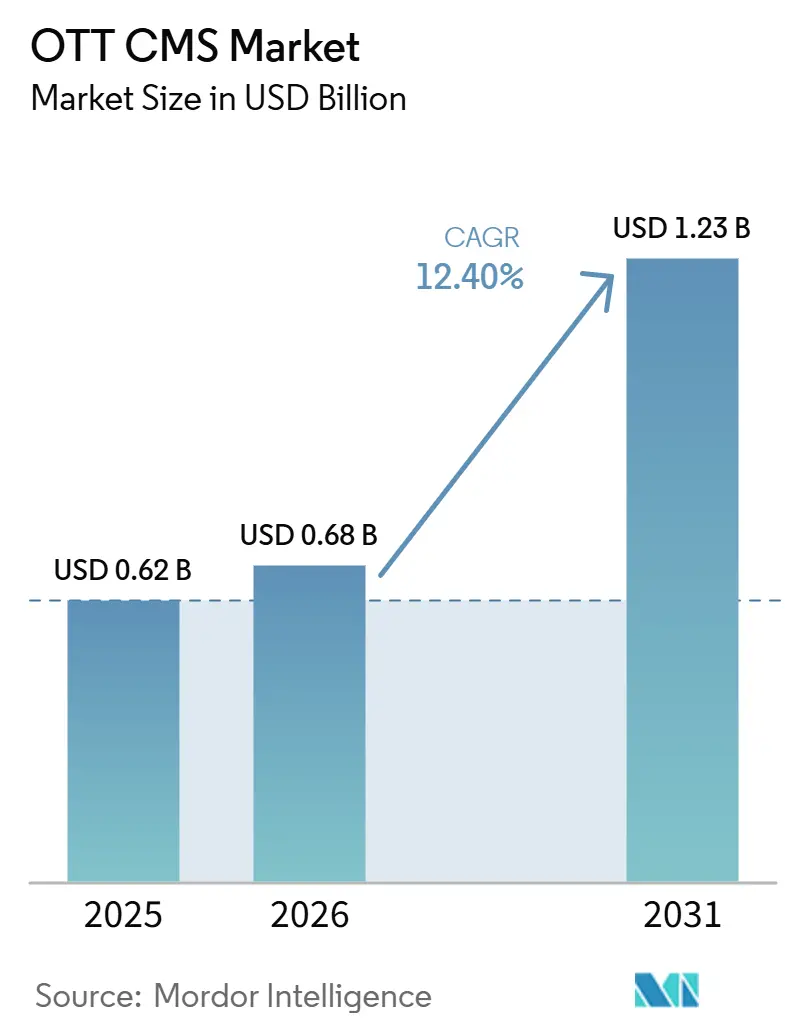
The OTT CMS market size is expected to increase from USD 0.62 billion in 2025 to reach USD 1.23 billion by 2031, growing at a CAGR of 12.40% over 2026-2031, as operators invest in systems that can manage content, data, permissions, and publishing activity in one connected environment. Cloud delivery has become the operating base for many platforms because it supports flexible capacity, faster publishing, modular upgrades, and a staged move away from local infrastructure without interrupting the core content library. The OTT content management system (CMS) market is also being shaped by the need to manage one title across subscription, advertising-supported, transactional, hybrid, and free access models, while maintaining accurate metadata and permitted viewing conditions for each service. Live events raise the required level of real-time rights control, feed management, access enforcement, and operational monitoring because content decisions must be applied while viewers are watching. Consolidation is bringing established video brands into larger platform groups, while leaving room for specialized providers of DRM, rights automation, and metadata management that can be added to existing systems without a full platform replacement. Migration difficulty, piracy risks, fragmented supply chains, and compliance duties can slow replacement decisions, especially for smaller vendors in the OTT CMS market that must respond to customer requirements across several territories.
Key Report Takeaways
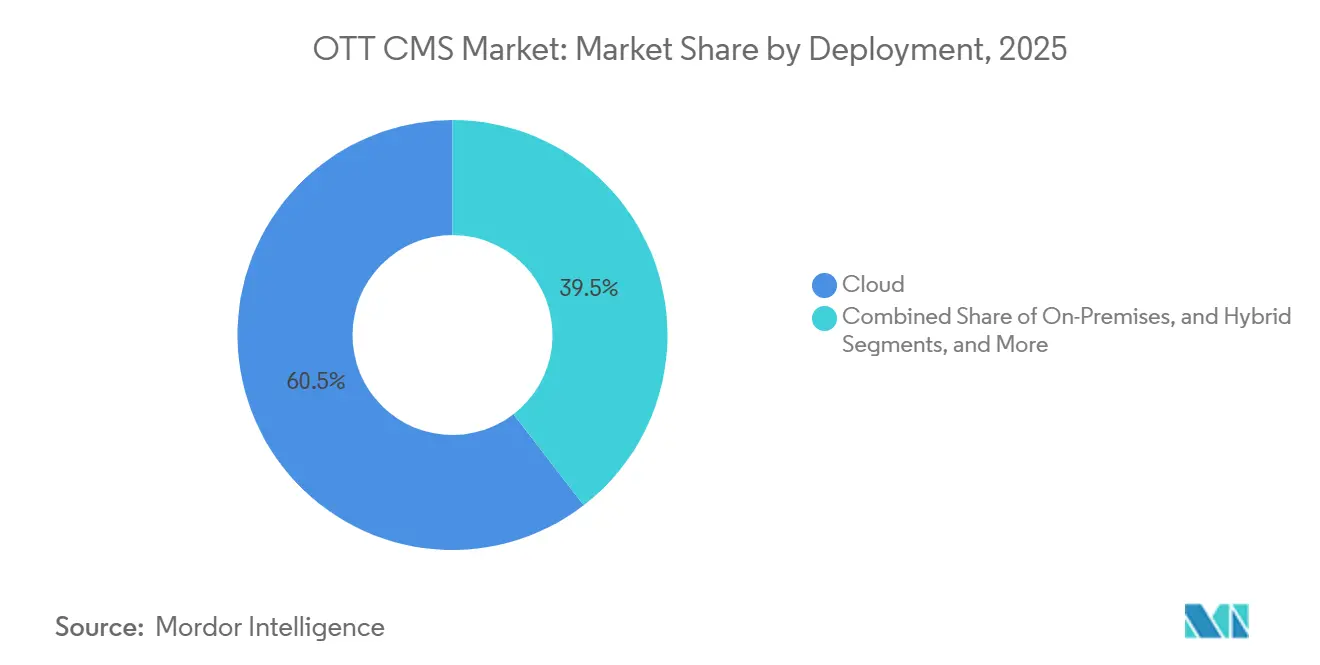
- By deployment, cloud held 60.46% of the OTT CMS market share in 2025, while hybrid deployment remained important for operators moving from local systems to cloud environments.
- By revenue model, SVOD held 60.77% of the OTT content management system market share in 2025, while AVOD is projected to expand at a 13.11% CAGR through 2031.
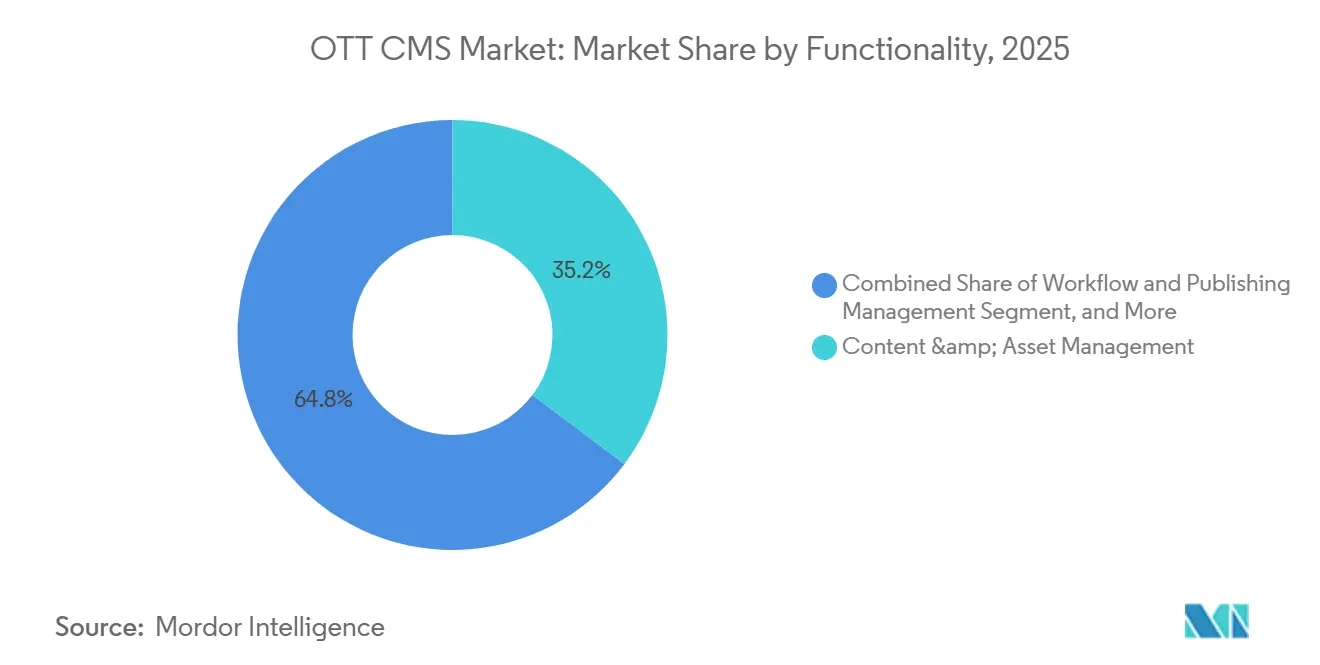
- By functionality, content and asset management accounted for 35.24% of the OTT Content Management System (CMS) market size in 2025, while rights, security, and compliance management are expected to grow at a 12.96% CAGR from 2026 to 2031.
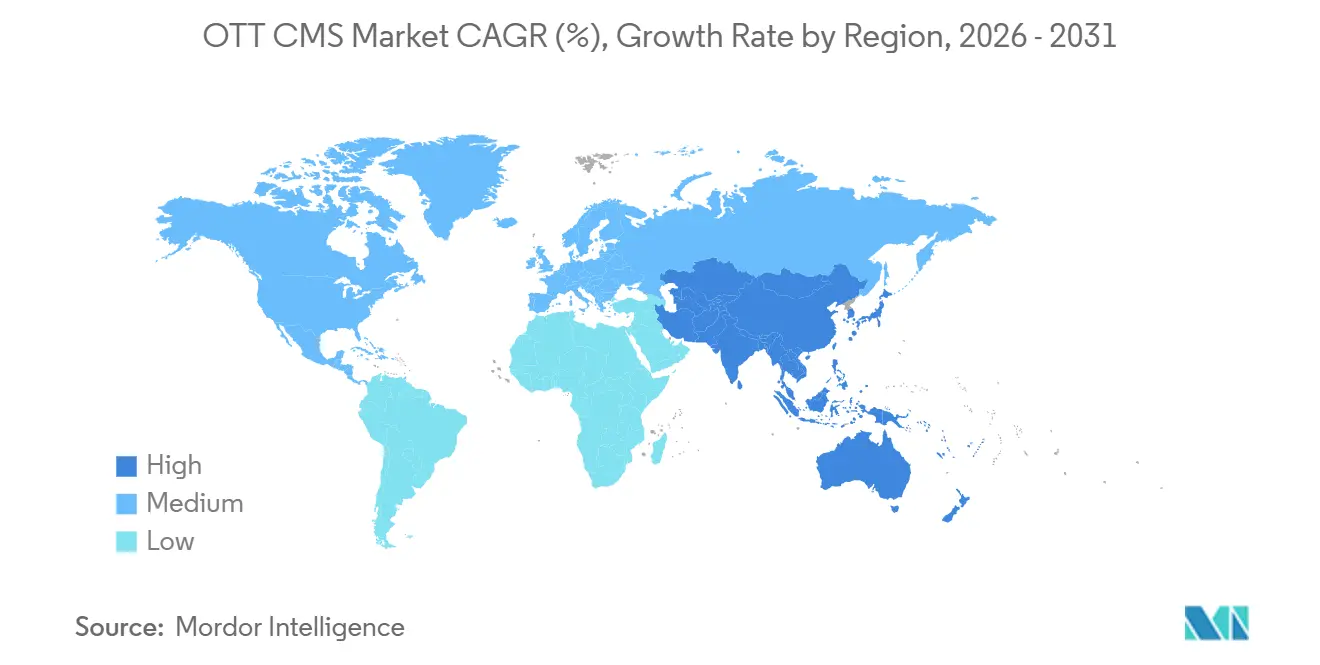
- By geography, North America held 38.73% of the OTT CMS market in 2025, while Asia-Pacific is projected to grow at a 13.22% CAGR through 2031.
Note: Market size and forecast figures in this report are generated using Mordor Intelligence’s proprietary estimation framework, updated with the latest available data and insights as of January 2026.
Market Trends and Insights
Drivers Impact Analysis of OTT CMS Market*
| Driver | (~) % Impact on CAGR Forecast | Geographic Relevance | Impact Timeline |
|---|---|---|---|
| Rising Demand for Cloud-Native OTT Workflows | +3% | Global | Medium term (2-4 years) |
| Growth in Multi-Language and Regional Content Delivery | +2.5% | Asia-Pacific, Middle East and Africa, South America | Long term (≥ 4 years) |
| Expansion of Live Sports and Event Streaming | +2.2% | North America and Europe, with spillover to Asia-Pacific | Short term (≤ 2 years) |
| Increasing Need for Rights-Aware Content Operations | +1.8% | North America and Europe | Medium term (2-4 years) |
| Rising Adoption of AI-Assisted Metadata and Search | +1.3% | Global | Short term (≤ 2 years) |
| Demand for Monetization Flexibility Across SVOD, AVOD, and TVOD | +1% | Asia-Pacific, South America, Africa | Medium term (2-4 years) |
| Source: Mordor Intelligence | |||
Rising Demand for Cloud-Native OTT Workflows
Cloud infrastructure has become a core requirement for competitive OTT CMS operations because streaming demand can change sharply by title, territory, and event. Cloud-based platforms allow operators to scale encoding, packaging, storage, and delivery according to actual viewing demand rather than maintaining fixed capacity for occasional peaks. They also support shorter publishing cycles during live events and large releases, when editorial teams must prepare assets and distribution settings within a narrow window. Containerized services allow teams to update transcoding, DRM, advertising, or metadata modules without replacing the entire system or interrupting the core asset library. This approach reduces the effect of older, tightly integrated technology stacks on the OTT content management system market and lets operators modernize selected functions in stages. It also gives specialized vendors a clearer route to offer individual capabilities alongside broader platform suites, while buyers retain control over their existing workflow design.
Growth in Multi-Language and Regional Content Delivery
Multi-language delivery is increasing the amount of information that OTT CMS platforms must manage for every title, including the relationship between language versions, territory rules, and release windows. A single asset may require different audio tracks, subtitles, localized metadata, program descriptions, artwork, and rights settings across many territories, even when the underlying program is identical. In April 2026, Amagi introduced AI reasoning agents within Amagi NOW that automate metadata enrichment in more than 25 languages and localization in more than 100 languages.[1]Amagi Corporation, “Amagi Unveils Agentic Capabilities Across Its Industry Cloud Platform, Enabling Autonomous Media Operations,” Amagi Corporation, amagi.com The release shows why the OTT content management system (CMS) market needs publishing workflows that can handle localization, quality checks, and repeated asset updates without matching increases in staffing or slower release schedules. Disney+ expanded its audio support from 41 to 58 languages in 2026, including Arabic, Hindi, Tamil, Telugu, and Indonesian.[2]The Walt Disney Company, “Disney+ Expands Language Support to 58 Audio Languages and Adds Right-to-Left Interface,” The Walt Disney Company, thewaltdisneycompany.com Regional platforms that release several language tracks for one title will continue to need efficient metadata and asset-versioning processes that preserve a consistent title record across each local release.
Expansion of Live Sports and Event Streaming
Live sports and events are making real-time workflow performance more important in the OTT CMS market because the content, access rules, and distribution decisions must work together at the moment of viewing. Streaming services must coordinate feeds, viewer access, territory restrictions, distribution rules, and protection measures during a live program, rather than completing those tasks before a scheduled release. The required processes have little tolerance for delays because distribution decisions are made while the event is in progress, and an error may affect a large audience immediately. CMS platforms, therefore, need fast ingest-to-publish workflows, dependable operational monitoring, and rights enforcement at the viewing-session level across several delivery paths. Real-time metadata also supports highlight creation, audience alerts, advertising signals, and distribution decisions that can increase the value of a live feed after the initial broadcast. In April 2026, Wowza made its Video Intelligence Framework generally available for producing real-time metadata, clips, alerts, and machine-readable event signals from live streams.
Increasing Need for Rights-Aware Content Operations
Content owners increasingly use overlapping release windows across subscription, advertising-supported, free streaming, and syndication services, which makes one static rights record insufficient for daily operations. The OTT CMS market must therefore support rights settings for the asset, territory, platform, customer tier, device, and viewing session, with a clear record of how those settings change over time. Rights data also needs to work alongside advertising rules, viewer-consent requirements, and distribution agreements so that a valid title is shown only in the permitted context. The Motion Picture Association has continued to support consistent digital metadata standards for content protection and distribution.[3]Restraint (~) % Impact on CAGR Forecast Geographic Relevance Impact Timeline High Re-Platforming and Migration Complexity -1.40% Global, most acute in North America and Europe Short term (≤ 2 years) Persistent Content Piracy and Rights Leakage Risk -1.00% Global, highest exposure in Europe, Asia-Pacific, and South America Long term (≥ 4 years) Fragmented Legacy Media Supply Chains -0.70% North America and Europe Medium term (2-4 years) Compliance Burden Across Privacy, Accessibility, and Territorial Rights -0.50% Europe and North America Long term (≥ 4 years) Restraint (~) % Impact on CAGR Forecast Geographic Relevance Impact Timeline High Re-Platforming and Migration Complexity -1.40% Global, most acute in North America and Europe Short term (≤ 2 years) Persistent Content Piracy and Rights Leakage Risk -1.00% Global, highest exposure in Europe, Asia-Pacific, and South America Long term (≥ 4 years) Fragmented Legacy Media Supply Chains -0.70% North America and Europe Medium term (2-4 years) Compliance Burden Across Privacy, Accessibility, and Territorial Rights -0.50% Europe and North America Long term (≥ 4 years) In July 2026, Mediagenix announced agentic AI capabilities that connect title data, rights information, audience data, and monetization intelligence through its Semantic Intelligence layer. These developments make rights automation a more important part of CMS selection and daily operations because an error in the rights layer can affect availability, revenue treatment, and contractual compliance.
Restraints Impact Analysis of OTT CMS Market*
| Restraint | (~) % Impact on CAGR Forecast | Geographic Relevance | Impact Timeline |
|---|---|---|---|
| High Re-Platforming and Migration Complexity | -1.4% | Global, most acute in North America and Europe | Short term (≤ 2 years) |
| Persistent Content Piracy and Rights Leakage Risk | -1% | Global, highest exposure in Europe, Asia-Pacific, and South America | Long term (≥ 4 years) |
| Fragmented Legacy Media Supply Chains | -0.7% | North America and Europe | Medium term (2-4 years) |
| Compliance Burden Across Privacy, Accessibility, and Territorial Rights | -0.5% | Europe and North America | Long term (≥ 4 years) |
| Source: Mordor Intelligence | |||
High Re-Platforming and Migration Complexity
Replacing an OTT CMS is a multi-month operational project for organizations with several regions, subscriber records, rights data, connected applications, and established publishing routines. Operators may need to keep the existing platform active while testing the replacement environment, reconciling asset records, and confirming that entitlements remain accurate. This can add cost, require additional staff attention, and limit the speed of a changeover even when the proposed platform offers better features. The risk of disrupted subscriptions, incomplete rights data, or inconsistent viewing experiences also encourages cautious decisions by operators that rely on uninterrupted service. As a result, some operators keep older platforms longer than their feature gaps would otherwise justify and choose narrower upgrades instead of a full replacement. This slower replacement cycle can protect established suppliers and reduce near-term demand in the OTT content management system market, particularly where a platform is connected to many internal and external systems.
Persistent Content Piracy and Rights Leakage Risk
Piracy risks extend beyond unauthorized redistribution of video streams and can involve misuse of credentials, licenses, and access controls that were issued to legitimate users. Rights holders increasingly expect platforms to control suspicious license requests, concurrent viewing activity, and unauthorized use of issued keys across the full viewing process. Multi-DRM protects content in transit, but it does not, by itself, address every risk after a license reaches a device or when access behavior appears inconsistent. This requirement raises the security standard for platforms handling premium content because providers must demonstrate practical controls as well as encryption support. Forensic watermarking and session-level monitoring are becoming more important for providers serving major rights holders that need to identify and respond to misuse quickly. These requirements can raise development costs, complicate product roadmaps, and make it harder for older CMS products to remain competitive in the OTT content management system (CMS) market.
*Our forecasts treat driver/restraint impacts as directional, not additive. The impact forecasts reflect baseline growth, mix effects, and variable interactions.
OTT CMS Market Segment Analysis
By Deployment:
Cloud Architecture Defines the Platform's Operating ModelCloud deployment held 60.46% of the OTT CMS market in 2025, confirming that cloud use has moved beyond limited trials for many streaming operators. This position reflects the scale of cloud migration already completed by operators that need flexible infrastructure for content libraries, release activity, and high-demand viewing periods. Cloud platforms can shorten ingest-to-publish work and expand capacity during live events, when a fixed local system may be less able to adjust quickly. They also support incremental upgrades to AI metadata, DRM, advertising functions, and other modules that can be introduced as needs change. This flexibility is difficult to replicate in a fixed local environment, particularly when the operator must support several services, territories, or content formats from the same platform.
Brightcove's 2026 roadmap included 8 new AI Suite capabilities and a redesigned Prism interface delivered as updates to its cloud platform. On-premises systems still serve broadcasters with sensitive content or unfavorable connectivity economics. Hybrid models combine local processing with cloud storage, metadata, and rights controls. This approach is useful for broadcasters with legacy systems and regulatory requirements. Wowza Streaming Engine 4.11 supports bare metal, virtual machines, Docker, Kubernetes, local environments, hybrid environments, and public clouds from one management interface. The OTT Content Management System (CMS) market is therefore serving operators at different stages of the transition rather than treating cloud use as a single decision.



By Revenue Model:
SVOD Scale Meets AVOD's Structural MomentumSVOD accounted for 60.77% of the OTT CMS market in 2025, supported by the long-established platform investments of major subscription streaming services. Subscription platforms have built mature entitlement systems, tiered access controls, and connections to subscriber data that guide access to broad content libraries. Their established scale explains the segment's leading position and the depth of its operational requirements. Hybrid and freemium services have smaller current shares, but their workflows are more complex because multiple commercial models can apply to the same program. A single library may need separate subscription, advertising, and free-access rules at the same time, with a dependable process for showing the correct offer to each viewer.
AVOD is projected to record a 13.11% CAGR through 2031. Advertising-supported services need content and audience data that can support targeted placement and content allocation. They are also expanding catalogs to create more advertising inventory. This makes metadata, advertising rules, and rights controls more central to the OTT Content Management System (CMS) market. TVOD and pay-per-view configurations continue to serve premium events, concerts, sports windows, and film releases. These services need microtransaction support alongside standard entitlement controls. The OTT CMS industry must support these models without forcing operators to manage disconnected content libraries.
By Functionality:
Rights Management Outpaces Legacy CMS ModulesContent and asset management captured 35.24% of the OTT Content Management System (CMS) market size in 2025, which reflects its role as the operating foundation for content businesses of different sizes. Asset cataloging, metadata tagging, and ingest controls remain necessary across every type of streaming operator, from subscription services to advertising-supported and event-led platforms. These functions form the base for publishing, monetization, and rights administration because other decisions depend on accurate information about each asset. Workflow and publishing tools link asset preparation with distribution activity across applications and regions. AI tools are adding support for captioning, chapter detection, and social publishing within these workflows, helping teams process more versions of a title while retaining central control over its core record.
Rights, security, and compliance management is forecast to expand at a 12.96% CAGR from 2026 to 2031. Operators now need rights information to be resolved during each playback session rather than stored only as a basic asset field. Specialized DRM providers such as BuyDRM and EZDRM address license and rights needs for operators that do not require a full-suite platform. Monetization and business intelligence tools use CMS data to assess asset performance across subscription, advertising-supported, and transactional services. In May 2026, Kaltura open-sourced production-tested AI agent skills that enable developers to build applications on its platform. This approach can help operators extend functions without creating a completely separate workflow.
Geography Analysis
North America OTT CMS Market
North America accounted for 38.73% of the OTT CMS market in 2025, making it the leading regional base for providers serving large and complex video operations. The region has major subscription platforms, enterprise video publishers, and sports rights holders that require robust content operations across many titles, devices, and viewer access models. Its operators need enterprise-level rights control, multi-tier monetization, and infrastructure for large live audiences that may place sharp demands on capacity and operational response. The United States sets much of the region's technology demand through large streaming services and rights-led content investments. Canada and Mexico also contribute through broadcaster cloud investment, expanding streaming activity, and the need to manage content across national and regional audiences.
APAC OTT CMS Market
Asia-Pacific is projected to grow at a 13.22% CAGR through 2031, supported by a broad mix of high-volume markets and mature premium-content markets. India requires multilingual content operations because platforms often publish several regional language tracks for each title and must maintain reliable data for every version. This creates demand for AI-assisted metadata processes and structured asset libraries that reduce manual work without weakening control over language and territory details. China has high-volume OTT environments through services including iQIYI and Youku, where domestic platforms use local formats and tailored infrastructure that differ from many Western systems. In March 2026, Tving and Wave announced mutual sharing of original content, which highlights the need for cross-platform metadata and rights synchronization. Japan and Australia remain mature, high-ARPU markets where premium content packaging and sports rights shape CMS spending, with platform decisions focused on service quality and content differentiation rather than subscriber scale alone.
MEA and South America OTT CMS Market
Middle East, Africa, and South America represent emerging parts of the OTT content management system market, but the operating needs of their countries are not identical. Saudi Arabia and the United Arab Emirates need Arabic-language metadata, right-to-left interfaces, and Halal content classification as domestic content investment grows and local catalogs develop. South Africa, Egypt, and Nigeria are important African adoption markets, where mobile viewing increases the need for bandwidth-adaptive streaming settings and practical distribution controls. Brazil and Argentina support South American demand, with Brazil placing particular attention on AVOD-capable configurations that can support a growing advertising opportunity. Smaller operators across these regions are cost-sensitive and often favor cloud-native, subscription-priced alternatives to large local installations, creating an opening for vendors that can offer required functions without complex implementation.

Competitive Landscape
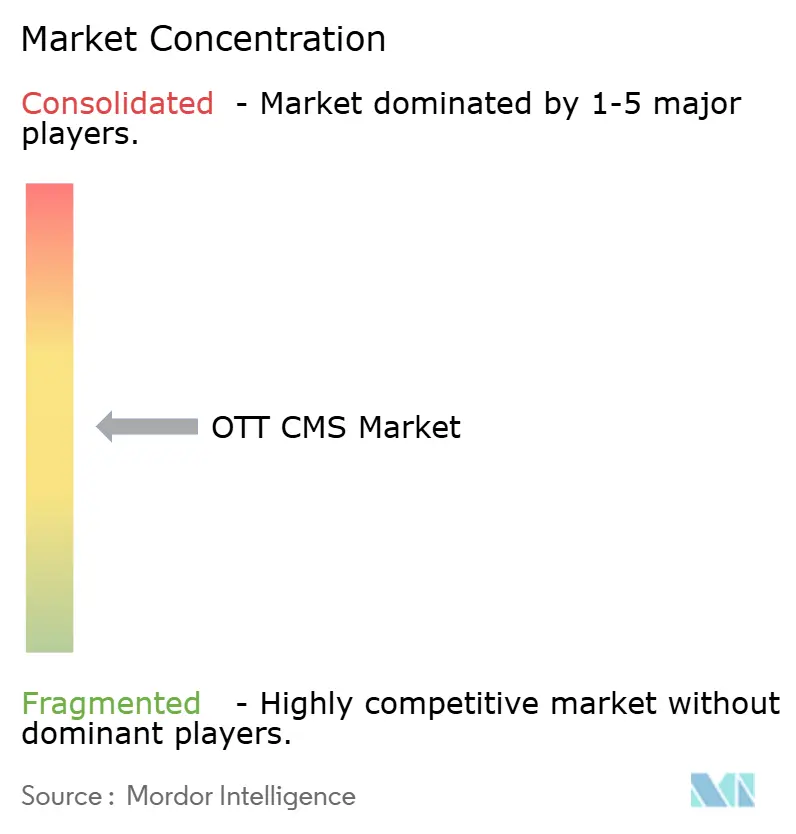
The OTT CMS market is moderately concentrated, with full-suite platforms, specialist DRM suppliers, and video infrastructure providers serving different parts of the delivery process. Consolidation during 2025 and 2026 brought recognized video platforms under common ownership, changing the competitive position of companies that previously operated separately. Bending Spoons completed its acquisition of Vimeo for USD 1.38 billion in November 2025 after acquiring Brightcove. The group can support both brands with shared AI and data resources, although each continues to address distinct customer needs and product contexts. This arrangement strengthens its presence in media, enterprise video, and self-service publishing while increasing the importance of differentiation for independent vendors.
Kaltura and Wowza are differentiating through open platform connections and AI-supported workflows. In April 2026, Kaltura announced native integrations with Adobe Experience Manager, WordPress, and Drupal, allowing organizations to embed its video capabilities into existing digital properties. In April 2026, Wowza launched a framework for real-time AI metadata, clips, alerts, and event signals from live streams. These moves address the growing demand for connected publishing, live-event processing, and faster content decisions. The OTT Content Management System (CMS) market continues to reward vendors that can add functions without requiring a full migration.
Rights automation, agentic media operations, and accessible tools for smaller operators remain areas of active competition. Platforms need to coordinate rights across territories and monetization models without interrupting established publishing systems. BuyDRM and EZDRM address specialized rights and license needs, although their scope is narrower than a full CMS suite. Common Encryption under ISO/IEC 23001 and W3C Encrypted Media Extensions provide a technical basis for interoperable DRM modules. Vendors that combine standards-based protection with forensic watermarking and session-level monitoring can address more demanding rights requirements. MediaKind's June 2026 merger with Harmonic's video business created an independent video infrastructure entity with more than USD 250 million in combined annual revenue.
OTT CMS Industry Leaders
Brightcove Inc.
Kaltura, Inc.
Vimeo, Inc.
JW Player, Inc.
Quickplay Media, Inc.
- *Disclaimer: Major Players sorted in no particular order
OTT CMS Market Companies Covered in this Report
- Brightcove Inc.
- Kaltura, Inc.
- Vimeo, Inc.
- JW Player, Inc.
- Wowza Media Systems, LLC
- Muvi LLC
- Dacast, Inc.
- Zype, Inc.
- Uscreen, Inc.
- Quickplay Media, Inc.
- Contus Tech
- Bitmovin Inc.
- Akamai Technologies, Inc.
- Cloudflare, Inc.
- Vbrick Systems, Inc.
- Panopto, Inc.
- Wistia, Inc.
- Haivision Systems Inc.
- Axinom GmbH
- BuyDRM, Inc.
- EZDRM LLC

Recent Industry Developments in OTT CMS Market
- July 2026: Mediagenix announced new agentic AI capabilities for trusted workflow automation across title management, planning, and scheduling, powered by its Semantic Intelligence layer that connects content, metadata, rights, audience data, and monetization intelligence.
- June 2026: Harmonic Inc. completed the USD 145 million cash sale of its Video Business to MediaKind, creating an independent video infrastructure entity with more than USD 250 million in combined annual revenue and more than USD 100 million in annual recurring revenue.
- May 2026: Brightcove launched Prism, a fully redesigned platform interface developed with input from over 100 customers, intended to simplify daily CMS workflows and create consistent navigation across platform modules.
- April 2026: Wowza Media Systems launched the Wowza Video Intelligence Framework with general availability, enabling media and sports organizations to generate real-time AI metadata, clips, alerts, and machine-readable event signals within live streaming workflows.


Global OTT CMS Market Report Scope
OTT CMS Market refers to the ecosystem of software platforms that help OTT providers manage, organize, publish, and monetize streaming content across devices and channels. It acts as the control layer behind OTT services, handling content ingestion, metadata, scheduling, user access, and distribution.
The OTT CMS Market Report is Segmented by Deployment (Cloud, On-Premises, and Hybrid), Revenue Model (Subscription Video on Demand (SVOD), Advertising Supported Streaming (AVOD), Transactional and Pay-Per-View (TVOD), Hybrid Monetization, and Freemium), Functionality (Content and Asset Management, Workflow and Publishing Management, Monetization and Business Intelligence, and Rights, Security and Compliance Management), and Geography (North America, Europe, Asia-Pacific, Middle East, Africa, South America). Forecasts are in Value (USD).
| Cloud |
| On-Premises |
| Hybrid |
| Subscription Video on Demand (SVOD) |
| Advertising Supported Streaming (AVOD) |
| Transactional and Pay-Per-View (TVOD) |
| Hybrid Monetization |
| Freemium |
| Content and Asset Management |
| Workflow and Publishing Management |
| Monetization and Business Intelligence |
| Rights, Security and Compliance Management |
| North America | United States |
| Canada | |
| Mexico | |
| Rest of North America | |
| Europe | Germany |
| United Kingdom | |
| France | |
| Russia | |
| Rest of Europe | |
| Asia-Pacific | China |
| Japan | |
| India | |
| South Korea | |
| Australia | |
| Rest of Asia-Pacific | |
| Middle East | Saudi Arabia |
| United Arab Emirates | |
| Turkey | |
| Rest of Middle East | |
| Africa | South Africa |
| Egypt | |
| Nigeria | |
| Rest of Africa | |
| South America | Brazil |
| Argentina | |
| Rest of South America |
| By Deployment | Cloud | |
| On-Premises | ||
| Hybrid | ||
| By Revenue Model | Subscription Video on Demand (SVOD) | |
| Advertising Supported Streaming (AVOD) | ||
| Transactional and Pay-Per-View (TVOD) | ||
| Hybrid Monetization | ||
| Freemium | ||
| By Functionality | Content and Asset Management | |
| Workflow and Publishing Management | ||
| Monetization and Business Intelligence | ||
| Rights, Security and Compliance Management | ||
| By Geography | North America | United States |
| Canada | ||
| Mexico | ||
| Rest of North America | ||
| Europe | Germany | |
| United Kingdom | ||
| France | ||
| Russia | ||
| Rest of Europe | ||
| Asia-Pacific | China | |
| Japan | ||
| India | ||
| South Korea | ||
| Australia | ||
| Rest of Asia-Pacific | ||
| Middle East | Saudi Arabia | |
| United Arab Emirates | ||
| Turkey | ||
| Rest of Middle East | ||
| Africa | South Africa | |
| Egypt | ||
| Nigeria | ||
| Rest of Africa | ||
| South America | Brazil | |
| Argentina | ||
| Rest of South America | ||


Key Questions Answered in the Report
What is the projected size of the OTT CMS market?
The OTT CMS market is expected to reach USD 1.23 billion by 2031 from USD 0.62 billion in 2025, at a 12.40% CAGR over 2026-2031. The forecast reflects continued investment in cloud-based content operations and rights controls.
What is driving demand for OTT CMS platforms?
Cloud workflows, multilingual delivery, live-event streaming, and session-level rights operations are increasing platform requirements. Operators also need one system to coordinate release windows and monetization settings across several services.
Which deployment model leads OTT CMS adoption?
Cloud deployment led with 60.46% share in 2025 because it supports scalable capacity and incremental feature updates. Hybrid environments remain relevant where local processing, legacy technology, or regulatory requirements shape deployment decisions.
Which revenue model is growing fastest in OTT CMS?
AVOD is projected to grow at a 13.11% CAGR through 2031 as services seek advertising revenue and broader audience access. Its workflows require accurate catalog data, advertising rules, and rights settings alongside subscription options.
Which functionality is expected to grow most quickly?
Rights, security, and compliance management is forecast to grow at a 12.96% CAGR from 2026 to 2031. The function supports territory permissions, access controls, security expectations, and more complex content release models.
Which region will grow fastest for OTT CMS platforms?
Asia-Pacific is expected to grow at a 13.22% CAGR through 2031, supported by multilingual publishing needs and high-volume streaming operations. India, China, Japan, Australia, and South Korea each create different requirements for content localization and platform connections.
Page last updated on:





