
OTT Billing Platform Market Size and Share
Market Overview
| Study Period | 2020 - 2031 |
|---|---|
| Market Size (2026) | USD 0.87 Billion |
| Market Size (2031) | USD 1.55 Billion |
| Growth Rate (2026 - 2031) | 12.24 % |
| Fastest Growing Market | Asia-Pacific |
| Largest Market | North America |
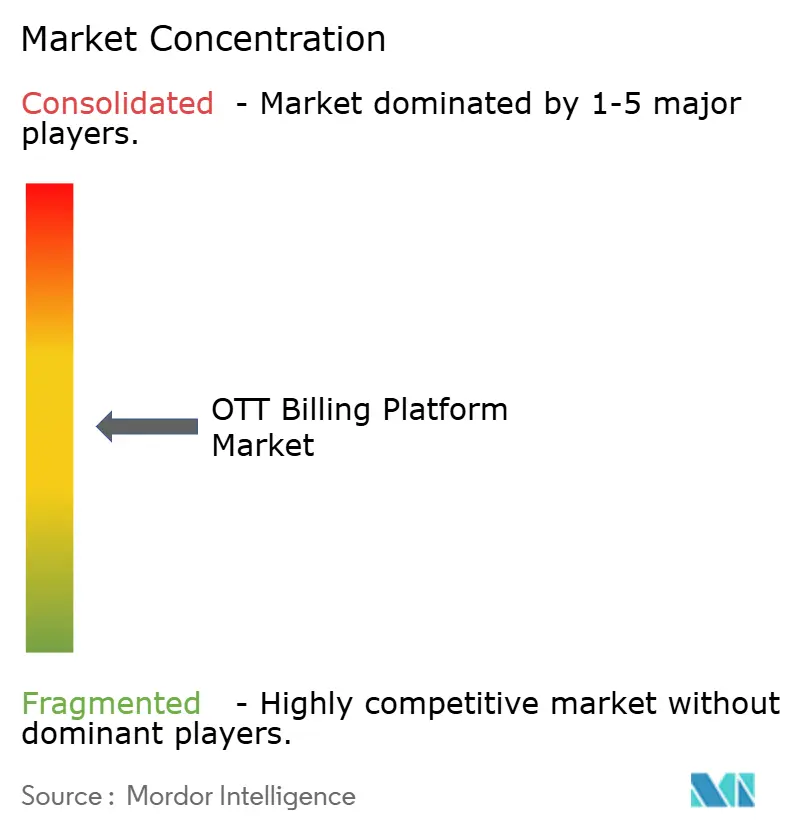
| Market Concentration | Medium |
Major Players *Disclaimer: Major Players sorted in no particular order Image © Mordor Intelligence. Reuse requires attribution under CC BY 4.0. | |
OTT Billing Platform Market Analysis by Mordor Intelligence
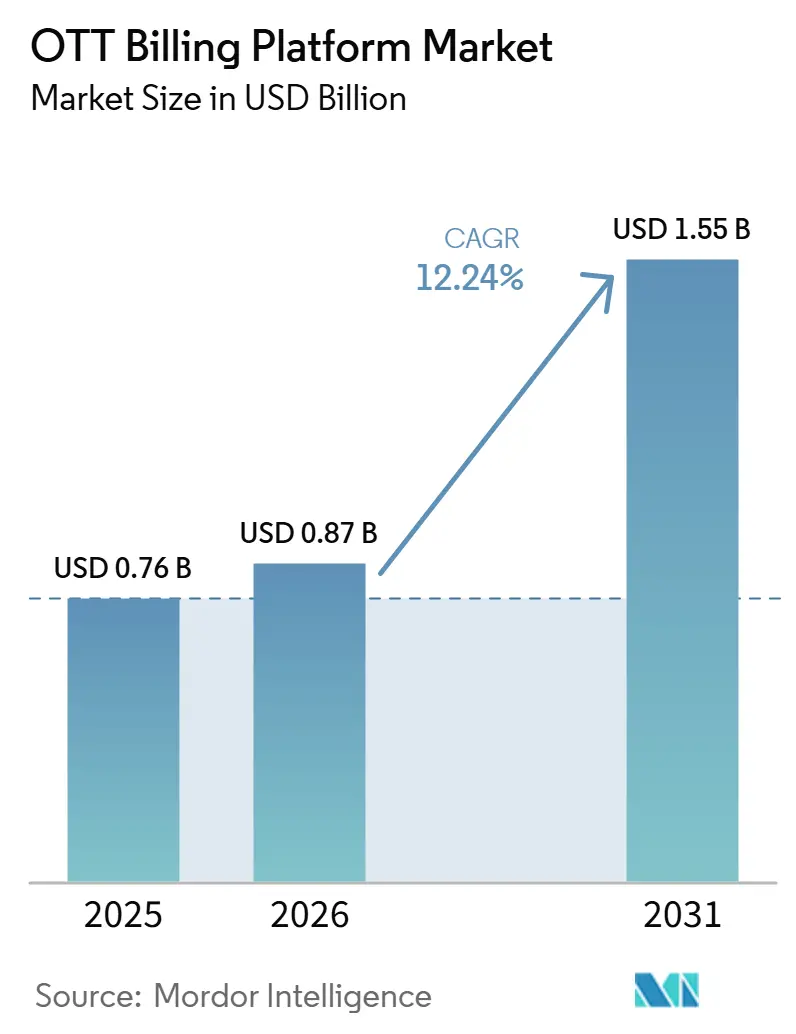
The OTT billing platform market size was valued at USD 0.76 billion in 2025 and is estimated to grow from USD 0.87 billion in 2026 to reach USD 1.55 billion by 2031, at a CAGR of 12.24% during the forecast period (2026-2031). The shift from a single subscription offer to combinations of subscription, advertising-supported, and transactional offers is expanding the number of billing and access decisions that operators must manage. Billing systems now determine whether a viewer can use a service, the offer they receive, and the commercial terms that apply across devices. This change is moving the OTT billing platform market from basic payment processing toward subscriber management, entitlement control, and revenue reconciliation. Operators also need systems that can recognize payment events from direct websites, app stores, connected-TV platforms, and telecom partners, while providing a single record for support teams and straightforward customer follow-up handling across teams. The opportunity is strongest for providers that can support local payment methods, maintain subscriber data quality, reduce operational work, and provide teams with a consistent view when services add new offers or enter new countries.
Key Report Takeaways
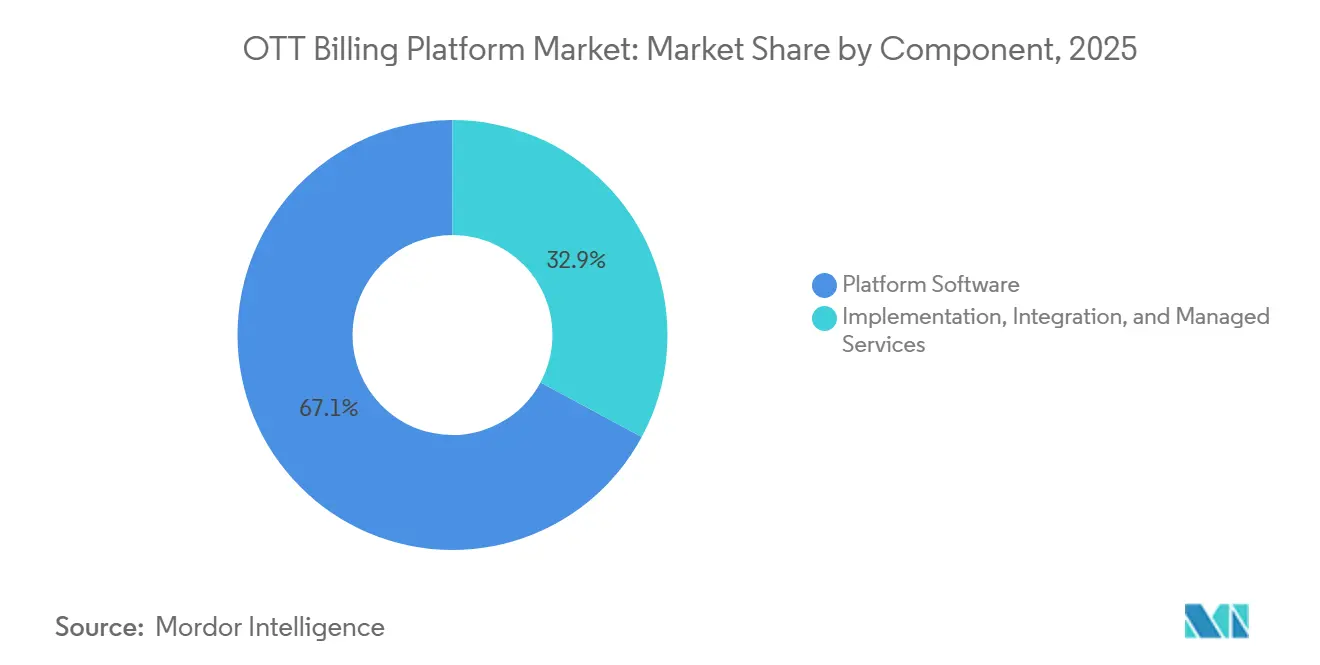
- By component, platform software held 67.13% of the OTT billing platform market share in 2025, while implementation, integration, and managed services are projected to expand at a 12.58% CAGR through 2031.
- By deployment mode, cloud-based systems accounted for 73.48% of the OTT billing platform market share in 2025 and are expected to grow at a 12.51% CAGR through 2031.
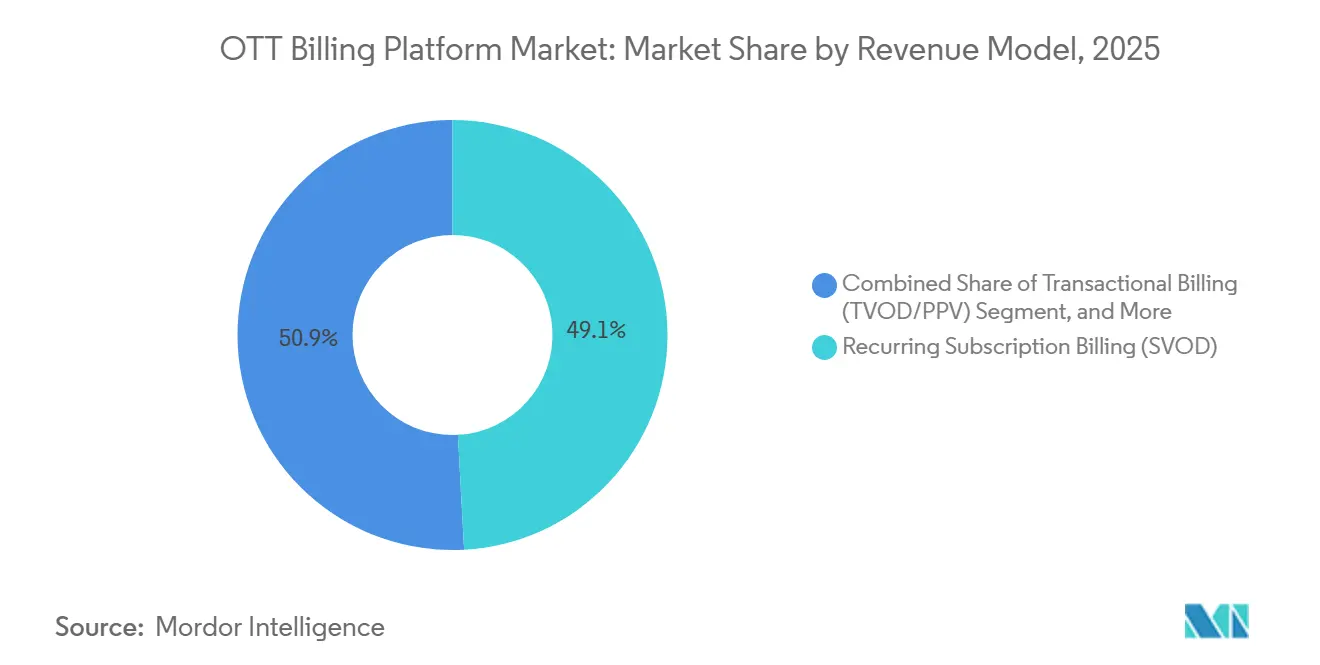
- By revenue model, recurring subscription billing, or SVOD, held 49.14% of the market in 2025, while advertising-supported billing, or AVOD and FAST, is projected to record a 12.34% CAGR through 2031.
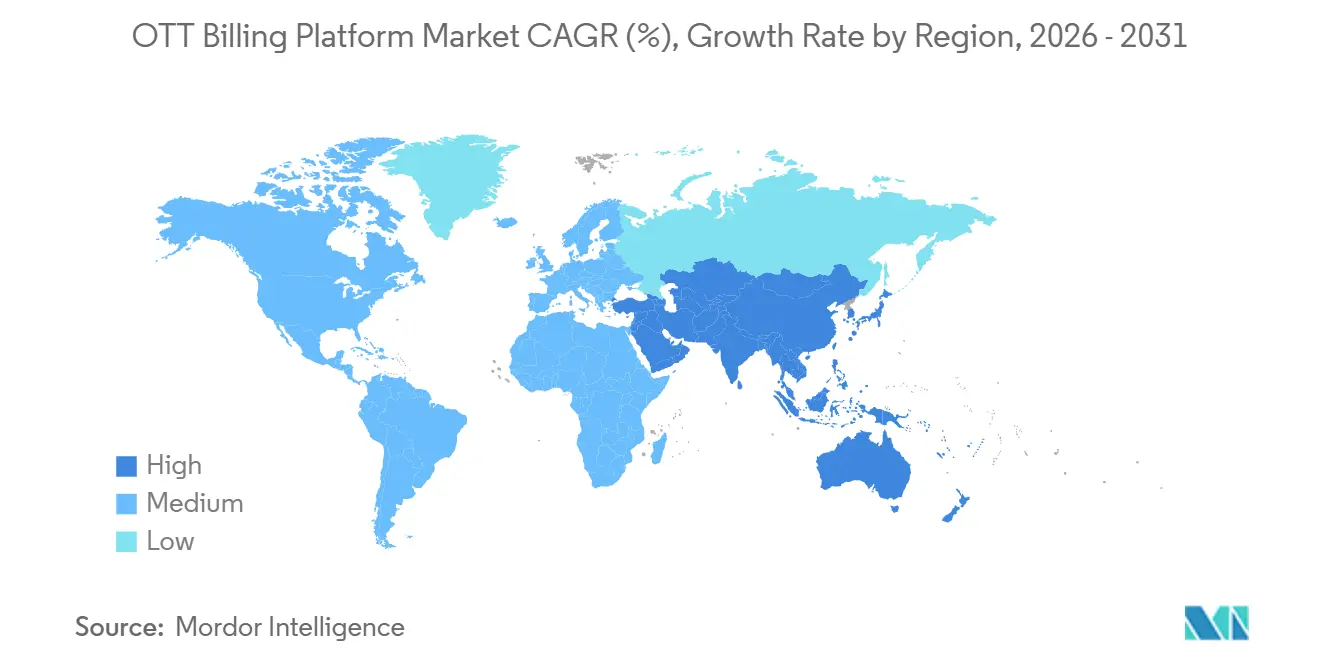
- By geography, North America held 38.67% of the over-the-top (OTT) billing platform market in 2025, while Asia-Pacific is projected to grow at a 12.44% CAGR through 2031.
Note: Market size and forecast figures in this report are generated using Mordor Intelligence’s proprietary estimation framework, updated with the latest available data and insights as of January 2026.
Market Trends and Insights
Drivers Impact Analysis of OTT Billing Platform Market*
| Driver | (~) % Impact on CAGR Forecast | Geographic Relevance | Impact Timeline |
|---|---|---|---|
| Expansion of Hybrid Monetization Models | +2.8% | Global, with faster adoption in Asia-Pacific | Medium term (2-4 years) |
| Rising Cross-Platform Subscription Complexity | +2.3% | North America and Europe, expanding globally | Medium term (2-4 years) |
| Growth of Direct-to-Consumer Streaming Services | +2.0% | Global, with Asia-Pacific leading in volume and North America in average revenue per user | Medium term (2-4 years) |
| Demand for Payment Recovery and Churn Reduction | +1.5% | Global, with North America leading adoption | Short term (≤ 2 years) |
| Real-Time Billing Intelligence Across Territories | +1.0% | Global, with coverage expanding in the Middle East, Africa, and Asia-Pacific | Long term (≥ 4 years) |
| Entitlement-Aware Billing as a Revenue Control Layer | +0.8% | North America and Europe | Long term (≥ 4 years) |
| Source: Mordor Intelligence | |||
Expansion of Hybrid Monetization Models Reshapes Billing Architecture
Hybrid offers are increasing the need for systems that combine subscription, advertising-supported, and transactional billing within a single customer record. A viewer who moves from an ad-supported offer to a paid tier needs an immediate change in access and advertising treatment. A separate transaction for a live event must also work with the viewer’s existing account and device permissions. These workflows make entitlement management central to the OTT billing platform market, rather than a separate operational task. The underlying system must match payment status, offer rules, device access, and content rights without creating conflicting subscriber states. Providers with built-in entitlement functions can therefore address operational needs that basic payment tools do not cover when offers overlap within the same subscriber account.
Rising Cross-Platform Subscription Complexity Increases Reconciliation Needs
Streaming services sell through direct websites, mobile app stores, connected-TV platforms, marketplaces, and telecom bundles. Each channel can report payments, refunds, and subscriber changes on a different schedule and with different levels of detail. This makes it difficult to maintain a single subscriber record without a platform that normalizes incoming data. The OTT billing platform market benefits when operators need to reconcile those channels before finance, customer support, and retention teams can act on the same information. Different renewal notices, commission arrangements, and cancellation steps can also apply by distribution channel. A unified billing layer helps operators limit the backlog of mismatched payment and access records as their subscriber bases grow across direct, partner, and application-based channels.
Growth of Direct-to-Consumer Streaming Services Expands Billing Responsibility
Content owners that sell directly to viewers take responsibility for payments, taxes, refunds, chargebacks, and subscriber communications. That responsibility was often handled by distributors when programming was licensed through a television or telecom bundle. Direct-to-consumer launches, therefore, create demand for billing software that can manage the complete subscriber lifecycle. The over-the-top (OTT) billing platform market also gains from operators that need local payment support and settlement rules as they serve viewers in several countries. These requirements are especially important in mobile-first settings, where a card-based payment flow may not meet consumer preferences. The result is a stronger need for configurable billing operations than for a standard checkout tool alone, particularly when services manage both recurring payments and local settlement.
Demand for Payment Recovery and Churn Reduction Strengthens Platform Value
Failed recurring payments can end a subscription even when the viewer has not chosen to cancel. Operators need payment retry rules that account for the reason a charge failed and the payment method used. This gives billing providers a direct role in retention, not only in transaction processing. Evergent states that its convergent charging and rating platform supports real-time charging, rating, and subscriber management for digital services.[1]Evergent, “Convergent Usage Charging and Rating Platform,” Evergent, evergent.com. Cleeng introduced cross-platform AI agents in April 2026 to work with subscriber information across web, iOS, Android, Roku, and telecom environments. Such capabilities increase the value of the OTT billing platform market for operators seeking better visibility over subscription performance, recovery activity, and subscriber behavior across distribution channels.
Restraints Impact Analysis of OTT Billing Platform Market*
| Restraint | (~) % Impact on CAGR Forecast | Geographic Relevance | Impact Timeline |
|---|---|---|---|
| Integration Complexity With Legacy OSS/BSS and Finance Systems | -1.8% | Global, with the greatest effect in Europe and North America | Long term (≥ 4 years) |
| Fragmented Tax, Auto-Renewal, and Cancellation Requirements | -1.3% | North America and Europe, with added complexity in Asia-Pacific | Medium term (2-4 years) |
| Data Quality Gaps Across App Stores, Payment Gateways, and Devices | -0.9% | Global, with the highest fragmentation in Asia-Pacific | Medium term (2-4 years) |
| High Cost of Migration From Bespoke Billing Stacks | -0.6% | North America and Europe | Long term (≥ 4 years) |
| Source: Mordor Intelligence | |||
Integration Complexity With Legacy OSS/BSS and Finance Systems Extends Migration Timelines
Incumbent telecom and media operators often use billing environments that were customized over many years. Their order management, network provisioning, finance, and customer records can be closely connected to older systems. Replacing one part of that environment requires careful data transfer and ongoing invoice checks. This slows adoption in the OTT billing platform market, particularly when an operator supports both OTT and IPTV services. A parallel operating period may be needed to validate subscriber balances and access rights before a full transition. The burden favors vendors that can integrate with established systems, support staged testing, and provide services during migration without disrupting existing billing operations.
Fragmented Tax, Renewal, and Cancellation Requirements Increase Compliance Work
Subscription rules can vary across jurisdictions, payment channels, and consumer protection frameworks. Operators must configure renewal notices, consent records, refund steps, and cancellation paths for the locations they serve. These requirements are not always consistent between countries or between national and local rules. The OTT billing platform market faces additional implementation work because each configuration must also integrate with the operator’s offers and customer support processes. Smaller direct-to-consumer services can find it difficult to manage this work internally. Providers that offer configurable controls can help reduce the effort required to adapt billing workflows while preserving clear records of consent, refunds, and cancellations.
*Our forecasts treat driver/restraint impacts as directional, not additive. The impact forecasts reflect baseline growth, mix effects, and variable interactions.
OTT Billing Platform Market Segment Analysis
By Component:
Platform Software Leads While Services Support Complex DeploymentsPlatform software accounted for 67.13% of the OTT billing platform market in 2025. This position in the OTT billing platform market reflects the central role of transaction processing, subscriber records, offer configuration, and entitlement management in streaming operations. Operators use the software layer to connect payments with customer access across websites, applications, connected-TV devices, and other distribution channels. It also supports pricing changes, promotional offers, tax settings, refund handling, and the recordkeeping needed by finance and support teams.
Implementation, integration, and managed services are projected to grow at a 12.58% CAGR through 2031. Operators need specialized support when they introduce monetization models, connect billing to older subscriber systems, or coordinate data across application stores and direct channels. Managed services can also help with payment operations, local tax settings, exception handling, and ongoing configuration changes. Mid-sized direct-to-consumer providers may prefer external support when they lack large billing engineering teams. This pattern creates room for specialist vendors that understand streaming entitlements and reconciliation, making services an important complement to the software segment in the OTT billing platform industry.



By Deployment Mode:
Cloud-Based Systems Become the Preferred ArchitectureCloud-based systems held 73.48% of the OTT billing platform market in 2025. Their lead reflects the need to process a large number of payments, offer changes, and access updates without relying on batch processing. Cloud delivery allows operators to scale processing capacity when a major event or content release increases subscriber activity. Within the OTT billing platform market, it can also support geographic redundancy, more frequent product updates, and common controls across services spanning multiple tiers and markets.
Cloud-based systems are also projected to grow at a 12.51% CAGR through 2031. Amdocs states that its real-time billing offering supports cloud-native deployment and real-time charging for communications service providers.[2]Amdocs, “Amdocs Real-Time Billing,” Amdocs, amdocs.com. On-premises systems remain relevant where data residency requirements, local infrastructure rules, or deep customization make replacement difficult. However, cloud-based tools are better placed to support continuous updates, fast service changes, and the security and compliance reviews required by large streaming operators.
By Revenue Model:
SVOD Holds the Largest Base While AVOD and FAST AdvanceRecurring subscription billing, or SVOD, held 49.14% of the OTT billing platform market in 2025. It remains the core workflow for many streaming services because it supports recurring charges, account changes, trials, renewal communications, payment recovery, and customer status changes. Its established position means that many billing tools were initially built around subscription schedules and recurring card payments. SVOD will continue to serve as the main installed base for vendors and the starting point for platforms that later add additional monetization options.
Advertising-supported billing, including AVOD and FAST, is projected to grow at a 12.34% CAGR through 2031. These models require connections between viewer status, advertising delivery, and content-level revenue tracking. Transactional billing for pay-per-view content remains relevant for premium live events and specific sports rights windows. In the over-the-top (OTT) billing platform market, hybrid monetization combines these approaches, increasing the number of rules a platform must manage within a single viewer account. The OTT billing platform market is moving toward systems that run several commercial models without separate billing processes for each new offer.
Geography Analysis
North America OTT Billing Platform Market
North America held 38.67% of the OTT billing platform market in 2025. The region has a large base of services that use direct subscriptions, app store distribution, and connected TV payment channels. This creates an ongoing need to reconcile subscriber and payment information across multiple platforms. Operators also use pricing changes, bundles, and advertising-supported offers to manage established subscription bases. These conditions favor billing systems that can coordinate promotions, offer eligibility, and customer communications.
APAC OTT Billing Platform Market
Asia-Pacific is projected to record the fastest growth at a 12.44% CAGR through 2031. The region includes markets with different payment preferences, currencies, languages, and mobile usage patterns. That diversity raises the value of localized checkout, settlement, and entitlement functions. Japan illustrates the demand for local subscription infrastructure, with Hitachi Solutions expanding BSS Symphony in January 2026 to include multi-service consolidated billing and flexible receivables management.[3]Hitachi Solutions, “BSSsymphony Subscription Platform Service Enhancement,” Hitachi Solutions, hitachi-solutions.co.jp. The Asia Video Industry Association identified China, Japan, Australia, South Korea, and India as leading contributors to regional online video revenue in its 2026 report.
EMEA and South America OTT Billing Platform Market
Europe requires billing configurations that can accommodate varied consumer and subscription rules. South America is gaining relevance as operators introduce recurring payment options adapted to local banking behavior. Globoplay added Pix Automático as a payment option in June 2025, demonstrating the use of recurring local payment methods for streaming services. The Middle East and Africa present earlier-stage demand, where localized payment support, mobile use, and carrier billing can shape deployment choices. Across these regions, the over-the-top (OTT) billing platform market is supported by providers that can adapt to local commercial, payment, language, and subscriber support conditions.

Competitive Landscape
The OTT billing platform market includes specialist streaming providers, enterprise subscription management vendors, and payment infrastructure companies. Cleeng, Vindicia, Recurly, Zuora, Chargebee, Salesforce, Oracle, Amdocs, Evergent, and Aria Systems compete through different combinations of billing, payments, subscriber management, and entitlement capabilities. The market is moderately fragmented because no single vendor controls the entire streaming monetization stack. Buyers assess functional fit, integration capacity, geographic coverage, and support for existing systems. Standards for telecom interoperability can also influence procurement decisions, as operators connect new platforms to established billing environments. This makes product capability and implementation capacity as important as price.
Zuora launched its AI Monetization Suite in June 2026 with Metered Entitlements, Flexible Commitments, and an AI Pricing Simulator.[4]Zuora, “Zuora Launches AI Monetization Suite to Turn AI Products Into Revenue,” Zuora, zuora.com. The release extended its tools for pricing, commitments, and entitlement configuration beyond conventional subscription plans. Aria Systems launched Allegro ACE in June 2026 as an adaptive charging engine for real-time authorization and balance management before usage is billed. These moves show that vendors are competing on real-time decision-making as well as on recurring invoice generation. Providers that combine charging, access control, and flexible offer design can address more complex digital-service requirements. The same capabilities can be applied in streaming when operators manage high volumes of concurrent usage and changing access rights.
Cleeng deployed its Subscriber Retention Management platform for PDC TV in April 2026, supporting localized payments, multiple currencies, and integrated tax compliance for an international streaming rollout. The company also supported VBTV’s use of Pix Automático for Brazilian subscribers in February 2026 through its platform and payment partners. These deployments show how specialist providers can compete by leveraging local payment processing and subscriber operations. Larger enterprise vendors retain an advantage where customers require broad integrations and support across several business lines. Smaller providers can differentiate through streaming-specific entitlement design and managed services. The OTT billing platform market will remain contested as vendors seek to combine local execution with scalable product capabilities.
OTT Billing Platform Industry Leaders
Zuora, Inc.
Cleeng B.V.
Recurly, Inc.
Brightcove Inc.
Kaltura, Inc.
- *Disclaimer: Major Players sorted in no particular order
OTT Billing Platform Market Companies Covered in this Report
- Zuora, Inc.
- Salesforce, Inc.
- SAP SE
- Oracle Corporation
- Recurly, Inc.
- Stripe, Inc.
- Chargebee Inc.
- Cleeng B.V.
- Vindicia, Inc.
- Brightcove Inc.
- Kaltura, Inc.
- Aria Systems
- JW Player
- Muvi LLC
- Endeavor Streaming, LLC
- Amdocs
- CRM.COM
- Evergent Technologies
- Synamedia Limited
- Setplex LLC
- FastSpring, Inc.
- Paddle.com Market Limited

Recent Industry Developments in OTT Billing Platform Market
- July 2026: Recurly and Juspay announced a strategic partnership integrating Juspay's Hyperswitch open-source payment orchestration platform into the Recurly subscription management ecosystem. The integration gives Recurly merchants access to over 300 global payment service providers and acquirers through a single connection, expanding Recurly's coverage for OTT operators seeking multi-region payment support without rebuilding existing payment infrastructure.
- July 2026: Synamedia announced the completion of its Video Network business divestiture to Lumine Group and the appointment of Dr. Tzvi Gerstl as CEO, succeeding Paul Segre, who transitioned to executive chairman. The divestiture narrows Synamedia's focus toward streaming monetization and viewer engagement through its Quortex, Synamedia Go, and OpenMO portfolio, concentrating its product direction on direct-to-consumer services and monetization capabilities.
- June 2026: Zuora launched its AI Monetization Suite, including the AI Pricing Simulator for testing pricing models and revenue impact before launch, Metered Entitlements for configuring usage-based billing for AI products, and Flexible Commitments for structuring committed-spend agreements. The launch positions Zuora's billing infrastructure as a commercial layer for AI product monetization beyond traditional subscription workflows.
- June 2026: Aria Systems launched Allegro ACE, an Adaptive Charging Engine that validates customer entitlement before usage and charges in milliseconds. The system is designed for streaming operators managing high-volume concurrent usage events and requiring pre-committed billing authorization.


Global OTT Billing Platform Market Report Scope
The OTT Billing Platform Market comprises software platforms and related services that enable over-the-top (OTT) media and entertainment providers to manage subscriber billing, payment processing, revenue collection, invoicing, taxation, and monetization across digital streaming services. These platforms support the complete billing lifecycle, including customer account management, subscription administration, pricing configuration, payment gateway integration, recurring invoicing, transaction processing, revenue recognition, and analytics, allowing OTT providers to efficiently monetize video, audio, gaming, and other digital content delivered over the internet.
The OTT Billing Platform Market Report is Segmented by Component (Platform Software and Implementation, Integration, and Managed Services), Deployment Mode (Cloud-Based and On-Premises), Revenue Model (Recurring Subscription Billing (SVOD), Transactional Billing (TVOD/PPV), Advertising-Supported Billing (AVOD/FAST), and Hybrid Monetization Billing), and Geography (North America, South America, Europe, Asia-Pacific, Middle East, and Africa). The Market Forecasts are Provided in Terms of Value (USD).
| Platform Software |
| Implementation, Integration, and Managed Services |
| Cloud-Based |
| On-Premises |
| Recurring Subscription Billing (SVOD) |
| Transactional Billing (TVOD/PPV) |
| Advertising-Supported Billing (AVOD/FAST) |
| Hybrid Monetization Billing |
| North America | United States |
| Canada | |
| Mexico | |
| South America | Brazil |
| Argentina | |
| Rest of South America | |
| Europe | United Kingdom |
| Germany | |
| France | |
| Italy | |
| Spain | |
| Russia | |
| Rest of Europe | |
| Asia-Pacific | China |
| India | |
| Japan | |
| South Korea | |
| Australia | |
| Rest of Asia-Pacific | |
| Middle East | Saudi Arabia |
| United Arab Emirates | |
| Turkey | |
| Israel | |
| Rest of Middle East | |
| Africa | South Africa |
| Nigeria | |
| Kenya | |
| Rest of Africa |
| By Component | Platform Software | |
| Implementation, Integration, and Managed Services | ||
| By Deployment Mode | Cloud-Based | |
| On-Premises | ||
| By Revenue Model | Recurring Subscription Billing (SVOD) | |
| Transactional Billing (TVOD/PPV) | ||
| Advertising-Supported Billing (AVOD/FAST) | ||
| Hybrid Monetization Billing | ||
| By Geography | North America | United States |
| Canada | ||
| Mexico | ||
| South America | Brazil | |
| Argentina | ||
| Rest of South America | ||
| Europe | United Kingdom | |
| Germany | ||
| France | ||
| Italy | ||
| Spain | ||
| Russia | ||
| Rest of Europe | ||
| Asia-Pacific | China | |
| India | ||
| Japan | ||
| South Korea | ||
| Australia | ||
| Rest of Asia-Pacific | ||
| Middle East | Saudi Arabia | |
| United Arab Emirates | ||
| Turkey | ||
| Israel | ||
| Rest of Middle East | ||
| Africa | South Africa | |
| Nigeria | ||
| Kenya | ||
| Rest of Africa | ||


Key Questions Answered in the Report
What is the 2026 size of the OTT billing platform market?
The OTT billing platform market is estimated at USD 0.87 billion in 2026 and is forecast to reach USD 1.55 billion by 2031 at a 12.24% CAGR.
What is driving demand for OTT billing platforms?
Hybrid subscription, advertising-supported, and transactional offers increase the need to manage payments, access rights, and subscriber records in one environment across websites, apps, and connected-TV platforms.
Which component held the largest share in 2025?
Platform software led with 67.13% in 2025 because operators rely on it for billing, customer records, offer management, and entitlements.
Why are cloud-based billing systems preferred?
Cloud-based systems held 73.48% in 2025 and can support scalable payment processing, real-time updates, and faster service changes.
Which revenue model is growing fastest for OTT billing providers?
Advertising-supported billing, including AVOD and FAST, is projected to grow at a 12.34% CAGR through 2031.
Which region is expected to grow fastest through 2031?
Asia-Pacific is expected to record a 12.44% CAGR through 2031 because operators need localized payments, settlement, and mobile-first billing functions.
Page last updated on:





