
OTT Anime Market Size and Share
Market Overview
| Study Period | 2020 - 2031 |
|---|---|
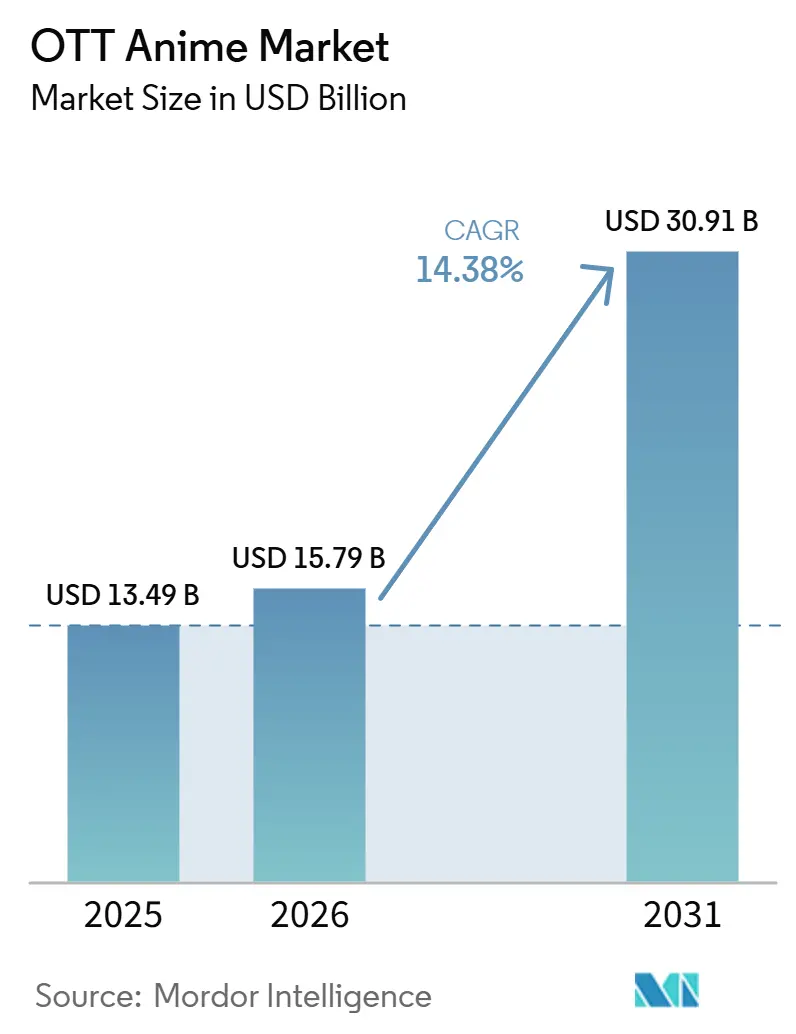
| Market Size (2026) | USD 15.79 Billion |
| Market Size (2031) | USD 30.91 Billion |
| Growth Rate (2026 - 2031) | 14.38 % |
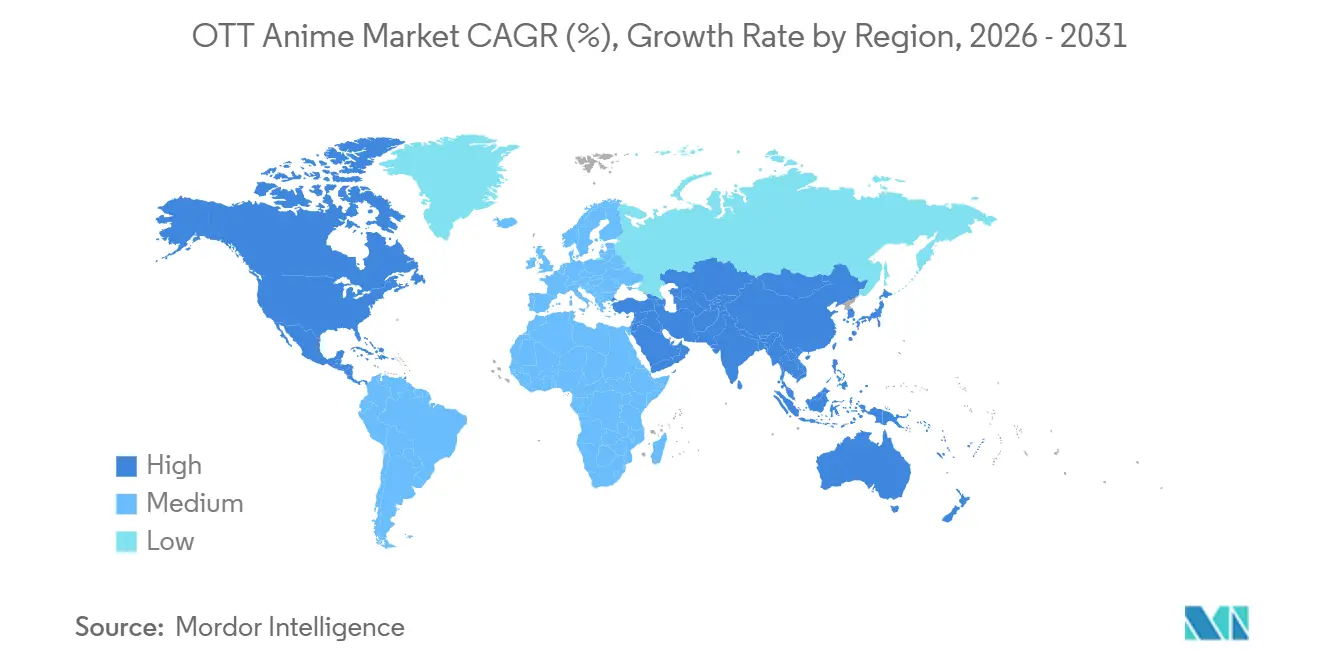
| Fastest Growing Market | Asia-Pacific |
| Largest Market | North America |
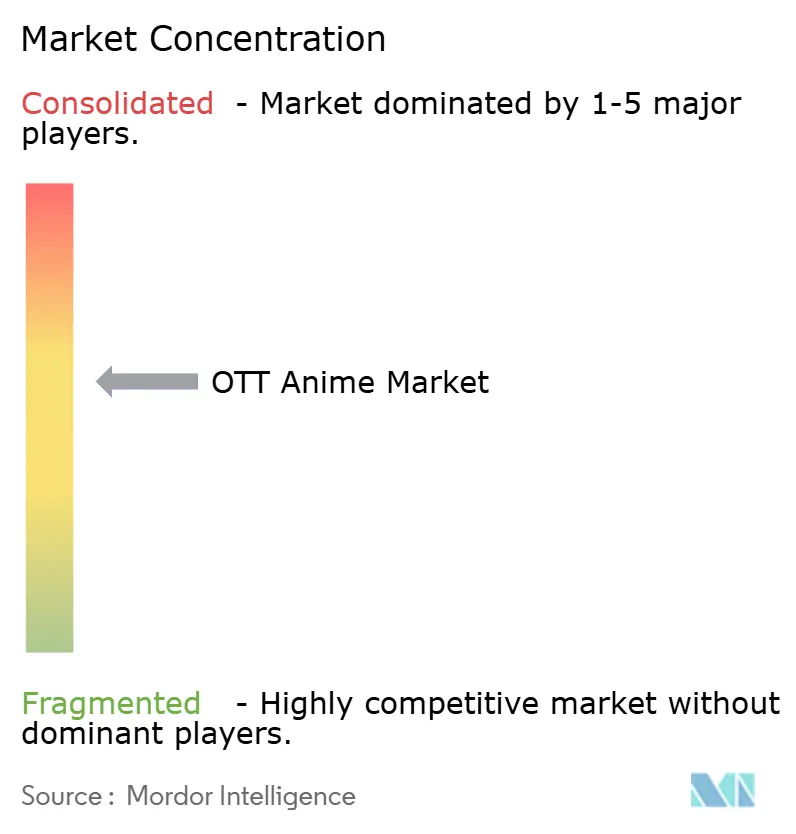
| Market Concentration | Medium |
Major Players *Disclaimer: Major Players sorted in no particular order Image © Mordor Intelligence. Reuse requires attribution under CC BY 4.0. | |
OTT Anime Market Analysis by Mordor Intelligence
The OTT anime market size was valued at USD 13.49 billion in 2025 and is forecast to reach USD 30.91 billion by 2031 at a CAGR of 14.38% during 2026-2031. The market is expanding because anime viewing has moved further from staggered national releases and physical media toward globally available streaming libraries, faster release windows, and platform-led discovery. International demand is now shaping the economics of the category more directly, as overseas anime revenue in Japan exceeded JPY 2.1702 trillion (USD 14.49 billion) in 2024 and became a larger commercial force for content owners. At the same time, wider language support, more dubbing capacity, and faster subtitle delivery are becoming basic operating requirements for scale rather than premium add-ons. Rising production and licensing costs are also changing competition, which favors companies that can combine platform reach, franchise ownership, and direct studio relationships inside the OTT anime market. Legal free-access channels, price-tiered subscriptions, and regional bundles are creating room for broader audience conversion, especially where mobile viewing is strong but subscription spending remains uneven.
Key Report Takeaways
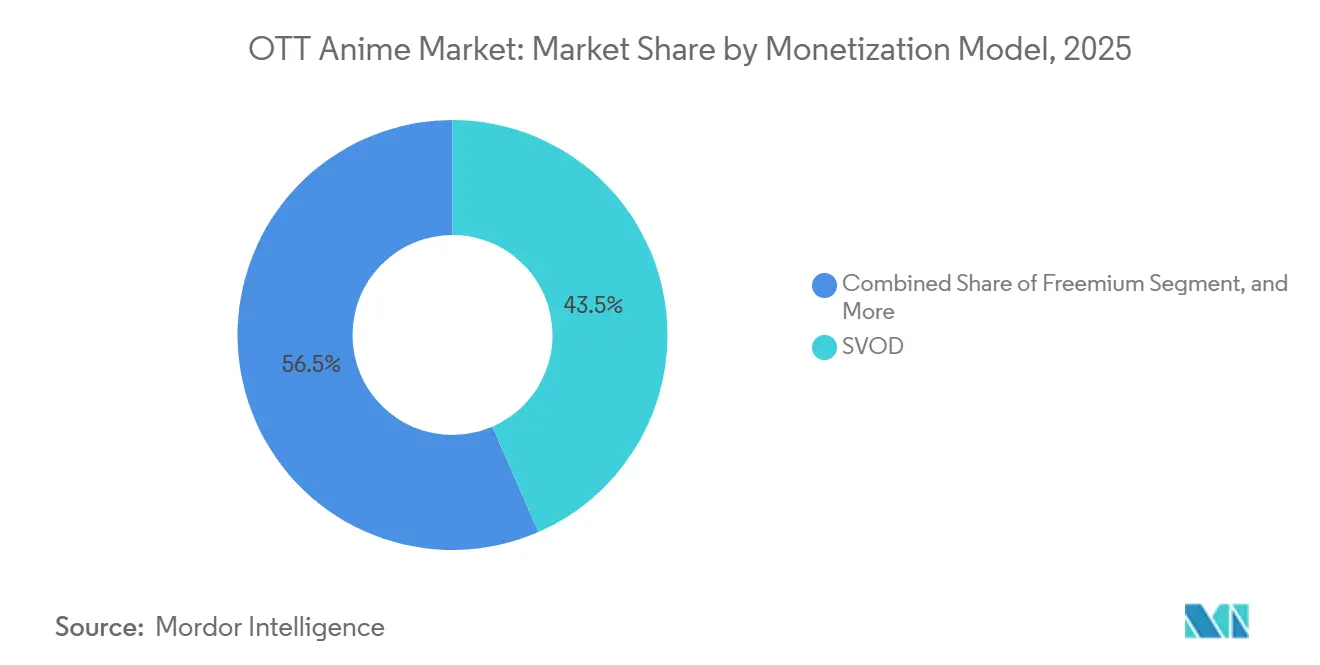
- By monetization model, SVOD held 43.46% of OTT anime market share in 2025, while Freemium is projected to expand at a 14.90% CAGR through 2031.
- By genre, Action and Adventure accounted for 34.37% in 2025, while Fantasy is projected to grow at a 15.80% CAGR through 2031.
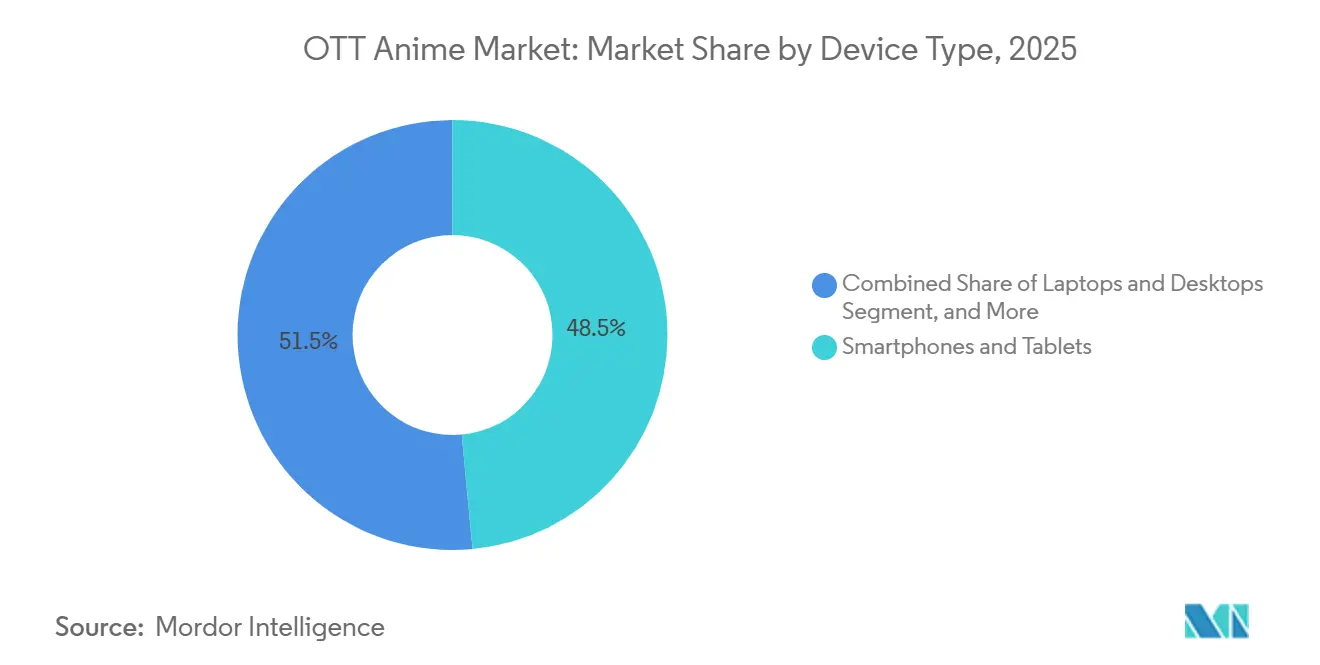
- By device type, Smartphones and Tablets represented 48.52% in 2025, while Smart TVs are projected to advance at a 15.16% CAGR through 2031.
- By viewer age group, Young Adults and Seniors held 58.62% in 2025, while Children and Teens are projected to expand at a 15.88% CAGR through 2031.
- By geography, Asia-Pacific held 40.42% of OTT anime market share in 2025, while North America is projected to grow at a 16.11% CAGR through 2031.
Note: Market size and forecast figures in this report are generated using Mordor Intelligence’s proprietary estimation framework, updated with the latest available data and insights as of January 2026.
Market Trends and Insights
Drivers Impact Analysis of OTT Anime Market*
| Driver | (~) % Impact on CAGR Forecast | Geographic Relevance | Impact Timeline |
|---|---|---|---|
| Rise of Mobile-First Anime Consumption | +3.8% | Global, highest concentration in Asia-Pacific and South America | Short term (≤ 2 years) |
| Expansion of Simulcast and Same-Day Localization | +2.9% | Global, with early gains in North America, Europe, and Southeast Asia | Short term (≤ 2 years) |
| Bundling of Anime Within Premium Streaming Subscriptions | +2.1% | North America, Europe, and East Asia | Medium term (2-4 years) |
| Growth of Franchise-Driven Global Fandom and Merchandise Flywheels | +1.8% | Global, highest in Asia-Pacific and North America | Long term (≥ 4 years) |
| Advertising-Supported Anime Catalog Expansion | +1.2% | North America, Southeast Asia, and South America | Medium term (2-4 years) |
| AI-Assisted Localization and Subtitle Workflow Scaling | +0.9% | Global, with emerging spillover into Middle East and Africa and South America | Medium term (2-4 years) |
| Source: Mordor Intelligence | |||
Rise Of Mobile-First Anime Consumption
Mobile viewing has become a default access point in many high-growth territories, so the OTT anime market is increasingly being shaped by handset habits rather than fixed-screen viewing patterns. Crunchyroll said its India localization rollout covered more than 900 titles and over 180 dubbed series in Hindi, Tamil, and Telugu, and that this effort tripled platform watch time while dubbed titles generated more than 65% of viewing on the service.[1]Patrick Frater, “Crunchyroll to Expand into Taiwan and Korea,” Variety, variety.com The same localized approach also produced a fourfold rise in viewership in Thailand after launch, which showed that language access and mobile availability can unlock demand quickly in fandom-heavy markets. In practical terms, anime already fits mobile behavior well because short episodic formats, serialized storytelling, and repeat viewing patterns sit comfortably inside app-based streaming habits. Japan’s domestic SVOD market reached JPY 601.7 billion (USD 4.02 billion) in 2025 after 14.3% growth, and anime was identified as the most watched genre among Japanese SVOD subscribers, which reinforces the wider link between streaming intensity and anime demand in the OTT anime market.
Expansion of Simulcast and Same-Day Localization
International same-day availability has become a baseline expectation, and the OTT anime market now rewards platforms that can close the gap between Japanese broadcast and global release. Netflix’s anime leadership in Japan said the platform’s goal is to distribute titles across 190 countries without a time lag, and that work is being done in partnership with studios including MAPPA. Crunchyroll also used same-day English dubbing for Gachiakuta in July 2026, which showed that localization speed itself is becoming part of subscriber acquisition and retention strategy rather than only a back-end operating process.[2]Anime News Network, “Gachiakuta TV Anime Gets Same-Day English Dub on July 6,” Anime News Network, animenewsnetwork.com As this standard spreads, Japanese rights holders gain stronger pricing power because delay-sensitive platforms are less willing to accept slower exclusivity windows or incomplete territory coverage. This shift also helps the OTT anime market defend legal viewing, because faster localized release reduces the period in which unauthorized versions can dominate fan attention.
Bundling of Anime Within Premium Streaming Subscriptions
Anime has become a stronger subscription decision factor, which means the OTT anime market is now influencing wider streaming bundle design rather than sitting at the edge of premium catalogs. Dentsu’s 2025 cross-country study found that anime is a key consideration in streaming subscription choices, and anime fans subscribe to nearly twice as many streaming services as non-anime viewers. In South Korea, Disney+, TVING, and Wavve launched the 3 PACK bundle in November 2025 at KRW 21,500 per month (USD 14.66), which represented savings of up to 37% against separate plans and marked the country’s first tri-platform streaming bundle. Bundling matters because anime-driven subscribers often move into other content categories after joining, so the retention value reaches beyond animation and improves the economics of the whole package. For that reason, the OTT anime market is becoming more important inside mainstream subscription planning, especially where platforms want to reduce churn without relying only on flagship live-action releases.
Growth Of Franchise-Driven Global Fandom and Merchandise Flywheels
Large anime franchises now operate as multi-layer revenue systems, so the OTT anime market is being supported not only by streaming demand but also by licensing, merchandise, games, and theatrical tie-ins. Licensing International’s 2026 study said the Character and Entertainment category reached USD 161.8 billion in retail sales, and anime, video games, comics, and related properties accounted for 34% of licensing revenues within that category.[3]Licensing International, “Licensing International’s 2026 Global Study Shows Licensing Industry’s Continued Growth Reaching 389.8 Billion in Sales,” Licensing Magazine, licensingmagazine.com Netflix also reported that global anime views reached 1.5 billion in 2025, up from 1 billion in 2023, which shows that powerful catalog titles continue to draw very large repeat audiences over time. Sony strengthened this flywheel further through its stake in KADOKAWA and its linked control over distribution and production assets, which shows how ownership of IP pathways is becoming central to competition. As a result, the OTT anime market increasingly rewards franchises that can sustain audience engagement across multiple commercial windows instead of relying only on first-run streaming performance.
Restraints Impact Analysis of OTT Anime Market*
| Restraint | (~) % Impact on CAGR Forecast | Geographic Relevance | Impact Timeline |
|---|---|---|---|
| Fragmented Global Licensing and Territorial Exclusivity | -1.4% | Global, most acute in Europe, Middle East, and Southeast Asia | Long term (≥ 4 years) |
| Rising Content Acquisition Costs for Premium Anime Rights | -1.1% | Global, most pronounced in North America and Europe | Medium term (2-4 years) |
| Piracy and Unauthorized Fan Distribution | -0.8% | Asia-Pacific, South America, and Middle East and Africa | Long term (≥ 4 years) |
| Overdependence on a Few High-Performing Titles and Studios | -0.6% | Global, primarily affecting platforms in North America and Europe | Medium term (2-4 years) |
| Source: Mordor Intelligence | |||
Fragmented Global Licensing and Territorial Exclusivity
Territorial fragmentation remains a structural weakness because the OTT anime market still works through a rights system in which simulcast, subscription, ad-supported, dubbing, and home video rights are often split across geographies and owners. Vulture reported that traditional licensing routes through sub-agents and territory aggregators can add several months to deal timelines and lift fees by 15% to 20%, which creates clear disadvantages for services without direct studio relationships in Japan. This problem is most visible in Europe, the Middle East, and Southeast Asia, where fans may find only partial franchise availability across multiple services or formats in the same country. Even when platform demand is strong, incomplete catalogs weaken retention because core viewers often want continuity across seasons, films, and dubbed editions rather than a single title window. Until more of these rights move into broader packages, the OTT anime market will continue to face friction between audience demand and legal access.
Rising Content Acquisition Costs for Premium Anime Rights
Content inflation is another important restraint because the OTT anime market is now competing for premium catalog and simulcast rights under tighter cost conditions. Nikkei Asia reported that anime production costs have risen by more than 50% over the past several years as global viewership and platform competition increased. This cost pressure becomes heavier when subtitle and dubbing rights are handled separately, since major language versions such as English, Spanish, and French add extra cost layers that regional services cannot absorb as easily as global players. Platforms with direct production stakes or stronger balance sheets can spread those costs across a wider audience base, while smaller services remain dependent on third-party deals at prevailing market rates. That imbalance favors scale inside the OTT anime market and makes it harder for independent regional operators to compete for top-tier titles on equal terms.
*Our forecasts treat driver/restraint impacts as directional, not additive. The impact forecasts reflect baseline growth, mix effects, and variable interactions.
OTT Anime Market Segment Analysis
By Monetization Model:
SVOD Anchors Revenue as Freemium Scales Entry FunnelSVOD held 43.46% in 2025, which made it the largest monetization base within the OTT anime market and the main revenue anchor for premium services. Crunchyroll had surpassed 21 million paid subscribers by May 2026 after reaching 17 million in 2025, which showed that dedicated anime subscriptions still have room to scale when catalog depth and localization stay strong. Netflix also said that more than 50% of its 325 million-plus subscribers watched anime, and that anime generated 1.5 billion views globally in 2025, which underlined how mainstream the category has become inside large general entertainment services. These figures support the role of SVOD as the most stable path for simulcast scheduling, catalog monetization, and premium dubbing recovery across the OTT anime market. They also show why paid subscriptions remain commercially central even when the audience is broadening through free and hybrid access points.
Freemium is expected to grow at a 14.90% CAGR through 2031 because low-cost entry remains an effective way to acquire mobile-first viewers before converting them to higher-yield plans. This model is especially relevant in India, Indonesia, Brazil, and other price-sensitive territories where fans often begin with free or limited access before moving to paid tiers as viewing intensity rises. REMOW expanded its It’s Anime FAST channel lineup across North America in January 2026, which reflected a wider effort to widen legal free anime access outside the traditional SVOD path. ODK Media also launched Anime 24/7 on TCLtv+ in May 2026, which added more free ad-supported anime programming to connected TV households in the United States. Together, these models show that the OTT anime industry is moving toward a broader revenue mix in which SVOD retains its lead while freemium, AVOD, FAST, TVOD, and hybrid offers expand the entry funnel.



By Genre:
Action Dominates but Fantasy Reflects the Franchise FrontierAction and Adventure accounted for 34.37% of the OTT anime market size in 2025, which reflected the strength of long-running franchises that already carry strong recognition across streaming, retail, and theatrical channels. Titles built around action-heavy worlds and serialized conflict remain highly visible because they support repeat viewing, large back catalogs, and clear merchandising opportunities across several audience groups. Netflix said anime views rose to 1.5 billion globally in 2025, and it also noted that new titles accounted for only a minority of total anime viewing, which confirmed the staying power of established catalog franchises rather than a pure dependence on fresh seasonal launches. That pattern explains why action-oriented libraries continue to dominate platform homepages and acquisition discussions in the OTT anime market. It also shows why content owners with deep franchise shelves often negotiate from a stronger position than smaller suppliers with only limited hit exposure.
Fantasy is projected to grow at a 15.80% CAGR through 2031, because alternate-world settings and expansive world-building travel well across language and cultural boundaries. This genre also lends itself to sequels, spin-offs, games, and merchandise, which gives platforms a wider range of ways to keep viewers inside a franchise ecosystem over time. Comedy and Romance remain smaller categories, but they attract loyal audience cohorts and help services reach female viewers and older viewers who may not enter anime through action titles. Netflix’s approach to anime originals has also included genre blending, which broadens the path for casual viewers who may come into anime through hybrids rather than classic shonen-style franchises. Taken together, these patterns show that the OTT anime market still relies on action for scale, while fantasy offers one of the clearest routes to long-duration franchise expansion.
By Device Type:
Smartphones Dominate, Smart TVs Signal Living Room ResurgenceSmartphones and Tablets captured 48.52% of the OTT anime market size in 2025, which kept handheld viewing at the center of audience access in South Asia, Southeast Asia, and South America. In many of these markets, the phone is still the primary internet device, so anime platforms benefit from a format that already suits shorter sessions, repeat episodes, and app-led discovery. This advantage is reinforced by localization, because dubbed and subtitled content can be distributed quickly into mobile-first territories without waiting for broader linear or theatrical infrastructure. The device mix therefore supports both mass audience reach and lower-friction sampling, which helps the OTT anime market grow even where household spending on premium video remains limited. Mobile dominance also strengthens freemium and ad-supported models, since those plans match daily usage patterns more naturally than fixed monthly commitments for some viewer groups.
Smart TVs are projected to grow at a 15.16% CAGR through 2031, and Parks Associates said Smart TVs accounted for 62% of primary streaming video devices in the first quarter of 2026. This shift matters because anime is drawing more casual and household viewing, especially around films, big franchise events, and free ad-supported channels designed for lean-back consumption. FAST channel expansion supports that move, as connected TV platforms make it easier for first-time viewers to encounter curated anime streams without an upfront payment step. Laptops and desktops still matter for university-age viewers and work-study settings, but their relative role is becoming more selective as phones and televisions cover most mainstream usage cases. The result is a two-track device structure in the OTT anime market, with mobile leading reach and Smart TVs gaining importance for longer sessions, co-viewing, and premium visual presentation.
By Viewer Age Group:
Young Adults Lead Revenue as Children and Teens Drive Future GrowthYoung Adults and Seniors held 58.62% of the OTT anime market share in 2025, which made this group the largest revenue base for subscriptions, premium event viewing, and merchandise spending. This audience tends to show stronger willingness to pay, which makes it especially valuable for SVOD plans, TVOD film windows, and franchise tie-ins that extend beyond streaming alone. GEM Partners said 31% of global consumers aged 13-65 watched anime at least once each week, and the highest engagement band sat within the 18-34 age group across North America, Europe, and Asia-Pacific. That concentration helps explain why so much of the OTT anime market still centers on programming, user experience, and release pacing designed for older teens and young adults. It also supports the strong role of catalog titles, because this group often returns to known franchises while also following new seasonal launches.
Children and Teens are projected to grow at a 15.88% CAGR through 2031, which reflects the steady handoff of anime fandom across generations and the rising availability of age-appropriate streaming access. Younger viewers often enter through free or low-cost tiers, then deepen their engagement through dubbed content, familiar franchises, and mobile-friendly viewing habits. That path matters because youth audiences are more likely to convert into longer-term subscribers as spending power rises, which gives platforms a multi-year payoff from early acquisition. At the same time, services need stronger parental controls, age ratings, and child-safe environments if they want to serve this group at scale across multiple regions. This makes the OTT anime market more dependent on trust, compliance, and family usability than it was when the audience was defined mainly by older niche fandom.
Geography Analysis
APAC OTT Anime Market
Asia-Pacific held 40.42% in 2025 and remained the largest regional base of the OTT anime market because it combines the production core of Japanese animation with the broadest population pool of anime viewers. Japan and China continue to anchor regional demand, since they support both established streaming ecosystems and large communities of regular anime consumers. Bilibili recorded CNY 30.35 billion (USD 4.18 billion) in revenue in FY2025 and achieved full-year profitability for the first time, which showed that anime and youth video demand can scale profitably in large regional ecosystems. India and Southeast Asia are now the clearest regional growth engines, because localized access is widening the audience beyond core fandom into more price-sensitive and mobile-first users. Crunchyroll said its India service lifted watch time 3.5 times and pushed daily viewing above 60 minutes per user, while Thailand became one of its highest-engagement markets after full localization.
The Americas OTT Anime Market
North America is projected to advance at a 16.11% CAGR through 2031, which makes it the fastest-growing geography in the OTT anime market and the main commercial hub for global licensing and platform investment. The region hosts the major acquisition and distribution centers of Netflix, Crunchyroll, Amazon Prime Video, and Disney+, so many global rights decisions are shaped there even when the content originates in Japan. Anime viewing in the United States reached 22% of the population in 2025, which showed that the audience had already moved well beyond a narrow enthusiast base. Crunchyroll also identified the United States and Brazil as major recent growth markets, which highlighted the linked role of North America and South America in wider audience expansion. Legal free-viewing infrastructure is also broadening, and ODK Media’s Anime 24/7 launch on TCLtv+ in May 2026 added more connected TV anime exposure in the United States.
EMEA OTT Anime Market
Europe remains strategically important to the OTT anime market, but it is more fragmented because rights, dubbing coverage, and catalog depth are often divided across several services and territories. Mainstream Media announced the AKIBA Anime FAST channel for summer 2026 in Germany, which showed that Europe is now building a more direct ad-supported path for anime discovery and casual viewing. The Middle East, especially Saudi Arabia, the United Arab Emirates, and Qatar, has become one of Crunchyroll’s faster-growing areas because the regional audience skews young and smartphone use is high. Africa remains earlier in development, but improving digital infrastructure and youth-led entertainment demand keep it part of the longer-range OTT anime market opportunity.

Competitive Landscape
The OTT anime market is moderately concentrated at the platform level because a limited group of companies controls a large share of premium rights access, localization capacity, and direct franchise relationships. Crunchyroll had surpassed 21 million paid subscribers by May 2026 after reaching 17 million in 2025, which showed that the largest dedicated platform is still adding scale quickly. Netflix said more than 50% of its subscriber base watched anime and that yearly anime views reached 1.5 billion in 2025, which confirmed that anime has become a major category inside general entertainment streaming as well. These two companies benefit from very different structures, but each has enough audience scale to spread licensing and localization costs over a broad global base. That advantage keeps the OTT anime market tilted toward larger platforms when premium rights packages come to market.
Sony strengthened its position in January 2025 when it acquired a 10% stake in KADOKAWA, which improved access to a broad pool of manga, anime, and related intellectual property. Sony also extended its upstream footprint through Aniplex’s acquisition of Egg Firm, adding more direct production capacity to a portfolio that already included A-1 Pictures and CloverWorks. Netflix pushed further upstream as well through its co-production partnership with MAPPA, which showed that the fight for anime is moving beyond licensing and into original development and studio alignment. Disney, TVING, and Wavve took a different route with the 3 PACK bundle in South Korea, which demonstrated that reach can also be expanded through pricing and distribution partnerships inside broader streaming packages. These moves show that the OTT anime market is being shaped by a mix of vertical integration, co-production, and bundle-based audience aggregation.
There is still room for challengers, but the openings are narrower and more specialized than before. AMC Networks’ HIDIVE, CyberAgent’s AbemaTV, Bilibili, and iQIYI remain relevant because they compete through regional depth, language fit, or focused curation rather than through a single global scale model. Copyright enforcement, platform compliance costs, and rising content prices are easier for the largest companies to absorb, so mid-sized entrants face a tougher expansion path as the category grows. For that reason, the OTT anime market is likely to stay led by a few scaled global platforms, with several regional specialists defending strong positions in selected countries and audience segments.
OTT Anime Industry Leaders
Netflix, Inc.
Sony Group Corporation
Crunchyroll, LLC
The Walt Disney Company
Amazon.com, Inc.
- *Disclaimer: Major Players sorted in no particular order
OTT Anime Market Companies Covered in this Report
- Netflix, Inc.
- Sony Group Corporation
- The Walt Disney Company
- Amazon.com, Inc.
- Bilibili Inc.
- Tencent Holdings Limited
- iQIYI, Inc.
- AMC Networks Inc.
- CyberAgent, Inc.
- Muse Communication Co., Ltd.
- U-NEXT HOLDINGS Co., Ltd.
- Rakuten Group, Inc.
- Toei Animation Co., Ltd.
- Toho Co., Ltd.
- Kodansha Ltd.
- KADOKAWA Corporation
- Bandai Namco Holdings Inc.
- Docomo Anime Store, Inc.
- Nippon Television Holdings, Inc.
- TV TOKYO Holdings Corporation

Recent Industry Developments in OTT Anime Market
- May 2026: Crunchyroll disclosed surpassing 21 million paid subscribers globally during Sony's FY2025 earnings briefing on May 8, 2026, marking approximately 25% year-over-year growth from 17 million in 2025. The announcement coincided with expanded membership promotions tied to the Ani-May 2026 campaign and investments in local-market pricing strategies in India.
- May 2026: ODK Media launched two new FAST channels, Anime 24/7 and Amasian TV Movies and More, on TCLtv+ in May 2026, featuring major franchises such as Demon Slayer, Fullmetal Alchemist: Brotherhood, Naruto, and Hunter x Hunter, expanding free ad-supported anime access on connected TV platforms in the United States.
- April 2026: Germany's Mainstream Media announced the launch of AKIBA Anime, a new FAST channel, for summer 2026, featuring Demon Slayer, Sword Art Online, and Fire Force in themed programming blocks targeting European viewers aged 16 and above. The launch marks one of the first dedicated anime FAST channels in continental Europe.
- January 2026: REMOW expanded its "It's Anime" FAST channel lineup in January 2026 on VIZIO WatchFree+ and Samsung TV Plus in North America, adding simulcast titles including Hell Teacher: Jigoku Sensei Nube and High School! Kimengumi, reinforcing the FAST model as a legitimate simulcast distribution channel alongside premium SVOD platforms.


Global OTT Anime Market Report Scope
The Global OTT Anime Market refers to the worldwide industry involved in the licensing, production, distribution, and consumption of anime content delivered through over-the-top (OTT) streaming platforms via internet-enabled devices, allowing viewers to access anime series, films, specials, and original productions without traditional broadcast or cable television services.
The OTT Anime Market is Segmented by Monetization Model (SVOD, AVOD, TVOD, Hybrid, and Freemium), Genre (Action/Adventure, Fantasy, Comedy, Romance, and Other Genres), Device Type (Smartphones/Tablets, Smart TVs, Laptops and Desktops, and Other Device Types), Viewer Age Group (Children/Teens and Young Adults/Seniors), and Geography (North America, South America, Europe, Asia-Pacific, Middle East, and Africa). The Market Forecasts are Provided in Terms of Value (USD).
| SVOD |
| AVOD |
| TVOD |
| Hybrid |
| Freemium |
| Action and Adventure |
| Fantasy |
| Comedy |
| Romance |
| Other Genres |
| Smartphones and Tablets |
| Smart TVs |
| Laptops and Desktops |
| Other Device Types |
| Children/ Teens |
| Young Adults/ Seniors |
| North America | United States |
| Canada | |
| Mexico | |
| South America | Brazil |
| Argentina | |
| Chile | |
| Rest of South America | |
| Europe | Germany |
| United Kingdom | |
| France | |
| Italy | |
| Spain | |
| Rest of Europe | |
| Asia-Pacific | China |
| Japan | |
| India | |
| South Korea | |
| Australia | |
| Rest of Asia-Pacific | |
| Middle East | Saudi Arabia |
| United Arab Emirates | |
| Qatar | |
| Rest of Middle East | |
| Africa | South Africa |
| Egypt | |
| Nigeria | |
| Rest of Africa |
| By Monetization Model | SVOD | |
| AVOD | ||
| TVOD | ||
| Hybrid | ||
| Freemium | ||
| By Genre | Action and Adventure | |
| Fantasy | ||
| Comedy | ||
| Romance | ||
| Other Genres | ||
| By Device Type | Smartphones and Tablets | |
| Smart TVs | ||
| Laptops and Desktops | ||
| Other Device Types | ||
| By Viewer Age Group | Children/ Teens | |
| Young Adults/ Seniors | ||
| By Geography | North America | United States |
| Canada | ||
| Mexico | ||
| South America | Brazil | |
| Argentina | ||
| Chile | ||
| Rest of South America | ||
| Europe | Germany | |
| United Kingdom | ||
| France | ||
| Italy | ||
| Spain | ||
| Rest of Europe | ||
| Asia-Pacific | China | |
| Japan | ||
| India | ||
| South Korea | ||
| Australia | ||
| Rest of Asia-Pacific | ||
| Middle East | Saudi Arabia | |
| United Arab Emirates | ||
| Qatar | ||
| Rest of Middle East | ||
| Africa | South Africa | |
| Egypt | ||
| Nigeria | ||
| Rest of Africa | ||


Key Questions Answered in the Report
How large is the OTT anime market and how fast is it growing?
The OTT anime market was valued at USD 13.49 billion in 2025 and is projected to reach USD 30.91 billion by 2031, growing at a 14.38% CAGR during 2026-2031.
Which monetization model leads anime streaming revenue?
SVOD led with a 43.46% share in 2025, supported by large paid bases on dedicated and general streaming platforms.
Why is freemium growing so quickly in anime streaming?
Freemium is projected to grow at a 14.90% CAGR because it lowers the entry barrier in mobile-first and price-sensitive markets, then creates a path toward paid conversion.
Which genre has the strongest position in streaming anime?
Action and Adventure led with 34.37% in 2025 because established franchises continue to drive catalog viewing, repeat engagement, and related merchandise demand.
What devices matter most for anime streaming?
Smartphones and Tablets accounted for 48.52% in 2025, while Smart TVs are the fastest-growing device group at a 15.16% CAGR as living room viewing and FAST channels expand.
Which regions are shaping future growth the most?
Asia-Pacific held the largest share at 40.42% in 2025, while North America is projected to grow the fastest at a 16.11% CAGR through 2031.
Page last updated on:





