
Osteosynthesis Devices Market Size and Share
Market Overview
| Study Period | 2020 - 2031 |
|---|---|
| Market Size (2026) | USD 11.53 Billion |
| Market Size (2031) | USD 16.85 Billion |
| Growth Rate (2026 - 2031) | 7.88 % |
| Fastest Growing Market | Asia Pacific |
| Largest Market | North America |
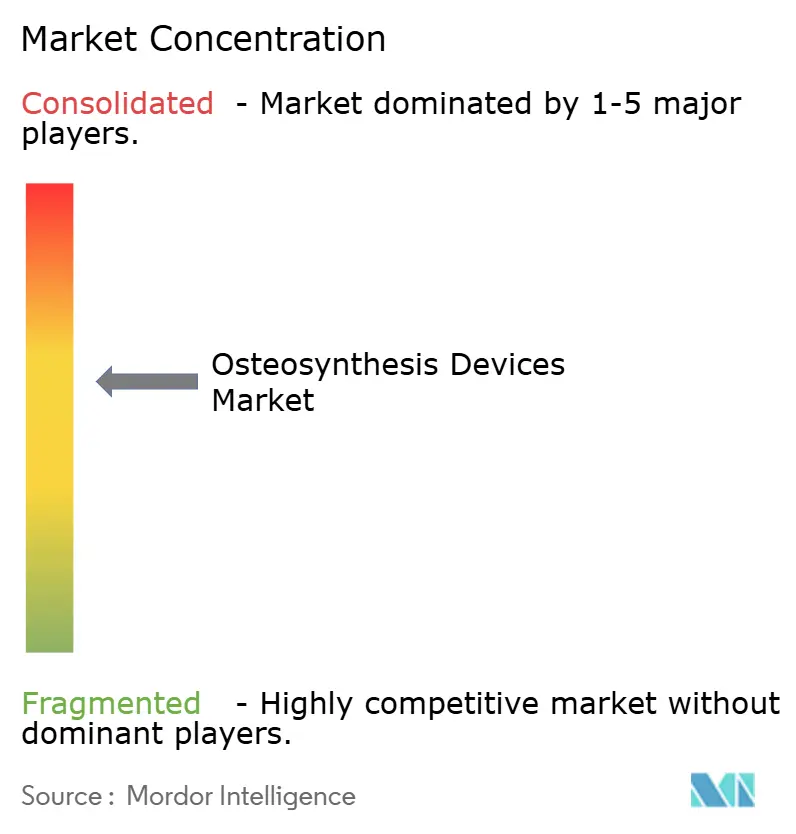
| Market Concentration | Medium |
Major Players *Disclaimer: Major Players sorted in no particular order Image © Mordor Intelligence. Reuse requires attribution under CC BY 4.0. | |
Osteosynthesis Devices Market Analysis by Mordor Intelligence
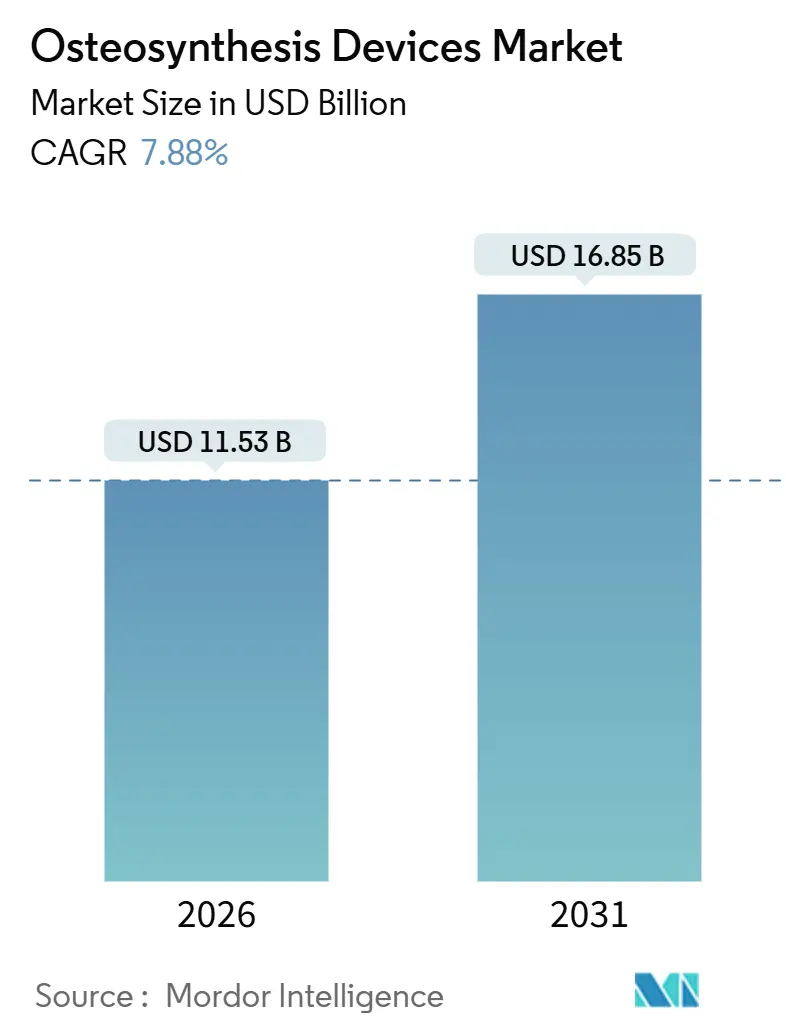
The Osteosynthesis Devices Market size is estimated at USD 11.53 billion in 2026, and is expected to reach USD 16.85 billion by 2031, at a CAGR of 7.88% during the forecast period (2026-2031).
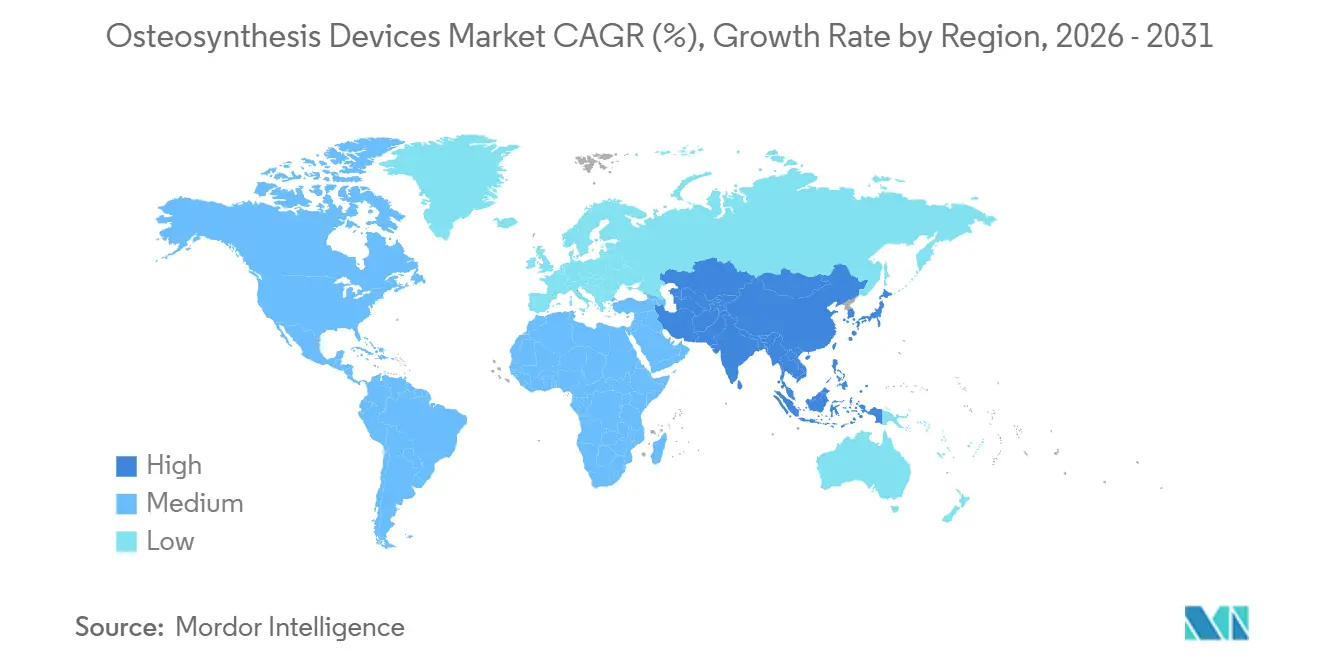
Accelerated uptake of bioabsorbable metals, real-time data–enabled implants, and value-based payment models are reshaping competitive dynamics, while lingering material-supply volatility and regulatory backlogs temper near-term growth. Surgeons continue to favor internal fixation for routine fractures, yet external systems are advancing fastest as staged damage-control surgery gains traction. Hospitals dominate procurement, but ambulatory surgical centers capture incremental share, aided by expanded CMS procedure lists. Regionally, North America retains the largest revenue base, whereas Asia-Pacific delivers the highest CAGR on the strength of national trauma-care upgrades.
Key Report Takeaways
- By device type, internal fixation led with 76.24% of osteosynthesis devices market share in 2025, external fixation is forecast to expand at a 9.02% CAGR to 2031.
- By material, non-degradable metals and polymers accounted for 78.45% share of the osteosynthesis devices market size in 2025, degradable alloys are advancing at an 11.45% CAGR through 2031.
- By anatomy, hip fractures held 27.58% revenue share in 2025, spine fixation is projected to expand at an 8.35% CAGR between 2026–2031.
- By end user, hospitals retained 64.25% share of the osteosynthesis devices market size in 2025, ambulatory surgical centers are rising at a 9.24% CAGR to 2031.
- By geography, North America commanded 34.67% of osteosynthesis devices market share in 2025, while Asia-Pacific is forecast to expand at a 9.13% CAGR through 2031.
Note: Market size and forecast figures in this report are generated using Mordor Intelligence’s proprietary estimation framework, updated with the latest available data and insights as of January 2026.
Global Osteosynthesis Devices Market Trends and Insights
Drivers Impact Analysis*
| Driver | (~) % Impact on CAGR Forecast | Geographic Relevance | Impact Timeline |
|---|---|---|---|
| Rising geriatric fractures & osteoporosis prevalence | +1.4% | Europe, North America, aging APAC | Long term (≥ 4 years) |
| Surge in road-traffic and sports injuries | +1.1% | India, China, Southeast Asia, MEA | Medium term (2-4 years) |
| Advances in locking-plate & minimally invasive fixation tech | +1.3% | North America, Europe, Japan, South Korea | Medium term (2-4 years) |
| Emerging-market trauma-care expansion | +0.9% | China, India, Brazil, GCC | Long term (≥ 4 years) |
| Adoption of antibacterial-coated & sensor-enabled implants | +0.8% | United States, Western Europe, GCC | Short term (≤ 2 years) |
| Regulatory fast-tracks for bioabsorbable Mg/Zn implants | +0.7% | United States, Europe | Medium term (2-4 years) |
| Source: Mordor Intelligence | |||
Rising Geriatric Fractures & Osteoporosis Prevalence
The global population aged 60 and above will reach 1.4 billion by 2030, adding millions of fragility fractures that demand reliable fixation.[1]World Health Organization, “Ageing and Health,” WHO, who.int Hip-fracture hospitalizations in the United States rose to 300,000 in 2025, with average inpatient costs topping USD 40,000 per episode, which intensifies payer pressure for implants that support faster recovery.[2]Centers for Disease Control and Prevention, “Hip Fractures Among Older Adults,” CDC, cdc.gov Lower bone-mineral density doubles fracture risk, driving surgeons toward titanium locking plates that reduce stress shielding in osteoporotic bone. Bundled-payment models reward devices that minimize re-operation, reinforcing premium-implant adoption in the osteosynthesis devices market. Collectively, these demographic and economic forces lift long-run procedure volumes across Europe, North America, and aging Asian economies.
Surge in Road-Traffic and Sports Injuries
Road collisions cause 50 million non-fatal injuries annually, many of which require surgical fracture management. India reported 461,000 road deaths in 2024, a spike linked to two-wheeler crashes with helmet use below 40%, escalating demand for tibial and femoral fixation hardware. China documented 58,000 sports-related fractures needing surgery in 2025, a 12% jump tied to skiing and marathon participation among urban millennials. High-energy trauma produces comminuted fractures that first receive damage-control external frames before definitive internal fixation, boosting dual-device sales in the osteosynthesis devices market. Evidence that staged protocols cut pulmonary complications by 30% further cements external-fixator growth in fast-growing economies.[3]American Academy of Orthopaedic Surgeons, “Damage-Control Orthopaedics: Evidence and Outcomes,” AAOS, aaos.org
Advances in Locking-Plate & Minimally Invasive Fixation Tech
Polyaxial locking screws reduce malunion in distal femur fractures by 18% compared with monoaxial designs, underscoring the clinical value of fixed-angle constructs. Fluoroscopy-guided percutaneous plate insertion shortens operative time by up to 35%, a critical metric for ambulatory surgical centers that now perform more trauma procedures. Stryker’s AxSOS 3 portfolio delivered a 23% revenue surge in 2025, illustrating how modular, anatomically contoured plates resonate with busy trauma units. Twelve new locking systems cleared the FDA in 2025, several featuring self-tapping screws that reduce instrument-tray counts and sterilization costs. These innovations lift the performance ceiling for internal fixation and sustain premium-price elasticity inside the osteosynthesis devices market.
Emerging-Market Trauma-Care Expansion
China’s Healthy China 2030 initiative allocated USD 1.2 billion in 2025 to equip 1,200 county hospitals with imaging suites and locking-plate inventories, shrinking inter-provincial patient transfers by an estimated 70%. India’s Ayushman Bharat scheme added 18 orthopedic procedures to its reimbursement list in 2024, catalyzing volume growth for cost-efficient stainless-steel implants priced under USD 150. Brazil certified 14% more trauma centers in 2025, most in regions where road-injury rates exceed national averages by 40%. The World Bank calculates a USD 3.2 million economic return for every USD 1 million invested in trauma capacity, bolstering public-funding commitments. As infrastructure spreads beyond tier-one cities, procedure numbers rise faster than gross domestic product, enlarging the osteosynthesis devices market footprint in emerging regions.
Restraints Impact Analysis*
| Restraint | (~) % Impact on CAGR Forecast | Geographic Relevance | Impact Timeline |
|---|---|---|---|
| High cost of advanced implants in low-income regions | −0.6% | Sub-Saharan Africa, South Asia, Andean states | Long term (≥ 4 years) |
| Stringent regulatory & testing standards | −0.4% | Europe, North America | Medium term (2-4 years) |
| Raw-material supply volatility (Ti, Mg alloys) | −0.5% | Global, China and Ukraine chokepoints | Short term (≤ 2 years) |
| Surgeon skill gap for minimally invasive techniques | −0.3% | Rural APAC, MEA, Latin America | Medium term (2-4 years) |
| Source: Mordor Intelligence | |||
High Cost of Advanced Implants in Low-Income Regions
Locking plates and bioabsorbable screws retail at three-to-five times the price of basic stainless-steel implants, creating affordability hurdles where out-of-pocket health spending tops 50% of total expenses. Per-capita health expenditure averaged just USD 78 in Sub-Saharan Africa during 2025, forcing surgeons to rely on Kirschner wires and external fixators priced below USD 100. In rural India, a USD 500 titanium plate equals two months of household income, limiting uptake despite growing trauma caseloads. Value-engineered implants priced under USD 200 lack robust clinical evidence, restricting their inclusion on public formularies. As a result, premium hardware penetration remains shallow, constraining growth for the osteosynthesis devices market in the poorest regions.
Stringent Regulatory & Testing Standards
The European Union’s Medical Device Regulation backlog exceeded 10,000 files by December 2025, driving re-certification costs above USD 500,000 per product line for mid-tier manufacturers. The FDA received 4,200 510(k) submissions in fiscal 2025, an 18% year-over-year jump that stretched median clearance times to 11 months. ISO 10993 biocompatibility and ASTM mechanical-test requirements add 12-18 months to development cycles for novel bioabsorbables, eroding first-mover advantage. Smaller innovators often lack the capital and quality-management infrastructure to navigate these hurdles, prompting portfolio cuts or market exits. These factors slow new-product flow and temper innovation-driven gains in the osteosynthesis devices market.
*Our forecasts treat driver/restraint impacts as directional, not additive. The impact forecasts reflect baseline growth, mix effects, and variable interactions.
Segment Analysis
By Device Type: External Fixation Gains Share in Complex Trauma
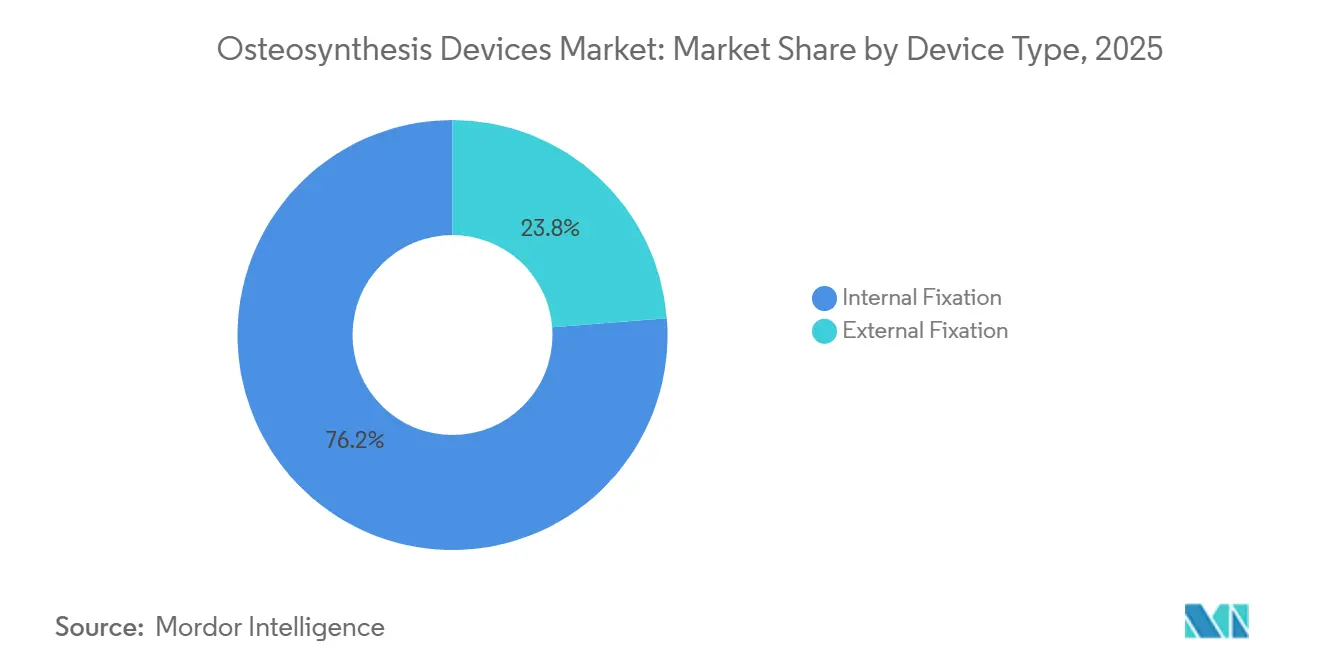
External systems represented 23.76% revenue in 2025 and are set to grow at a 9.02% CAGR, the fastest device-type trajectory within the osteosynthesis devices market. Damage-control orthopedics favors rapid stabilization, making circular and hybrid frames indispensable during multi-system injury management. Ilizarov-style constructs for limb lengthening deliver 11% annual growth, while hinged fixators enable early joint motion that cuts contracture risk. Internal fixation remains the primary workhorse, securing 76.24% market share in 2025; however, its CAGR lags at 7.5% as maturation limits upside. The osteosynthesis devices market size for plates and screws is forecast to reach USD 9.8 billion by 2031, supported by modular designs that cut OR turnover times.
Early definitive nailing of femoral and tibial shafts underpins stable internal-fixation volumes, yet complex peri-articular fractures increasingly start with temporary external frames before conversion, a protocol shift that broadens dual-device demand. Smart-nail prototypes that transmit load data could close the feedback loop between staged surgeries, driving cross-device integration. Growth in ambulatory surgical centers also boosts low-instrumentation external systems suited to outpatient settings. Collectively, external-fixation innovations are narrowing the historical revenue gap and altering supplier investment maps.


By Material: Degradable Alloys Disrupt Metal Dominance
Non-degradable stainless steel, titanium, and PEEK composites delivered 78.45% of osteosynthesis devices market share in 2025, yet degradable materials post the highest CAGR at 11.45%. Magnesium-calcium screws resorb in 12 months, eliminating secondary removal surgeries that add USD 5,000–8,000 per episode. Zinc-based alloys with slower 18- to 24-month degradation extend bioabsorbability to load-bearing anatomies. The osteosynthesis devices market size attributable to degradables is projected to surpass USD 2.3 billion by 2031, underscoring their strategic relevance. Meanwhile titanium, buoyed by additive-manufacturing compatibility, retains dominance in high-value spine fixation, and CFR-PEEK cages secure radiolucent visualization advantages for fusion assessment.
Degradable uptake accelerates when payers recognize total-episode savings; early U.S. bundled-payment pilots report 18–23% cost cuts when resorbables avert removal surgeries. Supply-chain headaches, including China’s magnesium export quotas imposed mid-2025, threaten pricing stability, prompting OEMs to consider localized alloy casting. Hybrid constructs that pair titanium plates with bioabsorbable screws emerge as compromise solutions in weight-bearing scenarios.
By Fracture/Anatomy Type: Spine Fixation Outpaces Hip Segment
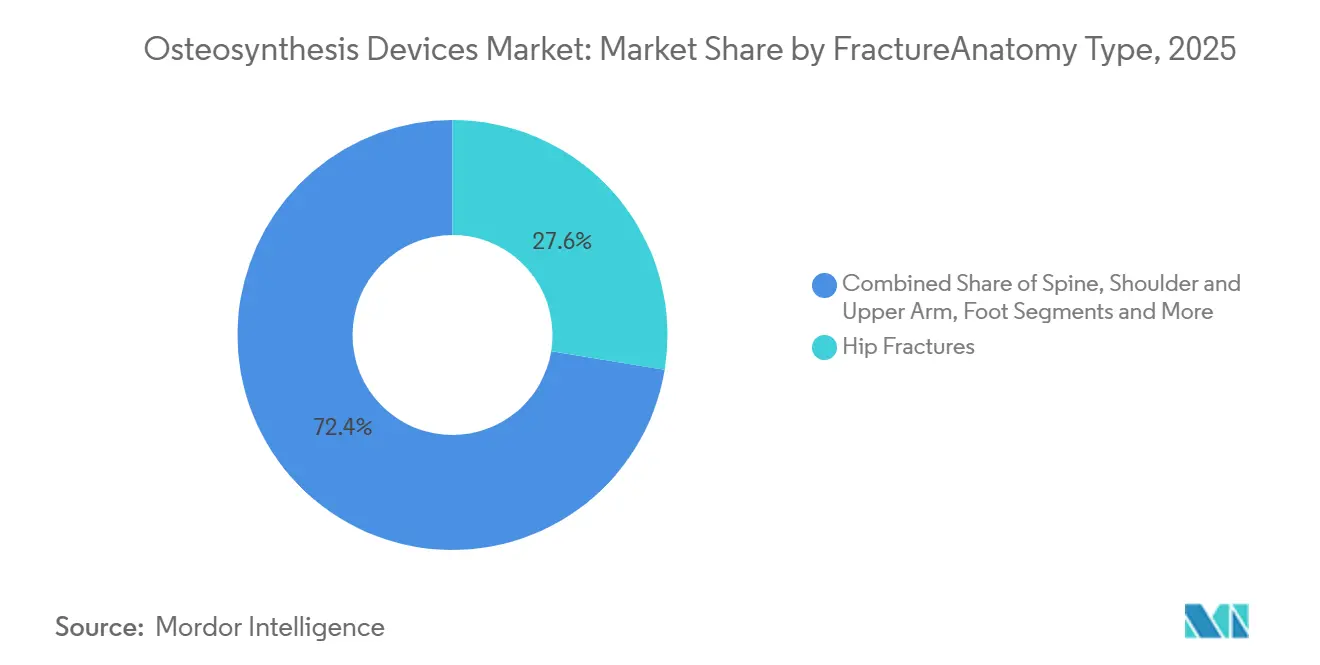
Hip fractures captured 27.58% of 2025 revenue, but spine fixation posts the strongest 8.35% CAGR. Pedicle-screw systems engineered for percutaneous insertion slash blood loss by 65% and trim inpatient stays to 23 hours, rendering them ASC-friendly. Volar locking plates for distal radius fractures migrate patients to immediate wrist mobilization, curbing rehabilitation timelines. The osteosynthesis devices market share for spine hardware is set to reach 19% by 2031 as vertebral compression fracture prevalence rises among aging cohorts.
Hip fixation technology continues evolving through cephalomedullary nails with helical blades that cut implant-related failures in osteoporotic bone. Peri-prosthetic fractures surrounding total knee implants add incremental distal-femur plate demand, reinforcing diversified anatomical portfolios. Hand and foot mini-fragment systems represent small ticket items individually yet cumulatively deliver nearly USD 700 million annual revenue, making them worthwhile niches for specialist suppliers.

By End User: ASCs Capture Share from Hospitals
Hospitals still account for 64.25% of end-user revenue, but ASCs advance at a 9.24% CAGR as CMS green-lights additional fracture procedures for same-day reimbursement. Reduced facility fees, shorter procedure times, and private-equity roll-ups energize the shift. The osteosynthesis devices market size sourced from ASCs could top USD 5.1 billion by 2031 if current momentum persists. Hospitals remain indispensable for polytrauma and comorbidity-heavy cases, sustaining bulk volumes for high-acuity devices.
Orthopedic specialty clinics grow at 6.8% annually, propelled by surgeon-owned integrated models that capture both professional and facility margins. Military and academic centers support early adoption of smart implants via grant-funded trials that feed evidence into approval dossiers. The user landscape therefore demands tiered product lines spanning premium, value, and research-grade configurations.
Geography Analysis
North America retained 34.67% revenue in 2025, supported by Medicare Advantage’s 54% penetration and bundled-payment incentives that prize durable fixation. Canada pilots value-based procurement, paring implant outlays by 18% in Ontario through multiyear supply agreements. Mexico’s cross-border trauma programs drive implant demand in border states. The osteosynthesis devices market size in North America is expected to reach USD 5.9 billion by 2031.
Asia-Pacific delivers the highest 9.13% CAGR. China logged 2.8 million fixation surgeries in 2025, with county-hospital upgrades under Healthy China 2030 supplying most incremental volume. India’s Ayushman Bharat reimbursement expansion fuels stainless-steel plate demand, whereas Japan leverages its Sakigake fast-track to speed locking-plate approvals. South Korea’s insurance coverage for pediatric bioabsorbables spurs regional supplier partnerships, and Australia’s TGA alignment with the FDA trims regulatory lag, drawing new launches southward.
Europe grapples with MDR-driven SKU attrition; Germany reported a 12% drop in available trauma plate ranges. France now mandates cost-effectiveness dossiers for premium implants, slowing bioabsorbable and smart-device uptake. The United Kingdom centralizes procurement to harvest 25% price cuts under NHS contracts. Middle East & Africa and South America shows growth becuse of state-funded trauma-care expansion and regional manufacturing capacity.

Competitive Landscape
The market is of moderate concentration. Stryker’s USD 120 million Suzhou plant localizes titanium-plate production, hedging currency and freight risks. Zimmer Biomet’s 2025 purchase of a European magnesium-implant portfolio widens its bioabsorbable pipeline. DePuy Synthes prototyped a Bluetooth-enabled intramedullary nail that secured FDA breakthrough designation, positioning Johnson & Johnson for early smart-implant leadership.
Globus Medical’s 2024 NuVasive acquisition forged an 18% share in pedicle screws, intensifying spine-hardware rivalry. Regional specialists in China and India exploit additive manufacturing to offer patient-specific implants at 40% lower cost, an advantage in price-sensitive tenders. Patent grants for magnesium and zinc alloys climbed 34% in 2025, reflecting a surge in degradable-metal R&D. Overall, incumbents defend positions through vertical supply integration and geographic manufacturing footprints, while disruptors ride regulatory fast-tracks and niche clinical evidence to capture emerging segments.
Osteosynthesis Devices Industry Leaders
Stryker Corporation
Smith & Nephew plc
B. Braun Melsungen AG
Johnson & Johnson Services LLC
Zimmer Biomet Holdings
- *Disclaimer: Major Players sorted in no particular order

Recent Industry Developments
- July 2025: Spineway’s subsidiary Spine Innovations secured GMED approval for its new ESP prostheses production line, ensuring continuous supply capability.
- June 2025: Smith + Nephew launched the TRIGEN MAX tibia nail, the first side-specific system offering anatomic screw trajectories with headless options.
- February 2025: Bioretec obtained CE mark for the RemeOs Trauma Screw portfolio, immediately opening European distribution across adult and pediatric indications.


Global Osteosynthesis Devices Market Report Scope
Osteosynthesis devices are defined as specialized surgical implants, typically made of metal, such as plates, screws, rods, nails, and wires, designed to align, stabilize, and join bone fragments following fractures or osteotomies. These devices provide mechanical stability to facilitate faster bone healing and functional recovery.
The Osteosynthesis Devices Market Report is segmented by Device Type, Material, Fracture/Anatomy Type, End User, and Geography. By Device Type, the market is segmented into Internal Fixation and External Fixation. By Material, the market is segmented into Non-Degradable, Degradable/Bioabsorbable, and Composite/Hybrid. By Fracture/Anatomy Type, the market is segmented into Hip, Knee, Spine, Shoulder, Forearm, Hand, Foot, and Others. By End User, the market is segmented into Hospitals, Orthopedic Specialty Clinics, ASCs, and Others.By Geography, the market is segmented into North America, Europe, Asia-Pacific, Middle East & Africa, and South America. The market report also covers the estimated market sizes and trends across major regions globally. Market Forecasts are Provided in Terms of Value (USD).
| Internal Fixation | Plates & Screws |
| Wires & Pins | |
| Intramedullary Rods & Nails | |
| Spinal Fixation Devices | |
| External Fixation | Fracture Fixation Frames (unilateral / bilateral) |
| Circular Fixators (Ilizarov, Taylor Spatial) | |
| Hybrid Fixators (ring + bar combinations) | |
| Dynamic External Fixators (hinged, articulating) | |
| Bone-Lengthening Systems |
| Non-Degradable | Stainless Steel Alloys |
| Titanium & Ti-6Al-4V Alloys | |
| Cobalt-Chrome Alloys | |
| PEEK Polymers | |
| CFR-PEEK Composites | |
| Degradable / Bioabsorbable | Polymers (PLA, PGA, PLGA, PCL) |
| Magnesium-Based Alloys | |
| Zinc-Based Alloys (Zn-Mg, Zn-Cu) | |
| Composite / Hybrid Materials | Bioceramic-Polymer Composites |
| Fiber-Reinforced Resorbable Composites |
| Hip |
| Knee / Distal Femur & Proximal Tibia |
| Spine |
| Shoulder & Upper Arm |
| Forearm & Wrist |
| Hand & Fingers |
| Foot |
| Others |
| Hospitals |
| Orthopedic Specialty Clinics |
| Ambulatory Surgical Centers (ASCs) |
| Others |
| North America | United States |
| Canada | |
| Mexico | |
| Europe | Germany |
| France | |
| United Kingdom | |
| Italy | |
| Spain | |
| Rest of Europe | |
| Asia-Pacific | China |
| Japan | |
| India | |
| South Korea | |
| Australia | |
| Rest of Asia-Pacific | |
| Middle East & Africa | GCC |
| South Africa | |
| Rest of Middle East & Africa | |
| South America | Brazil |
| Argentina | |
| Rest of South America |
| By Device Type | Internal Fixation | Plates & Screws |
| Wires & Pins | ||
| Intramedullary Rods & Nails | ||
| Spinal Fixation Devices | ||
| External Fixation | Fracture Fixation Frames (unilateral / bilateral) | |
| Circular Fixators (Ilizarov, Taylor Spatial) | ||
| Hybrid Fixators (ring + bar combinations) | ||
| Dynamic External Fixators (hinged, articulating) | ||
| Bone-Lengthening Systems | ||
| By Material | Non-Degradable | Stainless Steel Alloys |
| Titanium & Ti-6Al-4V Alloys | ||
| Cobalt-Chrome Alloys | ||
| PEEK Polymers | ||
| CFR-PEEK Composites | ||
| Degradable / Bioabsorbable | Polymers (PLA, PGA, PLGA, PCL) | |
| Magnesium-Based Alloys | ||
| Zinc-Based Alloys (Zn-Mg, Zn-Cu) | ||
| Composite / Hybrid Materials | Bioceramic-Polymer Composites | |
| Fiber-Reinforced Resorbable Composites | ||
| By Fracture / Anatomy Type | Hip | |
| Knee / Distal Femur & Proximal Tibia | ||
| Spine | ||
| Shoulder & Upper Arm | ||
| Forearm & Wrist | ||
| Hand & Fingers | ||
| Foot | ||
| Others | ||
| By End User | Hospitals | |
| Orthopedic Specialty Clinics | ||
| Ambulatory Surgical Centers (ASCs) | ||
| Others | ||
| By Geography | North America | United States |
| Canada | ||
| Mexico | ||
| Europe | Germany | |
| France | ||
| United Kingdom | ||
| Italy | ||
| Spain | ||
| Rest of Europe | ||
| Asia-Pacific | China | |
| Japan | ||
| India | ||
| South Korea | ||
| Australia | ||
| Rest of Asia-Pacific | ||
| Middle East & Africa | GCC | |
| South Africa | ||
| Rest of Middle East & Africa | ||
| South America | Brazil | |
| Argentina | ||
| Rest of South America | ||


Key Questions Answered in the Report
What CAGR is expected for global osteosynthesis devices between 2026 and 2031?
The segment is forecast to expand at a 7.88% CAGR, rising from USD 11.53 billion in 2026 to USD 16.85 billion by 2031.
Which device category is projected to exhibit the fastest growth over the next five years?
External fixation systems, fueled by staged damage-control protocols and limb-lengthening procedures, are anticipated to rise at a 9.02% CAGR through 2031.
How are bioabsorbable magnesium and zinc alloys reshaping orthopedic purchasing decisions?
These alloys eliminate second-stage implant-removal surgery, driving an 11.45% CAGR for degradable materials, especially in pediatrics and osteoporotic cases where anesthesia risk is high.
Why are ambulatory surgical centers gaining share in fracture fixation?
CMS has added 12 trauma procedures to the ASC list, cutting facility fees to roughly USD 3,200 and pushing ASC revenue to a projected USD 5.1 billion by 2031.
What supply-chain risks should procurement teams watch in 2026?
Volatility in titanium sponge from Ukraine and magnesium quotas from China continue to pressure input costs, with Ti-6Al-4V powder up 22% between January 2024 and December 2025.
Page last updated on:





