
On-Trade Dairy Market Size and Share
Market Overview
| Study Period | 2022 - 2032 |
|---|---|
| Market Size (2027) | USD 210.27 Billion |
| Market Size (2032) | USD 276.77 Billion |
| Growth Rate (2027 - 2032) | 5.65 % |
| Fastest Growing Market | Middle East and Africa |
| Largest Market | Asia-Pacific |
| Market Concentration | Low |
Major Players *Disclaimer: Major Players sorted in no particular order Image © Mordor Intelligence. Reuse requires attribution under CC BY 4.0. | |
On-Trade Dairy Market Analysis by Mordor Intelligence
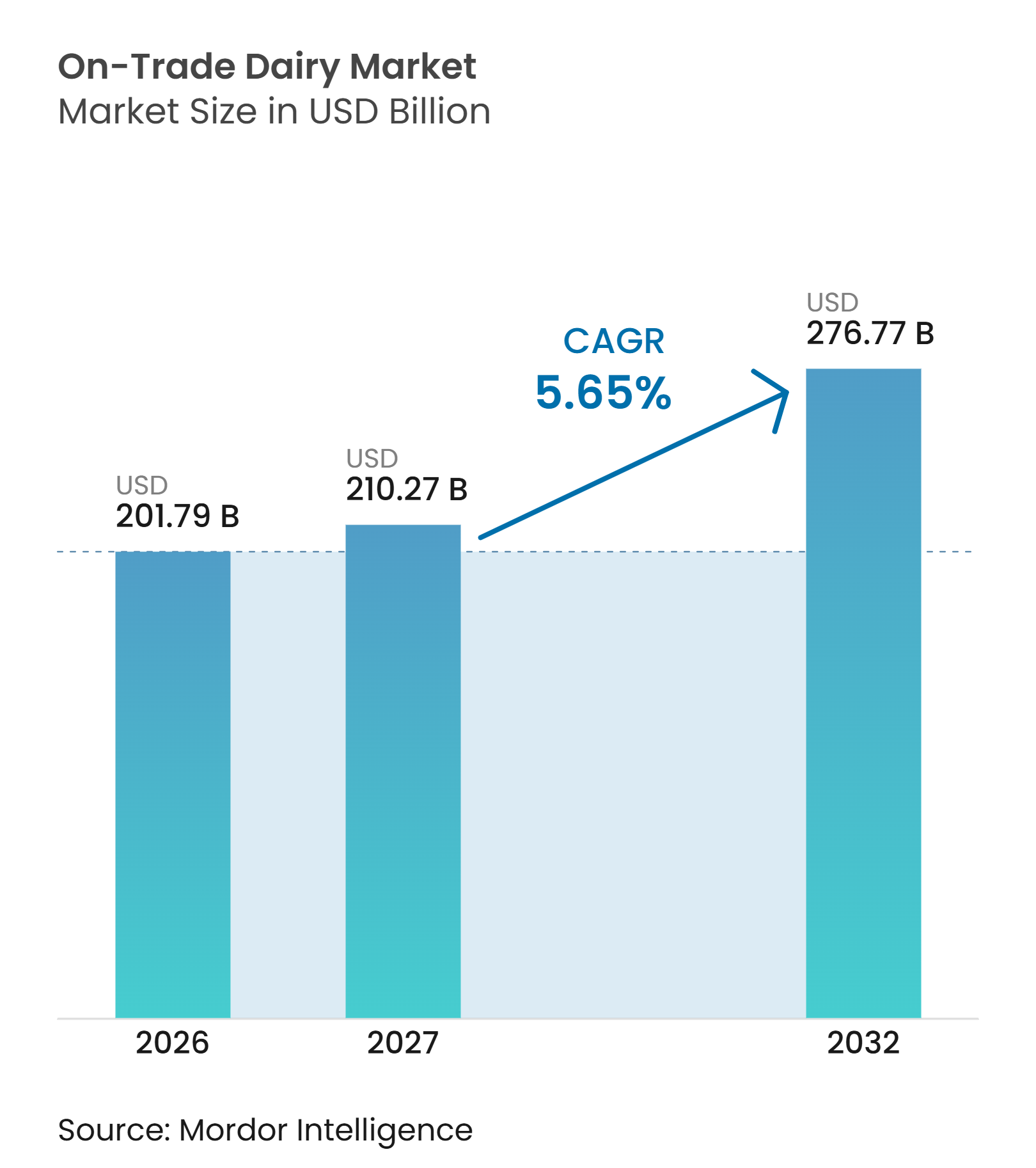
The on-trade dairy market size is expected to grow from USD 201.79 billion in 2026 to USD 210.27 billion in 2027 and is forecast to reach USD 276.77 billion by 2032 at a 5.65% CAGR over 2027-2032. The market is supported by the growing integration of dairy products across foodservice menus, as restaurants, cafés, hotels, and institutional kitchens increasingly use dairy to enhance flavour, texture, and product appeal. Dairy ingredients also contribute to menu innovation and value addition, supporting their use across a wide range of food and beverage applications. Demand is further supported by the growth of specialty beverages, bakery offerings, desserts, and prepared meals that incorporate dairy in diverse formats. The market is characterised by global dairy producers, regional processors, and specialised foodservice suppliers offering products tailored to professional kitchen requirements. Continuous product innovation, specialised foodservice solutions, and expanding procurement relationships are shaping the competitive landscape.
Key Report Takeaways
-
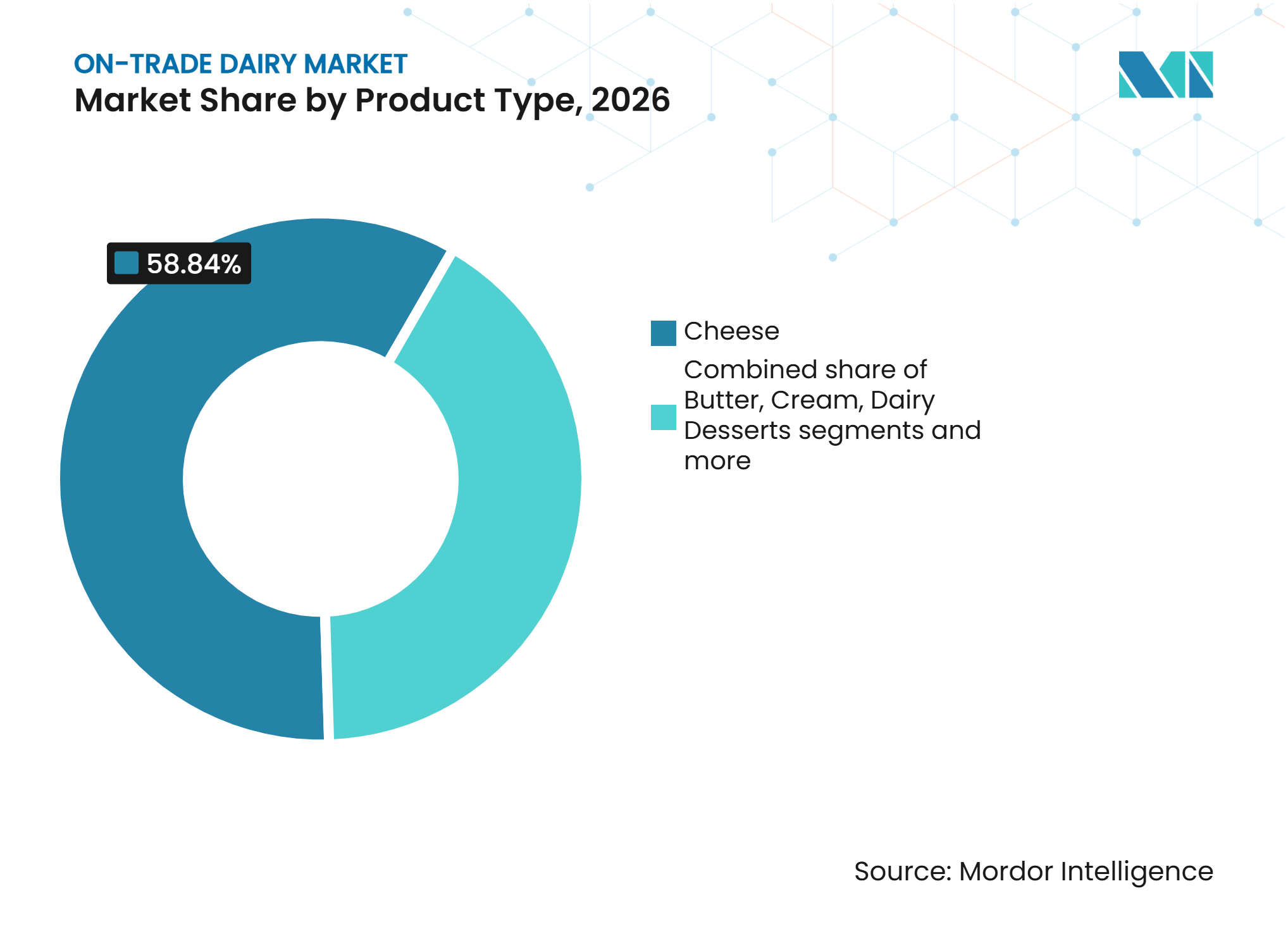
By product type, cheese held 58.84% of the On-trade dairy market share in 2026, while yogurt is forecast to grow at a 6.85% CAGR from 2027 to 2032.
-
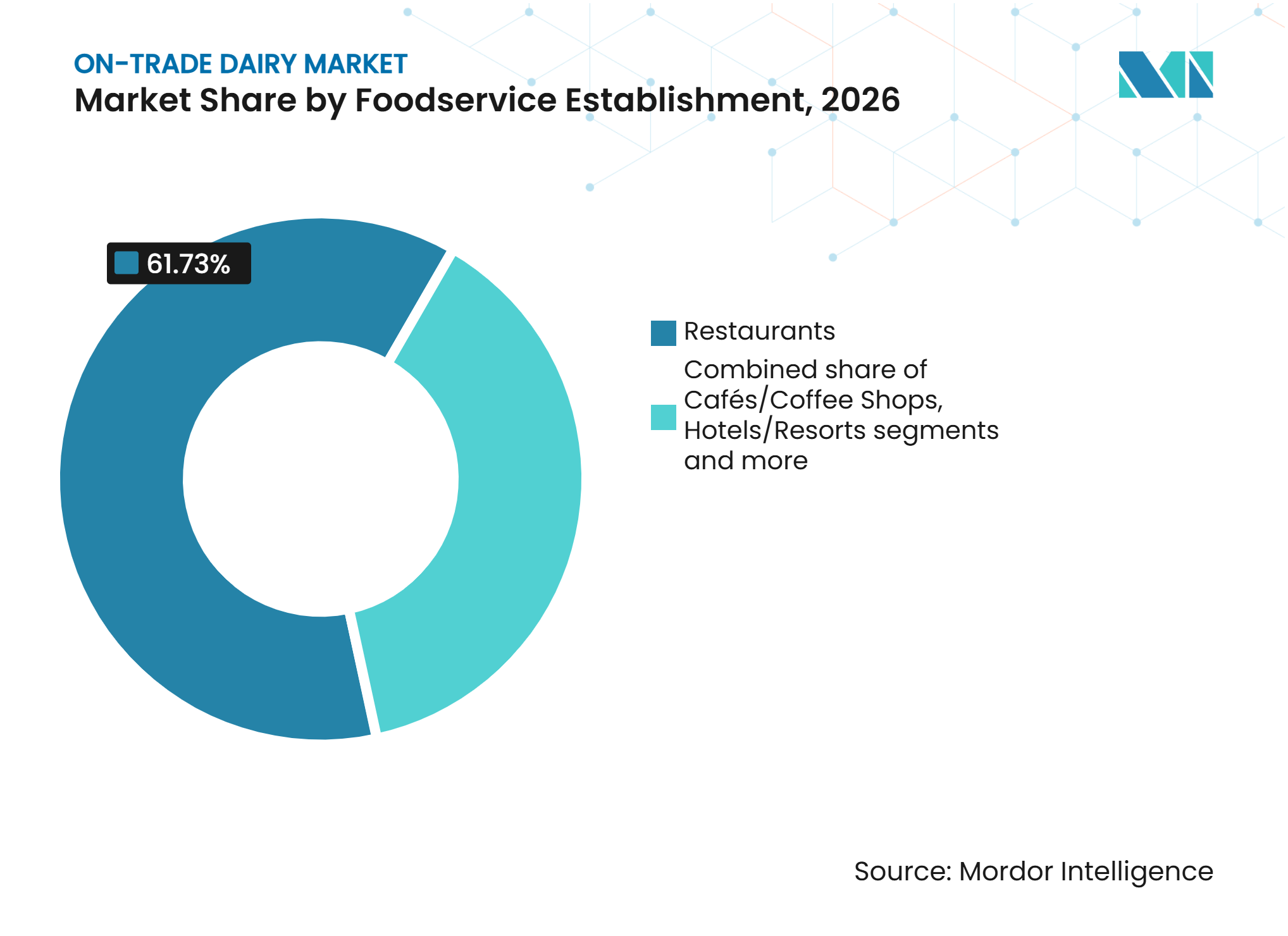
By foodservice establishment, restaurants held 61.73% of the On-trade dairy market share in 2026, while cafés and coffee shops are forecast to grow at a 7.05% CAGR from 2027 to 2032.
-
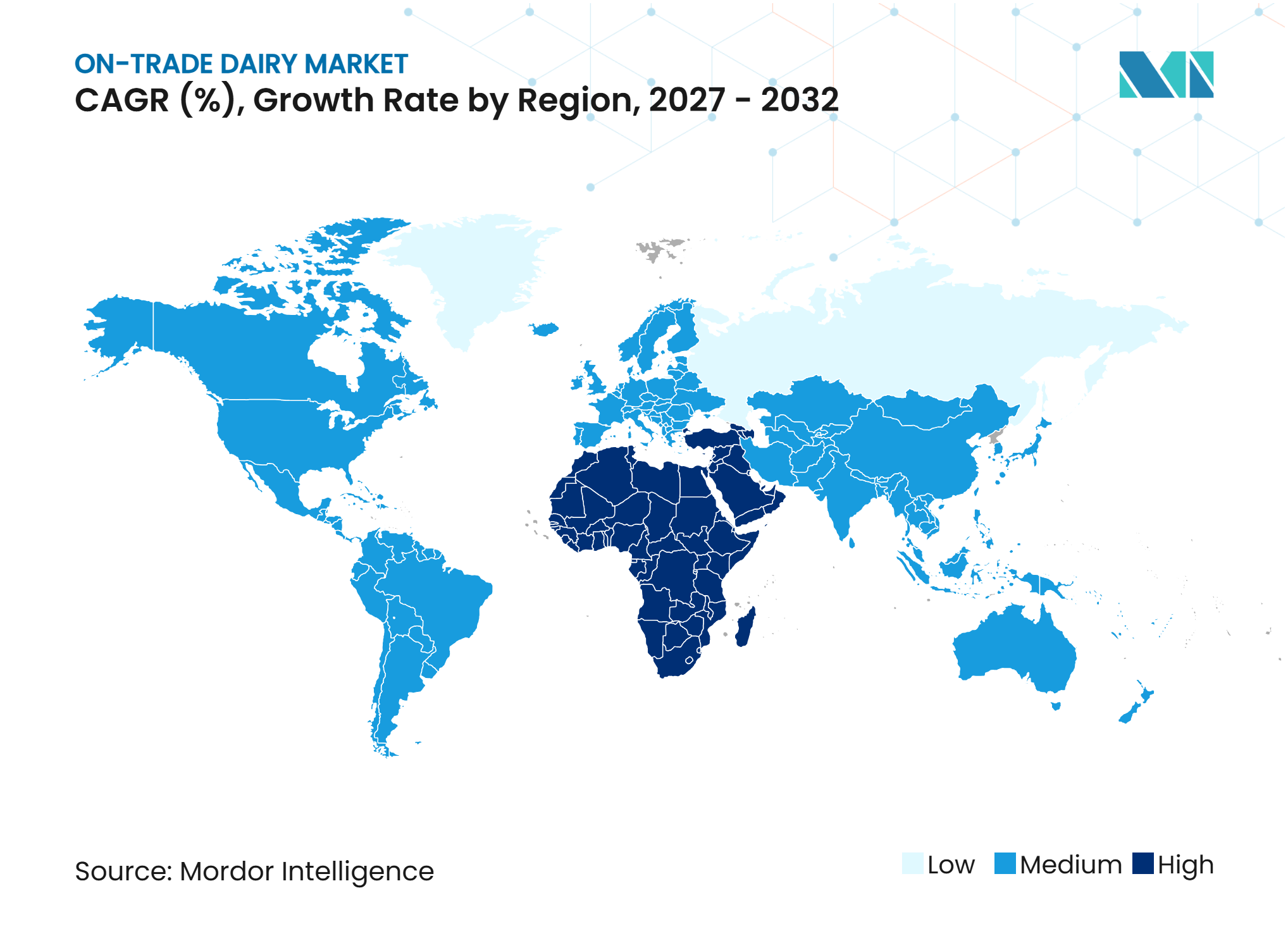
By geography, Asia-Pacific held 40.86% of the On-trade dairy market share in 2026, while the Middle East and Africa is forecast to grow at a 7.35% CAGR from 2027 to 2032.
Note: Market numbers in this report are based on Mordor Intelligence's proprietary estimation framework, which combines nine months of actuals with Q4 projections for base year 2026.
Market Trends and Insights
Drivers Impact Analysis of On-Trade Dairy Market*
| Driver | (~) % Impact on CAGR Forecast | Geographic Relevance | Impact Timeline |
|---|---|---|---|
| Expansion of restaurant, hotel and institutional foodservice establishments | +1.2% | Global, with concentrated near-term gains in Asia-Pacific, the Middle East and Africa, and South America | Medium term (2–4 years) |
| Growing use of dairy ingredients in restaurant sauces, dressings and prepared meals | +0.8% | Global; highest adoption intensity in North America and Western Europe | Short term (≤ 2 years) |
| Increasing consumer preference for protein-rich and nutrition-oriented dairy products | +0.9% | Global; strongest in North America, Australia, South Korea, and urban India | Medium term (2–4 years) |
| Premiumization of foodservice menus through specialty cheese and cream offerings | +0.8% | North America, Europe, and East Asia | Medium term (2–4 years) |
| Growing adoption of value-added dairy products and innovative dairy-based menu applications | +0.7% | Asia-Pacific core, with spill-over to the Middle East and Africa, and South America | Long term (≥ 4 years) |
| Increasing demand for convenient, consistent and customized dairy ingredient solutions | +0.7% | Global, with acute demand in markets with labour-constrained professional kitchens | Short to medium term |
| Source: Mordor Intelligence | |||
Expansion of Restaurant, Hotel and Institutional Foodservice Establishments
The expansion of restaurants, hotels, cafés, and institutional foodservice establishments is strengthening demand for dairy products across commercial foodservice operations. According to the United States Bureau of Labor Statistics (BLS), the number of private food services and drinking places establishments increased from 719,907 in the second quarter of 2025 to 724,059 in the third quarter and 728,580 in the fourth quarter[1]. This expansion broadens the customer base for dairy suppliers, as commercial kitchens require regular procurement of milk, cream, butter, cheese, and other dairy ingredients for food and beverage preparation. The growing foodservice infrastructure also supports recurring demand for bulk dairy supplies and specialised products suited to professional kitchen applications.
Growing Use of Dairy Ingredients in Restaurant Sauces, Dressings and Prepared Meals
The increasing incorporation of dairy ingredients into restaurant sauces, dressings, and prepared meals is supporting demand across the on-trade dairy market. According to the United Kingdom's Agriculture and Horticulture Development Board (AHDB), the share of foodservice menu items containing dairy increased from 24.9% in 2024 to 30.1% in 2026, reflecting wider incorporation of dairy across commercial food offerings[2]. Dairy ingredients such as cheese, cream, butter, and milk contribute flavour, texture, and consistency to sauces, dressings, toppings, and prepared meals, encouraging foodservice operators to incorporate them across a broader range of menu applications. This growing use supports recurring procurement of dairy products by restaurants, cafés, hotels, and institutional kitchens.
Increasing Consumer Preference for Protein-Rich and Nutrition-Oriented Dairy Products
Growing consumer interest in protein intake and nutritional quality is supporting demand for dairy products across foodservice establishments. According to research published by the International Foodservice Manufacturers Association (IFMA) in May 2026, 83% of surveyed consumers in the United States actively considered their daily protein intake, while 51% expressed interest in more high-protein breakfast options[3]. These preferences are encouraging foodservice operators to incorporate protein-rich ingredients into meals and beverages, supporting the use of dairy products such as cheese, milk, yogurt, and cream-based preparations. The nutritional value and versatility of dairy ingredients further support their incorporation into menus targeting health-conscious consumers.
Premiumization of Foodservice Menus Through Specialty Cheese and Cream Offerings
The growing emphasis on menu differentiation and premium dining experiences is encouraging foodservice operators to incorporate specialty dairy ingredients into their offerings. Restaurants, hotels, cafés, and other foodservice establishments are increasingly using premium cheeses, speciality creams, and value-added dairy preparations to enhance the flavour, texture, presentation, and perceived quality of their dishes. The use of multiple cheese varieties, distinctive flavour combinations, and indulgent cream-based preparations also allows operators to introduce differentiated menu items and create more distinctive dining experiences. This supports demand for specialised dairy products that offer greater culinary versatility and enable foodservice businesses to expand their premium menu offerings.
Restraints Impact Analysis of On-Trade Dairy Market*
| Restraint | (~) % Impact on CAGR Forecast | Geographic Relevance | Impact Timeline |
|---|---|---|---|
| Volatility in raw-milk and dairy ingredient prices | -0.9% | Global; most acute in Oceania and markets with high import dependency | Short to medium term |
| Competition from plant-based dairy alternatives and dietary restrictions | -0.8% | North America and Western Europe primarily; emerging in urban Asia-Pacific | Medium to long term |
| Refrigerated storage, handling and dairy spoilage challenges | -0.5% | Middle East and Africa, South America, and emerging Asia-Pacific markets with cold-chain gaps | Long term (≥ 4 years) |
| Food safety, labelling and packaging compliance requirements | -0.5% | Global; regulatory intensity highest in Europe, the United States (FDA), and India | Medium term (2–4 years) |
| Source: Mordor Intelligence | |||
Volatility in Raw-Milk and Dairy Ingredient Prices
Fluctuations in raw-milk prices and the costs of processed dairy ingredients can create uncertainty in procurement and purchasing decisions across the on-trade dairy market. Changes in milk availability, feed costs, weather conditions, and broader supply-demand dynamics can influence the prices of essential dairy inputs, including butter, cheese, cream, and milk powders. These variations affect the operating costs of dairy processors and foodservice suppliers, influencing the pricing of products supplied to restaurants, hotels, cafés, and institutional kitchens. Frequent input cost fluctuations can also complicate long-term procurement planning and pricing arrangements for foodservice operators, making cost management an important consideration across the market.
Competition from Plant-Based Dairy Alternatives and Dietary Restrictions
The growing availability of plant-based dairy alternatives and changing dietary preferences are influencing product choices across foodservice establishments. Restaurants, cafés, hotels, and institutional kitchens increasingly accommodate consumers with lactose intolerance, milk allergies, vegan preferences, and other dietary requirements. Alternatives made from ingredients such as soy, oat, almond, and coconut are expanding the range of non-dairy options available across beverages, desserts, sauces, and prepared meals. This diversification encourages foodservice operators to offer a broader selection of ingredients and menu preparations, influencing procurement decisions and the use of conventional dairy products across certain foodservice applications.
*Our forecasts treat driver/restraint impacts as directional, not additive. The impact forecasts reflect baseline growth, mix effects, and variable interactions.
On-Trade Dairy Market Segment Analysis
By Product Type:
Cheese Commands the Kitchen, Yogurt AcceleratesCheese accounts for 58.84% of the on-trade dairy market in 2026, reflecting its extensive use across restaurant menus, hotel kitchens, cafés, and quick-service establishments. Its versatility in terms of flavour, texture, melting, and binding properties makes it a widely used ingredient across pizzas, burgers, sandwiches, pasta, baked dishes, and prepared meals. Both natural and processed cheese varieties serve different foodservice requirements, with applications spanning premium dining, commercial kitchens, and large-scale food preparation. Consistent demand across multiple cuisines and menu formats supports cheese's leading position in the on-trade dairy market.
Yogurt is the fastest-growing product type, registering a projected CAGR of 6.85% during 2027–2032. Its growth is supported by increasing consumer interest in protein-rich foods, healthier menu options, and versatile dairy-based preparations across foodservice establishments. The expanding popularity of smoothies, breakfast bowls, dips, dressings, sauces, and yogurt-based desserts is creating additional applications for the product. Growing menu diversification and the incorporation of yogurt into both traditional and contemporary food preparations are further supporting its adoption across restaurants, cafés, hotels, and other foodservice outlets.



By Foodservice Establishment:
Restaurants Sustain Value, Cafés Reshape Dairy DemandRestaurants account for 61.73% of the on-trade dairy market in 2026, reflecting their extensive use of dairy ingredients across diverse food and beverage preparations. Dairy products such as cheese, cream, butter, milk, and yogurt are widely incorporated into restaurant menus, spanning main courses, sauces, desserts, baked dishes, and beverages. Both full-service and quick-service restaurants rely on these ingredients for their culinary versatility and ability to support consistent food preparation across different menu offerings. The broad range of dairy applications and recurring procurement requirements across restaurant operations support the segment's leading market share.
Cafés and Coffee Shops are the fastest-growing establishment type, registering a projected CAGR of 7.05% during 2027–2032. Growth is supported by the expanding popularity of specialty coffee, blended beverages, desserts, and dairy-based drink preparations, which are increasing the use of milk, cream, butter, and other dairy ingredients. Hotels and Resorts also contribute to demand through their extensive food and beverage operations, including restaurants, breakfast services, banquets, and premium dining facilities. Bakeries and Pastry Shops rely on dairy ingredients such as butter, cream, cheese, and milk for bakery products, fillings, toppings, and desserts.

Geography Analysis
Asia-Pacific
Asia-Pacific accounts for 40.86% of the on-trade dairy market in 2026, supported by urbanisation, rising disposable incomes, and the expansion of organised foodservice establishments. The region's growing restaurant, café, bakery, and beverage sectors are strengthening demand for dairy ingredients such as cheese, cream, butter, and milk. China contributes significantly through its expanding bakery, tea beverage, and quick-service restaurant industries, which require specialised dairy ingredients for commercial food preparation. Southeast Asian markets, including Indonesia, Vietnam, Thailand, and Malaysia, are also supporting demand through the growth of café chains, bakeries, and organised foodservice operators. India further contributes through its large dairy consumption base and expanding institutional and commercial foodservice sectors. Meanwhile, Japan, South Korea, and Australia represent established markets with demand for premium dairy ingredients across hospitality and foodservice applications.
Middle East and Africa
The Middle East and Africa is the fastest-growing regional market, registering a projected CAGR of 7.35% during 2027–2032. Growth is supported by tourism development, hospitality investments, expanding restaurant infrastructure, and rising demand for organised foodservice services. Saudi Arabia is an important growth market, where hotel developments, dining establishments, and entertainment infrastructure are creating additional demand for cheese, cream, butter, and other dairy ingredients. The expansion of foodservice distribution and dairy processing capabilities is further supporting the availability of specialised products for commercial kitchens. Across other regional markets, population growth, urbanisation, and the development of modern retail and hospitality infrastructure are contributing to wider adoption of dairy products across restaurants, cafés, hotels, and catering establishments.
Europe, North America and South America
Europe represents an established on-trade dairy market, supported by its developed hospitality sector, established dairy processing industry, and extensive use of cheese, cream, and butter in traditional and contemporary foodservice applications. Demand is further supported by the presence of restaurants, bakeries, hotels, and institutional catering operators with diverse dairy procurement requirements. North America also maintains a significant market presence, driven by its organised restaurant industry, extensive quick-service restaurant networks, and established institutional foodservice sector. The region's demand encompasses a broad range of dairy ingredients used in prepared meals, bakery products, sauces, beverages, and desserts. South America represents an emerging growth market, supported by expanding restaurant and café networks, rising foodservice activity, and the development of commercial dairy supply capabilities. Increasing investments in foodservice operations and wider availability of processed dairy ingredients are contributing to the region's market development.
Competitive Landscape
Market Concentration
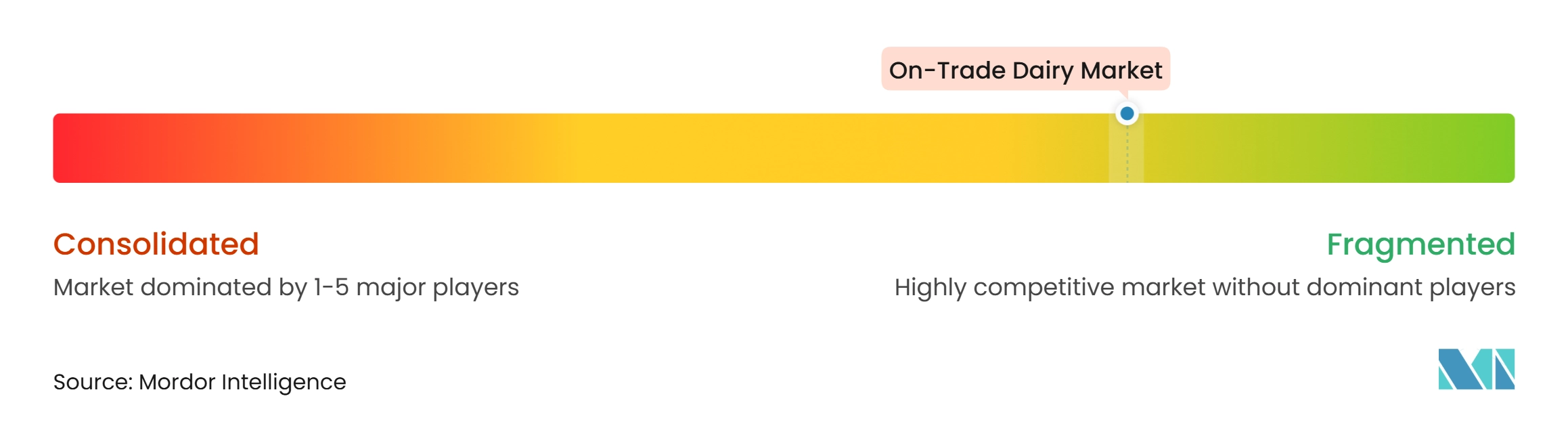
The on-trade dairy market is fragmented, reflecting the presence of global dairy cooperatives, multinational processors, regional manufacturers, and specialised foodservice suppliers. Leading players include Fonterra Co-operative Group Limited, Groupe Lactalis, Arla Foods amba, Saputo Inc., and Royal FrieslandCampina N.V. These companies maintain competitive positions through extensive dairy portfolios, established processing capabilities, distribution networks, and relationships with foodservice operators. Their offerings span cheese, butter, cream, milk, yogurt, and other dairy ingredients used across restaurants, hotels, cafés, bakeries, and institutional kitchens.
Leading players are strengthening their positions through investments in dairy processing facilities, expansion of foodservice-focused product portfolios, and improvements in manufacturing and distribution capabilities. Their strategies increasingly focus on developing application-specific dairy formats, including whipping creams, cooking creams, mozzarella, processed cheese, and other ingredients suited to commercial kitchen requirements. Companies are also expanding partnerships with foodservice distributors and large restaurant operators while investing in product innovation, supply-chain efficiency, and technical support to address the requirements of professional foodservice customers.
Emerging and regional players are competing through specialised product offerings, local distribution relationships, and greater responsiveness to foodservice customer requirements. These companies often focus on particular dairy categories, domestic foodservice channels, or application-specific solutions for restaurants, cafés, bakeries, and catering operators. Their competitive strategies include introducing customised dairy formats, strengthening relationships with local distributors, and expanding processing and supply capabilities to serve regional demand. This creates opportunities for specialised suppliers to establish positions in niche foodservice applications alongside larger multinational dairy producers.
On-Trade Dairy Industry Leaders
-
Fonterra Co-operative Group Limited
-
Groupe Lactalis
-
Arla Foods amba
-
Saputo Inc.
-
Royal FrieslandCampina N.V.
- *Disclaimer: Major Players sorted in no particular order
On-Trade Dairy Market Companies Covered in this Report
- Fonterra Co-operative Group Limited
- Groupe Lactalis
- Arla Foods amba
- Nestlé S.A.
- Saputo Inc.
- Dairy Farmers of America, Inc.
- Royal FrieslandCampina N.V.
- Agropur Cooperative
- Bel SA
- Savencia
- Schreiber Foods, Inc.
- The Magnum Ice Cream Company N.V.
- Meiji Co., Ltd.
- Gujarat Cooperative Milk Marketing Federation Ltd.
- ALMARAI COMPANY
- TINE SA
- Lakeland Dairies
- Ornua Co-operative Limited
- Land O'Lakes, Inc.
- Leprino Foods Company
Recent Industry Developments in On-Trade Dairy Market
- October 2026: Tropolite launched Flexi Royale Dairy Cooking Cream, a UHT-treated recombined dairy cream developed specifically for professional kitchens. The product targets chefs, hotels, restaurants, QSRs, and cloud kitchens, with applications spanning gravies, pasta sauces, soups, baked dishes, and desserts.
- September 2026: Paras Dairy entered the cream cheese category with the launch of Galacia Cream Cheese at Anuga Select India. The product targets institutional and professional foodservice customers, including bakeries, cafés, hotels, restaurants, cloud kitchens and QSRs. The company introduced 1-kg packs primarily for HoReCa customers, with applications including cheesecakes, frostings, desserts, sandwiches, dips and spreads.
- October 2025: Arla Foods and McDonald's expanded their longstanding dairy partnership through McDonald's participation in Arla's FarmAhead Customer Partnership programme. The collaboration introduced the ReNature initiative across approximately 60 organic dairy farms supplying Arla. Arla supplies organic milk to McDonald's restaurants across the United Kingdom, including milk used in teas, coffees and Happy Meal milk bottles.
Global On-Trade Dairy Market Report Scope
The on-trade dairy market covers dairy products procured and used by commercial foodservice establishments for preparing and serving food and beverages. It includes a range of dairy products supplied to restaurants, cafés, hotels, bakeries, and other foodservice operators. The market is segmented by product type, including butter, cheese, cream, dairy desserts, milk, yogurt, sour milk drinks, and others; foodservice establishment, including restaurants, cafés and coffee shops, hotels and resorts, bakeries and pastry shops, and more; and geography, covering North America, Europe, Asia-Pacific, South America, and the Middle East and Africa. The market forecasts are provided in terms of value in USD.
Segmentation Overview
| Butter | |
| Cheese | Natural Cheese |
| Processed Cheese | |
| Cream | Fresh Cream |
| Cooking Cream | |
| Whipping Cream | |
| Dairy Desserts | |
| Milk | Fresh Milk |
| UHT Milk | |
| Condensed Milk | |
| Yogurt | |
| Sour Milk Drinks | |
| Others |
| Restaurants |
| Cafés/Coffee Shops |
| Hotels/Resorts |
| Bakeries/Pastry Shops |
| Institutional/Contract Foodservice |
| North America | United States |
| Canada | |
| Mexico | |
| Rest of North America | |
| Europe | Germany |
| United Kingdom | |
| Italy | |
| France | |
| Spain | |
| Netherlands | |
| Poland | |
| Belgium | |
| Sweden | |
| Rest of Europe | |
| Asia-Pacific | China |
| India | |
| Japan | |
| Australia | |
| Indonesia | |
| South Korea | |
| Thailand | |
| Singapore | |
| Rest of Asia-Pacific | |
| South America | Brazil |
| Argentina | |
| Colombia | |
| Chile | |
| Peru | |
| Rest of South America | |
| Middle East and Africa | South Africa |
| Saudi Arabia | |
| United Arab Emirates | |
| Nigeria | |
| Egypt | |
| Morocco | |
| Turkey | |
| Rest of Middle East and Africa |
| By Product Type | Butter | |
| Cheese | Natural Cheese | |
| Processed Cheese | ||
| Cream | Fresh Cream | |
| Cooking Cream | ||
| Whipping Cream | ||
| Dairy Desserts | ||
| Milk | Fresh Milk | |
| UHT Milk | ||
| Condensed Milk | ||
| Yogurt | ||
| Sour Milk Drinks | ||
| Others | ||
| By Foodservice Establishment | Restaurants | |
| Cafés/Coffee Shops | ||
| Hotels/Resorts | ||
| Bakeries/Pastry Shops | ||
| Institutional/Contract Foodservice | ||
| By Geography | North America | United States |
| Canada | ||
| Mexico | ||
| Rest of North America | ||
| Europe | Germany | |
| United Kingdom | ||
| Italy | ||
| France | ||
| Spain | ||
| Netherlands | ||
| Poland | ||
| Belgium | ||
| Sweden | ||
| Rest of Europe | ||
| Asia-Pacific | China | |
| India | ||
| Japan | ||
| Australia | ||
| Indonesia | ||
| South Korea | ||
| Thailand | ||
| Singapore | ||
| Rest of Asia-Pacific | ||
| South America | Brazil | |
| Argentina | ||
| Colombia | ||
| Chile | ||
| Peru | ||
| Rest of South America | ||
| Middle East and Africa | South Africa | |
| Saudi Arabia | ||
| United Arab Emirates | ||
| Nigeria | ||
| Egypt | ||
| Morocco | ||
| Turkey | ||
| Rest of Middle East and Africa | ||
Key Questions Answered in the Report
What is the size of the On-trade dairy market?
The On-trade dairy market is valued at USD 201.79 billion in 2026 and is projected to reach USD 276.77 billion by 2032, at a 5.65% CAGR from 2027 to 2032.
Which product holds the largest share in on-trade dairy?
Cheese leads with a 58.84% share in 2026 because it is widely used across restaurant, quick-service, hotel, and catering menus.
Which foodservice channel is expanding fastest?
Cafés and coffee shops are forecast to grow at a 7.05% CAGR from 2027 to 2032 as beverage, dessert, and bakery formats create more dairy occasions.
Which region leads demand and which grows fastest?
Asia-Pacific holds the largest 2026 share at 40.86%, while the Middle East and Africa is forecast to grow fastest at a 7.35% CAGR through 2032.