
On-Device AI Inference Software Market Size and Share
Market Overview
| Study Period | 2020 - 2031 |
|---|---|
| Market Size (2026) | USD 5.62 Billion |
| Market Size (2031) | USD 17.41 Billion |
| Growth Rate (2026 - 2031) | 25.38 % |
| Fastest Growing Market | Asia-Pacific |
| Largest Market | North America |
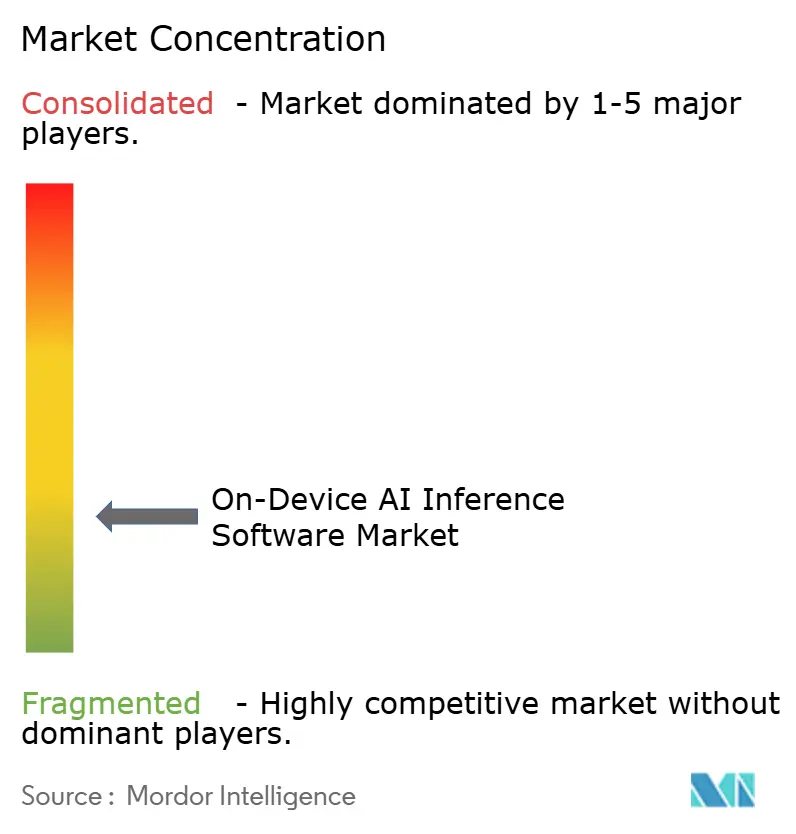
| Market Concentration | Low |
Major Players *Disclaimer: Major Players sorted in no particular order Image © Mordor Intelligence. Reuse requires attribution under CC BY 4.0. | |
On-Device AI Inference Software Market Analysis by Mordor Intelligence
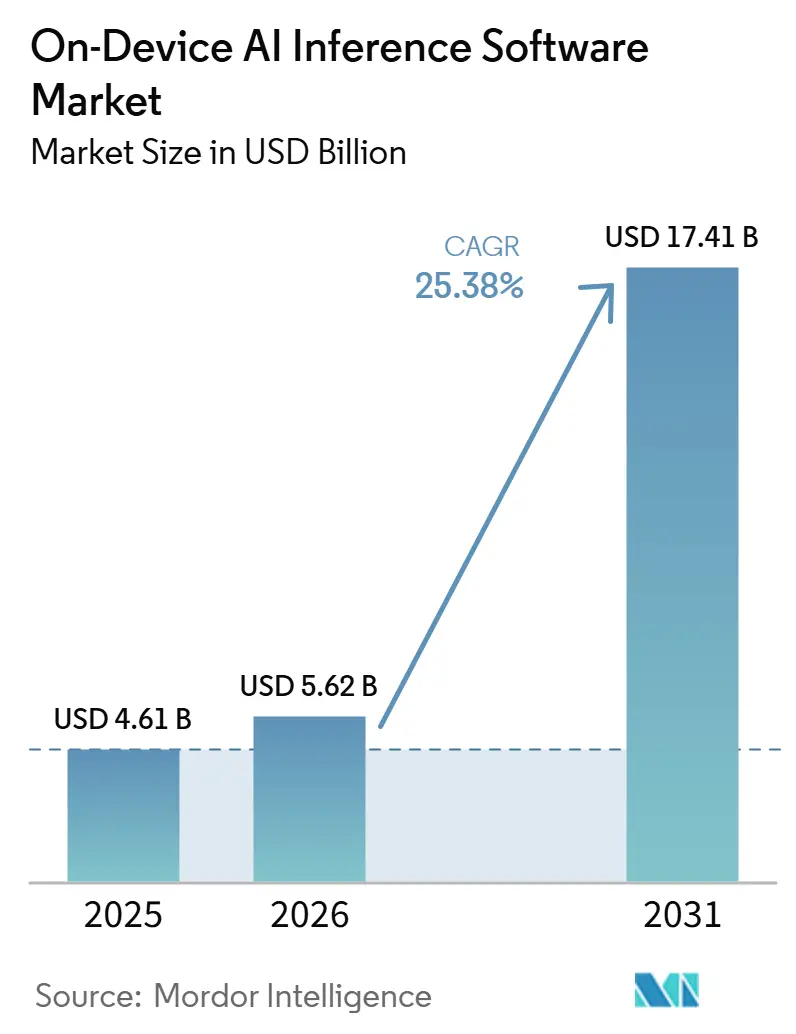
The On-Device AI Inference Software Market size is expected to increase from USD 4.61 billion in 2025 to USD 5.62 billion in 2026 and reach USD 17.41 billion by 2031, growing at a CAGR of 25.38% over 2026-2031. The On-Device AI Inference Software Market is expanding as AI processing moves from centralized servers to phones, vehicles, industrial equipment, and other connected endpoints. Smaller models and dedicated neural processing units are making local deployment more practical across a wider range of devices. Demand centers on faster responses, lower data transfer needs, and the ability to keep sensitive inputs on the device. Integrated software environments are gaining importance because buyers need model optimization, deployment, monitoring, and device updates to work together. The On-Device AI Inference Software Market also faces limitations from uneven hardware support, constrained memory and power, and quality losses that can result from aggressive model compression.
Key Report Takeaways
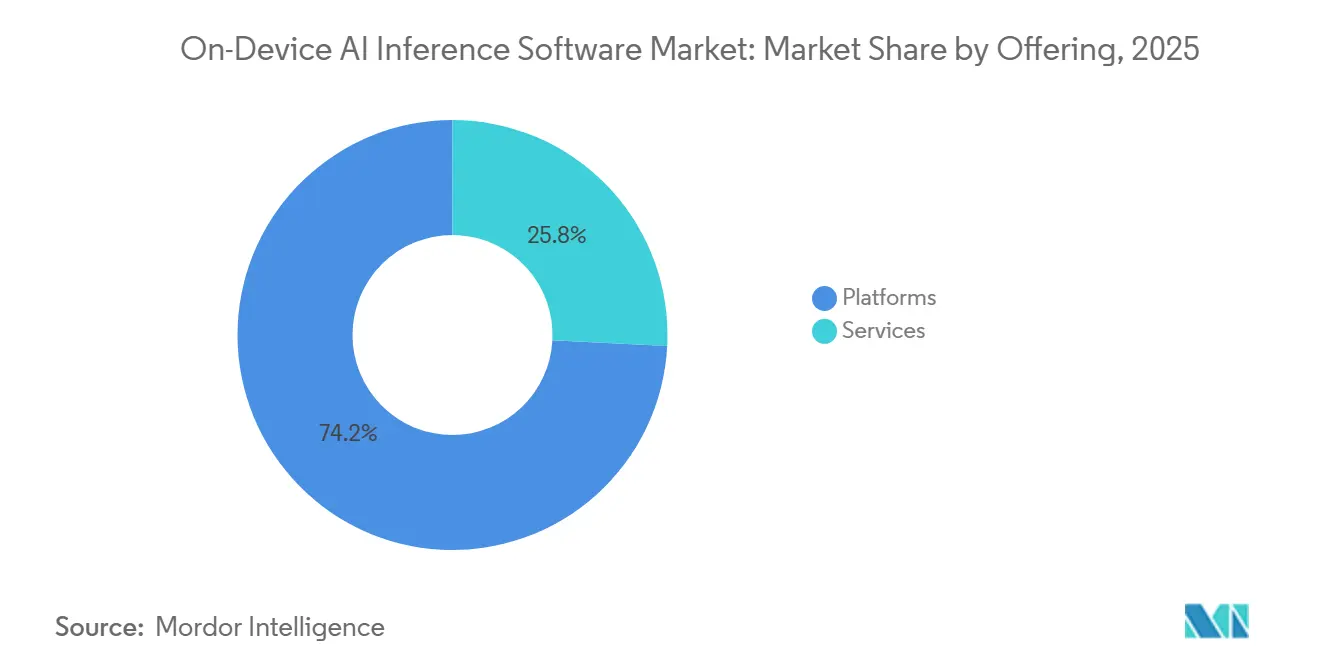
- By offering, platforms held 74.18% of revenue in 2025, while services are projected to expand at a 28.41% CAGR through 2031.
- By device type, smartphones accounted for 36.42% of the On-Device AI Inference Software Market in 2025, while robotics and drones are projected to grow at a 29.73% CAGR through 2031.
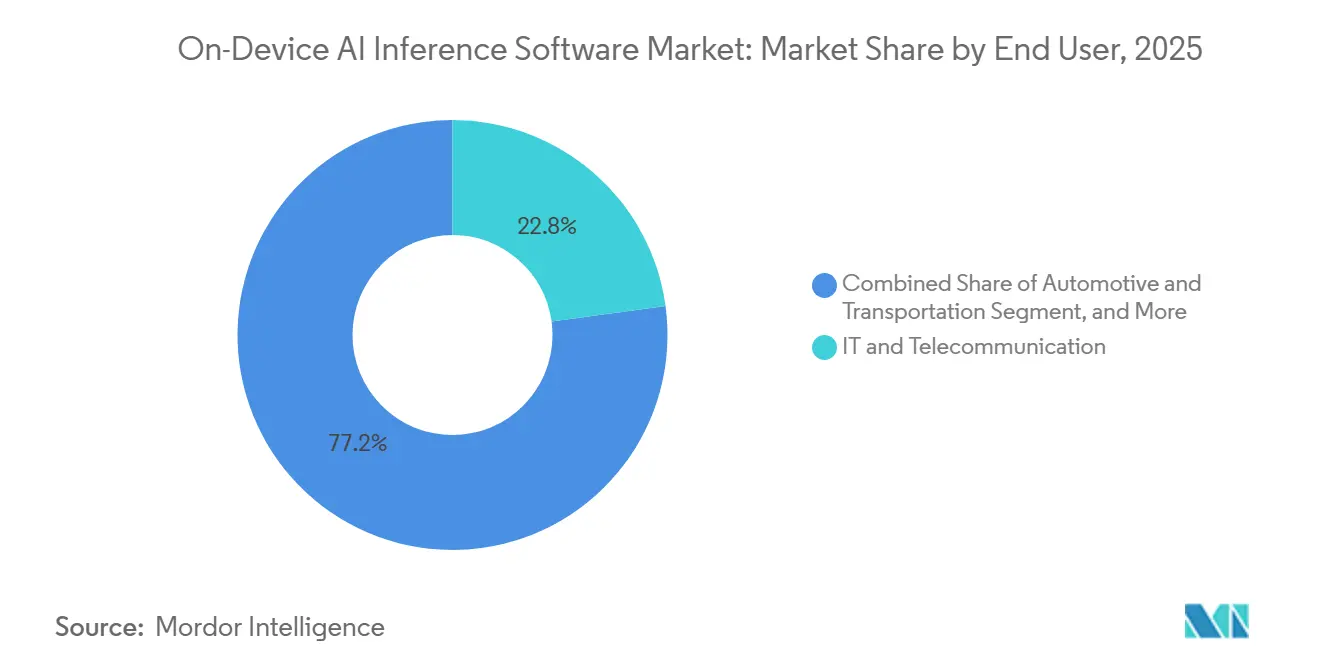
- By end user, IT and telecommunications accounted for 22.84% of revenue in 2025, while automotive and transportation are projected to record the highest CAGR at 30.16% through 2031.
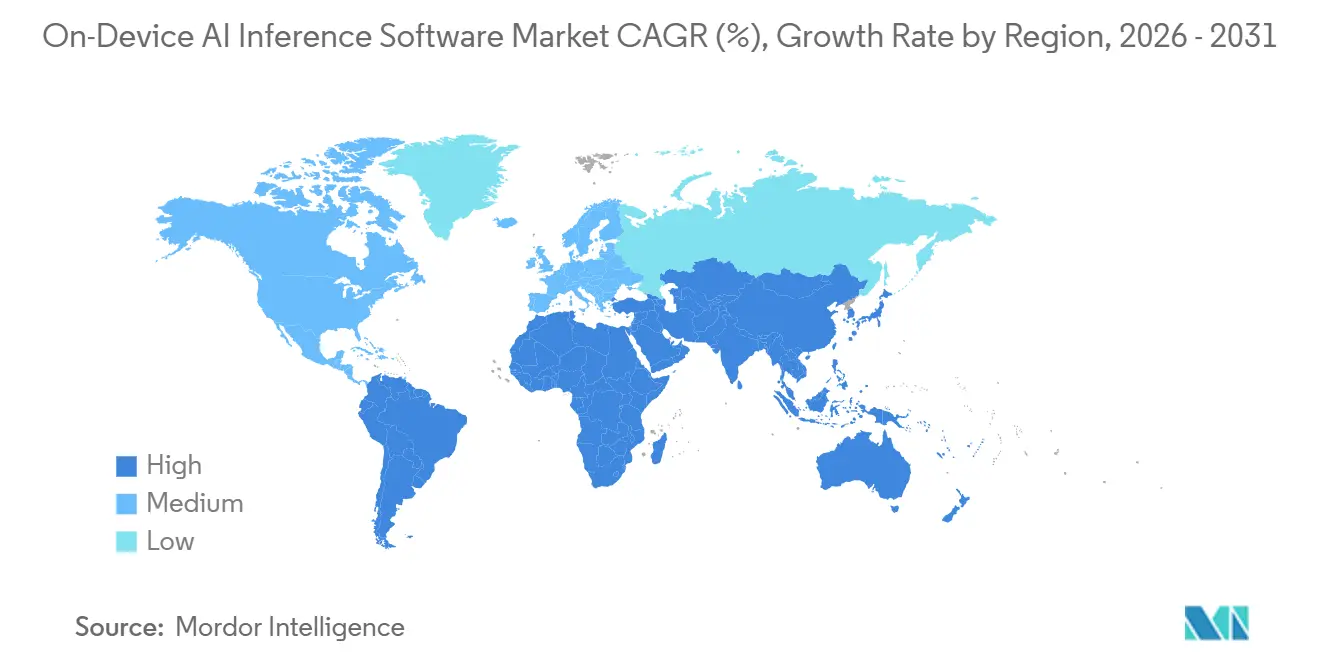
- By geography, North America accounted for 34.62% of revenue in the the On-Device AI Inference Software Market in 2025, while Asia-Pacific is projected to expand at a 29.84% CAGR through 2031.
Note: Market size and forecast figures in this report are generated using Mordor Intelligence’s proprietary estimation framework, updated with the latest available data and insights as of January 2026.
Market Trends and Insights
Drivers Impact Analysis of On-Device AI Inference Software Market*
| Driver | (~) % Impact on CAGR Forecast | Geographic Relevance | Impact Timeline |
|---|---|---|---|
| Proliferation of IoT Endpoint Data | +5.5% | Global, with Asia-Pacific core markets in China, South Korea, and Japan, and North America as primary generators | Short term (≤ 2 years) |
| Demand for Low-Latency Decision-Making | +5.0% | Global, strongest in North America, Europe, and Asia-Pacific industrial corridors | Short term (≤ 2 years) |
| Expansion of Generative AI on Resource-Constrained Devices | +4.5% | North America and Asia-Pacific for smartphones and PCs, and Europe for industrial edge applications | Short term (≤ 2 years) |
| Privacy-Preserving Local Inference Requirements | +4.0% | Europe and North America, with wider relevance in data-localization markets in Asia-Pacific | Medium term (2-4 years) |
| Hardware-Software Co-Optimization Around NPUs | +3.5% | North America, South Korea, China, and Taiwan as primary design hubs | Medium term (2-4 years) |
| Device-Level AI Governance and Offline Resilience | +2.5% | Global, with early adoption in regulated sectors across North America and Europe | Long term (≥ 4 years) |
| Source: Mordor Intelligence | |||
Proliferation of IoT Endpoint Data Accelerates Local Deployment Demand
The On-Device AI Inference Software Market is benefiting from the growing volume of data produced by connected devices. The research cited 21 billion IoT devices in use globally in early 2026, generating continuous streams of data from sensors, cameras, and equipment. Sending every stream to centralized infrastructure can raise bandwidth costs and expose applications to network delays. New system-on-chip designs include lightweight neural processing units, vector extensions, and digital signal processing cores for local tasks. These capabilities support anomaly detection, condition monitoring, and compact vision models at the point where data is created. Software providers can build recurring relationships when their tools combine inference, telemetry, model-drift checks, and over-the-air updates.
Demand for Low-Latency Decision-Making Reshapes Software Architecture
The On-Device AI Inference Software Market supports applications that cannot wait for a cloud response. Drones, industrial systems, vehicles, and network equipment need decisions during active operations. The supplied analysis noted that cloud round-trip times can range from 50 to 200 milliseconds, while local processing can reduce response times to low single-digit milliseconds. A drone moving at 12 meters per second would travel 2.4 meters during a 200-millisecond delay, which can create a material control problem. Automotive perception systems also require short perception-to-action times for advanced driver-assistance functions. This need encourages software vendors to build hardware-specific kernel libraries that improve performance on particular neural processing units.[1]Qualcomm Technologies, “AI Disruption Is Driving Innovation in On-Device Inference,” Qualcomm Technologies, qualcomm.com
Privacy-Preserving Local Inference Requirements Create a Compliance Tailwind
The On-Device AI Inference Software Market has a stronger case in sectors that handle sensitive information. The EU AI Act established obligations for high-risk systems used in areas such as healthcare, biometrics, critical infrastructure, and transportation.[2]European Parliament and Council, “Regulation (EU) 2024/1689 Laying Down Harmonized Rules on Artificial Intelligence,” Official Journal of the European Union, eur-lex.europa.eu Local processing can keep medical images, biometric signals, and transaction data at the endpoint, rather than sending raw inputs to third-party servers. This approach can simplify documentation related to data handling and system controls. The European Data Protection Board identified inference-phase data leakage as a relevant privacy risk for large language models in its 2025 guidance. Vendors that include audit trails, reporting tools, and data-minimization controls are better placed to serve regulated buyers.[3]European Data Protection Board, “AI Privacy Risks and Mitigations, Large Language Models,” European Data Protection Board, edpb.europa.eu
Generative AI Expansion on Resource-Constrained Devices Opens New Uses
The On-Device AI Inference Software Market is also being broadened by smaller language and multimodal models. Google reported that frozen multi-token prediction on Pixel devices improved text generation speed and energy use without requiring a separate drafting model for each task.[4]Google Research, “Accelerating Gemini Nano Models on Pixel With Frozen Multi-Token Prediction,” Google Research, research.google Research using Samsung Galaxy S25 and iPhone 16 Pro devices showed that a mixture-of-experts design achieved 1.8-3.8 times faster prefill at an equivalent INT4 memory footprint. Arm stated that its KleidiAI work with Stability AI enabled 30 times faster text-to-audio generation on Arm-based smartphones than its prior baseline. These developments expand local deployment beyond established classification tasks to voice, image, and language generation. They also increase the value of software that manages memory, performs key-value caching, and efficiently streams outputs.
Restraints Impact Analysis of On-Device AI Inference Software Market*
| Restraint | (~) % Impact on CAGR Forecast | Geographic Relevance | Impact Timeline |
|---|---|---|---|
| Fragmented Hardware and Runtime Ecosystems | -3.5% | Global, most acute in industrial and automotive applications with mixed silicon fleets | Medium term (2-4 years) |
| Memory, Thermal, and Battery Constraints | -2.5% | Global, most binding in IoT, wearable, and consumer edge applications | Short term (≤ 2 years) |
| Model Accuracy Loss From Compression and Quantization | -2.0% | Global, most critical in healthcare, automotive, and financial services | Medium term (2-4 years) |
| Distributed Model Security and Update Exposure | -1.5% | Global, most pressing in government, defense, and critical infrastructure deployments | Long term (≥ 4 years) |
| Source: Mordor Intelligence | |||
Fragmented Hardware and Runtime Ecosystems Limit Cross-Platform Portability
The On-Device AI Inference Software Market remains divided across hardware-specific backends and runtime environments. HailoRT, Qualcomm AI Engine Direct, MediaTek NeuroPilot, Apple Core ML, Google LiteRT, and ONNX Runtime use different toolchains and optimization approaches. A model prepared for one neural processing unit often needs revised operator handling, memory layouts, and precision settings before it can run well on another. Deep integration with a single silicon family can improve performance but reduce the range of devices a vendor can address. Broad compatibility can widen coverage but may sacrifice the latency benefits that enterprise buyers expect. The supplied material, therefore, identifies portability tools as a major area of competition for software suppliers.
Memory, Thermal, and Battery Constraints Challenge Sustained Use
The On-Device AI Inference Software Market must operate within strict physical limits on many endpoints. Research on the deployment of embedded neural networks found that aggressive sub-4-bit quantization can require costly quantization-aware training and reduce accuracy on reasoning-intensive tasks. Sustained workloads can also generate heat, reducing neural processing unit clock speeds and lowering real-world throughput. Battery-powered wearables and remote sensors need low-power operation for always-on use cases. These limits can restrict generative functions to occasional use rather than continuous execution. Software platforms, therefore, need scheduling, thermal controls, memory management, and adaptive precision as core capabilities.
*Our forecasts treat driver/restraint impacts as directional, not additive. The impact forecasts reflect baseline growth, mix effects, and variable interactions.
On-Device AI Inference Software Market Segment Analysis
By Offering:
Platforms Lead Revenue While Services Grow FasterPlatforms held 74.18% of the on-device AI Inference Software Market share in 2025. Organizations favor integrated environments that combine model optimization, runtime deployment, and device-fleet management into a single workflow. This model reduces the effort required to assemble separate tools for compression, deployment, and monitoring. Platform vendors also participate throughout the model lifecycle, from quantization and pruning to orchestration and performance telemetry. That broad role can make a platform difficult to replace after an organization has deployed it across a large device fleet.
Services are projected to expand at a 28.41% CAGR through 2031. Buyers increasingly use external support for inference optimization, model compression, and managed edge deployment rather than building all these capabilities internally. This demand is notable in industrial manufacturing and healthcare, where models often need domain-specific tuning and detailed compliance records. The services category gives specialized providers a route to enterprise customers without requiring a complete platform stack. It also creates a focused opportunity for firms that optimize models for a buyer's selected hardware environment.


By Device Type:
Smartphones Lead Revenue While Robotics and Drones Grow FastestSmartphones accounted for 36.42% of the on-device AI Inference Software Market share in 2025. Their position reflects a large installed base and the growing presence of dedicated neural processing units in mobile silicon. Qualcomm, Apple, Samsung, and MediaTek have integrated neural processing capability into flagship processors. These processors support local voice, vision, and language functions that require software to coordinate model execution. Mobile software can generate revenue through device licensing, developer tools, and the broader application ecosystem.
Robotics and drones are projected to expand at a 29.73% CAGR through 2031. These systems often operate in locations with weak connectivity, limited GPS coverage, or safety requirements that prevent reliance on remote processing. They need local perception, navigation, and action functions to work reliably. NVIDIA introduced Cosmos 3 Edge in July 2026 as a 4-billion-parameter open world model designed to run on Jetson Thor hardware for local vision reasoning and robot action generation. PCs and laptops remain an important revenue category as neural processing unit-equipped AI PCs become common hardware. Automotive, IoT, and industrial edge devices add demand, although lower per-device spend in many IoT deployments shifts monetization toward management platforms.
By End User:
IT and Telecom Hold the Largest Share While Automotive and Transportation Lead GrowthIT and telecommunication held 22.84% of the On-Device AI Inference Software Market share in 2025. The sector adopted edge infrastructure early and offers a deployment path via network equipment, customer-premises devices, and enterprise gateways. Telecom operators use local inference to prioritize traffic and detect anomalies in radio access networks. These functions need rapid responses that remote processing cannot consistently provide. The sector's installed infrastructure and operational expertise support continued adoption of local software tools.
Automotive and transportation are projected to grow at a 30.16% CAGR through 2031. Software-defined vehicle designs require persistent local AI for driver-assistance systems, in-cabin monitoring, and predictive maintenance. Safety certification requirements under ISO 26262 and IEC 61508 increase validation work and support premium pricing for approved runtimes. Financial services also use local voice AI for credit scoring, fraud detection, and customer authentication, where data-localization requirements limit cloud use. Healthcare providers, retailers, manufacturers, governments, education providers, and utilities each have applications tailored to their own response times and compliance needs.

Geography Analysis
North America On-Device AI Inference Software Market
North America held 34.62% of the On-Device AI Inference Software Market share in 2025. The region has a high concentration of software developers, enterprise technology buyers, and connected-device deployments across manufacturing, logistics, and healthcare. The United States contributed much of this demand through its AI chip supply chain, a large base of enterprise software customers, and established channels for selling premium development tools. Qualcomm's Snapdragon platform and neural processing unit roadmaps, along with those from Intel and AMD, provide a broad hardware base for local software deployment. Canada also supports demand in healthcare applications where data-localization policies favor processing near the point of care.
APAC On-Device AI Inference Software Market
Asia-Pacific is projected to grow at a 29.84% CAGR through 2031. China is expanding industrial IoT deployments, India is digitizing financial services, Japan has a mature robotics base, and South Korea has significant research and semiconductor activity in neural processing units. The supplied material reported that China's edge AI box market reached CNY 8.5 billion (USD 1.17 billion) in 2025 and is projected to reach CNY 12 billion (USD 1.65 billion) in 2026. South Korea benefits from work on neural processing unit-integrated memory, while India has a demand for local fraud detection in regulated payments. Japan and Southeast Asia are seeing demand for robotics manufacturing and smart retail applications that require local-language support, tailored sensor capabilities, and software that can be maintained across dispersed device fleets.
EMEA and South America On-Device AI Inference Software Market
Europe held a meaningful share in 2025 and is expected to maintain solid growth through 2031. Germany's automotive manufacturers and Industry 4.0 facilities use local inference for quality control, predictive maintenance, and material handling. The EU AI Act makes auditability, human oversight, and data minimization important factors in software procurement. South America, the Middle East, and Africa are smaller but developing opportunities, supported by Brazil's smart-city and financial technology activity, sovereign AI programs in Saudi Arabia and the United Arab Emirates, and mobile-first deployments in Nigeria and South Africa.

Competitive Landscape
The On-Device AI Inference Software Market is fragmented at the platform layer and moderately concentrated in silicon-linked runtime environments. Qualcomm, Apple, and NVIDIA have strong developer reach through their hardware ecosystems, while Edge Impulse, ZEDEDA, ClearBlade, Neurala, Viso AI, and ailia compete through device coverage, MLOps capabilities, and focus on particular verticals. Hailo, BrainChip, and Kneron pair runtimes, model conversion tools, and profiling features with their silicon offerings. Cross-neural-processing-unit portability remains a gap, as enterprise fleets often mix Qualcomm, MediaTek, and specialized industrial processors.
Hailo demonstrated the ASUS UGen300 USB edge AI accelerator powered by its Hailo-10H processor in January 2026. The product was presented as a way for laptops and edge computers to run offline generative and established AI workloads through a plug-in device. NVIDIA introduced Jetson T3000 and T2000 modules in July 2026, extending its hardware range from 70 TOPS to 2,000 teraflops and linking deployment tools to the Jetson ecosystem. BrainChip began commercial shipments of its Akida AKD1500 neuromorphic processor in June 2026 for defense and wearable applications. These actions show how vendors combine accessible hardware, developer tools, specialized low-power designs, and distribution relationships to create lasting software relationships.
Pure software suppliers need to solve portability without losing device-level performance. Buyers need practical ways to compile, validate, deploy, monitor, secure, and update models across mixed fleets. Hardware suppliers can offer close integration but are limited by their installed base, while specialized software providers can differentiate through fleet management, security controls, and vertical expertise. Neuromorphic stacks address always-on, low-power functions where conventional quantized transformer models remain demanding. The market concentration score is 3 out of 10 because the supplied material describes a fragmented platform field and does not show a top-player share above 5%.
On-Device AI Inference Software Industry Leaders
Edge Impulse, Inc.
Latent AI, Inc.
ZEDEDA, Inc.
ClearBlade, Inc.
Viso AI AG
- *Disclaimer: Major Players sorted in no particular order
On-Device AI Inference Software Market Companies Covered in this Report
- Edge Impulse, Inc.
- Latent AI, Inc.
- ClearBlade, Inc.
- ZEDEDA, Inc.
- Viso AI AG
- Axelera AI B.V.
- Hailo Technologies Ltd.
- Kneron, Inc.
- Blaize, Inc.
- Neurala, Inc.
- EdgeCortix Inc.
- DEEPX Co., Ltd.
- Quadric.io, Inc.
- ailia Inc.
- Embedl AS
- RunAnywhere AI, Inc.
- Zetic AI, Inc.
- BrainChip Holdings Ltd.
- Synaptics Incorporated
- Gorilla Technology Group Inc.

Recent Industry Developments in On-Device AI Inference Software Market
- July 2026: Farnell announced a new global distribution partnership with Hailo to expand access to Hailo's edge AI processors and AI vision processors across its global distribution network and engineering community, targeting physical AI, smart cities, industrial automation, logistics, automotive, and intelligent retail applications.
- July 2026: NVIDIA introduced the Jetson T3000 and T2000 modules, extending its scalable edge AI platform from 70 TOPS to 2,000 teraflops. The T3000 delivers 865 FP4 teraflops with 32 GB LPDDR5X memory, while the T2000 provides 400 FP4 teraflops. Production availability is scheduled for Q1 2027.
- June 2026: BrainChip announced commercial availability and initial production shipments of its Akida AKD1500 neuromorphic processor, manufactured with GlobalFoundries on 22 nm FDX technology. The chip delivers sub-300 mW continuous edge inference and is shipping to customers for defense and wearable use cases.
- March 2026: BrainChip entered a technology licensing agreement with EDGEAI, a Korea-based semiconductor company, to integrate Akida 2 IP into a forthcoming system-on-chip product line for next-generation smart metering in water, gas, and electricity utilities. The agreement includes an upfront license fee and royalties based on production volume.


Global On-Device AI Inference Software Market Report Scope
The on-device AI inference software market refers to the ecosystem of platforms and services that execute pre-trained artificial intelligence and machine learning models directly on local hardware, such as smartphones, personal computers, IoT devices, automotive systems, and industrial edge equipment, without requiring continuous connectivity to cloud-based servers. This software includes runtime engines, model optimizers, and compilers that compress and adapt AI models to operate efficiently within the computational, memory, and power constraints of edge devices. By processing data locally, on-device AI inference enables real-time, low-latency decision-making, significantly reduces bandwidth consumption, and enhances data privacy and security by keeping sensitive information on the device. The market caters to diverse end users across industries including automotive, healthcare, manufacturing, and IT, driven by the increasing integration of dedicated neural processing units (NPUs) and the growing enterprise demand for autonomous, reliable, and offline intelligent operations.
The On-Device AI Inference Software Market Report is Segmented by Offering (Platforms, and Services), Device Type (Smartphones, PCs and Laptops, Automotive Systems, IoT Devices, Industrial Edge Devices, and Robotics and Drones), End User (IT and Telecommunication, BFSI, Automotive and Transportation, Healthcare and Life Sciences, Retail and E-Commerce, Industrial Manufacturing, Education and Research Institutions, Government and Administration, Energy and Utilities, and Other End-User Industries), and Geography (North America, South America, Europe, Asia-Pacific, and Middle East and Africa). The Market Forecasts are Provided in Terms of Value (USD).
| Platforms |
| Services |
| Smartphones |
| PCs and Laptops |
| Automotive Systems |
| IoT Devices |
| Industrial Edge Devices |
| Robotics and Drones |
| IT and Telecommunication |
| BFSI |
| Automotive and Transportation |
| Healthcare and Life Sciences |
| Retail and E-Commerce |
| Industrial Manufacturing |
| Education and Research Institutions |
| Government and Administration |
| Energy and Utilities |
| Other End Users |
| North America | United States | |
| Canada | ||
| Mexico | ||
| South America | Brazil | |
| Argentina | ||
| Rest of South America | ||
| Europe | Germany | |
| United Kingdom | ||
| France | ||
| Russia | ||
| Spain | ||
| Rest of Europe | ||
| Asia-Pacific | China | |
| Japan | ||
| India | ||
| South Korea | ||
| Southeast Asia | ||
| Rest of Asia-Pacific | ||
| Middle East and Africa | Middle East | Saudi Arabia |
| United Arab Emirates | ||
| Rest of Middle East | ||
| Africa | South Africa | |
| Nigeria | ||
| Rest of Africa | ||
| By Offering | Platforms | ||
| Services | |||
| By Device Type | Smartphones | ||
| PCs and Laptops | |||
| Automotive Systems | |||
| IoT Devices | |||
| Industrial Edge Devices | |||
| Robotics and Drones | |||
| By End User | IT and Telecommunication | ||
| BFSI | |||
| Automotive and Transportation | |||
| Healthcare and Life Sciences | |||
| Retail and E-Commerce | |||
| Industrial Manufacturing | |||
| Education and Research Institutions | |||
| Government and Administration | |||
| Energy and Utilities | |||
| Other End Users | |||
| By Geography | North America | United States | |
| Canada | |||
| Mexico | |||
| South America | Brazil | ||
| Argentina | |||
| Rest of South America | |||
| Europe | Germany | ||
| United Kingdom | |||
| France | |||
| Russia | |||
| Spain | |||
| Rest of Europe | |||
| Asia-Pacific | China | ||
| Japan | |||
| India | |||
| South Korea | |||
| Southeast Asia | |||
| Rest of Asia-Pacific | |||
| Middle East and Africa | Middle East | Saudi Arabia | |
| United Arab Emirates | |||
| Rest of Middle East | |||
| Africa | South Africa | ||
| Nigeria | |||
| Rest of Africa | |||


Key Questions Answered in the Report
What is the size of the On-Device AI Inference Software Market?
The On-Device AI Inference Software Market is expected to rise from USD 4.61 billion in 2025 to USD 5.62 billion in 2026 and USD 17.41 billion by 2031, at a 25.38% CAGR. Growth reflects wider local deployment across endpoint devices rather than reliance on centralized processing alone.
What is driving adoption of local AI inference software?
The On-Device AI Inference Software Market is supported by connected-device data, low-latency needs, privacy controls, and smaller generative models that can run on endpoint hardware. Buyers also value lower dependence on connectivity for applications that must keep operating during network interruptions.
Which offering has the largest share?
Platforms held 74.18% of On-Device AI Inference Software Market revenue in 2025 because buyers value integrated model optimization, deployment, monitoring, and fleet-management tools. These environments can also reduce the work of combining separate software components for each device group.
Which device category is growing fastest?
Robotics and drones in the On-Device AI Inference Software Market are projected to grow at a 29.73% CAGR through 2031. They need reliable local perception and action in low-connectivity settings, where a delayed cloud response can affect safe operation.
Which end-user category has the highest projected growth?
Automotive and transportation in the On-Device AI Inference Software Market is projected to expand at a 30.16% CAGR through 2031, supported by driver-assistance systems and software-defined vehicles. Local execution also supports in-cabin monitoring and predictive maintenance functions that need persistent availability.
Which region is growing fastest?
Asia-Pacific in the On-Device AI Inference Software Market is projected to grow at a 29.84% CAGR through 2031, supported by industrial IoT, financial-services digitization, robotics, and semiconductor activity. The region combines growing deployment demand with hardware development in several major economies.
Page last updated on:


 Your data is secure and never sold or shared.


