
Olive Harvesting Machinery Market Size and Share
Market Overview
| Study Period | 2022 - 2032 |
|---|---|
| Market Size (2027) | USD 1.34 Billion |
| Market Size (2032) | USD 1.78 Billion |
| Growth Rate (2027 - 2032) | 5.84 % |
| Fastest Growing Market | Asia-Pacific |
| Largest Market | Europe |
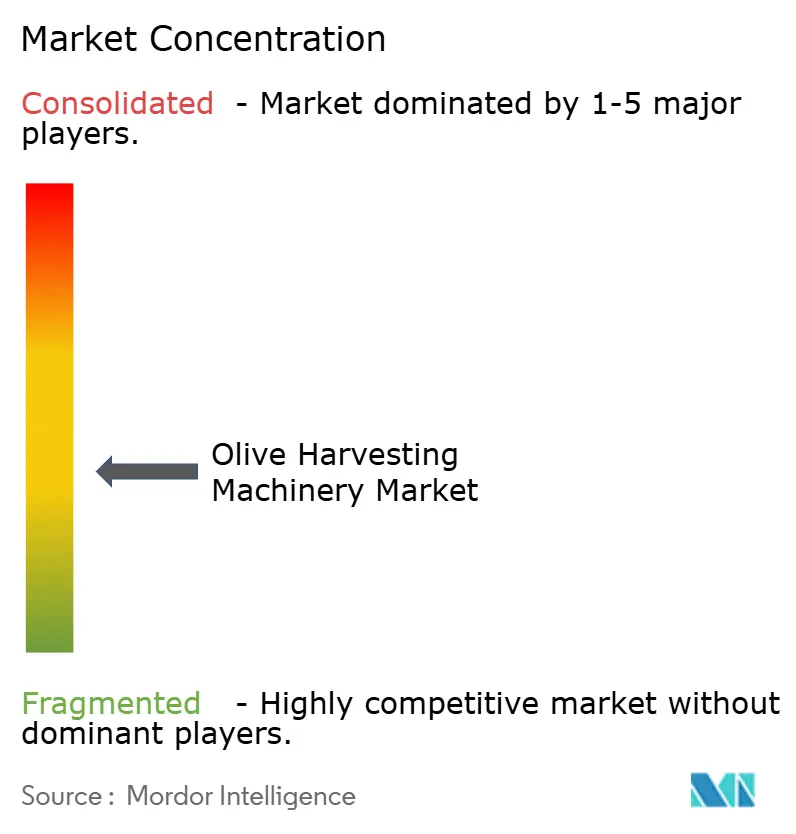
| Market Concentration | Medium |
Major Players *Disclaimer: Major Players sorted in no particular order Image © Mordor Intelligence. Reuse requires attribution under CC BY 4.0. | |
Olive Harvesting Machinery Market Analysis by Mordor Intelligence
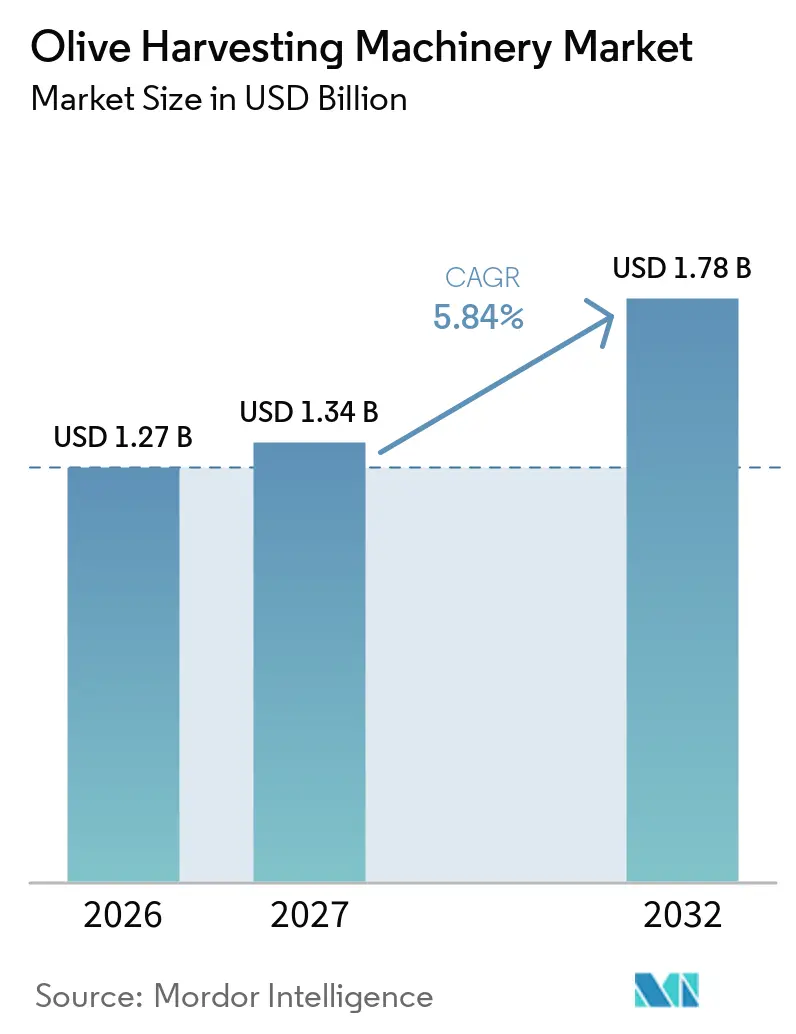
The olive harvesting machinery market was valued at USD 1.27 billion in 2026 and is forecast to grow from USD 1.34 billion in 2027 to USD 1.78 billion by 2032, at a CAGR of 5.84% during the forecast period 2027-2032. Market growth is driven by the declining viability of manual harvesting due to labor shortages and narrow harvest windows. Rising production of olive oil and table olives is increasing demand for timely fruit collection and quality control. The expansion of high-density orchards is also supporting broader adoption of machine-compatible harvesting systems. Manufacturers are responding with portable electric tools, self-propelled shakers, and equipment designed for varied orchard layouts. Public funding in major producing countries is reducing acquisition costs and supporting equipment upgrades. The market is also benefiting from advances in battery-powered and precision-harvesting equipment, which are improving operator efficiency and reducing reliance on labor-intensive harvesting methods. Increasing mechanization across major olive-producing regions is encouraging equipment manufacturers to develop solutions that improve harvesting speed, reduce fruit damage, and accommodate different orchard structures.
Key Report Takeaways
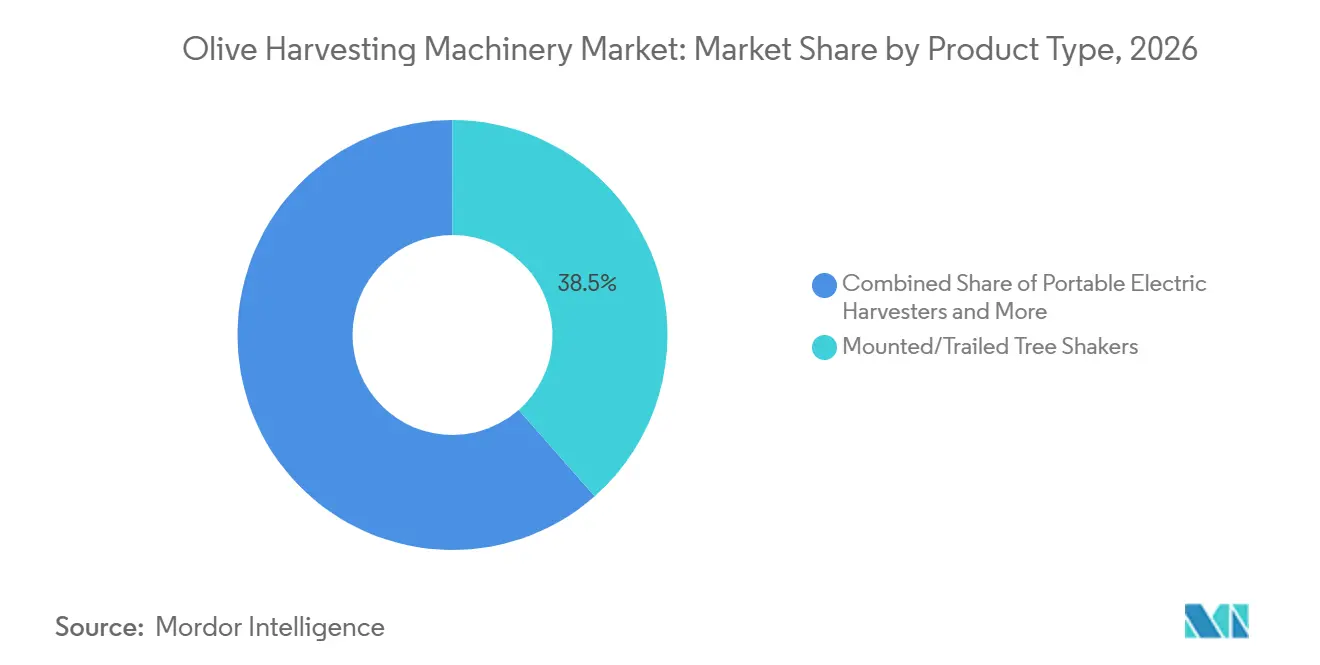
- By product type, mounted/trailed tree shakers accounted for 38.5% of the olive harvesting machinery market share in 2026, while autonomous/crawler harvesters are forecast to grow at a CAGR of 6.9% from 2027 to 2032.
- By power source, battery-electric systems accounted for 44.3% of the olive harvesting machinery market in 2026 and are forecast to grow at a CAGR of 6.8% from 2027 to 2032.
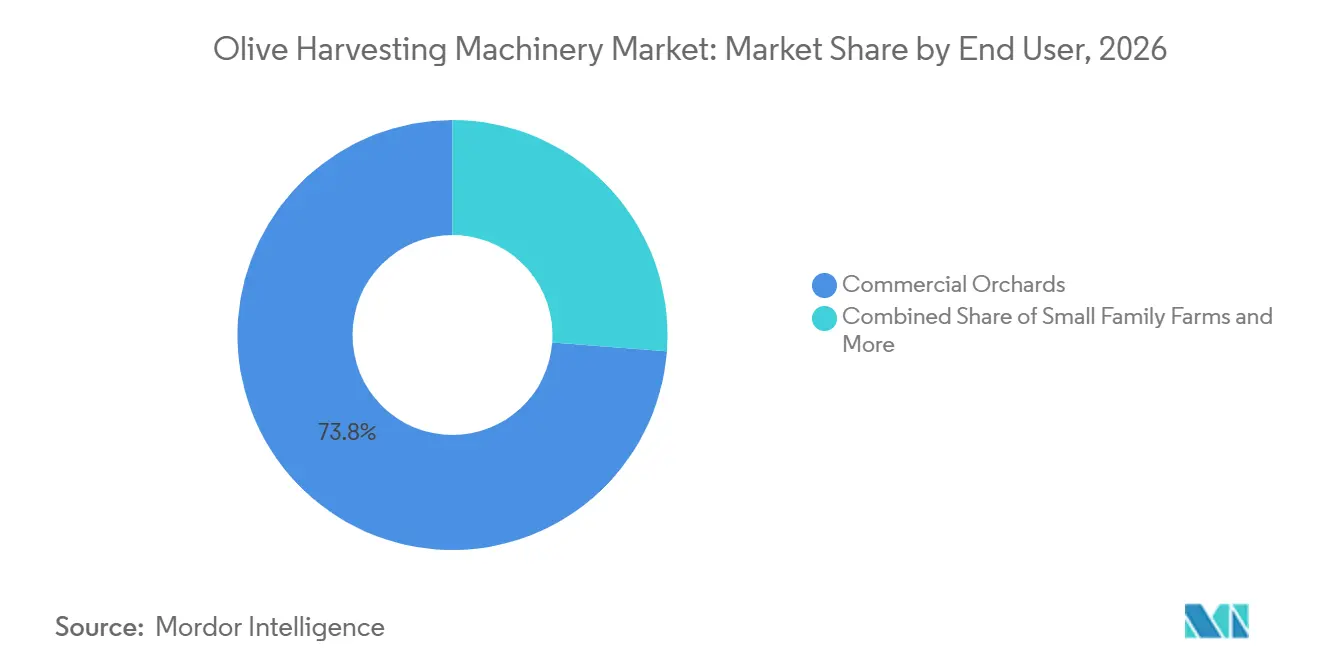
- By end user, commercial orchards accounted for 73.8% of the olive harvesting machinery market share in 2026, while the small family farms segment is forecast to grow at a CAGR of 7.6% from 2027 to 2032.
- By geography, Europe accounted for 42.3% of the olive harvesting machinery market share in 2026, while Asia-Pacific is forecast to grow at a CAGR of 8.2% from 2027 to 2032.
Note: Market numbers in this report are based on Mordor Intelligence's proprietary estimation framework, which combines nine months of actuals with Q4 projections for base year 2026.
Market Trends and Insights
Drivers Impact Analysis of Olive Harvesting Machinery Market*
| Driver | (~) % Impact on CAGR Forecast | Geographic Relevance | Impact Timeline |
|---|---|---|---|
| Rising Olive Oil and Table Olive Demand | +1.2% | Global, highest intensity in Europe and the Middle East | Medium term (2-4 years) |
| Olive-Grove Labor Shortages and Wage Inflation | +1.5% | Global, most acute in Spain, Italy, Greece, and North Africa | Short term (≤ 2 years) |
| Government Mechanization and Digital-Farming Support | +0.8% | Europe, Asia-Pacific, and Africa | Medium term (2-4 years) |
| Battery-Electric Productivity and Ergonomic Gains | +1.0% | Global, concentrated in Europe and North America | Medium term (2-4 years) |
| High-Density Orchard Expansion Enabling Over-the-Row Harvesting | +0.7% | Europe, South America, and Australia | Long term (≥ 4 years) |
| Harvest-Window Compression from Climate Variability | +0.6% | Mediterranean Europe, the Middle East, and North Africa | Short term (≤ 2 years) |
| Source: Mordor Intelligence | |||
Rising Olive Oil and Table Olive Demand
Global olive oil consumption reached 3,215,000 metric tons in the 2024/25 crop year, up 15% from the prior season[1]. The International Olive Council (IOC) estimated consumption at 3,248,000 metric tons for the 2025/26 crop year. Growing consumption increases the importance of efficient harvesting operations that enable producers to collect olives within optimal timeframes and deliver them to mills promptly. This is particularly relevant for extra-virgin and single-origin oils, where harvest timing can influence product quality. According to the IOC, Australian olive oil imports totaled 42,272 metric tons in the 2024/25 crop year, while imports during the early 2025/26 period rose 12.5%, indicating continued demand for imported olive oil. To meet growing market requirements and improve operational efficiency, olive growers are increasingly incentivized to adopt mechanized harvesting solutions that reduce harvesting time, improve labor productivity, and support timely processing. These factors strengthen the role of harvesting machinery in commercial olive production, particularly as producers seek to maintain output quality and manage rising harvesting costs.
Olive-Grove Labor Shortages and Wage Inflation
Labor availability remains a persistent constraint in olive-growing areas of Spain, Italy, and Greece. Rural migration and difficulties in attracting seasonal workers have made harvest staffing less reliable. Qualified harvesting and pruning labor is becoming increasingly scarce in key olive-producing regions, increasing the need for mechanized harvesting solutions. Mechanization therefore serves as a means to reduce exposure to staffing risks as well as labor costs. Portable battery-powered tools offer smaller farms an entry point where a full harvesting platform is not viable. The olive harvesting machinery market gains a broader customer base when family farms view mechanization as a practical response to recurring labor shortages. As labor constraints persist across major olive-producing regions, demand is anticipated to shift toward accessible and scalable mechanized solutions that can reduce reliance on seasonal workers across farms of different sizes.
Government Mechanization and Digital-Farming Support
Government investment programs in olive-producing regions are supporting orchard modernization and mechanization, creating demand for harvesting machinery and related technologies. In October 2025, Regione Calabria announced a EUR 50 million (USD 55.7 million) investment program under its 2023–2027 rural development program to improve the competitiveness of olive-sector farms. The scheme provided capital grants covering up to 65% of eligible expenditure, increasing to 75% for small farms, and included support for new machinery and equipment, mechanized harvesting, orchard establishment and restructuring, and digital technologies. Eligible beneficiaries included individual and associated agricultural entrepreneurs operating in Calabria's olive sector[2]. The program demonstrates public support for mechanization and technological investment in olive production. Such measures can reduce the upfront investment burden for eligible growers and support the adoption of mechanical harvesters and other equipment designed to improve harvesting efficiency and farm productivity.
Battery-Electric Productivity and Ergonomic Gains
Battery-electric harvesting tools are improving operator productivity and ergonomics while reducing some of the maintenance and operating limitations associated with pneumatic and internal-combustion equipment. Their lighter, cordless configurations are particularly relevant in remote, sloped, and terraced olive groves where equipment portability and operator mobility are important. PELLENC's POWER 48 electric shaker rake uses a 480-watt brushless motor, and the manufacturer claims it can harvest up to eight times faster than manual methods. INFACO's V5000 olive shaker features a frameless motor integrated directly into the harvesting head, eliminating the need for conventional transmission components and gears. Battery-powered equipment can also reduce local emissions and fuel-related operating costs. At the same time, the expansion of high-density olive groves and increasingly narrow weather-dependent harvesting windows is encouraging growers to adopt equipment that can increase daily harvesting capacity while reducing operator fatigue.
Restraints Impact Analysis of Olive Harvesting Machinery Market*
| Restraint | (~) % Impact on CAGR Forecast | Geographic Relevance | Impact Timeline |
|---|---|---|---|
| High Upfront Cost for Commercial Harvesters | -1.2% | Global, most acute in Africa, the Middle East, and small-farm markets | Long term (≥ 4 years) |
| Terrain and Orchard-Geometry Limitations | -0.8% | Mediterranean Europe, Turkey, and Morocco | Medium term (2-4 years) |
| Fragmented Service, Training, and Parts Infrastructure | -0.6% | Asia-Pacific, Africa, and the Middle East | Medium term (2-4 years) |
| Battery Lifecycle and End-of-Life Management | -0.4% | Global, with concentrated regulatory exposure in Europe | Long term (≥ 4 years) |
| Source: Mordor Intelligence | |||
High Upfront Cost for Commercial Harvesters
The high upfront investment required for tractor-mounted and self-propelled over-the-row harvesters limits access for many smallholders and cooperatives. This cost barrier divides demand between well-capitalized commercial orchards and farms that rely on lower-cost portable equipment. The constraint is more pronounced in Africa and the Middle East, where agricultural credit and subsidy systems are less developed. Equipment sharing and contractor models can reduce the initial financial burden, but they also reduce direct unit sales for manufacturers. Limited dealer networks, training, and parts availability in emerging regions can increase downtime and discourage adoption. The olive harvesting machinery market remains dependent on financing options and local service capacity to expand its reach among small and mid-sized farms.
Terrain and Orchard-Geometry Limitations
Sloping terrain, irregular spacing, multi-trunk trees, and stone terraces restrict the use of large harvesting equipment in many Mediterranean groves. Terrain heterogeneity and limited accessibility in steep orchards continue to be major structural barriers to mechanization. According to the Olive Oil World Congress, 69% of Spain's olive-growing area consists of rainfed olive groves, many of which are low-yield or located on steep slopes, making mechanization challenging or economically marginal in some traditional production areas[3]. Narrow crawler platforms and improved vibration-arm designs can improve access, but do not eliminate all terrain constraints. The European Union Battery Regulation (EU) 2023/1542 introduces phased requirements for battery sustainability, recycling, and end-of-life management. Battery passport obligations from February 2027 apply to specified battery categories, including electric-vehicle batteries, light-means-of-transport batteries, and industrial batteries exceeding 2 kWh, rather than automatically applying to all portable harvesting-tool batteries. Compliance requirements therefore depend on battery classification, capacity, and the applicable implementation date. As a result, portable harvesting tools remain important in locations that are unsuitable for large harvesting platforms.
*Our forecasts treat driver/restraint impacts as directional, not additive. The impact forecasts reflect baseline growth, mix effects, and variable interactions.
Olive Harvesting Machinery Market Segment Analysis
By Product Type:
Tree Shakers Anchor Revenue as Crawler Systems Gain MomentumMounted/trailed tree shakers held 38.5% of the olive harvesting machinery market share in 2026, reflecting their established role in larger commercial orchards. Their high throughput and compatibility with existing tractor fleets make them suitable for Spain, Italy, Argentina, and other regions with accessible orchard rows. The equipment is well-suited for farms that already use tractors for transport, pruning, and other orchard work. These machines are particularly effective in super-high-density orchards, where uniform row spacing and consistent canopy dimensions enable efficient, large-scale mechanized harvesting.
Autonomous/crawler harvesters are forecast to grow at a CAGR of 6.9% from 2027 to 2032, driven by the need for equipment capable of operating across variable terrain while reducing the skill level required for harvesting. Portable electric harvesters and pneumatic rakes continue to serve small farms and cooperatives that require lower-cost and transportable equipment. Sensor-based controls, guidance functions, and data links can improve machine positioning and support orchard management decisions. Manual hand tools remain relevant in heritage groves and highly constrained landscapes where larger machinery cannot operate.

By Power Source:
Battery-Electric Systems Reshape the Industry Cost StructureBattery-electric systems held 44.3% of the olive harvesting machinery market share in 2026 and are forecast to grow at a CAGR of 6.8% from 2027 to 2032. Growth is supported by lower battery costs and performance that meets routine harvesting requirements across a range of farm sizes. Battery-powered portable tools can operate for 7 to 8 hours on a single charge, reducing dependence on air compressors, fuel supplies, and equipment transport in remote groves. Battery-electric equipment also offers reduced physical effort, quieter operation, and lower maintenance requirements.
Pneumatic systems retain an installed base where compressor infrastructure is already in place and replacement economics favor continued use. Internal combustion remains relevant where access to charging is limited, including parts of Morocco, Egypt, and inland Turkey. Hybrid systems have limited adoption, though suppliers and researchers are examining them for applications that exceed a single battery cycle. Battery requirements under Regulation (EU) 2023/1542 may influence long-term procurement decisions, particularly for buyers assessing total ownership costs across multiple seasons.
By End User:
Commercial Scale Anchors Demand as Small Farms Accelerate AdoptionCommercial orchards held 73.8% of the olive harvesting machinery market share in 2026, supported by their ability to spread equipment costs across greater acreage and harvest volumes. Large operators also benefit from more predictable work schedules and stronger access to financing, dealer support, and trained operators. According to the Olive Oil World Congress report published in 2025, super-intensive orchards in Andalusia and Extremadura use mechanized harvesting systems, achieving yields of 10,000 to 12,000 kilograms per hectare and harvesting costs of EUR 0.03 to EUR 0.04 per kilogram (USD 0.03 to USD 0.04 per kilogram). Cooperatives also support demand by pooling capital, scheduling equipment use, and sharing access among member farms.
Small family farms are forecast to grow at a CAGR of 7.6% from 2027 to 2032. Lower-priced battery-powered tools, public co-financing, and rising labor costs strengthen the case for mechanization at smaller scales. These buyers generally purchase portable equipment rather than self-propelled platforms, as portable tools are better suited to smaller plots and can be stored more easily. The decision is also influenced by the need to reduce dependence on seasonal workers during a short harvest period. Manufacturers can reach these farms through local dealers, financing programs, operator training, and equipment designed for uneven terrain.
Geography Analysis
Europe held 42.3% of the olive harvesting machinery market share in 2026, supported by its established olive cultivation base and dense equipment service network. Spain, Italy, Greece, Portugal, and France remain the main regional demand centers. Spain provides a substantial demand base, with approximately 2.83 million hectares of olive groves in 2024, including around 1.70 million hectares in Andalusia and 301,000 hectares in Extremadura. The expansion of high-density and super-intensive planting systems in Spain is also supporting the adoption of mechanized harvesting technologies suited to hedgerow orchards. Italy further supports orchard modernization and machinery investment through national and regional funding programs, encouraging the adoption of mechanized harvesting technologies in olive production.
Asia-Pacific is forecast to grow at a CAGR of 8.2% from 2027 to 2032. China, India, Australia, and Japan are expanding olive cultivation, increasing demand for modern harvesting equipment. South America is also benefiting from the expansion of super-intensive orchards in Argentina and Chile, where suppliers can position high-throughput systems alongside portable equipment suited to more varied farm structures. The expansion of mechanized and high-density olive production in these emerging regions is creating opportunities for companies to adapt harvesting technologies to local orchard layouts, labor conditions, and farm sizes.
Africa and the Middle East combine established producer bases with room for greater mechanization. Morocco and Tunisia support demand for portable and shared harvesting equipment, while Turkey requires large mounted equipment in plains and lightweight tools in hillside groves. North America is led by California's super-intensive commercial olive operations, where labor costs and orchard expansion sustain investment in over-the-row platforms. These regional conditions create different product requirements across the olive harvesting machinery market, rather than a uniform global equipment pattern.
Competitive Landscape
The olive harvesting machinery market was moderately consolidated in 2026, with PELLENC S.A.S., Oxbo International Corporation, SICMA S.r.l., Campagnola S.r.l., and Moresil S.L. representing major players. Competition spans portable harvesting tools, trunk and front-mounted vibrators, self-propelled harvesters, and over-the-row systems designed for different orchard configurations. PELLENC S.A.S. offers battery-powered harvesting rakes, tractor-mounted vibrators, self-propelled trunk shakers, and towed harvesting equipment, while Oxbo International Corporation focuses on mechanized harvesting solutions for high-density crops. SICMA S.r.l., Campagnola S.r.l., and Moresil S.L. serve farms of different sizes and harvesting requirements with equipment suited to varying orchard layouts and operating conditions.
Competitive differentiation increasingly centers on harvesting throughput, orchard compatibility, operator comfort, and automation. PELLENC S.A.S.'s OPTIMUM XXL80 carrier can be equipped with the ARBO’ PROCESS harvesting head, designed for olive and almond orchards. Its documented features include four ground-following sensors to maintain harvesting height, automatic height stops, a maximum bin capacity of 4,200 liters, and a vibration-isolation system designed to reduce cab vibration. Moresil S.L.'s VS+ super-high-density olive harvester uses sensors for machine steering and height control, with cabin cameras and continuous unloading. Auxiliary hoppers and GPS assistance are available as optional equipment. New Holland Agriculture's Braud 10.90X Olive is specifically designed for super-high-density olive orchards and combines the SDC shaking system with the Noria collection system. Its documented technology also includes the IntelliView IV touchscreen interface for machine control and management. These features illustrate how manufacturers are addressing harvesting efficiency, fruit handling, machine guidance, and operator comfort.
Beyond machine specifications, competitive positioning is influenced by portfolio breadth and the ability to serve growers with different mechanization requirements and investment capacities. Manufacturers offering multiple equipment types can address a wider range of purchasing needs, from portable tools for manual harvesting operations to specialized machinery for commercial, high-density orchards. Product development that improves machine reliability, simplifies operation, and reduces maintenance requirements can further differentiate suppliers by influencing total operating costs over the equipment's service life. For capital-intensive machinery, the availability of technical assistance, spare parts, and maintenance services can also affect purchasing decisions because equipment downtime during the harvest season may disrupt harvesting schedules and increase operating costs.
Olive Harvesting Machinery Industry Leaders
-
Oxbo International Corporation (Ploeger Oxbo Group B.V.)
-
SICMA S.r.l.
-
Campagnola S.r.l.
-
Moresil S.L.
-
PELLENC S.A.S. (Pellenc Group S.A.S.)
- *Disclaimer: Major Players sorted in no particular order
Olive Harvesting Machinery Market Companies Covered in this Report
- PELLENC S.A.S. (Pellenc Group S.A.S.)
- Oxbo International Corporation (Ploeger Oxbo Group B.V.)
- Campagnola S.r.l.
- SICMA S.r.l.
- Moresil S.L.
- Agromelca S.L.
- Solano Horizonte S.L.U.
- Infaco S.A.S.
- Cifarelli S.p.A.
- AGRIMAGLIE S.r.l.
- Agrotechnic Crete S.A.
- Zanon S.r.l.
- New Holland Agriculture (CNH Industrial N.V.)
- Stalea S.r.l.
- IBEA S.r.l.
Recent Industry Developments in Olive Harvesting Machinery Market
- November 2025: Grégoire, a member of the SDF Group, showcased its GX10.6 self-propelled multi-crop harvester for super-intensive olive, almond, and tree crop operations. The machine relies on a 190-horsepower Deutz Stage V engine, permanent four-wheel drive designed for slopes up to 28%, an ARC² header with a 115-centimeter opening, a 5-meter shaker train, and two stainless-steel hoppers with a combined capacity of 5,600 liters. Its NEOmass yield-weighing, NEOmap yield-mapping, and NEOtrack row-tracking tools position it for data-led harvesting in intensive Mediterranean groves.
- November 2025: INFACO launched the V5000 electric olive shaker at SITEVI Montpellier. The 2.2-kilogram fixed-version tool uses a 900-watt, 48-volt battery system and a patented criss-cross reciprocating movement intended to protect tree branches. INFACO also introduced a simplified finger-change system that can be adapted in seconds, with availability planned for the 2026 harvest season.
- November 2025: Greek manufacturer INTRA launched its expanded olive-harvesting machine series Mini, Mini S, Premium, and Ultra, designed for mounting on orchard tractors, with hydraulic drives and polyurethane rotating rods for gentle harvesting. These are aimed at small- to medium-sized Mediterranean grove operations.
Global Olive Harvesting Machinery Market Report Scope
Olive harvesting machinery includes specialized equipment designed to expedite the process of removing olives from trees. This equipment ranges from handheld electric rakes to large tractor-mounted trunk shakers and self-propelled harvesters. The olive harvesting machinery market report is segmented by product type (portable electric harvesters, pneumatic rakes, mounted/trailed tree shakers, and autonomous/crawler harvesters), by power source (battery-electric, pneumatic, internal-combustion, hybrid), by end user (commercial orchards, small family farms, cooperatives), and by geography (North America, South America, Europe, Asia-Pacific, Middle East, and Africa). The market forecasts are provided in terms of value (USD).
Segmentation Overview
| Portable Electric Harvesters |
| Pneumatic Rakes |
| Mounted/Trailed Tree Shakers |
| Autonomous/Crawler Harvesters |
| Battery-Electric |
| Pneumatic |
| Internal-Combustion |
| Hybrid |
| Commercial Orchards |
| Small Family Farms |
| Cooperatives |
| North America | United States |
| Canada | |
| Mexico | |
| Rest of North America | |
| South America | Brazil |
| Argentina | |
| Chile | |
| Rest of South America | |
| Europe | Spain |
| Italy | |
| Greece | |
| France | |
| Portugal | |
| Russia | |
| Rest of Europe | |
| Asia-Pacific | China |
| Japan | |
| India | |
| Australia | |
| Rest of Asia-Pacific | |
| Middle East | Turkey |
| Saudi Arabia | |
| United Arab Emirates | |
| Rest of Middle East | |
| Africa | Morocco |
| Egypt | |
| South Africa | |
| Tunisia | |
| Rest of Africa |
| By Product Type | Portable Electric Harvesters | |
| Pneumatic Rakes | ||
| Mounted/Trailed Tree Shakers | ||
| Autonomous/Crawler Harvesters | ||
| By Power Source | Battery-Electric | |
| Pneumatic | ||
| Internal-Combustion | ||
| Hybrid | ||
| By End User | Commercial Orchards | |
| Small Family Farms | ||
| Cooperatives | ||
| By Geography | North America | United States |
| Canada | ||
| Mexico | ||
| Rest of North America | ||
| South America | Brazil | |
| Argentina | ||
| Chile | ||
| Rest of South America | ||
| Europe | Spain | |
| Italy | ||
| Greece | ||
| France | ||
| Portugal | ||
| Russia | ||
| Rest of Europe | ||
| Asia-Pacific | China | |
| Japan | ||
| India | ||
| Australia | ||
| Rest of Asia-Pacific | ||
| Middle East | Turkey | |
| Saudi Arabia | ||
| United Arab Emirates | ||
| Rest of Middle East | ||
| Africa | Morocco | |
| Egypt | ||
| South Africa | ||
| Tunisia | ||
| Rest of Africa | ||
Key Questions Answered in the Report
What is the size of the olive harvesting machinery market?
The olive harvesting machinery market was valued at USD 1.27 billion in 2026 and is forecast to grow from USD 1.34 billion in 2027 to USD 1.78 billion by 2032, at a CAGR of 5.84% during the forecast period 2027–2032.
What is driving demand for olive harvesting equipment?
Labor scarcity, higher olive oil and table olive demand, public modernization funding, and the wider use of high-density orchards support demand.
Which product category leads olive harvesting equipment sales?
Mounted/trailed tree shakers led product demand with a 38.5% of olive harvesting equipment market in 2026.
What limits mechanization in olive groves?
High equipment costs, steep terrain, irregular orchard geometry, and limited service infrastructure can delay adoption.