
Oil and Gas Well Intervention Wireline Pressure Control Equipment Market Size and Share
Market Overview
| Study Period | 2021 - 2031 |
|---|---|
| Market Size (2026) | USD 2.57 Billion |
| Market Size (2031) | USD 3.74 Billion |
| Growth Rate (2026 - 2031) | 7.84 % |
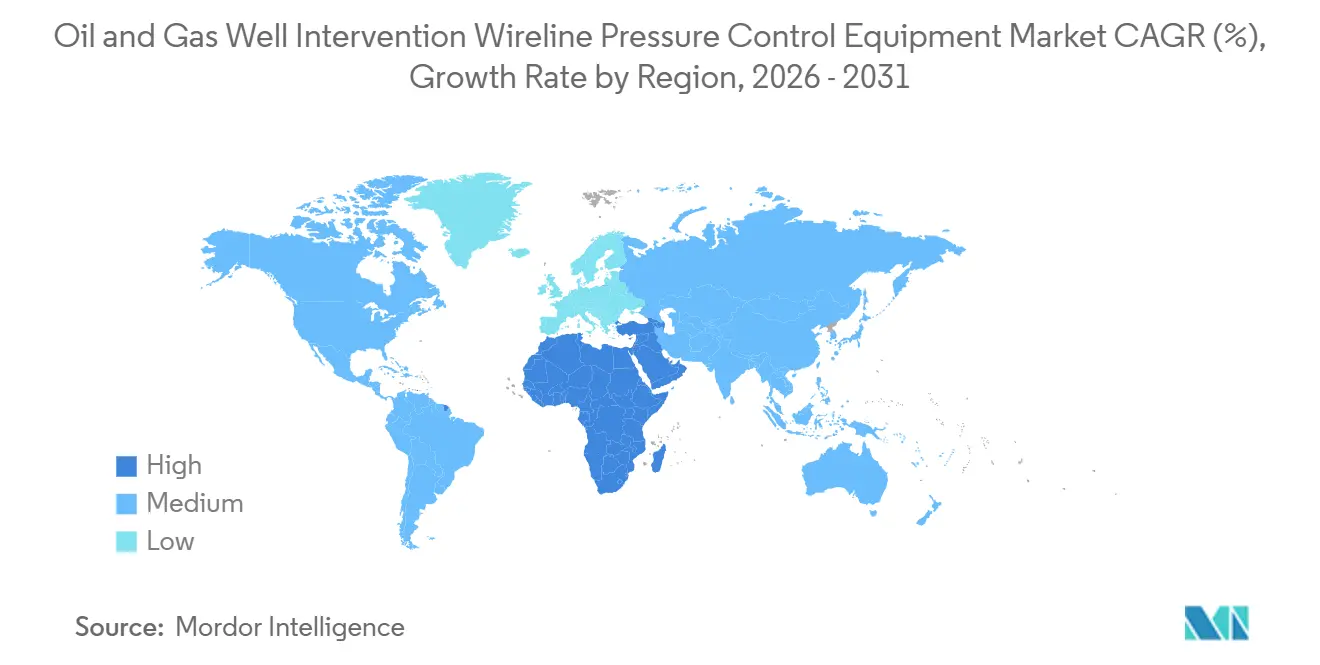
| Fastest Growing Market | Middle East and Africa |
| Largest Market | Middle East and Africa |
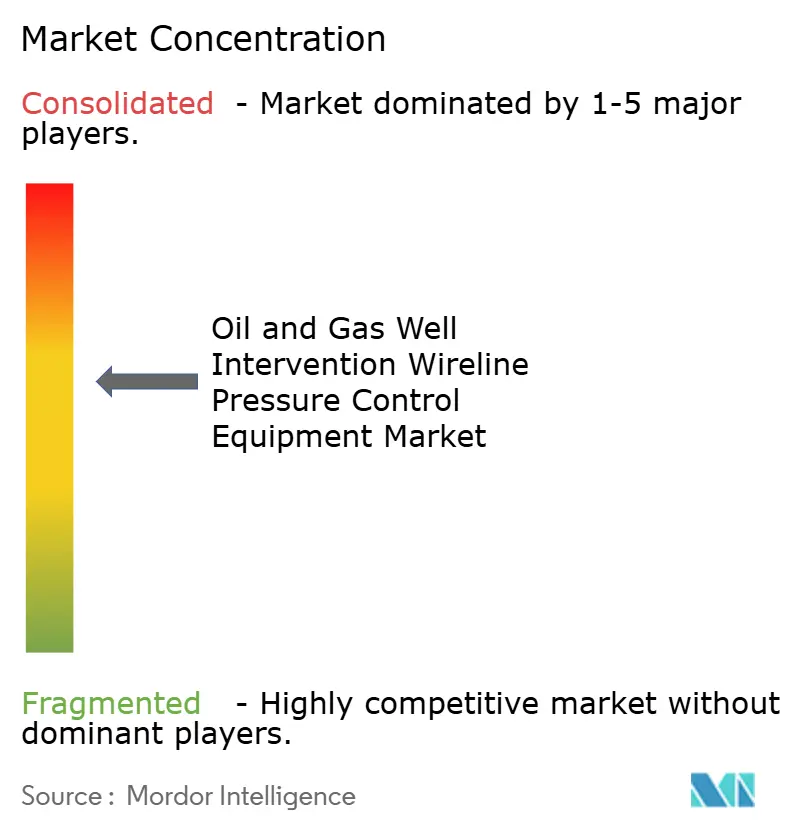
| Market Concentration | Medium |
Major Players *Disclaimer: Major Players sorted in no particular order Image © Mordor Intelligence. Reuse requires attribution under CC BY 4.0. | |
Oil and Gas Well Intervention Wireline Pressure Control Equipment Market Analysis by Mordor Intelligence
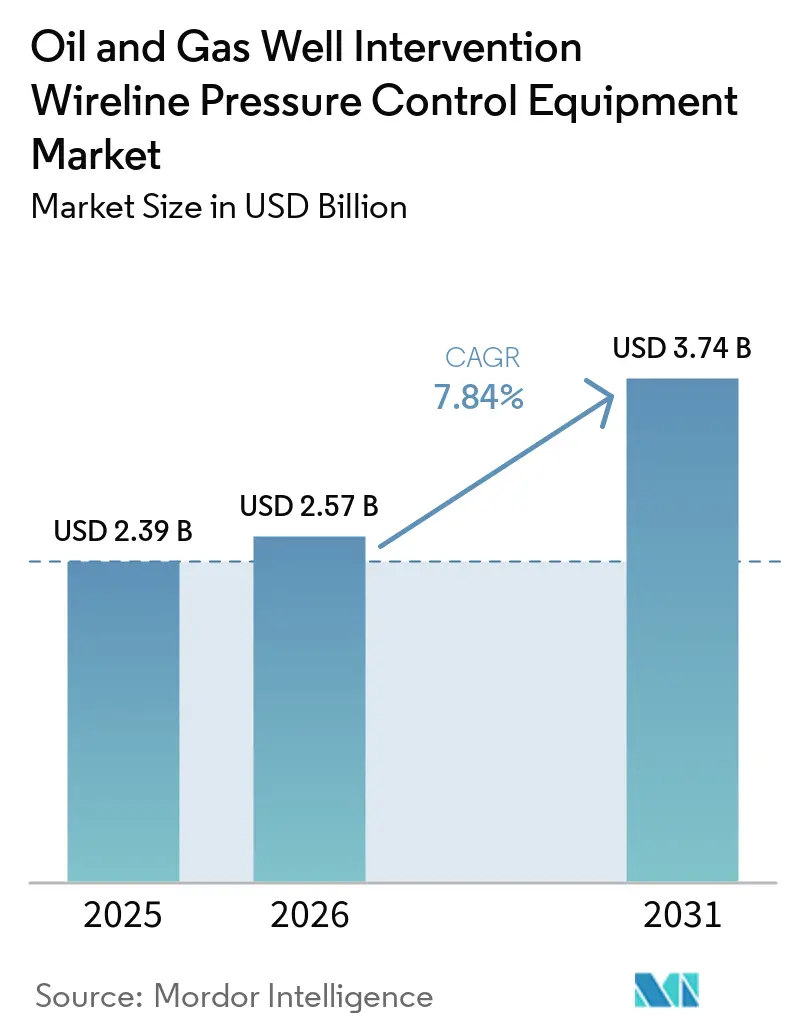
The Oil And Gas Well Intervention Wireline Pressure Control Equipment Market size is expected to grow from USD 2.39 billion in 2025 to USD 2.57 billion in 2026 and is forecast to reach USD 3.74 billion by 2031 at 7.84% CAGR over 2026-2031. The wireline pressure control equipment market is supported by a large base of mature wells that require production logging, integrity work, and mechanical remediation without full rig mobilization. Decommissioning rules are also bringing more plug and abandonment work into planned intervention schedules, especially in the North Sea and West Africa. Operators are extending brownfield programs in the Middle East, Southeast Asia, and North America, which supports demand for equipment that can handle repeated pressure cycles. Higher-pressure gas and deepwater projects are increasing the need for specialized barriers, cables, seals, and stack assemblies. Suppliers are responding through service contracts, certified equipment designs, and products that reduce emissions, rig-up time, and recertification delays.
Key Report Takeaways
- By equipment type, Lubricators and Grease Injection Systems held 32.2% of the wireline pressure control equipment market share in 2025 and are forecast to grow at an 8.6% CAGR through 2031.
- By pressure rating class, Standard Pressure configurations accounted for 50.6% of the wireline pressure control equipment market size in 2025, while HPHT and Extreme Service Applications are projected to advance at an 8.2% CAGR through 2031.
- By application, Production Logging and Monitoring held 30.3% revenue share in 2025, while Well Abandonment and P&A is forecast to grow at an 8.4% CAGR through 2031.
- By geography, the Middle East and Africa held 33.8% revenue share in 2025 and is forecast to expand at an 8.3% CAGR through 2031.
Note: Market size and forecast figures in this report are generated using Mordor Intelligence’s proprietary estimation framework, updated with the latest available data and insights as of January 2026.
Market Trends and Insights
Drivers Impact Analysis of Oil and Gas Well Intervention Wireline Pressure Control Equipment Market*
| Driver | % Impact on CAGR Forecast | Geographic Relevance | Impact Timeline |
|---|---|---|---|
| Mature-Well Intervention Intensity | +2.10% | Global; concentrated in North America, MEA, and APAC | Long term (≥ 4 years) |
| Unconventional and Tight-Reservoir Well Servicing | +1.30% | North America (Permian, Haynesville, Montney) | Medium term (2–4 years) |
| Offshore and Deepwater Well Access | +1.50% | North Sea, Gulf of Mexico, Brazil, West Africa | Medium term (2–4 years) |
| High-Pressure, High-Temperature Well Complexity | +1.10% | MEA deep gas, Brazil pre-salt, Asia-Pacific | Long term (≥ 4 years) |
| Remote Certification and Digital Asset Tracking | +0.70% | Global; early adoption in MENA and APAC | Short term (≤ 2 years) |
| Greaseless and Low-Emission Intervention Systems | +0.80% | North America, North Sea, emerging in MEA | Short term (≤ 2 years) |
| Source: Mordor Intelligence | |||
Mature-Well Intervention Intensity
More than two-thirds of producing wells globally are expected to exceed 10 years of age by 2030, creating a growing requirement for integrity evaluations, production logging, and mechanical remediation [1]. The wireline pressure control equipment market is tied more closely to intervention frequency than to rig counts, which provides some protection from changes in drilling activity. The Middle East directed USD 130 billion to oil and gas supply investment in 2025, or 15% of the global total, and mature-field support formed part of that investment base. More well work increases the use of surface barrier components and can shorten the replacement and recertification cycle for stack assemblies. This pattern supports recurring equipment and refurbishment demand without requiring additional rig mobilization. It also gives manufacturers a steadier source of revenue than product lines that depend only on new drilling programs.
Unconventional and Tight-Reservoir Well Servicing
Long horizontal wells in North American unconventional fields require equipment that can support pump-down delivery and multistage perforating at demanding surface pressures. An SPE paper on a deep HPHT tight-reservoir program described a 0.28-in OD polymer-locked wireline cable with MP35N sour-service armor operating at a 490-bar pressure differential [2]. Such conditions place greater strain on conventional lubrication and sealing, and support the use of packoff-based greaseless systems. Forum Energy Technologies reported that its backlog at the end of 2025 was 46% above the start of that year, supported in part by wireline cable orders from North American completions and international development programs [3]. Refracturing work also supports investment in high-specification equipment when operators see an economic case for restoring production from existing wells. The wireline pressure control equipment market benefits when intervention work is selected as an alternative to drilling a new well.
Offshore and Deepwater Well Access
Riserless light well intervention allows vessel-based wireline work to be performed without a full semisubmersible workover campaign. The supplied research described a purpose-built fleet of 28 vessels in early 2026, compared with 12 vessels in 2018. This wider vessel base increases opportunities for compact subsea-rated pressure control systems. Weatherford secured offshore intervention and P&A contracts with Constellation Oil Services in Brazil during May 2026, supporting operations in the Campos and Espírito Santo basins through December 2028. Vessel-based work can also bring forward P&A activity for wells that were previously waiting for rig availability. This creates a more regular demand pattern for subsea barriers, lubricators, and related intervention equipment.
High-Pressure, High-Temperature Well Complexity
Deep gas programs and deepwater projects are raising equipment requirements in the Middle East, Brazil, and parts of the Asia-Pacific. SLB states that its Xtreme HPHT logging platform is qualified to 25,000 psi and 500°F. The supporting SPE research indicates that cable and stack design must work together to maintain sealing performance under high pressure and corrosive conditions. These wells require corrosion-resistant alloys, specialized seals, and designs that can maintain pressure integrity above 10,000 psi. This raises the value of each equipment package and increases development and qualification time. The wireline pressure control equipment market is therefore moving toward HPHT capability as a standard procurement requirement for some gas and deepwater programs.
Restraints Impact Analysis of Oil and Gas Well Intervention Wireline Pressure Control Equipment Market*
| Restraint | % Impact on CAGR Forecast | Geographic Relevance | Impact Timeline |
|---|---|---|---|
| Upstream Capital-Spending Cyclicality | -1.50% | Global; most acute in non-GCC Africa and Latin America | Short to medium term (≤ 4 years) |
| Stringent Pressure-Equipment Qualification Requirements | -0.80% | Global (API 6A/16A, ISO 13628, ATEX/IECEx in offshore) | Long term (≥ 4 years) |
| Skilled Intervention-Crew and Certification Shortages | -0.70% | North America, North Sea, Southeast Asia | Medium term (2–4 years) |
| Site-Specific Engineering and Long Qualification Cycles | -0.50% | MEA deep gas, ultra-deepwater globally | Long term (≥ 4 years) |
| Source: Mordor Intelligence | |||
Upstream Capital-Spending Cyclicality
Equipment orders usually follow rig-contract approvals and field-development milestones, so the response to changes in oil prices can be delayed by 6-12 months. The IEA reported that investment outside the Gulf Cooperation Council remains more exposed to oil-price corrections, particularly in non-OPEC Africa and Latin America [4]. Weatherford reported lower Middle East wireline activity in its second-quarter 2026 results amid heightened geopolitical tensions. When operators delay field work, they can defer new equipment orders and retain installed assets longer. This weakens refurbishment volumes for specialist suppliers that rely on replacement cycles. The wireline pressure control equipment market remains exposed to this risk even where maintenance work provides a degree of support.
Stringent Pressure-Equipment Qualification Requirements
Wireline pressure control systems must meet applicable API 6A and API 16A requirements, and offshore systems can also require ISO 13628 compliance. Regional requirements for sour service, explosion protection, and operator consent create additional work for manufacturers. Expro launched its Solus single-valve system in February 2026 with API Std 17G validation and NACE MR0175 compliance. These qualifications can make certified equipment more attractive during operator selection, but they also raise entry barriers. New HPHT designs can require 18-36 months to move from design through certification. Long cycles can leave operators using recertified older equipment when new configurations are not yet qualified.
*Our forecasts treat driver/restraint impacts as directional, not additive. The impact forecasts reflect baseline growth, mix effects, and variable interactions.
Oil and Gas Well Intervention Wireline Pressure Control Equipment Market Segment Analysis
By Equipment Type:
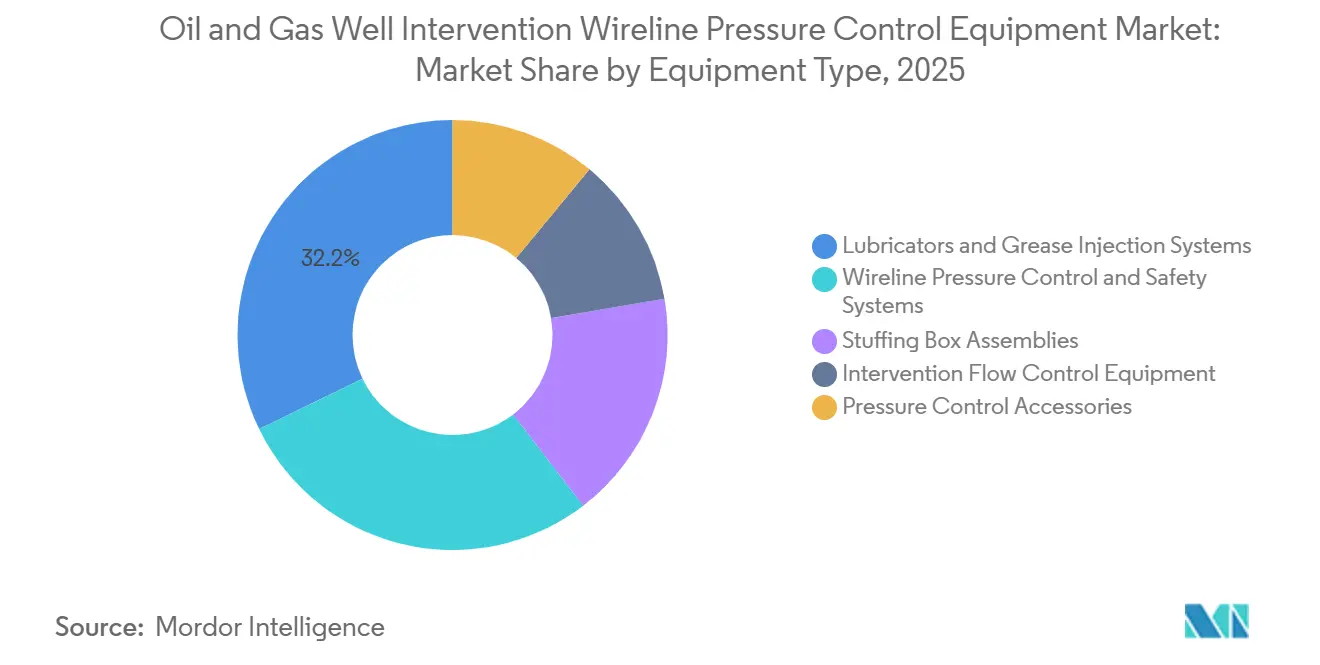
Lubricators Lead as Greaseless Packoffs Reshape the StackLubricators and Grease Injection Systems held 32.2% revenue share in 2025 within the wireline pressure control equipment market. Every live-well wireline run requires a pressure-bearing lubricator string to introduce and retrieve the tool string safely. This requirement makes the category a core part of routine electric-line and slickline work. Its installed base is changing as polymer-jacket greaseless cables and packoff-based sealing reduce reliance on conventional grease-injection configurations. SLB offers the StreamLine polymer-locked wireline cable, while Forum Energy Technologies offers the Enviro-Lite E-Line greaseless cable.
Within the wireline pressure control equipment market, Lubricators and Grease Injection Systems are projected to grow at an 8.6% CAGR from 2026 to 2031. Wireline Pressure Control and Safety Systems and Stuffing Box Assemblies provide the annular sealing function that protects the wellbore pressure barrier. Intervention Flow Control Equipment and Pressure Control Accessories manage fluids and pressure across the stack. Digitally instrumented variants can transmit wellhead pressure and temperature information to remote operations centers. The supplied material indicates a move toward modular accessories that can reduce rig-up time and simplify field servicing.

By Pressure Rating Class:
Standard Pressure Anchors Revenue as HPHT Resets the Specification FloorStandard Pressure configurations, rated at 5,000-10,000 psi, accounted for 50.6% of the wireline pressure control equipment market size in 2025. Within the wireline pressure control equipment market, their position reflects the large number of onshore conventional and shallow-shelf wells operating within this range. Standardized bore dimensions, established API 6A production methods, and sizable installed inventories support a broad aftermarket. These systems remain the usual procurement option for routine production logging and mechanical intervention in mature conventional fields. Periodic API 6A revisions can accelerate purchases when installed assets fall outside current recertification windows.
HPHT and Extreme Service Applications are expected to grow at an 8.2% CAGR from 2026 to 2031. The segment is supported by wells with pressures above 15,000 psi and temperatures above 150°C in the Arabian Peninsula, the Gulf of Mexico, and Southeast Asia. Corrosion-resistant alloys, non-elastomeric seals, and polymer-locked cable systems raise equipment value compared with standard-pressure configurations. The supplied SPE paper supports the need for integrated cable and pressure-control design under a 490-bar differential pressure. High-pressure configurations rated at 10,001-15,000 psi serve deep offshore, sour-gas, and subsea work.
By Application:
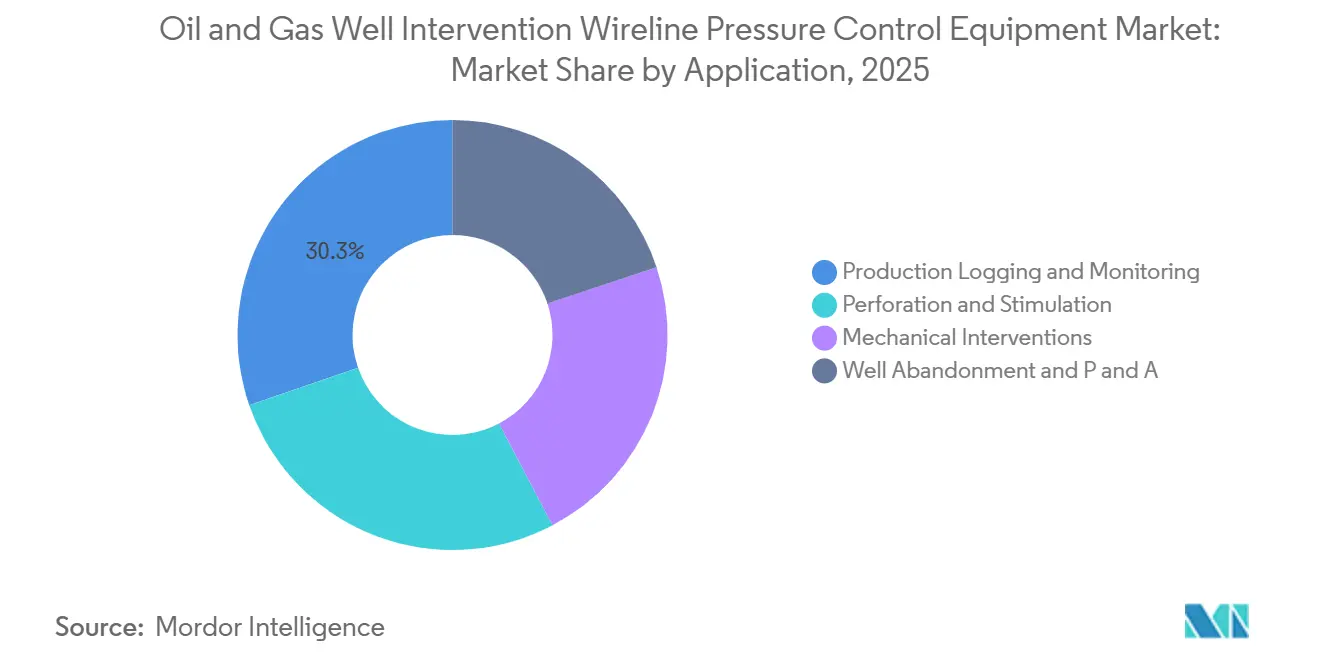
Production Logging Dominates but P&A Is Redefining the Scope of Pressure ControlProduction Logging and Monitoring held 30.3% revenue share in 2025 across the wireline pressure control equipment market. Operators use these campaigns to assess fluid contribution, water encroachment, and zonal allocation before choosing mechanical work. The work uses instrumented electric-line tools within dedicated lubricator and stuffing-box configurations. This creates repeat use of equipment and recurring recertification needs. Halliburton launched the Xaminer Deep Testing logging service in May 2026 for complex, stacked, and heterogeneous formations in a single wireline run.
Within the wireline pressure control equipment market, Well Abandonment and P&A is projected to expand at an 8.4% CAGR from 2026 to 2031. These programs require pressure-control stacks for barrier evaluation, mechanical plug setting, and cement squeeze operations. Their demand is tied to regulatory obligations as well as production economics. Archer received a June 2026 contract covering P&A services for more than 260 wells across the Beryl and Forties fields in the UK North Sea. The work includes wireline, coiled tubing, and specialized downhole access equipment under a multiyear framework.
Geography Analysis
MEA Oil and Gas Well Intervention Wireline Pressure Control Equipment Market
The Middle East and Africa held 33.8% of the wireline pressure control equipment market share in 2025 and is expected to grow at an 8.3% CAGR through 2031. This position reflects active deep-gas and tight-carbonate projects, continued mature-field work, and rising decommissioning requirements in West Africa. The IEA recorded USD 130 billion of oil and gas supply investment in the Middle East in 2025. Saudi Aramco provided 2026 capital-expenditure guidance of USD 50-55 billion and stated that 65-70% would be directed to upstream exploration and production. Marjan, Zuluf, and Jafurah's activity requires sustained intervention work and supports demand for HPHT equipment.
North America and Europe Oil and Gas Well Intervention Wireline Pressure Control Equipment Market
North America remained an important revenue contributor in 2025 because of high intervention activity in the Permian, Haynesville, and Montney plays. Methane-control requirements encourage contractors to use zero-venting lubricators and closed-loop pressure-control systems. Europe is shaped largely by North Sea brownfield decommissioning. The North Sea Transition Authority expects 1,000 wells to be permanently plugged over the coming decade. Expro stated that its Solus valve was used in a North Sea P&A campaign before its February 2026 commercial release.
APAC and South America Oil and Gas Well Intervention Wireline Pressure Control Equipment Market
Asia-Pacific has a substantial base of standard-pressure intervention work in Indonesia, Malaysia, India, and China. Deep-gas and tight-formation programs are also increasing demand for higher-rated systems. In the wireline pressure control equipment market, South America combines Brazil’s high-specification pre-salt work with steady demand from mature onshore fields in Colombia, Guyana, and Argentina. Weatherford’s Brazil contracts demonstrate continued use of offshore intervention and P&A equipment in Campos and Espírito Santo.
Competitive Landscape
The wireline pressure control equipment market has a moderately consolidated top tier. Baker Hughes, Halliburton, SLB, and Weatherford combine pressure-control equipment with proprietary toolstrings and long-term service contracts. Expro, NOV through its Elmar brand, Forum Energy Technologies, and Hunting serve specialized needs in subsea work, vessel-based intervention, and high-pressure applications. Baker Hughes completed the formation of a joint venture with Cactus on January 1, 2026, contributing its surface pressure control business to the new entity. Suppliers compete through certification, equipment reliability, integrated service capacity, and project-specific requirements.
Expro launched Solus in February 2026 as a single shear-and-seal ball-valve system for slickline, braided wireline, and coiled-tubing operations. Its API Std 17G validation and NACE MR0175 compliance demonstrate the value of certified designs in subsea work. NOV’s remote recertification program in Mumbai processed more than 600 wireline parts requests over 18 months and reduced average lead times by up to 10 weeks. Halliburton has also filed a patent application for a robotic subsea wireline intervention system that could operate without direct vessel dependency. Smaller providers retain roles where fast customization and local service are important.
The main opportunity areas in the wireline pressure control equipment market are greaseless, low-emission stacks and digitally instrumented assemblies that communicate barrier data to operations centers. Major service companies can use installed tool ecosystems and contracts to support wider adoption. Specialist manufacturers can compete through niche engineering and regional service support. Qualification remains an important barrier because high-pressure and offshore designs require extensive validation.
Oil and Gas Well Intervention Wireline Pressure Control Equipment Industry Leaders
-
Schlumberger Limited
-
Baker Hughes Company
-
Halliburton Company
-
Weatherford International plc
-
NOV Inc.
- *Disclaimer: Major Players sorted in no particular order
Oil and Gas Well Intervention Wireline Pressure Control Equipment Market Companies Covered in this Report
- Baker Hughes Company
- Brace Tool, Inc.
- Expro Group Holdings N.V.
- FHE USA, LLC
- Forum Energy Technologies, Inc.
- GKD Industries Ltd.
- Halliburton Company
- Hunting PLC
- Integrated Equipment Services, LLC
- NOV Inc.
- NXL Technologies, Inc.
- PROBUS Maschinenbau GmbH
- RMZ Oilfield Engineering LLC
- Schlumberger Limited
- TIS Manufacturing Ltd.
- Weatherford International plc
Recent Industry Developments in Oil and Gas Well Intervention Wireline Pressure Control Equipment Market
- June 2026: Archer Limited contracted by Well-Safe Solutions for plug and abandonment services across the Beryl and Forties fields, covering more than 260 wells across 7 platforms. Archer provides platform-based drilling services, wireline, coiled tubing, and specialist subsea P&A solutions under a multiyear integrated framework.
- May 2026: Halliburton launched the Xaminer Deep Testing logging service, a wireline-based formation testing platform delivering deep-reading producibility and boundary identification in complex, stacked, and heterogeneous reservoirs in a single run. The service integrates high-resolution pressure measurements and multizone capability.
- May 2026: Weatherford International secured offshore well intervention and P&A contracts with Constellation Oil Services in Brazil’s Campos and Espírito Santo basins. The contracts run through December 2028 and support operations on the ultra-deepwater semisubmersible Gold Star.
- April 2026: Halliburton introduced the Volta all-electric control system for intelligent completions. The mono-conductor, single-line design eliminates hydraulics and integrates with wireline-deployed smart-well completions.
Global Oil and Gas Well Intervention Wireline Pressure Control Equipment Market Report Scope
Oil and Gas Well Intervention Wireline Pressure Control Equipment (WPCE) refers to a set of high-pressure containment and sealing devices installed at the wellhead during wireline intervention operations. These devices safely control well pressure while allowing wireline tools to be deployed into or retrieved from a live (pressurized) oil or gas well without killing the well. WPCE forms a pressure-tight barrier between the wellbore and the environment, preventing the uncontrolled release of hydrocarbons while ensuring the safe execution of logging, perforating, plug setting, fishing, and other wireline intervention activities.
The Oil and Gas Well Intervention Wireline Pressure Control Equipment Market is segmented by equipment type, pressure rating, application, and geography. By equipment type, the market is segmented into lubricators and grease injection systems, wireline pressure control and safety systems, stuffing box assemblies, intervention flow control equipment, and pressure control accessories. By pressure rating, the market is segmented into standard pressure (5,000-10,000 psi), high pressure (10,001-15,000 psi), and HPHT / extreme service applications. By application, the market is segmented into production logging and monitoring, perforation and stimulation, mechanical interventions and well abandonment and P&A. By geography, the market is segmented into across 22 countries in key regions. For each segment, the market sizing and forecasts have been provided on the basis of value (USD).
| Lubricators and Grease Injection Systems |
| Wireline Pressure Control and Safety Systems |
| Stuffing Box Assemblies |
| Intervention Flow Control Equipment |
| Pressure Control Accessories |
| Standard Pressure (5,000-10,000 psi) |
| High Pressure (10,001-15,000 psi) |
| HPHT / Extreme Service Applications |
| Production Logging and Monitoring |
| Perforation and Stimulation |
| Mechanical Interventions |
| Well Abandonment and P&A |
| North America | United States |
| Canada | |
| Mexico | |
| Europe | United Kingdom |
| Norway | |
| Netherlands | |
| Denmark | |
| Rest of Europe | |
| Asia-Pacific | China |
| India | |
| Australia | |
| ASEAN Countries | |
| Rest of Asia-Pacific | |
| South America | Brazil |
| Argentina | |
| Colombia | |
| Guyana | |
| Rest of South America | |
| Middle East and Africa | Saudi Arabia |
| United Arab Emirates | |
| Kuwait | |
| Qatar | |
| Oman | |
| Nigeria | |
| Angola | |
| Egypt |
| By Equipment Type | Lubricators and Grease Injection Systems | |
| Wireline Pressure Control and Safety Systems | ||
| Stuffing Box Assemblies | ||
| Intervention Flow Control Equipment | ||
| Pressure Control Accessories | ||
| By Pressure Rating Class | Standard Pressure (5,000-10,000 psi) | |
| High Pressure (10,001-15,000 psi) | ||
| HPHT / Extreme Service Applications | ||
| By Application | Production Logging and Monitoring | |
| Perforation and Stimulation | ||
| Mechanical Interventions | ||
| Well Abandonment and P&A | ||
| By Geography | North America | United States |
| Canada | ||
| Mexico | ||
| Europe | United Kingdom | |
| Norway | ||
| Netherlands | ||
| Denmark | ||
| Rest of Europe | ||
| Asia-Pacific | China | |
| India | ||
| Australia | ||
| ASEAN Countries | ||
| Rest of Asia-Pacific | ||
| South America | Brazil | |
| Argentina | ||
| Colombia | ||
| Guyana | ||
| Rest of South America | ||
| Middle East and Africa | Saudi Arabia | |
| United Arab Emirates | ||
| Kuwait | ||
| Qatar | ||
| Oman | ||
| Nigeria | ||
| Angola | ||
| Egypt | ||
Key Questions Answered in the Report
What is driving demand for wireline pressure control equipment?
Mature-well interventions, decommissioning work, offshore access, and higher-pressure wells support demand for pressure-control systems.
How large is the wireline pressure control equipment market?
The sector is estimated at USD 2.57 billion in 2026 and is forecast to reach USD 3.74 billion by 2031 at a 7.84% CAGR.
Which equipment type leads revenue?
Lubricators and Grease Injection Systems led with 32.2% share in 2025 and are forecast to grow at an 8.6% CAGR through 2031.
Which application is growing fastest?
Well Abandonment and P&A is forecast to grow at an 8.4% CAGR from 2026 to 2031.
Which region has the strongest outlook?
The Middle East and Africa held 33.8% share in 2025 and is expected to expand at an 8.3% CAGR through 2031.