
Oil and Gas Upstream Fasteners Market Size and Share
Market Overview
| Study Period | 2021 - 2031 |
|---|---|
| Market Size (2026) | USD 517.64 Million |
| Market Size (2031) | USD 602.77 Million |
| Growth Rate (2026 - 2031) | 3.09 % |
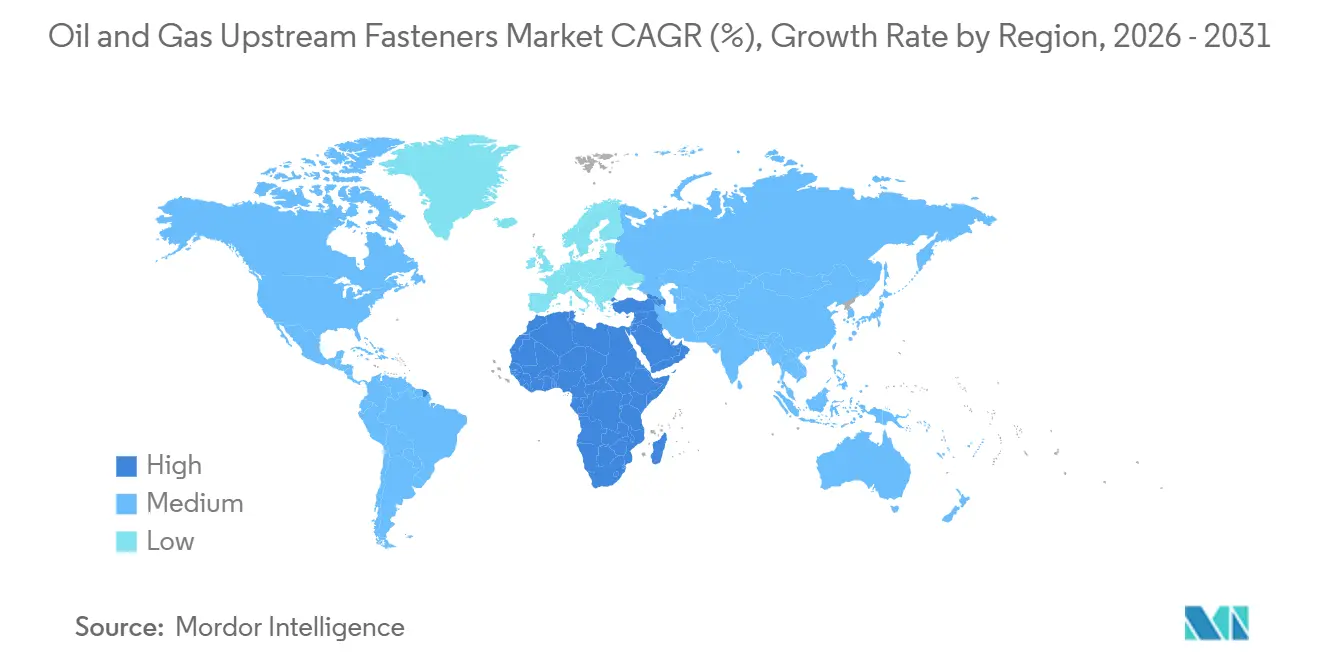
| Fastest Growing Market | Middle East and Africa |
| Largest Market | North America |
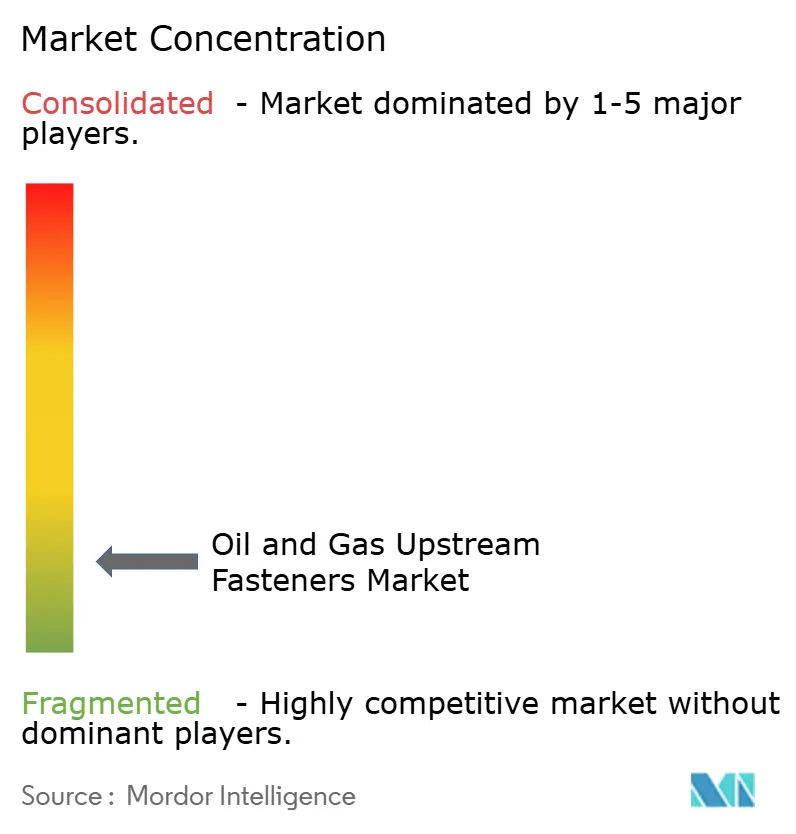
| Market Concentration | Low |
Major Players *Disclaimer: Major Players sorted in no particular order Image © Mordor Intelligence. Reuse requires attribution under CC BY 4.0. | |
Oil and Gas Upstream Fasteners Market Analysis by Mordor Intelligence
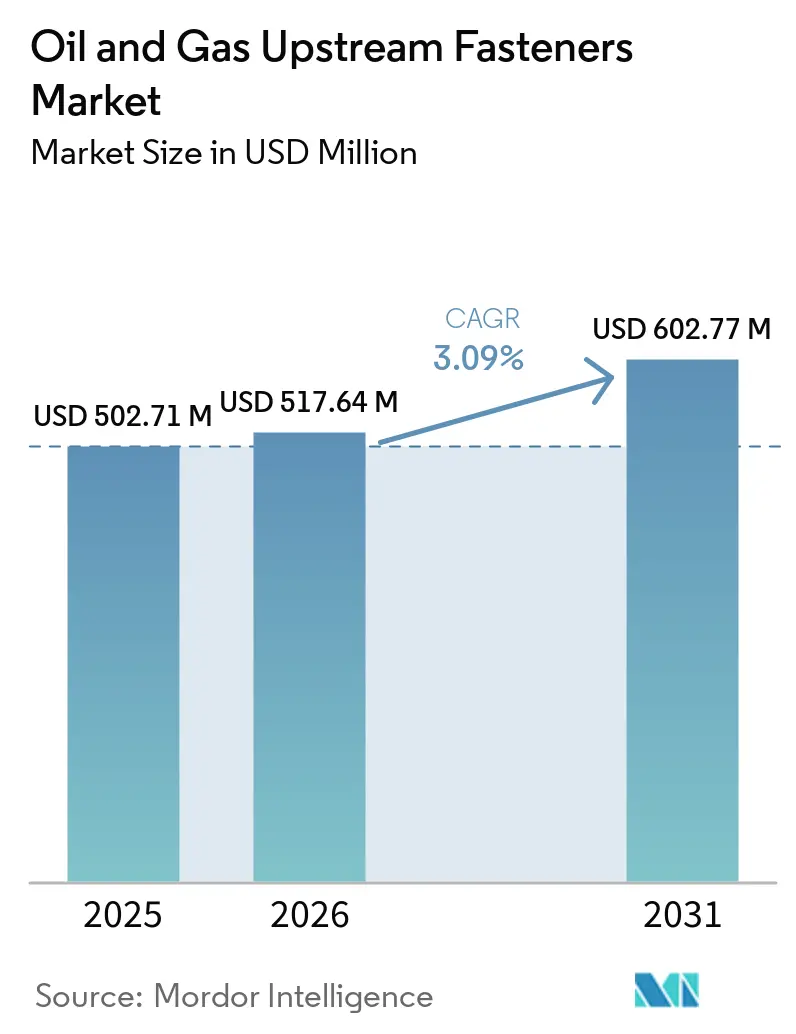
The Oil and Gas Upstream Fasteners Market size is projected to expand from USD 502.71 million in 2025 and USD 517.64 million in 2026 to USD 602.77 million by 2031, registering a CAGR of 3.09% between 2026 and 2031. The oil and gas upstream fasteners market is shaped by deepwater construction, mature-asset maintenance, and more demanding material specifications. Carbon and alloy steel remain important in drilling and topside work, while duplex, super duplex, and nickel alloys are gaining relevance in subsea and sour-service work. These uses require traceability, testing, and supplier qualification that are harder for general distributors to provide. The oil and gas upstream fasteners market, therefore, offers stronger opportunities for suppliers that can combine certified manufacturing, material control, and timely delivery. Oil-price movements and steel costs can still delay procurement decisions and pressure supplier margins.
Key Report Takeaways
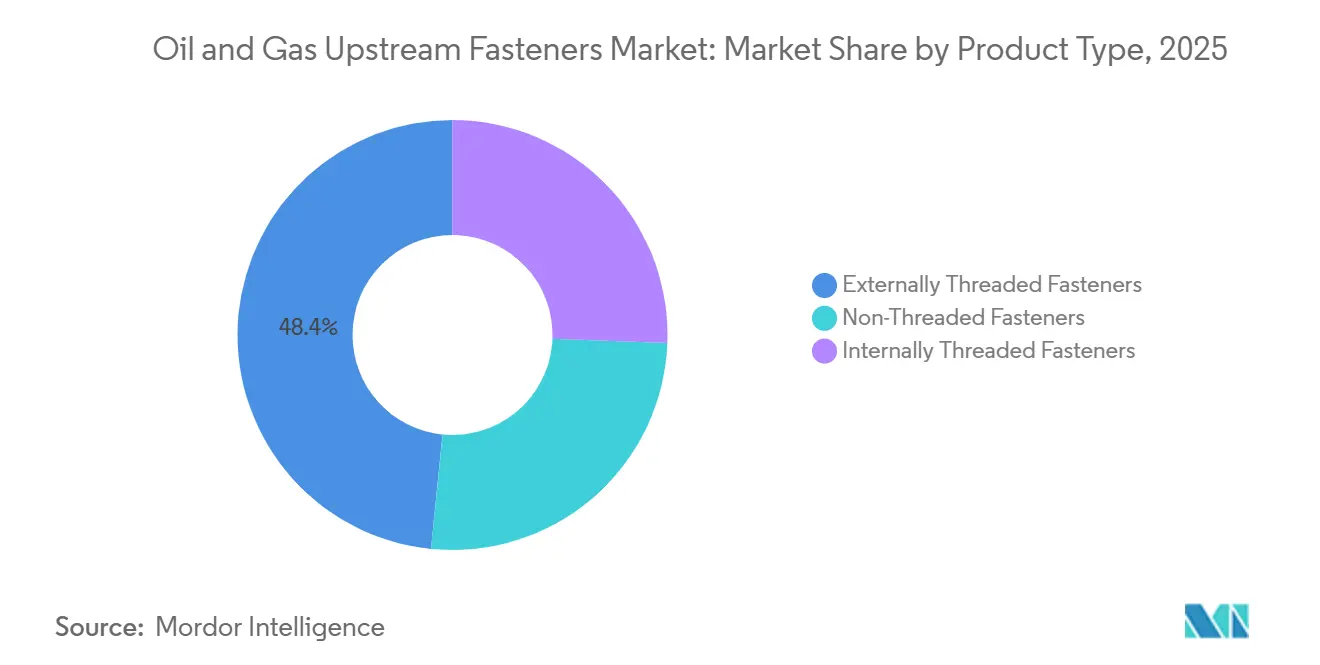
- By product type, externally threaded fasteners led with 48.4% revenue share in 2025, while internally threaded fasteners recorded the highest projected CAGR at 3.6% through 2031.
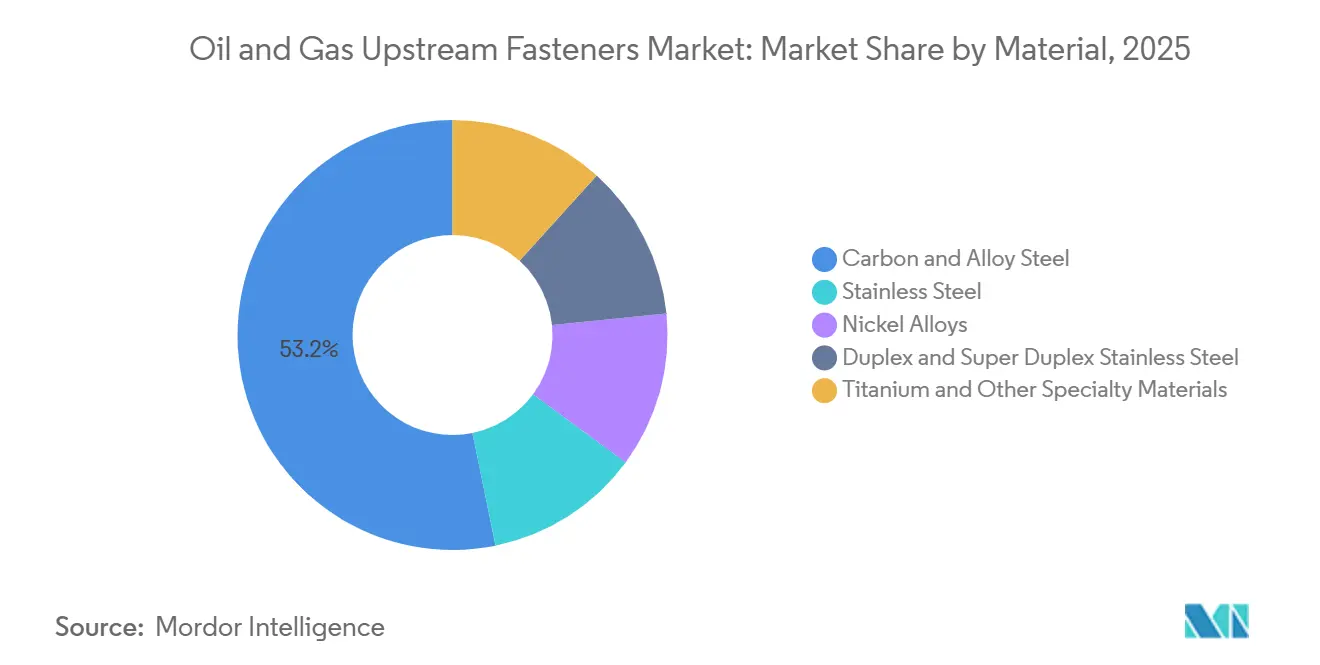
- By material, carbon and alloy steel held 53.2% revenue share in 2025, while duplex and super duplex stainless steel recorded the highest projected CAGR at 3.8% through 2031.
- By application, drilling equipment accounted for 27.4% of the oil and gas upstream fasteners market size in 2025, while subsea infrastructure is advancing at a 4.1% CAGR through 2031.
- By geography, North America held 29.1% revenue share in 2025, while the Middle East and Africa recorded the highest projected CAGR at 4.3% through 2031.
Note: Market size and forecast figures in this report are generated using Mordor Intelligence’s proprietary estimation framework, updated with the latest available data and insights as of January 2026.
Market Trends and Insights
Drivers Impact Analysis of Oil and Gas Upstream Fasteners Market*
| Driver | (~) % Impact on CAGR Forecast | Geographic Relevance | Impact Timeline |
|---|---|---|---|
| Deepwater and Ultra-Deepwater Project Development | +0.80% | Global; Latin America, Asia-Pacific, and West Africa lead | Long term (≥ 4 years) |
| Brownfield Well Intervention and Integrity Programs | +0.60% | North Sea, Gulf of Mexico, Southeast Asia | Medium term (2–4 years) |
| API 20E and API 20F Qualification-Driven Procurement | +0.40% | Global; concentrated in North America and Middle East | Short term (≤ 2 years) |
| Middle East and Asian NOC Upstream Investment | +0.70% | Middle East & Africa, Asia-Pacific | Medium term (2–4 years) |
| Digitally Traceable and Smart Fastener Adoption | +0.20% | Global; led by North Sea and Gulf of Mexico operators | Long term (≥ 4 years) |
| Sour-Service and Corrosion-Resistant Fastener Upgrading | +0.50% | Middle East, Gulf of Mexico, Southeast Asia | Short to medium term (≤ 4 years) |
| Source: Mordor Intelligence | |||
Deepwater and Ultra-Deepwater Project Development
Deepwater activity supports demand for components that can withstand pressure, seawater exposure, and sour-service conditions. The oil and gas upstream fasteners market benefits because subsea trees, wellheads, manifolds, and connectors use high-specification bolting across many critical joints. These assemblies commonly require duplex, super duplex, or nickel-based materials instead of standard carbon steel. Petrobras planned to sign 6 proprietary FPSO contracts in 2026 and 2027, supporting continued demand for equipment installed around offshore production systems. Suppliers with documented material traceability and subsea approval can address this demand more effectively than suppliers serving only standard industrial applications. The oil and gas upstream fasteners market also gains value per unit when offshore specifications require more testing and higher-grade alloys.
Brownfield Well Intervention and Integrity Programs
Mature offshore assets require regular inspection, repair, and replacement work to maintain safe operation. This work supports recurring demand in the oil and gas upstream fasteners market because corroded or damaged joint systems may require replacement sets rather than isolated parts. Equinor extended NOK 17 billion in drilling and well services agreements for the Norwegian Continental Shelf in May 2026[1]. Shell expanded its U.S. Gulf brownfield engineering program during 2026, which adds visibility to work on existing offshore assets[2]. Brownfield programs favor suppliers that can provide certified replacements within maintenance schedules. The oil and gas upstream fasteners market also benefits when lifecycle work shifts procurement from occasional purchases to managed service agreements.
API 20E and API 20F Qualification-Driven Procurement
Qualification requirements have raised the importance of manufacturing controls, testing records, and heat traceability in upstream bolting procurement. The oil and gas upstream fasteners market has a narrower supplier base in subsea and sour-service applications because buyers need evidence that products meet their specified standards. LoneStar Fasteners Hydrobolt received API 20E third-edition accreditation for BSL-1, BSL-2, and BSL-3 on March 7, 2025[3]. This type of accreditation helps suppliers compete for applications where product failure can affect asset integrity. The requirement for repeatable documentation can slow entry by distributors without manufacturing capabilities. It also gives established specialists a reason to invest in quality systems and inspection capacity.
Middle East and Asian NOC Upstream Investment
National oil company programs are sustaining demand for offshore platforms, wellheads, and related equipment across the Middle East and Asia. The oil and gas upstream fasteners market is exposed to these programs because sour gas and offshore applications often need corrosion-resistant materials and traceable components. Aramco reported 2026 capital expenditure guidance of USD 50 billion to USD 55 billion and continued investment in upstream capacity. Eni and PETRONAS established Searah in June 2026 to pursue assets in Indonesia and Malaysia. These programs can improve order continuity for approved suppliers over several years. They also increase the importance of local service capability and reliable access to specialty materials.
Restraints Impact Analysis of Oil and Gas Upstream Fasteners Market*
| Restraint | (~) % Impact on CAGR Forecast | Geographic Relevance | Impact Timeline |
|---|---|---|---|
| Upstream Capex Cyclicality and Oil-Price Exposure | -0.60% | Global | Short to medium term (≤ 4 years) |
| Qualification, Documentation, and Testing Burden | -0.30% | Global | Short term (≤ 2 years) |
| Alloy, Steel, and Tariff Cost Volatility | -0.50% | North America; global supply chains | Short term (≤ 2 years) |
| Installation Error and Hydrogen-Embrittlement Risk | -0.20% | Global; concentrated in subsea and sour-service environments | Medium term (2–4 years) |
| Source: Mordor Intelligence | |||
Upstream Capex Cyclicality and Oil-Price Exposure
Capital spending decisions remain sensitive to oil prices, project economics, and operator cash priorities. When project sanctions move later, the oil and gas upstream fasteners market faces less visibility into forward orders for specialty grades. Suppliers may be reluctant to hold large inventories of duplex or nickel-based products when demand timing is uncertain. Delays also reduce the benefit of long production lead times for qualified materials. Some suppliers seek adjacent work in hydrogen, carbon capture, or offshore wind to reduce exposure to one investment cycle. That shift is not simple because these applications require their own qualifications, customer relationships, and operating capabilities.
Alloy, Steel, and Tariff Cost Volatility
Raw-material prices can directly affect the cost base for carbon steel, alloy steel, and corrosion-resistant fasteners. U.S. steel import tariffs were increased to 50% from June 4, 2025, adding cost pressure across supply chains. The oil and gas upstream fasteners market is particularly exposed when suppliers cannot pass higher input costs through contract terms. Specialty grades have an additional constraint because material qualification is linked to controlled heats and traceability. A change in raw material source can require renewed testing and documentation before critical use. This limits supplier flexibility when nickel and specialty alloy costs change quickly.
*Our forecasts treat driver/restraint impacts as directional, not additive. The impact forecasts reflect baseline growth, mix effects, and variable interactions.
Oil and Gas Upstream Fasteners Market Segment Analysis
By Product Type:
Threaded Geometry Supports Critical ConnectionsExternally threaded fasteners held 48.4% of the oil and gas upstream fasteners market share in 2025. Studs, bolts, and cap screws remain widely used in wellhead assemblies, drilling equipment, platform topsides, and FPSO systems. Their design fits common flange arrangements and established tensioning practices. The segment benefits from a large installed base that requires both new-build and replacement components. External threads also support high-load connections where access for tensioning equipment is available. This keeps the product category important across established upstream equipment designs.
Internally threaded fasteners are projected to expand at a 3.6% CAGR through 2031. Their use is increasing in subsea assemblies where remote operation and repeatable torque application are important. Female-connection designs can suit equipment installed with remotely operated vehicles in low-visibility conditions. They can also require more complex machining and inspection than standard external-thread products. Non-threaded products, including pins, clips, and retaining rings, retain a smaller role in equipment exposed to vibration and cyclic loads. The oil and gas upstream fasteners market will continue to use each product type because equipment design and operating environment determine the appropriate joint configuration.

By Material:
Corrosion Resistance Raises the Value of Specialty GradesCarbon and alloy steel accounted for 53.2% of the oil and gas upstream fasteners market share in 2025. These materials serve drilling equipment, structural connections, and onshore well-pad infrastructure, where cost and availability remain important. They are suitable for many applications that do not require high resistance to sour fluids or seawater. Steel tariffs and more stringent material requirements can affect their competitive position. This leaves the category exposed to both input-cost changes and specification limits. It nonetheless remains central to the oil and gas upstream fasteners industry because of its broad use across upstream operations.
Duplex and super duplex stainless steel are expected to grow at a 3.8% CAGR through 2031. These grades offer higher strength and corrosion resistance in chloride-rich offshore conditions than common austenitic stainless steel. Research published in 2025 examined stress corrosion cracking in downhole duplex stainless steels, reinforcing the importance of material behavior in sour-service applications[4]. Nickel alloys occupy the highest-value applications in ultra-deepwater trees, high-pressure manifolds, and actuator systems. Standard stainless steel has a stable position in moderate offshore conditions. Titanium and other specialty materials remain relevant where weight reduction or a particular strength-to-weight requirement justifies their cost.
By Application:
Subsea Systems Create Higher-Specification DemandDrilling equipment held 27.4% of the oil and gas upstream fasteners market share in 2025. Blowout preventers, top drives, and drill-collar assemblies require regular inspection and replacement cycles. This demand is linked not only to new rig construction but also to maintenance requirements. The segment includes many critical joints that require dependable load-bearing performance. Suppliers compete on product availability, documentation, and the ability to meet equipment specifications. The oil and gas upstream fasteners market, therefore, retains a large recurring opportunity in drilling-related equipment.
Subsea infrastructure is the fastest-growing application, with a projected 4.1% CAGR through 2031. It includes trees, manifolds, connectors, umbilical systems, risers, and flowlines that operate in demanding offshore conditions. SLB OneSubsea received an integrated EPC award for CNOOC's Kaiping 18-1 deepwater development in March 2026. FPSOs need fasteners across mooring, riser, process, hull, and topside systems. SBM Offshore signed contracts for Petrobras FPSOs SEAP-I and SEAP-II during 2026. Wellheads, offshore platforms, and flowline systems continue to support demand through asset-life extension and integrity programs.
Geography Analysis
North America and Europe Oil and Gas Upstream Fasteners Market
North America held 29.1% of the oil and gas upstream fasteners market share in 2025. The region combines drilling activity, Gulf of Mexico deepwater work, and maintenance needs in Canadian oil sands operations. Domestic sourcing can support standard carbon steel products, while specialty grades may still rely on broader supply networks. SLB OneSubsea received a subsea boosting contract for bp's Thunder Horse project in June 2026. This work supports the demand for documented subsea components. Europe is supported by North Sea maintenance, intervention, and integrity activity. Equinor's May 2026 drilling and well services extension illustrates the continued need for work on mature offshore infrastructure. European operators also continue to adopt digital approaches to bolted-joint management. MODS updated its Connect Integrity platform in June 2025 with unique joint IDs, digital checks, and validation functions.
APAC and South America Oil and Gas Upstream Fasteners Market
Asia-Pacific demand is tied to activity by PETRONAS, CNOOC, and ONGC across offshore and gas assets. The oil and gas upstream fasteners market gains from Indonesian, Malaysian, and South China Sea developments that need subsea production equipment. Eni and PETRONAS established Searah in June 2026 to combine their interests in Indonesia and Malaysia. SLB OneSubsea was awarded a major umbilical contract for an offshore Indonesia project during 2026. South America is led by Brazil, where pre-salt developments support a long pipeline of FPSO and subsea work. SBM Offshore contracted its seventh Multi-Purpose Floater hull in June 2026. These projects require components across production, mooring, and flow-assurance systems.
MEA Oil and Gas Upstream Fasteners Market
The Middle East and Africa is projected to grow at a 4.3% CAGR through 2031. The region benefits from large national oil company programs that can provide more consistent demand than short-cycle drilling markets. Aramco's 2026 capital guidance of USD 50 billion to USD 55 billion includes continued upstream investment. Offshore construction and sour-service conditions raise the need for certified, corrosion-resistant bolting. The oil and gas upstream fasteners market is positioned to benefit where new platforms, wellheads, and subsea facilities move into execution. African deepwater projects add a further source of demand for qualified offshore products. Suppliers able to support local logistics and approved-vendor requirements are likely to be better placed in these programs.
Competitive Landscape
The oil and gas upstream fasteners market is fragmented. Specialist manufacturers compete with a broader set of industrial fastener distributors that have developed oil and gas offerings. Certification depth, material control, and traceability are key competitive factors for high-specification work. LoneStar Group's API 20E third-edition accreditation in March 2025 supported its position in BSL-1, BSL-2, and BSL-3 applications. Such credentials are important in deepwater and sour-service procurement. The oil and gas upstream fasteners market favors suppliers that can document performance and maintain reliable lead times. Approved vendor systems can make it harder for newer suppliers to enter critical applications.
Lamons has expanded its capabilities through the acquisition of Auge Industrial Fasteners and the ModuHouston facility. These moves added oil and gas bolting capacity and zinc-nickel coating capabilities to its operations. Lamons also introduced its Extreme Temperature Gasket in April 2025, extending its offering into high-temperature sealing applications. LoneStar Group's accreditation supports access to certified global supply chains. MODS has developed a digital joint-management capability that supports inspection and traceability workflows. The oil and gas upstream fasteners market may create further opportunities where digital identification is integrated with physical asset maintenance.
Xerafy launched the XPLORER Screw in April 2026 for OCTG and tubular lifecycle tracking. This product reflects interest in faster asset identification and inspection processes. Competition is also emerging from specialty alloy producers that can offer qualified products at competitive prices. Incumbents retain an advantage where they already meet operator documentation and field-performance requirements. The oil and gas upstream fasteners market remains open to innovation in high-pressure, high-temperature, and digitally traceable applications. Smaller suppliers may find it difficult to fund certification, testing, and global logistics at the same time.
Oil and Gas Upstream Fasteners Industry Leaders
-
LoneStar Group
-
Lamons Manufacturing & Service Co.
-
LISI Group
-
National Bolt & Nut Corporation
-
Dokka Fasteners AS
- *Disclaimer: Major Players sorted in no particular order
Oil and Gas Upstream Fasteners Market Companies Covered in this Report
- All-Pro Fasteners
- All-Pro Threaded Products
- APIS MC Ltd
- Birmingham Fastener and Supply Inc.
- Brighton-Best International
- Dokka Fasteners AS
- Doxsteel Fasteners
- Hague Fasteners Limited
- HCL Fasteners Ltd
- Lamons Manufacturing & Service Co.
- LISI Group
- LoneStar Group
- MARO Fasteners B.V.
- MW Industries, Inc.
- National Bolt & Nut Corporation
- Thomas Smith Fasteners
- U.S. Bolt Manufacturing, Inc.
Recent Industry Developments in Oil and Gas Upstream Fasteners Market
- April 2026: Xerafy launched the XPLORER Screw, an embeddable M24-threaded RFID tag for OCTG and tubular asset lifecycle tracking with a 5-meter in-metal read range, presented at OTC Houston 2026; the product extends RFID-based digital identity management from supply-chain logistics into field inspection and integrity workflows.
- November 2025: MODS released a major update to MODS Connect Integrity, adding lifetime unique joint IDs, digital check sheets, built-in torque and piping specification validation, and automatic anomaly flagging for bolted flange management across offshore and LNG assets.
- March 2025: LoneStar Fasteners Hydrobolt achieved API 20E 3rd Edition compliance (BSL-1, BSL-2, and BSL-3), effective March 7, 2025, under the updated API Monogram Program; the accreditation qualifies the company for deepwater and sour-service bolting procurement under the revised global standard.
Global Oil and Gas Upstream Fasteners Market Report Scope
Oil and gas upstream fasteners are mechanical fastening components used to join, assemble, and maintain equipment and structures involved in the exploration, drilling, production, and well-completion stages of the oil and gas industry. These include bolts, nuts, screws, studs, threaded rods, washers, and other specialized fastening products designed to withstand high pressures, temperatures, vibration, corrosive environments, and demanding offshore and onshore operating conditions.
The Oil and Gas Upstream Fastener Market is segmented by product type, material, application, and geography. By product type, the market is segmented into externally threaded fasteners, internally threaded fasteners, and non-threaded fasteners. By material, the market is segmented into carbon and alloy steel, stainless steel, nickel alloys, duplex and super duplex stainless steel, and titanium and specialty materials. By application, the market is segmented into drilling equipment, subsea infrastructure, wellheads, FPSOs, offshore platforms, and flowlines and risers. The report also covers the market size and forecasts for the global oil and gas upstream fastener market across 26 countries in key regions. For each segment, the market sizing and forecasts have been provided on the basis of value (USD).
Segmentation Overview
| Externally Threaded Fasteners |
| Internally Threaded Fasteners |
| Non-Threaded Fasteners |
| Carbon and Alloy Steel |
| Stainless Steel |
| Nickel Alloys |
| Duplex and Super Duplex Stainless Steel |
| Titanium and Other Specialty Materials |
| Drilling Equipment |
| Subsea Infrastructure |
| Wellheads and Christmas Trees |
| FPSOs and Floating Production Units |
| Offshore Platforms and Rigs |
| Flowlines, Risers, and Manifolds |
| North America | United States |
| Canada | |
| Mexico | |
| Europe | Germany |
| France | |
| Italy | |
| Spain | |
| United Kingdom | |
| Poland | |
| Russia | |
| Rest of Europe | |
| Asia-Pacific | China |
| India | |
| Japan | |
| South Korea | |
| Australia | |
| Indonesia | |
| Vietnam | |
| Thailand | |
| Rest of Asia-Pacific | |
| South America | Brazil |
| Argentina | |
| Chile | |
| Rest of South America | |
| Middle East and Africa | Saudi Arabia |
| United Arab Emirates | |
| Egypt | |
| South Africa | |
| Morocco | |
| Rest of Middle East and Africa |
| By Product Type | Externally Threaded Fasteners | |
| Internally Threaded Fasteners | ||
| Non-Threaded Fasteners | ||
| By Material | Carbon and Alloy Steel | |
| Stainless Steel | ||
| Nickel Alloys | ||
| Duplex and Super Duplex Stainless Steel | ||
| Titanium and Other Specialty Materials | ||
| By Application | Drilling Equipment | |
| Subsea Infrastructure | ||
| Wellheads and Christmas Trees | ||
| FPSOs and Floating Production Units | ||
| Offshore Platforms and Rigs | ||
| Flowlines, Risers, and Manifolds | ||
| By Geography | North America | United States |
| Canada | ||
| Mexico | ||
| Europe | Germany | |
| France | ||
| Italy | ||
| Spain | ||
| United Kingdom | ||
| Poland | ||
| Russia | ||
| Rest of Europe | ||
| Asia-Pacific | China | |
| India | ||
| Japan | ||
| South Korea | ||
| Australia | ||
| Indonesia | ||
| Vietnam | ||
| Thailand | ||
| Rest of Asia-Pacific | ||
| South America | Brazil | |
| Argentina | ||
| Chile | ||
| Rest of South America | ||
| Middle East and Africa | Saudi Arabia | |
| United Arab Emirates | ||
| Egypt | ||
| South Africa | ||
| Morocco | ||
| Rest of Middle East and Africa | ||
Key Questions Answered in the Report
What is the projected growth of oil and gas upstream fasteners?
The category is projected to grow at a 3.09% CAGR from 2026 to 2031, reaching USD 602.77 million by 2031.
Which product category had the largest share in 2025?
Externally threaded fasteners led with 48.4% revenue share in 2025.
Which material is expected to grow fastest?
Duplex and super duplex stainless steel is projected to grow at a 3.8% CAGR through 2031.
Why are subsea applications important for fastener suppliers?
Subsea infrastructure is the fastest-growing application at a 4.1% CAGR and requires corrosion-resistant, traceable products.
Which region is expected to grow fastest?
The Middle East and Africa is expected to grow at a 4.3% CAGR through 2031.
What capabilities matter most to upstream fastener suppliers?
API qualification, material traceability, testing, corrosion-resistant materials, and reliable delivery are key capabilities.