
Nuclear Generators and Motors Market Size and Share
Market Overview
| Study Period | 2021 - 2031 |
|---|---|
| Market Size (2026) | USD 1.42 Billion |
| Market Size (2031) | USD 1.59 Billion |
| Growth Rate (2026 - 2031) | 2.24 % |
| Fastest Growing Market | Asia-Pacific |
| Largest Market | Europe |
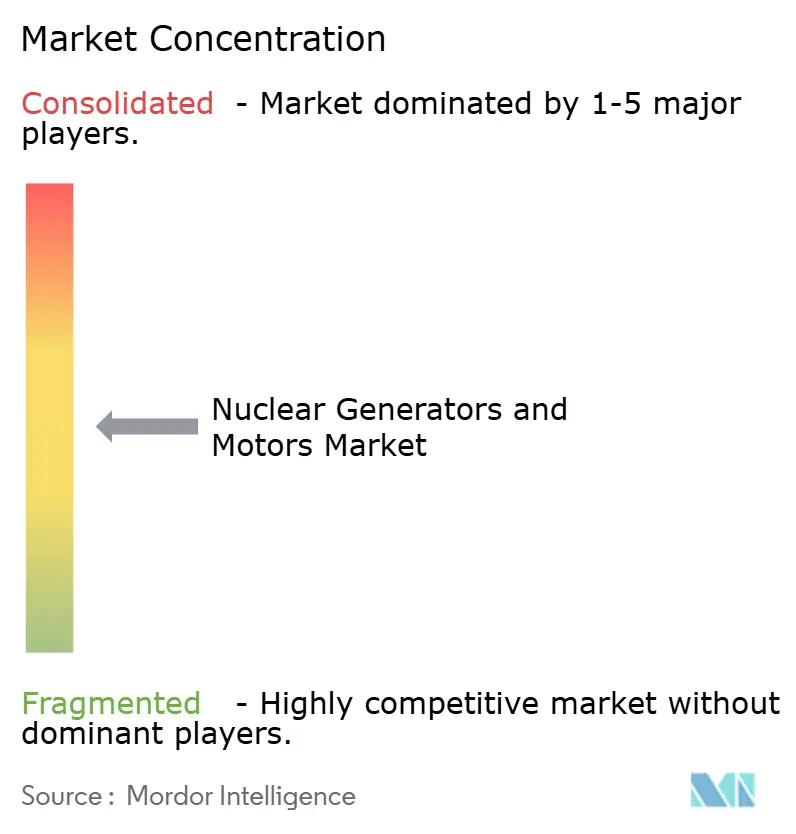
| Market Concentration | Medium |
Major Players *Disclaimer: Major Players sorted in no particular order Image © Mordor Intelligence. Reuse requires attribution under CC BY 4.0. | |
Nuclear Generators and Motors Market Analysis by Mordor Intelligence
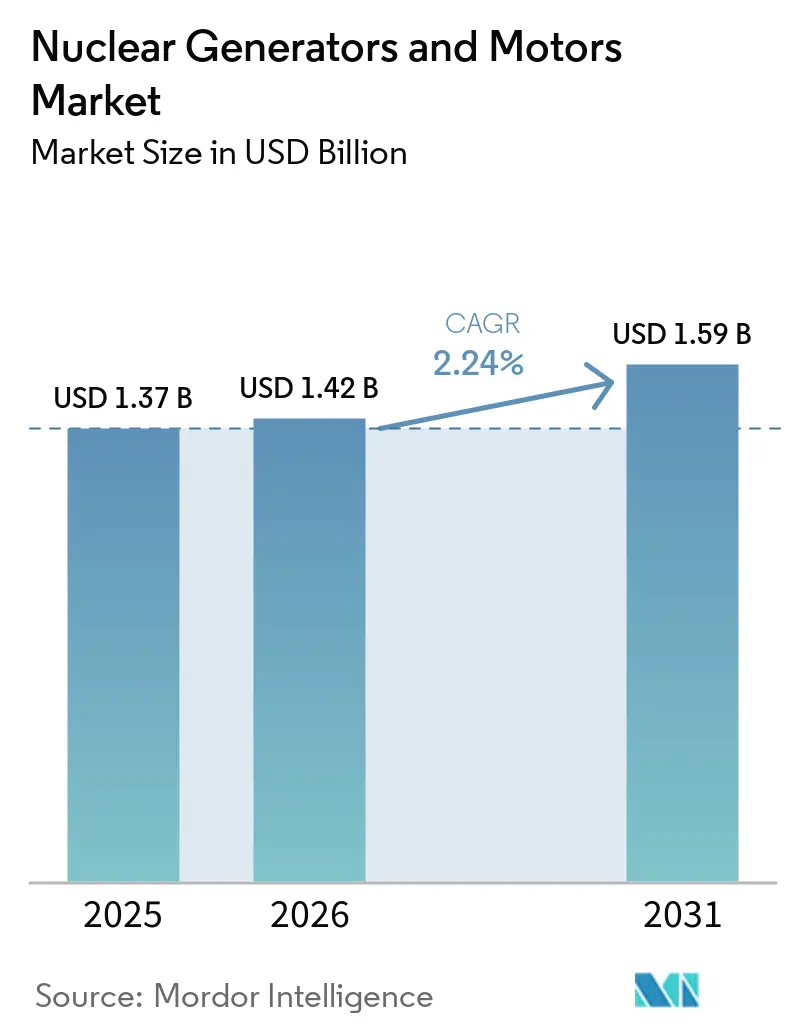
The Nuclear Generators and Motors Market size is projected to expand from USD 1.37 billion in 2025 and USD 1.42 billion in 2026 to USD 1.59 billion by 2031, registering a CAGR of 2.24% between 2026 and 2031. The nuclear generators and motors market is supported by reactor construction, fleet life extensions, and the replacement needs of aging equipment. Nuclear power projects require long procurement cycles, which gives equipment suppliers clearer order visibility than many industrial machinery suppliers. Qualification requirements also limit the number of suppliers that can participate in safety-critical work. Demand from data centers and industrial users is strengthening the case for long-term nuclear generation contracts. The nuclear generators and motors market, therefore, combines modest growth with a stable demand base and high entry barriers.
Key Report Takeaways
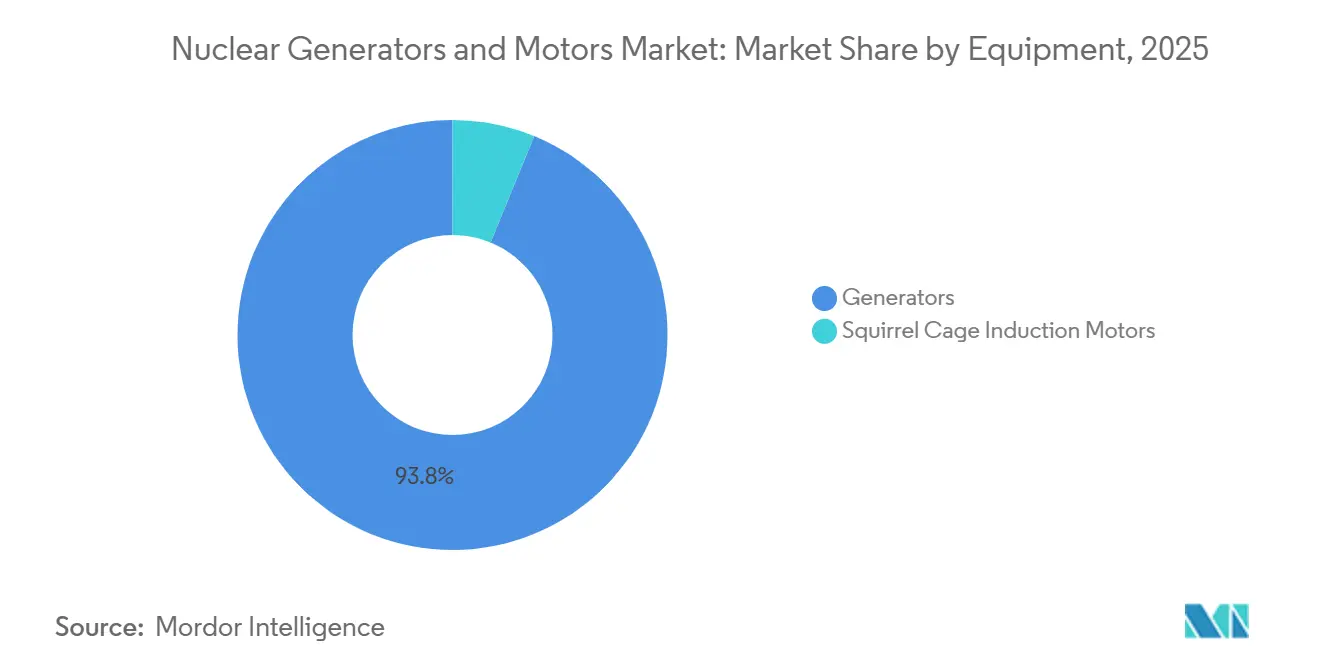
- By equipment, generators held 93.8% of revenue in 2025, while the same segment is forecast to grow at a 2.4% CAGR through 2031.
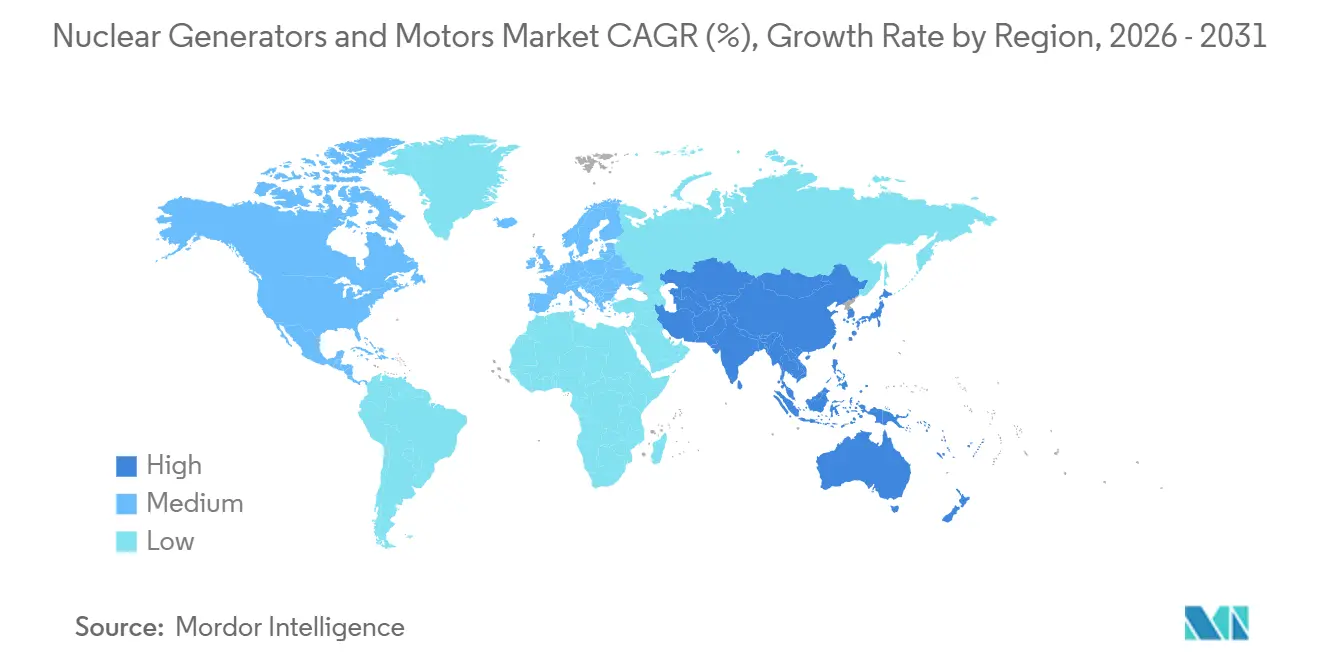
- By geography, Europe accounted for 42.1% of revenue in 2025, while Asia-Pacific is expected to grow at a 3.5% CAGR through 2031.
Note: Market size and forecast figures in this report are generated using Mordor Intelligence’s proprietary estimation framework, updated with the latest available data and insights as of January 2026.
Market Trends and Insights
Drivers Impact Analysis of Nuclear Generators and Motors Market*
| Driver | (~) % Impact on CAGR Forecast | Geographic Relevance | Impact Timeline |
|---|---|---|---|
| Nuclear New-Build and Reactor Life-Extension Programs | +0.70% | Global, concentrated in China, Europe, and South Asia | Medium term (2-4 years) |
| Grid Reliability and Low-Carbon Baseload Requirements | +0.30% | North America, EU, APAC emerging economies | Long term (≥ 4 years) |
| SMR and Advanced-Reactor Deployment Pipeline | +0.30% | North America, Europe, APAC; spill-over to MEA | Long term (≥ 4 years) |
| Replacement of Aging Turbine-Generator and Class 1E Motor Fleets | +0.40% | Europe (France, UK), North America, Japan | Short term (≤ 2 years) |
| Nuclear-Powered Data-Centre and Industrial Load Strategies | +0.20% | North America, with early gains in APAC | Medium term (2-4 years) |
| Standardized, Factory-Manufactured Nuclear Equipment | +0.20% | Global, led by Canada, UK, Poland, South Korea | Long term (≥ 4 years) |
| Source: Mordor Intelligence | |||
Nuclear New-Build and Reactor Life-Extension Programs
Nuclear construction has reached its strongest level in 3 decades. Ten reactor construction starts took place in 2025, including 9 in China and 1 in Russia, adding 12.2 GW to the global pipeline[1]. The OECD Nuclear Energy Agency reported 70 GWe under construction worldwide, with non-OECD countries accounting for nearly 80% of this capacity[2]. Each large reactor requires a turbine-generator train and multiple safety-critical induction motors. This construction base supports new equipment orders across the nuclear generators and motors market. France’s fourth periodic safety review program also requires turbine-island upgrades for 1,300 MW reactors through 2040.
The value of construction activity does not always follow the same geography as reactor starts. Chinese and South Korean developers lead many new projects, while licensed designs can still create supply roles for European and North American equipment makers. Large turbine-generator contracts are awarded well before commissioning, which helps suppliers plan capacity and engineering resources. Life-extension work adds a separate stream of plant-specific orders that is less dependent on new-site approvals. These programs often cover rotating equipment, auxiliary systems, and qualification work at the same time. The nuclear generators and motors market benefits when utilities combine safety upgrades with longer operating licenses.
Replacement of Aging Turbine-Generator and Class 1E Motor Fleets
Much of the Western nuclear fleet was built from 1970 to 1990, leaving major rotating assets near or beyond their original design lives. ASNR approved operation beyond 40 years for France’s 20 reactors in the 1,300 MW series during July 2025[3]. Jeumont Electric completed the replacement of a 1,300 MW alternator rotor at EDF’s Golfech plant in September 2025. This work shows how fleet maintenance programs convert into high-value refurbishment and replacement orders. IEEE 334-2024 requires Class 1E equipment to demonstrate performance over its installed service life[4]. The standard supports demand for requalification, documented replacement, and new motor supply.
Legacy documentation has substantial commercial value in safety-critical motor applications. A supplier that retains design files can offer a like-for-like replacement without starting a full qualification program. Utilities must avoid unqualified substitutes because nuclear regulators require formal evidence before safety equipment can be installed. This makes aftermarket competition narrower than in general industrial motor sales. Replacement spending can be scheduled during planned outages, which gives operators time to align equipment work with wider modernization programs. The nuclear generators and motors market is thus supported by a recurring replacement cycle alongside new reactor investment.
SMR and Advanced-Reactor Deployment Pipeline
Small modular reactor programs are moving from design work into early supply-chain commitments. The OECD Nuclear Energy Agency identified 127 SMR technologies globally in its 2025 dashboard, with 74 meeting readiness criteria across licensing, siting, financing, supply chain, and fuel. GE Vernova Hitachi began construction of a commercial BWRX-300 at Ontario Power Generation’s Darlington site in June 2026. Siemens Energy and Oklo signed a binding contract in November 2025 for an SST-600 steam turbine and SGen-100A generator for the Aurora project. These agreements show that power-conversion equipment is becoming part of early SMR project planning. The work favors vendors that can complete qualification before fleet orders are placed.
SMR units rated from 50 MW to 345 MW require rotating-machine designs that differ from equipment used in large reactors. Their generator requirements create a distinct product category rather than a simple replacement for 900 MW to 1,500 MW equipment. Rolls-Royce SMR reported contractual commitments in the United Kingdom and the Czech Republic during April 2026. Siemens Energy has been positioned to provide conventional-island technology for this program. Standardized plant designs can allow suppliers to repeat approved equipment configurations across several sites. The nuclear generators and motors market can gain additional volume when standardized SMR orders move into manufacturing.
Nuclear-Powered Data Center and Industrial Load Strategies
Large technology companies are using long-term power agreements to secure firm, low-carbon electricity for data centers. Amazon Web Services entered a 17-year agreement for 1.92 GW of power associated with the Susquehanna nuclear plant. Microsoft’s agreement to restart Three Mile Island Unit 1 targets power delivery around 2027 under a 20-year arrangement. These commitments strengthen the economic case for life extensions and potential new capacity. Equipment demand follows when operators refurbish turbine islands and replace safety motors for extended operation. The nuclear generators and motors market is linked to these decisions through the capital work needed to sustain reactor output.
Technology companies are also supporting advanced-reactor developers through commercial partnerships. Amazon has partnered with X-energy, while other companies have entered arrangements with developers including Oklo, TerraPower, and Kairos Power. These commitments can reduce uncertainty around future electricity buyers before construction begins. Earlier visibility of customer demand can shorten the time needed to make investment decisions. Equipment suppliers must still meet nuclear licensing and quality requirements before receiving orders. The effect is strongest where project sponsors can combine committed off-take, an approved design, and a qualified supply chain.
Restraints Impact Analysis of Nuclear Generators and Motors Market*
| Restraint | (~) % Impact on CAGR Forecast | Geographic Relevance | Impact Timeline |
|---|---|---|---|
| High Capital Intensity and Long Project Lead Times | -0.30% | Global | Long term (≥ 4 years) |
| Nuclear Licensing, Qualification and Procurement Complexity | -0.20% | North America, EU | Medium term (2-4 years) |
| Nuclear-Grade Forging, Insulation and Testing Bottlenecks | -0.10% | Global, concentrated in East Asia and North America | Short to medium term (≤ 4 years) |
| Obsolescence of Qualification Records for Aging Motors and Generators | -0.10% | North America, Europe, Japan | Short term (≤ 2 years) |
| Source: Mordor Intelligence | |||
Nuclear-Grade Forging, Insulation and Testing Bottlenecks
Nuclear-grade component supply depends on specialized forging, machining, welding, testing, and inspection capacity. The Nuclear Scaling Initiative identified machining, welding, finishing, and non-destructive examination as important supply-chain constraints because they require qualified facilities and skilled labor. Class 1E applications also use insulation systems that require specific qualification records. The U.S. Department of Energy announced USD 17.5 billion in conditional loans during June 2026 to support long-lead procurement for 10 AP1000 reactors. The program recognizes that finance cannot immediately create qualified manufacturing throughput. Long lead items can delay generator and motor procurement even after a project receives financial backing.
Nuclear quality rules make material substitution difficult after an order has been placed. A change in a qualified material, process, or component can require formal review and additional documentation. Utilities, therefore, reserve manufacturing slots early when construction schedules are firm. This practice increases the advantage of suppliers with established quality systems and available capacity. It also places smaller suppliers under pressure when they need to add nuclear-specific testing or inspection capability. The nuclear generators and motors market remains exposed to these limits because large equipment depends on several tightly controlled supply stages.
Nuclear Licensing, Qualification and Procurement Complexity
Nuclear equipment procurement requires traceability, audited quality programs, and documentation from raw material through installation. These requirements limit the number of qualified bidders for many contract packages. Older plants face an additional issue when the original motor and generator design records are incomplete. Framatome describes a channel-to-market model that provides access to licensed Siemens motor designs in the nuclear aftermarket. This arrangement shows that design rights can be as important as manufacturing capacity. Qualification work can require reverse engineering when a legacy supplier has been acquired, restructured, or exited the field.
Utilities must maintain approved vendor lists and complete source audits before they can procure nuclear equipment. They also need to manage nonconformance reports and demonstrate compliance during installation. These steps extend project schedules and increase the cost of changing suppliers. At the same time, the same rules protect qualified vendors from untested competition. The nuclear generators and motors market has high barriers because both equipment performance and documentation must be accepted. This environment rewards suppliers that maintain records for legacy fleets and new reactor designs.
*Our forecasts treat driver/restraint impacts as directional, not additive. The impact forecasts reflect baseline growth, mix effects, and variable interactions.
Nuclear Generators and Motors Market Segment Analysis
By Equipment:
Generators Anchor Revenue While Motor Demand Tracks Safety UpgradesGenerators held 93.8% of the nuclear generators and motors market share in 2025 and are expected to grow at a 2.4% CAGR through 2031. The segment leads because every commercial reactor needs a turbine-generator train whose value substantially exceeds that of the plant’s motor contingent, and because operators need specialist services throughout its operating life. Replacement sets for 1,000 MW-class reactors can involve assemblies above 2,000 tonnes and reaching 65 meters in length, while the related project work includes installation planning, testing, and long-term service support. New-build awards, stator-bar rewinding, rotor refurbishment, and digital excitation upgrades support generator revenue, with each activity tied to an operating plant’s maintenance schedule and safety requirements. SMR generator sets rated from 125 MW to 345 MW require design approaches that differ from conventional large-reactor equipment, and Siemens Energy’s selected SGen-100A unit for Oklo’s Aurora project illustrates this developing requirement.
Squirrel cage induction motors accounted for the remaining 6.2% of revenue in 2025, a smaller value base that remains important because these motors serve plant safety systems. They operate main coolant pumps, feed-water systems, and emergency core cooling equipment, so replacement decisions require evidence that the proposed unit will perform under the applicable nuclear conditions. IEEE 334-2024 has increased the importance of records demonstrating continued performance over installed service life, which makes technical documentation a core part of the purchase decision. Harbin Electric has qualifications across Hualong One, Guohe One, and CAP1400 main coolant pump motor designs in China, while Jeumont Electric remains a reference supplier for reactor coolant pump motors in French and Korean fleets. National qualification regimes consequently limit cross-border competition even when several suppliers can meet similar technical specifications.

Geography Analysis
Europe Nuclear Generators and Motors Market
Europe held 42.1% of the nuclear generators and motors market share in 2025, giving the region the largest revenue position. France’s large installed fleet and its continuing life-extension work support a long stream of turbine refurbishment, alternator work, and motor replacement. ASNR’s July 2025 decision covered 20 French reactors in the 1,300 MW series beyond 40 years of operation, beginning fourth periodic safety reviews that require work on turbine islands and safety equipment. These reviews spread procurement over individual plant outages, which supports a stable aftermarket rather than a single concentrated order cycle. Hungary began construction at Paks II Unit 1 during February 2026, while Rolls-Royce SMR signed early works for a Czech project during April 2026, adding new conventional-island opportunities to the regional service base.
APAC Nuclear Generators and Motors Market
Asia-Pacific is forecast to grow at a 3.5% CAGR through 2031, making it the fastest-growing region in the nuclear generators and motors market. China has the world’s most concentrated reactor construction program, and its local reactor designs sustain demand for generators, reactor coolant pump motors, and supporting rotating equipment. The U.S. Energy Information Administration reported that China’s nuclear capacity had nearly doubled since 2016, showing the scale of the country’s long-term buildout. Domestic companies benefit from local qualification routes and established links to Chinese reactor designs, with Harbin Electric completing delivery of main coolant pump motors for the Guohe One demonstration project in 2025. India’s Kaiga 5 and 6 program adds procurement depth, while Japan’s reactor restarts and recovering nuclear business provide a separate demand base for equipment and services.
The Americas and MEA Nuclear Generators and Motors Market
North America, South America, the Middle East, and Africa represented the remaining global revenue base. The U.S. Department of Energy’s USD 17.5 billion conditional loan commitment supports early long-lead planning for AP1000 projects, and Canada’s BWRX-300 construction start has activated engineering and procurement work. Egypt’s Dabaa project is the most significant near-term opportunity in the Middle East and Africa, whereas Brazil’s Angra 3 and Argentina’s CAREM project offer more limited regional activity during the forecast period. International safety requirements and bilateral cooperation arrangements determine which suppliers can access these project markets and can extend the qualification barriers seen elsewhere.
Competitive Landscape
The nuclear generators and motors market is moderately concentrated among suppliers with established nuclear design, manufacturing, and qualification records. GE Vernova, Siemens Energy, Doosan Enerbility through Doosan Škoda Power, Mitsubishi Heavy Industries, and Framatome with Jeumont Electric compete for major turbine-generator work outside China, while Jeumont Electric, Harbin Electric, and ELIN Motoren address distinct parts of the motor supply base. Entry barriers include design certification, forging access, seismic and environmental qualification evidence, and established working relationships with nuclear regulators and utilities. These conditions restrict the viable bidder pool for large equipment orders and favor suppliers that can provide both hardware and supporting records. The nuclear generators and motors market concentration is reinforced by long equipment lives, plant-specific documentation, and the cost of qualifying a replacement supplier.
Siemens Energy secured an exclusive preferred-supplier arrangement with Rolls-Royce SMR during February 2025 for conventional-island equipment, placing its turbine and generator capability within a planned SMR fleet. X-energy and Doosan Enerbility then signed a binding 16-unit reservation agreement during December 2025 for Xe-100 main power system steel components, connecting manufacturing capacity to an advanced-reactor order pipeline. Jeumont Electric’s Golfech rotor replacement showed its ability to execute complex work within an operating French nuclear plant, where outage coordination and proven technical procedures are essential. Framatome and Jeumont Electric have also retained legacy motor and generator documentation that supports licensed aftermarket supply. Together, these approaches combine fleet relationships, qualified designs, and early project commitments, making it difficult for a new supplier to gain work without extensive prior approval.
SMR generator sets offer a developing opportunity for suppliers that enter reactor partnerships before final equipment selections are made. Digital condition monitoring, excitation upgrades, and qualification-record management provide service work alongside equipment sales and can be relevant across aging fleets. Emerging nuclear countries can create new relationships where no legacy supplier holds an installed base, although new vendors still need accepted documentation and local regulatory access. Curtiss-Wright announced an USD 80 million multi-year expansion in Cheswick, Pennsylvania, for nuclear motors, canned motor pumps, generators, and control rod drive mechanisms. IEEE 334-2024 and comparable requirements create demand for suppliers that combine manufacturing capacity, qualification knowledge, and regulatory acceptance.
Nuclear Generators and Motors Industry Leaders
-
Mitsubishi Heavy Industries, Ltd.
-
GE Vernova Inc.
-
Siemens Energy AG
-
Toshiba Corporation
-
Doosan Enerbility Co., Ltd.
- *Disclaimer: Major Players sorted in no particular order
Nuclear Generators and Motors Market Companies Covered in this Report
- Ansaldo Energia S.p.A.
- Bharat Heavy Electricals Limited
- BWX Technologies, Inc.
- Dongfang Electric Corporation Limited
- Doosan Enerbility Co., Ltd.
- ELIN Motoren GmbH
- Framatome
- GE Vernova Inc.
- Harbin Electric Company Limited
- Hitachi GE Vernova Nuclear Energy, Ltd.
- Jeumont Electric SAS
- Larsen & Toubro Limited
- Mitsubishi Heavy Industries, Ltd.
- NIDEC CORPORATION
- Public Joint-Stock Company “Power Machines”
- Shanghai Electric Group Company Limited
- Siemens Energy AG
- The Babcock & Wilcox Company
- Toshiba Corporation
- Westinghouse Electric Company LLC
Recent Industry Developments in Nuclear Generators and Motors Market
- June 2026: The U.S. Department of Energy announced USD 17.5 billion in conditional loans to Westinghouse to pre-purchase long-lead items, including forgings and generator components, for 10 AP1000 reactors across 5 two-reactor projects.
- May 2026: Construction commenced on the first commercial BWRX-300 SMR at Ontario Power Generation’s Darlington site in Canada, activating engineering and equipment procurement work.
- April 2026: Rolls-Royce SMR signed an Early Works Contract with CEZ Group for the Czech Republic’s first SMR at Temelín, adding to its previous United Kingdom commitment.
- February 2026: First concrete was poured for Paks II Unit 1 in Hungary, formally beginning construction of a VVER-1200 unit rated at 1,100 MW.
Global Nuclear Generators and Motors Market Report Scope
Nuclear generators and motors are electrical machines used in nuclear power plants and other nuclear facilities to generate electricity, convert electrical energy into mechanical energy, or drive critical plant equipment. They are designed to operate reliably under demanding conditions, including high temperatures, radiation exposure, vibration, and stringent nuclear safety requirements.
The global nuclear generators and motors market is segmented by equipment and geography. By equipment, the market is segmented into squirrel cage induction motors and generators. The report also covers the market size and forecasts for the global nuclear generators and motors market across 26 key countries in key regions. For each segment, the market sizing and forecasts have been provided on the basis of value (USD).
Segmentation Overview
| Squirrel Cage Induction Motors |
| Generators |
| North America | United States |
| Canada | |
| Mexico | |
| Europe | Germany |
| France | |
| Italy | |
| Spain | |
| United Kingdom | |
| Poland | |
| Russia | |
| Rest of Europe | |
| Asia-Pacific | China |
| India | |
| Japan | |
| South Korea | |
| Australia | |
| Indonesia | |
| Vietnam | |
| Thailand | |
| Rest of Asia-Pacific | |
| South America | Brazil |
| Argentina | |
| Chile | |
| Rest of South America | |
| Middle East and Africa | Saudi Arabia |
| United Arab Emirates | |
| Egypt | |
| South Africa | |
| Morocco | |
| Rest of Middle East and Africa |
| By Equipment | Squirrel Cage Induction Motors | |
| Generators | ||
| By Geography | North America | United States |
| Canada | ||
| Mexico | ||
| Europe | Germany | |
| France | ||
| Italy | ||
| Spain | ||
| United Kingdom | ||
| Poland | ||
| Russia | ||
| Rest of Europe | ||
| Asia-Pacific | China | |
| India | ||
| Japan | ||
| South Korea | ||
| Australia | ||
| Indonesia | ||
| Vietnam | ||
| Thailand | ||
| Rest of Asia-Pacific | ||
| South America | Brazil | |
| Argentina | ||
| Chile | ||
| Rest of South America | ||
| Middle East and Africa | Saudi Arabia | |
| United Arab Emirates | ||
| Egypt | ||
| South Africa | ||
| Morocco | ||
| Rest of Middle East and Africa | ||
Key Questions Answered in the Report
What is the projected value of the nuclear generators and motors market by 2031?
The value is projected to reach USD 1.59 billion by 2031, expanding at a 2.24% CAGR from 2026.
What is driving demand for nuclear generators and motors?
In the nuclear generators and motors market, new reactor construction, life-extension programs, and replacement of aging turbine-generators and Class 1E motors support demand through the full forecast period for the nuclear generators and motors market ahead.
Which equipment category leads nuclear rotating-equipment revenue?
In the nuclear generators and motors market, generators led with 93.8% of revenue in 2025 and are forecast to grow at a 2.4% CAGR through 2031.
Why are Class 1E motors important at nuclear plants?
The nuclear generators and motors market relies on Class 1E motors because they power safety-critical systems and require documented qualification under IEEE 334-2024.
Which region is expected to grow fastest through 2031?
Asia-Pacific leads growth in the nuclear generators and motors market, with a forecast CAGR of 3.5% supported by construction in China and India.
How do SMRs affect generator demand?
SMRs add demand to the nuclear generators and motors market through purpose-built power-conversion equipment and generator sets that differ from large-reactor models.