
North America Scaffolding Rental Market Size and Share
Market Overview
| Study Period | 2021 - 2032 |
|---|---|
| Forecast Data Period | 2027 - 2032 |
| Base Year Market Size (2026) | USD 4.5 Billion |
| Market Size (2027) | USD 4.80 Billion |
| Market Size (2032) | USD 6.67 Billion |
| Growth Rate (2027 - 2032) | 6.78 % |
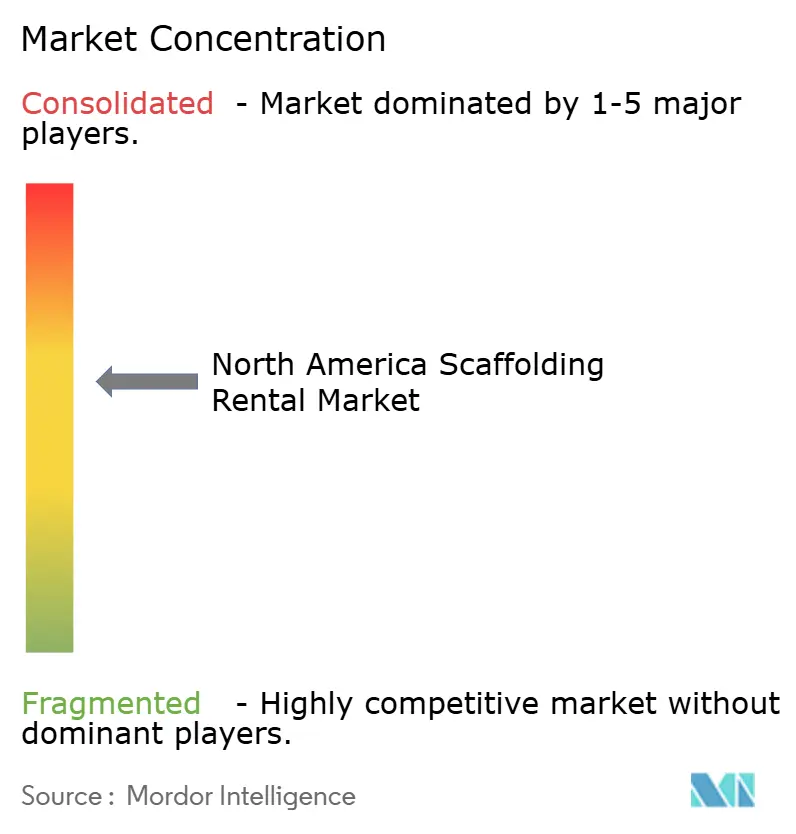
| Market Concentration | Medium |
Major Players *Disclaimer: Major Players sorted in no particular order Image © Mordor Intelligence. Reuse requires attribution under CC BY 4.0. | |
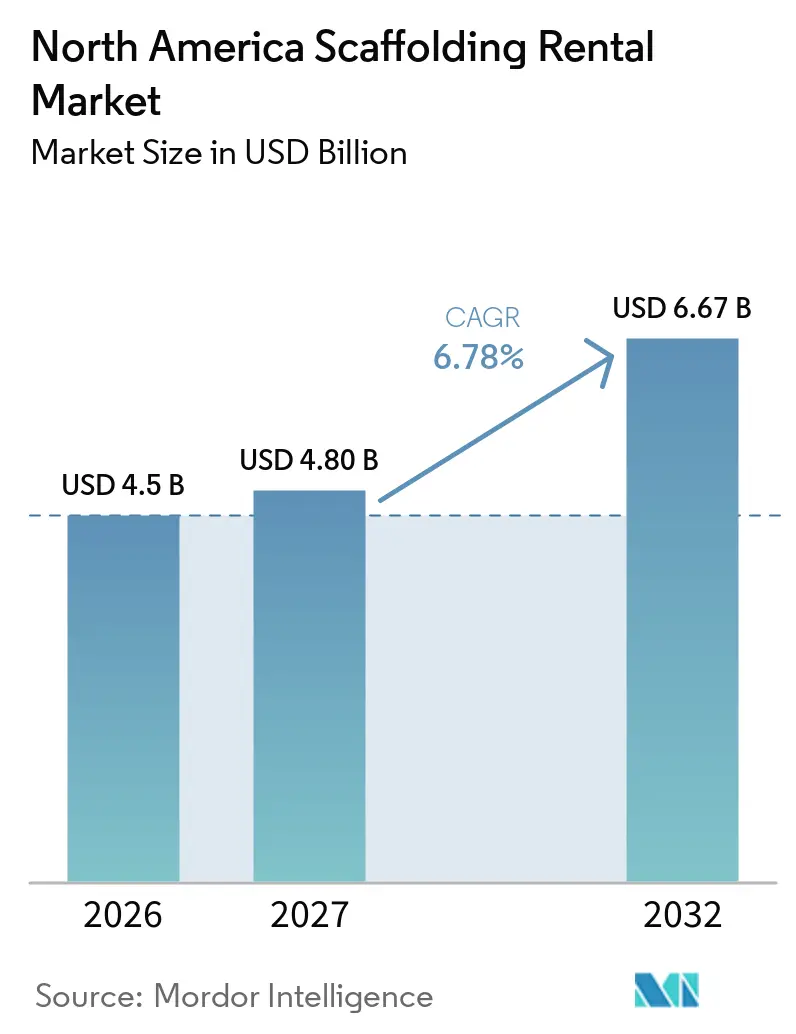
North America Scaffolding Rental Market Analysis by Mordor Intelligence
The North America Scaffolding Rental Market size is expected to grow from USD 4.5 billion in 2026 to USD 4.80 billion in 2027 and is forecast to reach USD 6.67 billion by 2032 at 6.78% CAGR over 2027-2032.
Infrastructure rehabilitation gives rental providers a stable source of demand that is less exposed to changes in new building starts. Contractors are also using rental fleets to avoid inventory ownership, inspection administration, and end-of-project handling. Data centers, advanced manufacturing plants, and energy facilities require access systems over long construction and maintenance periods. These projects reward providers that combine equipment availability with inspection records, engineering support, and site planning. Office construction remains a constraint in some United States cities, so operators with balanced industrial and infrastructure exposure are better placed to protect fleet utilization.
Key Report Takeaways
- By type, supported scaffold held 47% of the North America scaffolding rental market share in 2026, while suspended scaffold is forecast to grow at a 7.4% CAGR through 2032.
- By system, frame and H-frame systems held 32% of the North America scaffolding rental market share in 2026, while modular and ringlock systems are forecast to grow at a 7.8% CAGR through 2032.
- By material type, steel held 56% of the North America scaffolding rental market share in 2026, while aluminum is forecast to grow at a 7.9% CAGR through 2032.
- By sector, commercial held 39% of the North America scaffolding rental market share in 2026, while infrastructure is forecast to grow at a 7.6% CAGR through 2032.
- By geography, the United States held 70% of the North America scaffolding rental market share in 2026, while Mexico is forecast to grow at a 7.3% CAGR through 2032.
Note: Market numbers in this report are based on Mordor Intelligence's proprietary estimation framework, which combines nine months of actuals with Q4 projections for base year 2026.
Market Trends and Insights
Drivers Impact Analysis of North America Scaffolding Rental Market*
| Drivers | (~) % Impact on CAGR Forecast | Geographic Relevance | Impact Timeline |
|---|---|---|---|
| Infrastructure Renewal and Retrofit Activity Under Federal Funding Programs | +2.0% | United States and Canada | Long term (≥ 4 years) |
| Contractor Preference for Rental Over Fleet Ownership | +1.8% | North America-wide | Medium term (2-4 years) |
| OSHA Compliance Driving Demand for Certified, Inspected Rental Fleets | +1.2% | United States | Medium term (2-4 years) |
| Data Center and Advanced Manufacturing Construction | +1.0% | United States, with secondary effects in Mexico | Short term (≤ 2 years) |
| Refinery, Petrochemical, and Power Plant Turnarounds Along the Gulf Coast | +0.7% | United States Gulf Coast states | Medium term (2-4 years) |
| Nearshoring-Led Industrial Construction in Mexico | +0.6% | Mexico, with spillover to the United States border region | Long term (≥ 4 years) |
| Source: Mordor Intelligence | |||
Infrastructure Renewal and Retrofit Activity Under Federal Funding Programs
The North America scaffolding rental market draws a durable base of work from bridge, highway, utility, and public-facility rehabilitation. The American Society of Civil Engineers gave the United States infrastructure a C grade in its 2025 report card and identified a USD 3.7 trillion funding gap through 2033[1]. This shortfall indicates that deferred maintenance will remain a significant source of access work even when private construction slows down. The Infrastructure Investment and Jobs Act has also moved public projects toward documented wage, domestic-content, and workforce requirements. Those conditions favor rental providers that can demonstrate fleet traceability and consistent inspection procedures. The North America scaffolding rental market therefore benefits when contractors select established providers for complex public works rather than arranging unverified equipment supply.
Bridge rehabilitation and utility-corridor work often require phased access over long periods. Such projects can produce more consistent equipment demand than short new-build assignments. Public spending is not the only factor, since state and local capital programs also determine the timing of work. Still, the underlying repair need reduces the dependence of the North America scaffolding rental market on commercial construction cycles. Rental firms can also use these projects to improve utilization across multiple locations. Their ability to mobilize standardized components and trained crew’s remains important when public schedules overlap.
Contractor Preference for Rental Over Fleet Ownership
Contractors are increasingly choosing rental arrangements because owned scaffold inventory ties up capital and requires dedicated tracking. The Associated General Contractors of America reported that construction firms continued to face broad hiring difficulties in 2025[2]. A limited labor pool makes it harder for contractors to maintain their own inspection, storage, transport, and erection capabilities. Rental contracts shift much of that administrative burden to the access provider. They also allow contractors to match equipment volumes with the changing scope of each project. This supports demand in the North America scaffolding rental market where project teams need flexibility more than permanent fleet ownership.
The value of rental extends beyond the physical delivery of tubes, frames, decks, and guardrails. Providers can offer component lists, delivery sequencing, inspection documentation, and recovery plans after a project closes. These services reduce the risk of excess equipment being left idle between jobs. They can also give contractors a clearer view of material availability before work begins. Apache Industrial has used scanning-based scaffold planning and real-time project information in industrial settings, showing how planning tools can support a managed-service model. As these practices spread, the North America scaffolding rental market can compete on operating support instead of daily rental price alone.
OSHA Compliance Driving Demand for Certified, Inspected Rental Fleets
Occupational Safety and Health Administration requirements make inspection capability an important part of rental selection in the United States. The agency’s scaffolding requirements are set out in 29 CFR 1926.451, which requires safe construction, use, and inspection practices for scaffolds[3]. Contractors need equipment records and competent-person oversight to show that site practices meet these requirements. A certified rental fleet can provide standardized components and documentation that simplify this task. This requirement strengthens the position of providers that treat compliance as a continuing service. The North America scaffolding rental market gains value when customers view documented safety procedures as part of the rental package.
The Occupational Safety and Health Review Commission affirmed a 2025 citation involving suspension scaffolds that lacked required independent support lines. The decision reinforced the operational consequences of failing to maintain required safeguards. Contractors working on high-visibility projects have strong reasons to use providers with clear inspection procedures. Shift-level checks can also create recurring service work through the duration of a rental assignment. This makes compliance support more durable than a single equipment transaction. In turn, the North America scaffolding rental market increasingly rewards operators with training systems, documented controls, and consistent field supervision.
Data Center and Advanced Manufacturing Construction
Data center and advanced manufacturing construction are expanding the need for access systems in large, technically demanding projects. The International Brotherhood of Electrical Workers has described the growing labor and capital requirements associated with data center construction. These projects often involve extended installation schedules for electrical, mechanical, and building-envelope work. Their scale can require access planning before the construction phase reaches peak activity. This gives rental providers an opportunity to secure longer commitments and better visibility on equipment needs. The North America scaffolding rental market benefits when contractors want a single provider to coordinate components, planning, and field support.
Advanced manufacturing facilities add a related source of work because they require controlled, sequenced installation across large interiors. Semiconductor and microchip construction can demand frequent access changes as equipment installation moves through a plant. Apache Industrial confirmed its entry into data center and microchip construction during 2025, using capabilities developed for industrial work. That move shows how industrial access specialists are adapting their service models to new construction settings. The North America scaffolding rental market may therefore see more competition for projects that combine tight schedules with substantial safety and coordination requirements. The opportunity is strongest for providers able to plan access early and manage changing material needs on site.
Restraints Impact Analysis of North America Scaffolding Rental Market*
| Restraints | (~) % Impact on CAGR Forecast | Geographic Relevance | Impact Timeline |
|---|---|---|---|
| Skilled Erection Labor Shortages | -1.5% | North America-wide, most acute in the United States | Medium term (2-4 years) |
| Commercial Real Estate Cycle Volatility | -0.9% | United States and Canada | Short term (≤ 2 years) |
| Freight, Storage, and Site Logistics Costs | -0.6% | North America-wide, most exposed in remote and border regions | Short term (≤ 2 years) |
| Substitution by Aerial Work Platforms and Mast Climbers | -0.5% | United States and Canada | Long term (≥ 4 years) |
| Source: Mordor Intelligence | |||
Skilled Erection Labor Shortages
Scaffold erection depends on workers with site-specific training, and this capacity cannot be expanded immediately. The Associated General Contractors of America reported persistent difficulty filling construction positions in 2025. A shortage of trained erectors can delay work even when equipment is available. The constraint is especially relevant for industrial shutdowns, where many workers are needed within a short period. It can limit how quickly the North America scaffolding rental market converts booked projects into revenue. Providers with apprenticeship and training programs are better able to protect service levels during peak demand.
BuildForce Canada projected that many experienced construction workers will retire between 2025 and 2034, requiring significant hiring to replace them and support growth. This adds to the pressure on access providers serving Canadian energy, transit, and infrastructure work. Modular systems partly address the challenge because standardized connections can reduce assembly complexity. They do not eliminate the need for competent supervisors and trained crews. Operators will need to retain labor, improve training, and plan mobilization earlier. The North America scaffolding rental market will remain constrained where a shortage of skilled erection labor coincides with concentrated project activity.
Commercial Real Estate Cycle Volatility
Commercial office construction is less reliable than industrial and infrastructure work in the current cycle. Reduced new office development lowers demand for facade access and fit-out equipment in some major cities. This is significant because tall office projects have historically created visible, high-value scaffold assignments. Rental providers that depend heavily on this activity can face lower fleet utilization when projects start to decline. The North America scaffolding rental market is partly protected by renovation, conversion, and selective premium-office work. However, these projects are often smaller and less predictable than large new-build contracts.
The effect differs by location and asset type. Some urban areas still require access for building upgrades, repairs, and conversions. Data centers, healthcare facilities, industrial sites, and public infrastructure offer alternative work for operators with diversified fleets. This shift makes sector balance more important than a simple focus on geographic footprint. Providers that can move equipment between commercial, industrial, and public projects can respond better to uneven demand. The North America scaffolding rental market will therefore favor firms that limit exposure to a single construction category. Diversification also reduces the effect of a prolonged slowdown in high-rise office development.
*Our forecasts treat driver/restraint impacts as directional, not additive. The impact forecasts reflect baseline growth, mix effects, and variable interactions.
North America Scaffolding Rental Market Segment Analysis
By Type:
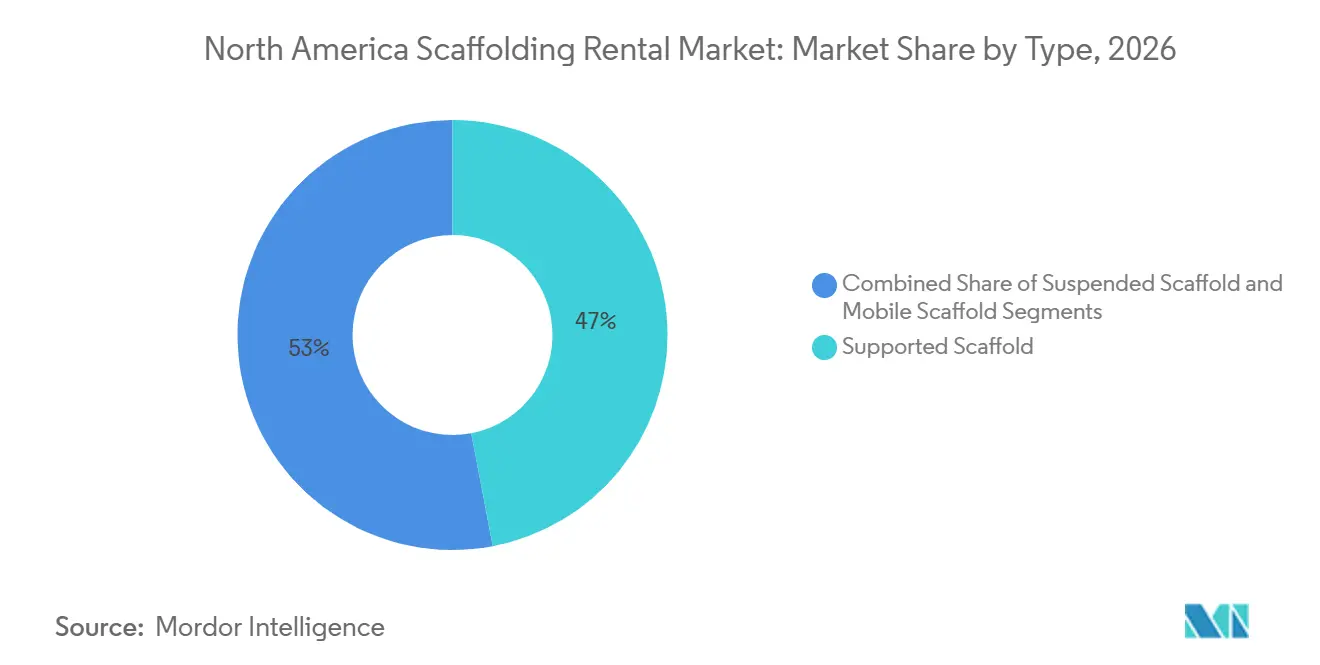
Supported Scaffold Holds the Largest Position While Suspended Systems Expand at HeightSupported scaffold accounted for 47% of the North America scaffolding rental market size in 2026. It is the standard solution for industrial maintenance, bridge rehabilitation, commercial facade activity, and power-plant turnarounds. Ground-supported platforms allow several crews to work across broad areas for extended periods. Data center campuses and refinery units reinforce this role because their layouts require stable access across wide horizontal footprints. The format is also suitable for projects where work sequencing changes gradually rather than by the hour. This keeps supported systems central to the North America scaffolding rental market even as other access options develop.
Suspended scaffold is forecast to grow at a 7.4% CAGR through 2032. It serves high-rise construction and exterior-cladding rehabilitation where ground space is limited, or work must be performed above street level. The system is particularly relevant in dense markets such as Manhattan, Miami, and Houston. PERI has supplied access solutions for complex United States building projects, including large residential developments in Miami. Building forms are also becoming more complex in healthcare and data center construction. This creates additional cases for specialized suspension providers beyond conventional high-rise assignments.

By System:
Frame and H-Frame Systems Remain Broadly Used While Modular and Ringlock Systems Gain SpeedFrame and H-frame systems held 32% of the North America scaffolding rental market share in 2026. They remain a cost-effective choice for residential work, mid-scale commercial projects, and general industrial assignments. Their broad installed base and familiar operating practices support steady use across the region. Contractors often select these systems when project requirements are straightforward and lower material cost is important. Their availability across rental fleets also makes replacement components easier to source. These advantages sustain their position in the North America scaffolding rental market despite the growing use of modular products.
Modular and ringlock systems are forecast to grow at a 7.8% CAGR through 2032. Their standardized connections can reduce assembly time and support work in projects with demanding schedules. A March 2026 demonstration of PERI UP at the Southern Regional Council of Carpenters’ Atlanta training center showed a 3-person crew assembling a working stage in under 30 minutes. Conventional arrangements can require larger crews for equivalent work. Modular systems also suit projects that require consistent records of components and inspection status. The North America scaffolding rental market is therefore seeing stronger demand for systems that improve labor efficiency without reducing access performance.
By Material Type:
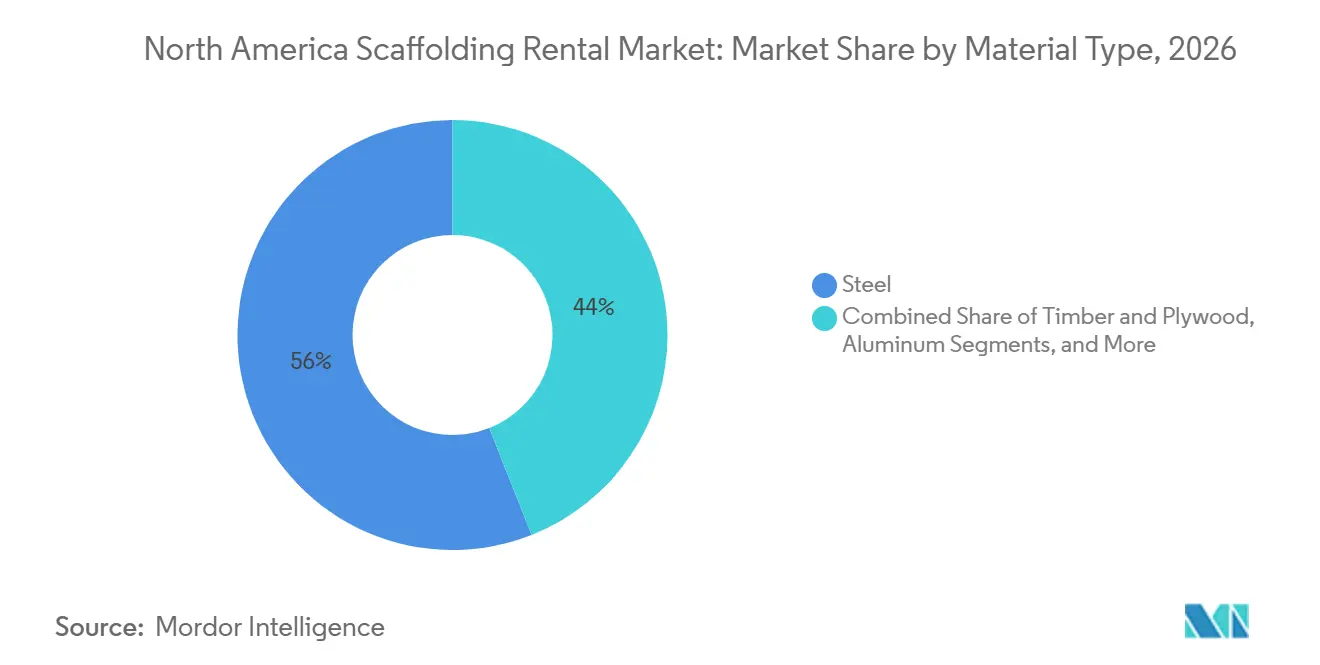
Steel Retains Heavy-Duty Leadership While Aluminum Advances in Rapid-Cycle WorkSteel held 56% of the North America scaffolding rental market share in 2026. Its load-bearing strength, lower unit cost, and widespread availability make it the primary material for much of the regional fleet. Refineries, petrochemical facilities, and power plants continue to favor steel for long-duration and heavy-duty work. These settings can require platforms that carry personnel, tools, and equipment across demanding turnaround schedules. Established rental inventories also give steel a practical advantage for immediate mobilization. Steel will consequently remain essential to the North America scaffolding rental market across industrial and infrastructure applications.
Aluminum is forecast to grow at a 7.9% CAGR through 2032. Its lower weight supports rapid repositioning in data center fit-outs, bridge rehabilitation, and space-constrained urban projects. The material can make handling easier where crews need to move equipment frequently between work areas. Plastic and fiberglass systems serve more specialized needs in electrically hazardous or corrosive settings. Timber and plywood have limited uses in residential and heritage work where traditional materials remain suitable. The North America scaffolding rental market is thus developing a more differentiated material mix while steel keeps its core heavy-duty role.
By Sector:
Commercial Work Provides the Largest Revenue Base While Infrastructure Shows the Strongest GrowthCommercial held 39% of the North America scaffolding rental market size in 2026. Facade access, retail fit-outs, and mixed-use development support this position in large metropolitan areas. Selective leasing activity still creates requirements for building improvements and premium space upgrades. Commercial work also provides a visible base of short- and medium-term assignments for local rental branches. The slowdown in new office construction makes this segment less predictable than it was in earlier cycles. Even so, its installed building base continues to generate repair, renovation, and conversion activity.
Infrastructure is forecast to grow at a 7.6% CAGR through 2032. Bridge rehabilitation, highway reconstruction, grid modernization, and port work provide a long pipeline of access requirements. Public projects frequently involve phased work, which can extend equipment utilization over several years. Industrial and logistics customers add recurring work through maintenance schedules and turnaround planning. The interaction between data center power demand and energy infrastructure can also create linked construction and maintenance needs. The North America scaffolding rental market can grow through these channels even when commercial development remains uneven.
Geography Analysis
United States
The United States held 70% of the North America scaffolding rental market share in 2026. Its scale reflects the concentration of petrochemical facilities, power plants, data center campuses, and a large bridge and highway network. The Gulf Coast remains a major source of industrial maintenance activity because refinery and petrochemical sites require repeated access during turnarounds. United States public works also benefit from an infrastructure repair need identified in the 2025 ASCE report card. Occupational Safety and Health Administration requirements under 29 CFR 1926.451 influence equipment selection because contractors must manage scaffold safety and inspection obligations. Data center development in Northern Virginia, Atlanta, Chicago, and Phoenix further broadens demand beyond traditional office construction. Operators that provide documented inspection and planning services are well positioned to serve these projects.
Mexico
Mexico is forecast to grow at a 7.3% CAGR through 2032, the fastest rate among the countries in the North America scaffolding rental market. Manufacturing relocation and logistics investment are supporting activity in northern border cities and the Bajío region. Industrial corridors in Monterrey, Saltillo, Tijuana, Ciudad Juárez, Reynosa, Querétaro, Guanajuato, San Luis Potosí, and Aguascalientes are important locations for new facility construction. AT-PAC’s 2026 Mexico hub combines Ringlock equipment with engineering, digital management, and field support. ULMA Construction has also delivered BRIO training that follows the Secretaría del Trabajo y Previsión Social DC3 competency framework. These investments show that equipment suppliers are linking local capacity with training and technical services. Stronger attention to height-work safety supports providers with certified fleets and trained teams.
Canada and the Wider Regional Network
Canada provides a second pillar for the North America scaffolding rental market through oil sands maintenance, liquefied natural gas infrastructure, transit expansion, and bridge programs. Alberta maintenance activity and Pacific coast energy projects create recurring work that is less dependent on office construction. BuildForce Canada’s 2025-2034 outlook identified substantial retirement pressure in the construction workforce. This supports interest in modular systems that can improve productivity for trained crews. Compliance factors also differ by province, with provincial safety bodies such as WorkSafeBC influencing site requirements across Canada, Mexico, and the United States. Manufacturing centers are creating a distributed pattern of demand. Providers with regional depots, training capability, and inventory visibility can respond more effectively than firms focused only on the largest metropolitan locations.
Competitive Landscape
BrandSafway, Sunbelt Rentals, and United Rentals are prominent participants in the North America scaffolding rental market. Their scale supports broad fleet availability, geographic coverage, and the ability to serve complex customer requirements. Large operators compete through inspection processes, delivery capability, and bundled service agreements rather than equipment volume alone. Regional specialists such as Apache Industrial, The Brock Group, and Atlantic Pacific Equipment remain important in petrochemical and industrial maintenance work. These companies compete through technical experience and familiarity with demanding shutdown environments. The resulting structure combines large national rental platforms with specialized regional access providers.
BrandSafway appointed JP Saini as senior vice president and chief digital and information officer in June 2025. The appointment reflected the company’s focus on digital systems across supply chain, data, and customer engagement. In January 2026, BrandSafway launched the Spider SC1000 Voyager battery-powered traction hoist for projects where grid power or generators are impractical. AT-PAC’s Mexico hub is another strategic move because it pairs product availability with engineering and software support. These examples show that providers are adding planning and technology capabilities to retain customers in complex projects.
Layher has developed LaySIM and LayPLAN SUITE tools that combine 3D modeling, virtual reality, augmented reality, laser scanning, and building information modeling connectivity. Such tools can shorten planning cycles and reduce errors during industrial turnaround preparation. Apache Industrial’s scanning-based planning approach similarly points to a shift toward managed scaffold lifecycle services. The competitive opportunity lies in linking preconstruction simulation, field inspection, inventory control, and dismantling records within one service. The North America scaffolding rental market remains moderately concentrated at the top while local specialists retain strong positions in technically demanding work.
North America Scaffolding Rental Industry Leaders
-
BrandSafway
-
Sunbelt Rentals, Inc.
-
United Rentals, Inc.
-
The Brock Group
-
Atlantic Pacific Equipment, LLC
- *Disclaimer: Major Players sorted in no particular order
North America Scaffolding Rental Market Companies Covered in this Report
- BrandSafway
- Sunbelt Rentals, Inc.
- United Rentals, Inc.
- The Brock Group
- Atlantic Pacific Equipment, LLC
- Layher Holding GmbH & Co. KG
- PERI SE
- ULMA Construction
- Altrad Group
- SGB Services
- Associated Scaffolding Company, Inc.
- Apache Industrial Services, Inc.
- Excel Modular Scaffold
- United Scaffolding, Inc.
- Universal Builders Supply Inc.
- American Scaffolding
- Southwest Scaffolding and Supply Co.
- BETCO Scaffolds
- Brewer Equipment Co.
- Contractors Access Equipment, Inc.
Recent Industry Developments in North America Scaffolding Rental Market
- June 2026: Sunbelt Rentals acquired Gilco Scaffolding Co. LLC, a third-generation, family-owned, full-service scaffolding company. The transaction strengthens Sunbelt Rentals' already significant Midwest footprint and is the second scaffolding acquisition the company completed in 2026 alone, signaling an accelerating consolidation strategy in the specialty access segment.
- February 2026: Sunbelt Rentals completed the acquisition of Superior Scaffold Services, Inc., a 74-year-old family-owned scaffolding company headquartered in Bensalem, Pennsylvania, serving commercial, industrial, and institutional customers across the East Coast.
- January 2026: ConTeras Industrial Group, a national multi-craft specialty contractor that provides scaffolding, industrial insulation, coatings, shoring, and access systems to the power generation, chemical, commercial, and critical infrastructure markets, announced a strategic partnership with funds managed by Oaktree Capital Management, L.P. Oaktree manages USD 218 billion in assets under management.
North America Scaffolding Rental Market Report Scope
Segmentation Overview
| Supported Scaffold |
| Suspended Scaffold |
| Mobile Scaffold |
| Tube and Coupler |
| Cuplock |
| Modular and Ringlock |
| Frame and H-Frame |
| Timber and Plywood |
| Steel |
| Aluminum |
| Plastic and Fiberglass |
| Others |
| Residential |
| Commercial |
| Industrial and Logistics |
| Infrastructure |
| United States |
| Canada |
| Mexico |
| By Type | Supported Scaffold |
| Suspended Scaffold | |
| Mobile Scaffold | |
| By System | Tube and Coupler |
| Cuplock | |
| Modular and Ringlock | |
| Frame and H-Frame | |
| By Material Type | Timber and Plywood |
| Steel | |
| Aluminum | |
| Plastic and Fiberglass | |
| Others | |
| By Sector | Residential |
| Commercial | |
| Industrial and Logistics | |
| Infrastructure | |
| By Country | United States |
| Canada | |
| Mexico |
Key Questions Answered in the Report
What is the expected growth rate for North America scaffolding rentals?
The North America scaffolding rental market is forecast to grow at a 6.78% CAGR from 2027 to 2032, reaching USD 6.7 billion by 2032.
Which scaffold type holds the largest share in North America?
Supported scaffold held 47% of revenue in 2026 because it serves industrial maintenance, bridge work, power plants, and commercial access needs.
Which scaffolding system is growing the fastest in North America?
Modular and ringlock systems are forecast to grow at a 7.8% CAGR through 2032 due to their speed, standardized connections, and labor efficiency.
Why do contractors rent scaffolding instead of owning it?
Rental reduces capital tied up in equipment and gives contractors access to inspection support, component tracking, transport, and project-specific volumes.
Which country is growing fastest for scaffolding rental demand in North America?
Mexico is forecast to grow at a 7.3% CAGR through 2032, supported by nearshoring-led manufacturing and logistics construction.
How do safety requirements affect scaffolding rental decisions?
OSHA scaffold requirements encourage contractors to use providers with certified equipment, competent person inspections, and clear documentation.