
North America Outdoor Furniture Market Size and Share
Market Overview
| Study Period | 2021 - 2032 |
|---|---|
| Forecast Data Period | 2026 - 2032 |
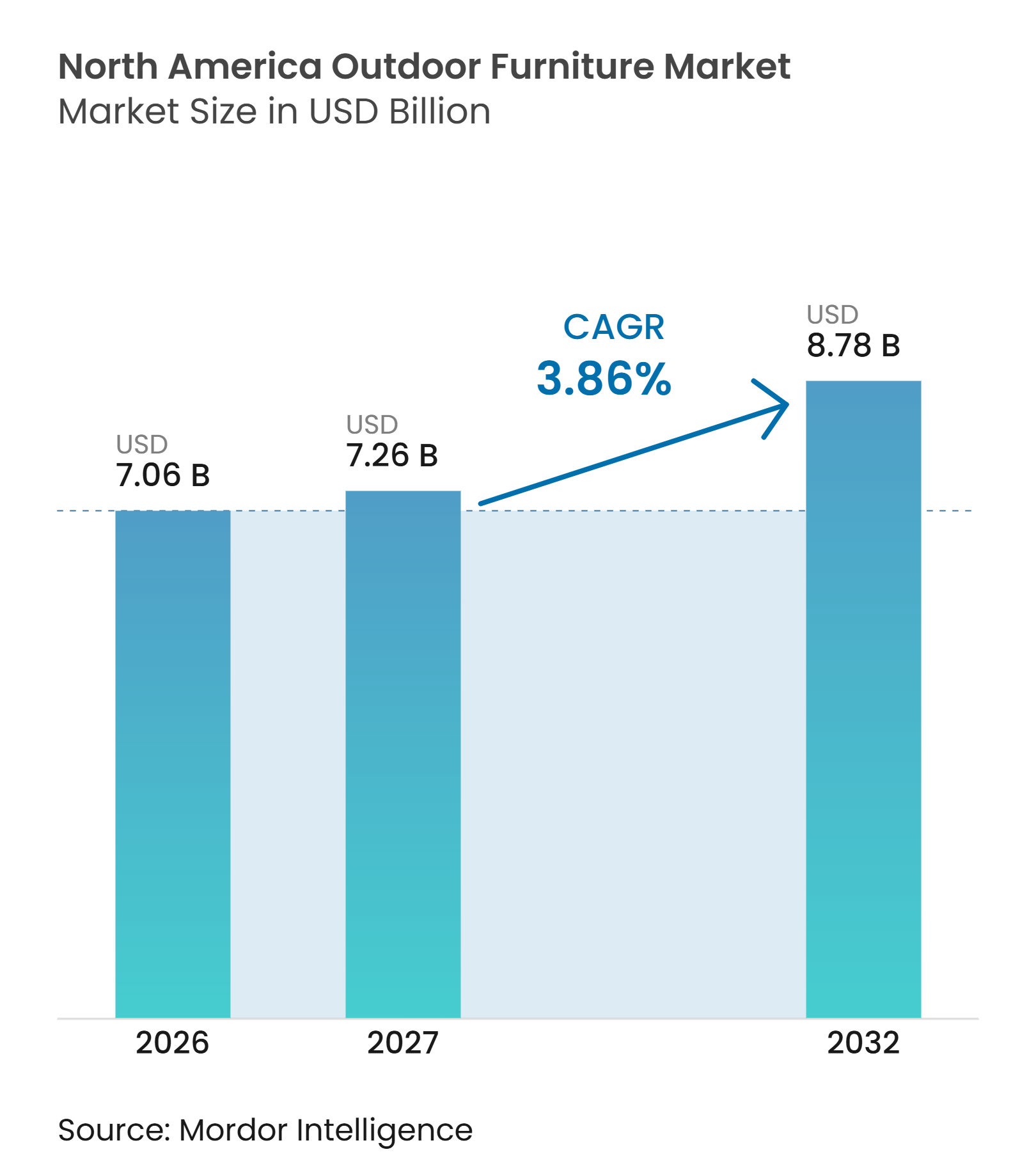
| Base Year Market Size (2026) | USD 7.06 Billion |
| Market Size (2027) | USD 7.26 Billion |
| Market Size (2032) | USD 8.78 Billion |
| Growth Rate (2026 - 2032) | 3.86 % |
| Market Concentration | Low |
Major Players *Disclaimer: Major Players sorted in no particular order Image © Mordor Intelligence. Reuse requires attribution under CC BY 4.0. | |
North America Outdoor Furniture Market Analysis by Mordor Intelligence
The North America outdoor furniture market size was valued at USD 7.06 billion in 2026 and is estimated to reach USD 8.78 billion by 2032, at a CAGR of 3.86% during the forecast period, 2027 to 2032. The category is benefiting as households treat patios, decks, and gardens as planned living areas rather than occasional seasonal spaces. The North America outdoor furniture market is therefore becoming more closely tied to broader spending on home comfort, usable space, and exterior design continuity. Outdoor upgrades increasingly sit beside decks, pergolas, and kitchens in renovation plans, which can raise the value of a complete project. Commercial buyers also view exterior seating as usable revenue space for hotels, resorts, restaurants, and multifamily properties. Tariff exposure and higher landed costs are changing sourcing decisions, especially in the mid-priced offer. Manufacturers with domestic production, durable materials, and established commercial specifications are better positioned to respond to these changes. Their advantage rests on execution across design, availability, product performance, and the ability to serve both project buyers and individual households. This requires attention to product development, inventory discipline, communication with channel partners, and after-sales support when buyers need replacement parts or matching pieces across diverse exterior settings over time.
Key Report Takeaways
-
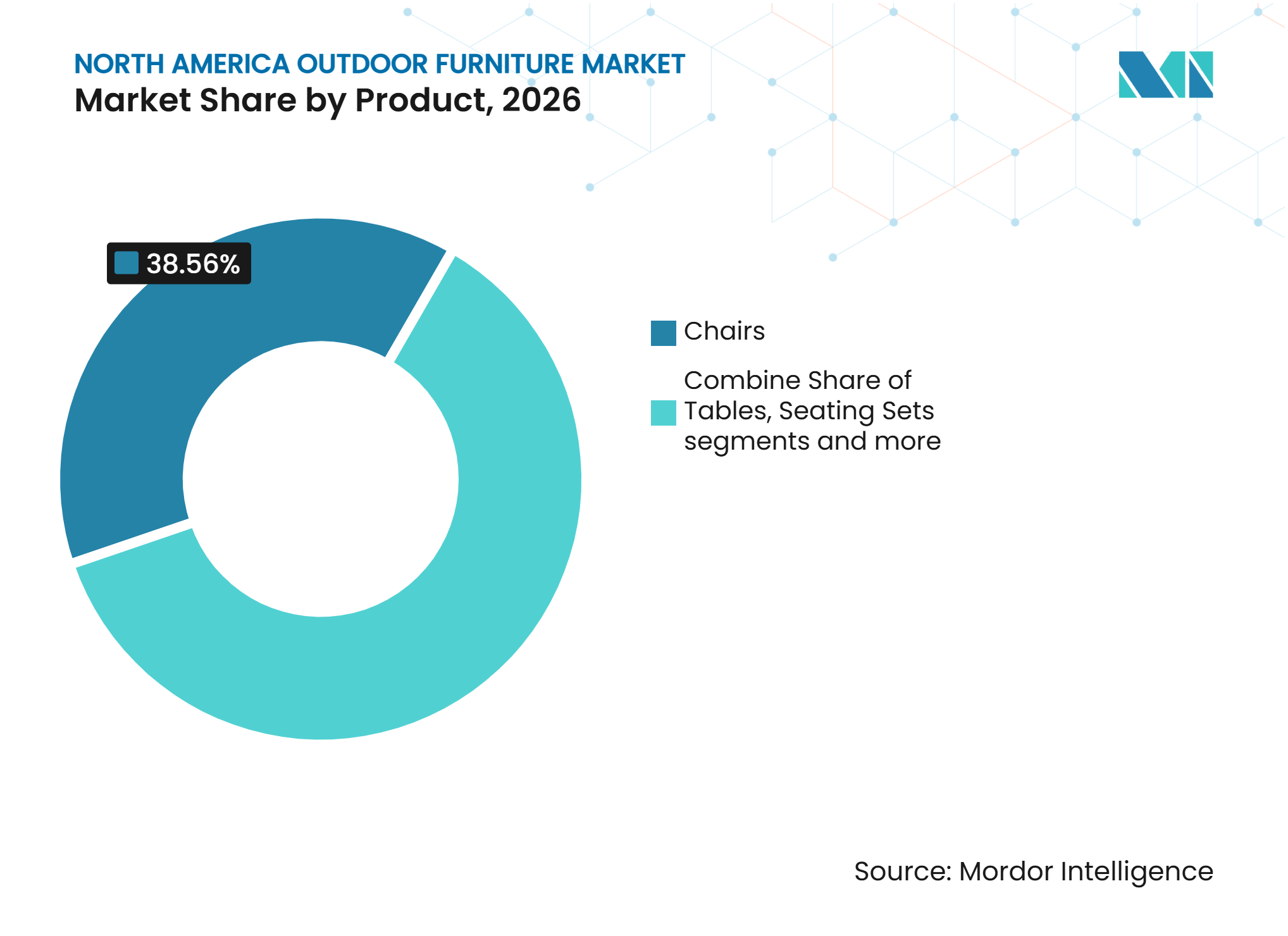
By product, Chairs held 38.56% of the North America outdoor furniture market share in 2026, while Loungers and Daybeds are forecast to grow at a 4.50% CAGR through 2032.
-
By material, Wood held a 42.16% share in 2026, while Plastic & Polymer is forecast to grow at a 4.26% CAGR through 2032.
-
By price range, Mid-Range held a 51.62% share in 2026, while Premium is forecast to grow at a 4.85% CAGR through 2032.
-
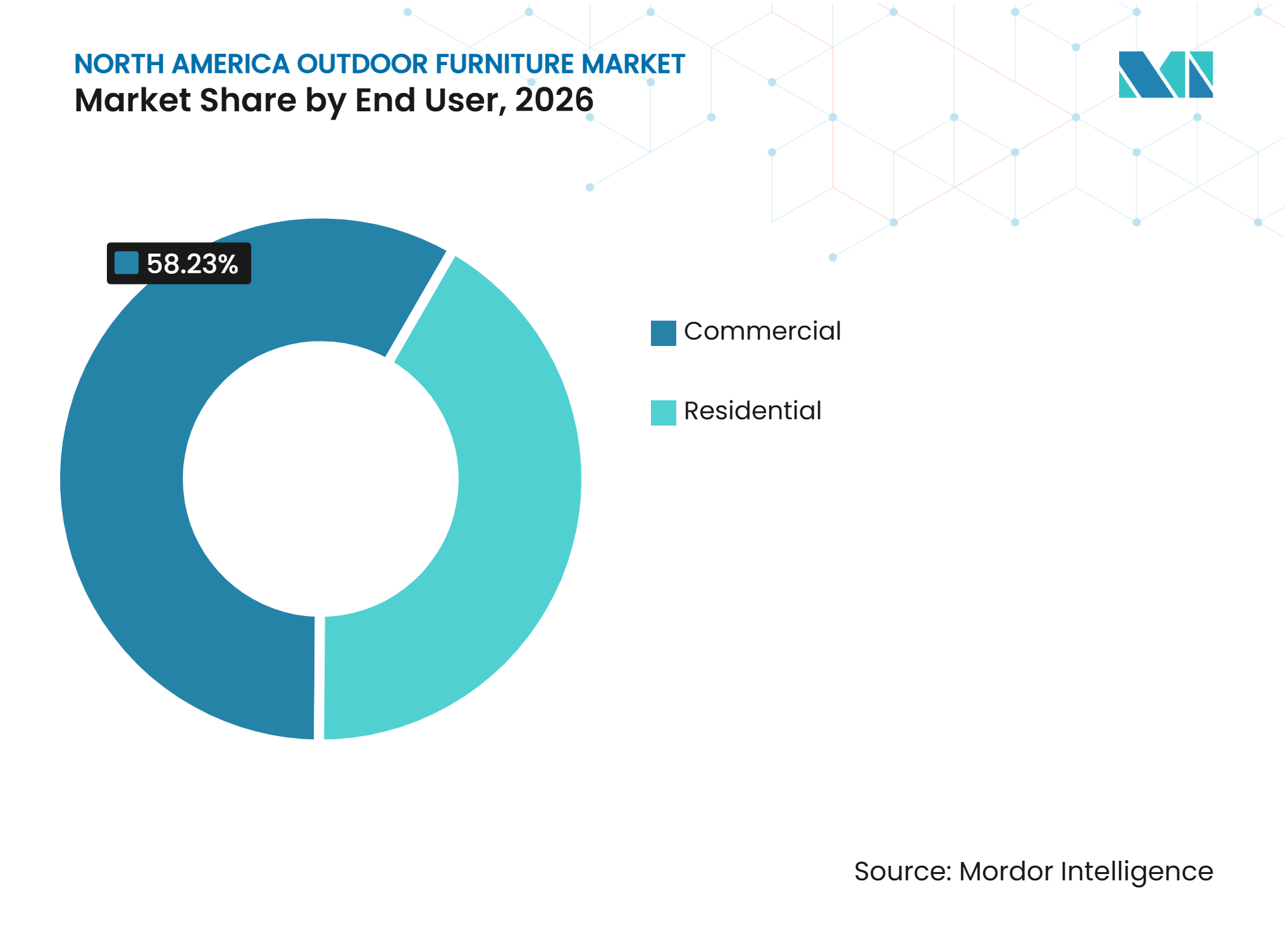
By end user, Commercial held a 58.23% share in 2026, while Residential is forecast to grow at a 4.71% CAGR through 2032.
-
By distribution channel, B2B/Contractors held a 60.12% share in 2026, while B2C/Retail is forecast to grow at a 5.17% CAGR through 2032.
-
By geography, the United States held an 82.15% share in 2026, while Mexico is forecast to grow at a 4.32% CAGR through 2032.
Note: Market numbers in this report are based on Mordor Intelligence's proprietary estimation framework, which combines nine months of actuals with Q4 projections for base year 2026.
Market Trends and Insights
Drivers Impact Analysis of North America Outdoor Furniture Market*
| Driver | (~) % Impact on CAGR Forecast | Geographic Relevance | Impact Timeline |
|---|---|---|---|
| Outdoor Living as an Extension of the Home | +1.2% | North America-wide, strongest in the Sun Belt and suburban United States | Short term (≤ 2 years) |
| Real Estate and Commercial Construction Expansion | +0.8% | United States and Canada, with spillover to border cities in Mexico | Medium term (2-4 years) |
| Hospitality and Foodservice Outdoor Amenity Investment | +0.7% | United States, Mexican resort corridors, and Canadian urban hospitality | Medium term (2-4 years) |
| Preference for Low-Maintenance, Weather-Resistant Materials | +0.6% | North America-wide, strongest in coastal and high-humidity locations | Long term (≥ 4 years) |
| Patio Heating and Extended Seasonal Utilization | +0.4% | Northern United States and Canada, with secondary relevance in the Mid-Atlantic and Pacific regions | Short term (≤ 2 years) |
| Retrofit-Friendly Modular and Sustainable Product Demand | +0.5% | North America-wide, with momentum in multifamily and institutional settings | Long term (≥ 4 years) |
| Source: Mordor Intelligence | |||
Outdoor Living as an Extension of the Home
The North America outdoor furniture market is gaining support as outdoor areas become a planned part of home improvement work. A Trex-commissioned survey found that 41% of homeowners had firm exterior renovation plans, 67% expected to spend more time outdoors, and 87% believed exterior improvements could improve resale value. The same shift links furniture purchases to decks, pergolas, and outdoor kitchens instead of isolated seasonal purchases. This broader project framing can increase the value of each order and make design coordination more important. Buyers are also placing greater weight on durability because they expect the space to serve them over several years. The North America outdoor furniture market therefore benefits when suppliers offer collections that work with permanent exterior improvements. Coordinated furniture, shade, lighting, and surface choices can make a purchase feel integral to the home project instead of an optional add-on. This changes the sales discussion from a single chair or table to a connected set of decisions on comfort, scale, color, weather resistance, storage, and how the space will be used by family members or guests.
Hospitality and Foodservice Outdoor-Amenity Investment
Hotels, resorts, and foodservice operators are using exterior space to support revenue and guest experience. The Propane Education & Research Council states that propane patio heating can extend the usable seating season by 12 to 16 weeks for restaurant and hospitality clients[1]. This additional operating period strengthens the case for durable tables, seating, and shade products. In March 2025, Under Canvas committed USD 50 million to its 2025 season, including new locations, refreshed outdoor seating areas, and shade pods[2]. Procurement through group purchasing organizations can favor suppliers with commercial-grade product lines and established specifications. The North America outdoor furniture market can benefit from this demand because commercial buyers typically purchase in larger volumes than individual households. Their requirements also favor dependable lead times, product consistency, and designs that can be repeated across several locations. Furniture must often work with the operator’s wider guest experience, withstand frequent use, and allow practical cleaning, replacement, and rearrangement without disrupting daily service.
Preference for Low-Maintenance, Weather-Resistant Materials
The North America outdoor furniture market is also supported by demand for materials that require less upkeep in rain, heat, humidity, and coastal conditions. High-density polyethylene, solution-dyed acrylic fabrics, and marine-grade aluminum address buyer concerns over moisture, fading, and cleaning. In May 2025, POLYWOOD launched POLYWOOD Select with Microcell Technology for moisture resistance and GenuineGrain Finish for a natural wood appearance. The release demonstrates how recycled HDPE suppliers are addressing appearance as well as performance. This direction makes engineered materials more relevant for buyers who might otherwise select teak or other tropical hardwoods. Durable materials can support premium pricing, even when longer product life reduces the need for frequent replacement. Suppliers are consequently balancing the value of lower maintenance against a need to keep collections visually relevant over a long ownership period. Their product decisions include frame construction, fabric performance, finish stability, repair options, and the visual detail needed to meet the expectations of residential customers and design-led hospitality projects.
Patio Heating and Extended Seasonal Utilization
Patio heating extends the period when households and businesses can use exterior furniture. The Propane Education & Research Council reports that propane heating can raise outdoor air temperatures by as much as 25°F in suitable settings. This supports investment in higher-quality furniture because owners can use it beyond the traditional summer period. Northern locations have a stronger practical need for heating, while covered commercial spaces can also use electric options. Restaurants can treat a heated patio as active seating capacity rather than a short seasonal extension. The North America outdoor furniture market can therefore gain when heating, shade, and furniture are planned together as one outdoor-use system. This combination is especially relevant where restaurants and hotels seek to turn underused exterior areas into reliable guest space.
Restraints Impact Analysis of North America Outdoor Furniture Market*
| Restraint | (~) % Impact on CAGR Forecast | Geographic Relevance | Impact Timeline |
|---|---|---|---|
| Climate Volatility and Seasonality | -0.5% | Northern United States and Canada, most acute in the Upper Midwest and Maritime provinces | Short term (≤ 2 years) |
| Import Tariffs and Landed-Cost Volatility | -0.6% | North America-wide, most acute for United States importers sourcing from China and Southeast Asia | Short term (≤ 2 years) |
| Maintenance, Storage, and Replacement Burden | -0.3% | Northern United States and Canada, plus dense urban housing with constrained storage | Long term (≥ 4 years) |
| Skilled-Labor and Automation Constraints in Domestic Production | -0.4% | United States and Canada, affecting manufacturers expanding domestic capacity | Long term (≥ 4 years) |
| Source: Mordor Intelligence | |||
Import Tariffs and Landed-Cost Volatility
Tariffs and changing landed costs remain a material constraint for import-dependent suppliers. The user-supplied draft states that Section 232 tariffs implemented in October 2025 imposed a 25% duty on upholstered wooden furniture and that the duty rose to 30% on January 1, 2026. Higher input and import costs can push retailers to revise prices or reduce promotional activity. The pressure is particularly visible in mid-priced patio sets, where shoppers are sensitive to a change in the initial purchase price. Domestic producers can gain a relative advantage when their sourcing and production systems are less exposed. The North America outdoor furniture market still faces a difficult transition because not every supplier can shift its supply chain or price architecture quickly. The resulting pressure can reduce the number of viable suppliers in the mid-priced range and reward businesses with closer control over manufacturing and distribution. Buyers may see fewer price promotions, reduced product choice in selected imported lines, and a stronger contrast between basic economy products and durable products positioned as longer-term investments.
Climate Volatility and Seasonality
Weather remains an immediate constraint because a delayed spring can shorten the highest-volume selling period. The supplied draft reported that unfavorable spring conditions affected patio retail results in the United States and Canada during 2025. A cold April week can postpone visits and purchases during a key period for showroom conversion. This does not always indicate lower underlying demand, because buyers may defer purchases until conditions improve. The draft also reported that retailers saw a 20% year-over-year gain in the 2026 season after delayed openings. The North America outdoor furniture market remains exposed to seasonal timing, particularly in regions with short outdoor-use periods. Retailers and brands need flexible inventory and promotion plans because weather can shift demand from one month into the next without eliminating it. The timing issue matters for showroom staffing, online promotion, delivery scheduling, warehouse space, and the availability of key seasonal colors and models when conditions finally encourage buyers to act.
*Our forecasts treat driver/restraint impacts as directional, not additive. The impact forecasts reflect baseline growth, mix effects, and variable interactions.
North America Outdoor Furniture Market Segment Analysis
By Product:
Seating Anchors Volume, While Lounging GrowsChairs accounted for 38.56% of the North America outdoor furniture market share in 2026. The category serves a wide range of residential and commercial settings, including patios, dining areas, pool decks, and hospitality spaces. This breadth helps explain the category’s scale because a chair can be sold as a single replacement item, as part of a coordinated dining set, or in volume for an operator that needs seating across many tables or guest areas. The supplied draft identified sectionals and motion chairs as strong product lines during the 2026 casual retail season. Tables, dining sets, and seating sets remain important where consumers want to create complete entertaining areas. Their role is tied to the continued alignment of indoor and outdoor design choices. Chairs also provide a practical entry point for replacement purchases, which supports their broad volume base. Their relatively flexible use across dining, lounge, and occasional seating layouts also makes them a central category for retail assortment planning.
Loungers and Daybeds are forecast to grow at 4.50% through 2032 in the North America outdoor furniture market. Premium homeowners are selecting these products for resort-style backyard settings and longer leisure use. Hospitality operators also use loungers around pools and other guest areas where seating can support spending and occupancy. Outdoor rugs, umbrellas, and planters are gaining interest as buyers complete a broader outdoor-room concept. In fall 2025, Brown Jordan debuted its first outdoor rug collection in 11 designs at High Point Market. The launch shows that accessory categories can complement core furniture purchases within the same selling season. It also reflects a broader move toward complete outdoor-room presentation, where buyers combine soft furnishings, shade, and decorative elements with larger furniture items. This approach lets a brand participate in several parts of the purchase while giving retailers more opportunities to help customers create a finished setting rather than leave with only a functional item.



By Material:
Wood Leads, While Recycled Polymers GainWood held 42.16% of the North America outdoor furniture market share in 2026. Teak remains relevant in mixed-material collections, particularly in premium residential and commercial applications. Its visual warmth and established position in exterior design support its continued use. Metal, led by powder-coated aluminum, is also important for high-traffic sites that need low-maintenance, large-format products. Aluminum suits hospitality installations because it is durable and adaptable across tables, seating, and shade-adjacent furniture. Material choice is increasingly shaped by weather exposure, maintenance needs, and the intended life of the product. These factors vary across coastal properties, colder metropolitan locations, pool decks, and high-turnover commercial venues, making a single material approach less suitable across the category. The choice must account for sun exposure, salt air, drainage, cleaning practices, the weight of the furniture, the ability to move it, and the visual language that the buyer wants to create.
Plastic & Polymer is forecast to expand at a 4.26% CAGR through 2032. Recycled HDPE is central to this growth because it can combine weather resistance with a more refined appearance. POLYWOOD says its process reclaims 99% of post-production plastic scrap and returns it to lumber production. New HDPE finishes aim to address buyers who previously preferred wood for aesthetic reasons. The design challenge is to preserve the ease of cleaning and moisture resistance associated with polymer furniture while offering texture, color, and visual warmth that fit higher-value exterior settings. Commercial specifications can also require clear evidence of durability and sustainability. BIFMA sustainability guidelines and Environmental Product Declarations are becoming more relevant in institutional and public-sector purchasing. Suppliers that can explain material origin, recycled content, durability, and maintenance expectations may be better prepared for these specification-led decisions.
By Price Range:
Mid-Range Leads, While Premium AdvancesMid-Range held 51.62% of the North America outdoor furniture market share in 2026. This position reflects demand from suburban households and mid-scale commercial operators. The category traditionally offers a balance of design, product life, and price. The supplied draft states that tariff-driven retail price inflation of 15% to 30% has put pressure on this buyer group. Shoppers who previously considered USD 800 to USD 1,500 patio sets are encountering entry prices that are USD 200 to USD 400 higher than earlier expectations. Some may trade down, while others may choose a longer-life premium option. This tension is narrowing the traditional mid-range value proposition, which has historically relied on a stable price point and wide appeal. Suppliers in this band need to make the practical benefit of their materials, construction, comfort, and warranty clear enough that customers understand why the product differs from a lower-cost alternative.
Premium furniture is forecast to grow at a 4.85% CAGR through 2032. This part of the category benefits when buyers assess warranty coverage and lifecycle cost alongside appearance. High-end collections also meet the needs of hospitality customers that require coordinated products and proven exterior durability. In these settings, the purchase is not solely decorative because operators must consider guest comfort, staff handling, cleaning, layout flexibility, and how furniture retains its appearance in continuous use. The supplied draft named DEDON, Kettal, Gloster, Brown Jordan, and TUUCI among brands associated with premium outdoor specification. Premium demand may be supported even when store traffic is lower because individual transactions can carry higher values. Economy products remain relevant for renters, entry-level homeowners, and event-rental operators, but cost pressure can limit supplier margins in that range. The price-sensitive end of the category must still offer credible outdoor performance because early failure can weaken customer confidence and increase returns.
By End User:
Commercial Leads, While Residential Builds MomentumCommercial users accounted for 58.23% of North America outdoor furniture market revenue in 2026. Hotels, restaurants, bars, country clubs, and multifamily developments often purchase exterior furniture through planned capital budgets. These buyers commonly place furniture within FF&E programs, which can create procurement cycles of 3 to 5 years. This planned spending can reduce exposure to short-term changes in household demand. Commercial projects also require larger order quantities and products that meet operational requirements. Suppliers with tested performance and commercial specifications have an advantage in this customer group. They can support project stakeholders who need consistent finishes, predictable replacement options, and products suitable for repeated use by guests and residents. The ability to maintain a collection over several procurement cycles is valuable because a project owner may need to replace a small number of pieces without changing the look of the wider property.
Residential demand is forecast to grow at 4.71% through 2032. The Joint Center for Housing Studies projected USD 509 billion in home remodeling expenditures for 2025. Elevated home equity and sustained attention to outdoor space can support residential spending. Hotel and resort experiences also influence what households expect from backyard furniture and layouts. The supplied draft noted a split between higher-income households that continue to invest and cost-pressured middle-income buyers that defer purchases. This makes product range, inventory planning, and warranty design important for brands serving residential buyers. A clear good, better, and premium offer can help buyers select products according to budget without losing access to essential weather resistance.

By Distribution Channel:
B2B Provides Scale, While B2C Grows FasterB2B/Contractors held 60.12% of North America outdoor furniture market revenue in 2026. Commercial developers, landscape architects, and hospitality consultants can direct large orders through trade pricing arrangements. This channel is important for manufacturers that can supply project quantities and meet commercial specifications. It also supports coordination across furniture, shade, and exterior design elements. This coordination can simplify the work of landscape architects, consultants, and property teams that need products to meet a common design direction and arrive within a project schedule. Project-based purchases can be less dependent on individual retail visits. Long-standing trade relationships can provide suppliers with repeat access to hospitality and multifamily work. They can also help manufacturers receive earlier visibility into design requirements and planned project timelines.
B2C/Retail is forecast to grow at 5.17% through 2032. Brand-direct websites, home improvement platforms, and online marketplaces are widening consumer access to outdoor furniture. The supplied draft cited augmented-reality tools as a way to improve digital engagement and reduce dependence on showroom visits. Home centers serve buyers who want convenience and project-related value. Specialty stores remain important for buyers who want design advice, material evaluation, and customization. Retailers can respond by emphasizing service and curated product choice rather than relying solely on physical foot traffic.
Geography Analysis
United States
The United States accounted for 82.15% of North America outdoor furniture market revenue in 2026. Its large suburban housing base, hospitality activity, and consumer spending on outdoor living support this leading position. The Joint Center for Housing Studies projected USD 509 billion in 2025 home remodeling expenditure. Texas, Florida, Arizona, and the Carolinas remain important demand areas because of favorable climate, population growth, and active residential construction. Tariff exposure is reshaping sourcing and can place more attention on domestic production, supplier diversification, and material choices. The North America outdoor furniture market size in the United States is therefore linked to both renovation activity and the ability of suppliers to manage changing import costs.
Mexico
Mexico is forecast to grow at a 4.28% CAGR through 2032. Construction linked to nearshoring, tourism, and urban expansion supports demand for contract products in cities such as Monterrey, Guadalajara, and Cancún. Coastal resorts require aluminum and weather-resistant wicker that can perform in humid and salt-air conditions. Product selection in these locations has to account for corrosion resistance, drainage, fabric suitability, and the appearance standards expected in guest-facing areas where exterior furniture is part of the overall property image. These requirements create a different B2B opportunity from inland residential purchasing. IKEA reported 9% year-over-year growth in Mexico during 2025 in the supplied draft, indicating that modern retail formats are broadening consumer access beyond Mexico City. The North America outdoor furniture market share held by Mexico can rise as hotel, resort, and mixed-use development continues in high-potential regions.
Canada and Regional Demand Patterns
Canada completes the regional picture with demand centered on climate resilience and design-focused metropolitan buyers. Statistics Canada reported that patio installation costs in Toronto rose 97.5% since 2017 and 78.1% since 2020[3]. Toronto, Vancouver, and Montréal have buyers who need to use limited outdoor space effectively. All-weather HDPE, covered patios, and heating solutions address the shorter outdoor season. These needs support products with clear durability and maintenance benefits. Manufacturers can differentiate through modular forms, compact layouts, and weather-resistant finishes that suit both Canada and northern United States locations. This regional pattern makes climate performance a practical design requirement rather than a secondary feature. It can influence fabric, frame, fastener, cover, storage, and heating choices throughout the customer journey. Suppliers serving northern climates must communicate these performance differences in simple terms because consumers are making decisions around a short season, limited space, and a need to protect the product between periods of use.
Competitive Landscape
Market Concentration
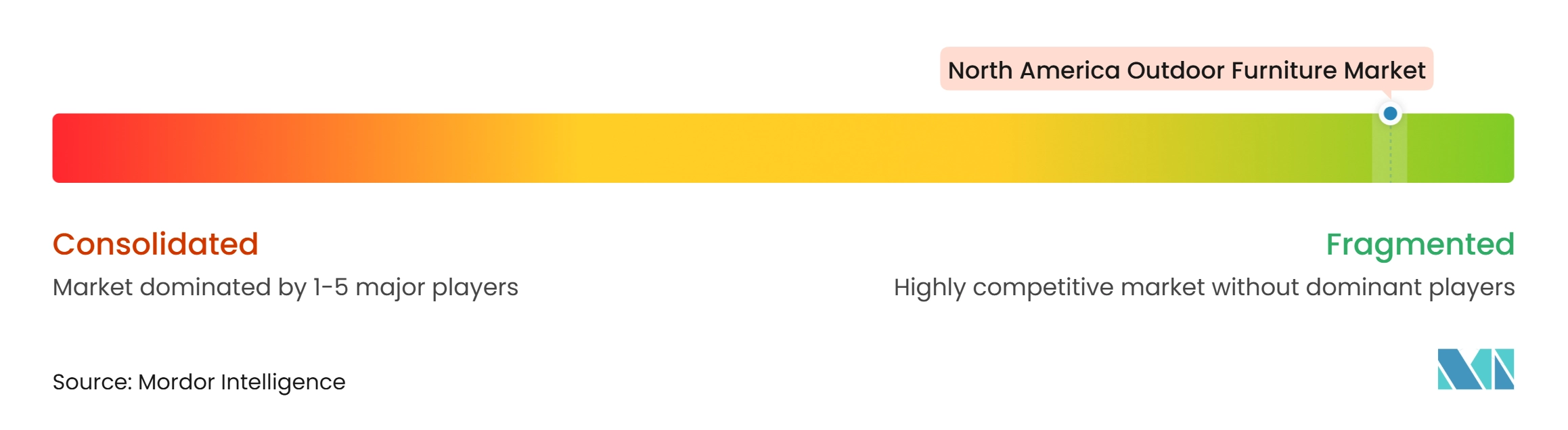
The North America outdoor furniture market has a moderately fragmented structure. Specialized domestic producers, mass-market suppliers, and international luxury brands operate across different price points and channels. POLYWOOD, Tropitone, and Homecrest have domestic production and commercial distribution strengths. POLYWOOD says it operates a 2.0 million-square-foot domestic manufacturing footprint. This production base can help reduce tariff exposure and support supply reliability for commercial customers. It also gives domestic manufacturers room to communicate material sourcing and quality control more directly to institutional buyers. That message can be important where purchasing teams need dependable documentation, a clear point of contact for service questions, and confidence that matching products or components will be available for later replacement.
European brands such as Fermob, DEDON, and Kettal compete through premium design, material quality, and distribution development. In 2025, Fermob renewed its New York City institutional contract after pre-building United States inventory, according to the supplied draft. That action illustrates how international suppliers can use inventory planning to protect customer commitments during tariff uncertainty. In 2025, TUUCI expanded beyond shade structures through furniture collections, and its Canyon Crue Collection received the BDNY Product Design Award and Architectural Record recognition. BIFMA and ANSI requirements can favor companies with tested commercial-grade products and a consistent certification record.
Brown Jordan has used category expansion to add accessory revenue alongside furniture. Its outdoor rug launch in 2025 extended its offer to buyers completing coordinated exterior spaces. Online direct-to-consumer brands continue to challenge entry and mid-priced specialist retailers on price. Physical retailers can respond with design advice, customization, and the ability to assess materials in person. The competitive field remains broad because leading-company share data were not provided in the supplied draft. Competition is consequently shaped by differentiated positioning, including domestic manufacturing, material innovation, commercial credentials, luxury design, and retail reach. This range of positions means that a brand does not need to compete on every dimension, but it does need a clear reason for buyers to select its products over alternatives that may be lower priced, more readily available, or more established in a specific channel.
North America Outdoor Furniture Industry Leaders
-
Ashley Furniture Industries, Inc.
-
Brown Jordan Inc.
-
Agio International Company, LTD.
-
POLYWOOD LLC
-
Lloyd Flanders, Inc.
- *Disclaimer: Major Players sorted in no particular order
North America Outdoor Furniture Market Companies Covered in this Report
- Ashley Furniture Industries, Inc.
- Brown Jordan Inc.
- Agio International Company, LTD.
- Lloyd Flanders, Inc.
- Homecrest Outdoor Living
- POLYWOOD LLC
- Woodard Furniture
- O.W. Lee Company
- Highwood USA
- Grosfillex North America
- Palm Casual
- MITY Incorporated
- Tropitone Furniture Company
- Gloster Furniture GmbH
- Kettal Group
- DEDON GmbH
- TUUCI LLC
- Fermob SA
- MAMAGREEN
- Landscape Forms, Inc.
- Castelle Furniture
- Winston Furniture
Recent Industry Developments in North America Outdoor Furniture Market
- July 2026: Sunset West, part of Hooker Furnishings, announced its largest product introduction in more than a decade at Casual Market Atlanta, introducing over 50 products across five collections: Vento, Kona, Maui, Encinitas and Universal.
- June 2026: Three Birds Casual announced two new outdoor furniture collections, Vera and Sanibel, scheduled for debut at Casual Market Atlanta in July. Vera combines teak construction, woven detailing and contemporary architectural lines across deep-seating, dining and counter-height furniture. Sanibel
- April 2026: POLYWOOD launched its Laguna In-Pool Collection, comprising chaise lounges, chairs and side tables designed for shallow-water pool ledges and sun shelves.
- April 2026: Rowe Furniture introduced Allteriors, its first dedicated outdoor furniture collection, extending the company's residential upholstery expertise into outdoor living.
North America Outdoor Furniture Market Report Scope
Segmentation Overview
| Chairs |
| Tables |
| Seating Sets |
| Loungers and Daybeds |
| Dining Sets |
| Other Products |
| Wood |
| Metal |
| Plastic & Polymer |
| Other Materials |
| Economy |
| Mid-Range |
| Premium |
| Residential |
| Commercial |
| B2C / Retail | Home Centers |
| Specialty Furniture Stores | |
| Online | |
| Other Distribution Channels | |
| B2B /Contractors |
| Canada |
| United States |
| Mexico |
| By Product | Chairs | |
| Tables | ||
| Seating Sets | ||
| Loungers and Daybeds | ||
| Dining Sets | ||
| Other Products | ||
| By Material | Wood | |
| Metal | ||
| Plastic & Polymer | ||
| Other Materials | ||
| By Price Range | Economy | |
| Mid-Range | ||
| Premium | ||
| By End User | Residential | |
| Commercial | ||
| By Distribution Channel | B2C / Retail | Home Centers |
| Specialty Furniture Stores | ||
| Online | ||
| Other Distribution Channels | ||
| B2B /Contractors | ||
| By Geography | Canada | |
| United States | ||
| Mexico | ||
Key Questions Answered in the Report
What is the projected value of North America outdoor furniture in 2032?
The category is projected to reach USD 8.78 billion by 2032, growing at a CAGR of 3.86% from 2027 to 2032. Outdoor projects, commercial investments, and demand for durable materials drive growth.
Which product category leads outdoor furniture sales in North America?
Chairs hold a 38.56% share in 2026, while loungers and daybeds are forecast to grow at a 4.50% CAGR through 2032. Tables, dining sets, and seating sets support complete outdoor spaces for dining, socializing, and relaxation.
Which material is growing fastest for outdoor furniture?
Plastic & Polymer is the fastest-growing material category, with a 4.26% CAGR through 2032, driven by recycled HDPE and weather-resistant products. Surface technologies improve synthetic lumber’s moisture resistance and appearance.
Why are commercial buyers important for outdoor furniture suppliers?
Commercial users accounted for 58.23% of revenue in 2026, driven by hotels, restaurants, country clubs, and multifamily projects.
Which sales channel is forecast to grow fastest?
The B2C/Retail segment is forecast to grow at a CAGR of 5.17% through 2032, supported by direct websites, home improvement platforms, and online marketplaces.