
North America Microgreens Market Size and Share
Market Overview
| Study Period | 2021 - 2031 |
|---|---|
| Forecast Data Period | 2026 - 2031 |
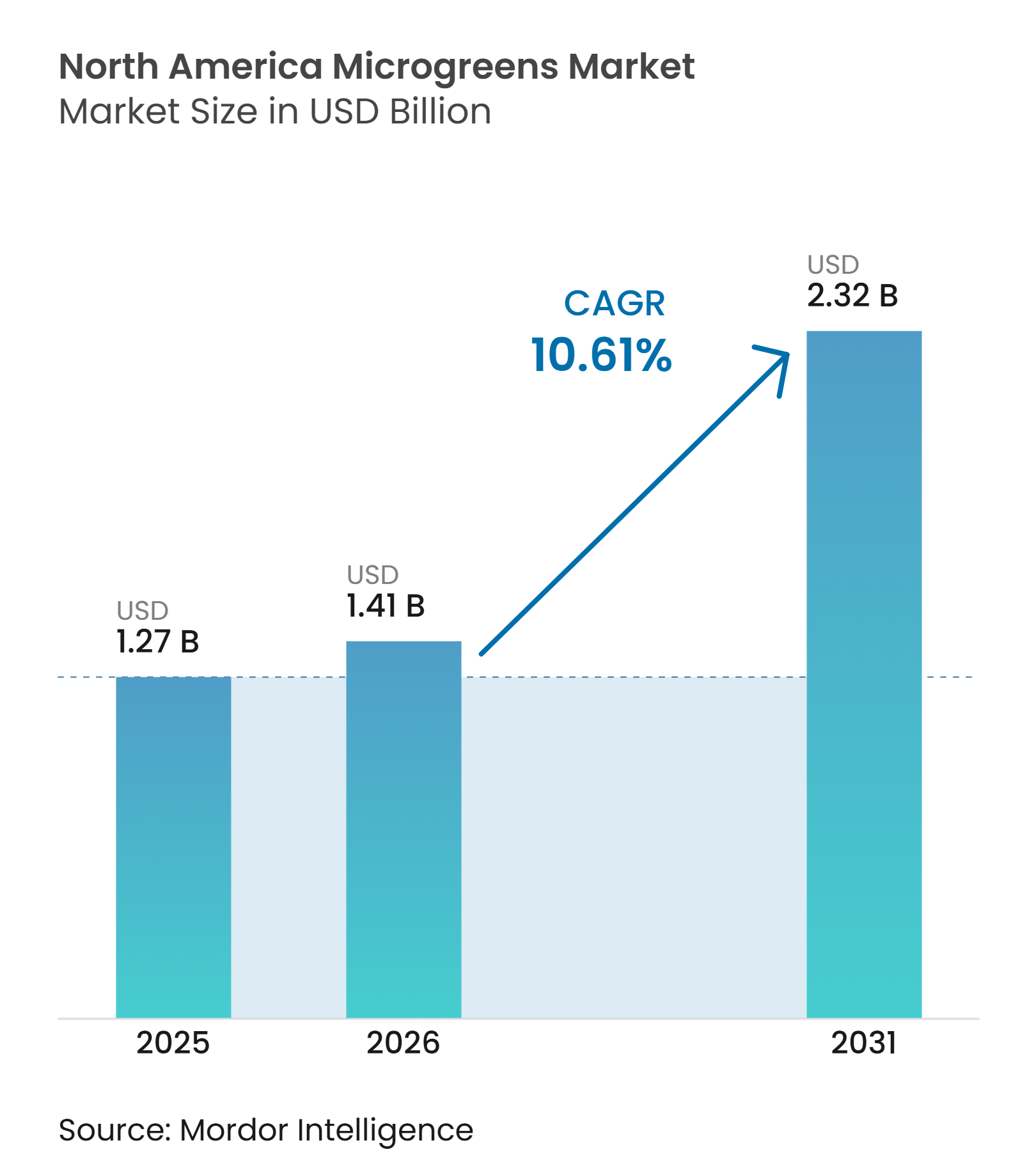
| Base Year Market Size (2025) | USD 1.27 Billion |
| Market Size (2026) | USD 1.41 Billion |
| Market Size (2031) | USD 2.32 Billion |
| Growth Rate (2026 - 2031) | 10.61 % |
| Market Concentration | Low |
Major Players *Disclaimer: Major Players sorted in no particular order Image © Mordor Intelligence. Reuse requires attribution under CC BY 4.0. | |
North America Microgreens Market Analysis by Mordor Intelligence
The North America microgreens market size is projected to expand from USD 1.27 billion in 2025 and USD 1.41 billion in 2026 to USD 2.32 billion by 2031, registering a CAGR of 10.61% between 2026 to 2031. Demand is moving beyond restaurant garnishes as consumers increasingly seek fresh foods with recognizable nutritional benefits. Retailers are allocating more shelf space to microgreens when suppliers can provide consistent quality, traceability, and reliable deliveries. Controlled-environment production is supporting this transition by enabling year-round cultivation closer to major consumption centers. Established growers can also serve foodservice, grocery, and direct-to-consumer channels from the same production base, improving market reach and utilization. Energy costs, food-safety requirements, seed availability, and refrigerated logistics remain the main constraints on broader market expansion.
Key Report Takeaways
- By crop type, broccoli held 24.1% of the North America microgreens market share in 2025, while amaranth is estimated to grow at the highest CAGR of 11.8% from 2026 to 2031.
- By farming method, vertical farming accounted for 40.3% of the North America microgreens market share in 2025, and estimated to grow at the highest CAGR of 11.4% from 2026 to 2031.
- By growth medium, peat moss accounted for a 30.1% of the North America microgreens market size in 2025, while coconut coir is estimated to grow at the highest CAGR of 11.2% from 2026 to 2031.
- By distribution channel, hypermarkets and supermarkets held 33.6% of the North America microgreens market share in 2025, while online channels are estimated to grow at the highest CAGR of 10.2% from 2026 to 2031.
- By geography, United States acounted for 82.1% of North America microgreens market share in 2025. while Canada is estimated to grow at the highest CAGR of 11.5% from 2026 to 2031.
Note: Market size and forecast figures in this report are generated using Mordor Intelligence’s proprietary estimation framework, updated with the latest available data and insights as of January 2026.
Market Trends and Insights
Drivers Impact Analysis of North America Microgreens Market*
| Driver | (~) % Impact on CAGR Forecast | Geographic Relevance | Impact Timeline |
|---|---|---|---|
| Rising demand for nutrient-dense and functional foods | +2.50% | North America, with highest intensity in the United States and Canada | Short term (≤ 2 years) |
| Expansion of protected and controlled-environment cultivation | +2.80% | United States and Canada, with spillover to Mexico | Medium term (2-4 years) |
| Growth of farm-to-table foodservice and premium produce | +1.50% | United States and Canada, concentrated in major metropolitan areas | Short term (≤ 2 years) |
| Supermarket private-label and omnichannel expansion | +1.20% | United States nationwide, with early gains in major Canadian cities | Medium term (2-4 years) |
| Retail microgreens becoming a repeat-purchase category | +1.00% | United States primary, Canada secondary | Medium term (2-4 years) |
| Hyperlocal production enabled by urban farm placement | +0.80% | United States metropolitan areas, Greater Toronto Area, and Vancouver | Long term (≥ 4 years) |
| Source: Mordor Intelligence | |||
Rising Demand for Nutrient-Dense and Functional Foods
Nutrient-dense foods are strengthening consumer demand in the North America microgreens market. The 2025 Nutritional Quality Profiles study found that broccoli microgreens had total phenolic content of 825.53 milligrams gallic acid equivalents per 100 grams of fresh weight, the highest level among 6 tested species[1]. Potassium levels across tested microgreens ranged from 187 to 416 milligrams per 100 grams of fresh weight, highlighting their potential as nutrient-dense fresh foods. The 2026 Microgreens as Functional Foods study also identified vitamin C, copper, zinc, carotenoids, flavonoids, and phenolic acids, strengthening the basis for nutritional positioning. This trend was reflected in Palm Ventures’ 2026 acquisition of AeroFarms, Inc., which cited growing consumer interest in nutrient-dense, sustainably grown, clean-label foods, including demand among users of glucagon-like peptide-1 medications. Clearer nutritional messaging can help retailers and growers communicate product value, encourage integration into daily meals, and support repeat purchasing beyond novelty-driven demand.
Expansion of Protected and Controlled-Environment Cultivation
Protected cultivation is changing how the North America microgreens market supplies retail customers by enabling more consistent production despite seasonal weather variations. Vertical farms can maintain stable growing conditions and product specifications, which is increasingly important for grocery chains seeking dependable year-round supply. The 2026 Vertical Farming Energy Market Integration study reported capital costs of USD 1,600 to USD 4,300 per square meter for vertical farms, favoring operators with patient capital and disciplined operating plans[2]. In 2026, GoodLeaf Farms achieved profitability across its facilities in Quebec, Ontario, and Alberta, demonstrating the potential for scaled operations supported by retail distribution. Greenhouse systems that combine natural daylight with supplemental lighting can provide an alternative where local conditions reduce electricity requirements. The market therefore favors operators that align facility design with energy economics, climate conditions, and customer density.
Growth of Farm-to-Table Foodservice and Premium Produce
Premium foodservice continues to shape product standards in the North America microgreens market, with restaurants using microgreens to add flavor, texture, and visual appeal while providing growers with an important testing ground for new varieties. In 2025, Fresh Origins, LLC introduced its Classics Collection at the International Fresh Produce Association Foodservice Conference, featuring 50 best-selling microgreens, edible flowers, and specialty products designed for year-round availability[3]. The Chef's Garden, Inc. also expanded its cultivation capabilities by working with Agripass on Robot of Human-Inspired Cultivation technology in 2025, becoming the first North American commercial user of the system in 2026. Direct-to-consumer subscription boxes are extending these specialty products beyond restaurant kitchens, creating a pathway for varieties that gain chef acceptance to reach broader consumer and retail markets.
Supermarket Private-Label and Omnichannel Expansion
Supermarket programs are expanding commercial access within the North America microgreens market, moving products beyond specialist foodservice into mainstream grocery channels. Private-label supply requires dependable volumes, documented handling, traceability, and strong food-safety systems, favoring growers with established operational and cold-chain capabilities. In 2025, AeroFarms, Inc. and Whole Foods Market marked 8 years of partnership, demonstrating how consistent supplier relationships can support sustained shelf presence and category development. Fresh Origins, LLC extends its reach through a national distributor network, while Planted Detroit, LLC uses Instacart and DoorDash to connect with consumers through digital grocery channels. The combination of physical retail and online delivery is creating broader routes to market, provided suppliers can maintain freshness, availability, and service quality across both channels.
Restraints Impact Analysis of North America Microgreens Market*
| Restraint | (~) % Impact on CAGR Forecast | Geographic Relevance | Impact Timeline |
|---|---|---|---|
| High energy intensity of indoor production | -1.80% | United States and Canada nationwide | Short term (≤ 2 years) |
| Pathogen and sanitation risk in dense growing systems | -1.20% | North America, with highest impact in the United States and Canada | Medium term (2-4 years) |
| Volatile certified-organic seed availability | -0.60% | United States and Canada organic production zones | Medium term (2-4 years) |
| Short shelf life and cold-chain execution risk | -0.90% | All North American markets, with highest risk in Mexico and Rest of North America | Short term (≤ 2 years) |
| Source: Mordor Intelligence | |||
High Energy Intensity of Indoor Production
Energy intensity remains a central operating constraint for the North America microgreens market. The Vertical Farming Energy Market Integration study in 2026 found that electricity represented 30% to 40% of total operating costs in vertical farming. Light-emitting diode lighting accounted for 80% of the electricity use reported in the same review. Cost pressure can quickly affect margins because microgreens require controlled lighting and climate systems. The Beyond Yield study in 2025 identified the need to assess energy, water, cost, and carbon together when evaluating indoor farm viability. The short growing cycle does not remove this concern because lighting is used continuously across repeated crop cycles. Energy policy and access to renewable power can influence facility location decisions. Operators that improve lighting efficiency or use hybrid growing systems can limit some exposure. The North America microgreens market will remain sensitive to local electricity pricing until these operating costs decline.
Pathogen and Sanitation Risk in Dense Growing Systems
Food safety risks can restrict customer confidence and commercial expansion in the North America microgreens market. Dense growing systems can increase the potential for contamination to move from seeds, water, or substrates to edible shoots. A 2025 food safety study identified Salmonella enterica, Escherichia coli, and Listeria monocytogenes as important concerns in microgreen production. High humidity, nutrient-rich substrates, and recirculated water can further increase pathogen-control requirements. In the United States, the Food and Drug Administration’s Produce Safety Rule under 21 CFR Part 112 applies to microgreens under produce safety standards[4]. The absence of commodity-specific protocols comparable to those established for sprouts can make control selection more challenging for smaller growers. Environmental monitoring, water sanitation, hygienic handling, and detailed traceability can help suppliers meet retailer requirements. Strong food-safety systems are therefore both an operating requirement and a commercial differentiator.
*Our forecasts treat driver/restraint impacts as directional, not additive. The impact forecasts reflect baseline growth, mix effects, and variable interactions.
North America Microgreens Market Segment Analysis
By Crop Type:
Broccoli Leads Sales While Amaranth Shows the Highest GrowthBroccoli accounted for 24.1% of the North America microgreens market by crop type in 2025, maintaining its leading position due to its recognized sulforaphane content and broad use across grocery and foodservice channels. The 2025 Nutritional Quality Profiles study reported the highest phenolic content among six tested microgreen species in broccoli. Lettuce, chicory, radish, arugula, basil, sunflower, and peas formed the other core commercial varieties, while fennel, cress, chard, and carrots served more specialized foodservice and retail demand. This broad crop mix allows growers to address mild, peppery, and aromatic flavor preferences across different customer segments.
Amaranth is forecast to record the fastest crop-type CAGR of 11.8% from 2026 to 2031. The 2025 Sustainable Microgreen Production study found that amaranth microsprouts had the highest antioxidant capacity among the tested species, supporting its positioning as a nutrient-focused specialty crop. Arugula, basil, cress, and chard are also contributing to category expansion through their culinary versatility and distinctive characteristics. Planted Detroit, LLC grows micro amaranth alongside established varieties, demonstrating commercial interest in expanding beyond widely cultivated crops. Rising consumer interest in distinctive colors, flavors, and nutritional attributes is estimated to support greater adoption of alternative microgreen varieties.
By Farming Method:
Vertical Farming Has the Strongest Commercial PositionVertical farming accounted for 40.3% of the North America microgreens market by farming method in 2025, supported by year-round production, repeatable crop conditions, and controlled product quality. These characteristics suit large grocery buyers and institutional foodservice customers that require consistent supply. Indoor farming represented another major production format, while greenhouses and outdoor farms continued to serve producers with different cost structures and regional advantages. Fresh Origins, LLC represents an outdoor specialty model in Southern California, while GoodLeaf Farms operated a 280,000-square-foot network across three farms in 2026. These formats allow producers to align cultivation systems with local climate, infrastructure, customer density, and distribution requirements.
Vertical farming is forecast to record the fastest farming-method CAGR of 11.4% from 2026 to 2031. AeroFarms, Inc. has stated that its aeroponic system uses substantially less land and water than traditional field farming, supporting the resource-efficiency case for controlled production. Indoor farming and other cultivation formats are also estimatedd to expand significantly through 2031 as producers seek reliable year-round supply. Hybrid greenhouses can combine natural daylight during high-sunlight periods with supplemental lighting when conditions are less favorable, helping reduce electricity exposure in suitable locations. Agricultural incentives in California, Michigan, and Virginia can further support qualifying facility investments. The North America microgreens market will therefore favor production models that balance supply reliability, resource efficiency, regional conditions, and operating costs.
By Growth Medium:
Peat Moss Retains Scale While Coconut Coir Gains GroundPeat moss accounted for 30.1% of the North America microgreens market by growth medium in 2025, supported by its established use, strong water retention, and reliable germination performance. Soil represented the next major medium, followed by coconut coir, while tissue paper, hemp mats, jute pads, and mineral wool served more specialized applications. Soil remains relevant for outdoor and hybrid farms that favor natural growing systems. The diversity of available media allows growers to select inputs according to crop characteristics, certification requirements, irrigation systems, and cultivation methods.
Coconut coir is forecast to record the fastest growth-medium CAGR of 11.2% from 2026 to 2031, supported by growing interest in biodegradable and reusable substrates. The 2025 Renewable Substrate-Enhanced Crop Yield study found that molded coconut coir improved leafy-green yields compared with rockwool and sponge, with pak choi biomass increasing by as much as 67.2% compared with sponge-based cultivation. GoodLeaf Farms and Perks Microgreens are also using coir-based and hemp-mat options, demonstrating commercial interest in alternative substrates. Tissue paper remains suitable for home-growing kits, while other media support specialized hydroponic and aeroponic systems. Increasing sustainability requirements are likely to strengthen demand for substrates that can reduce waste without compromising crop performance.
By Distribution Channel:
Supermarkets Lead While Online Sales Grow FastestHypermarkets and supermarkets accounted for 33.6% of the North America microgreens market by distribution channel in 2025, supported by investment in refrigerated specialty-produce sections and established supplier standards. Restaurants represented the next major route, followed by other channels and online sales. Retail requirements for traceability, food safety, and cold-chain verification favor producers with audited operating systems. In 2025, AeroFarms, Inc. expanded its retail presence to Harris Teeter stores and reached nearly 250 Costco warehouses, demonstrating how supermarket distribution can provide suppliers with greater volume, visibility, and recurring demand.
Online channels are forecast to record the fastest distribution-channel CAGR of 10.2% from 2026 to 2031 as subscription boxes, farm websites, and grocery delivery platforms broaden household access. Restaurants and other channels are also estimated to expand through 2031. Planted Detroit, LLC sells through DoorDash and Instacart in metropolitan Detroit, demonstrating how digital platforms allow local growers to reach households without developing a national grocery network. Restaurant sales will remain important for premium pricing and variety testing, while farmers' markets, institutional sales, and food hubs provide additional outlets for smaller suppliers. The North America microgreens market will therefore favor growers that adapt packaging, fulfillment, and delivery practices to the requirements of each distribution route.
Geography Analysis
The United States accounted for 82.1% of the North America microgreens market in 2025, reflecting its larger consumer base, established controlled-environment agriculture industry, and broader retail infrastructure. California, Virginia, Michigan, and the Greater New York metropolitan area are major production and demand centers, supported by dense foodservice and grocery networks. AeroFarms, Inc. held more than 70.0% of U.S. retail sales across nearly 2,000 locations, highlighting the importance of scaled retail distribution. Strong food-safety and organic requirements also favor producers capable of maintaining formal documentation, traceability, and regular audits, creating a more structured competitive environment.
Canada is forecast to grow at a CAGR of 11.5% from 2026 to 2031 as domestic production expands and retailers increasingly seek reliable local supply. GoodLeaf Farms achieved profitability across its Quebec, Ontario, and Alberta facilities in 2026, demonstrating improving commercial viability for scaled controlled-environment operations. In November 2025, the company raised USD 37.4 million to support capacity expansion and develop an Agricultural Centre of Excellence in Guelph, Ontario. Sky Harvest Farms Inc., Perks Microgreens, and Forest City Microgreens serve localized premium and grocery demand, while organic certification and Canadian Food Inspection Agency requirements favor auditable production systems and consistent quality management.
Mexico is estimated to grow steadily from 2026 to 2031, supported by rising demand from premium restaurants and specialty foodservice operators in Mexico City, Monterrey, and Guadalajara. Increasing awareness of fresh and nutrient-dense ingredients can create opportunities for local growers serving high-value customers, particularly where short supply routes provide freshness advantages. The rest of North America is also forecast to expand through 2031, although limited investment, fragmented production, and weaker refrigerated logistics constrain broader distribution, particularly across Caribbean markets. Growth across these emerging areas will depend on local production capacity, cold-chain development, foodservice adoption, and the ability of growers to establish reliable regional supply networks.
Competitive Landscape
Market Concentration
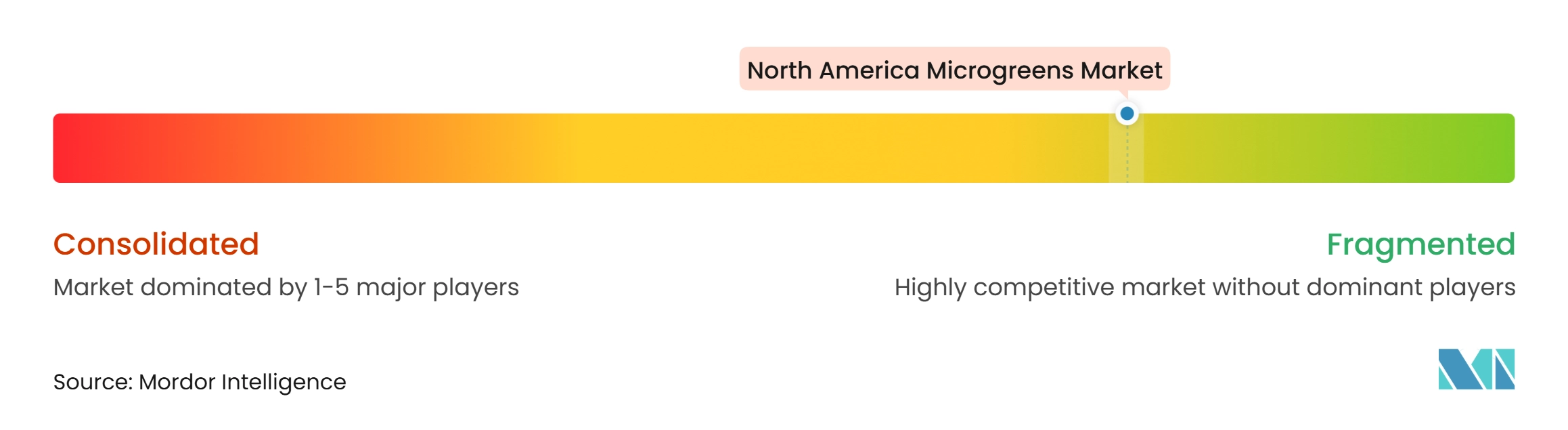
The North America microgreens market remains fragmented, although a group of established commercial suppliers has developed stronger positions across retail, premium foodservice, and institutional channels. AeroFarms, Inc., Fresh Origins, LLC, GoodLeaf Farms, and The Chef's Garden, Inc. represent the leading commercial tier, supported by established production systems, food-safety processes, and dependable distribution capabilities. AeroFarms uses aeroponic cultivation and supplies major retailers such as Costco and Whole Foods Market, while smaller urban farms compete through distinctive varieties, local customer relationships, and shorter delivery routes. This creates a competitive structure in which scale supports retail access, while proximity remains important for specialty demand.
Recent developments in 2026 show that leading suppliers are investing in product expansion, financial restructuring, and production technology. AeroFarms expanded its product range with Micro Arugula and Micro Broccoli to support wider retail distribution. Its acquisition by an affiliate of Palm Ventures in April 2026 reduced debt and brought in leadership focused on disciplined expansion. The Chef's Garden became the first North American commercial user of Agripass Robot of Human-Inspired Cultivation technology in 2026, highlighting increasing interest in automation and harvest consistency. These developments indicate that commercial suppliers are strengthening both their market reach and operational capabilities as retail requirements become more demanding.
Opportunities remain across mid-market private-label supply, secondary United States metropolitan areas, and Mexico's premium foodservice segment. Large national suppliers may not fully address retailers seeking smaller volumes, customized assortments, or regionally sourced products, creating space for agile producers. Organic production also offers opportunities as health-focused grocery demand expands and consumers place greater emphasis on production practices. The North America microgreens industry is therefore developing around two complementary competitive models: scale-led suppliers focused on retail and institutional distribution, and specialty-led growers competing through product differentiation, local relationships, and responsive service.
North America Microgreens Industry Leaders
-
AeroFarms, Inc.
-
Fresh Origins, LLC
-
Infinite Harvest, Inc.
-
The Chef’s Garden, Inc.
-
GoodLeaf Farms
- *Disclaimer: Major Players sorted in no particular order
North America Microgreens Market Companies Covered in this Report
- AeroFarms, Inc.
- Fresh Origins, LLC
- GoodLeaf Farms
- The Chef's Garden, Inc.
- Infinite Harvest, Inc.
- Sky Harvest Farms Inc.
- MicrogreenUSA, LLC
- Planted Detroit, LLC
- Marinka Farms Inc.
- The Six Farms Inc.
- Grand Valley Micro Farms
- Emerald Gardens Microgreens
- Forest City Microgreens
- Micro Plants Robert
- Perks Microgreens
Recent Industry Developments in North America Microgreens Market
- August 2026: AeroFarms, Inc. launched Micro Arugula and Micro Broccoli varieties, extending its retail footprint to approximately 2,000 grocery locations across the United States, including a club-sized Micro Broccoli pack available exclusively at Costco.
- December 2025: GoodLeaf Farms raised USD 52 million to expand production capacity at its Alberta and Quebec farms and establish an Agricultural Centre of Excellence in Ontario. The investment will support capacity doubling in 2026 and develop more sustainable, efficient growing practices.
- July 2025: AeroFarms, Inc. expanded its retail distribution through Harris Teeter, making Micro Broccoli, Rainbow Mix, Micro Kale, and Super Mix available across all stores. The expansion included 20 locations within 90 miles of its Virginia farm, supporting shorter supply routes, longer shelf life, and year-round availability.
North America Microgreens Market Report Scope
Our study defines the North America microgreens market as the aggregate farm-gate value of freshly cut, vegetable, herb, and grain seedlings harvested between the cotyledon and first true-leaf stages and sold either loose or as living trays to retail, food-service, and direct-to-consumer channels.
Scope exclusions include sprout products, baby-leaf greens, powdered extracts, and sales of cultivation equipment, which are kept outside this value pool.
The North America microgreens market report segmented by crop type (broccoli, lettuce and chicory, arugula, basil, fennel, carrots, sunflower, radish, peas, amaranth, cress and chard, and other crop types), by farming method (indoor farming, vertical farming, and other farming methods), by growth medium (peat moss, soil, coconut coir, tissue paper, and other growth media), by distribution channel (hypermarkets and supermarkets, restaurants, online channels, and other distribution channels), and by geography (United States, Mexico, and rest of North America). The market forecasts are provided in terms of value (USD).
Segmentation Overview
| Broccoli |
| Lettuce and Chicory |
| Arugula |
| Basil |
| Fennel |
| Carrots |
| Sunflower |
| Radish |
| Peas |
| Amaranth |
| Cress and Chard |
| Other Crop Types |
| Indoor Farming |
| Vertical Farming |
| Other Farming Methods |
| Peat Moss |
| Soil |
| Coconut Coir |
| Tissue Paper |
| Other Growth Media |
| Hypermarkets and Supermarkets |
| Restaurants |
| Online Channels |
| Other Distribution Channels |
| United States |
| Mexico |
| Canada |
| Rest of North America |
| By Crop Type | Broccoli |
| Lettuce and Chicory | |
| Arugula | |
| Basil | |
| Fennel | |
| Carrots | |
| Sunflower | |
| Radish | |
| Peas | |
| Amaranth | |
| Cress and Chard | |
| Other Crop Types | |
| By Farming Method | Indoor Farming |
| Vertical Farming | |
| Other Farming Methods | |
| By Growth Medium | Peat Moss |
| Soil | |
| Coconut Coir | |
| Tissue Paper | |
| Other Growth Media | |
| By Distribution Channel | Hypermarkets and Supermarkets |
| Restaurants | |
| Online Channels | |
| Other Distribution Channels | |
| By Geography | United States |
| Mexico | |
| Canada | |
| Rest of North America |
Key Questions Answered in the Report
What is the projected value of North American microgreens by 2031?
The North America microgreens market size is projected to reach USD 2.32 billion by 2031, registering a CAGR of 10.61% between 2026 to 2031
Which crop type has the highest share in North America?
Broccoli led crop-type sales with 24.1% share in 2025, supported by broad retail and foodservice demand.
Which farming method is growing fastest?
Vertical farming is forecast to grow at 11.4% CAGR through 2031, the fastest rate among farming methods.
What is the main food safety concern for growers?
Producers must manage risks from Salmonella enterica, Escherichia coli, and Listeria monocytogenes through sanitation and traceability controls.