
North America Kitchen Sink Market Size and Share
Market Overview
| Study Period | 2021 - 2032 |
|---|---|
| Forecast Data Period | 2027 - 2032 |
| Base Year Market Size (2026) | USD 1.14 Billion |
| Market Size (2027) | USD 1.19 Billion |
| Market Size (2032) | USD 1.46 Billion |
| Growth Rate (2027 - 2032) | 4.16 % |
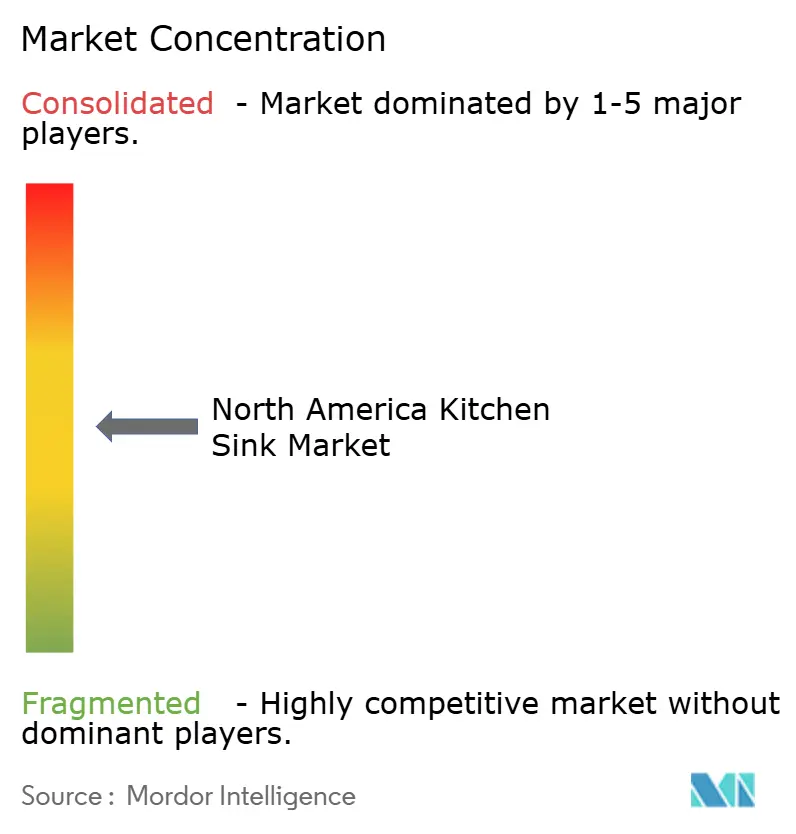
| Market Concentration | Medium |
Major Players *Disclaimer: Major Players sorted in no particular order Image © Mordor Intelligence. Reuse requires attribution under CC BY 4.0. | |
North America Kitchen Sink Market Analysis by Mordor Intelligence
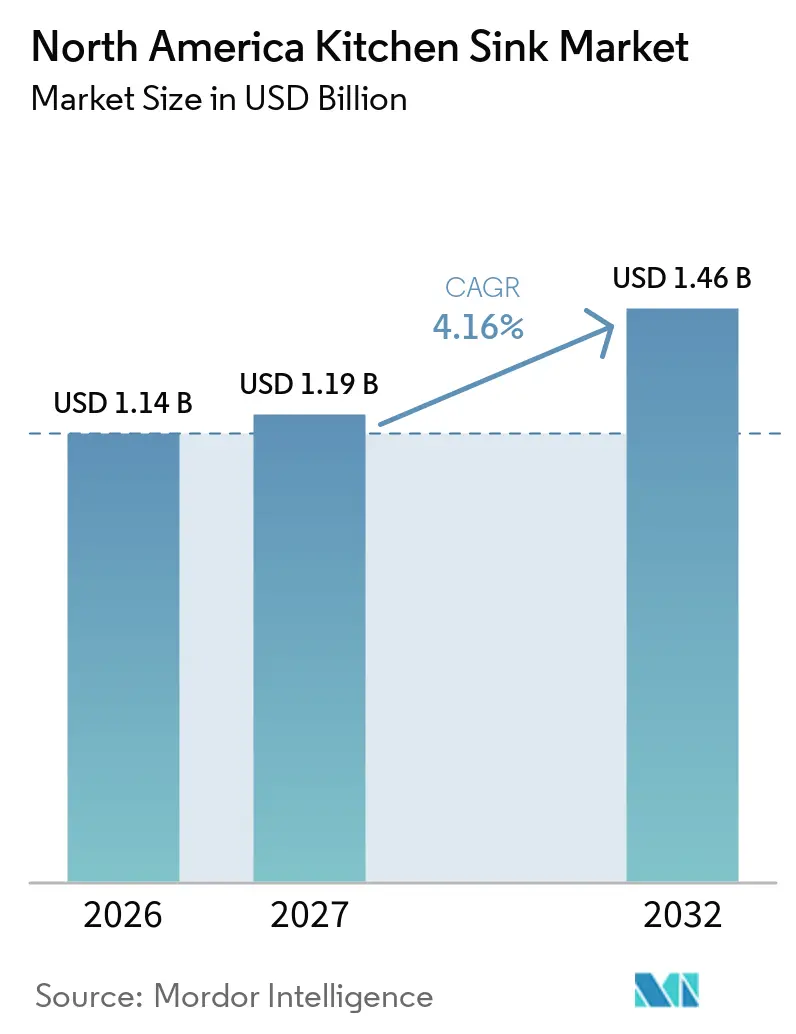
The North America kitchen sink market size is projected to expand from USD 1.14 billion in 2026 to USD 1.19 billion in 2027, and is forecast to reach USD 1.46 billion by 2032, growing at a 4.16% CAGR during 2027-2032. The North America kitchen sink market is supported by homeowners who remain in their homes longer and direct more spending toward kitchen upgrades. The National Kitchen & Bath Association expects United States kitchen and bath revenue to reach USD 228 billion in 2026, while new-construction spending declines 3%. Professional remodeling is growing faster than do-it-yourself activity, which supports premium sink specifications. The North America kitchen sink market also faces caution from middle-income households that are limiting large projects. Manufacturers are responding with workstation designs, accessory systems, and direct online purchase options.
Key Report Takeaways
- By material, stainless steel held 62.16% of the North America kitchen sink market share in 2026, while fireclay is projected to grow at a 5.88% CAGR through 2032.
- By installation type, undermount sinks accounted for 38.43% of the North America kitchen sink market share in 2026, while farmhouse and apron-front sinks are forecast to grow at a 5.67% CAGR through 2032.
- By bowl configuration, single-bowl sinks held 46.72% revenue share in 2026 and are forecast to expand at a 5.30% CAGR through 2032.
- By end user, residential users accounted for 70.28% revenue share in 2026, while commercial users are forecast to grow at a 4.85% CAGR through 2032.
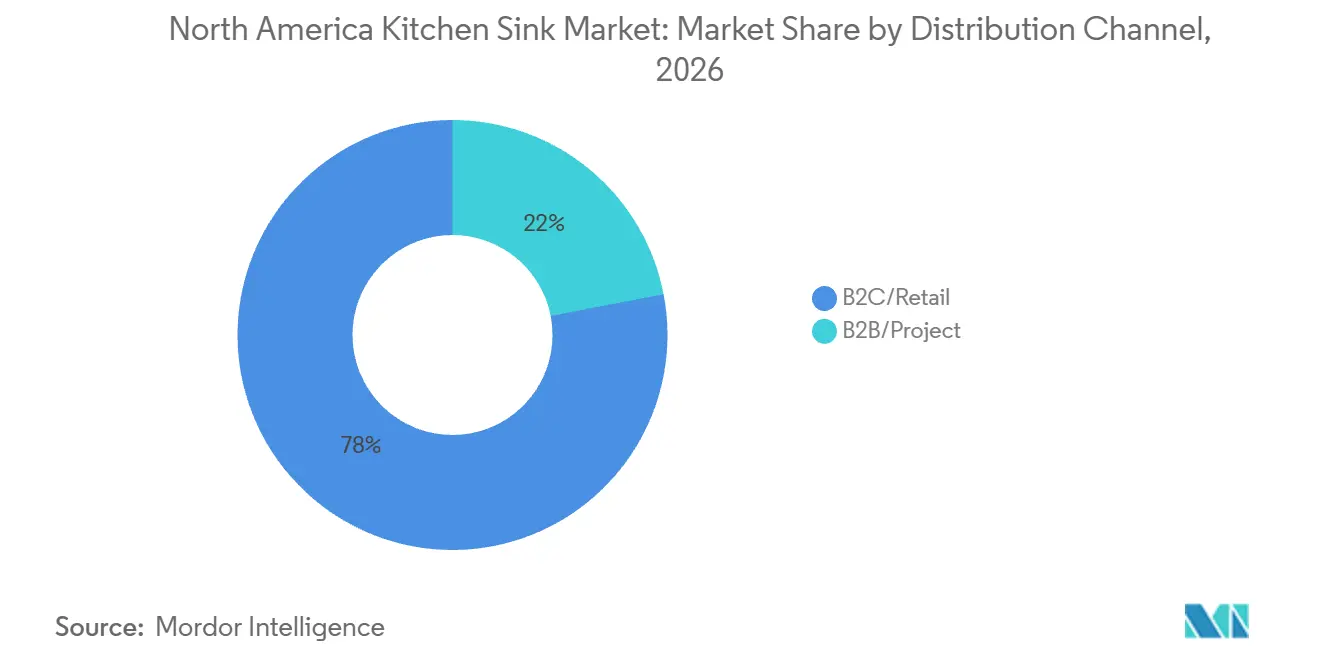
- By distribution channel, B2C and retail held 78.04% revenue share in 2026, while B2B and project channels are forecast to grow at a 5.24% CAGR through 2032.
- By geography, the United States held 76.25% revenue share in 2026, while Mexico is forecast to grow at a 5.73% CAGR through 2032.
Note: Market numbers in this report are based on Mordor Intelligence's proprietary estimation framework, which combines nine months of actuals with Q4 projections for base year 2026.
Market Trends and Insights
Drivers Impact Analysis of North America Kitchen Sink Market*
| Driver | (~) % Impact on CAGR Forecast | Geographic Relevance | Impact Timeline |
|---|---|---|---|
| Kitchen Remodeling and Replacement-Cycle Demand | +1.0% | United States nationwide, Canada secondary | Medium term (2-4 years) |
| New Housing Completions and Multifamily Construction | +0.8% | United States South and West, Mexico urban centers | Short term (≤ 2 years) |
| Premium Workstation and Smart-Sink Adoption | +0.9% | United States primary, Canada urban markets | Medium term (2-4 years) |
| E-Commerce-Led Product Discovery and Direct Purchase | +0.5% | United States and Canada | Short term (≤ 2 years) |
| Commercial Foodservice and Hospitality Renovation | +0.4% | United States nationwide, Mexico tourist corridors | Medium term (2-4 years) |
| Demand for Recycled and Low-Impact Materials | +0.3% | United States and Canada, emerging in Mexico | Long term (≥ 4 years) |
| Source: Mordor Intelligence | |||
Kitchen Remodeling and Replacement-Cycle Demand
The North America kitchen sink market benefits from a durable mortgage lock-in effect in the United States. The National Kitchen & Bath Association states that 73% of mortgaged homeowners have rates below 5%, making relocation less attractive for many households[1]. Average home tenure has consequently reached 16 years, concentrating renovation demand in kitchens that are reaching replacement age. An expected 23 million United States homes will be 20 to 39 years old in 2025, creating a sizable replacement base for fixtures. Households aged 55 and older control USD 110 trillion in wealth and represent 56% of owner-occupied homes, supporting aging-in-place upgrades. Millennials aged 35 to 44 also favor workstation and larger single-bowl designs during their peak renovation years.
New Housing Completions and Multifamily Construction
New residential construction delivered 1,497,800 completed United States housing units in 2025, and each unit required at least 1 kitchen sink installation[2]. The total was 7.9% below the 2024 level as higher land, labor, and materials costs affected builder decisions. Single-family completions were running at a seasonally adjusted annual rate of 1,009,000 units in October 2025, providing a continuing base for first installations. Multifamily completions had peaked and started to ease in several Sun Belt markets due to oversupply. Builders are limiting premium specifications in entry-level homes because of cost pressure. This leaves mid-range and upper-range single-family projects as the main new-construction outlet for premium sinks in the North America kitchen sink market.
Premium Workstation and Smart-Sink Adoption
Workstation products are shifting the residential category away from the standard undermount format. Kohler launched its Synthos Workstation collection in November 2025 in widths from 30 inches to 72 inches. The 16-gauge stainless products include SilentShield Plus noise reduction, multiple ledges, prep bowls, colanders, soaking bins, and serving trays. Elkay introduced its Crosstown Workstation in March 2025 as an 18-gauge Type 304 stainless kit for drop-in and undermount installations[3]. BLANCO introduced INTEOS as a workstation platform across stainless steel and SILGRANIT materials, with a unified accessory system across 4 sink sizes[4]. These launches make proprietary accessory systems an important way to compete in the North America kitchen sink market.
E-Commerce-Led Product Discovery and Direct Purchase
Online product discovery is changing how buyers compare kitchen sink features and brands. Product configurators, customer reviews, and detailed product content now influence decisions alongside showroom displays. This change favors suppliers that can explain fit, material, accessories, and installation requirements clearly online. It is especially relevant for replacement buyers who begin research before contacting a contractor. Direct purchase models can also make specialized products easier to reach outside traditional showroom networks. The North America kitchen sink market therefore gives greater weight to digital product information and direct customer engagement.
Restraints Impact Analysis of North America Kitchen Sink Market*
| Restraint | (~) % Impact on CAGR Forecast | Geographic Relevance | Impact Timeline |
|---|---|---|---|
| High Labor and Installation Costs for Premium Formats | -0.8% | United States nationwide, Canada, especially Ontario | Medium term (2-4 years) |
| Volatility in Stainless Steel, Quartz, and Freight Costs | -0.7% | Global supply, with effects in the United States, Canada, and Mexico | Short term (≤ 2 years) |
| Mature Housing Stock and Longer Replacement Cycles | -0.5% | United States Northeast and Midwest | Long term (≥ 4 years) |
| Private-Label and Big-Box Retailer Negotiating Power | -0.4% | United States and Canada | Medium term (2-4 years) |
| Source: Mordor Intelligence | |||
High Labor and Installation Costs for Premium Formats
Installation complexity limits the broader use of farmhouse, undermount, and workstation designs. Mid-sized kitchen remodels average USD 70,000, while large kitchens exceed USD 135,000, and labor consumes a meaningful share of those budgets. Apron-front and farmhouse sinks can require cabinet reinforcement costing USD 300 to USD 800 before countertop work. These added requirements place such products within fully funded kitchen reconfigurations rather than lower-cost updates. The National Kitchen & Bath Association reported in its second-quarter 2025 survey that middle-income buyers were increasingly choosing budget refreshes. Commercial projects face further specification work because plumbing standards govern drain placement and dimensions. These factors slow the conversion of demand into installations in the North America kitchen sink market.
Volatility in Stainless Steel, Quartz, and Freight Costs
Raw material changes remain a direct margin risk for sink manufacturers. Nickel prices ranged from USD 14,150 to USD 16,720 per metric ton during the first half of 2025. Indonesian mining quotas and changes in electric vehicle battery chemistry affected supply conditions during this period. Stainless steel is particularly important because it represented 62.16% of the category value in 2026. Outokumpu reported in 2025 that 1 in 3 surveyed organizations had paused or delayed stainless steel orders because of tariff disruption. North American buyers were responding by securing longer-term supply arrangements. Cost uncertainty can restrict promotion flexibility and pressure margins across the North America kitchen sink market.
*Our forecasts treat driver/restraint impacts as directional, not additive. The impact forecasts reflect baseline growth, mix effects, and variable interactions.
North America Kitchen Sink Market Segment Analysis
By Material:
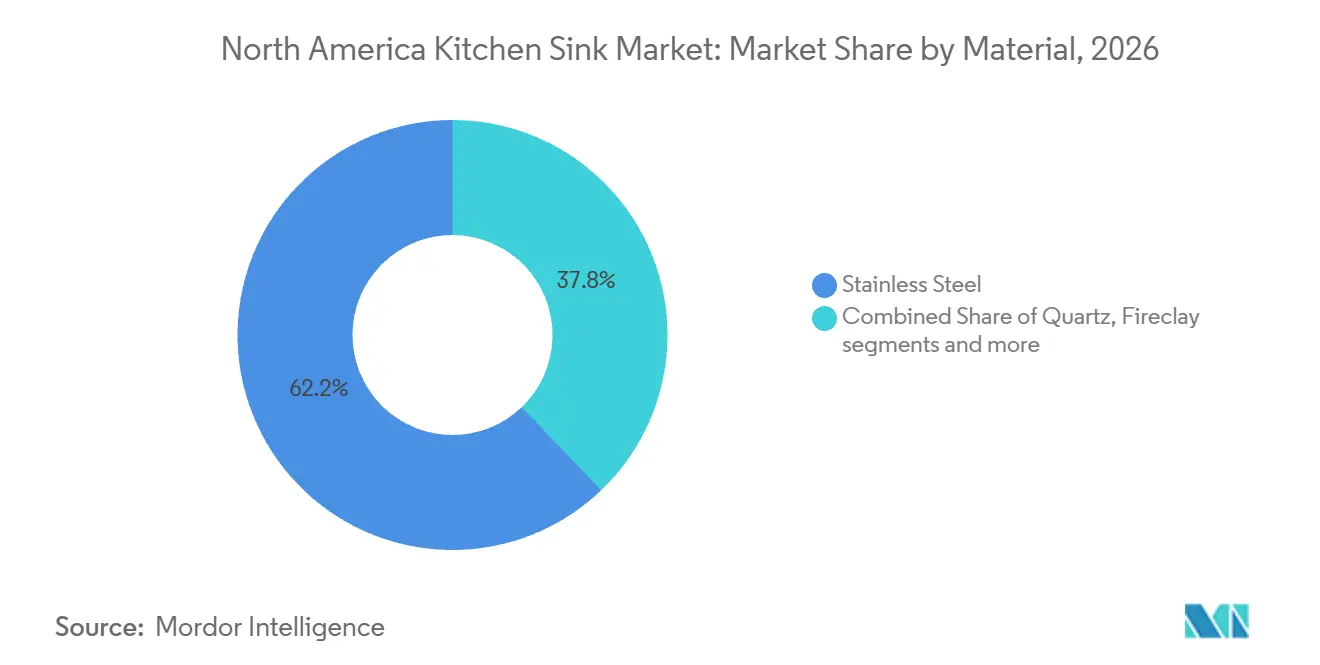
Premium Formats Gain Ground on Stainless IncumbencyStainless steel held 62.16% of value in 2026, making it the core material in the North America kitchen sink market. Its position reflects wide use across residential replacements and commercial installations. Within the category, 16-gauge products with nano-coatings and sound-dampening layers are replacing more basic 18-gauge products. Buyers are placing more weight on durability and acoustic performance when they select premium products. Fireclay is the fastest-growing material, with a 5.88% CAGR from 2027 to 2032. Its appeal is linked to farmhouse and apron-front designs used in mid-range and luxury renovations.
BLANCO, Ruvati, and American Standard have introduced fireclay ranges for more accessible retail channels. These offerings broaden access beyond bespoke renovation budgets. Franke states that its stainless steel kitchen sinks use 70% recycled steel and are fully recyclable at end of life. Quartz and granite composites address the growing intermediate tier between entry products and premium formats. Acrylic remains relevant for cost-sensitive replacement cycles. Material innovation therefore affects product choice without displacing stainless steel’s leading position in the North America kitchen sink market.

By Installation Type:
Farmhouse Format Converts from Luxury to MainstreamUndermount configurations held 38.43% of value in 2026, giving them the largest installation-type position. They are widely specified in premium renovations and architect-designed new homes. A seamless transition from countertop to basin makes the format a common design choice with stone and engineered quartz surfaces. Their use is limited in lower-budget projects because they require stone, solid surface, or engineered quartz countertops. Farmhouse and apron-front products are the fastest-growing installation type, with a 5.67% CAGR through 2032. Their growth follows demand for transitional and contemporary kitchens and their fit with single-bowl workstation formats.
Top-mount and drop-in products retain broad adoption because they work with many countertop materials. They also remain accessible for do-it-yourself projects, rental upgrades, and fix-and-flip renovations. Flush-mount and dual-mount formats serve design-focused projects that require more flexible installation choices. The National Kitchen & Bath Association identifies remodeling activity as an important demand source across renovation formats. Aging-in-place needs can support moderate-depth undermount and flush-mount products where knee clearance is required. Installation choice will continue to shape the premium mix within the North America kitchen sink market.
By Bowl Configuration:
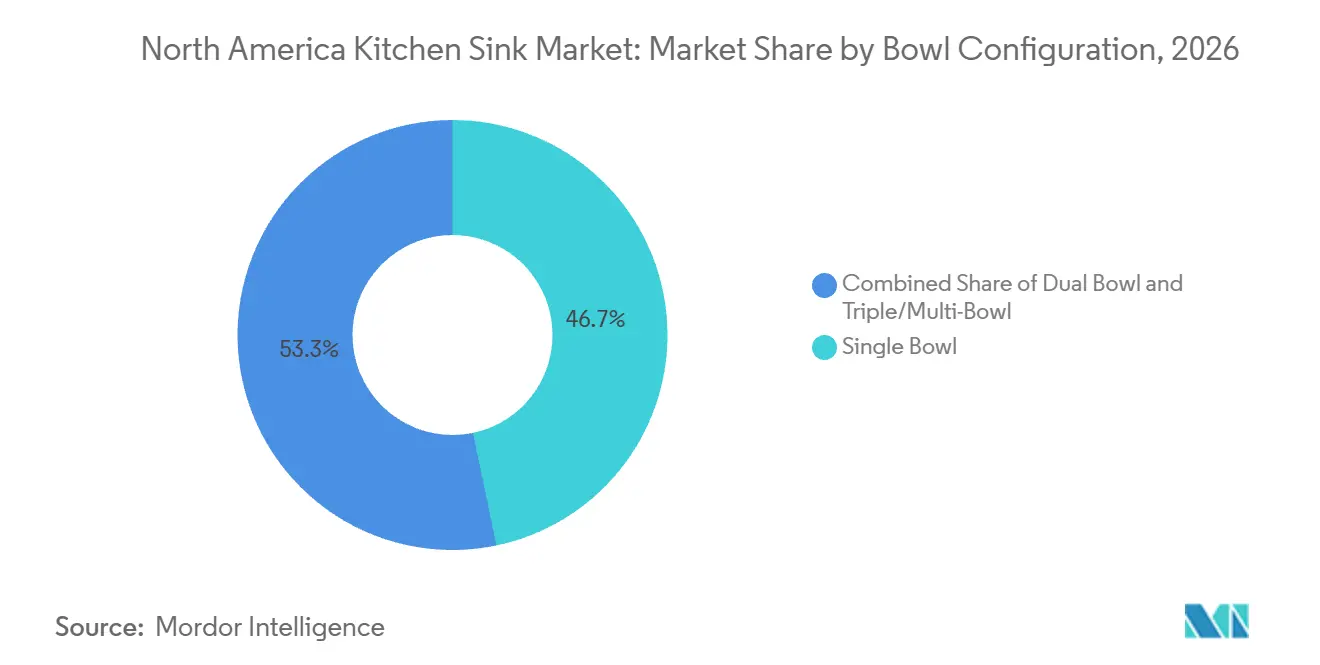
Single Bowl Commands Both Volume and Growth RateSingle-bowl sinks held 46.72% of value in 2026 and are forecast to expand at a 5.30% CAGR through 2032. This gives the configuration both the largest share and the highest growth rate. Workstation systems favor an uninterrupted basin because ledges and accessory rails require clear internal space. The format combines food preparation, washing, and drying around 1 integrated sink area. The North America kitchen sink market size for single-bowl products benefits from this fit with premium workstation demand. Households aged 35 to 44 are important buyers because they are entering peak renovation years.
Dual-bowl products retain broad appeal for households that prefer separate spaces for washing and soaking. They also remain a common builder-grade choice when workstation accessories are outside the project scope. Triple-bowl and multi-bowl models address more specialized commercial needs. Those applications may require separate washing, rinsing, and sanitizing functions. Kohler’s 2025 workstation accessory patent activity shows continuing product development in the single-bowl format. This design direction supports single-bowl demand across the North America kitchen sink market.
By End User:
Commercial Foodservice Outpaces Residential in Growth RateResidential customers accounted for 70.28% of value in 2026 and remain the largest end-user group. This position follows the scale of the region’s housing stock and replacement activity. High-income homeowners undertaking kitchen projects above USD 100,000 often select premium undermount and workstation products. The National Kitchen & Bath Association stated that customer group to drive 22% of kitchen and bath activity in 2025. These projects raise average revenue per residential installation. Residential demand therefore remains the base of the North America kitchen sink market.
Commercial demand is forecast to grow at a 4.85% CAGR through 2032, faster than residential demand. Renovation programs in foodservice and hospitality create regular replacement needs. The DuPage County Health Department’s 2025 construction manual specifies NSF-approved, 3-compartment stainless sinks with a minimum 84-inch length for relevant open food or beverage facilities. Such requirements create a replacement cycle that is less dependent on consumer remodeling decisions. Restaurants, hotels, and institutional kitchens are the main commercial settings. Regulatory requirements provide a steady basis for commercial demand in the North America kitchen sink market.
By Distribution Channel:
B2B Direct Outpaces Retail as Specification GrowsB2C and retail channels held 78.04% of value in 2026, making them the leading route to buyers. These channels include home centers, brand showrooms, hardware stores, and online retail. Their reach is especially important for homeowners replacing an existing sink. Digital content is increasingly part of this retail journey because buyers compare materials, dimensions, and accessories before purchase. Showrooms remain useful for products that require visual and tactile evaluation. Retail will remain central to the North America kitchen sink market because it serves the broad consumer replacement base.
B2B and project channels are forecast to grow at a 5.24% CAGR through 2032. Manufacturers use these channels to serve contractors, commercial operators, and large project buyers directly. The faster pace reflects professional remodeling and rising commercial specification activity. Contractor relationships are especially useful for premium and complex installation formats. Project channels also enable coordinated specifications with countertops and cabinetry. Their expansion gives the North America kitchen sink industry a more important professional route to demand.
Geography Analysis
The United States held 76.25% of value in 2026, making it the largest national market in the region. Its large housing base and older homes support both replacement and renovation purchases. The United States homeowners held more than USD 35 trillion in home equity in 2025, up 81% from the end of 2019. Average home equity was USD 406,000 per homeowner, helping finance kitchen upgrades even when mortgage borrowing is constrained. The Southeast and Texas lead in new construction, while the Northeast and Midwest show high renovation intensity per household. California, New York, and Illinois remain important demand centers for workstation and fireclay products.
Canada is a stable secondary market, supported by aging suburban and condominium housing. Ontario faces pressure from higher carrying costs and weaker renovation confidence. British Columbia and Alberta provide some offset because younger and higher-income buyers favor premium undermount and workstation products. Novanni Stainless produces sinks using 90% recycled materials and has received recognition from Natural Resources Canada for greenhouse-gas reduction commitments. This local supply position supports the role of sustainability in product choice. Greater Toronto and Vancouver also support demand for fireclay and composite products with design-forward kitchen styles.
Mexico is the fastest-growing geography, with a 5.73% CAGR forecast from 2027 to 2032. Urbanization, a growing middle class, and greater interest in kitchen renovation support demand. Buyers aged 35 to 40 are equipping first apartments and undertaking full kitchen replacements. This group resembles the renovation cohort that supports workstation demand in the United States. Tourist corridors also create a hospitality channel for commercial-grade stainless products. Mexico therefore expands the geographic opportunity for the North America kitchen sink market.
Competitive Landscape
The North America kitchen sink market has a moderately concentrated competitive structure. Kohler, Elkay, and BLANCO have strong premium brand positions. Ruvati, Kraus, and Houzer are important direct-to-consumer and online competitors in replacement purchases. Competition increasingly centers on accessory ecosystems rather than sink price alone. Proprietary ledges, modular rails, and coordinated components add utility to the base fixture. These systems can also make it harder for buyers to switch to a standard product line.
BLANCO’s INTEOS system illustrates this approach through a common accessory platform across stainless steel and SILGRANIT products. The system is available across 4 sink sizes and has received 2025 Red Dot Design Awards. Kohler’s Synthos range uses multiple ledges and bundled preparation accessories to target premium residential and hospitality projects. Elkay’s Crosstown product brings an all-in-one stainless workstation kit to both drop-in and undermount buyers. These products show that workstation capability has moved beyond a narrow premium niche. The USD 300 to USD 600 range remains an opportunity where buyers seek complete workstation functionality.
Sustainability is also becoming more relevant in premium specifications. Franke and POSCO reported a July 2025 collaboration that produced a stainless sink with more than 90% recycled steel and a 60% lower product carbon footprint against the stated Environmental Product Declaration benchmark. Environmental Product Declarations can support products intended for green-building specifications. Manufacturers with established contractor and designer relationships retain an advantage in professional channels. Direct-to-consumer brands have not fully matched this professional network. Retailer negotiating power remains a concern for mid-tier brands. The North America kitchen sink market therefore rewards both product differentiation and channel reach.
North America Kitchen Sink Industry Leaders
-
Elkay Manufacturing Company
-
Franke Group
-
Kohler Co.
-
BLANCO GmbH + Co KG
-
Teka Industrial S.A.
- *Disclaimer: Major Players sorted in no particular order
North America Kitchen Sink Market Companies Covered in this Report
- Kohler Co.
- Zurn Elkay Water Solutions (Elkay brand)
- Franke Group
- BLANCO GmbH + Co KG
- Kraus USA
- Teka Industrial S.A.
- Carysil Limited
- American Standard Brands
- Reginox B.V.
- Stainless Manufacturing Inc. (SMI)
- Villeroy & Boch AG
- Karran USA
- Swan / Swanstone
- Ruvati USA
- Houzer / HamatUSA
- VIGO Industries
- The Galley
- Native Trails
- Lenova
- BOCCHI USA
Recent Industry Developments in North America Kitchen Sink Market
- November 2025: Kohler Co. launched the Synthos Workstation sink collection in 5 widths from 30 inches to 72 inches, built from 16-gauge stainless steel with SilentShield Plus noise reduction and multi-level ledges, bundled with prep bowls, colanders, soaking bins, and serving trays for premium residential and hospitality channels.
- October 2025: BLANCO presented its Red Dot Award-winning INTEOS workstation sink, BLANCOCULINA II faucet, and organizer solutions at High Point Fall Market in partnership with NKBA, extending its centenary product launch strategy.
- July 2025: POSCO and Franke announced a collaboration producing a premium stainless sink from more than 90% recycled steel, verified to reduce the product carbon footprint by 60% against the Environmental Product Declaration benchmark.
- March 2025: Elkay launched the Crosstown Workstation sink, an 18-gauge Type 304 stainless all-in-one kit with a ledge rail, rolling cutting board, drying rack, and bottom grid for drop-in and undermount installation.
North America Kitchen Sink Market Report Scope
Segmentation Overview
| Stainless Steel |
| Quartz |
| Fireclay |
| Granite and Marble |
| Acrylic |
| Other Materials |
| Top-Mount/ Drop-In |
| Undermount |
| Farmhouse/ Apron-Front |
| Flush Mount |
| Dual Mount |
| Other Installation Types |
| Single Bowl |
| Dual Bowl |
| Triple / Multi-Bowl |
| Residential |
| Commercial |
| B2C/Retail | Home Centers/DIY |
| Exclusive Brand Outlets | |
| Local Hardware Shops/Unorganized Market | |
| Online | |
| Other Distribution Channels | |
| B2B/Project (Direct from the Manufacturers) |
| United States |
| Canada |
| Mexico |
| By Material | Stainless Steel | |
| Quartz | ||
| Fireclay | ||
| Granite and Marble | ||
| Acrylic | ||
| Other Materials | ||
| By Installation Type | Top-Mount/ Drop-In | |
| Undermount | ||
| Farmhouse/ Apron-Front | ||
| Flush Mount | ||
| Dual Mount | ||
| Other Installation Types | ||
| By Bowl Configuration | Single Bowl | |
| Dual Bowl | ||
| Triple / Multi-Bowl | ||
| By End User | Residential | |
| Commercial | ||
| By Distribution Channel | B2C/Retail | Home Centers/DIY |
| Exclusive Brand Outlets | ||
| Local Hardware Shops/Unorganized Market | ||
| Online | ||
| Other Distribution Channels | ||
| B2B/Project (Direct from the Manufacturers) | ||
| By Geography | United States | |
| Canada | ||
| Mexico | ||
Key Questions Answered in the Report
What is the projected value of the North America kitchen sink market by 2031?
The market is projected to reach USD 1.46 billion by 2032, from USD 1.14 billion in 2026.
Which material leads kitchen sink sales in North America?
Stainless steel leads with a 62.16% share in 2026 because it serves both residential replacements and commercial installations.
Which sink material is growing fastest in North America?
Fireclay is the fastest-growing material, with a forecast CAGR of 5.88% through 2032, supported by farmhouse and apron-front designs.
Why are workstation sinks becoming more important?
Workstation products combine ledges and accessories for preparation, washing, and drying, which supports premium kitchen renovation demand.
Which end-user group has the strongest growth outlook?
Commercial users are forecast to grow at a 4.85% CAGR through 2032 because foodservice and hospitality projects face recurring replacement requirements.